
AQA GCSE Design and Technology 8552 3 Commercial
- Slides: 25
AQA GCSE Design and Technology 8552 3 Commercial manufacturing, treatments and finishes Unit 5 B Timber based materials
Objectives • Know and understand how timbers and boards are selected and processed for commercial products • Learn how materials are cut, shaped and formed to a tolerance • Learn about the preparation and application of treatments and finishes to enhance functional and aesthetic properties
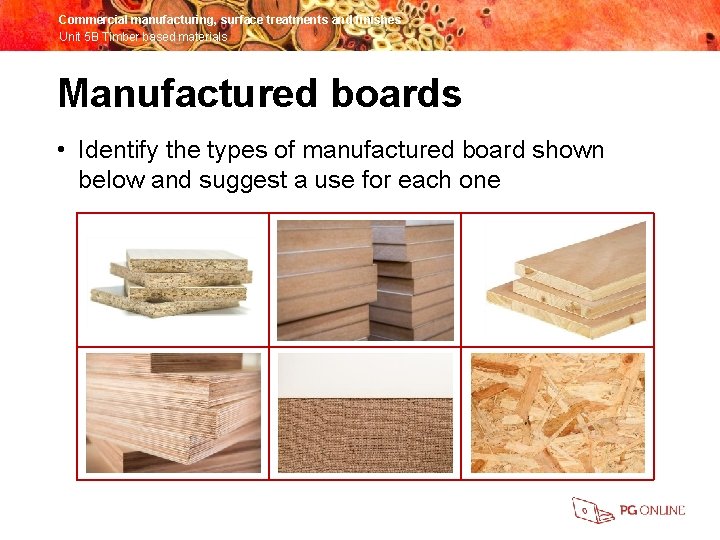
Commercial manufacturing, surface treatments and finishes Unit 5 B Timber based materials Manufactured boards • Identify the types of manufactured board shown below and suggest a use for each one
Commercial manufacturing, surface treatments and finishes Unit 5 B Timber based materials Engineered wood • Manufactured or engineered wood has many advantages over solid wood • May be mixed with glues to give greater strength and stability • Ideal for use in construction, industrial and domestic use • Efficient in its use of mixed materials and utilising waste wood • It can be made in a large sheets not limited by the diameter of a tree trunk • What would be three disadvantages of using man made board?
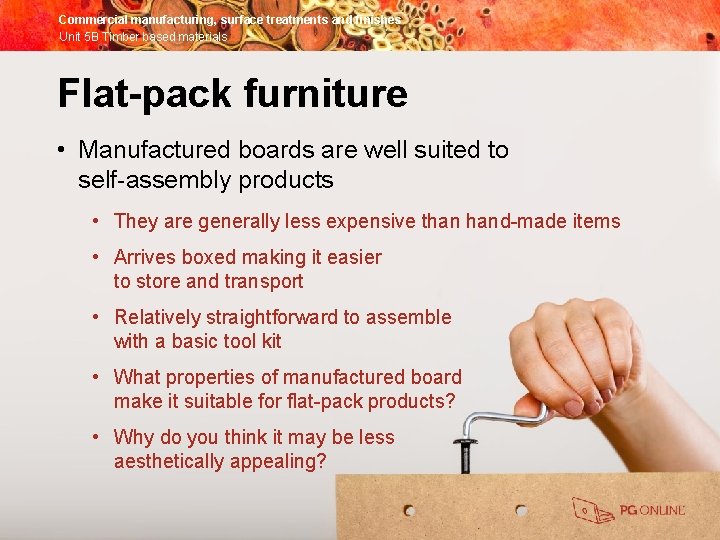
Commercial manufacturing, surface treatments and finishes Unit 5 B Timber based materials Flat-pack furniture • Manufactured boards are well suited to self-assembly products • They are generally less expensive than hand-made items • Arrives boxed making it easier to store and transport • Relatively straightforward to assemble with a basic tool kit • What properties of manufactured board make it suitable for flat-pack products? • Why do you think it may be less aesthetically appealing?
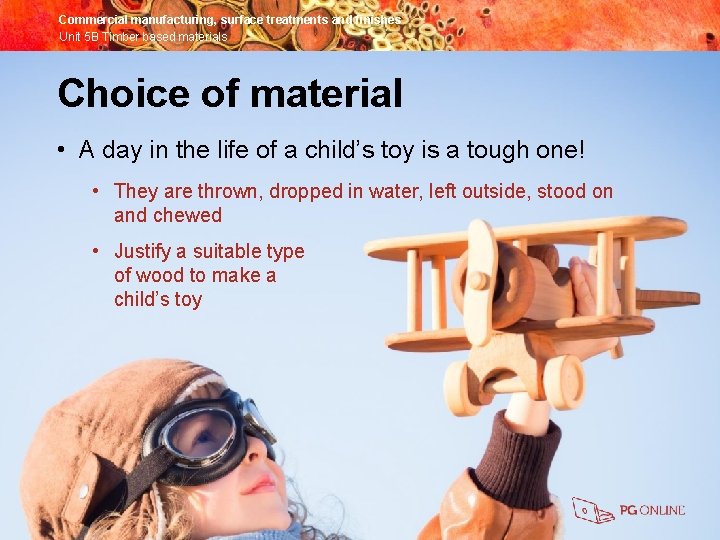
Commercial manufacturing, surface treatments and finishes Unit 5 B Timber based materials Choice of material • A day in the life of a child’s toy is a tough one! • They are thrown, dropped in water, left outside, stood on and chewed • Justify a suitable type of wood to make a child’s toy
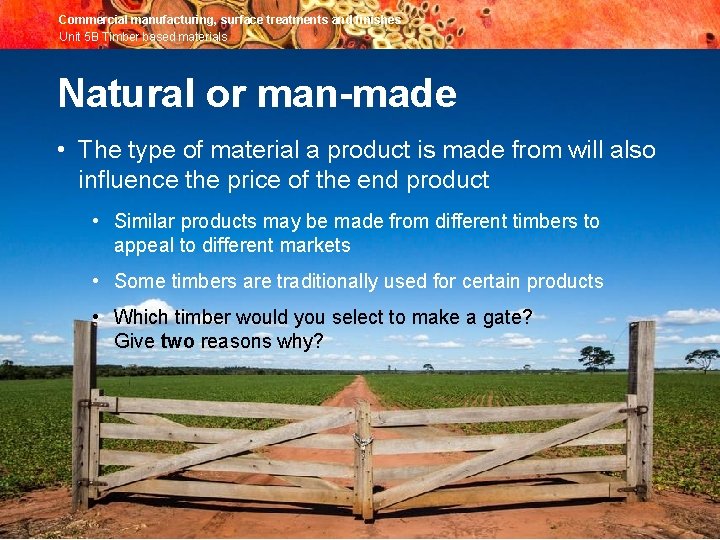
Commercial manufacturing, surface treatments and finishes Unit 5 B Timber based materials Natural or man-made • The type of material a product is made from will also influence the price of the end product • Similar products may be made from different timbers to appeal to different markets • Some timbers are traditionally used for certain products • Which timber would you select to make a gate? Give two reasons why?
Commercial manufacturing, surface treatments and finishes Unit 5 B Timber based materials Worksheet 3 • Complete Task 1 of the worksheet
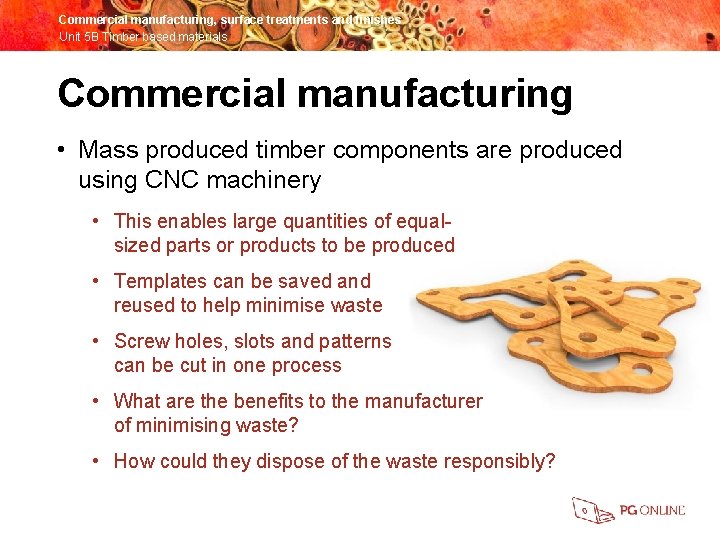
Commercial manufacturing, surface treatments and finishes Unit 5 B Timber based materials Commercial manufacturing • Mass produced timber components are produced using CNC machinery • This enables large quantities of equalsized parts or products to be produced • Templates can be saved and reused to help minimise waste • Screw holes, slots and patterns can be cut in one process • What are the benefits to the manufacturer of minimising waste? • How could they dispose of the waste responsibly?
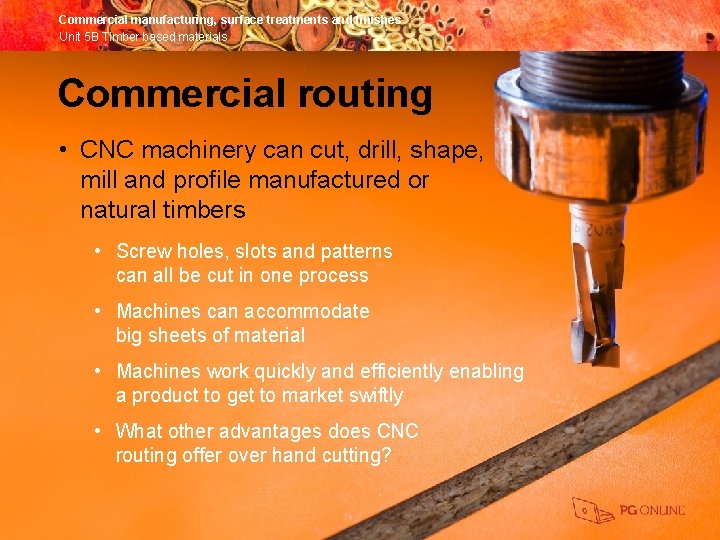
Commercial manufacturing, surface treatments and finishes Unit 5 B Timber based materials Commercial routing • CNC machinery can cut, drill, shape, mill and profile manufactured or natural timbers • Screw holes, slots and patterns can all be cut in one process • Machines can accommodate big sheets of material • Machines work quickly and efficiently enabling a product to get to market swiftly • What other advantages does CNC routing offer over hand cutting?
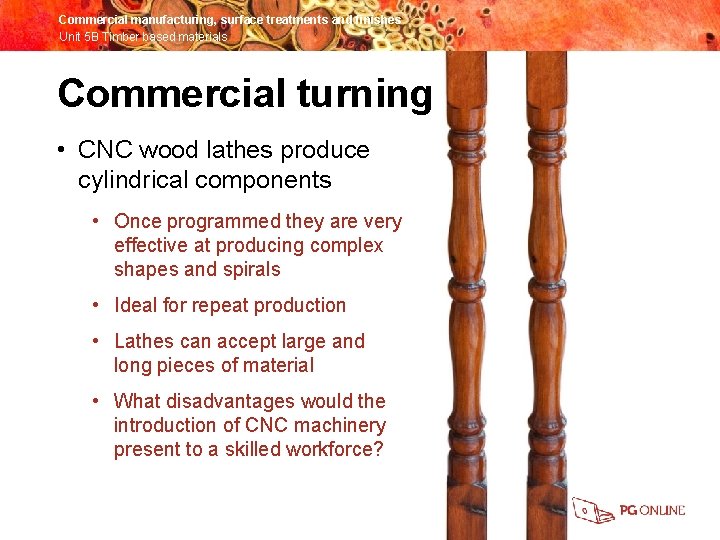
Commercial manufacturing, surface treatments and finishes Unit 5 B Timber based materials Commercial turning • CNC wood lathes produce cylindrical components • Once programmed they are very effective at producing complex shapes and spirals • Ideal for repeat production • Lathes can accept large and long pieces of material • What disadvantages would the introduction of CNC machinery present to a skilled workforce?
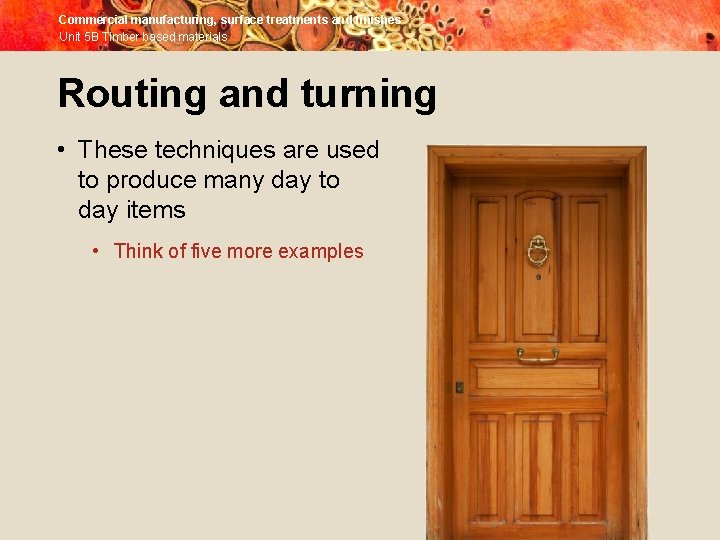
Commercial manufacturing, surface treatments and finishes Unit 5 B Timber based materials Routing and turning • These techniques are used to produce many day to day items • Think of five more examples
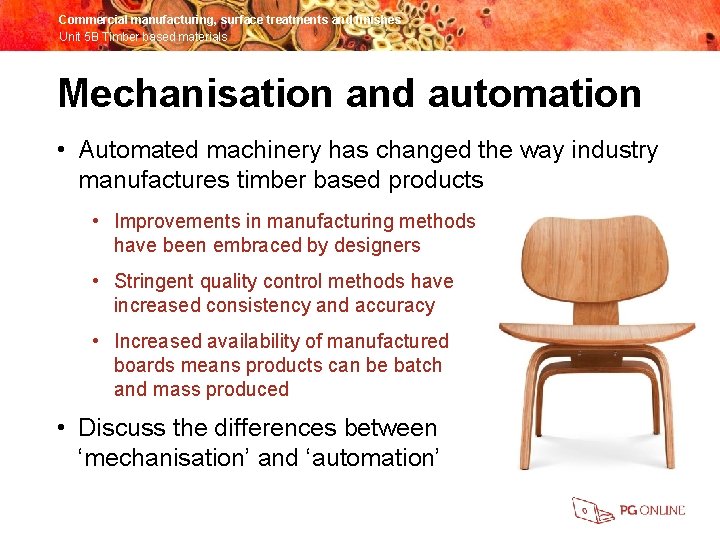
Commercial manufacturing, surface treatments and finishes Unit 5 B Timber based materials Mechanisation and automation • Automated machinery has changed the way industry manufactures timber based products • Improvements in manufacturing methods have been embraced by designers • Stringent quality control methods have increased consistency and accuracy • Increased availability of manufactured boards means products can be batch and mass produced • Discuss the differences between ‘mechanisation’ and ‘automation’
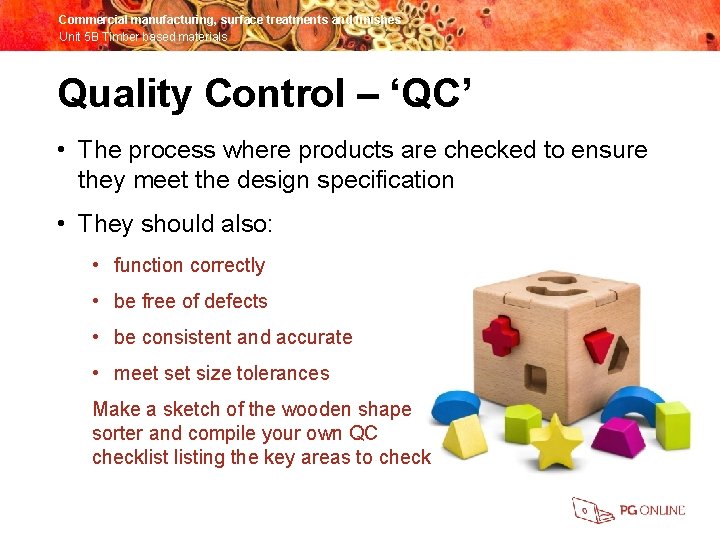
Commercial manufacturing, surface treatments and finishes Unit 5 B Timber based materials Quality Control – ‘QC’ • The process where products are checked to ensure they meet the design specification • They should also: • function correctly • be free of defects • be consistent and accurate • meet size tolerances Make a sketch of the wooden shape sorter and compile your own QC checklisting the key areas to check
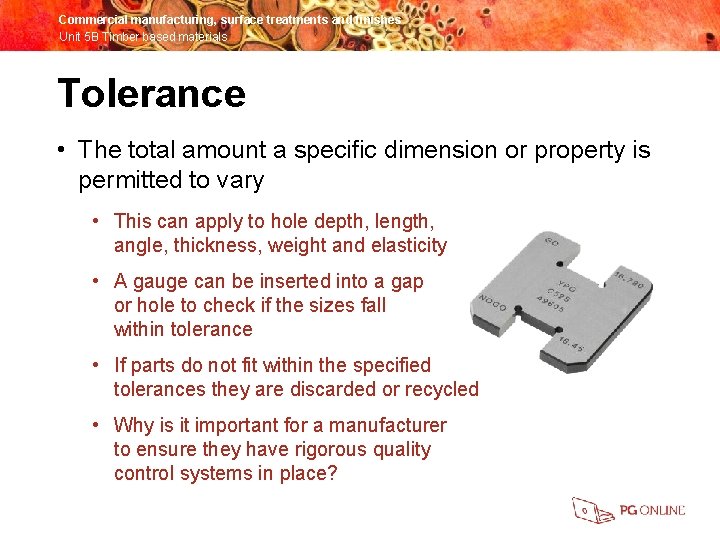
Commercial manufacturing, surface treatments and finishes Unit 5 B Timber based materials Tolerance • The total amount a specific dimension or property is permitted to vary • This can apply to hole depth, length, angle, thickness, weight and elasticity • A gauge can be inserted into a gap or hole to check if the sizes fall within tolerance • If parts do not fit within the specified tolerances they are discarded or recycled • Why is it important for a manufacturer to ensure they have rigorous quality control systems in place?
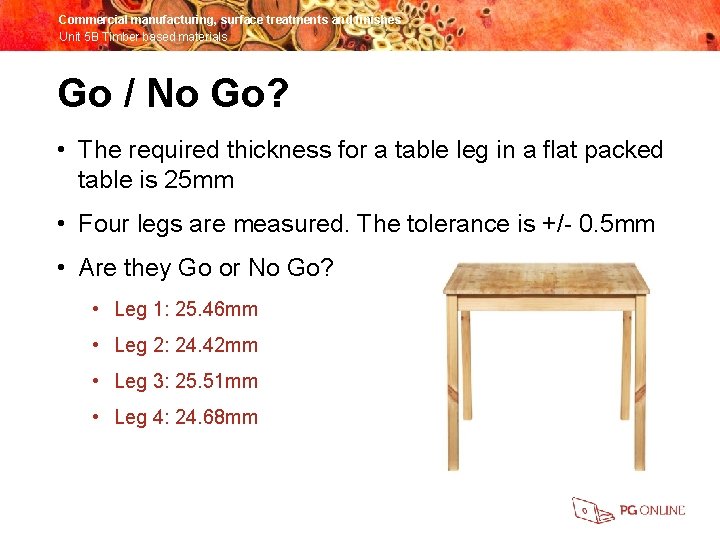
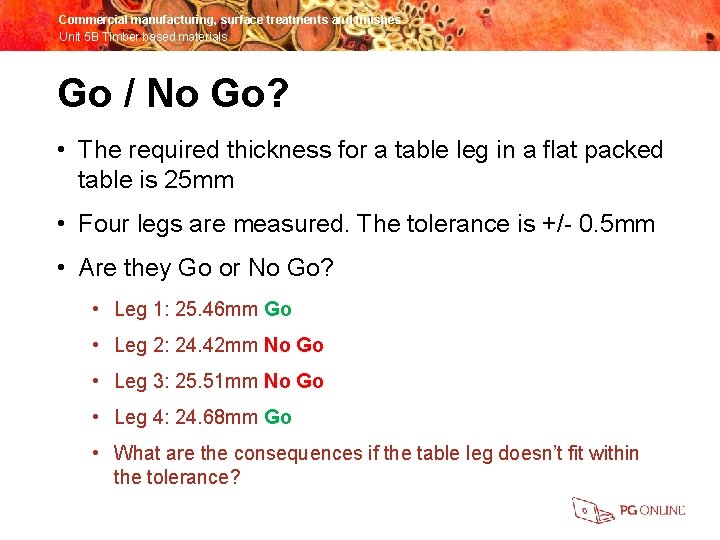
Commercial manufacturing, surface treatments and finishes Unit 5 B Timber based materials Go / No Go? • The required thickness for a table leg in a flat packed table is 25 mm • Four legs are measured. The tolerance is +/- 0. 5 mm • Are they Go or No Go? • Leg 1: 25. 46 mm • Leg 2: 24. 42 mm • Leg 3: 25. 51 mm • Leg 4: 24. 68 mm
Commercial manufacturing, surface treatments and finishes Unit 5 B Timber based materials Go / No Go? • The required thickness for a table leg in a flat packed table is 25 mm • Four legs are measured. The tolerance is +/- 0. 5 mm • Are they Go or No Go? • Leg 1: 25. 46 mm Go • Leg 2: 24. 42 mm No Go • Leg 3: 25. 51 mm No Go • Leg 4: 24. 68 mm Go • What are the consequences if the table leg doesn’t fit within the tolerance?
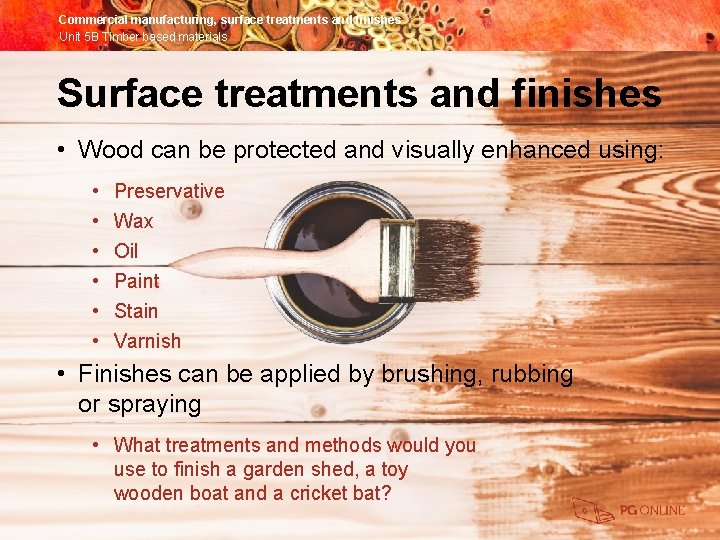
Commercial manufacturing, surface treatments and finishes Unit 5 B Timber based materials Surface treatments and finishes • Wood can be protected and visually enhanced using: • • • Preservative Wax Oil Paint Stain Varnish • Finishes can be applied by brushing, rubbing or spraying • What treatments and methods would you use to finish a garden shed, a toy wooden boat and a cricket bat?
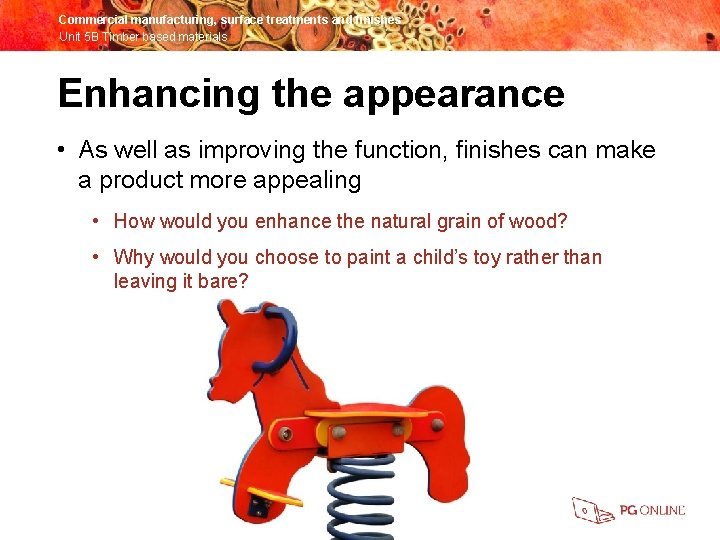
Commercial manufacturing, surface treatments and finishes Unit 5 B Timber based materials Enhancing the appearance • As well as improving the function, finishes can make a product more appealing • How would you enhance the natural grain of wood? • Why would you choose to paint a child’s toy rather than leaving it bare?
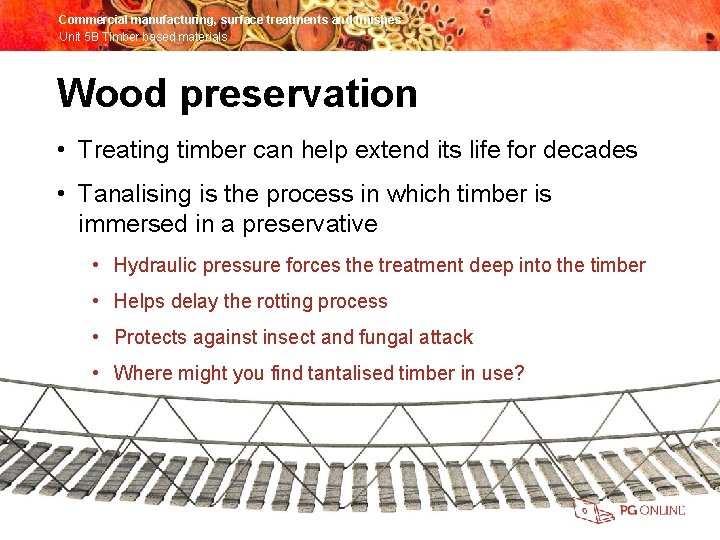
Commercial manufacturing, surface treatments and finishes Unit 5 B Timber based materials Wood preservation • Treating timber can help extend its life for decades • Tanalising is the process in which timber is immersed in a preservative • Hydraulic pressure forces the treatment deep into the timber • Helps delay the rotting process • Protects against insect and fungal attack • Where might you find tantalised timber in use?
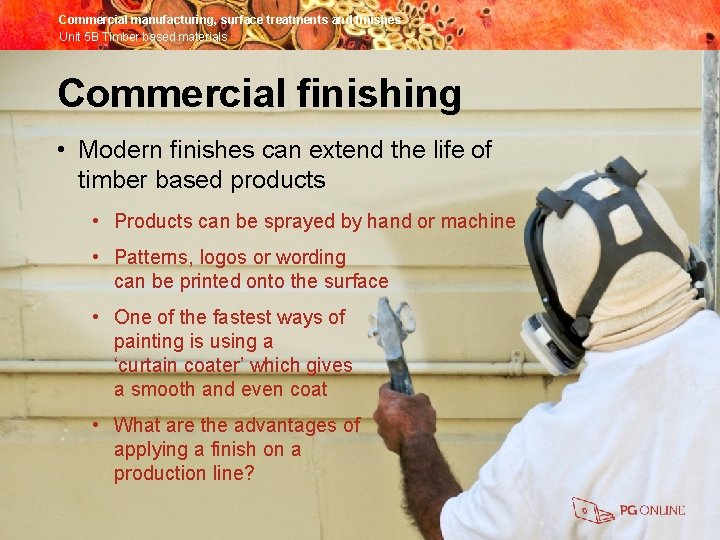
Commercial manufacturing, surface treatments and finishes Unit 5 B Timber based materials Commercial finishing • Modern finishes can extend the life of timber based products • Products can be sprayed by hand or machine • Patterns, logos or wording can be printed onto the surface • One of the fastest ways of painting is using a ‘curtain coater’ which gives a smooth and even coat • What are the advantages of applying a finish on a production line?
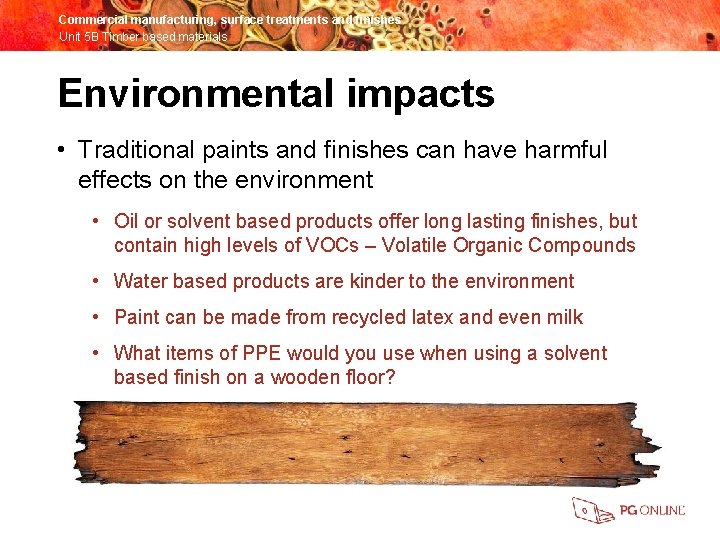
Commercial manufacturing, surface treatments and finishes Unit 5 B Timber based materials Environmental impacts • Traditional paints and finishes can have harmful effects on the environment • Oil or solvent based products offer long lasting finishes, but contain high levels of VOCs – Volatile Organic Compounds • Water based products are kinder to the environment • Paint can be made from recycled latex and even milk • What items of PPE would you use when using a solvent based finish on a wooden floor?
Commercial manufacturing, surface treatments and finishes Unit 5 B Timber based materials Worksheet 3 • Complete Task 2 on the worksheet
Commercial manufacturing, surface treatments and finishes Unit 5 B Timber based materials Plenary • What factors would a furniture manufacturer consider when selecting a material to make flat-pack furniture? • How has machinery improved the production of mass produced timber components? • Why are tolerances so important to check as part of the quality control process? • Which products help protect or improve the aesthetics of timber based materials?
Commercial manufacturing, surface treatments and finishes Unit 5 B Timber based materials Copyright © 2017 PG Online Limited The contents of this unit are protected by copyright. This unit and all the worksheets, Power. Point presentations, teaching guides and other associated files distributed with it are supplied to you by PG Online Limited under licence and may be used and copied by you only in accordance with the terms of the licence. Except as expressly permitted by the licence, no part of the materials distributed with this unit may be used, reproduced, stored in a retrieval system, or transmitted, in any form or by any means, electronic or otherwise, without the prior written permission of PG Online Limited. Licence agreement This is a legal agreement between you, the end user, and PG Online Limited. This unit and all the worksheets, Power. Point presentations, teaching guides and other associated files distributed with it is licensed, not sold, to you by PG Online Limited for use under the terms of the licence. The materials distributed with this unit may be freely copied and used by members of a single institution on a single site only. You are not permitted to share in any way any of the materials or part of the materials with any third party, including users on another site or individuals who are members of a separate institution. You acknowledge that the materials must remain with you, the licencing institution, and no part of the materials may be transferred to another institution. You also agree not to procure, authorise, encourage, facilitate or enable any third party to reproduce these materials in whole or in part without the prior permission of PG Online Limited.