
AQA GCSE Design and Technology 8552 1 Papers
- Slides: 23
AQA GCSE Design and Technology 8552 1 Papers and boards Unit 3 Materials and their working properties
Objectives • Know the primary sources of materials for producing papers and boards • Be able to recognise and characterise different types of papers and boards • Understand how the physical and working properties of a range of paper and board products affect their performance
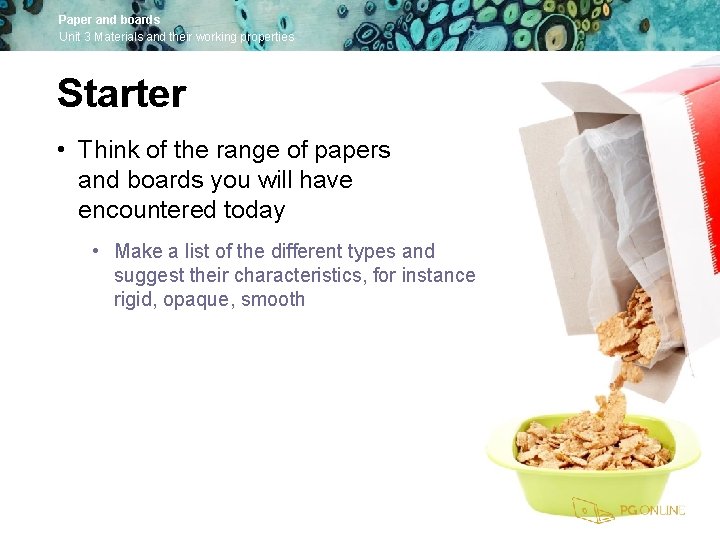
Paper and boards Unit 3 Materials and their working properties Starter • Think of the range of papers and boards you will have encountered today • Make a list of the different types and suggest their characteristics, for instance rigid, opaque, smooth
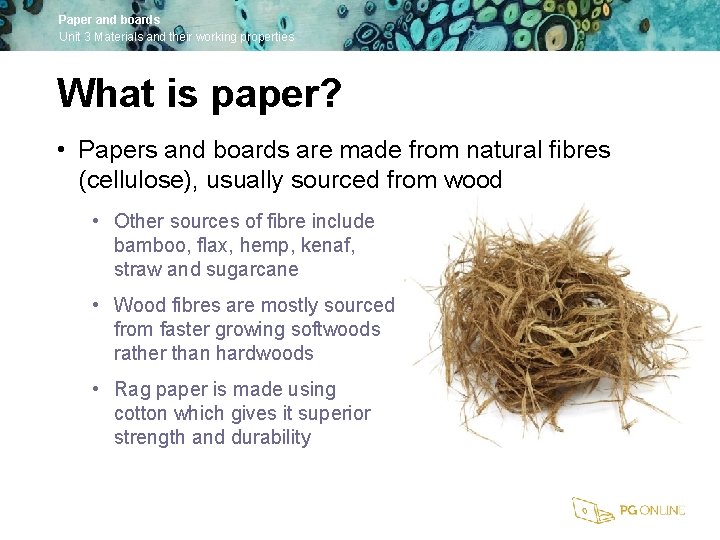
Paper and boards Unit 3 Materials and their working properties What is paper? • Papers and boards are made from natural fibres (cellulose), usually sourced from wood • Other sources of fibre include bamboo, flax, hemp, kenaf, straw and sugarcane • Wood fibres are mostly sourced from faster growing softwoods rather than hardwoods • Rag paper is made using cotton which gives it superior strength and durability
Paper and boards Unit 3 Materials and their working properties Pulp • The first stage in the production of paper and board is to make pulp • The natural cellulose fibres are mixed with water • This mixture is cooked which produces a fibrous liquid known as pulp • Pulp is fed onto a mesh conveyor which allows excess water to drain away • This makes its way through a series of rollers which help to press, form and dry the pulp into a continuous sheet which is either rolled or cut to size for commercial processing
Paper and boards Unit 3 Materials and their working properties Treatments and finishes • The final finish of paper or board depends upon: • the type of fibre used to make the pulp • any chemicals added during the manufacturing process • the addition of layers, different coatings or laminates • bleaching level which decreases the natural colour so it becomes whiter • When a high quality ‘bright’ paper is required, bleached pulp would be used
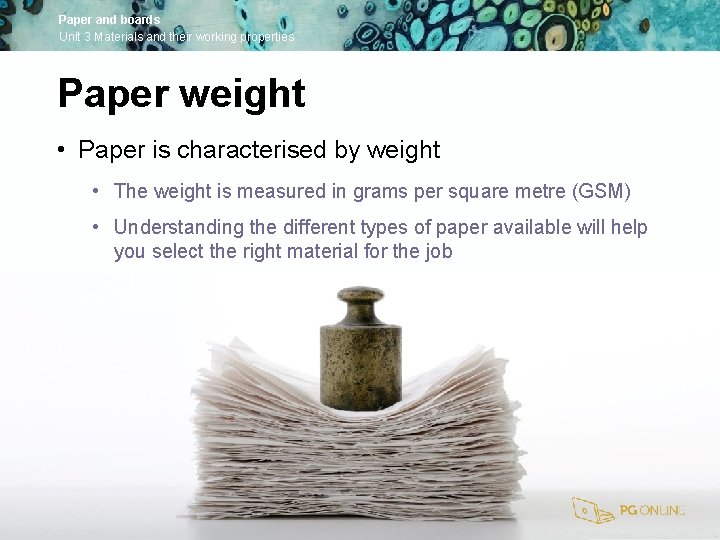
Paper and boards Unit 3 Materials and their working properties Paper weight • Paper is characterised by weight • The weight is measured in grams per square metre (GSM) • Understanding the different types of paper available will help you select the right material for the job
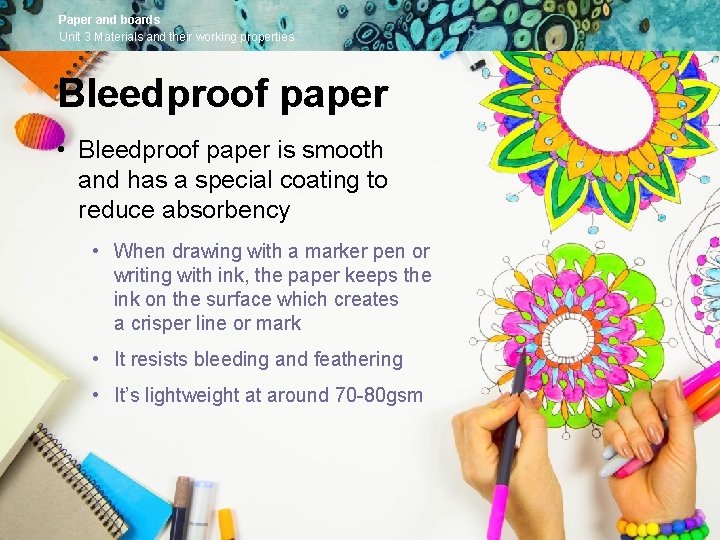
Paper and boards Unit 3 Materials and their working properties Bleedproof paper • Bleedproof paper is smooth and has a special coating to reduce absorbency • When drawing with a marker pen or writing with ink, the paper keeps the ink on the surface which creates a crisper line or mark • It resists bleeding and feathering • It’s lightweight at around 70 -80 gsm
Paper and boards Unit 3 Materials and their working properties Cartridge paper • A thick, quality paper with a slight texture • It’s used particularly for pencil and ink drawings and paintings • Available in a range of weights, a heavier paper at 200 gsm is more suitable for watercolour and acrylic painting • Would this type of paper be given a coating? Justify your answer
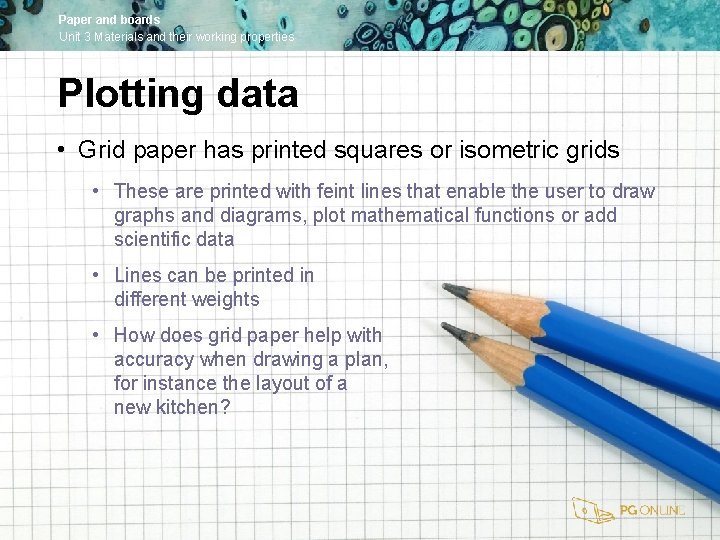
Paper and boards Unit 3 Materials and their working properties Plotting data • Grid paper has printed squares or isometric grids • These are printed with feint lines that enable the user to draw graphs and diagrams, plot mathematical functions or add scientific data • Lines can be printed in different weights • How does grid paper help with accuracy when drawing a plan, for instance the layout of a new kitchen?
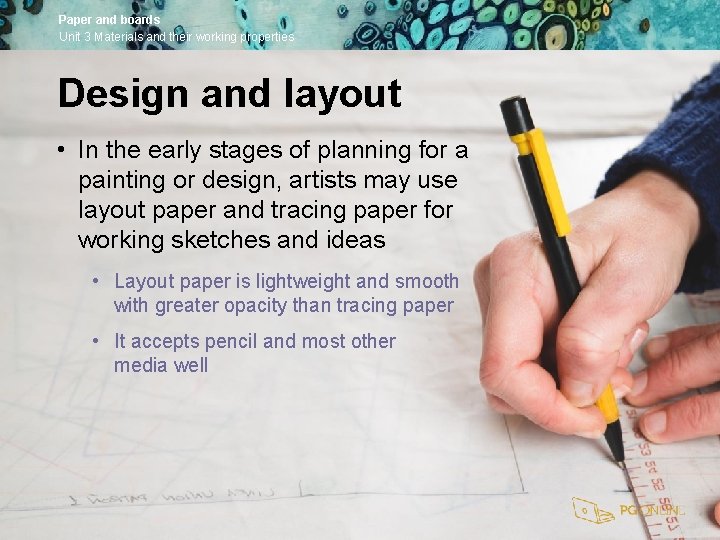
Paper and boards Unit 3 Materials and their working properties Design and layout • In the early stages of planning for a painting or design, artists may use layout paper and tracing paper for working sketches and ideas • Layout paper is lightweight and smooth with greater opacity than tracing paper • It accepts pencil and most other media well
Paper and boards Unit 3 Materials and their working properties Translucency • Tracing paper is smooth and sold in pads and rolls • Ranging from 40 gsm up to 280 gsm for specialist uses • It is made in the same way as ordinary paper, but is passed through a bath of acid which partially dissolves the paper • This increases the translucency, and it also increases the stability of the paper • As well as for tracing, suggest where else you may find this type of paper in use
Paper and boards Unit 3 Materials and their working properties Worksheet • Complete Task 1 of Worksheet 1
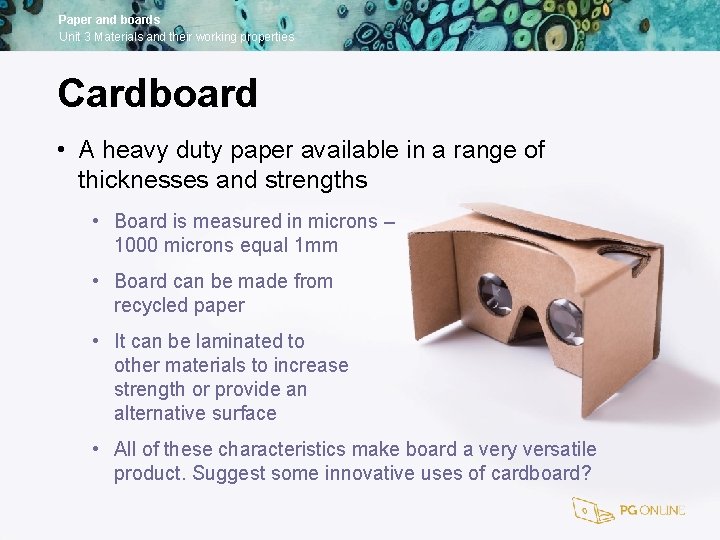
Paper and boards Unit 3 Materials and their working properties Cardboard • A heavy duty paper available in a range of thicknesses and strengths • Board is measured in microns – 1000 microns equal 1 mm • Board can be made from recycled paper • It can be laminated to other materials to increase strength or provide an alternative surface • All of these characteristics make board a very versatile product. Suggest some innovative uses of cardboard?
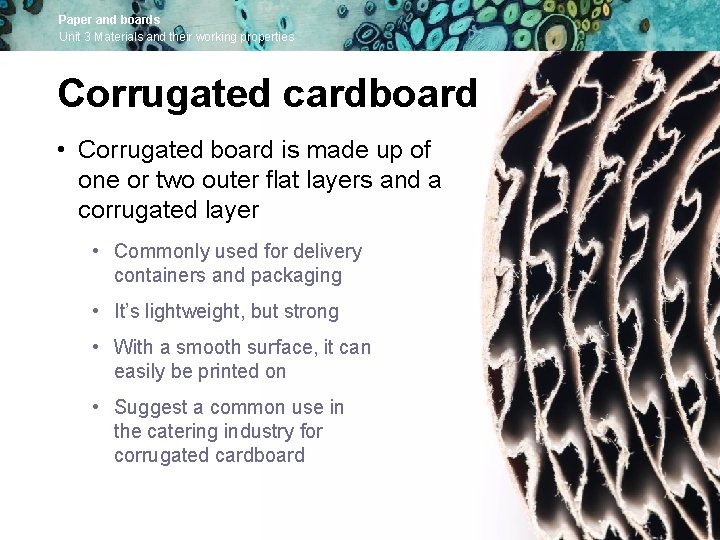
Paper and boards Unit 3 Materials and their working properties Corrugated cardboard • Corrugated board is made up of one or two outer flat layers and a corrugated layer • Commonly used for delivery containers and packaging • It’s lightweight, but strong • With a smooth surface, it can easily be printed on • Suggest a common use in the catering industry for corrugated cardboard
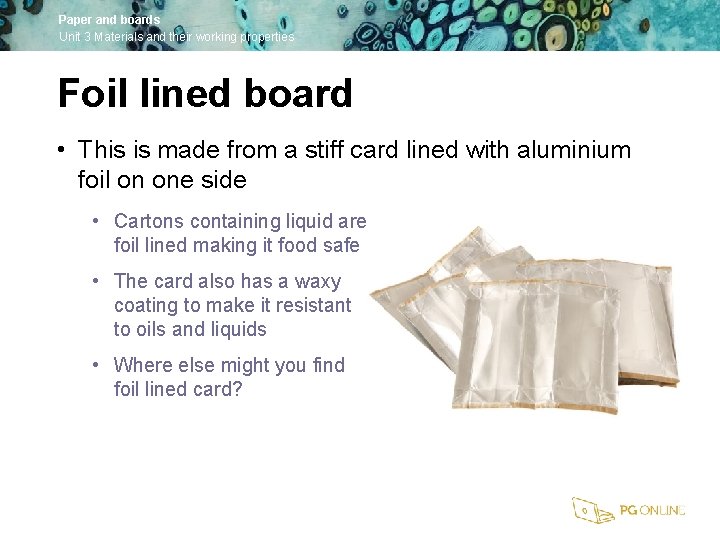
Paper and boards Unit 3 Materials and their working properties Foil lined board • This is made from a stiff card lined with aluminium foil on one side • Cartons containing liquid are foil lined making it food safe • The card also has a waxy coating to make it resistant to oils and liquids • Where else might you find foil lined card?
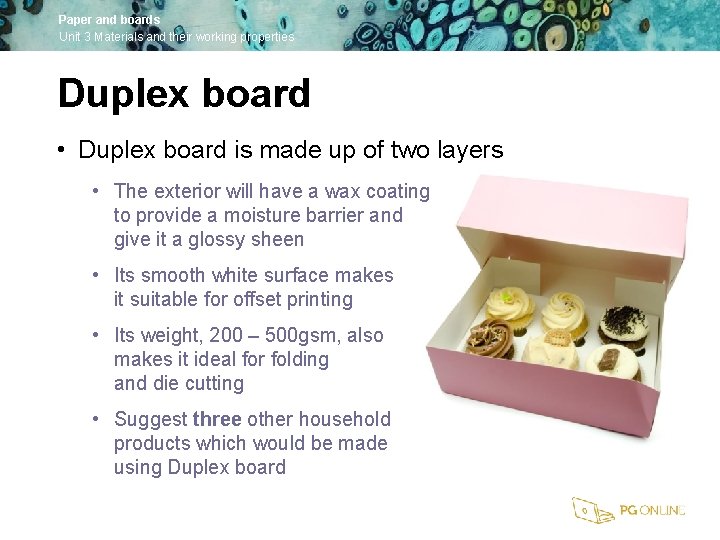
Paper and boards Unit 3 Materials and their working properties Duplex board • Duplex board is made up of two layers • The exterior will have a wax coating to provide a moisture barrier and give it a glossy sheen • Its smooth white surface makes it suitable for offset printing • Its weight, 200 – 500 gsm, also makes it ideal for folding and die cutting • Suggest three other household products which would be made using Duplex board
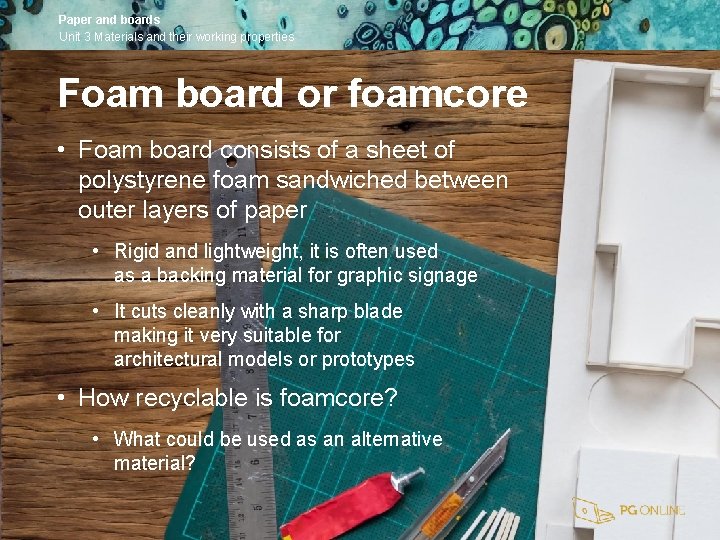
Paper and boards Unit 3 Materials and their working properties Foam board or foamcore • Foam board consists of a sheet of polystyrene foam sandwiched between outer layers of paper • Rigid and lightweight, it is often used as a backing material for graphic signage • It cuts cleanly with a sharp blade making it very suitable for architectural models or prototypes • How recyclable is foamcore? • What could be used as an alternative material?
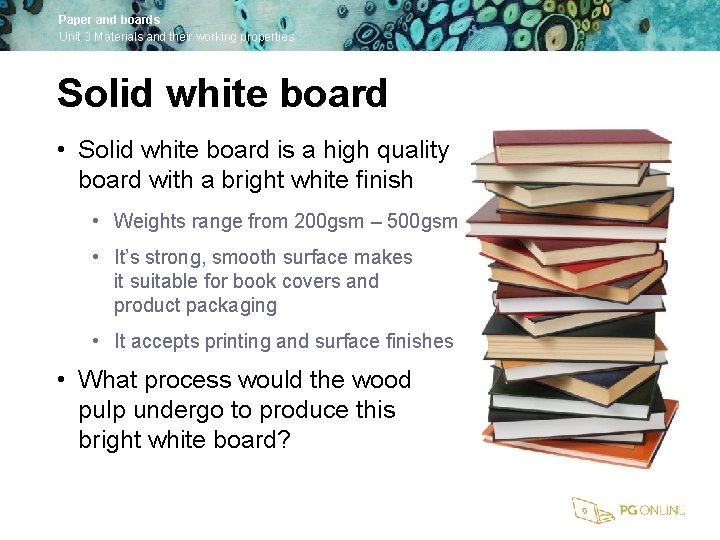
Paper and boards Unit 3 Materials and their working properties Solid white board • Solid white board is a high quality board with a bright white finish • Weights range from 200 gsm – 500 gsm • It’s strong, smooth surface makes it suitable for book covers and product packaging • It accepts printing and surface finishes • What process would the wood pulp undergo to produce this bright white board?
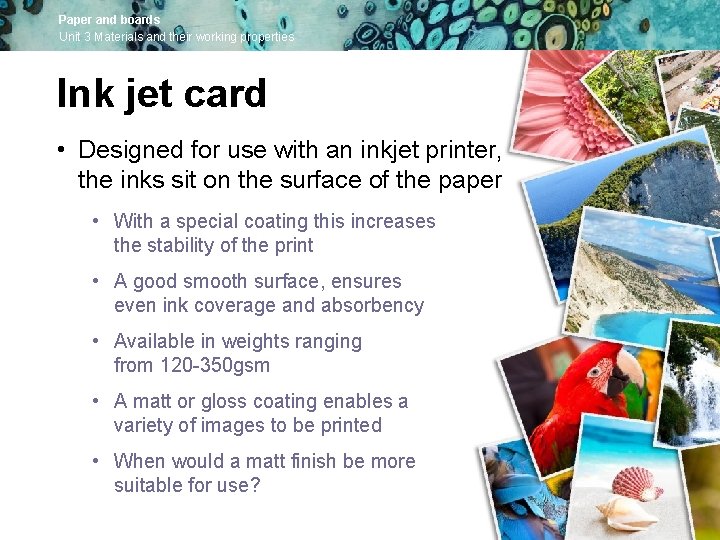
Paper and boards Unit 3 Materials and their working properties Ink jet card • Designed for use with an inkjet printer, the inks sit on the surface of the paper • With a special coating this increases the stability of the print • A good smooth surface, ensures even ink coverage and absorbency • Available in weights ranging from 120 -350 gsm • A matt or gloss coating enables a variety of images to be printed • When would a matt finish be more suitable for use?
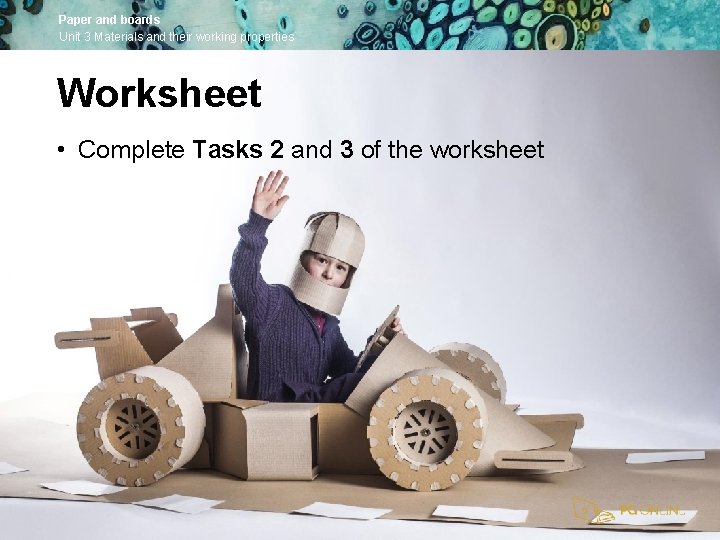
Paper and boards Unit 3 Materials and their working properties Worksheet • Complete Tasks 2 and 3 of the worksheet
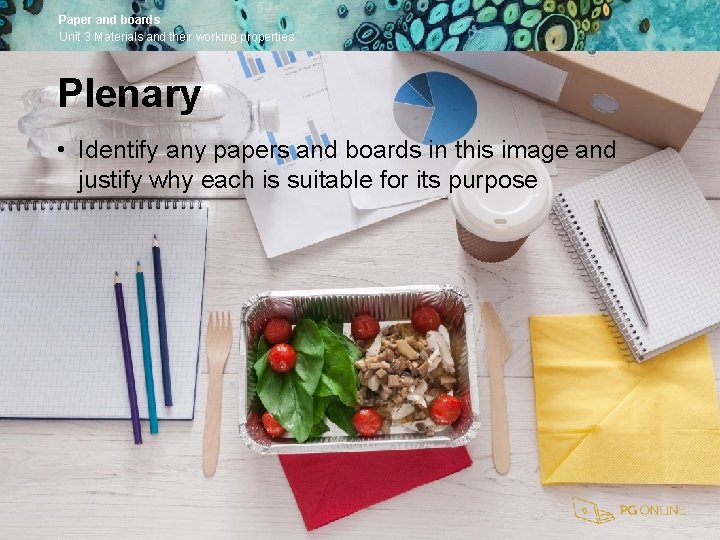
Paper and boards Unit 3 Materials and their working properties Plenary • Identify any papers and boards in this image and justify why each is suitable for its purpose
Paper and boards Unit 3 Materials and their working properties Copyright © 2017 PG Online Limited The contents of this unit are protected by copyright. This unit and all the worksheets, Power. Point presentations, teaching guides and other associated files distributed with it are supplied to you by PG Online Limited under licence and may be used and copied by you only in accordance with the terms of the licence. Except as expressly permitted by the licence, no part of the materials distributed with this unit may be used, reproduced, stored in a retrieval system, or transmitted, in any form or by any means, electronic or otherwise, without the prior written permission of PG Online Limited. Licence agreement This is a legal agreement between you, the end user, and PG Online Limited. This unit and all the worksheets, Power. Point presentations, teaching guides and other associated files distributed with it is licensed, not sold, to you by PG Online Limited for use under the terms of the licence. The materials distributed with this unit may be freely copied and used by members of a single institution on a single site only. You are not permitted to share in any way any of the materials or part of the materials with any third party, including users on another site or individuals who are members of a separate institution. You acknowledge that the materials must remain with you, the licencing institution, and no part of the materials may be transferred to another institution. You also agree not to procure, authorise, encourage, facilitate or enable any third party to reproduce these materials in whole or in part without the prior permission of PG Online Limited.