
AQA GCSE Design and Technology 8552 1 Investigation
- Slides: 25
AQA GCSE Design and Technology 8552 1 Investigation, primary and secondary data Unit 6 Designing principles
Designing principles Title: Investigation, primary and secondary data • Objectives • Understand how primary and secondary data can be collected to assist the understanding of client and user needs • Know how to write a design brief and produce a manufacturing specification • Understand how the environment, and social and economic challenges influence designing and making
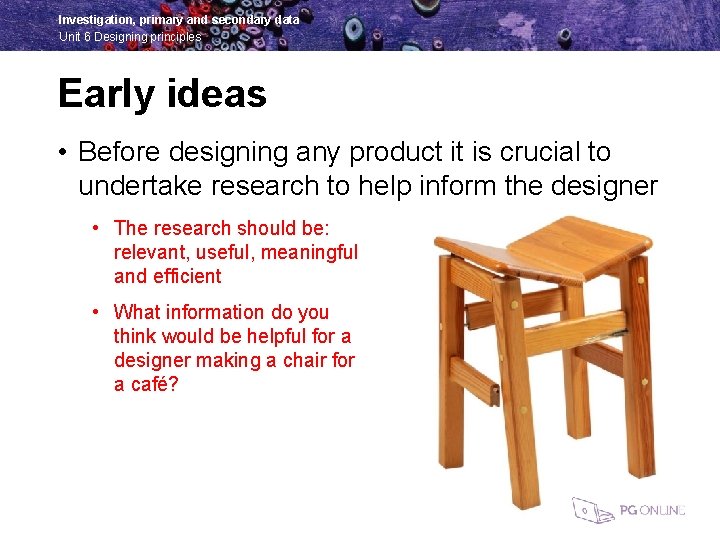
Investigation, primary and secondary data Unit 6 Designing principles Early ideas • Before designing any product it is crucial to undertake research to help inform the designer • The research should be: relevant, useful, meaningful and efficient • What information do you think would be helpful for a designer making a chair for a café?
Investigation, primary and secondary data Unit 6 Designing principles Investigation and research • Sources of data and information fall into two categories – Primary and Secondary • Primary data is new data, gathered by the researcher • Sources include: interviews, focus groups, questionnaires and case studies • Secondary data is gathered as part of research or reporting on primary data • Sources include articles, books and magazines • What other ways are there of gathering both primary and secondary data?
Investigation, primary and secondary data Unit 6 Designing principles What do you need to know? • The design proposal will raise a series of questions • Where might you gather the following information? • What are the client’s requirements? • Who will use the product? • Suitable materials for manufacture and the cost? • What size should it be? • Primary sources of data can also include: physical material testing, measurements and user observations
Investigation, primary and secondary data Unit 6 Designing principles Market research • Research helps designers analyse and identify the market need for a product, the competition and the customer base • Information can be gathered using interviews and questionnaires • Non-specific, open-ended questions can help to gather general information • Detailed questions help collect answers to very specific points • What variety of methods could you use to collect this type of market research? • How would you prepare to gather this data effectively?
Investigation, primary and secondary data Unit 6 Designing principles Product analysis • As part of your research, it’s essential to know what else is on the market and how it’s made • Consider the functionality of the product • Observe the aesthetics and customer appeal • Note the use of materials and the finish • Analyse both the successful and weak areas of a design • Qualitative feedback from focus groups is informative • How does this analysis help a designer improve their design?
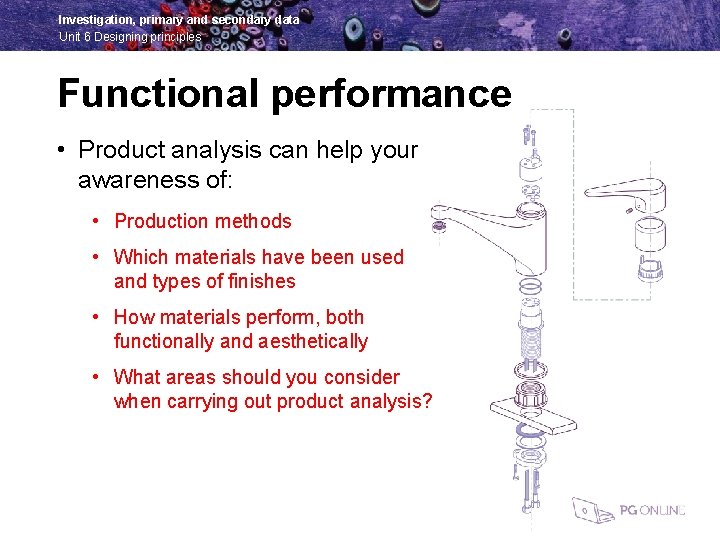
Investigation, primary and secondary data Unit 6 Designing principles Functional performance • Product analysis can help your awareness of: • Production methods • Which materials have been used and types of finishes • How materials perform, both functionally and aesthetically • What areas should you consider when carrying out product analysis?
Investigation, primary and secondary data Unit 6 Designing principles Product analysis results • Consider the following areas and their options: • Form – shape, size, weight, colour, texture • Materials – mild steel, glass, cotton, oak • Manufacturing processes – injection moulded, drape formed • Cost – production costs and retail price • Function – what does it do? • Standard components – nuts, bolts, switches, rivets, zips • Ergonomics – how easy it is to be used • Environmental factors – use of sustainable materials, recyclable
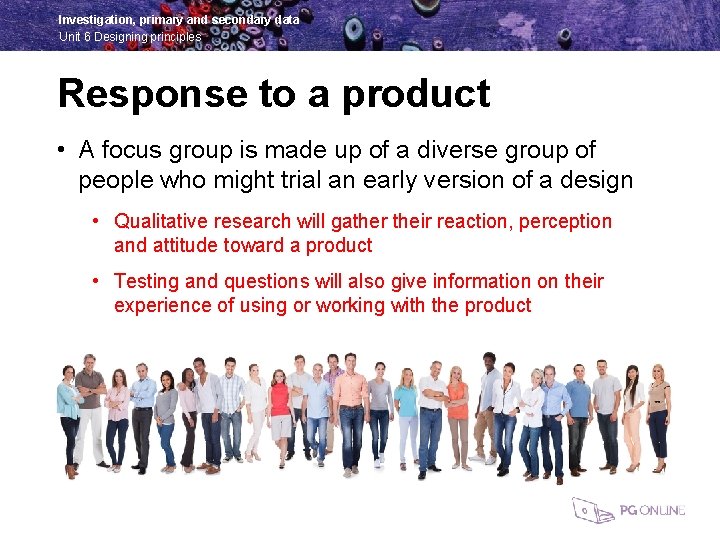
Investigation, primary and secondary data Unit 6 Designing principles Response to a product • A focus group is made up of a diverse group of people who might trial an early version of a design • Qualitative research will gather their reaction, perception and attitude toward a product • Testing and questions will also give information on their experience of using or working with the product
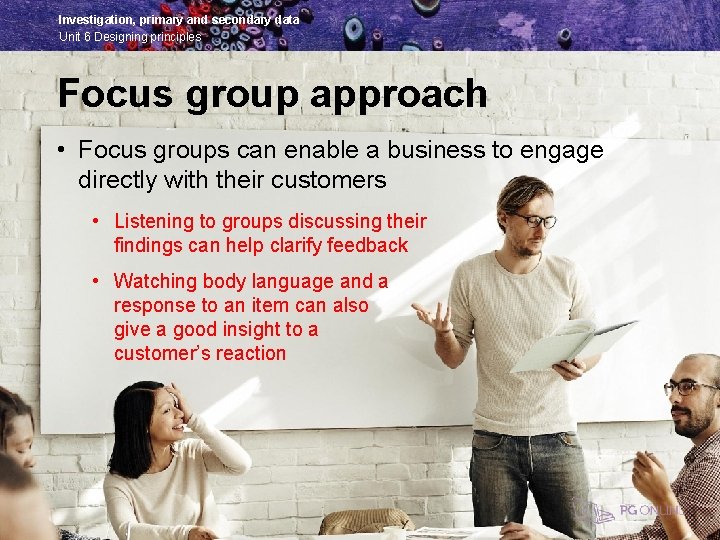
Investigation, primary and secondary data Unit 6 Designing principles Focus group approach • Focus groups can enable a business to engage directly with their customers • Listening to groups discussing their findings can help clarify feedback • Watching body language and a response to an item can also give a good insight to a customer’s reaction
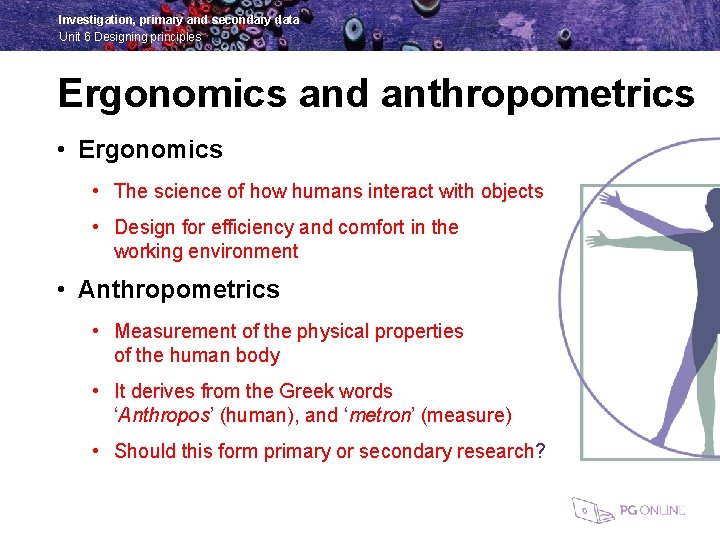
Investigation, primary and secondary data Unit 6 Designing principles Ergonomics and anthropometrics • Ergonomics • The science of how humans interact with objects • Design for efficiency and comfort in the working environment • Anthropometrics • Measurement of the physical properties of the human body • It derives from the Greek words ‘Anthropos’ (human), and ‘metron’ (measure) • Should this form primary or secondary research?
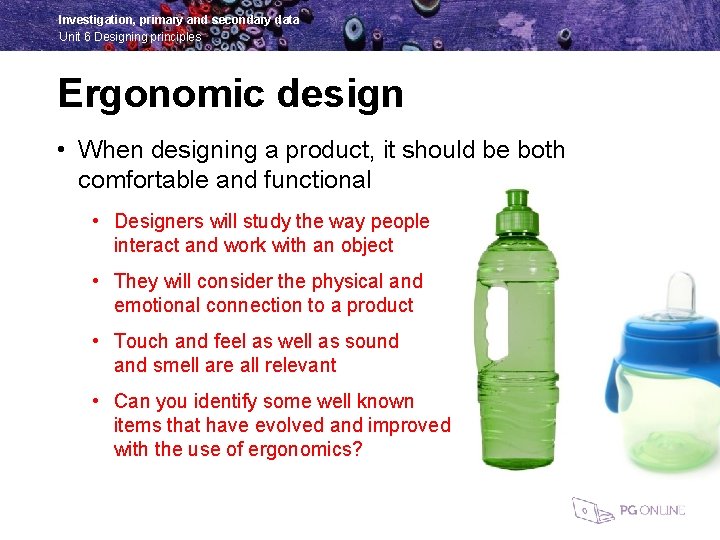
Investigation, primary and secondary data Unit 6 Designing principles Ergonomic design • When designing a product, it should be both comfortable and functional • Designers will study the way people interact and work with an object • They will consider the physical and emotional connection to a product • Touch and feel as well as sound and smell are all relevant • Can you identify some well known items that have evolved and improved with the use of ergonomics?
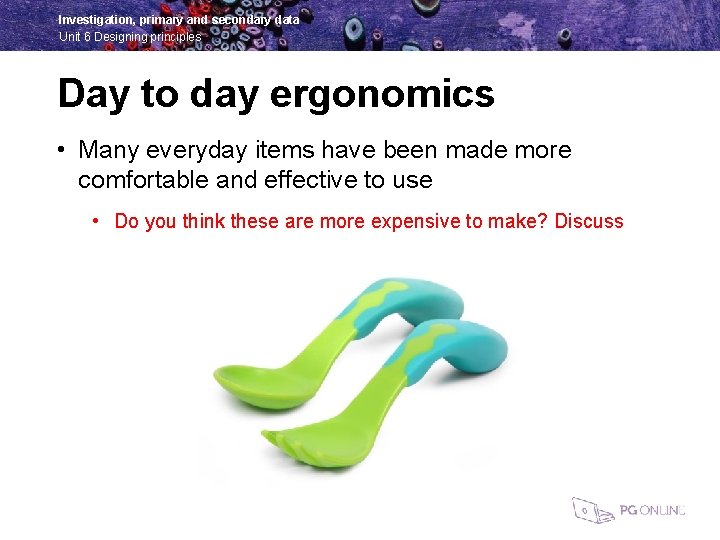
Investigation, primary and secondary data Unit 6 Designing principles Day to day ergonomics • Many everyday items have been made more comfortable and effective to use • Do you think these are more expensive to make? Discuss
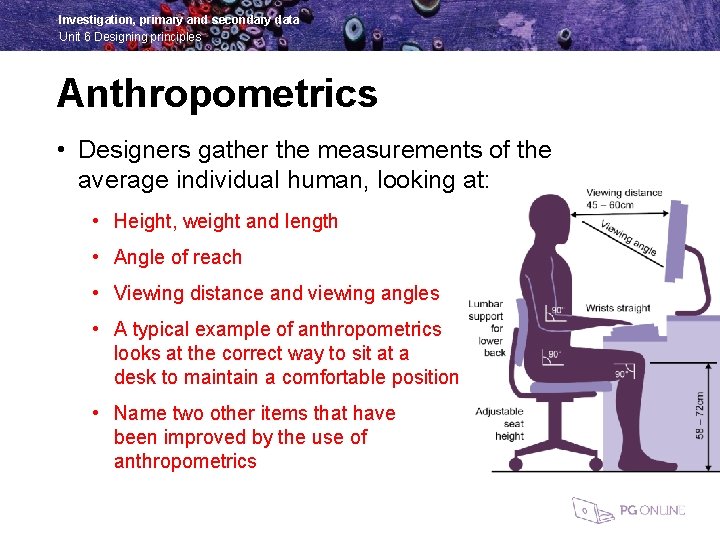
Investigation, primary and secondary data Unit 6 Designing principles Anthropometrics • Designers gather the measurements of the average individual human, looking at: • Height, weight and length • Angle of reach • Viewing distance and viewing angles • A typical example of anthropometrics looks at the correct way to sit at a desk to maintain a comfortable position • Name two other items that have been improved by the use of anthropometrics
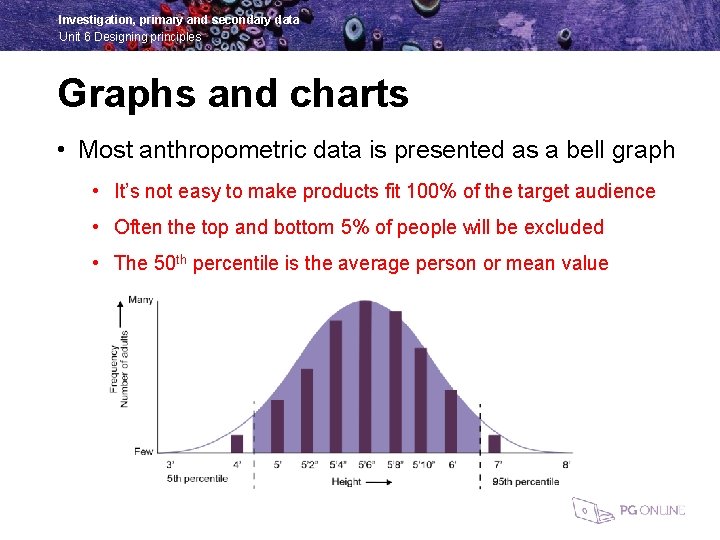
Investigation, primary and secondary data Unit 6 Designing principles Graphs and charts • Most anthropometric data is presented as a bell graph • It’s not easy to make products fit 100% of the target audience • Often the top and bottom 5% of people will be excluded • The 50 th percentile is the average person or mean value
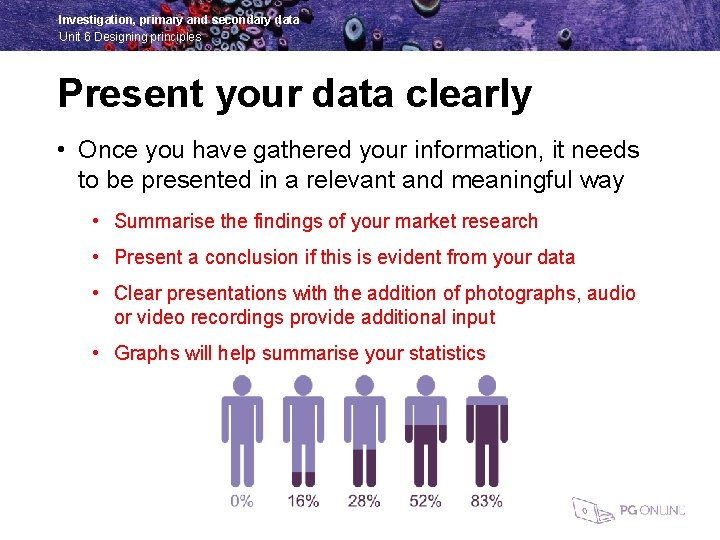
Investigation, primary and secondary data Unit 6 Designing principles Present your data clearly • Once you have gathered your information, it needs to be presented in a relevant and meaningful way • Summarise the findings of your market research • Present a conclusion if this is evident from your data • Clear presentations with the addition of photographs, audio or video recordings provide additional input • Graphs will help summarise your statistics
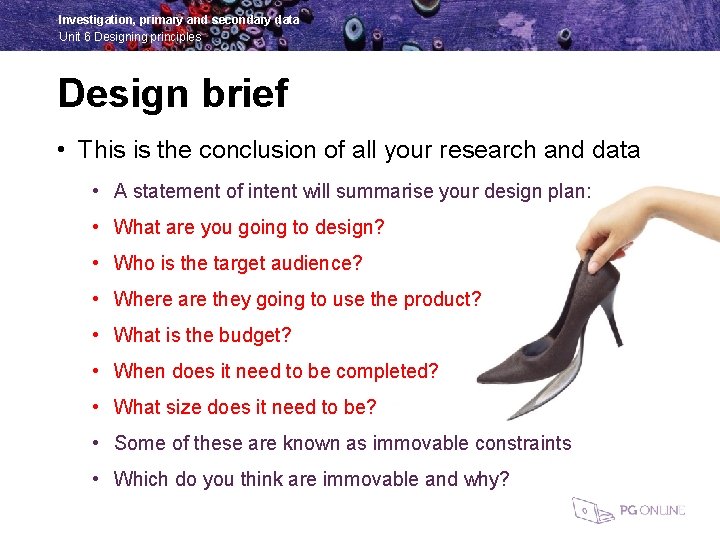
Investigation, primary and secondary data Unit 6 Designing principles Design brief • This is the conclusion of all your research and data • A statement of intent will summarise your design plan: • What are you going to design? • Who is the target audience? • Where are they going to use the product? • What is the budget? • When does it need to be completed? • What size does it need to be? • Some of these are known as immovable constraints • Which do you think are immovable and why?
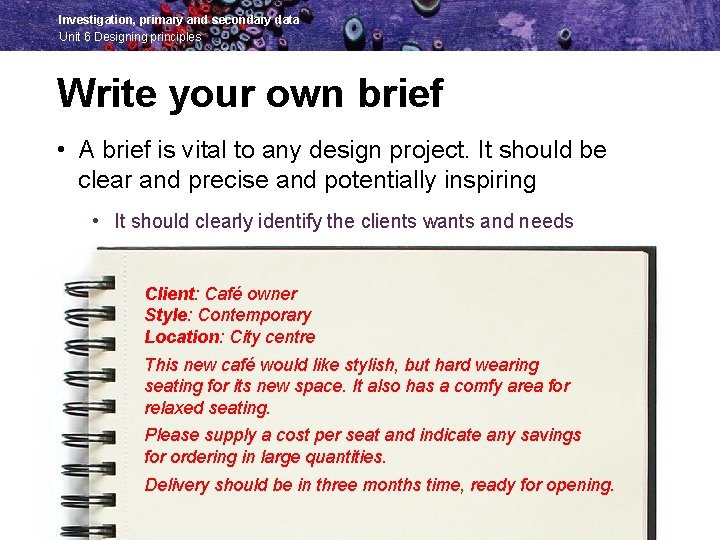
Investigation, primary and secondary data Unit 6 Designing principles Write your own brief • A brief is vital to any design project. It should be clear and precise and potentially inspiring • It should clearly identify the clients wants and needs Client: Café owner Style: Contemporary Location: City centre This new café would like stylish, but hard wearing seating for its new space. It also has a comfy area for relaxed seating. Please supply a cost per seat and indicate any savings for ordering in large quantities. Delivery should be in three months time, ready for opening.
Investigation, primary and secondary data Unit 6 Designing principles Design specification • A design specification is used to describe all of the client and technical requirements gathered throughout the research process • It is a series of statements that outline: • The function and type of materials to be used in the product • The client requirements including anthropometric data • Before manufacture, the design specification is used to help create the final designs for the product • The final designs are then used to develop a detailed manufacturing specification
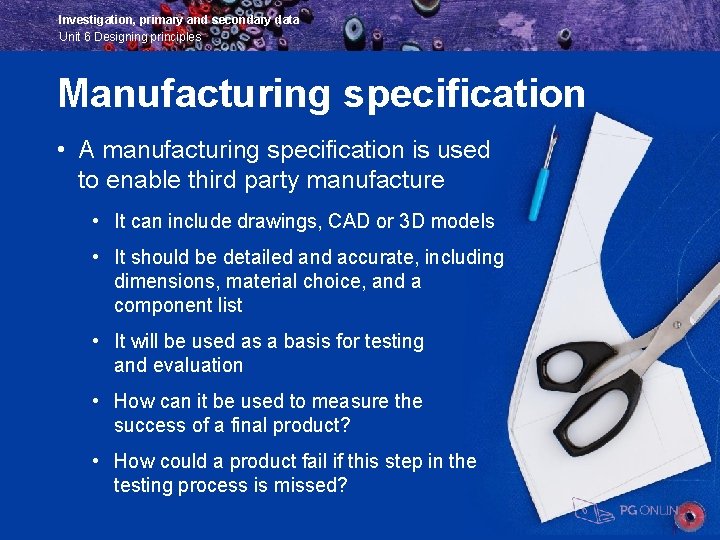
Investigation, primary and secondary data Unit 6 Designing principles Manufacturing specification • A manufacturing specification is used to enable third party manufacture • It can include drawings, CAD or 3 D models • It should be detailed and accurate, including dimensions, material choice, and a component list • It will be used as a basis for testing and evaluation • How can it be used to measure the success of a final product? • How could a product fail if this step in the testing process is missed?
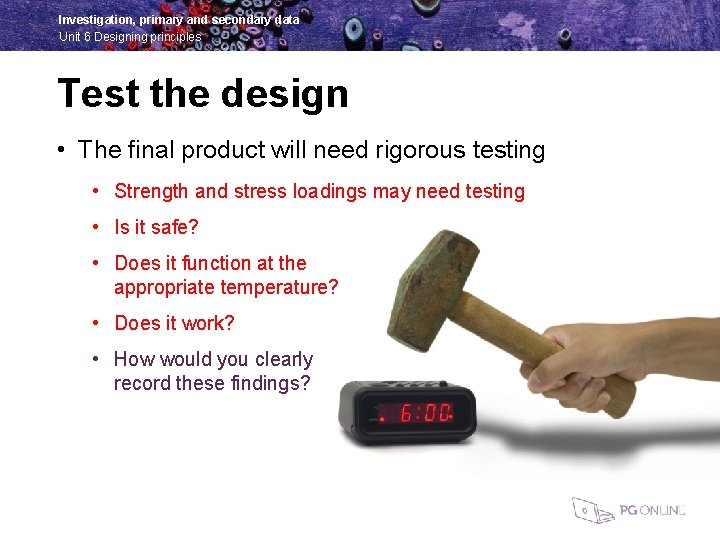
Investigation, primary and secondary data Unit 6 Designing principles Test the design • The final product will need rigorous testing • Strength and stress loadings may need testing • Is it safe? • Does it function at the appropriate temperature? • Does it work? • How would you clearly record these findings?
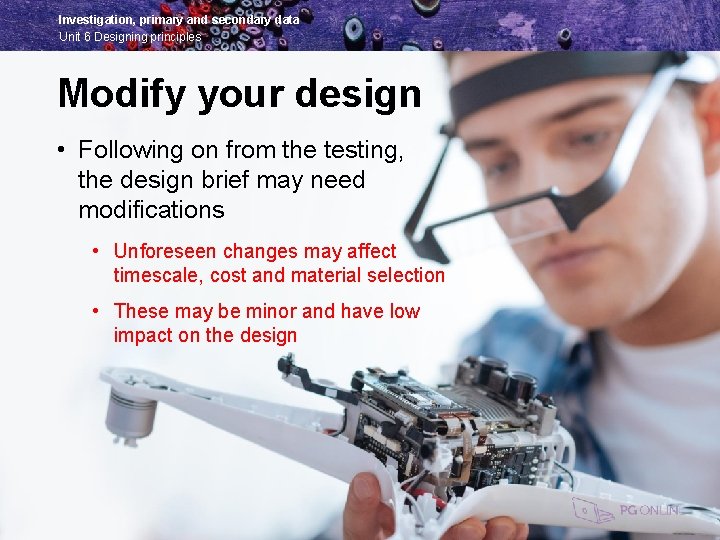
Investigation, primary and secondary data Unit 6 Designing principles Modify your design • Following on from the testing, the design brief may need modifications • Unforeseen changes may affect timescale, cost and material selection • These may be minor and have low impact on the design
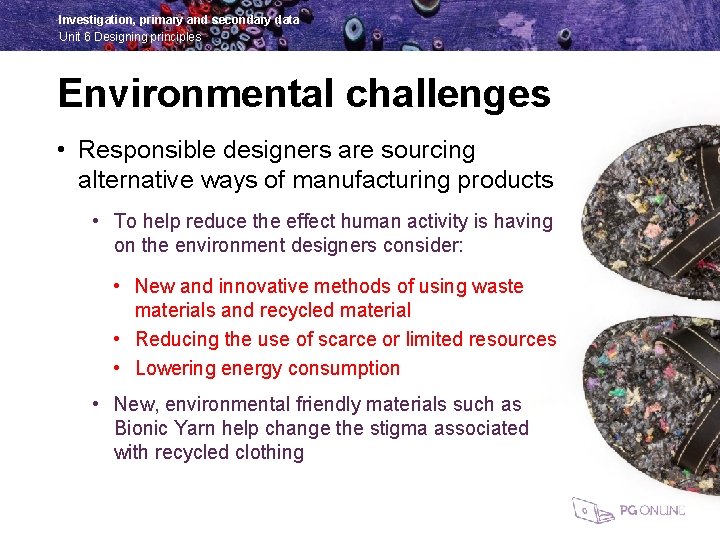
Investigation, primary and secondary data Unit 6 Designing principles Environmental challenges • Responsible designers are sourcing alternative ways of manufacturing products • To help reduce the effect human activity is having on the environment designers consider: • New and innovative methods of using waste materials and recycled material • Reducing the use of scarce or limited resources • Lowering energy consumption • New, environmental friendly materials such as Bionic Yarn help change the stigma associated with recycled clothing
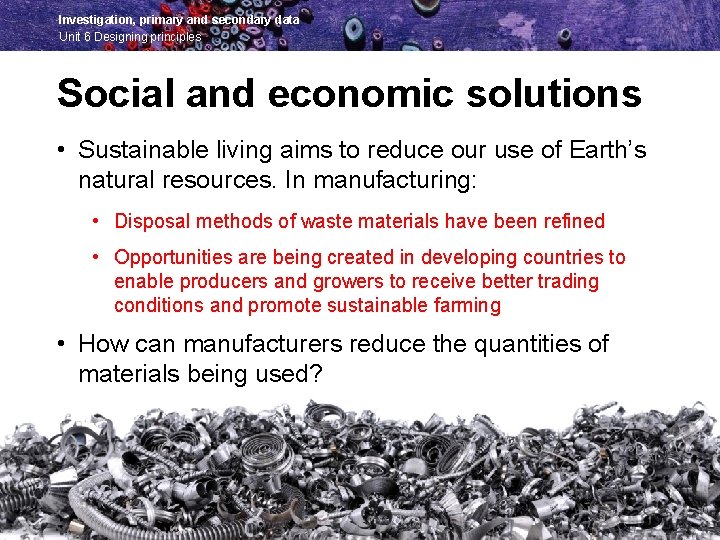
Investigation, primary and secondary data Unit 6 Designing principles Social and economic solutions • Sustainable living aims to reduce our use of Earth’s natural resources. In manufacturing: • Disposal methods of waste materials have been refined • Opportunities are being created in developing countries to enable producers and growers to receive better trading conditions and promote sustainable farming • How can manufacturers reduce the quantities of materials being used?