
AQA combined science trilogy Physics paper 1 Physics
AQA combined science trilogy Physics paper 1
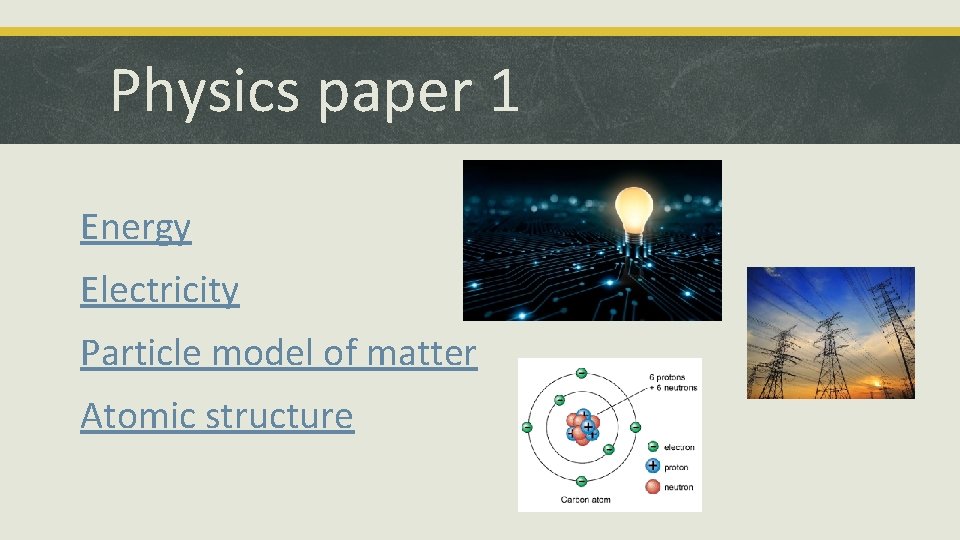
Physics paper 1 Energy Electricity Particle model of matter Atomic structure
How do I review my learning on forms of energy and energy calculations? Do Now Activity Last Week: Name the four Last Term: Which hormones that control the are used in contraceptive pills? menstrual cycle? Last Year: Outline the IVF process?
Energy v. Energy stores and systems v. Energy resources and their uses v. Kinetic and potential energy stores v. Wind, solar, and geothermal v. Specific heat capacity v. Hydroelectricity, waves and tidal v. Conservation of energy and power v. Biofuel and non renewable v. Reducing unwanted energy transfers v. Trends in energy resource use v. Efficiency
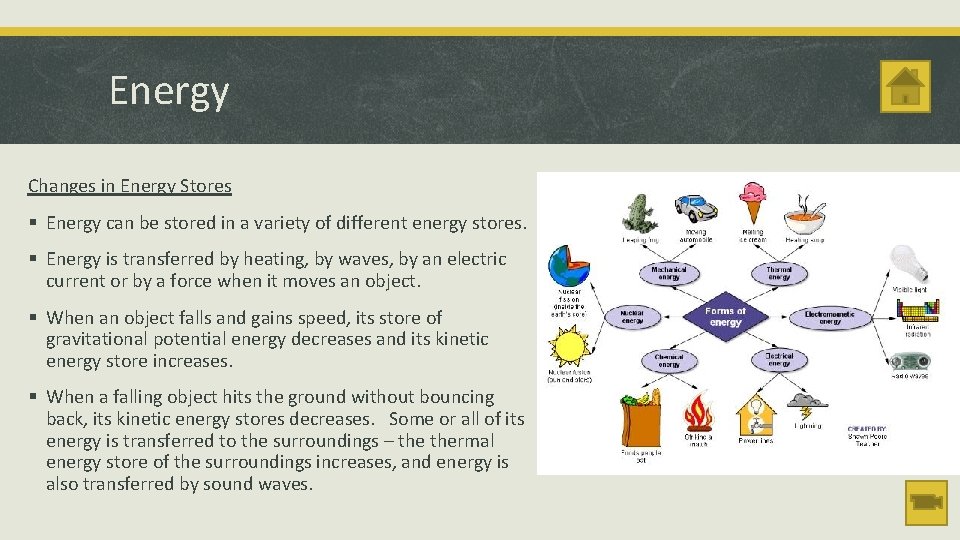
Energy Changes in Energy Stores § Energy can be stored in a variety of different energy stores. § Energy is transferred by heating, by waves, by an electric current or by a force when it moves an object. § When an object falls and gains speed, its store of gravitational potential energy decreases and its kinetic energy store increases. § When a falling object hits the ground without bouncing back, its kinetic energy stores decreases. Some or all of its energy is transferred to the surroundings – thermal energy store of the surroundings increases, and energy is also transferred by sound waves.
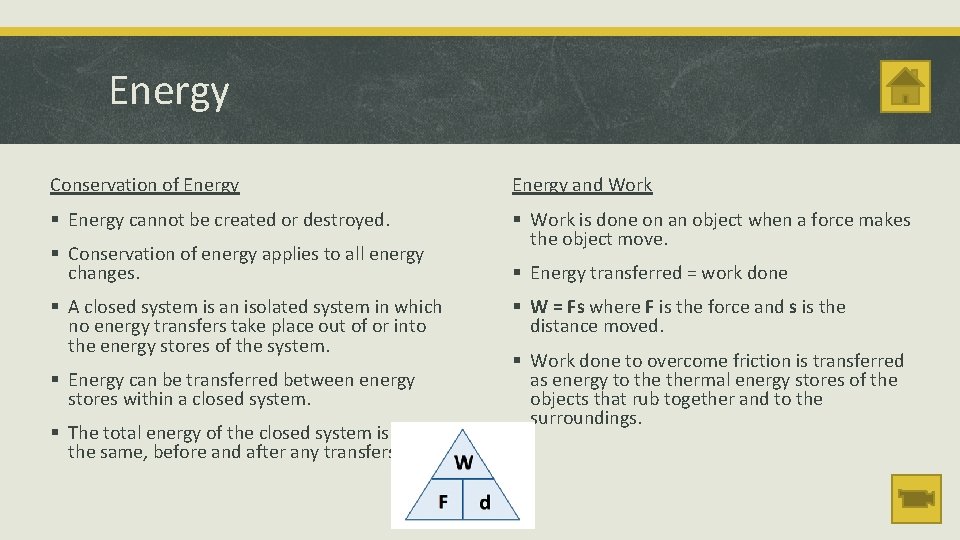
Energy Conservation of Energy and Work § Energy cannot be created or destroyed. § Work is done on an object when a force makes the object move. § Conservation of energy applies to all energy changes. § A closed system is an isolated system in which no energy transfers take place out of or into the energy stores of the system. § Energy can be transferred between energy stores within a closed system. § The total energy of the closed system is always the same, before and after any transfers. § Energy transferred = work done § W = Fs where F is the force and s is the distance moved. § Work done to overcome friction is transferred as energy to thermal energy stores of the objects that rub together and to the surroundings.
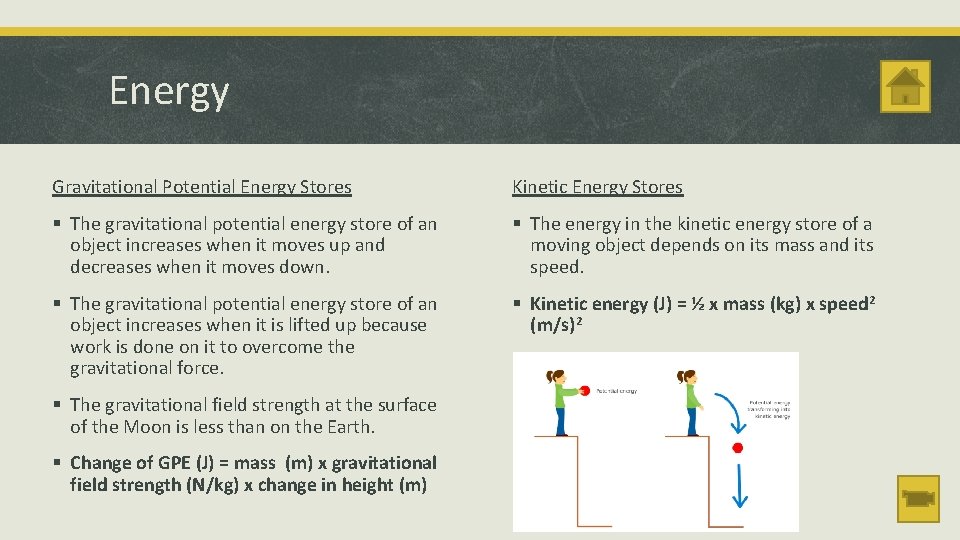
Energy Gravitational Potential Energy Stores Kinetic Energy Stores § The gravitational potential energy store of an object increases when it moves up and decreases when it moves down. § The energy in the kinetic energy store of a moving object depends on its mass and its speed. § The gravitational potential energy store of an object increases when it is lifted up because work is done on it to overcome the gravitational force. § Kinetic energy (J) = ½ x mass (kg) x speed 2 (m/s)2 § The gravitational field strength at the surface of the Moon is less than on the Earth. § Change of GPE (J) = mass (m) x gravitational field strength (N/kg) x change in height (m)
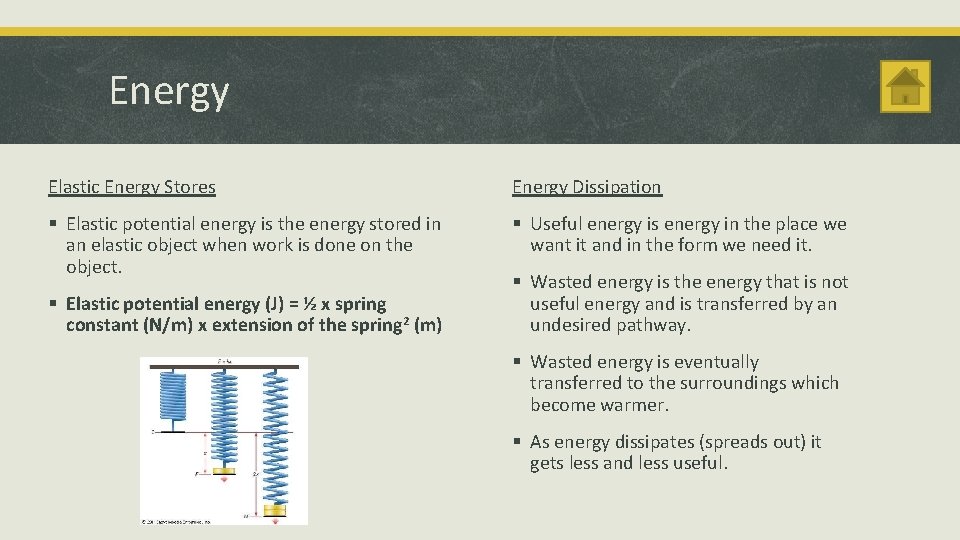
Energy Elastic Energy Stores Energy Dissipation § Elastic potential energy is the energy stored in an elastic object when work is done on the object. § Useful energy is energy in the place we want it and in the form we need it. § Elastic potential energy (J) = ½ x spring constant (N/m) x extension of the spring 2 (m) § Wasted energy is the energy that is not useful energy and is transferred by an undesired pathway. § Wasted energy is eventually transferred to the surroundings which become warmer. § As energy dissipates (spreads out) it gets less and less useful.
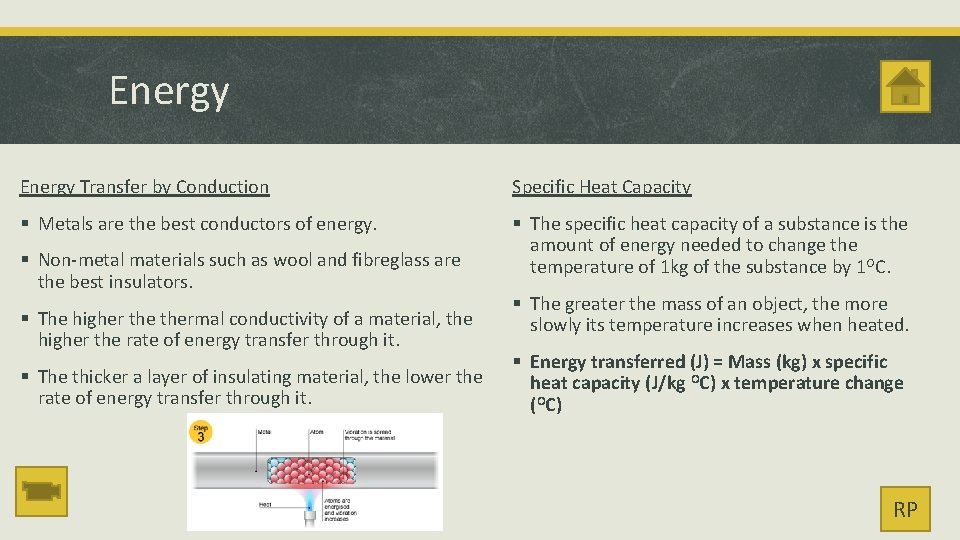
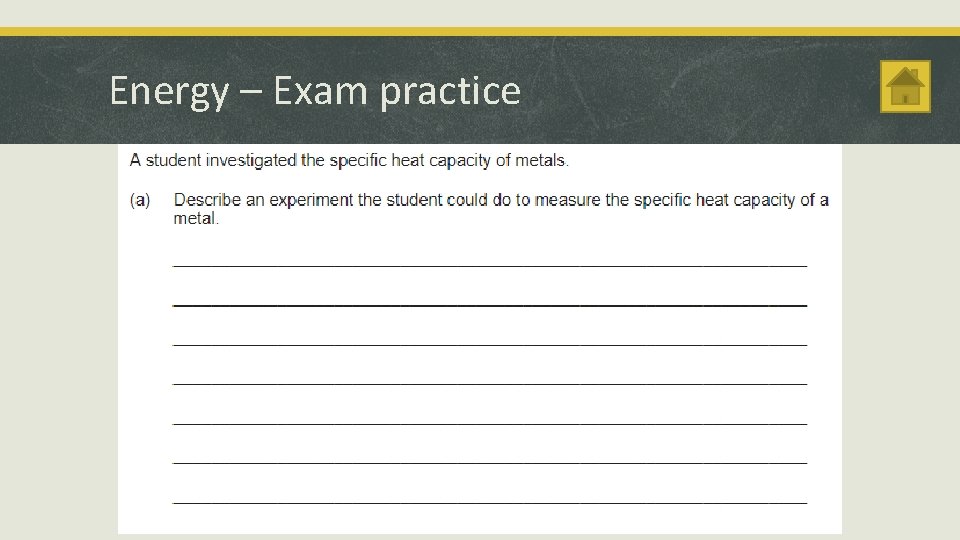
Energy Transfer by Conduction Specific Heat Capacity § Metals are the best conductors of energy. § The specific heat capacity of a substance is the amount of energy needed to change the temperature of 1 kg of the substance by 1 OC. § Non-metal materials such as wool and fibreglass are the best insulators. § The higher thermal conductivity of a material, the higher the rate of energy transfer through it. § The thicker a layer of insulating material, the lower the rate of energy transfer through it. § The greater the mass of an object, the more slowly its temperature increases when heated. § Energy transferred (J) = Mass (kg) x specific heat capacity (J/kg OC) x temperature change (OC) RP
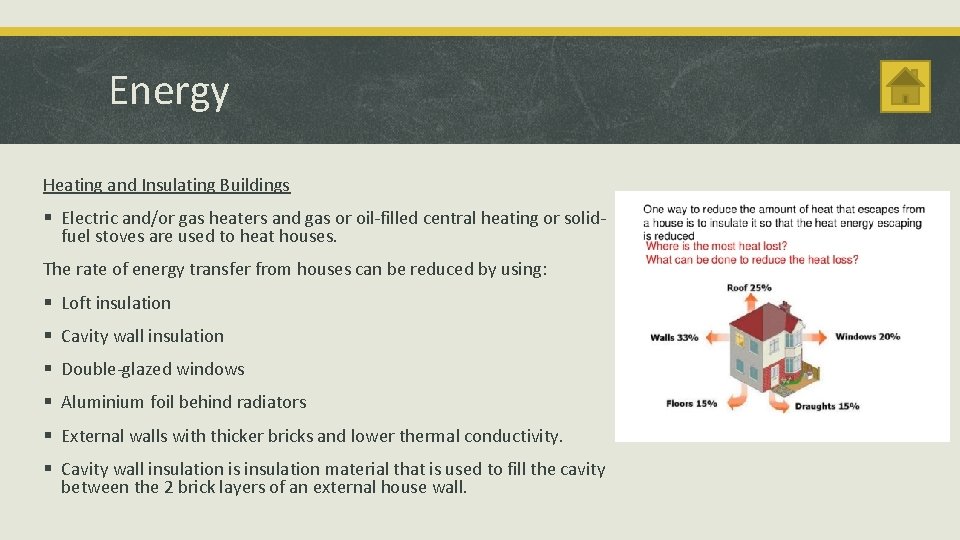
Energy Heating and Insulating Buildings § Electric and/or gas heaters and gas or oil-filled central heating or solidfuel stoves are used to heat houses. The rate of energy transfer from houses can be reduced by using: § Loft insulation § Cavity wall insulation § Double-glazed windows § Aluminium foil behind radiators § External walls with thicker bricks and lower thermal conductivity. § Cavity wall insulation is insulation material that is used to fill the cavity between the 2 brick layers of an external house wall.
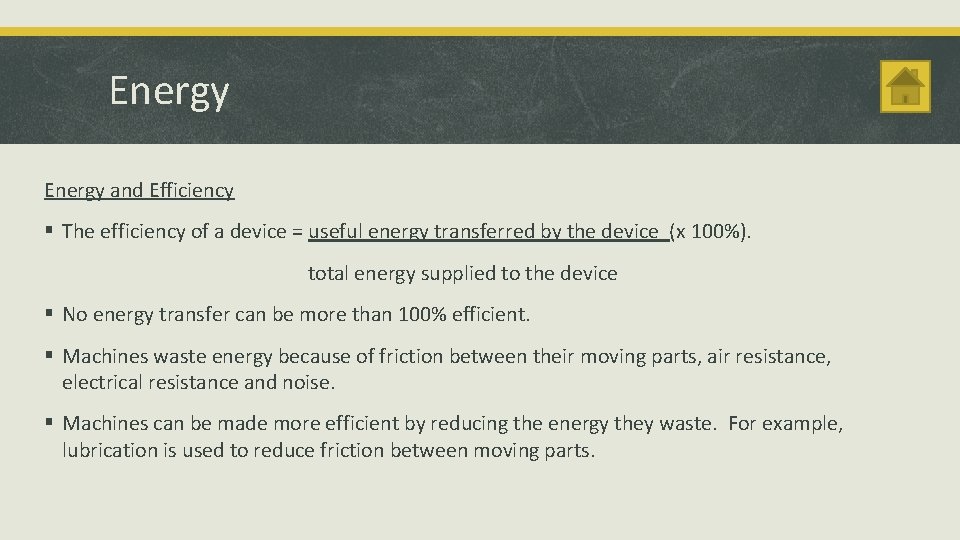
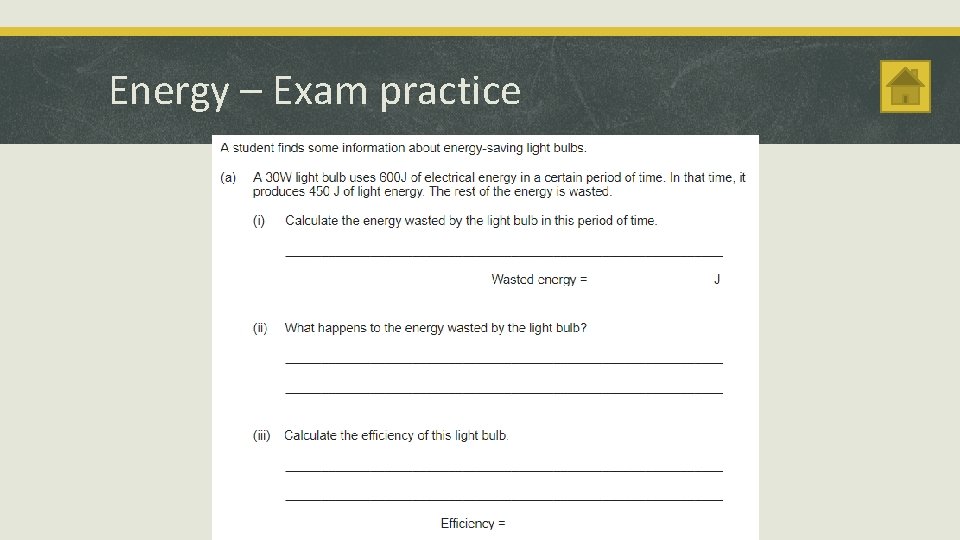
Energy and Efficiency § The efficiency of a device = useful energy transferred by the device (x 100%). total energy supplied to the device § No energy transfer can be more than 100% efficient. § Machines waste energy because of friction between their moving parts, air resistance, electrical resistance and noise. § Machines can be made more efficient by reducing the energy they waste. For example, lubrication is used to reduce friction between moving parts.
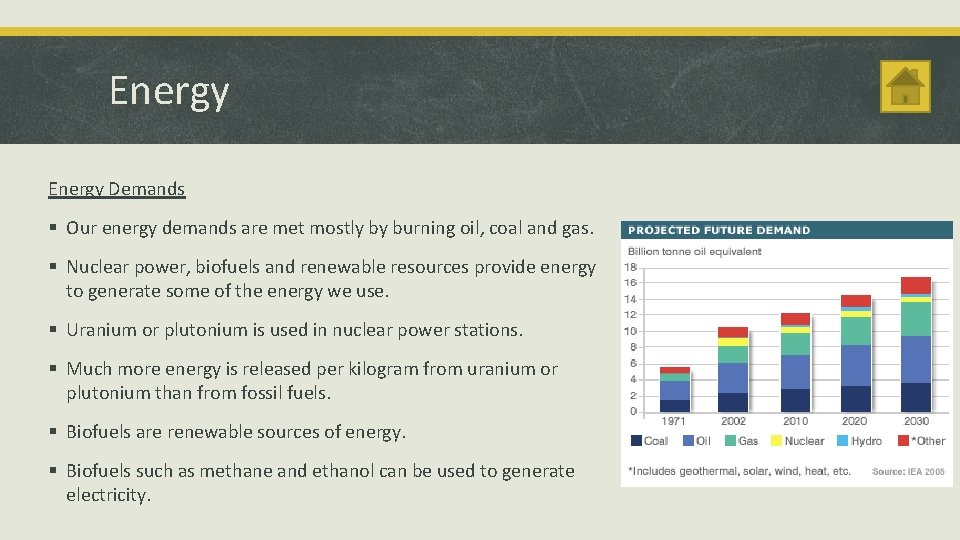
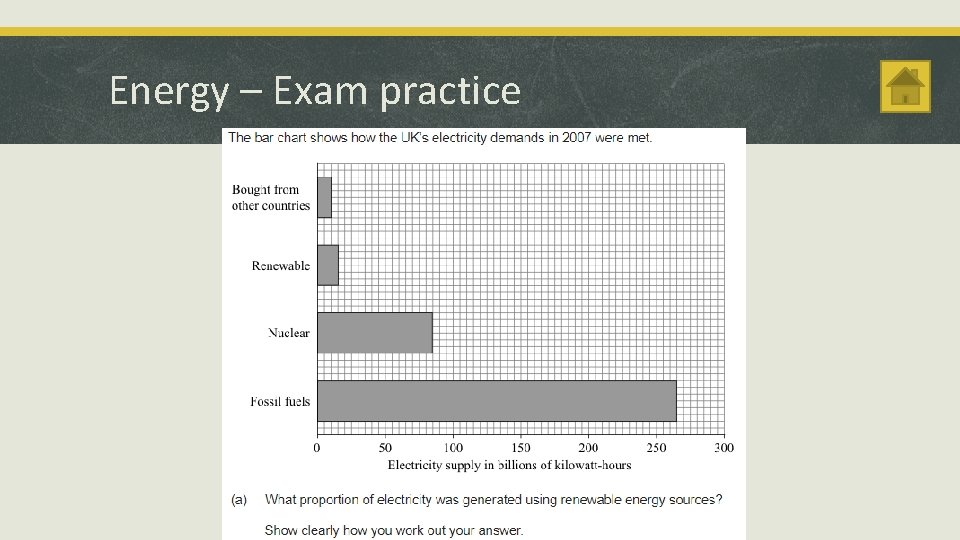
Energy Demands § Our energy demands are met mostly by burning oil, coal and gas. § Nuclear power, biofuels and renewable resources provide energy to generate some of the energy we use. § Uranium or plutonium is used in nuclear power stations. § Much more energy is released per kilogram from uranium or plutonium than from fossil fuels. § Biofuels are renewable sources of energy. § Biofuels such as methane and ethanol can be used to generate electricity.
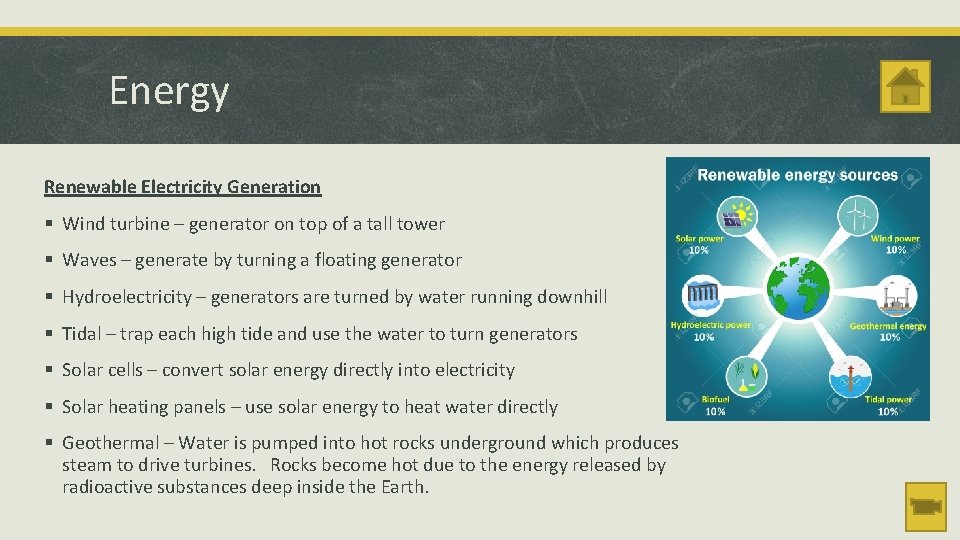
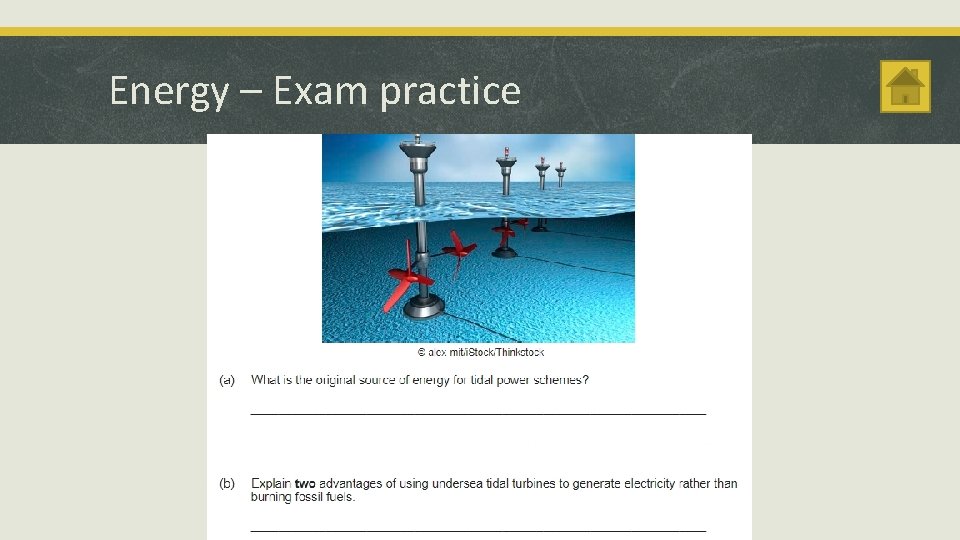
Energy Renewable Electricity Generation § Wind turbine – generator on top of a tall tower § Waves – generate by turning a floating generator § Hydroelectricity – generators are turned by water running downhill § Tidal – trap each high tide and use the water to turn generators § Solar cells – convert solar energy directly into electricity § Solar heating panels – use solar energy to heat water directly § Geothermal – Water is pumped into hot rocks underground which produces steam to drive turbines. Rocks become hot due to the energy released by radioactive substances deep inside the Earth.
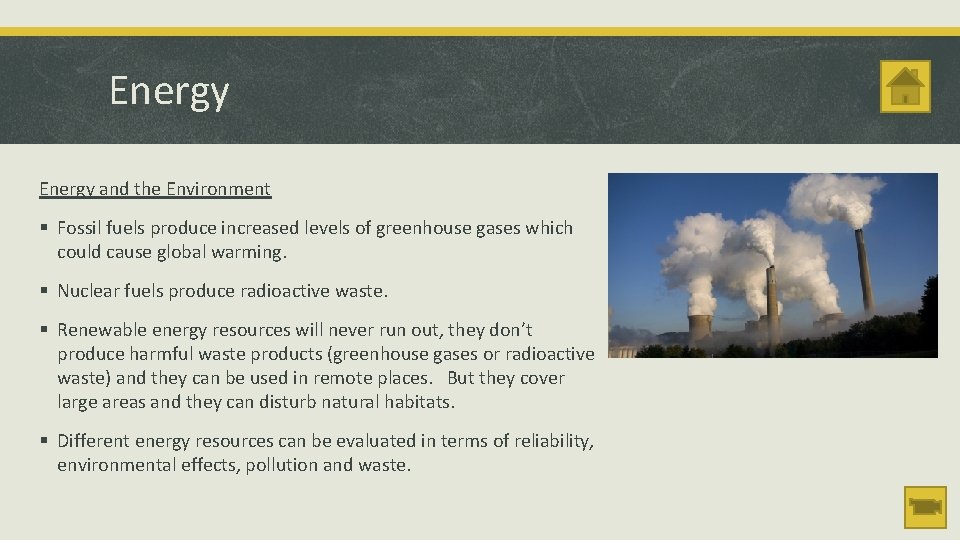
Energy and the Environment § Fossil fuels produce increased levels of greenhouse gases which could cause global warming. § Nuclear fuels produce radioactive waste. § Renewable energy resources will never run out, they don’t produce harmful waste products (greenhouse gases or radioactive waste) and they can be used in remote places. But they cover large areas and they can disturb natural habitats. § Different energy resources can be evaluated in terms of reliability, environmental effects, pollution and waste.
Energy Big Energy Issues § Gas-fired power stations and pumped-storage stations can meet variations in demand. § Nuclear power stations are expensive to build, run and decommission. § Carbon capture of fossil fuel emissions is likely to be expensive. § Renewable resources are cheap to run but expensive to install. § Nuclear power stations, fossil-fuel power stations that use carbon capture technology, and renewable energy resources are all likely to be needed for future energy supplies.
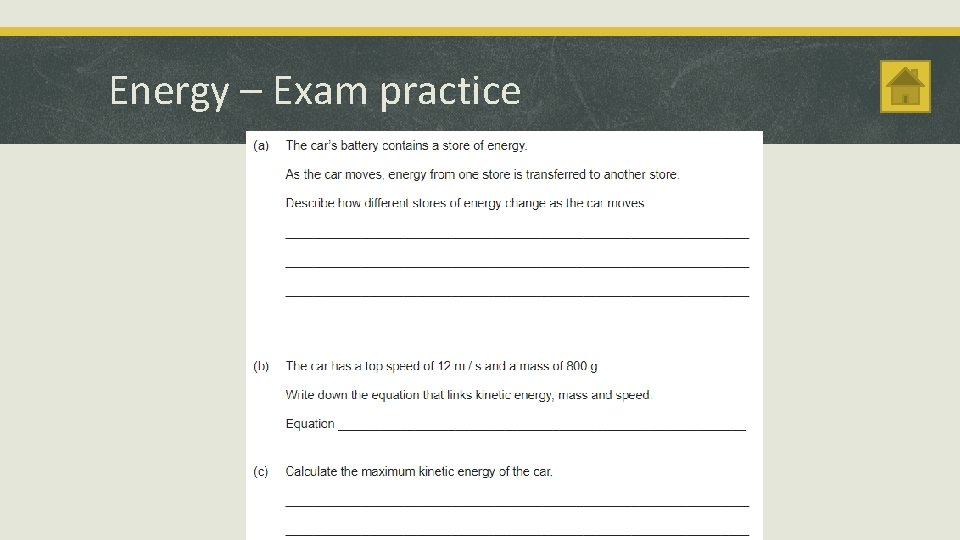
Energy – Exam practice
Energy – Exam practice
Energy – Exam practice
Energy – Exam practice
Energy – Exam practice
How do I review my learning on Electricity? Do Now Activity Last Week: What is Power, state all Last Term: What is electrical equations used to measure power charge? State the equation [ROTOE] [ROFOEC] Last Year: What is the job of a step up and step down transformer?
Electricity v. Current and circuit symbols v. Investigating resistance v. Resistance and V=IR v. Electricity in the home v. Resistance and I-V characteristics v. Power of appliances v. Circuit devices v. Series circuits v. Parallel circuits v. Power v. The national grid
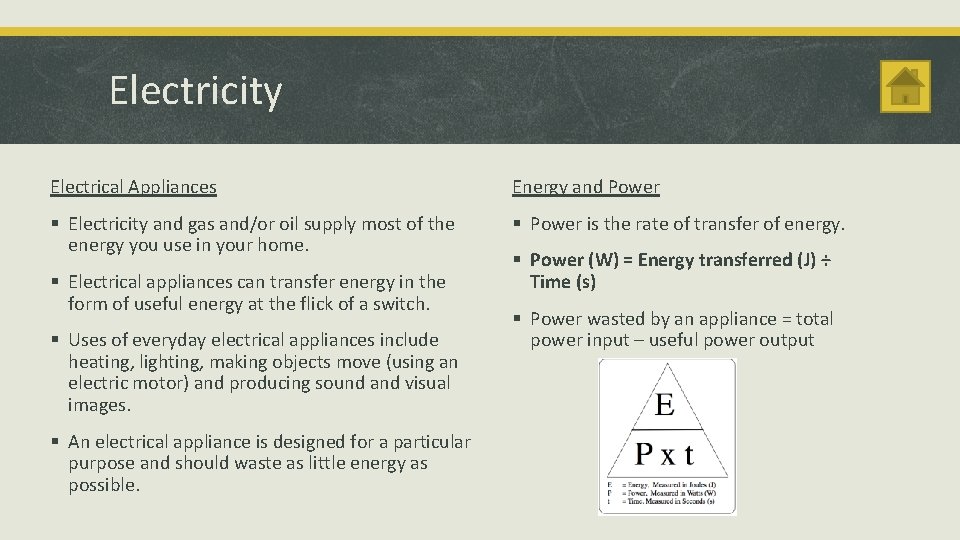
Electricity Electrical Appliances Energy and Power § Electricity and gas and/or oil supply most of the energy you use in your home. § Power is the rate of transfer of energy. § Electrical appliances can transfer energy in the form of useful energy at the flick of a switch. § Uses of everyday electrical appliances include heating, lighting, making objects move (using an electric motor) and producing sound and visual images. § An electrical appliance is designed for a particular purpose and should waste as little energy as possible. § Power (W) = Energy transferred (J) ÷ Time (s) § Power wasted by an appliance = total power input – useful power output
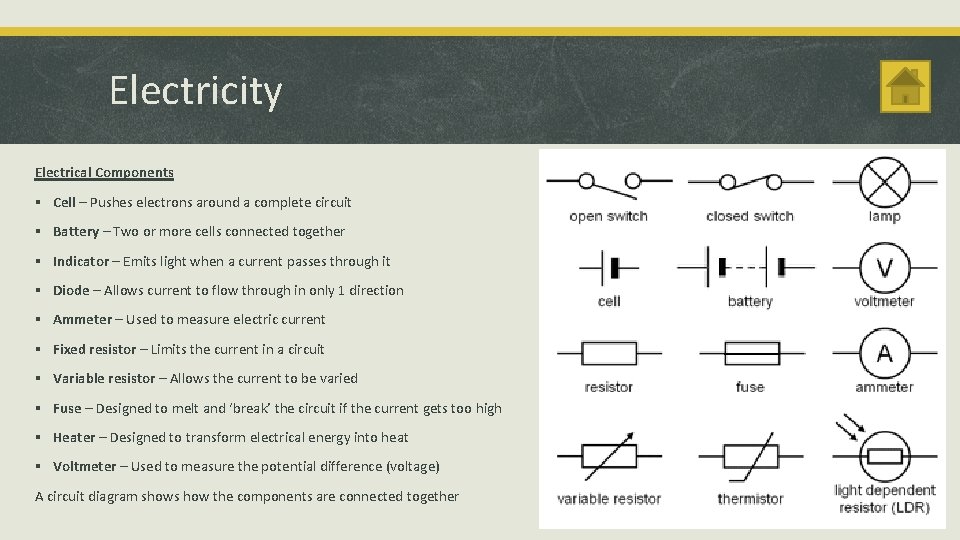
Electricity Electrical Components § Cell – Pushes electrons around a complete circuit § Battery – Two or more cells connected together § Indicator – Emits light when a current passes through it § Diode – Allows current to flow through in only 1 direction § Ammeter – Used to measure electric current § Fixed resistor – Limits the current in a circuit § Variable resistor – Allows the current to be varied § Fuse – Designed to melt and ‘break’ the circuit if the current gets too high § Heater – Designed to transform electrical energy into heat § Voltmeter – Used to measure the potential difference (voltage) A circuit diagram shows how the components are connected together
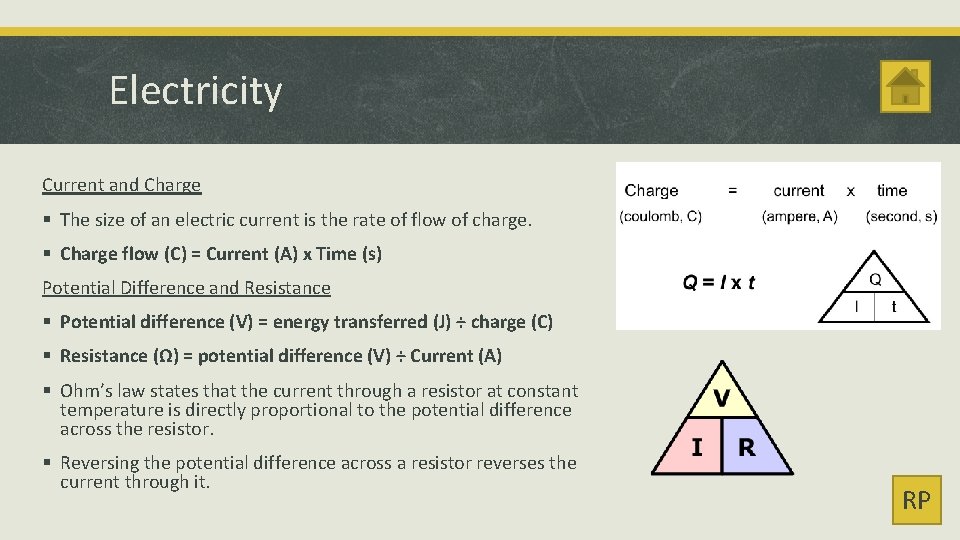
Electricity Current and Charge § The size of an electric current is the rate of flow of charge. § Charge flow (C) = Current (A) x Time (s) Potential Difference and Resistance § Potential difference (V) = energy transferred (J) ÷ charge (C) § Resistance (Ω) = potential difference (V) ÷ Current (A) § Ohm’s law states that the current through a resistor at constant temperature is directly proportional to the potential difference across the resistor. § Reversing the potential difference across a resistor reverses the current through it. RP
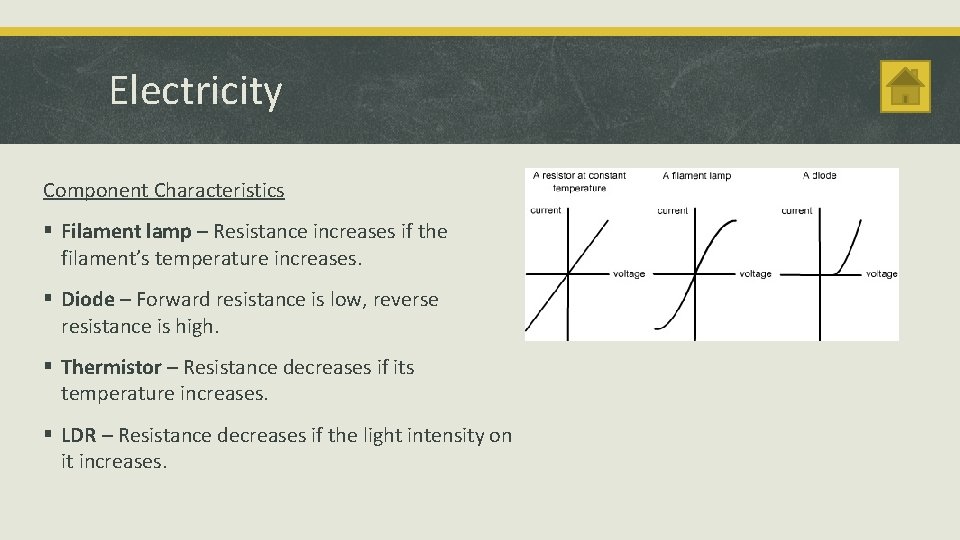
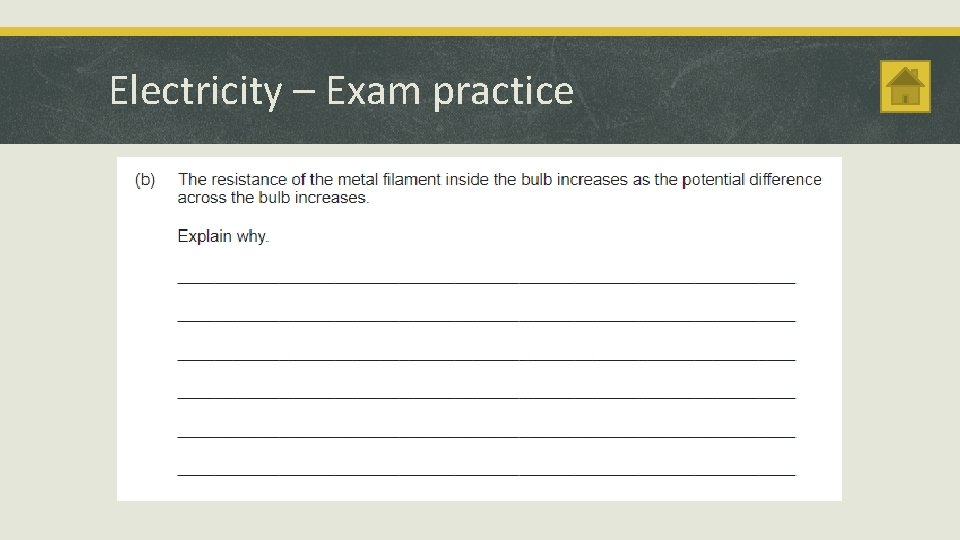
Electricity Component Characteristics § Filament lamp – Resistance increases if the filament’s temperature increases. § Diode – Forward resistance is low, reverse resistance is high. § Thermistor – Resistance decreases if its temperature increases. § LDR – Resistance decreases if the light intensity on it increases.
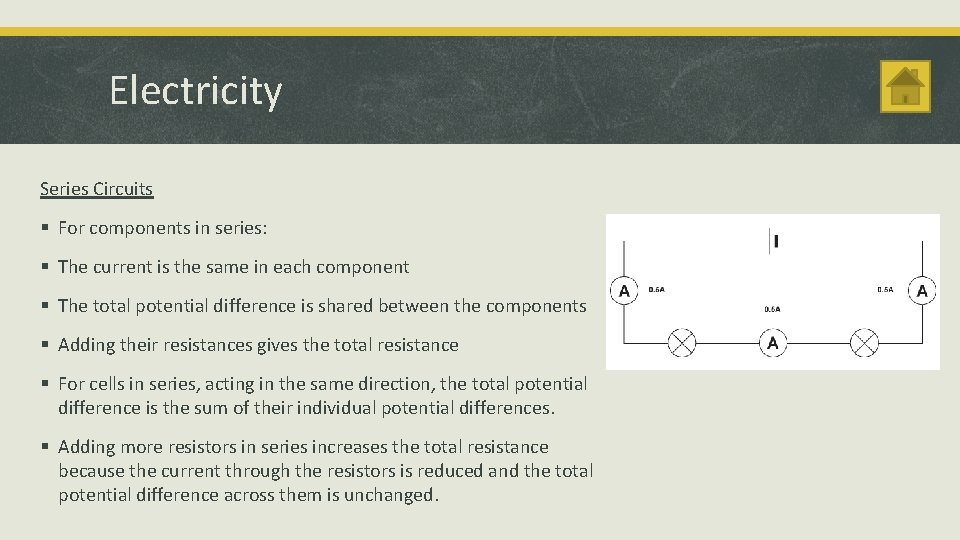
Electricity Series Circuits § For components in series: § The current is the same in each component § The total potential difference is shared between the components § Adding their resistances gives the total resistance § For cells in series, acting in the same direction, the total potential difference is the sum of their individual potential differences. § Adding more resistors in series increases the total resistance because the current through the resistors is reduced and the total potential difference across them is unchanged.
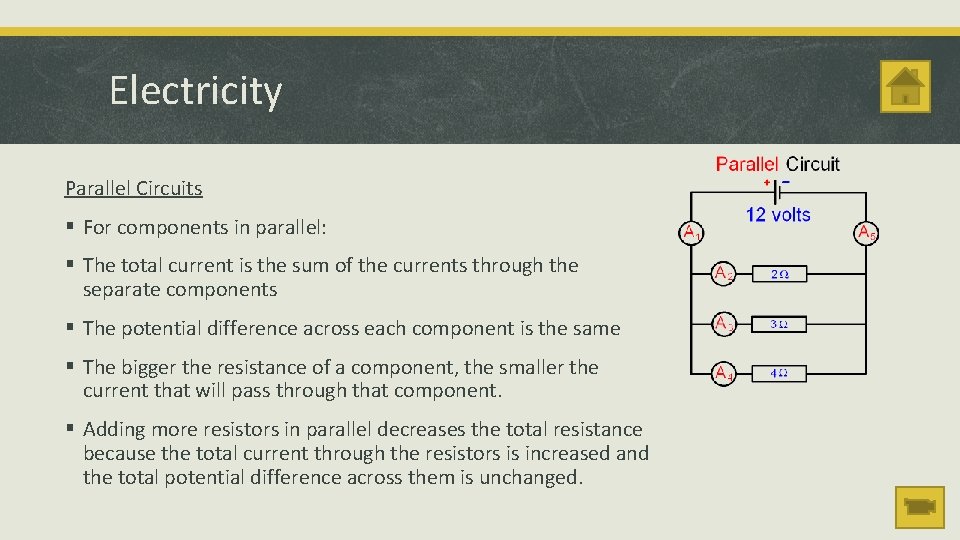
Electricity Parallel Circuits § For components in parallel: § The total current is the sum of the currents through the separate components § The potential difference across each component is the same § The bigger the resistance of a component, the smaller the current that will pass through that component. § Adding more resistors in parallel decreases the total resistance because the total current through the resistors is increased and the total potential difference across them is unchanged.
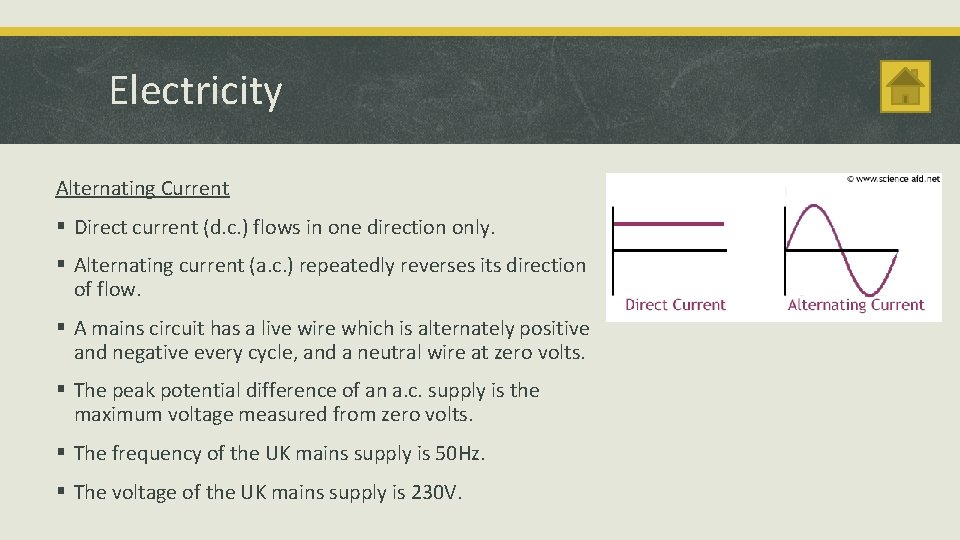
Electricity Alternating Current § Direct current (d. c. ) flows in one direction only. § Alternating current (a. c. ) repeatedly reverses its direction of flow. § A mains circuit has a live wire which is alternately positive and negative every cycle, and a neutral wire at zero volts. § The peak potential difference of an a. c. supply is the maximum voltage measured from zero volts. § The frequency of the UK mains supply is 50 Hz. § The voltage of the UK mains supply is 230 V.
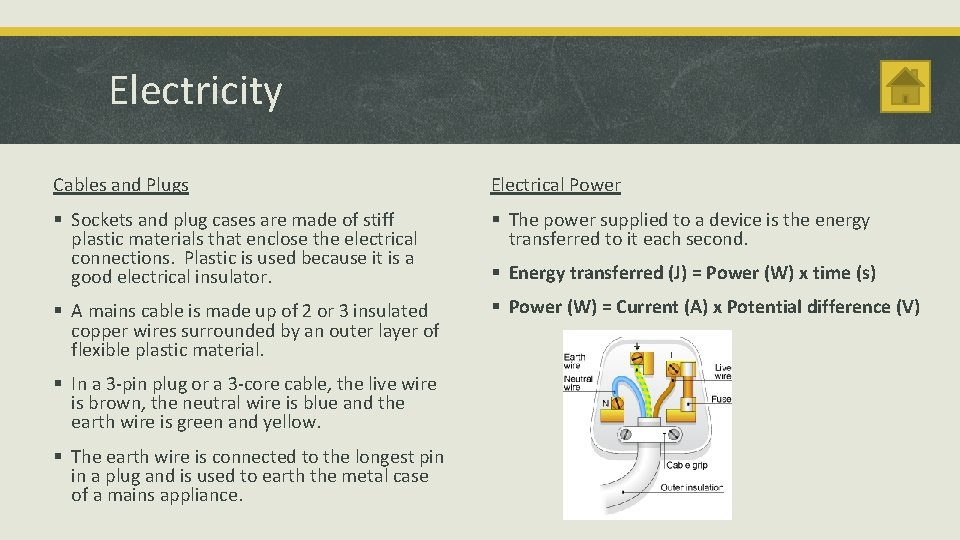
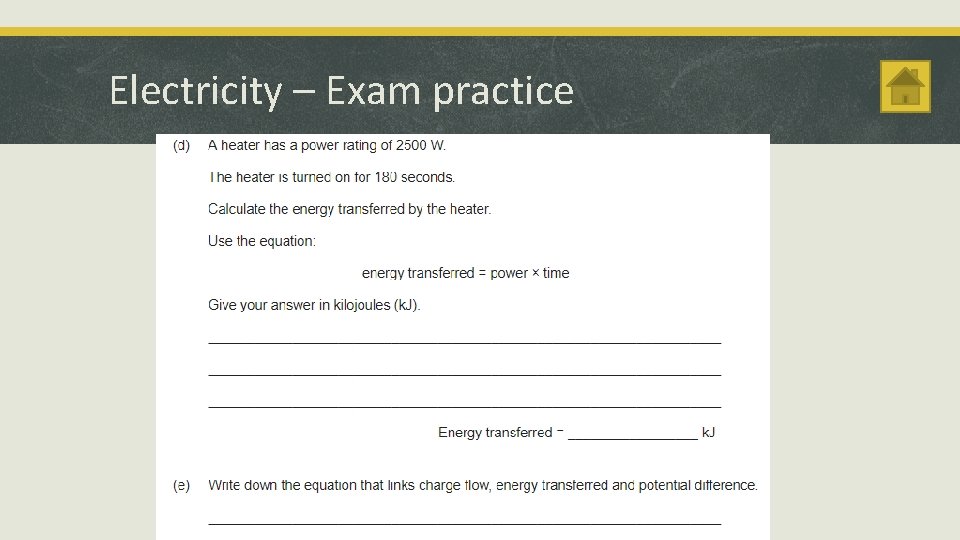
Electricity Cables and Plugs Electrical Power § Sockets and plug cases are made of stiff plastic materials that enclose the electrical connections. Plastic is used because it is a good electrical insulator. § The power supplied to a device is the energy transferred to it each second. § A mains cable is made up of 2 or 3 insulated copper wires surrounded by an outer layer of flexible plastic material. § Power (W) = Current (A) x Potential difference (V) § In a 3 -pin plug or a 3 -core cable, the live wire is brown, the neutral wire is blue and the earth wire is green and yellow. § The earth wire is connected to the longest pin in a plug and is used to earth the metal case of a mains appliance. § Energy transferred (J) = Power (W) x time (s)
Electricity Electrical Currents and Energy Transfer Appliances and Efficiency § Charge flow (C) = Current (A) x Time (s) § A domestic electricity meter measures how much energy is supplied. § When charge flows through a resistor, energy transferred to the resistor makes it hot. § Energy transferred (J) = Potential difference (V) x Charge flow (C) § When charge flows around a circuit for a given time, the energy supplied by the battery is equal to the energy transferred to all the components in the circuit. § Energy transferred (J) = Power (W) x Time (s) § Useful energy used = efficiency x energy supplied
Electricity – Exam practice
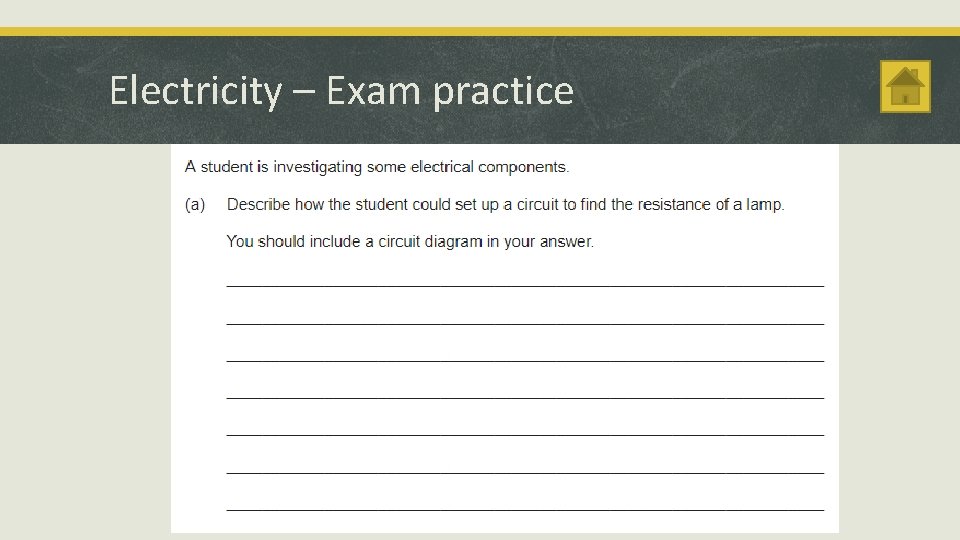
Electricity – Exam practice
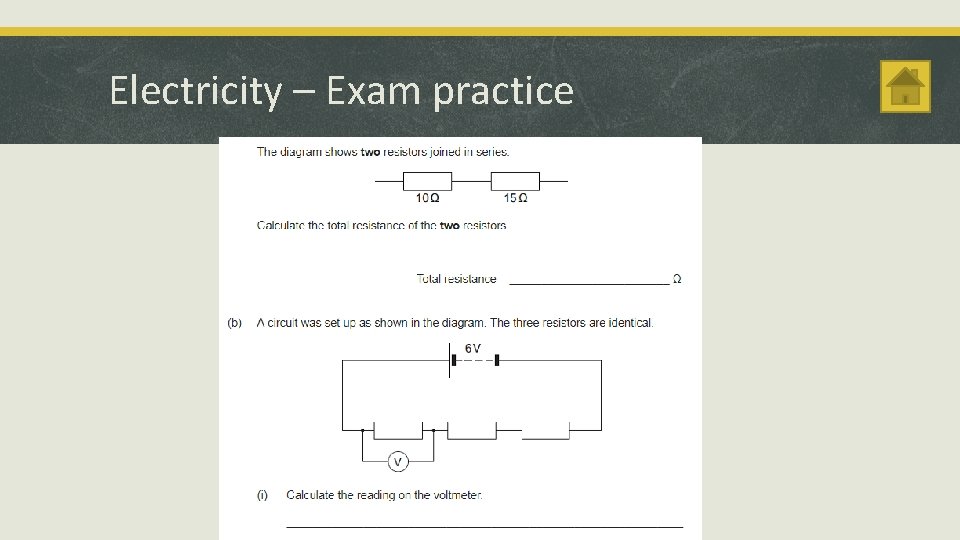
Electricity – Exam practice
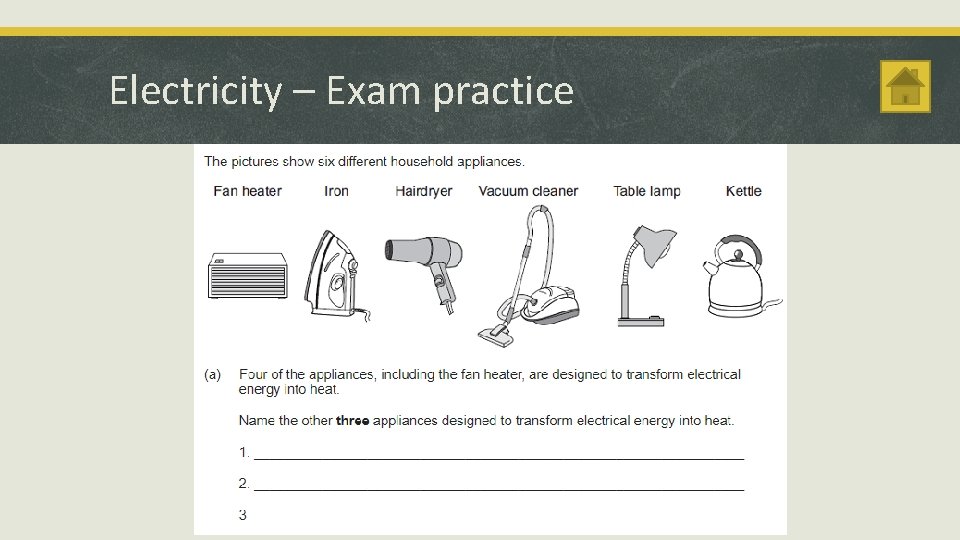
Electricity – Exam practice
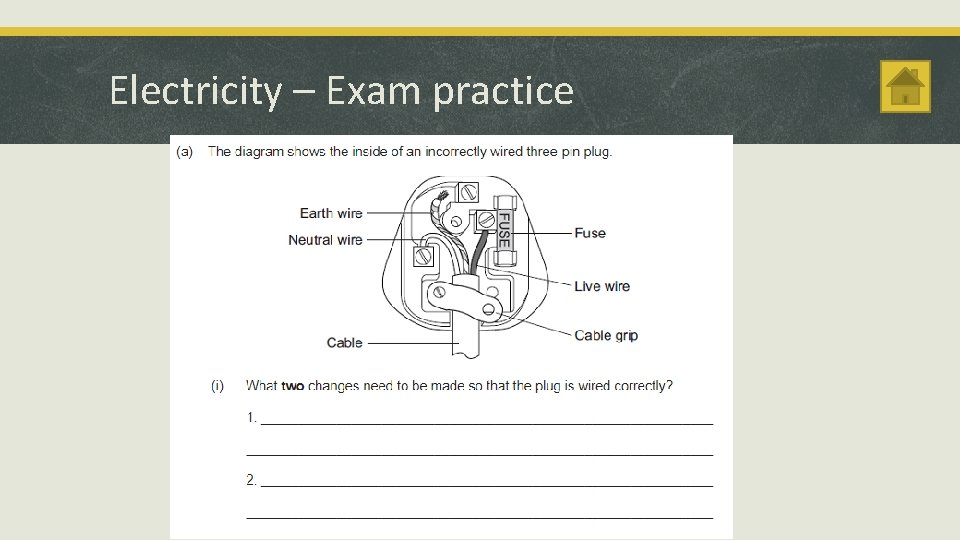
Electricity – Exam practice
Electricity – Exam practice
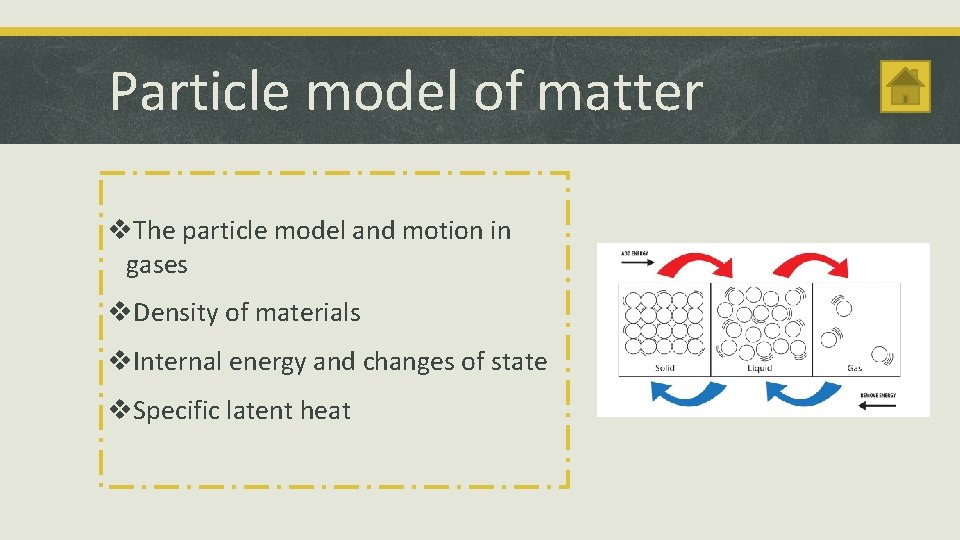
Particle model of matter v. The particle model and motion in gases v. Density of materials v. Internal energy and changes of state v. Specific latent heat
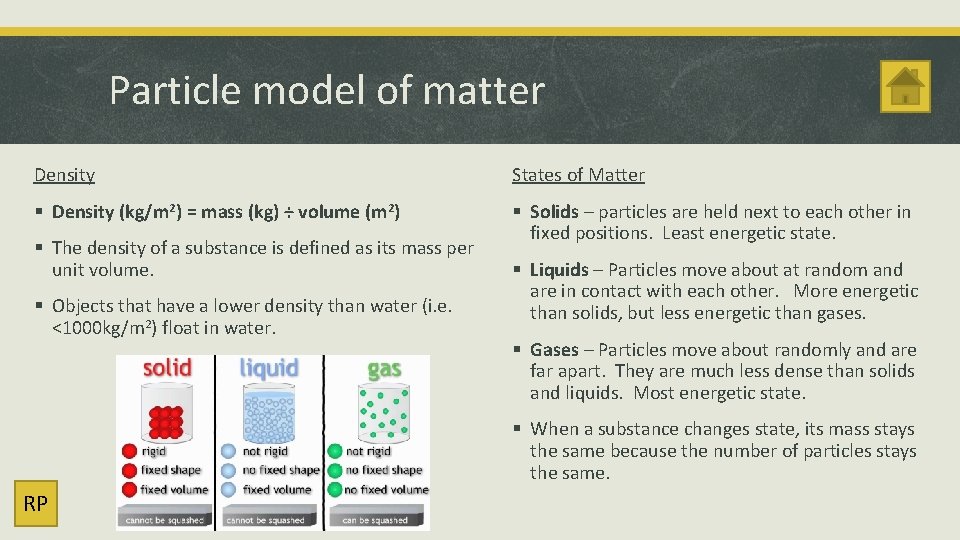
Particle model of matter Density States of Matter § Density (kg/m 2) = mass (kg) ÷ volume (m 2) § Solids – particles are held next to each other in fixed positions. Least energetic state. § The density of a substance is defined as its mass per unit volume. § Objects that have a lower density than water (i. e. <1000 kg/m 2) float in water. § Liquids – Particles move about at random and are in contact with each other. More energetic than solids, but less energetic than gases. § Gases – Particles move about randomly and are far apart. They are much less dense than solids and liquids. Most energetic state. § When a substance changes state, its mass stays the same because the number of particles stays the same. RP
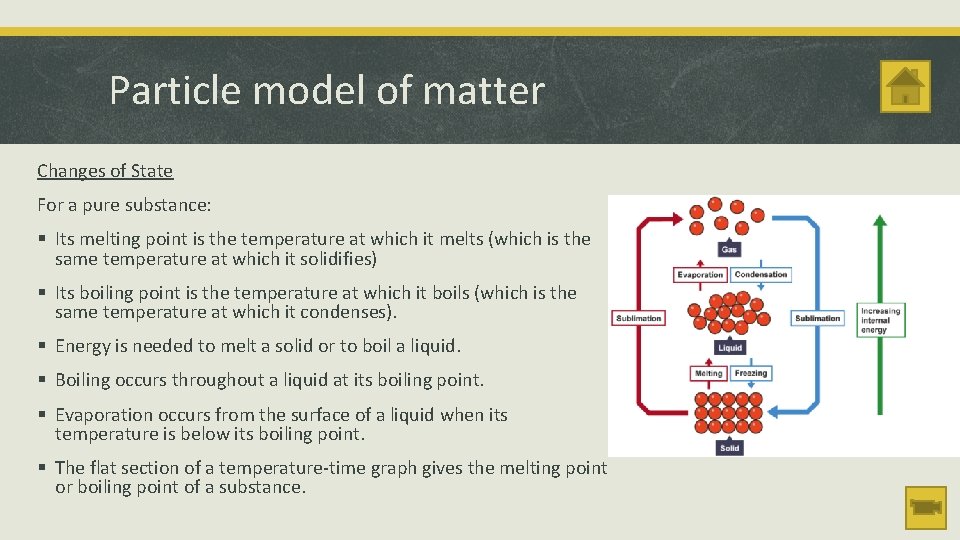
Particle model of matter Changes of State For a pure substance: § Its melting point is the temperature at which it melts (which is the same temperature at which it solidifies) § Its boiling point is the temperature at which it boils (which is the same temperature at which it condenses). § Energy is needed to melt a solid or to boil a liquid. § Boiling occurs throughout a liquid at its boiling point. § Evaporation occurs from the surface of a liquid when its temperature is below its boiling point. § The flat section of a temperature-time graph gives the melting point or boiling point of a substance.
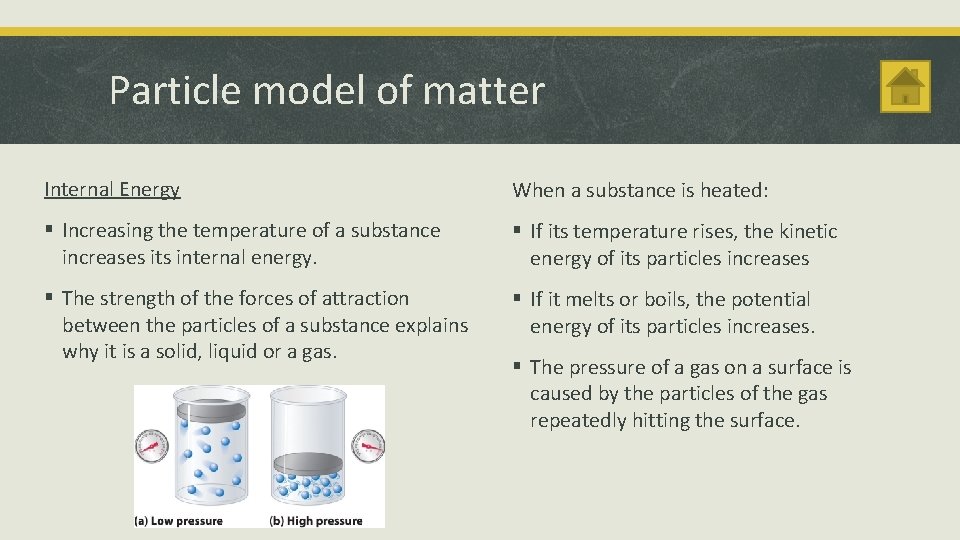
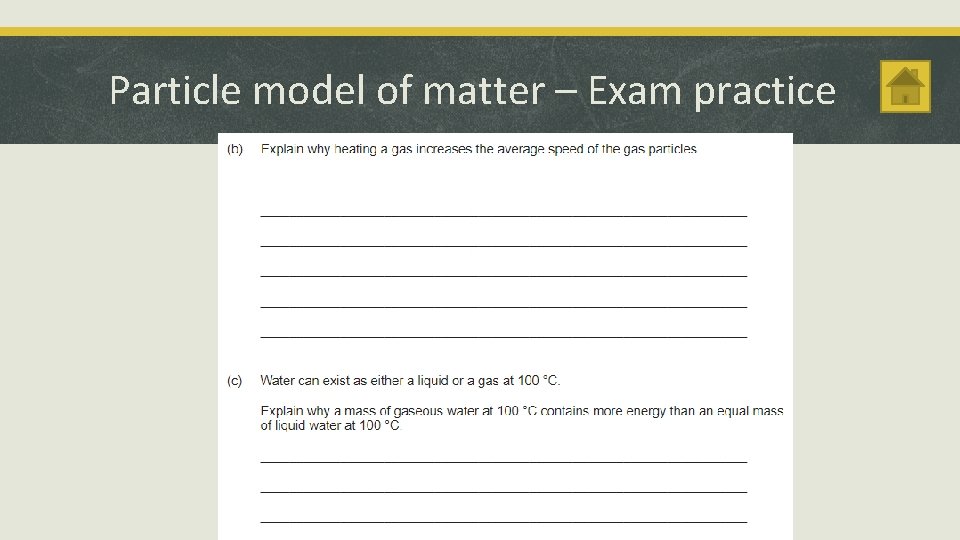
Particle model of matter Internal Energy When a substance is heated: § Increasing the temperature of a substance increases its internal energy. § If its temperature rises, the kinetic energy of its particles increases § The strength of the forces of attraction between the particles of a substance explains why it is a solid, liquid or a gas. § If it melts or boils, the potential energy of its particles increases. § The pressure of a gas on a surface is caused by the particles of the gas repeatedly hitting the surface.
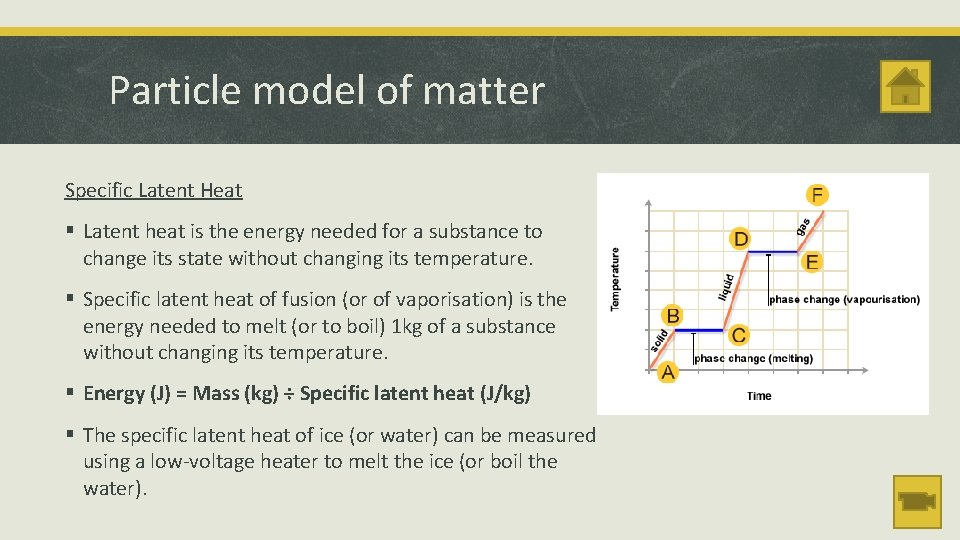
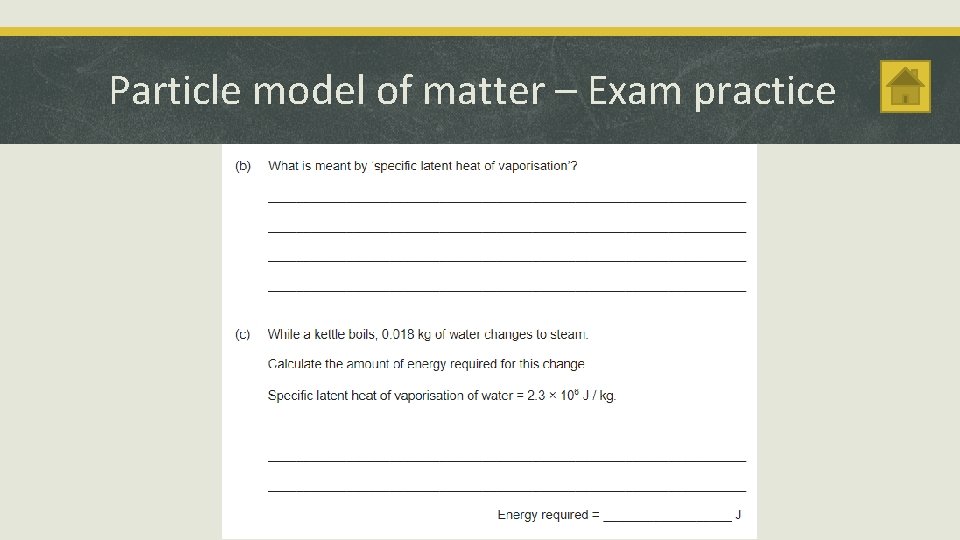
Particle model of matter Specific Latent Heat § Latent heat is the energy needed for a substance to change its state without changing its temperature. § Specific latent heat of fusion (or of vaporisation) is the energy needed to melt (or to boil) 1 kg of a substance without changing its temperature. § Energy (J) = Mass (kg) ÷ Specific latent heat (J/kg) § The specific latent heat of ice (or water) can be measured using a low-voltage heater to melt the ice (or boil the water).
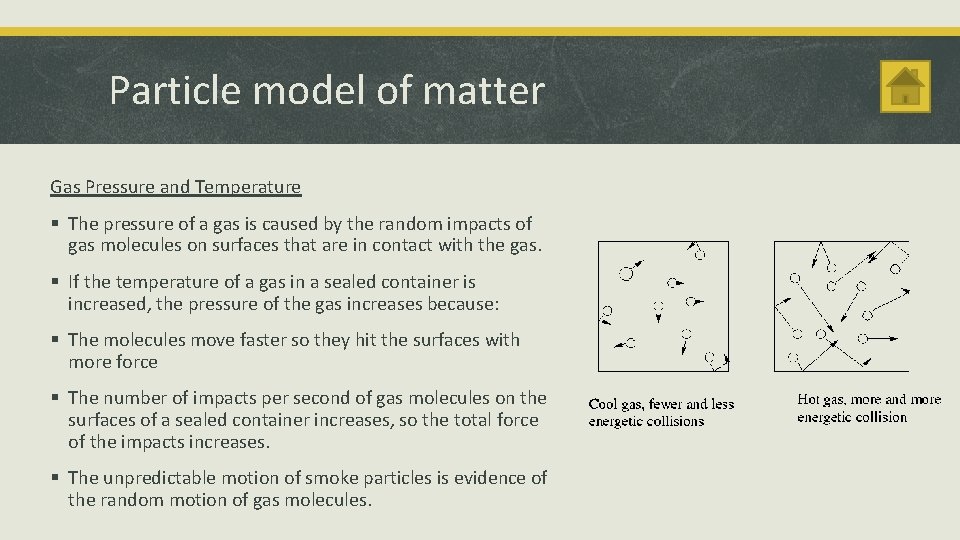
Particle model of matter Gas Pressure and Temperature § The pressure of a gas is caused by the random impacts of gas molecules on surfaces that are in contact with the gas. § If the temperature of a gas in a sealed container is increased, the pressure of the gas increases because: § The molecules move faster so they hit the surfaces with more force § The number of impacts per second of gas molecules on the surfaces of a sealed container increases, so the total force of the impacts increases. § The unpredictable motion of smoke particles is evidence of the random motion of gas molecules.
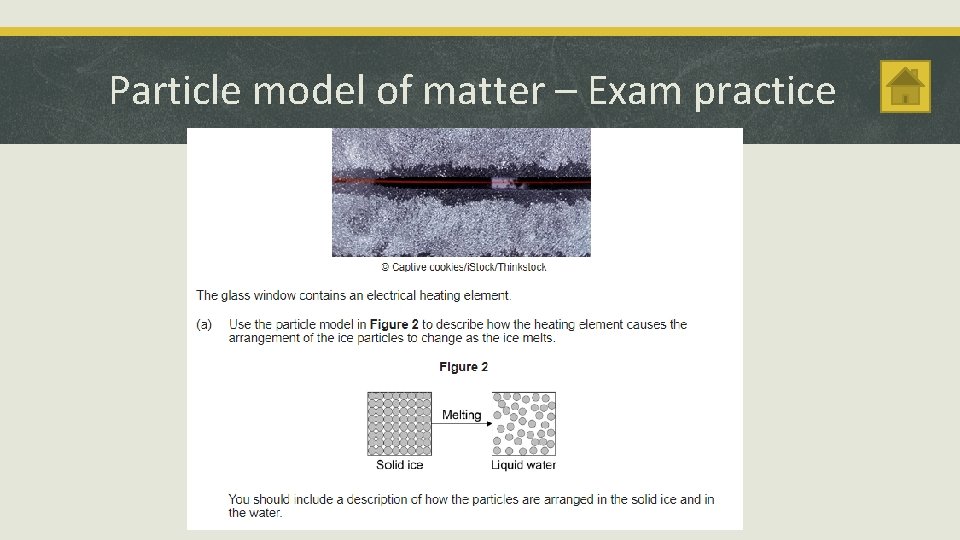
Particle model of matter – Exam practice
Particle model of matter – Exam practice
Particle model of matter – Exam practice
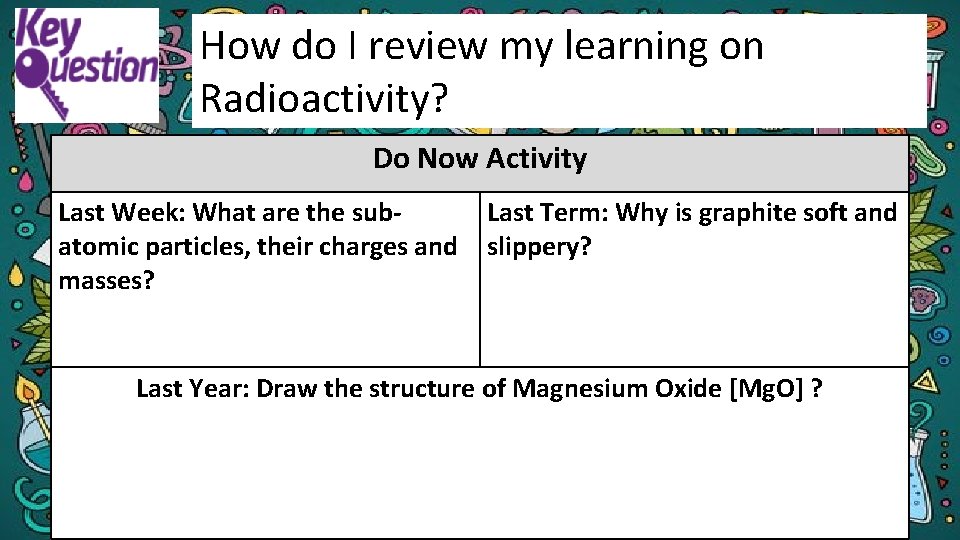
How do I review my learning on Radioactivity? Do Now Activity Last Week: What are the subatomic particles, their charges and masses? Last Term: Why is graphite soft and slippery? Last Year: Draw the structure of Magnesium Oxide [Mg. O] ?
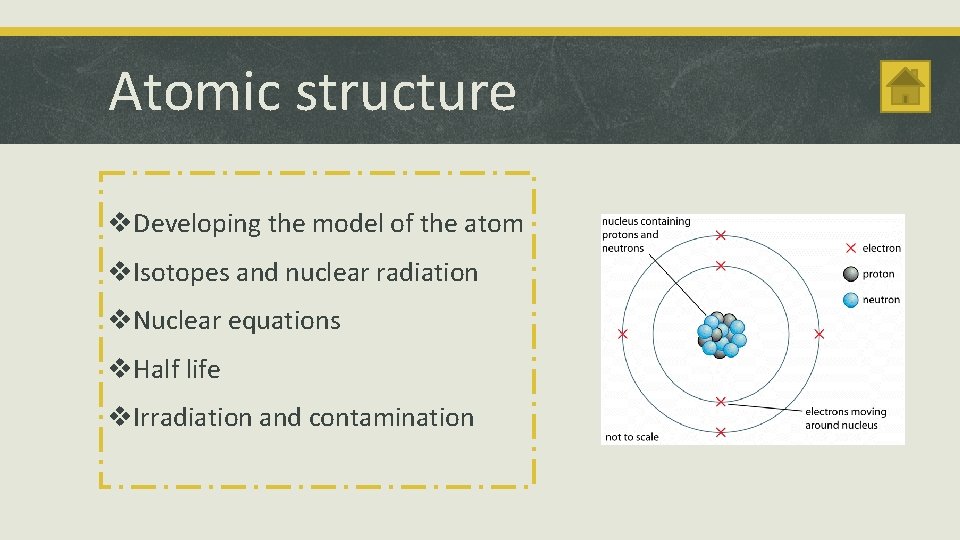
Atomic structure v. Developing the model of the atom v. Isotopes and nuclear radiation v. Nuclear equations v. Half life v. Irradiation and contamination
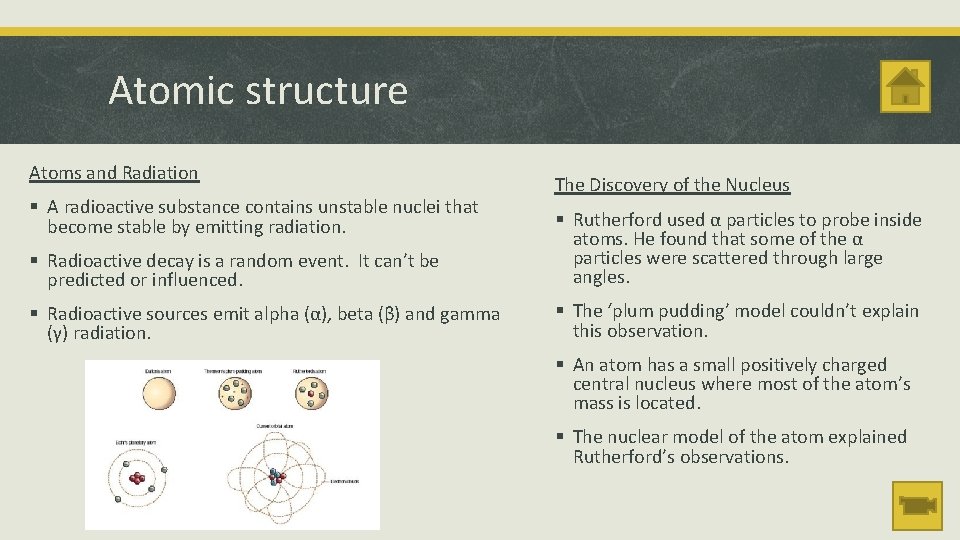
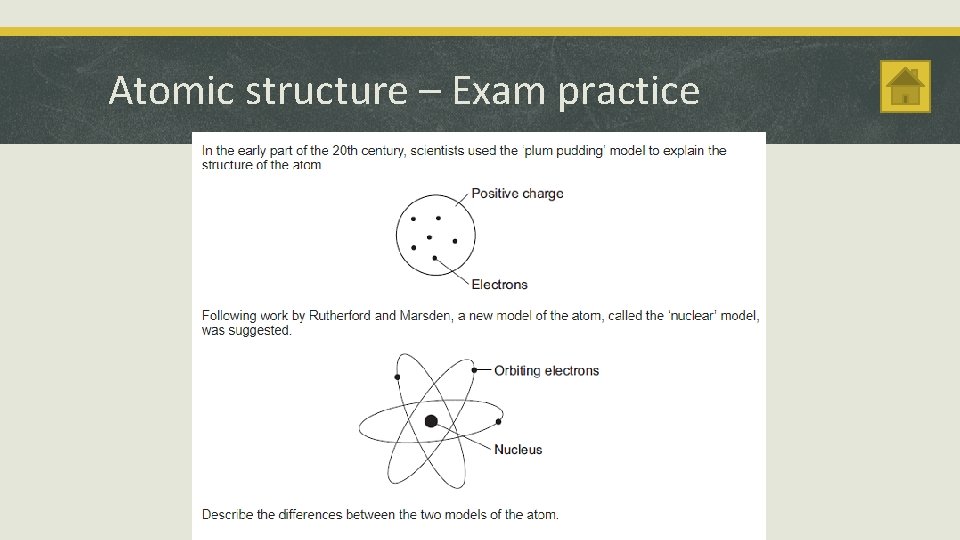
Atomic structure Atoms and Radiation § A radioactive substance contains unstable nuclei that become stable by emitting radiation. The Discovery of the Nucleus § Radioactive decay is a random event. It can’t be predicted or influenced. § Rutherford used α particles to probe inside atoms. He found that some of the α particles were scattered through large angles. § Radioactive sources emit alpha (α), beta (β) and gamma (γ) radiation. § The ‘plum pudding’ model couldn’t explain this observation. § An atom has a small positively charged central nucleus where most of the atom’s mass is located. § The nuclear model of the atom explained Rutherford’s observations.
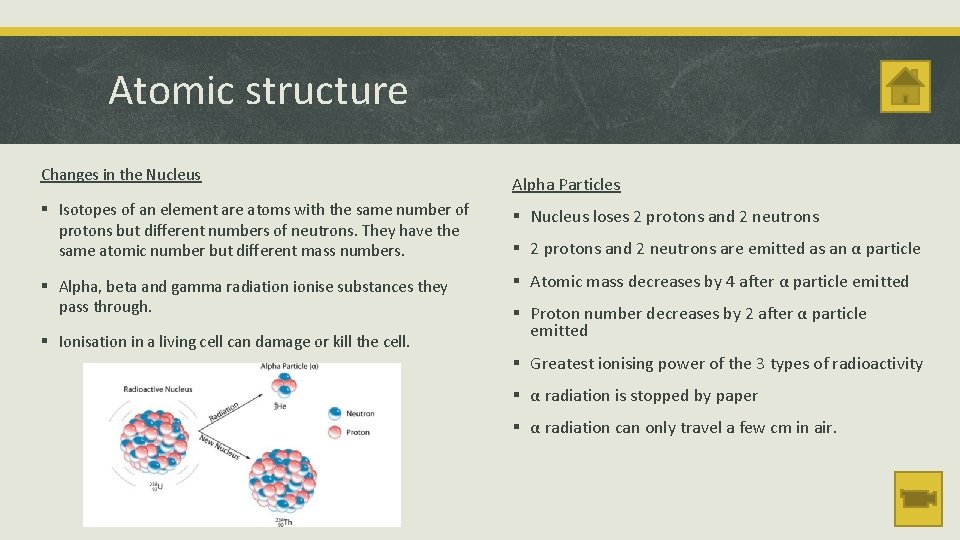
Atomic structure Changes in the Nucleus Alpha Particles § Isotopes of an element are atoms with the same number of protons but different numbers of neutrons. They have the same atomic number but different mass numbers. § Nucleus loses 2 protons and 2 neutrons § Alpha, beta and gamma radiation ionise substances they pass through. § Atomic mass decreases by 4 after α particle emitted § Ionisation in a living cell can damage or kill the cell. § 2 protons and 2 neutrons are emitted as an α particle § Proton number decreases by 2 after α particle emitted § Greatest ionising power of the 3 types of radioactivity § α radiation is stopped by paper § α radiation can only travel a few cm in air.
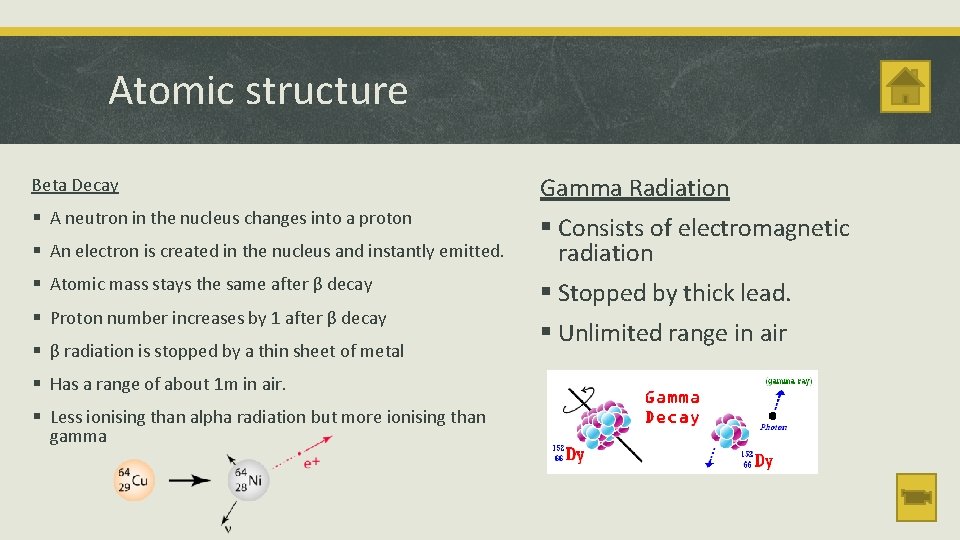
Atomic structure Beta Decay Gamma Radiation § A neutron in the nucleus changes into a proton § Consists of electromagnetic radiation § An electron is created in the nucleus and instantly emitted. § Atomic mass stays the same after β decay § Proton number increases by 1 after β decay § β radiation is stopped by a thin sheet of metal § Has a range of about 1 m in air. § Less ionising than alpha radiation but more ionising than gamma § Stopped by thick lead. § Unlimited range in air
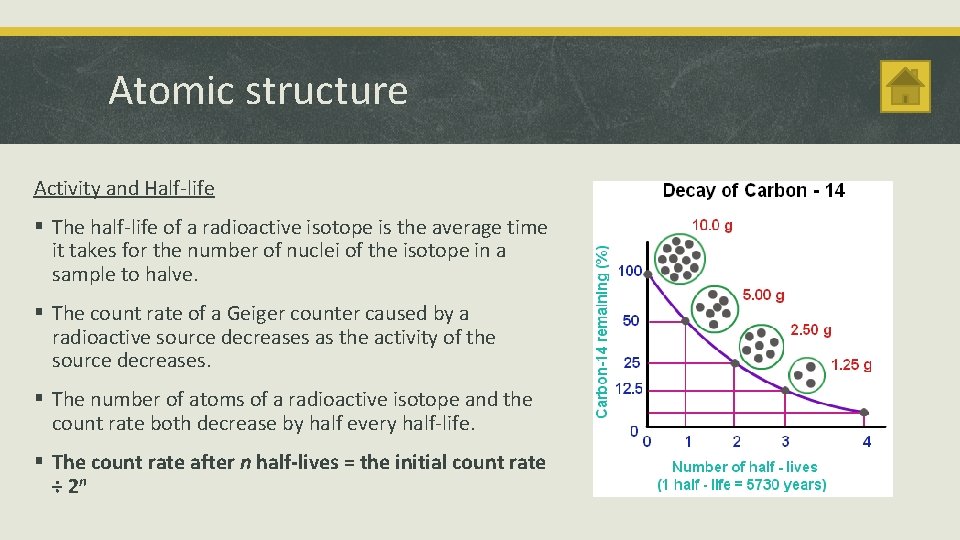
Atomic structure Activity and Half-life § The half-life of a radioactive isotope is the average time it takes for the number of nuclei of the isotope in a sample to halve. § The count rate of a Geiger counter caused by a radioactive source decreases as the activity of the source decreases. § The number of atoms of a radioactive isotope and the count rate both decrease by half every half-life. § The count rate after n half-lives = the initial count rate ÷ 2 n
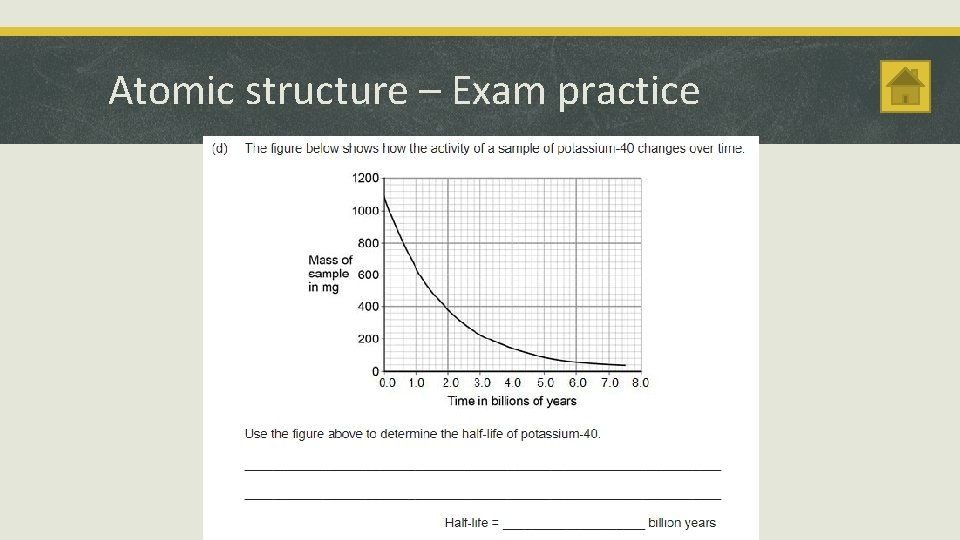
Atomic structure – Exam practice
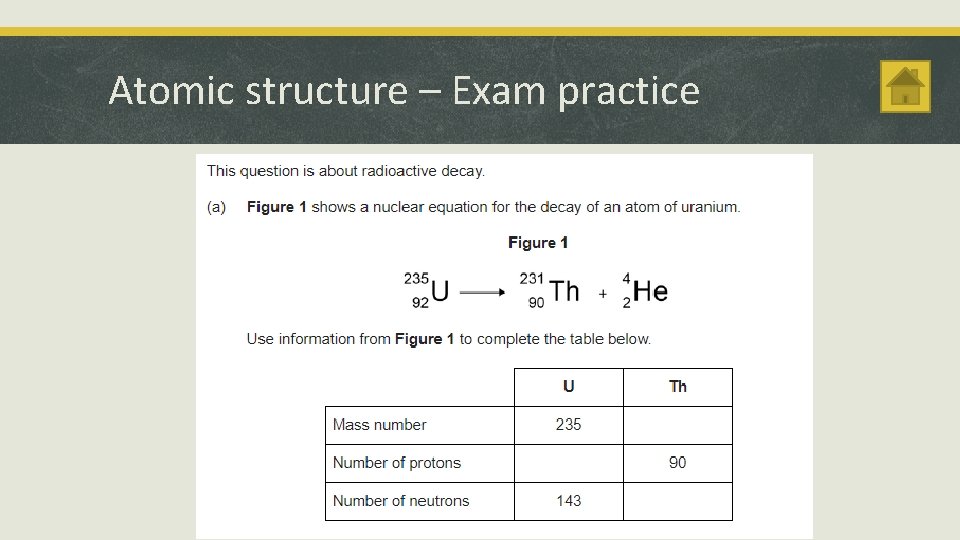
Atomic structure – Exam practice
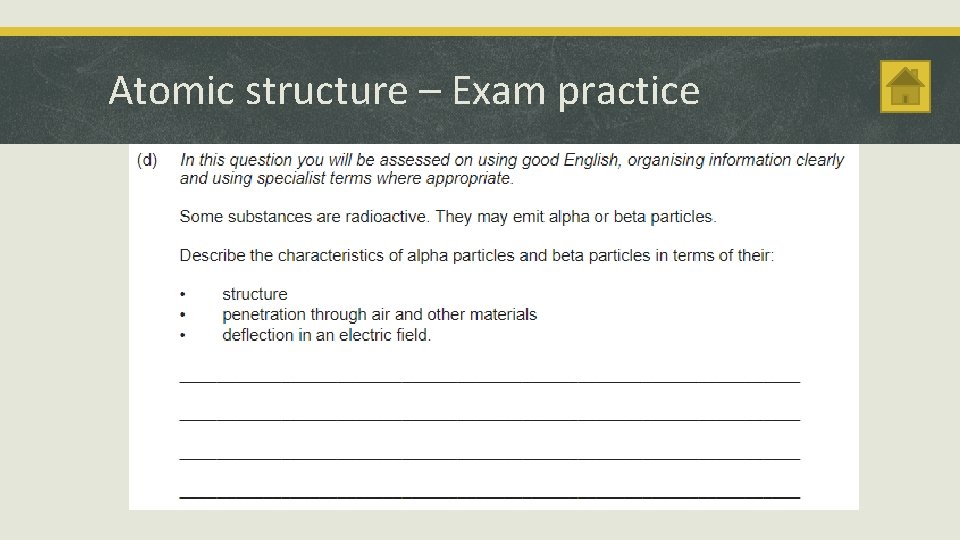
Atomic structure – Exam practice
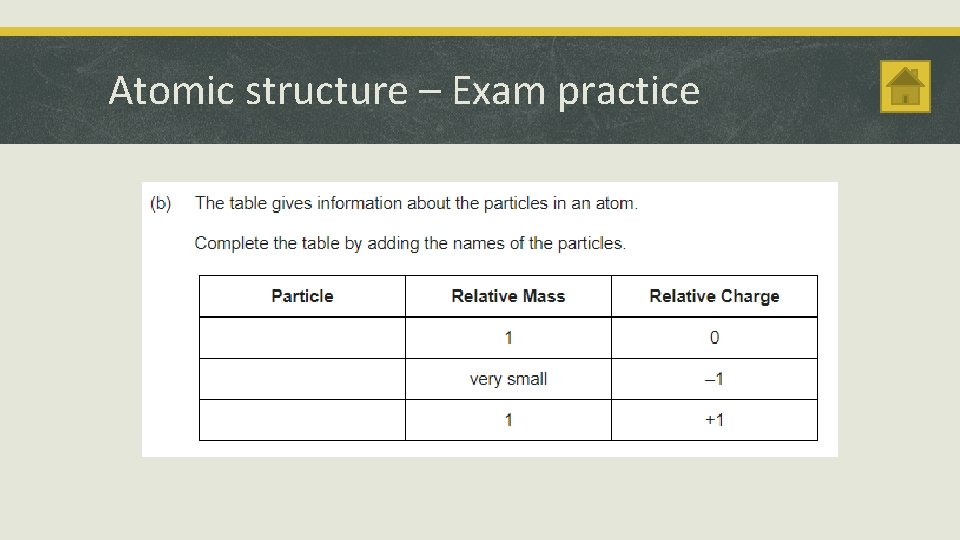
Atomic structure – Exam practice
Atomic structure – Exam practice
- Slides: 57