
AQA A level Design and Technology Product Design
- Slides: 19
AQA A level Design and Technology: Product Design The course is a follow on from the GCSE Design and Technology Course where your specialism has been in hard materials. In order to start the A-level, you be expecting to achieve a grade 6 in GCSE DT, and a Grade 5 in one of your English courses. In the first year, you will cover most of theory required for the exams which you will sit in Y 13 and to help you with theoretical aspects of your design and make project. These theory lessons will be a variety of teacher taught, student led, research, design, presentation, games, scavenger hunts, modelling and practical tasks. Towards the end of year 12, you will work on a ‘substantial’ design and make project – the format of this will be similar to your GCSE DT portfolio but will be a lot more in depth and you will be able to create a context of your own interest. Studying DT at A-level is challenging, but you will be supported in the practical and design elements of the course. You will develop considerably in your ability to respond to a given brief, design, evaluate and create products. To be able to do this, you will need to be prepared to commit to lessons, and complete work to all deadlines, to stay on top of your substantial workload. Below is an indicator of how you will be assessed. Notice that 50% of your A-level comes from the NEA – which is a piece of coursework. This will require a significant amount of commitment from you not just in lessons, but also outside lessons, spending study time in the department, to create work of the highest standard. Assessment: Paper 1 – 30% - mixture of short answer and extended response questions Paper 2 – 20% - designing and making principles NEA project – 50% - design portfolio and a prototype
Product Design – Week 1 Overview If you are thinking about A-level Product Design you should attempt some of this bridging work. It will give you an indication of what some of the work will be like. If you decide Product Design is the right course for you, and you are likely to achieve the entry requirements, you must complete the bridging course and summer work in full before you start Year 12. This week, you will: • read information provided and produce a written statement about the responsibilities of a designer for social, economic and environment issues and what a product footprint is. • research the negative social, economic and environmental impact of cobalt mining in the DRC using information provided and a video to start the research. You will need to investigate why cobalt is required for battery production and if there any current or developing technologies to replace this material. • investigate 2 products which are considered poor for their impact on society, the economy and the environment. • research 2 high profile products which are currently being produced with the mind set of reducing their social, economic and environmental impact. Assessment – students will produce a presentation, in a chosen format, entitled ‘Responsibilities of a Designer’ to present the research tasks from the first 2 weeks of the bridging course. This will be handed in at the start of the A Level course.
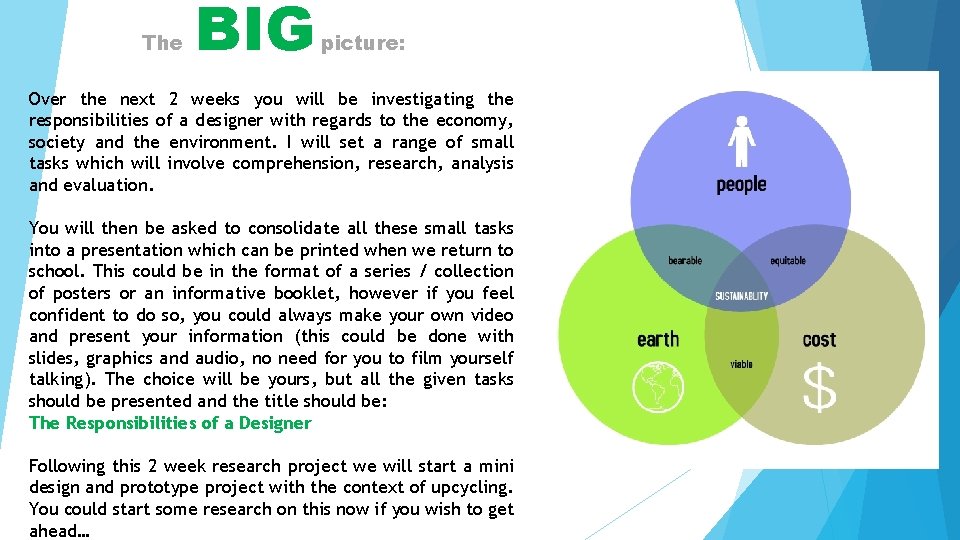
The BIG picture: Over the next 2 weeks you will be investigating the responsibilities of a designer with regards to the economy, society and the environment. I will set a range of small tasks which will involve comprehension, research, analysis and evaluation. You will then be asked to consolidate all these small tasks into a presentation which can be printed when we return to school. This could be in the format of a series / collection of posters or an informative booklet, however if you feel confident to do so, you could always make your own video and present your information (this could be done with slides, graphics and audio, no need for you to film yourself talking). The choice will be yours, but all the given tasks should be presented and the title should be: The Responsibilities of a Designer Following this 2 week research project we will start a mini design and prototype project with the context of upcycling. You could start some research on this now if you wish to get ahead…
The Responsibilities of a Designer: Success Criteria • All tasks, questions and components of the research have been carried out comprehensively, showing a thorough understanding of the topic. • Personal opinions or reflections have been added to showcase your own values and ideas on the topic. • Images, graphics and sketches have been used to help explore the topic and are relevant at all times. • Good levels of spelling, punctuality and grammar are used alongside high quality presentation techniques to deliver a professional presentation of the topic. • The layout of the presentation has been thoroughly considered to support easy interaction, reading and improve engagement of the audience. • Creativity has been shown in the presentation.
The Responsibilities of a Designer: Task 1 Using slides 6 and 7 make notes or a mind map as a starting point for research and investigations into the responsibilities of a designer. I have provided a range of questions which could form part of your investigation. Explore the answers to these and make notes on your findings. It would be good to include some examples where possible of designers or products which help to explore this topic. (remember this information will be presented at the end of the 2 week task, you could present the information in a variety of ways e. g. written statement, fact file, a responsible designer job advert / poster etc) Ø What is responsible design? Ø What does sustainable design mean? NEXT: We will look at how Ø What 3 strands of consideration do responsible designers take into account? material choice must be a Ø Why is it a designers responsibility to consider the 3 strands? consideration for a Ø How might a designer create an irresponsible or unsustainable design? responsible designer… Ø What effects could poor design have on the world? Ø Why might responsible or sustainable design be a positive strategy for a designer to attract customers? Ø Why might irresponsible or unsustainable design have negative effects why trying to attract customers? How could it be seen by the media? Ø Are there any examples of designers or companies who fall on either side of the responsible design debate?
The Responsibilities of a Designer: Responsible & Sustainable Design When discussing sustainability it is often easy to solely think about the environment e. g. energy use, recycling, pollution. However, sustainability and sustainable development is much broader than this, the Brundtland Commission, set up to unite countries to pursue sustainable development together, introduced the concept of sustainable development and has shaped the role and responsibilities of a designer as a result. ‘Development which meets the needs of current generations without compromising the ability of future generations to meet their own needs ’ Brundtland Commission Therefore a responsible designer must not just consider the immediate needs of their user but also ensure that the long term effects of their product are not detrimental to future generations. In order to do this designers must not just evaluate the environmental impact of their products, but also the social and economic effects. (ESE) ‘Designers should define their role broadly as agents of good in the world, and limit their work to legitimate products. This means products that are needed, and those that can be made without damage to nature or – through the unethical actions of manufacturers and investors – damage people’ Phillipe Starck
Environmental, Social and Economic Responsibilities Here is just a tiny example of the huge number of ESE concerns a responsible designer must consider… • Impact of their product on society e. g. Does the product create good quality jobs in safe working conditions? Does it promote communication and interaction? Is the production ethical and does it have a positive impact (think fair trade)? Does the product consider faith, gender, disabilities? • Impact of their product on the environment e. g. Can this product actually reduce the pollution or waste in the world? Can it be carbon neutral? Does the product source and use sustainable materials? Does the product use energy during its life? How is the product disposed of? Can the product be repaired easily? • Impact of their product on the economy e. g. Does it provide skilled jobs? Does the product promote economic growth? Is the product fair trade? Is the product a luxury or an affordable product for all? What long term effect could the product have on the economy over its life cycle? A footprint is a mark left behind by something or someone. Therefore a social footprint of a product is the affect a product has on people and society e. g. socialising, families, war. A designer has a responsibility to consider all aspects of their products footprint.
The Responsibilities of a Designer: Task 2 Create a case study to explore: The use of CT and cobalt in batteries for mobile phones and other battery powered devices and their effect on the environment, society and the economy. Use the information on slides 10 -14 and video provided on slide 14 to give you a short overview of the situation, make notes or mind maps to record your learning. You will then need to conduct your own research to explore and present this example of unsustainable development / design. Things to consider and include: Ø What is CT and cobalt? Why is it used in batteries? How is it sourced? Ø What environmental, social and economic concerns does the use of these materials raise? What affect does it have on current and future generations? Ø Do you believe consumers are fully aware of the impact of the materials used in their battery powered goods? Do you think education would change consumer opinions? Ø Why do big brands continue to use CT and cobalt if they are aware of the issues? Ø How do big brands ‘ethically’ source CT or cobalt? Ø Are their any alternatives to these materials in batteries? Are there any alternatives to batteries? Ø What do you think the designer, manufacturers, raw material producers, consumers, government should do to improve the impact of the use of these materials? Ø Include relevant images and facts to help engage the reader / viewer (use slide 9 to support how to create a case study) NEXT: We look at irresponsible design and also products which are helping sustainable development
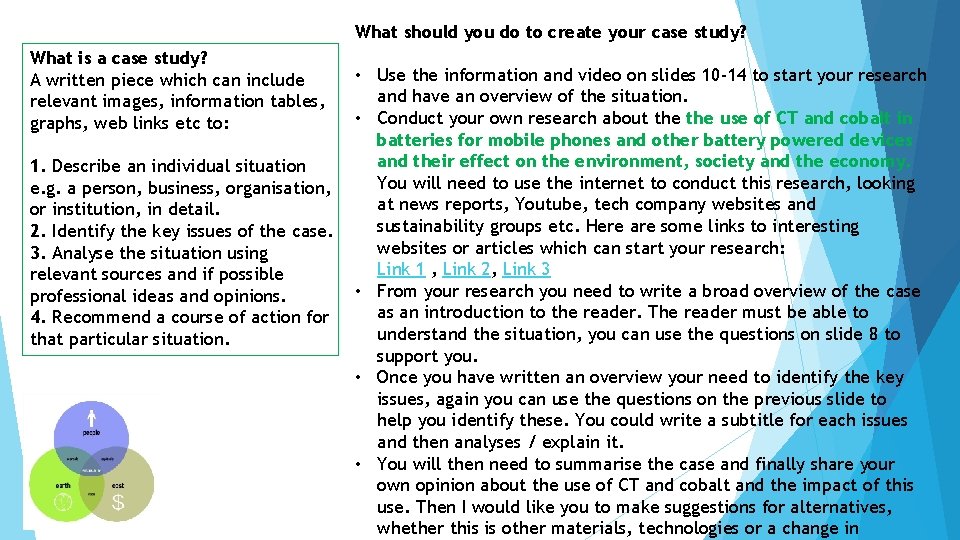
What should you do to create your case study? What is a case study? A written piece which can include relevant images, information tables, graphs, web links etc to: 1. Describe an individual situation e. g. a person, business, organisation, or institution, in detail. 2. Identify the key issues of the case. 3. Analyse the situation using relevant sources and if possible professional ideas and opinions. 4. Recommend a course of action for that particular situation. • Use the information and video on slides 10 -14 to start your research and have an overview of the situation. • Conduct your own research about the use of CT and cobalt in batteries for mobile phones and other battery powered devices and their effect on the environment, society and the economy. You will need to use the internet to conduct this research, looking at news reports, Youtube, tech company websites and sustainability groups etc. Here are some links to interesting websites or articles which can start your research: Link 1 , Link 2, Link 3 • From your research you need to write a broad overview of the case as an introduction to the reader. The reader must be able to understand the situation, you can use the questions on slide 8 to support you. • Once you have written an overview your need to identify the key issues, again you can use the questions on the previous slide to help you identify these. You could write a subtitle for each issues and then analyses / explain it. • You will then need to summarise the case and finally share your own opinion about the use of CT and cobalt and the impact of this use. Then I would like you to make suggestions for alternatives, whether this is other materials, technologies or a change in
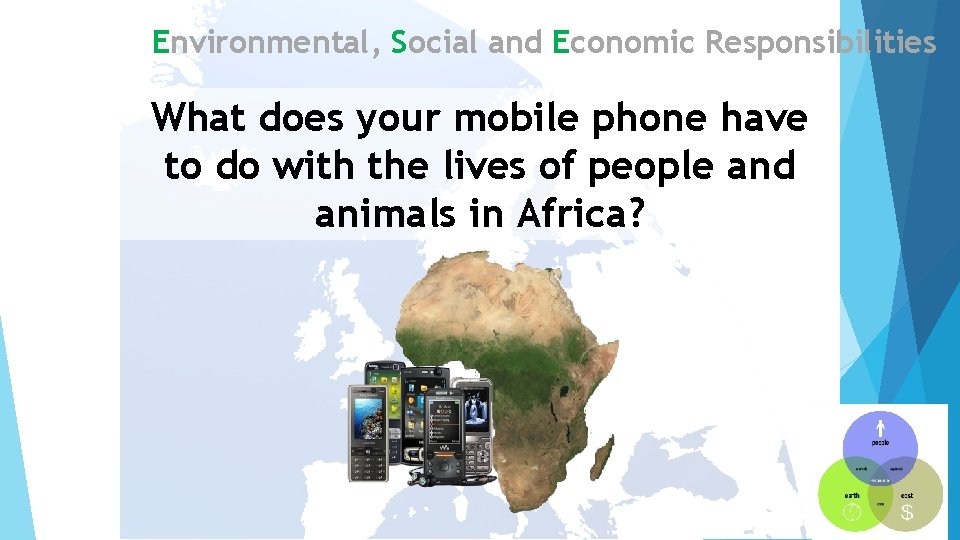
Environmental, Social and Economic Responsibilities What does your mobile phone have to do with the lives of people and animals in Africa?
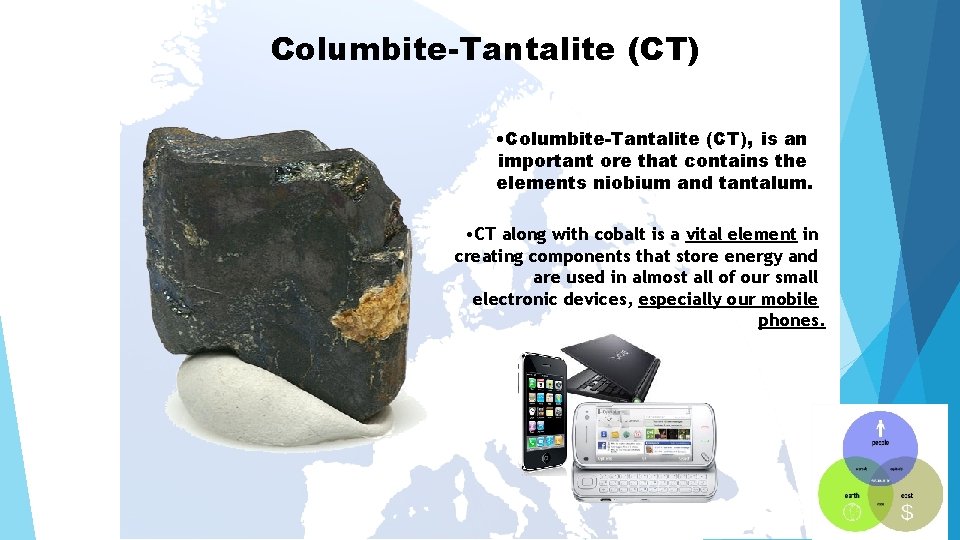
Columbite-Tantalite (CT) • Columbite-Tantalite (CT), is an important ore that contains the elements niobium and tantalum. • CT along with cobalt is a vital element in creating components that store energy and are used in almost all of our small electronic devices, especially our mobile phones.
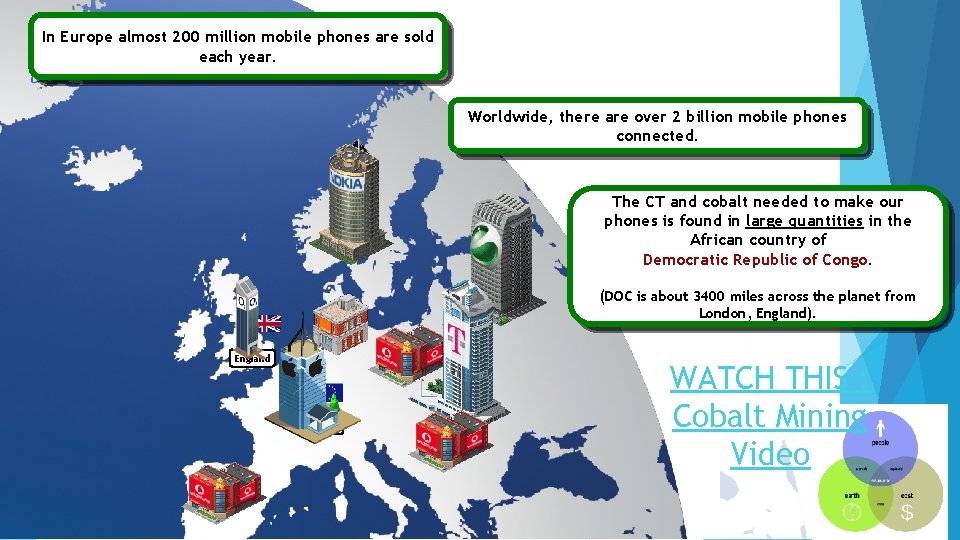
In Europe almost 200 million mobile phones are sold each year. Worldwide, there are over 2 billion mobile phones connected. The CT and cobalt needed to make our phones is found in large quantities in the African country of Democratic Republic of Congo. (DOC is about 3400 miles across the planet from London, England). England Europe WATCH THIS : Cobalt Mining Video
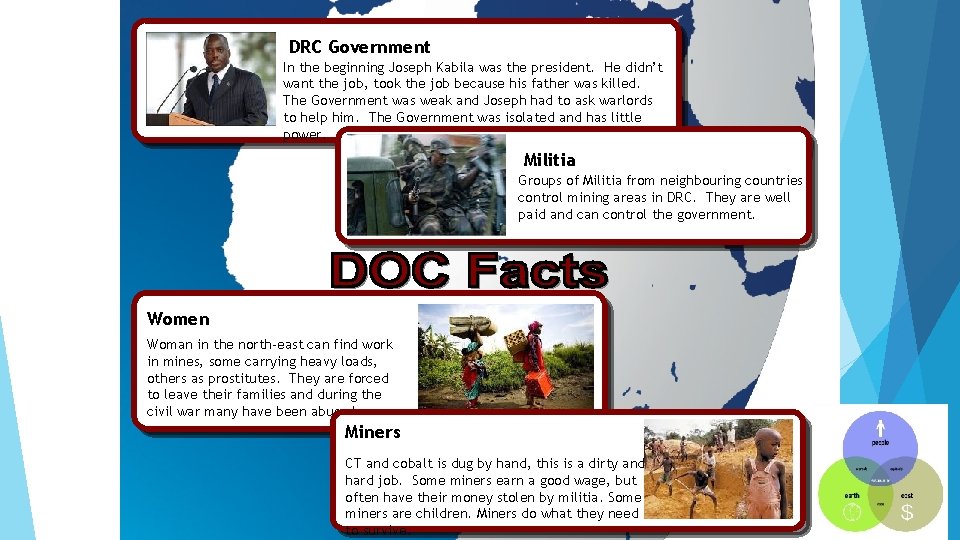
DRC Government In the beginning Joseph Kabila was the president. He didn’t want the job, took the job because his father was killed. The Government was weak and Joseph had to ask warlords to help him. The Government was isolated and has little power. Militia Groups of Militia from neighbouring countries control mining areas in DRC. They are well paid and can control the government. Women Woman in the north-east can find work in mines, some carrying heavy loads, others as prostitutes. They are forced to leave their families and during the civil war many have been abused. Miners CT and cobalt is dug by hand, this is a dirty and hard job. Some miners earn a good wage, but often have their money stolen by militia. Some miners are children. Miners do what they need to survive. DRC
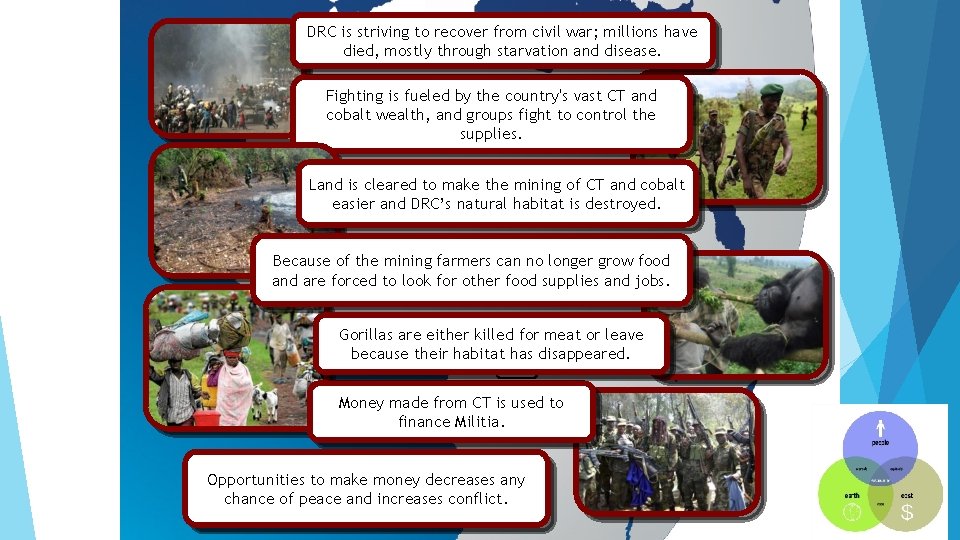
DRC is striving to recover from civil war; millions have died, mostly through starvation and disease. Fighting is fueled by the country's vast CT and cobalt wealth, and groups fight to control the supplies. Land is cleared to make the mining of CT and cobalt easier and DRC’s natural habitat is destroyed. Because of the mining farmers can no longer grow food and are forced to look for other food supplies and jobs. Gorillas are either killed for meat or leave because their habitat has disappeared. DRC Money made from CT is used to finance Militia. Opportunities to make money decreases any chance of peace and increases conflict.
The Responsibilities of a Designer: Task 3 Investigate 2 products or brands which you believe have a negative impact on the environment, the society, the economy or a combination. Give an overview of the product or brand explain how each has a negative impact. Remember to include product images, relevant images which can showcase the products effects and, at the end, your own options and ideas about how each product could improve or lessen their impact. Investigate 2 products or brands which you believe are improving the existing brand’s or product’s suitability qualities or a product which is new and has been responsibly designed and manufactured. The 4 following slides are examples of these which you could further explore or you could find your own. Remember to include product images, relevant images which can showcase the products positive effects and, at the end, your own options and ideas about how other products could adapt these approaches. Here is a web link which shows some less famous / low key products which have been designed to lessen their negative impact… https: //www. demilked. com/clever-eco-friendly-ideas/
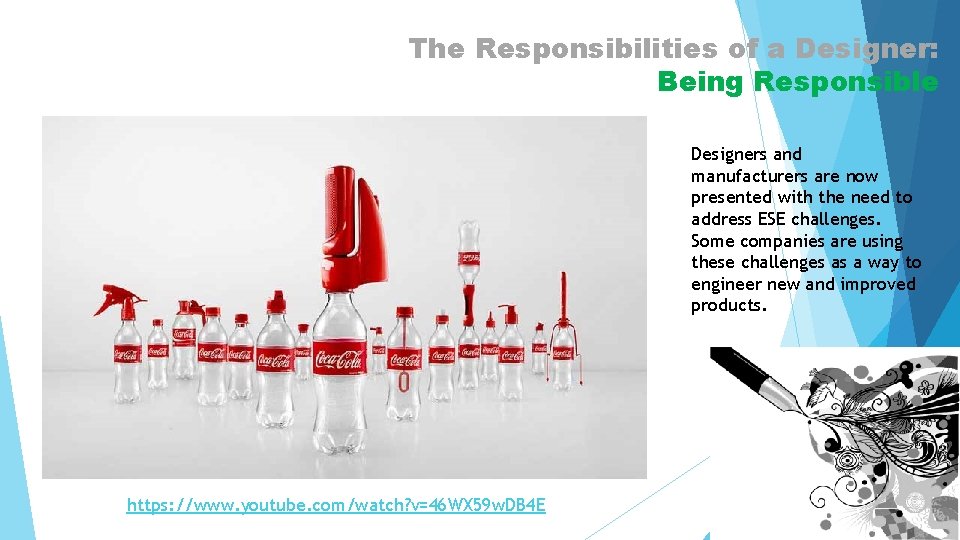
The Responsibilities of a Designer: Being Responsible Designers and manufacturers are now presented with the need to address ESE challenges. Some companies are using these challenges as a way to engineer new and improved products. https: //www. youtube. com/watch? v=46 WX 59 w. DB 4 E
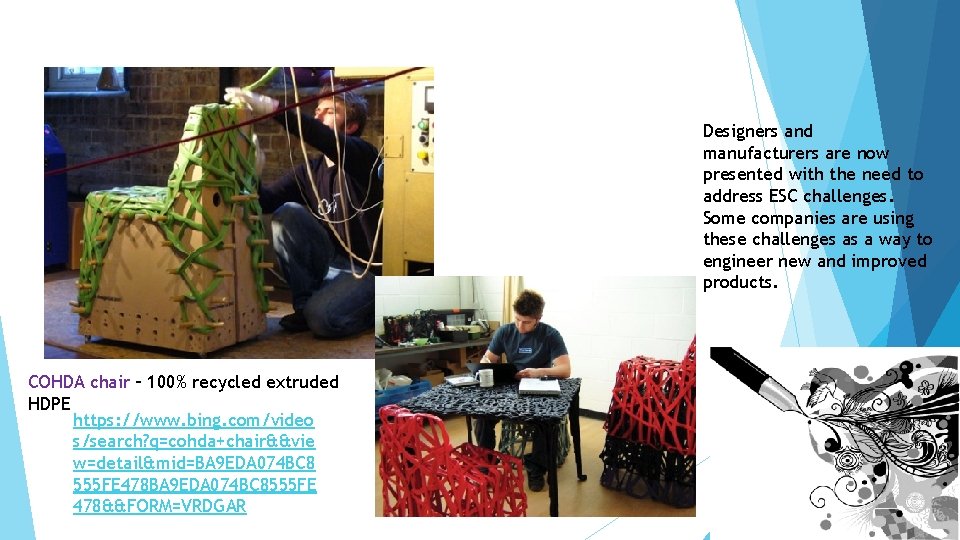
Designers and manufacturers are now presented with the need to address ESC challenges. Some companies are using these challenges as a way to engineer new and improved products. COHDA chair – 100% recycled extruded HDPE https: //www. bing. com/video s/search? q=cohda+chair&&vie w=detail&mid=BA 9 EDA 074 BC 8 555 FE 478 BA 9 EDA 074 BC 8555 FE 478&&FORM=VRDGAR
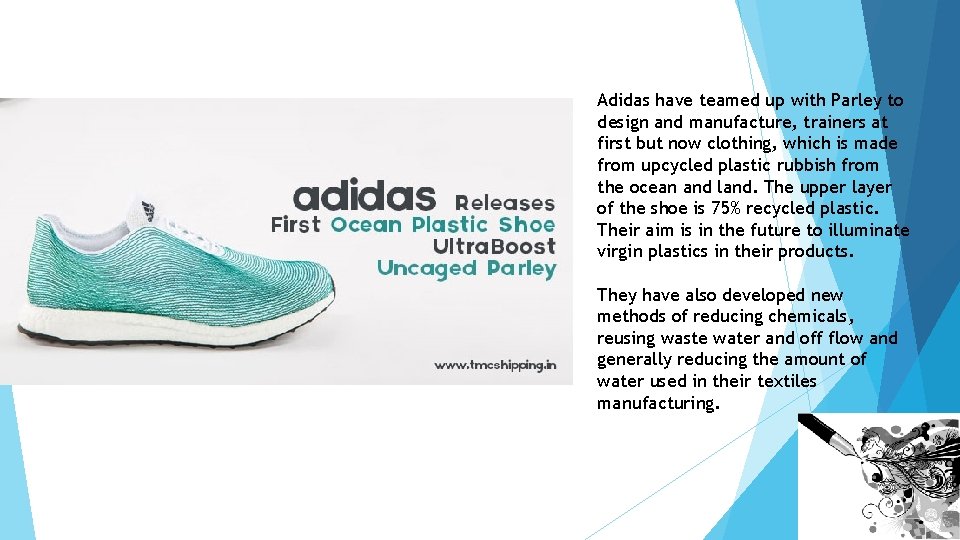
Adidas have teamed up with Parley to design and manufacture, trainers at first but now clothing, which is made from upcycled plastic rubbish from the ocean and land. The upper layer of the shoe is 75% recycled plastic. Their aim is in the future to illuminate virgin plastics in their products. They have also developed new methods of reducing chemicals, reusing waste water and off flow and generally reducing the amount of water used in their textiles manufacturing.
Fairtrade is about better prices, decent working conditions, local sustainability, and fair terms of trade for farmers and workers in the developing world. By requiring companies to pay sustainable prices (which must never fall lower than the market price), Fairtrade addresses the injustices of conventional trade, which traditionally discriminates against the poorest, weakest producers. It enables them to improve their position and have more control over their lives.