
APUSH PERIOD 9 RETURN TO CONSERVATIVES Conservative beliefs

APUSH PERIOD 9
RETURN TO CONSERVATIVES ➤ “Conservative beliefs regarding the need for traditional social values and a reduced role for government advanced in U. S. politics after 1980. ” ➤ Reagan’s 1980 election victory a milestone (watershed election)➤ Because of the return to conservative values = tax cuts for rich and probusiness ➤ Conservatives enacted: ➤ Tax cuts: ➤ ➤ “Reaganomics, ” “supply-side, ” or “trickle-down” economics ➤ Tax cuts for wealthy in order to stimulate economic growth ➤ Rates were cut in the 1980 s ➤ Similar to tax policies of the 1920 s under Secretary of Treasury Andrew Mellon Deregulation of many industries: ➤ Reagan promised in his campaign to decrease environmental regulations
RESISTANCE TO CONSERVATIVES ➤ B. Conservatives sought to limit liberal programs, but met liberal opposition because: ➤ Many programs remained popular with voters ➤ Social Security, Medicare
PERIOD 9 POLICIES ➤ C. Policy debates occurred regarding: ➤ Free-Trade agreements: ➤ North American Free Trade Agreement (NAFTA) ➤ ➤ ➤ Seattle World Trade Organization Protests (1999) Scope of the government social safety net: ➤ ➤ No tariffs on goods made/traded between America, Canada, and Mexico Welfare Reform (1996) ➤ Some viewed the public became too dependent on government assistance ➤ Instituted time limits on welfare assistance, increased eligibility requirements Calls to reform the U. S. financial system: ➤ Finance Reform - Financial Services Modernization Act - repealed parts of the Glass-Steagall Act (New Deal)
AMERICAN GLOBALIZATION American participation in worldwide economic opportunities increases (Globalization) Economic productivity increased Digital communications increased Computers, email, phones, etc. connected the world instantly
INNOVATION CHANGES Impact of technological innovations? Increased access to information: Many print newspapers shut down and are being replaced New social behaviors and networks C. Increase of service sector employment, decrease in manufacturing and union membership declined Rust Belt - Northern cities that lost manufacturing jobs Detroit, Cleveland
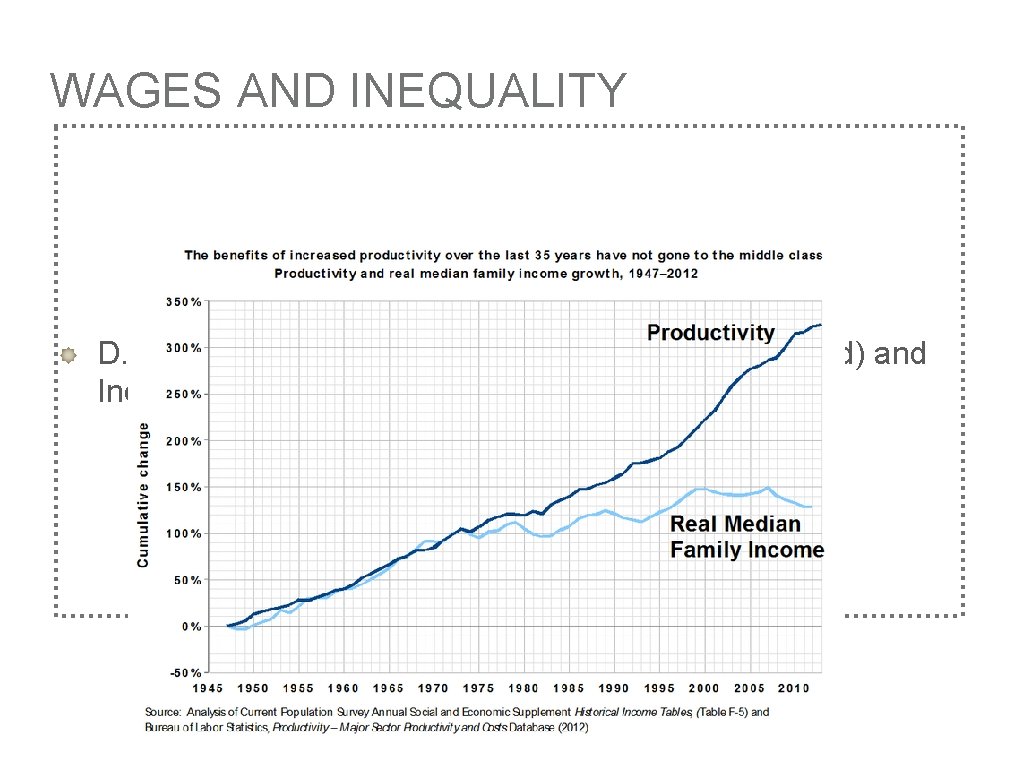
WAGES AND INEQUALITY D. Economy in post 1980: Wages stagnated (stopped) and Increase in economic inequality
POPULATION CHANGE A: Population growth in the South and West post 1980 (Sunbelt)… Who looses pop? Increase influence politically, economically, and culturally More representation in the House, more businesses
IMMIGRATION & DEBATES Immigration Latin America and Asia increased drastically Traditionally underrepresented groups Result of 1965 Immigration Act Helped supply the US with an important labor force Political debates continued over immigration policy, diversity, gender roles, and family structures: Immigration Reform and Control Act of 1986 Penalties for employers that hire illegal immigrants Don’t Ask, Don’t Tell - banned openly gay individuals from serving in the military Overturned under Obama’s Administration
REGAN ADMINISTRATION ➤ Reagan asserts US opposition to communism ➤ Speeches - “Mr. Gorbachev, tear down this wall”; “Evil Empire” ➤ Limited military interventions - overthrow of the government in Grenada ➤ Buildup of nuclear and conventional weapons - ICBMs, Strategic Defense Initiative - “Star Wars”
END OF THE COLD WAR ➤ Factors ending the cold war ➤ Increased ➤ Buildup ➤ Reagan’s U. S. military spending of ICBMs diplomatic initiatives ➤ Relationship ➤ Political and economic issues in Eastern Europe and Soviet Union ➤ Gorbachev’s ➤ Overall ➤ New with Mikhail Gorbachev glasnost and perestroika impacts of the end of the Cold War diplomatic relationships - expansion of NATO ➤ Peacekeeping ➤ Debates interventions - Iraq in 1991, bombings in the Federal Republic of Yugoslavia over America’s role in the world – How does it change pre and post WWII
FIGHTING TERRORISM POST 9/11 ➤ Attacks ➤ Al on 9/11 Qaida led attack on US - World Trade Center, Pentagon, and in PA ➤ Conflict in Afghanistan ➤ Response ➤ Conflict to the Taliban holding Osama bin Laden -> lengthy conflict in Iraq ➤ US-led conflict against Saddam Hussein -> suspected WMDs and connections to terrorism
WAR ON TERROR IMPACTS ➤ Impacts of the war on terror- ➤ Hoped to improve security in the US ➤ Raised questions about protection of civil liberties and human rights ➤ Civil Liberties - Patriot Act, increases power of the federal government to wiretap without warrant ➤ “Roving wiretap” - focuses on the person, not the device ➤ Edward Snowden
ENVIRONMENTAL PROTECTIONS ➤ Debates over fossil fuels and environmental impacts: ➤ ➤ Caused by: ➤ Conflict in the Middle East - 1 st Gulf War - 1991 ➤ Concerns about Climate Change - An Inconvenient Truth US continued as the world’s leading superpower despite economic and foreign policy challenges
PERIOD 9 TOPICS • Goals of conservatives • NAFTA and debates over free trade • Debates over scope and size of government • Impact of technology • Demographic changes - Sun Belt, Rust Belt • Economy since 1980 • US-Soviet Relations - especially with Gorbachev • US in the post-Cold War world
QUESTIONS TO KNOW 1. How has the economy changed since 1980? 2. What are the impacts of internal migration and immigrants on the US? 3. What changes occurred in the economy as a result of Reagan’s election in 1980? 4. Over what issues did conservatives and liberals debate? 5. How did Ronald Reagan interact with the Soviet Union in the 1980 s? 6. What led to the “war on terror” and what were its impacts domestically as well as internationally?
- Slides: 16