
Apuntes el 2 de noviembre Verb Conjugation When
Apuntes el 2 de noviembre Verb Conjugation When you conjugate a verb, you change the infinitive so that it shows who is doing the action. The ending of a verb tells who is doing the action.
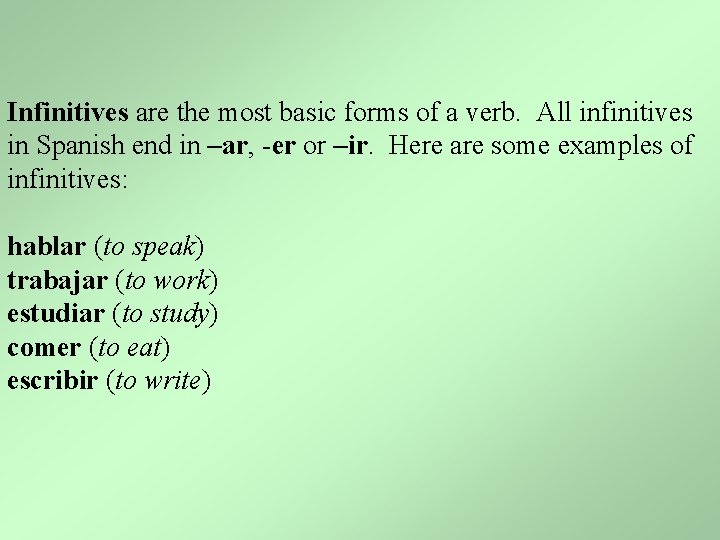
Infinitives are the most basic forms of a verb. All infinitives in Spanish end in –ar, -er or –ir. Here are some examples of infinitives: hablar (to speak) trabajar (to work) estudiar (to study) comer (to eat) escribir (to write)
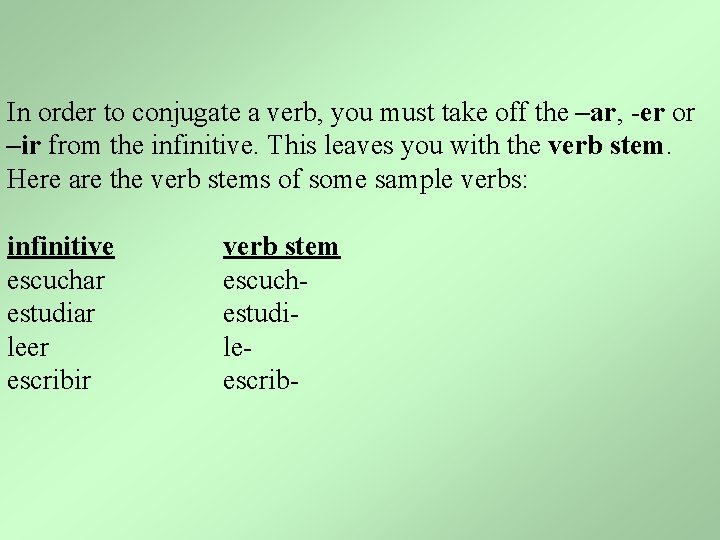
In order to conjugate a verb, you must take off the –ar, -er or –ir from the infinitive. This leaves you with the verb stem. Here are the verb stems of some sample verbs: infinitive verb stem escuchar escuchestudiar estudileer leescribir escrib

You complete the conjugation by adding the appropriate ending. The endings for regular verbs that end in –ar are as follows: Subject Verb ending yo -o tú -as Ud. , él/ella -a nosotros/as -amos vosotros/as -áis Uds. , ellos/as -an
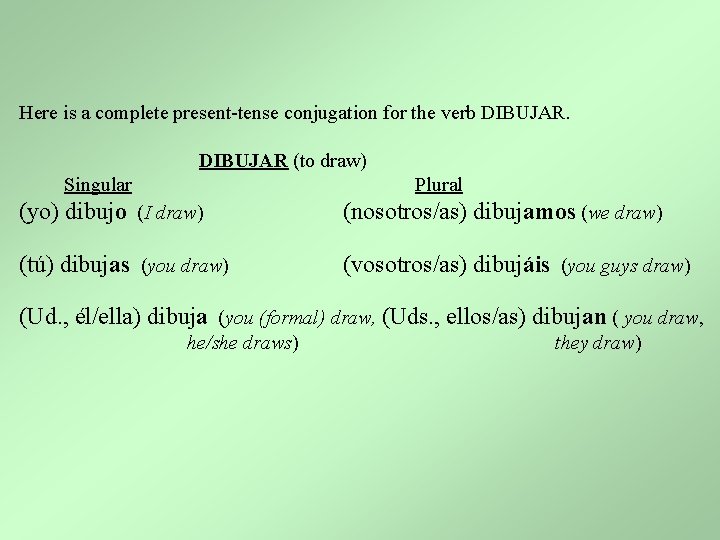
Here is a complete present-tense conjugation for the verb DIBUJAR (to draw) Singular Plural (yo) dibujo (I draw) (nosotros/as) dibujamos (we draw) (tú) dibujas (you draw) (vosotros/as) dibujáis (you guys draw) (Ud. , él/ella) dibuja (you (formal) draw, (Uds. , ellos/as) dibujan ( you draw, he/she draws) they draw)

When making a sentence, you change the ending to say who is doing the action. The subject pronoun is optional. (Yo) dibujo en la clase de arte. (I draw in art class. ) ¿Dibujan (ellos) en la clase de arte? (Do they draw in art class? )
To make a sentence negative, put a no in front of the verb. (Nosotros) no dibujamos en la clase de arte. (We don’t draw in art class. )
- Slides: 7