
APS Bridge Program and National Mentoring Community 29
APS Bridge Program and National Mentoring Community 29 August 2015 Arlene Modeste Knowles American Physical Society Diversity Programs Administrator knowles@aps. org
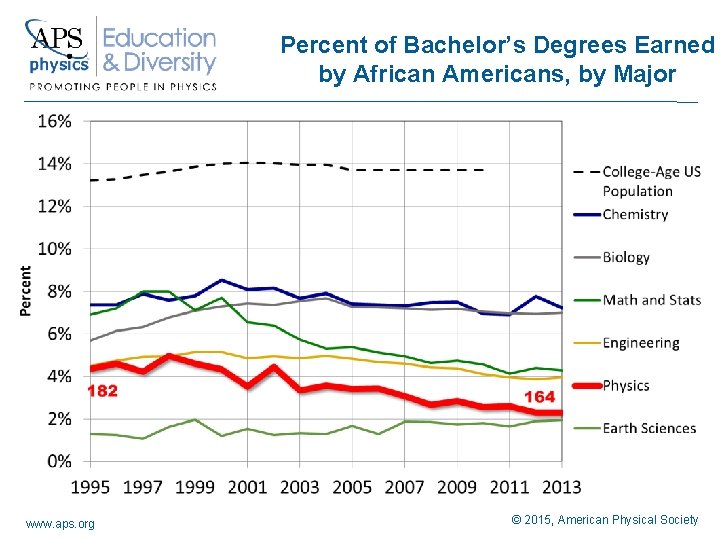
Percent of Bachelor’s Degrees Earned by African Americans, by Major www. aps. org © 2015, American Physical Society
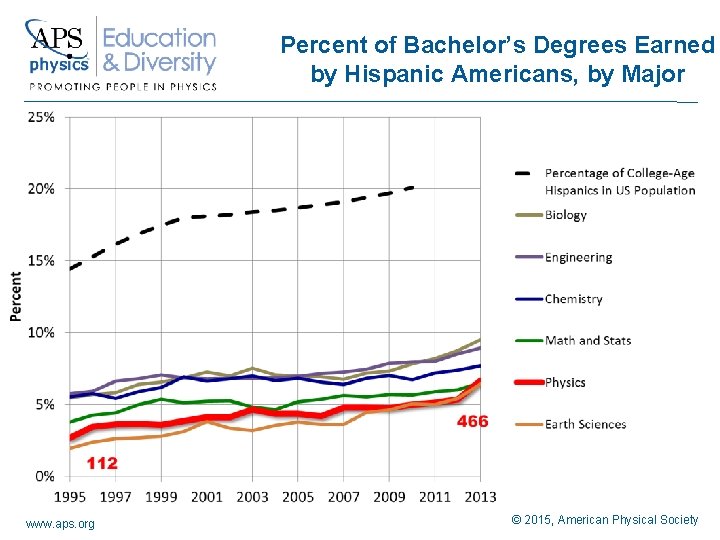
Percent of Bachelor’s Degrees Earned by Hispanic Americans, by Major www. aps. org © 2015, American Physical Society
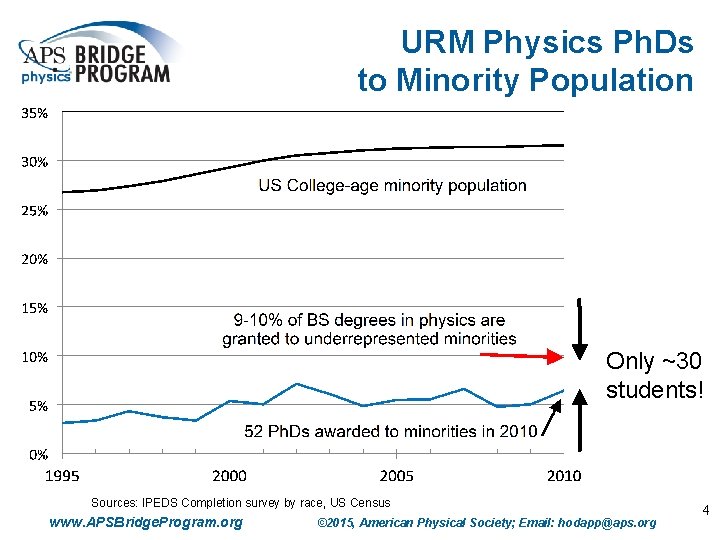
URM Physics Ph. Ds to Minority Population Only ~30 students! Sources: IPEDS Completion survey by race, US Census www. APSBridge. Program. org © 2015, American Physical Society; Email: hodapp@aps. org 4
APS Bridge Program: Project Goals • Increase, within a decade, the percentage of physics Ph. Ds awarded to underrepresented minority students to match the percentage of physics Bachelor’s degrees granted to these groups • Develop, evaluate, and document sustainable model bridging experiences that improve the access to and culture of graduate education for all students, with emphasis on those underrepresented in doctoral programs in physics • Promote and disseminate successful program components to the physics community www. APSBridge. Program. org © 2015, American Physical Society; Email: hodapp@aps. org 5
What is the APS Bridge Program? APS is working with physics graduate degree granting institutions to develop bridge programs for students who have the talent and drive to earn a Ph. D in physics, but lack certain skills to successfully matriculate into a Physics Ph. D program. www. APSBridge. Program. org © 2015, American Physical Society; Email: hodapp@aps. org 6
Bridge Sites: Key Components • Admission decisions (criteria, process) • Financial support (timing, amount) • Coursework (induction advising critical) • Multiple Mentoring (timing, intervention) • Progress monitoring (coursework, tutors if needed) • Community (induction, socialization) • Research (appropriate match) • Transition to Ph. D www. APSBridge. Program. org © 2015, American Physical Society; Email: hodapp@aps. org 7
Bridge Programs in Physics APS Sites : • Cal State Long Beach • Florida State University • The Ohio State University • University of South Florida • Indiana University - Bloomington • University of Central Florida Other Bridge Sites: • Fisk / Vanderbilt • Columbia University • MIT • University of Michigan www. APSBridge. Program. org © 2015, American Physical Society; Email: hodapp@aps. org 8
Student Eligibility • Bachelor’s degree in physics or closely related discipline • US citizen or permanent resident • Either: • Did not apply to graduate program • Applied but was not accepted • Be committed to improving diversity in physics • Meet individual requirements of the institution Bridge students may not be currently enrolled or have an existing physics graduate degree www. APSBridge. Program. org © 2015, American Physical Society; Email: hodapp@aps. org 9
Levels of Institutional Participation • Member Institution • Bridge Site (graduate only) • Partnership Institutions www. APSBridge. Program. org © 2015, American Physical Society; Email: hodapp@aps. org 10

2015 Student Data • 53 applications through APS recruiting • 25 attending Bridge Programs • CSULB: 5, IU: 3, FSU: 4, FV: 5, OSU: 2, UCF: 4, USF: 2 • 12 funded by APS-BP • 28 additional applications • 6 attending other (affiliated) sites • 21 others got offers (4 received no offers) • 2 withdrew / ineligible • 83% URM • ~1/2 Hispanic, ~1/2 African American • 28% female www. APSBridge. Program. org © 2015, American Physical Society; Email: hodapp@aps. org 11
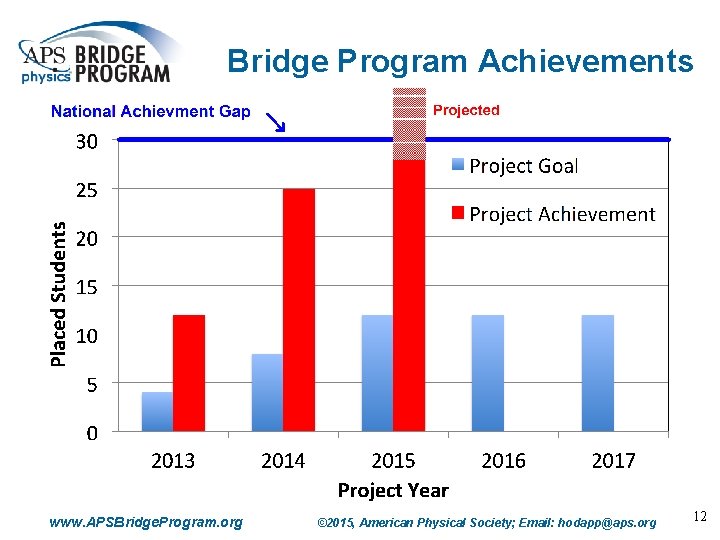
Bridge Program Achievements www. APSBridge. Program. org © 2015, American Physical Society; Email: hodapp@aps. org 12
Why the NMC? APS Minority Scholarship Student Assessment • Mentoring is important and impactful How could we scale up the mentoring effort to create a bigger impact? www. aps. org/NMC © 2015, American Physical Society; Email: nmc@aps. org 13
NMC Goals Overarching Goal: Increase the number of underrepresented minority students obtaining bachelors degrees in physics. Project Goals: • Provide a mentoring experience to as many underrepresented minority undergraduate students as possible with special focus placed on reaching students as early as possible in their physics studies • Document progress of mentored students toward completion of their undergraduate degree • Make available mentor training to all mentors of URM undergraduate students • Disseminate mentoring best practices with an eye toward encouraging broad adoption throughout the physics community www. aps. org/NMC © 2015, American Physical Society; Email: nmc@aps. org 14
Benefits of Mentoring • Professional Development • Connection to larger network • Connection to Resources • Address problems early on • Early Integration into the community, the field, and the profession • Decrease feelings of isolation • And more… www. aps. org/NMC © 2015, American Physical Society; Email: nmc@aps. org
NMC Mentor and Mentee Benefits Mentors • • Connection to mentors around the country Direct link to resources for students Integrates with current broader participation efforts Become a rockstar mentor! Mentees • All the General Benefits of Mentoring • Eligibility for travel funding to our conference www. aps. org/NMC © 2015, American Physical Society; Email: nmc@aps. org
Principle Components • Mentor Network • Biweekly Prompts and Resources • National Conference • Travel Funding Future Components • Mentee and Mentor Recognition • Scholarships www. aps. org/NMC © 2015, American Physical Society; Email: nmc@aps. org
Current Status • Began early May 2015 • Currently: • 72 Mentors • 15 Mentees • 40 Mentees invited but not registered yet www. aps. org/NMC © 2015, American Physical Society; Email: nmc@aps. org
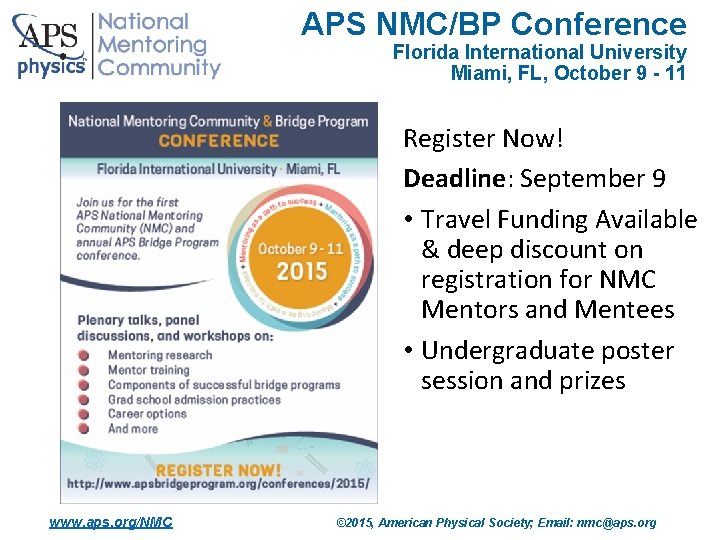
APS NMC/BP Conference Florida International University Miami, FL, October 9 - 11 Register Now! Deadline: September 9 • Travel Funding Available & deep discount on registration for NMC Mentors and Mentees • Undergraduate poster session and prizes www. aps. org/NMC © 2015, American Physical Society; Email: nmc@aps. org
Student Limiting Behaviors • Work in isolation • Study with other students • Don’t engage faculty • Go to office hours regularly • Get a faculty mentor • Poor time management • Work to eliminate procrastination • Have to earn $? Ask prof. for paid research internship • Don’t see themselves as scientists now or in the future • Don’t wait for external validation. Own the fact that you have the capacity and ability to do science www. aps. org/NMC © 2015, American Physical Society; Email: nmc@aps. org
THANK YOU! Arlene Modeste Knowles Diversity Programs Administrator American Physical Society 301 -209 -3232 Knowles@aps. org www. aps. org/NMC © 2015, American Physical Society; Email: knowles@aps. org 21
- Slides: 21