
Apron Section of the stage floor which projects
- Slides: 25
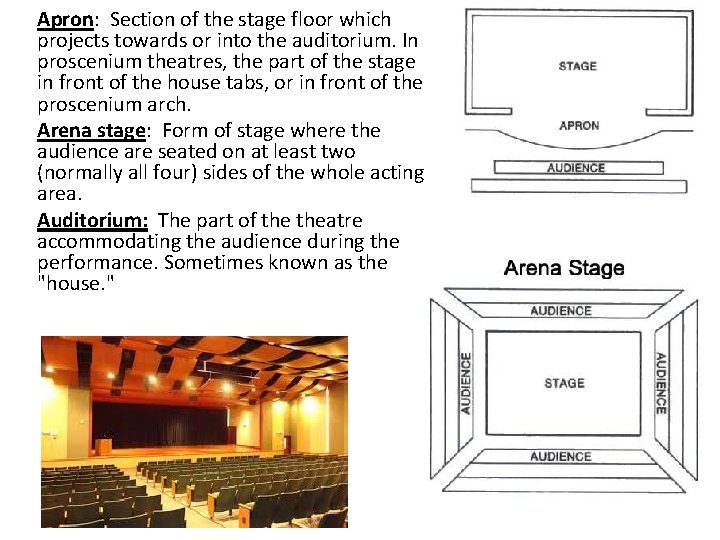
Apron: Section of the stage floor which projects towards or into the auditorium. In proscenium theatres, the part of the stage in front of the house tabs, or in front of the proscenium arch. Arena stage: Form of stage where the audience are seated on at least two (normally all four) sides of the whole acting area. Auditorium: The part of theatre accommodating the audience during the performance. Sometimes known as the "house. "
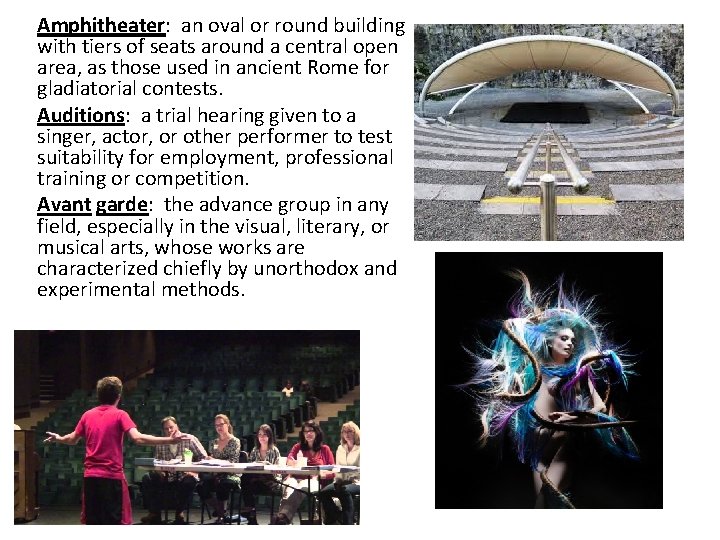
Amphitheater: an oval or round building with tiers of seats around a central open area, as those used in ancient Rome for gladiatorial contests. Auditions: a trial hearing given to a singer, actor, or other performer to test suitability for employment, professional training or competition. Avant garde: the advance group in any field, especially in the visual, literary, or musical arts, whose works are characterized chiefly by unorthodox and experimental methods.
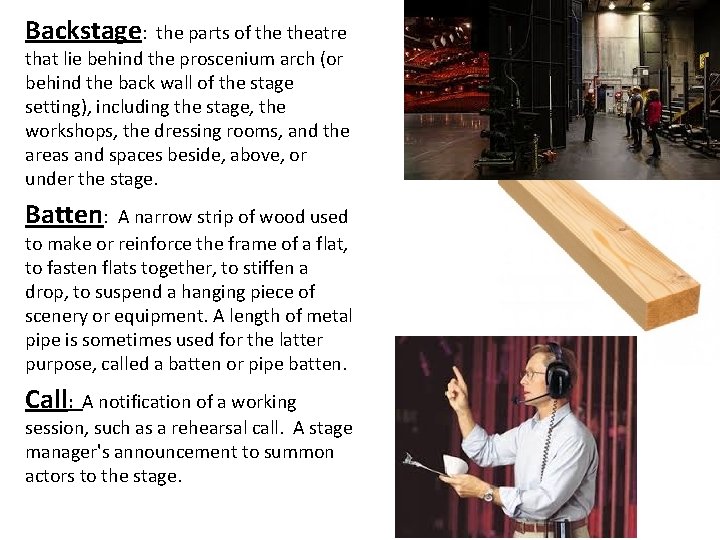
Backstage: the parts of theatre that lie behind the proscenium arch (or behind the back wall of the stage setting), including the stage, the workshops, the dressing rooms, and the areas and spaces beside, above, or under the stage. Batten: A narrow strip of wood used to make or reinforce the frame of a flat, to fasten flats together, to stiffen a drop, to suspend a hanging piece of scenery or equipment. A length of metal pipe is sometimes used for the latter purpose, called a batten or pipe batten. Call: A notification of a working session, such as a rehearsal call. A stage manager's announcement to summon actors to the stage.
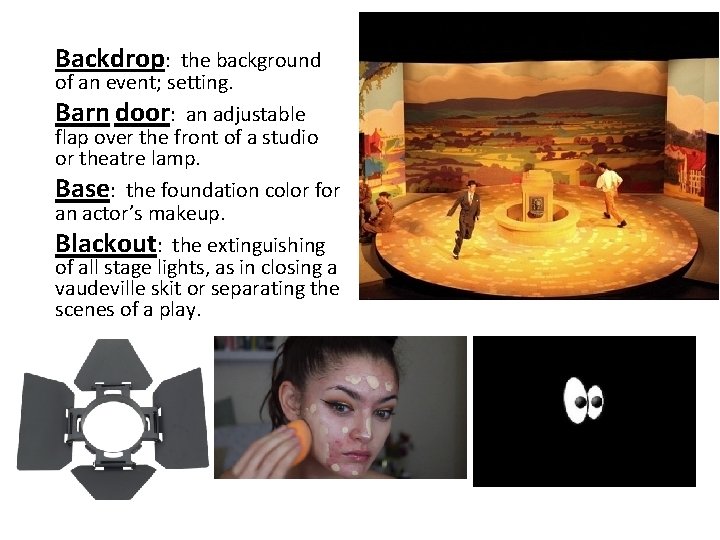
Backdrop: the background of an event; setting. Barn door: an adjustable flap over the front of a studio or theatre lamp. Base: the foundation color for an actor’s makeup. Blackout: the extinguishing of all stage lights, as in closing a vaudeville skit or separating the scenes of a play.
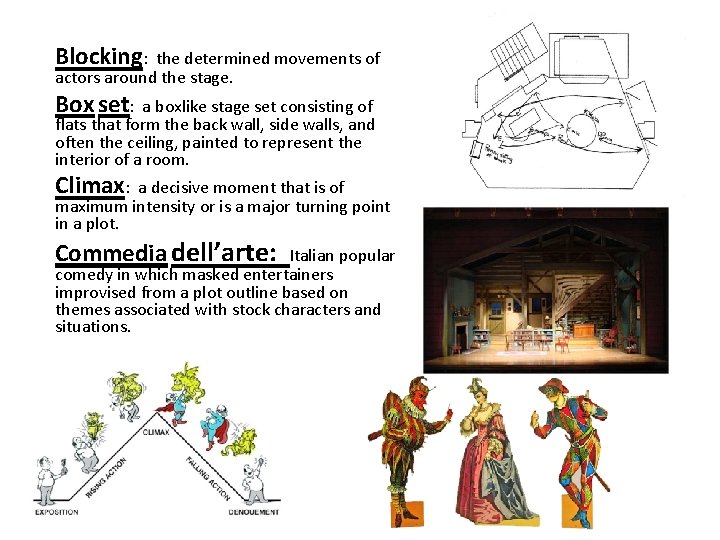
Blocking: the determined movements of actors around the stage. Box set: a boxlike stage set consisting of flats that form the back wall, side walls, and often the ceiling, painted to represent the interior of a room. Climax: a decisive moment that is of maximum intensity or is a major turning point in a plot. Commedia dell’arte: Italian popular comedy in which masked entertainers improvised from a plot outline based on themes associated with stock characters and situations.
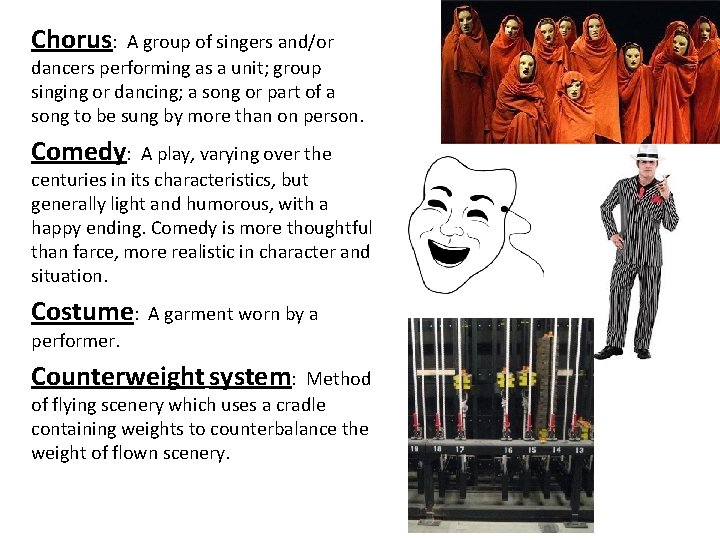
Chorus: A group of singers and/or dancers performing as a unit; group singing or dancing; a song or part of a song to be sung by more than on person. Comedy: A play, varying over the centuries in its characteristics, but generally light and humorous, with a happy ending. Comedy is more thoughtful than farce, more realistic in character and situation. Costume: A garment worn by a performer. Counterweight system: Method of flying scenery which uses a cradle containing weights to counterbalance the weight of flown scenery.
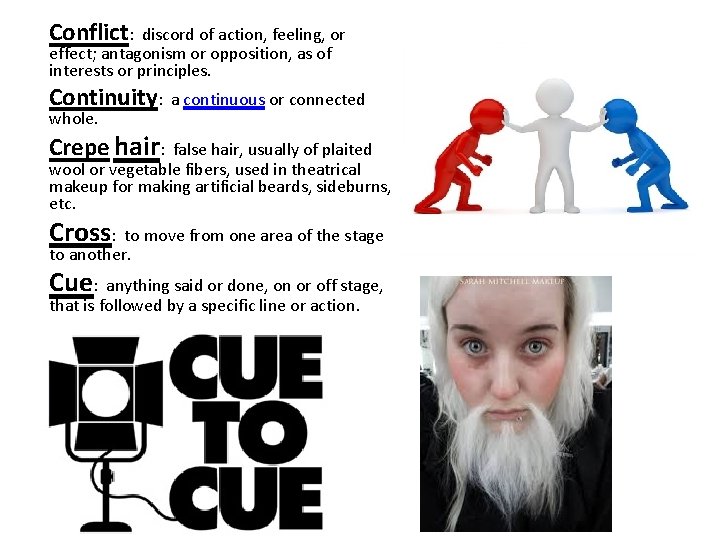
Conflict: discord of action, feeling, or effect; antagonism or opposition, as of interests or principles. Continuity: whole. a continuous or connected Crepe hair: false hair, usually of plaited wool or vegetable fibers, used in theatrical makeup for making artificial beards, sideburns, etc. Cross: to move from one area of the stage to another. Cue: anything said or done, on or off stage, that is followed by a specific line or action.
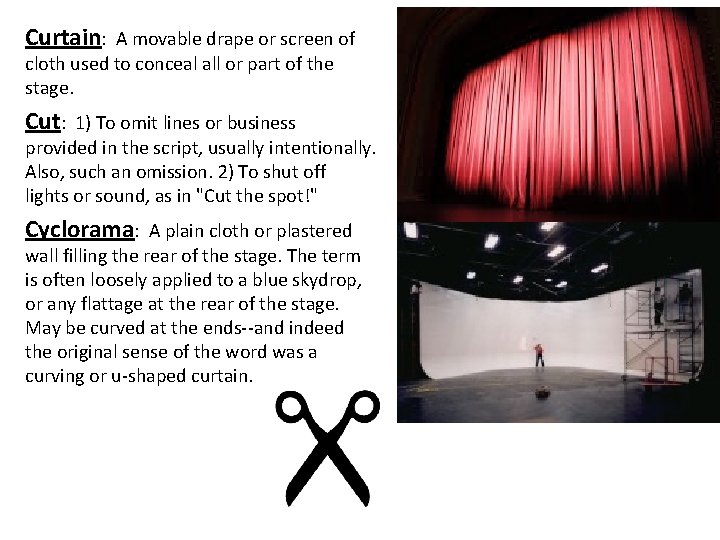
Curtain: A movable drape or screen of cloth used to conceal all or part of the stage. Cut: 1) To omit lines or business provided in the script, usually intentionally. Also, such an omission. 2) To shut off lights or sound, as in "Cut the spot!" Cyclorama: A plain cloth or plastered wall filling the rear of the stage. The term is often loosely applied to a blue skydrop, or any flattage at the rear of the stage. May be curved at the ends--and indeed the original sense of the word was a curving or u-shaped curtain.
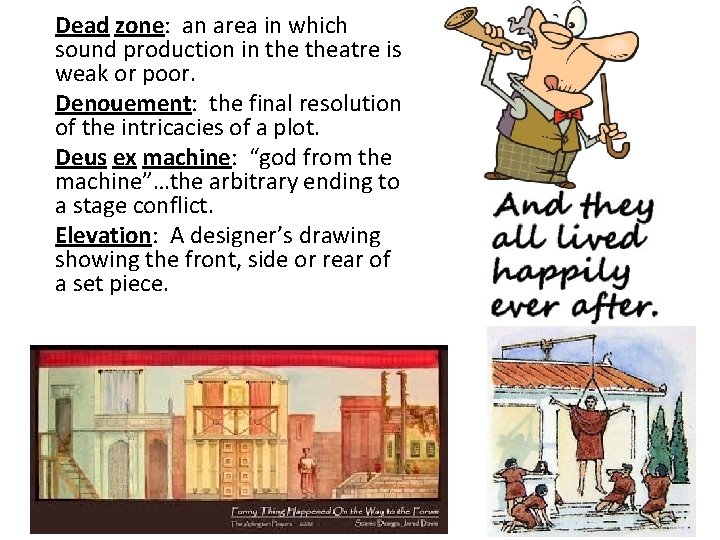
Dead zone: an area in which sound production in theatre is weak or poor. Denouement: the final resolution of the intricacies of a plot. Deus ex machine: “god from the machine”…the arbitrary ending to a stage conflict. Elevation: A designer’s drawing showing the front, side or rear of a set piece.
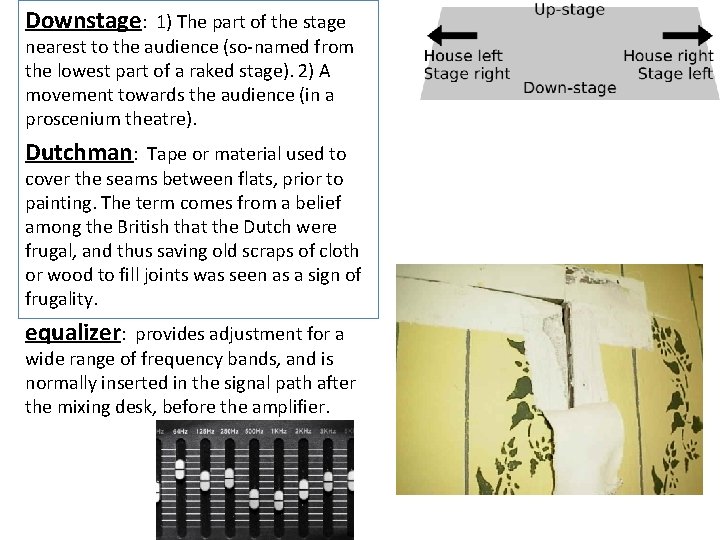
Downstage: 1) The part of the stage nearest to the audience (so-named from the lowest part of a raked stage). 2) A movement towards the audience (in a proscenium theatre). Dutchman: Tape or material used to cover the seams between flats, prior to painting. The term comes from a belief among the British that the Dutch were frugal, and thus saving old scraps of cloth or wood to fill joints was seen as a sign of frugality. equalizer: provides adjustment for a wide range of frequency bands, and is normally inserted in the signal path after the mixing desk, before the amplifier.
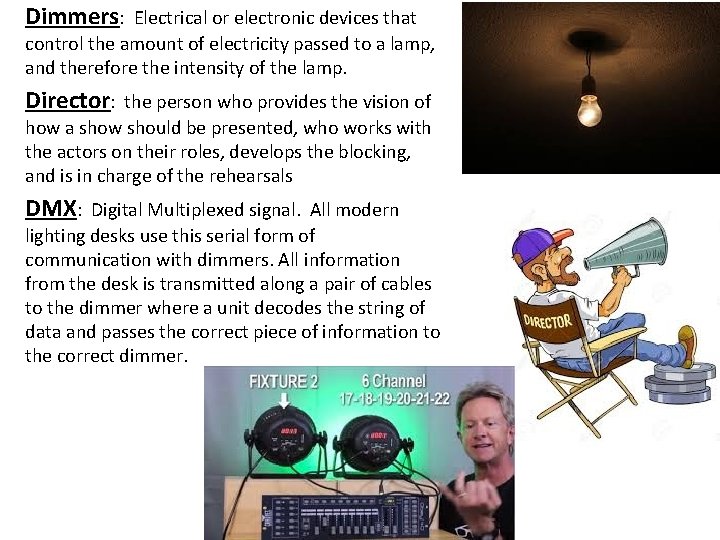
Dimmers: Electrical or electronic devices that control the amount of electricity passed to a lamp, and therefore the intensity of the lamp. Director: the person who provides the vision of how a show should be presented, who works with the actors on their roles, develops the blocking, and is in charge of the rehearsals DMX: Digital Multiplexed signal. All modern lighting desks use this serial form of communication with dimmers. All information from the desk is transmitted along a pair of cables to the dimmer where a unit decodes the string of data and passes the correct piece of information to the correct dimmer.
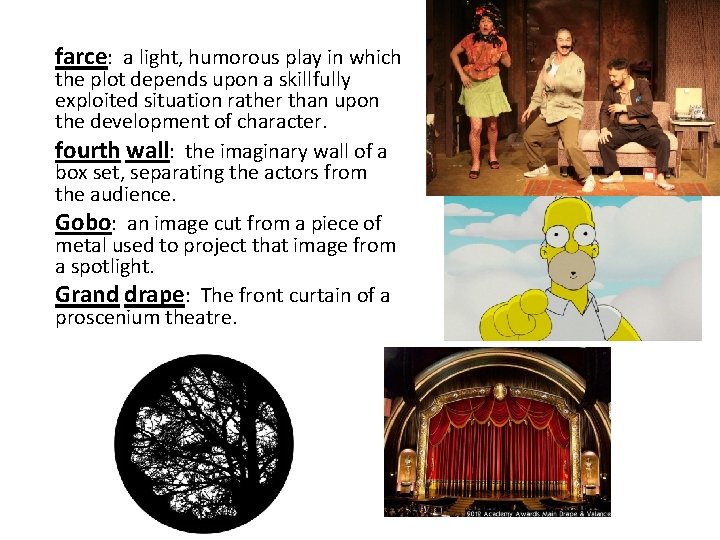
farce: a light, humorous play in which the plot depends upon a skillfully exploited situation rather than upon the development of character. fourth wall: the imaginary wall of a box set, separating the actors from the audience. Gobo: an image cut from a piece of metal used to project that image from a spotlight. Grand drape: The front curtain of a proscenium theatre.
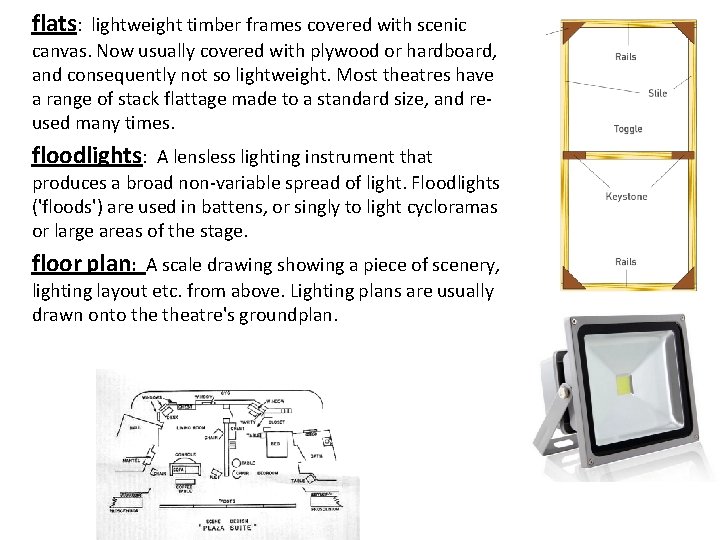
flats: lightweight timber frames covered with scenic canvas. Now usually covered with plywood or hardboard, and consequently not so lightweight. Most theatres have a range of stack flattage made to a standard size, and reused many times. floodlights: A lensless lighting instrument that produces a broad non-variable spread of light. Floodlights ('floods') are used in battens, or singly to light cycloramas or large areas of the stage. floor plan: A scale drawing showing a piece of scenery, lighting layout etc. from above. Lighting plans are usually drawn onto theatre's groundplan.
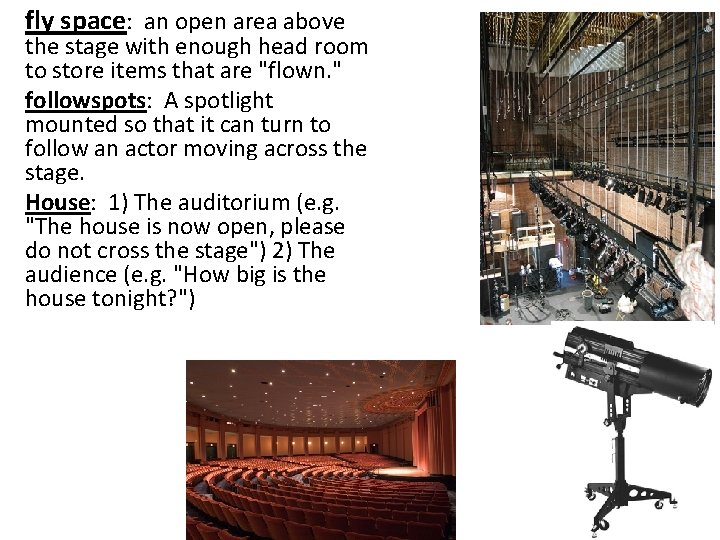
fly space: an open area above the stage with enough head room to store items that are "flown. " followspots: A spotlight mounted so that it can turn to follow an actor moving across the stage. House: 1) The auditorium (e. g. "The house is now open, please do not cross the stage") 2) The audience (e. g. "How big is the house tonight? ")
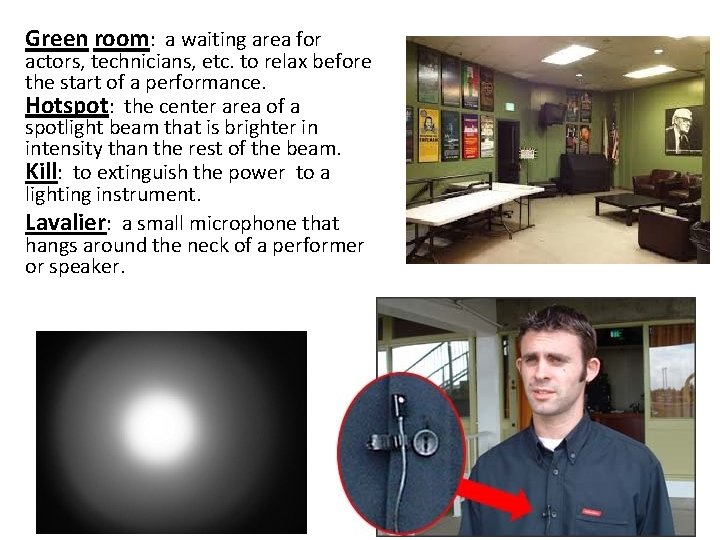
Green room: a waiting area for actors, technicians, etc. to relax before the start of a performance. Hotspot: the center area of a spotlight beam that is brighter in intensity than the rest of the beam. Kill: to extinguish the power to a lighting instrument. Lavalier: a small microphone that hangs around the neck of a performer or speaker.
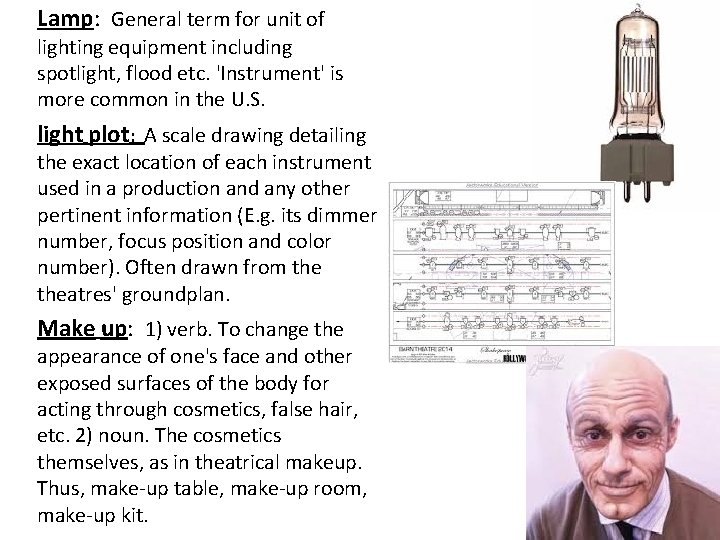
Lamp: General term for unit of lighting equipment including spotlight, flood etc. 'Instrument' is more common in the U. S. light plot: A scale drawing detailing the exact location of each instrument used in a production and any other pertinent information (E. g. its dimmer number, focus position and color number). Often drawn from theatres' groundplan. Make up: 1) verb. To change the appearance of one's face and other exposed surfaces of the body for acting through cosmetics, false hair, etc. 2) noun. The cosmetics themselves, as in theatrical makeup. Thus, make-up table, make-up room, make-up kit.
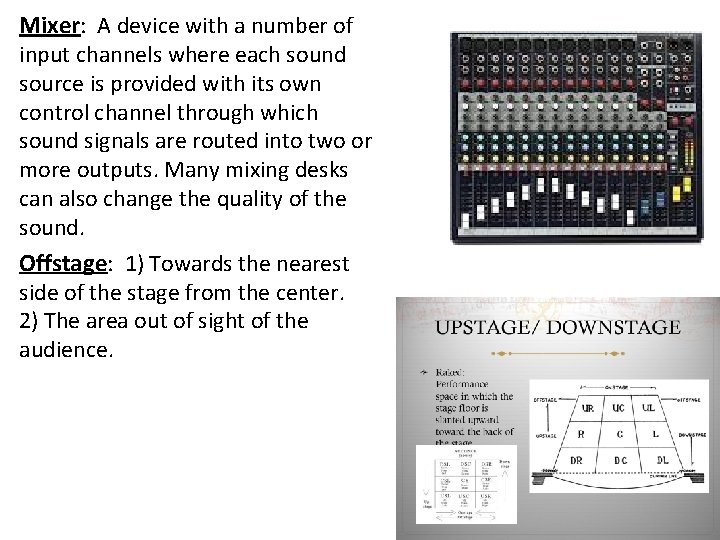
Mixer: A device with a number of input channels where each sound source is provided with its own control channel through which sound signals are routed into two or more outputs. Many mixing desks can also change the quality of the sound. Offstage: 1) Towards the nearest side of the stage from the center. 2) The area out of sight of the audience.
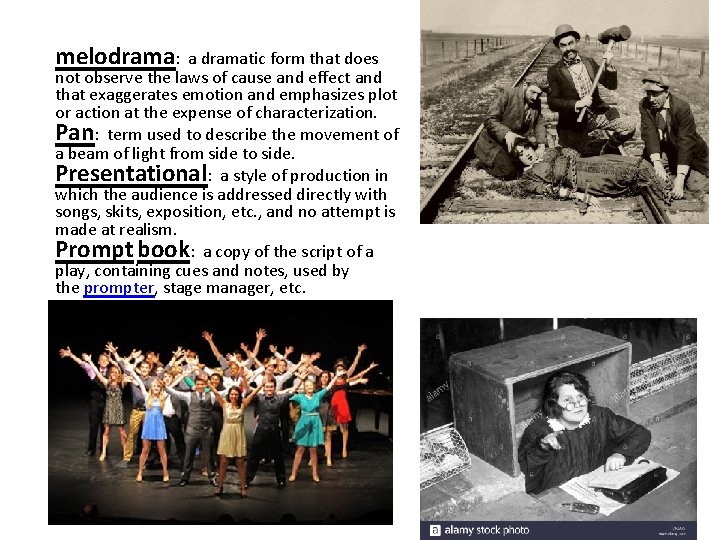
melodrama: a dramatic form that does not observe the laws of cause and effect and that exaggerates emotion and emphasizes plot or action at the expense of characterization. Pan: term used to describe the movement of a beam of light from side to side. Presentational: a style of production in which the audience is addressed directly with songs, skits, exposition, etc. , and no attempt is made at realism. Prompt book: a copy of the script of a play, containing cues and notes, used by the prompter, stage manager, etc.
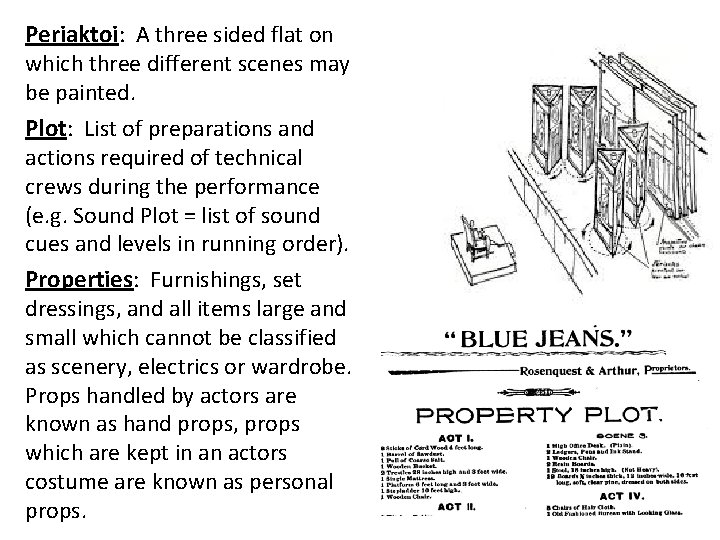
Periaktoi: A three sided flat on which three different scenes may be painted. Plot: List of preparations and actions required of technical crews during the performance (e. g. Sound Plot = list of sound cues and levels in running order). Properties: Furnishings, set dressings, and all items large and small which cannot be classified as scenery, electrics or wardrobe. Props handled by actors are known as hand props, props which are kept in an actors costume are known as personal props.
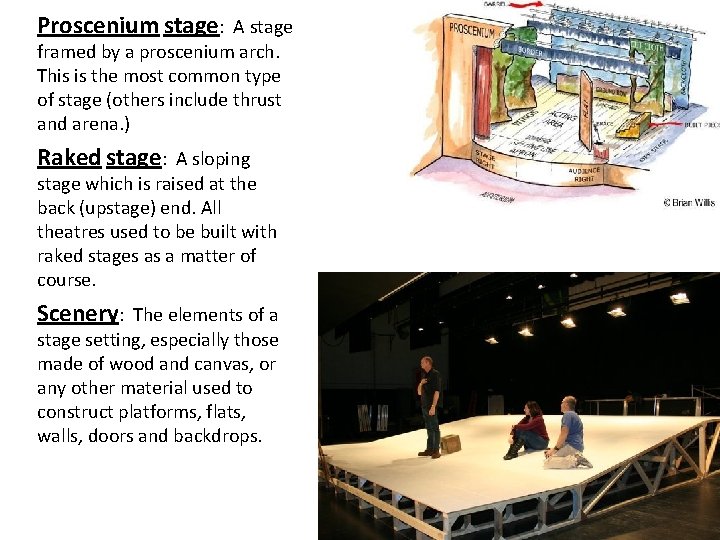
Proscenium stage: A stage framed by a proscenium arch. This is the most common type of stage (others include thrust and arena. ) Raked stage: A sloping stage which is raised at the back (upstage) end. All theatres used to be built with raked stages as a matter of course. Scenery: The elements of a stage setting, especially those made of wood and canvas, or any other material used to construct platforms, flats, walls, doors and backdrops.
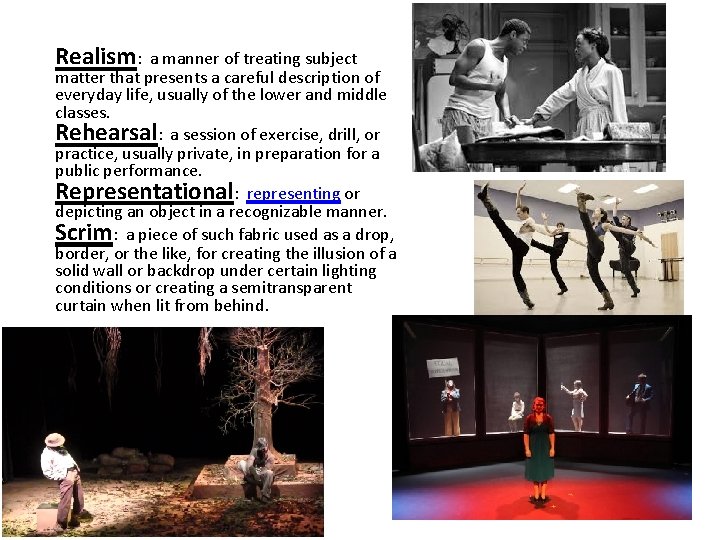
Realism: a manner of treating subject matter that presents a careful description of everyday life, usually of the lower and middle classes. Rehearsal: a session of exercise, drill, or practice, usually private, in preparation for a public performance. Representational: representing or depicting an object in a recognizable manner. Scrim: a piece of such fabric used as a drop, border, or the like, for creating the illusion of a solid wall or backdrop under certain lighting conditions or creating a semitransparent curtain when lit from behind.
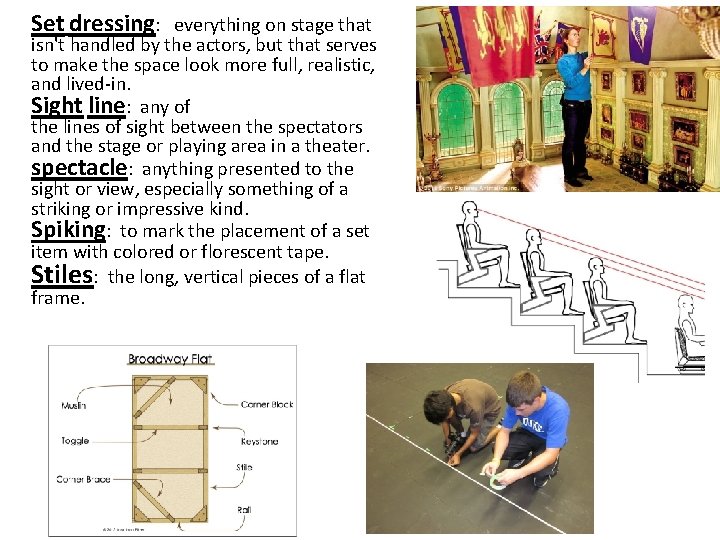
Set dressing: everything on stage that isn't handled by the actors, but that serves to make the space look more full, realistic, and lived-in. Sight line: any of the lines of sight between the spectators and the stage or playing area in a theater. spectacle: anything presented to the sight or view, especially something of a striking or impressive kind. Spiking: to mark the placement of a set item with colored or florescent tape. Stiles: the long, vertical pieces of a flat frame.
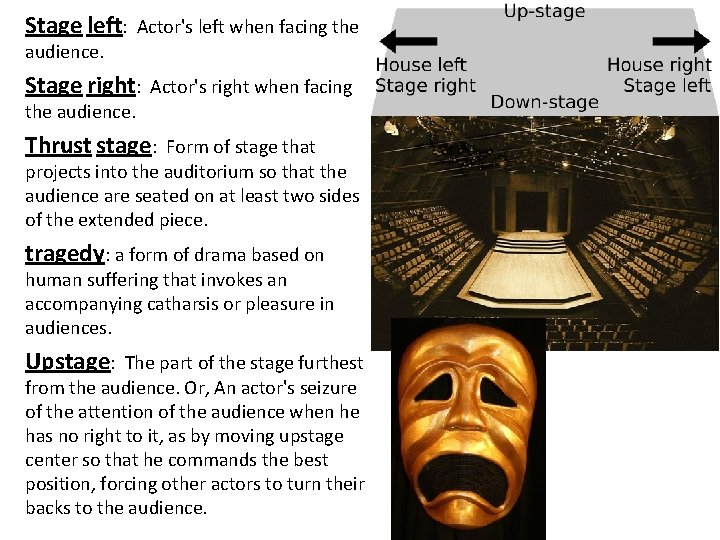
Stage left: Actor's left when facing the audience. Stage right: Actor's right when facing the audience. Thrust stage: Form of stage that projects into the auditorium so that the audience are seated on at least two sides of the extended piece. tragedy: a form of drama based on human suffering that invokes an accompanying catharsis or pleasure in audiences. Upstage: The part of the stage furthest from the audience. Or, An actor's seizure of the attention of the audience when he has no right to it, as by moving upstage center so that he commands the best position, forcing other actors to turn their backs to the audience.
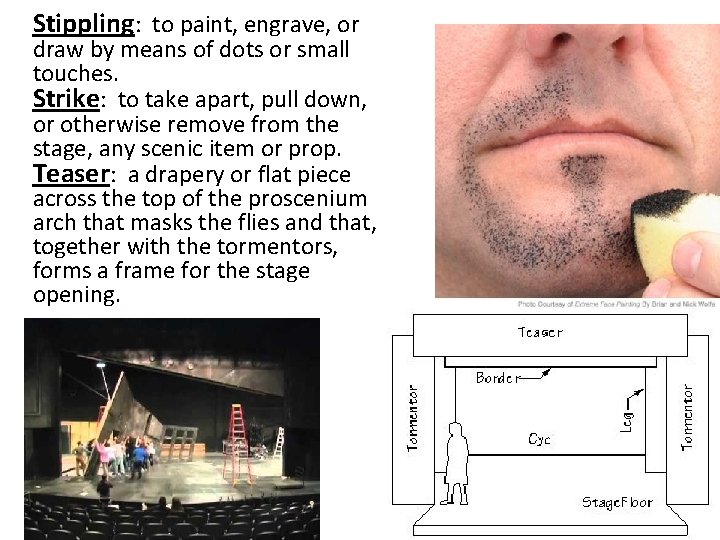
Stippling: to paint, engrave, or draw by means of dots or small touches. Strike: to take apart, pull down, or otherwise remove from the stage, any scenic item or prop. Teaser: a drapery or flat piece across the top of the proscenium arch that masks the flies and that, together with the tormentors, forms a frame for the stage opening.
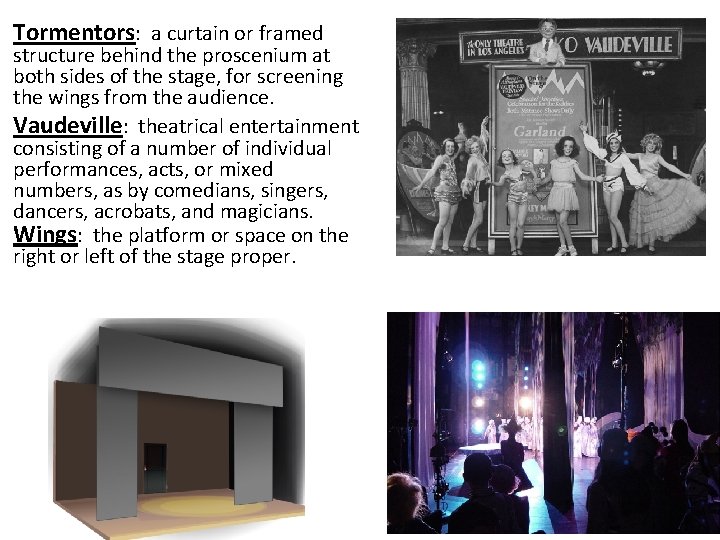
Tormentors: a curtain or framed structure behind the proscenium at both sides of the stage, for screening the wings from the audience. Vaudeville: theatrical entertainment consisting of a number of individual performances, acts, or mixed numbers, as by comedians, singers, dancers, acrobats, and magicians. Wings: the platform or space on the right or left of the stage proper.