
Approximations to the exchange correlation functional Local density
![KS scheme , For simplicity: vxc(r) vxc[ , m] = Exc[ , m]/ Bxc(r)](https://slidetodoc.com/presentation_image_h/f45a18cdb252828fdd33c6da94cd595a/image-14.jpg "KS scheme , For simplicity: vxc(r) vxc[ , m] = Exc[ , m]/ Bxc(r)")
![Hohenberg-Kohn theorem for superconductors 1 -1 [v(r), (r, r’), W(R)] [ (r), (r, r’),](https://slidetodoc.com/presentation_image_h/f45a18cdb252828fdd33c6da94cd595a/image-20.jpg "Hohenberg-Kohn theorem for superconductors 1 -1 [v(r), (r, r’), W(R)] [ (r), (r, r’),")
 vs[ , , ](r) s*[ ,](https://slidetodoc.com/presentation_image_h/f45a18cdb252828fdd33c6da94cd595a/image-21.jpg "Electronic KS equation s[ , , ](r, r’) vs[ , , ](r) s*[ ,")
 vs[ , , ](r) s*[ ,](https://slidetodoc.com/presentation_image_h/f45a18cdb252828fdd33c6da94cd595a/image-22.jpg "Electronic KS equation s[ , , ](r, r’) vs[ , , ](r) s*[ ,")
![Purely electronic contributions Fxc [ρ, ] = ee + Fxc [ ρ ] GGA](https://slidetodoc.com/presentation_image_h/f45a18cdb252828fdd33c6da94cd595a/image-25.jpg "Purely electronic contributions Fxc [ρ, ] = ee + Fxc [ ρ ] GGA")
- Slides: 31
Approximations to the exchange -correlation functional
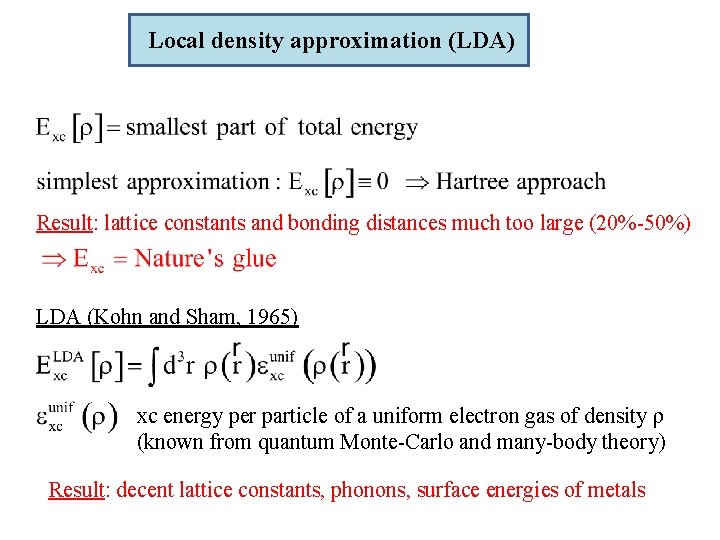
Local density approximation (LDA) Result: lattice constants and bonding distances much too large (20%-50%) LDA (Kohn and Sham, 1965) xc energy per particle of a uniform electron gas of density ρ (known from quantum Monte-Carlo and many-body theory) Result: decent lattice constants, phonons, surface energies of metals
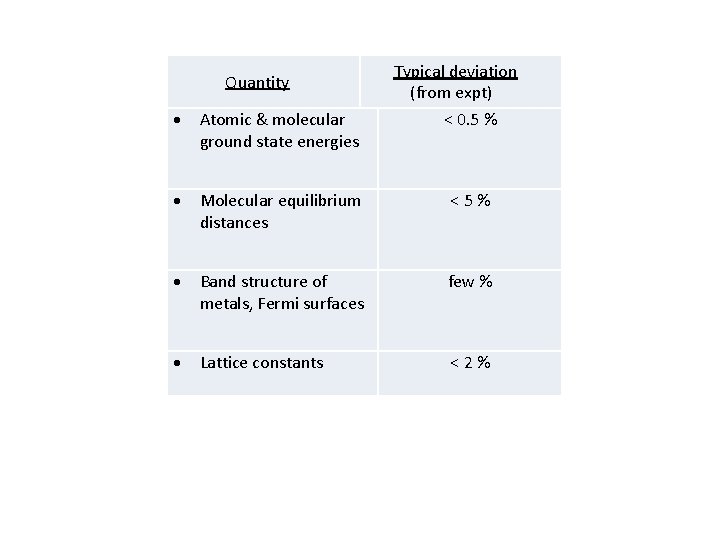
Quantity Typical deviation (from expt) < 0. 5 % Atomic & molecular ground state energies Molecular equilibrium distances <5% Band structure of metals, Fermi surfaces few % Lattice constants <2%
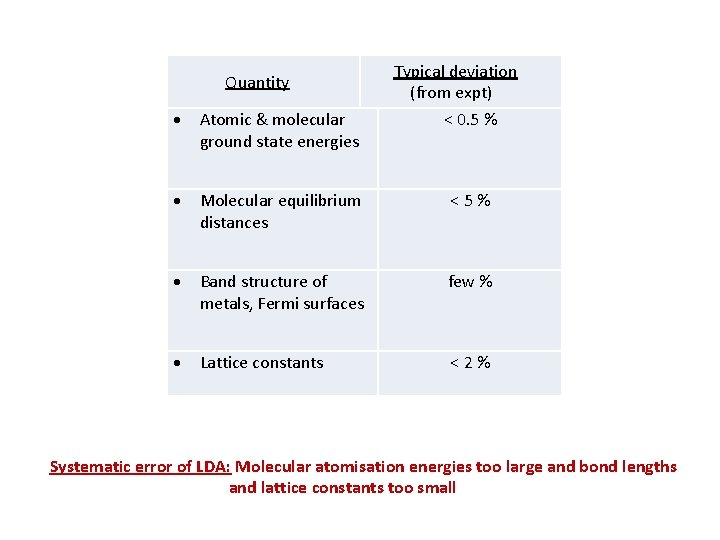
Quantity Typical deviation (from expt) < 0. 5 % Atomic & molecular ground state energies Molecular equilibrium distances <5% Band structure of metals, Fermi surfaces few % Lattice constants <2% Systematic error of LDA: Molecular atomisation energies too large and bond lengths and lattice constants too small
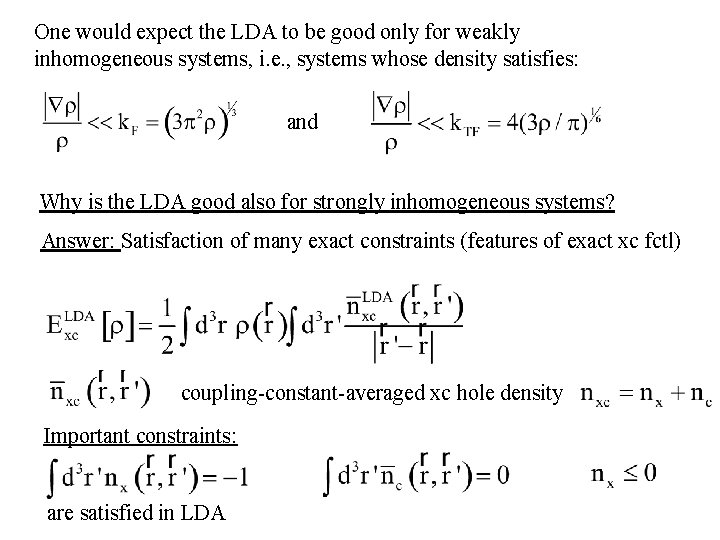
One would expect the LDA to be good only for weakly inhomogeneous systems, i. e. , systems whose density satisfies: and Why is the LDA good also for strongly inhomogeneous systems? Answer: Satisfaction of many exact constraints (features of exact xc fctl) coupling-constant-averaged xc hole density Important constraints: are satisfied in LDA
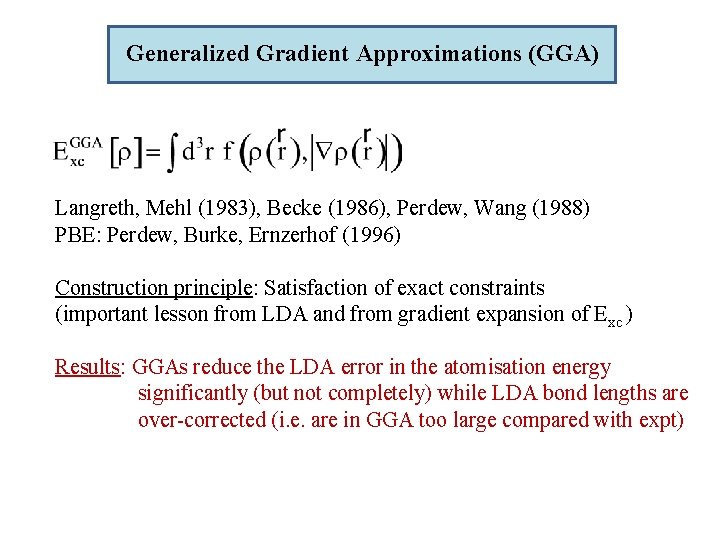
Generalized Gradient Approximations (GGA) Langreth, Mehl (1983), Becke (1986), Perdew, Wang (1988) PBE: Perdew, Burke, Ernzerhof (1996) Construction principle: Satisfaction of exact constraints (important lesson from LDA and from gradient expansion of Exc ) Results: GGAs reduce the LDA error in the atomisation energy significantly (but not completely) while LDA bond lengths are over-corrected (i. e. are in GGA too large compared with expt)
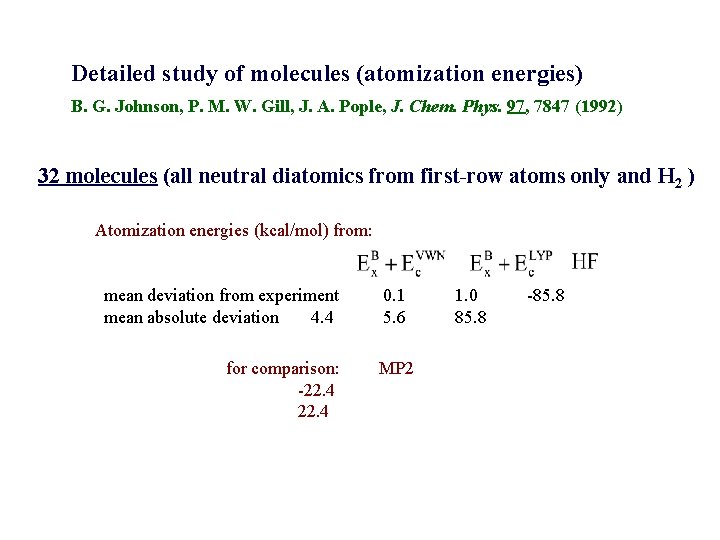
Detailed study of molecules (atomization energies) B. G. Johnson, P. M. W. Gill, J. A. Pople, J. Chem. Phys. 97, 7847 (1992) 32 molecules (all neutral diatomics from first-row atoms only and H 2 ) Atomization energies (kcal/mol) from: mean deviation from experiment mean absolute deviation 4. 4 for comparison: -22. 4 0. 1 5. 6 MP 2 1. 0 85. 8 -85. 8
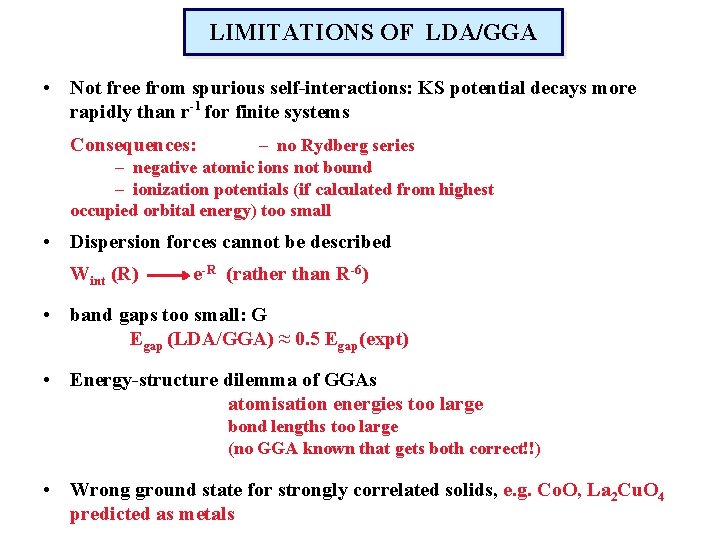
LIMITATIONS OF LDA/GGA • Not free from spurious self-interactions: KS potential decays more rapidly than r-1 for finite systems Consequences: – no Rydberg series – negative atomic ions not bound – ionization potentials (if calculated from highest occupied orbital energy) too small • Dispersion forces cannot be described Wint (R) e-R (rather than R-6) • band gaps too small: G Egap (LDA/GGA) ≈ 0. 5 Egap(expt) • Energy-structure dilemma of GGAs atomisation energies too large bond lengths too large (no GGA known that gets both correct!!) • Wrong ground state for strongly correlated solids, e. g. Co. O, La 2 Cu. O 4 predicted as metals
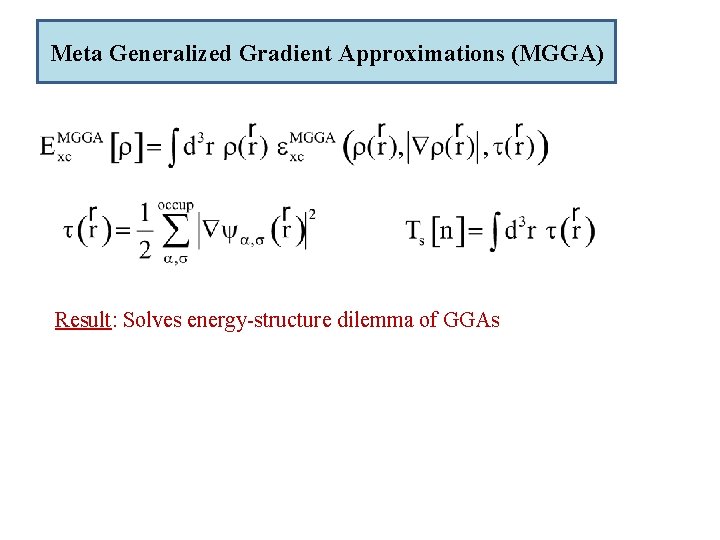
Meta Generalized Gradient Approximations (MGGA) Result: Solves energy-structure dilemma of GGAs
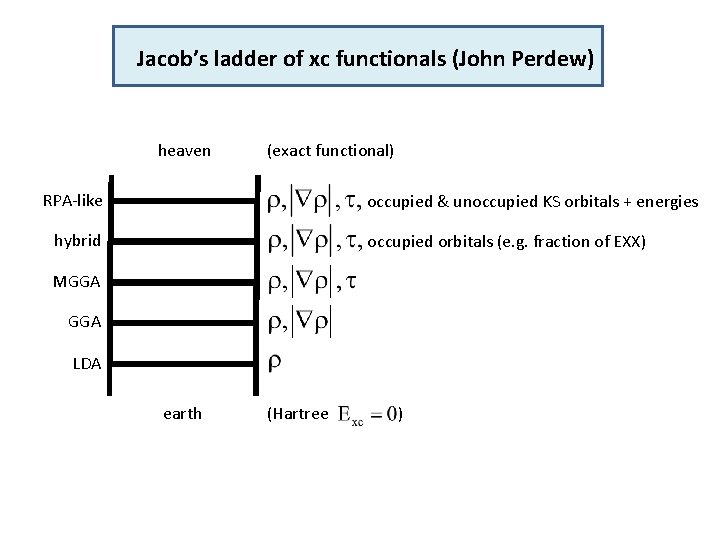
Jacob’s ladder of xc functionals (John Perdew) heaven (exact functional) RPA-like occupied & unoccupied KS orbitals + energies hybrid occupied orbitals (e. g. fraction of EXX) MGGA LDA earth (Hartree )
DFT description of quantum phases: Magnetism and Superconductivity
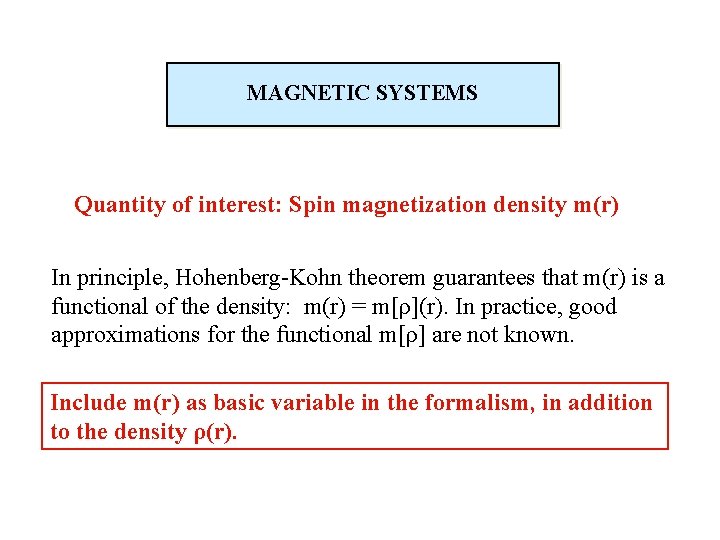
MAGNETIC SYSTEMS Quantity of interest: Spin magnetization density m(r) In principle, Hohenberg-Kohn theorem guarantees that m(r) is a functional of the density: m(r) = m[ρ](r). In practice, good approximations for the functional m[ρ] are not known. Include m(r) as basic variable in the formalism, in addition to the density ρ(r).
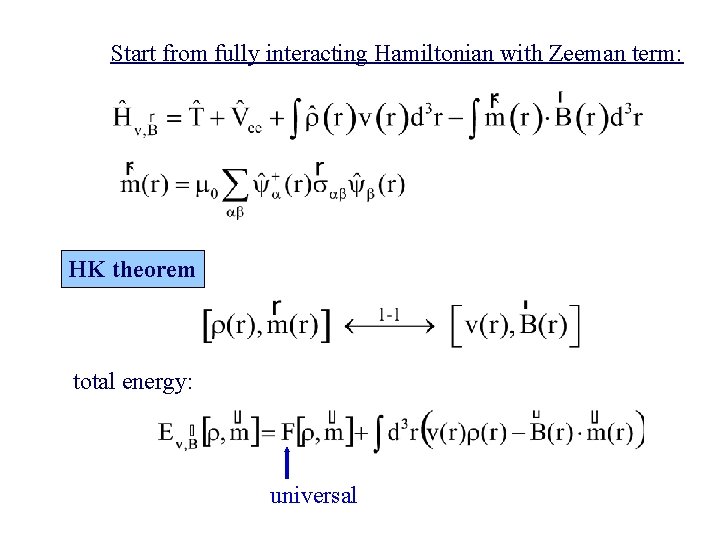
Start from fully interacting Hamiltonian with Zeeman term: HK theorem total energy: universal
KS scheme , For simplicity: vxc(r) vxc[ , m] = Exc[ , m]/ Bxc(r) Bxc[ , m] = Exc[ , m]/ m (r) = + (r) + - (r) , m (r) = + (r) - - (r) , ± = j± 2 B 0 limit These equations do not reduce to the original KS equations for B 0 if, in this limit, the system has a finite m(r).
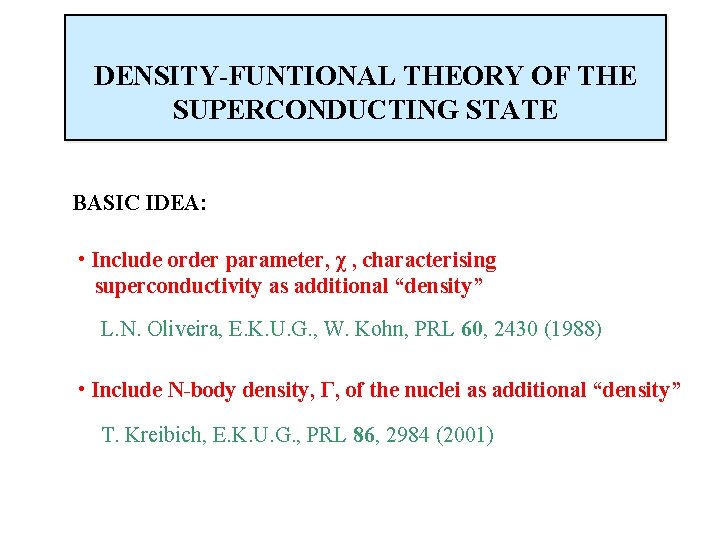
DENSITY-FUNTIONAL THEORY OF THE SUPERCONDUCTING STATE BASIC IDEA: • Include order parameter, χ , characterising superconductivity as additional “density” L. N. Oliveira, E. K. U. G. , W. Kohn, PRL 60, 2430 (1988) • Include N-body density, Γ, of the nuclei as additional “density” T. Kreibich, E. K. U. G. , PRL 86, 2984 (2001)
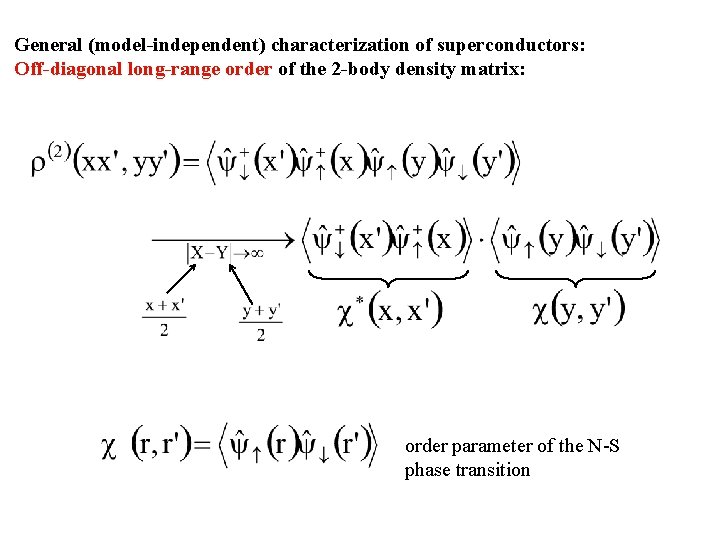
General (model-independent) characterization of superconductors: Off-diagonal long-range order of the 2 -body density matrix: order parameter of the N-S phase transition
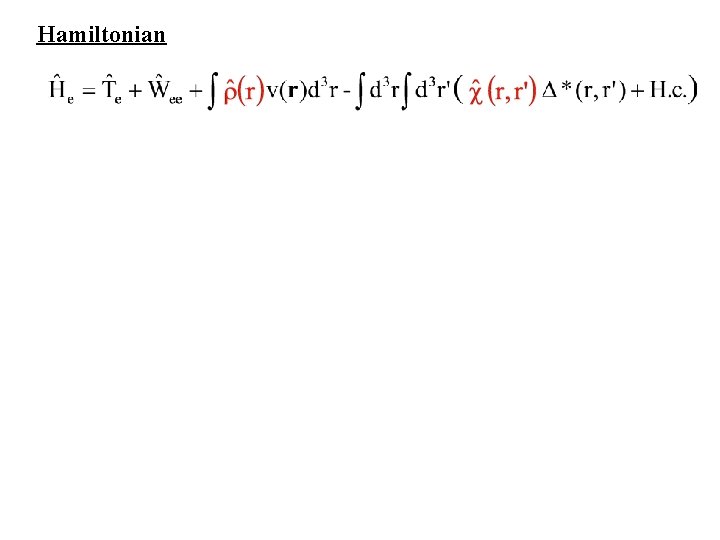
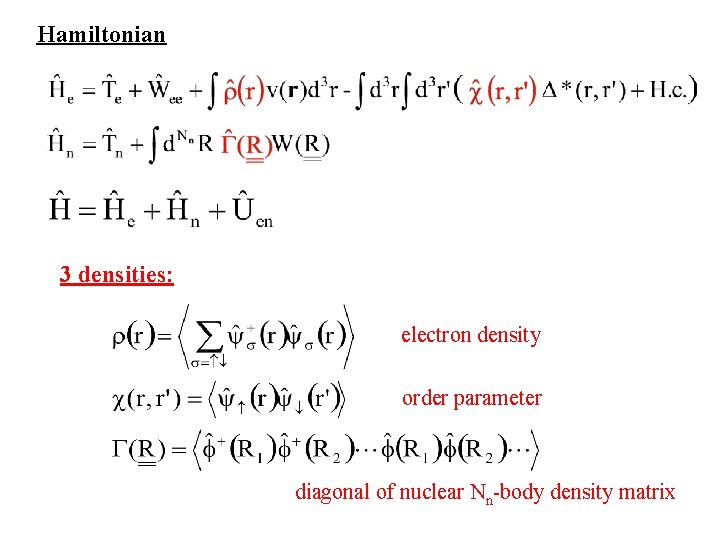
Hamiltonian
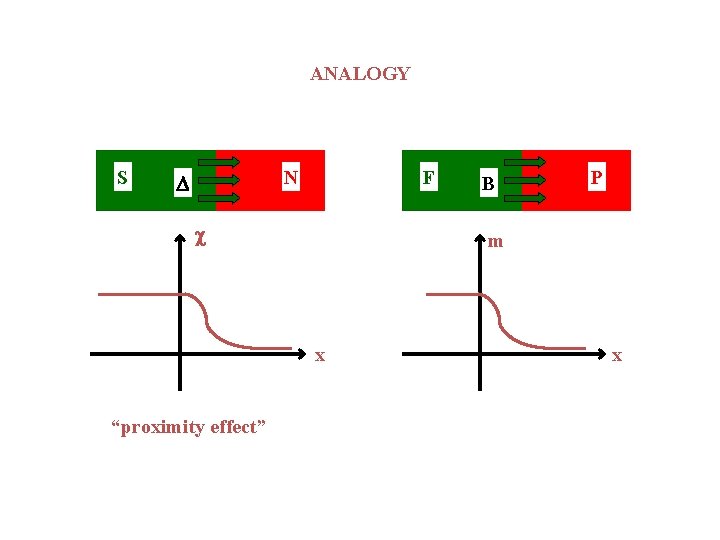
ANALOGY S N F P m x “proximity effect” B x
Hamiltonian 3 densities: electron density order parameter diagonal of nuclear Nn-body density matrix
Hohenberg-Kohn theorem for superconductors 1 -1 [v(r), (r, r’), W(R)] [ (r), (r, r’), (R)] Densities in thermal equilibrium at finite temperature
Electronic KS equation s[ , , ](r, r’) vs[ , , ](r) s*[ , , ](r, r’) vs[ , , ](r) Nuclear KS equation Ws[ , , ](R) 3 KS potentials: vs s Ws No approximation yet! “Exactification” of Bd. G mean-field eqs. KS theorem: There exist functionals vs[ , , ], Ws[ , , ], such that the above equations reproduce the exact densities of the interacting system
Electronic KS equation s[ , , ](r, r’) vs[ , , ](r) s*[ , , ](r, r’) vs[ , , ](r) Nuclear KS equation Ws[ , , ](R) Solved in harmonic approximation 3 KS potentials: vs s Ws No approximation yet! “Exactification” of Bd. G mean-field eqs. KS theorem: There exist functionals vs[ , , ], Ws[ , , ], such that the above equations reproduce the exact densities of the interacting system
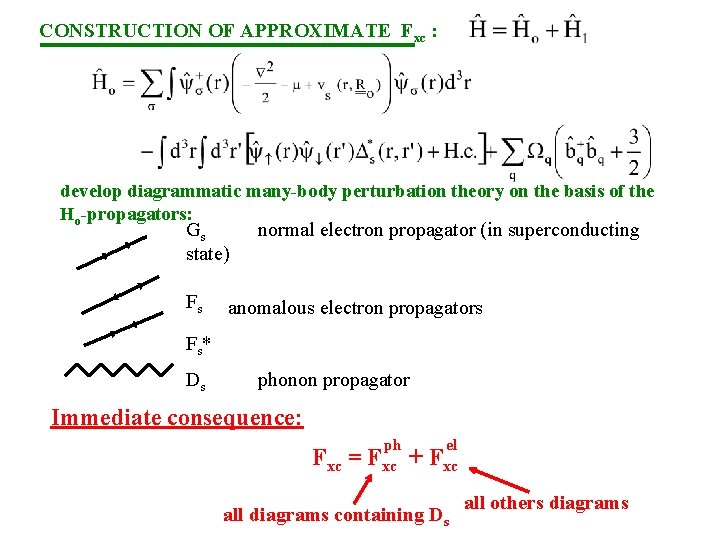
CONSTRUCTION OF APPROXIMATE Fxc : develop diagrammatic many-body perturbation theory on the basis of the Ho-propagators: Gs state) Fs normal electron propagator (in superconducting anomalous electron propagators Fs* Ds phonon propagator Immediate consequence: Fxc = ph Fxc + el Fxc all diagrams containing Ds all others diagrams
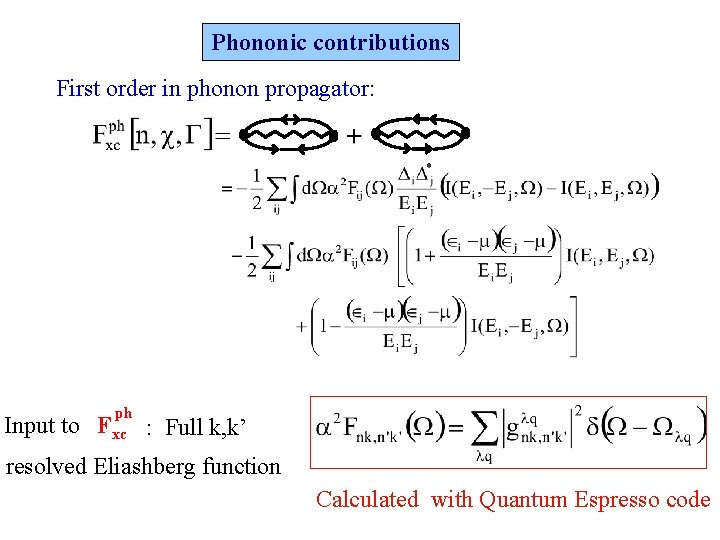
Phononic contributions First order in phonon propagator: Input to ph Fxc : Full k, k’ resolved Eliashberg function Calculated with Quantum Espresso code
Purely electronic contributions Fxc [ρ, ] = ee + Fxc [ ρ ] GGA RPA-screened electron-electron interaction Crucial point: NO ADJUSTABLE PARAMETERS
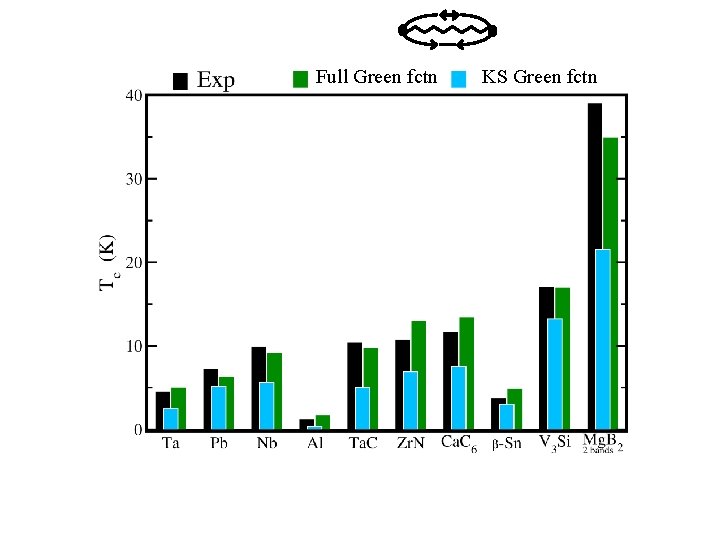
Full Green fctn KS Green fctn
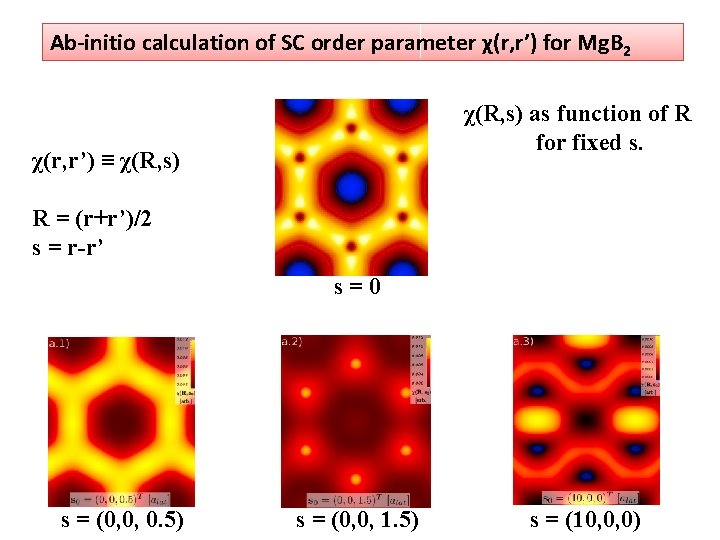
Ab-initio calculation of SC order parameter χ(r, r’) for Mg. B 2 χ(R, s) as function of R for fixed s. χ(r, r’) ≡ χ(R, s) R = (r+r’)/2 s = r-r’ s=0 s = (0, 0, 0. 5) s = (0, 0, 1. 5) s = (10, 0, 0)
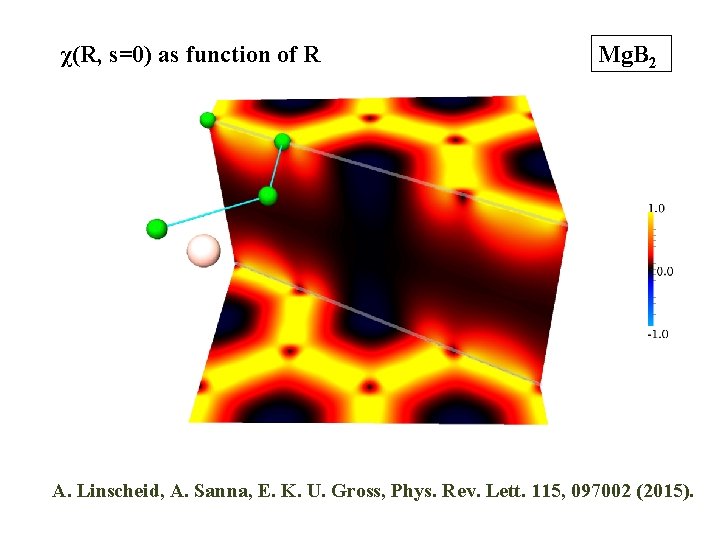
χ(R, s=0) as function of R Mg. B 2 A. Linscheid, A. Sanna, E. K. U. Gross, Phys. Rev. Lett. 115, 097002 (2015).
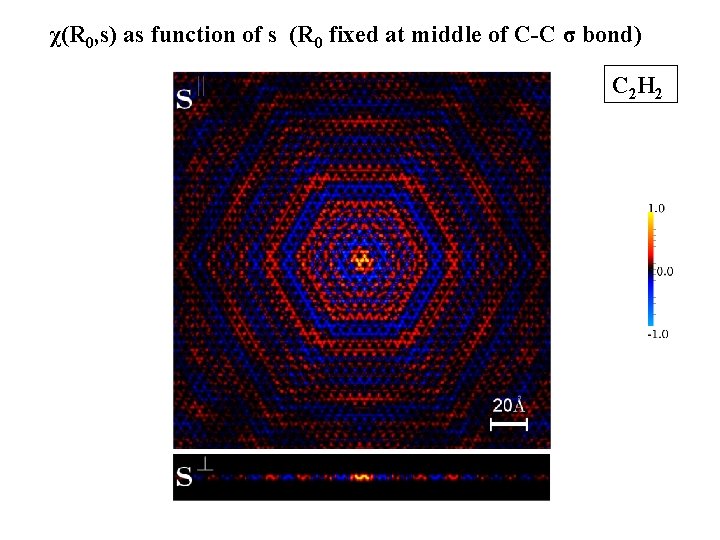
χ(R 0, s) as function of s (R 0 fixed at middle of C-C σ bond) C 2 H 2
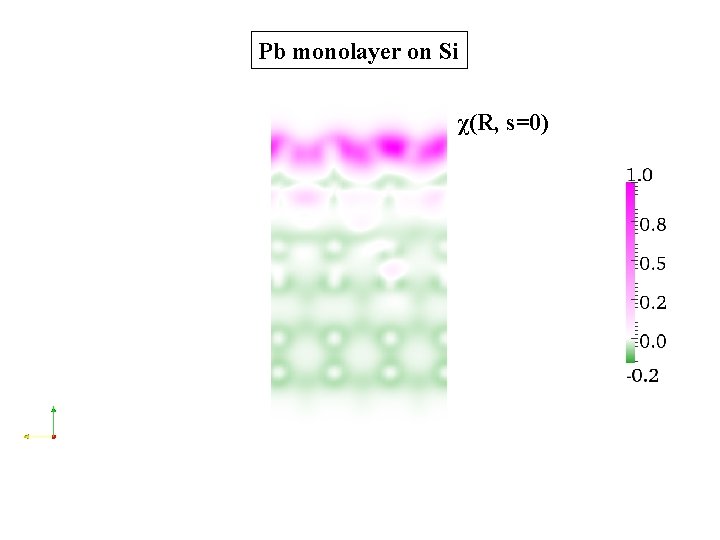
Pb monolayer on Si χ(R, s=0)
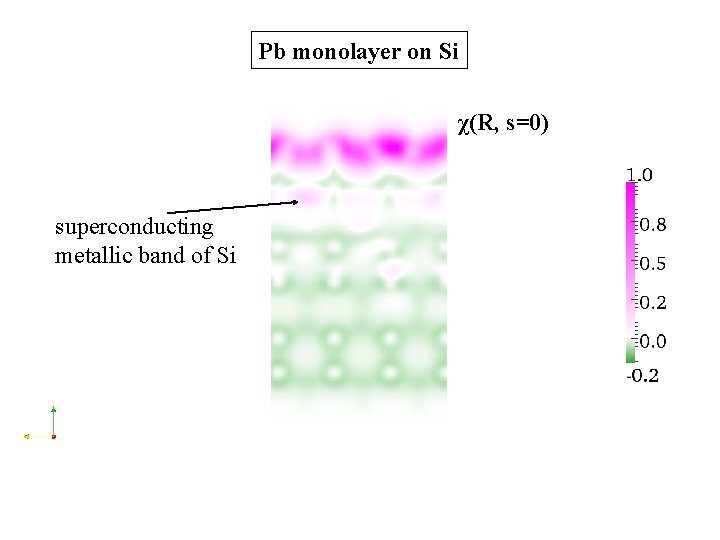
Pb monolayer on Si χ(R, s=0) superconducting metallic band of Si