
Approximating the WorstCase Execution Time of Soft Realtime
![Example void foo() { [1] int i, j; [101] for(i=0; i<100; i++) { [550]](https://slidetodoc.com/presentation_image_h/8fbf6dcb178b65669129db97dfb668fd/image-13.jpg "Example void foo() { [1] int i, j; [101] for(i=0; i<100; i++) { [550]")
- Slides: 30
Approximating the Worst-Case Execution Time of Soft Real-time Applications Matteo Corti, 2005 -03 -03
Goal WCET analysis: • estimation of the longest possible running time Soft real-time systems: • allow some approximations • large applications Matteo Corti, 2005 -03 -03 2
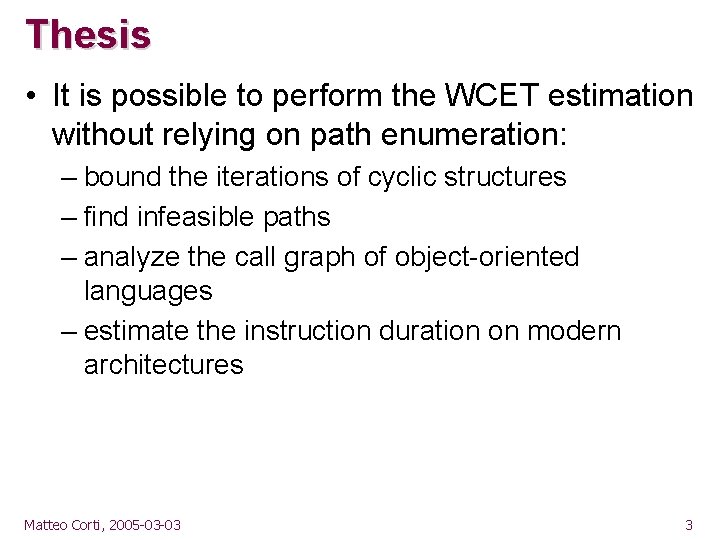
Thesis • It is possible to perform the WCET estimation without relying on path enumeration: – bound the iterations of cyclic structures – find infeasible paths – analyze the call graph of object-oriented languages – estimate the instruction duration on modern architectures Matteo Corti, 2005 -03 -03 3
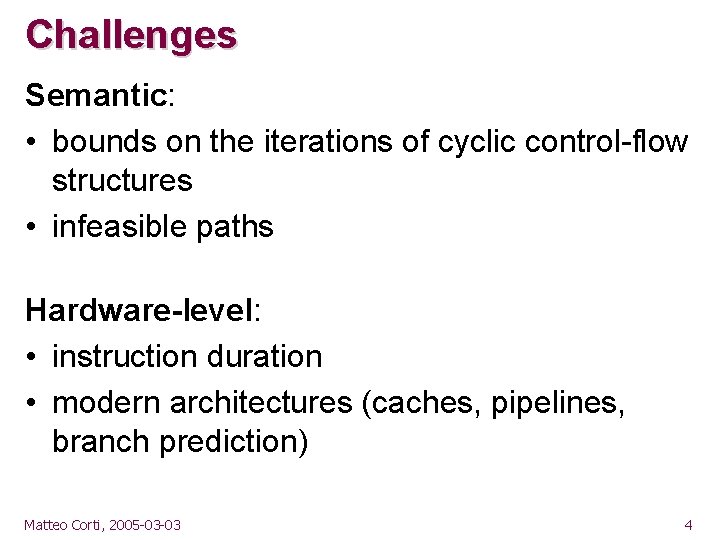
Challenges Semantic: • bounds on the iterations of cyclic control-flow structures • infeasible paths Hardware-level: • instruction duration • modern architectures (caches, pipelines, branch prediction) Matteo Corti, 2005 -03 -03 4
Outline • • • Goal and thesis Semantic analysis Hardware-level analysis Environment Results Concluding remarks Matteo Corti, 2005 -03 -03 5
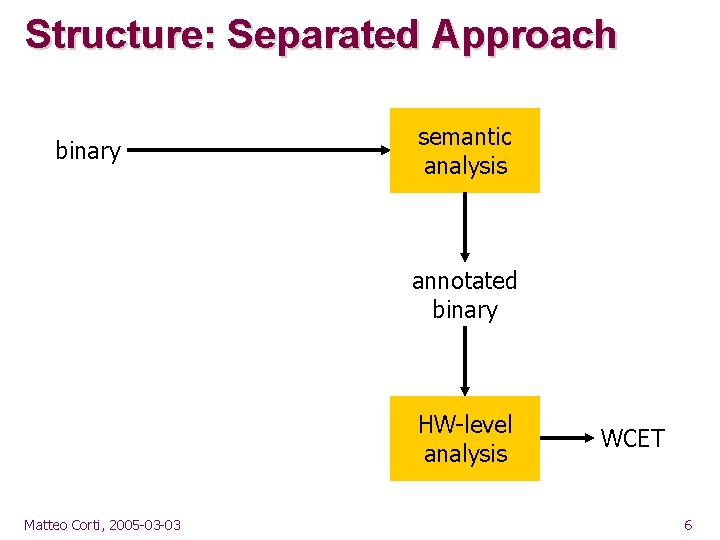
Structure: Separated Approach binary semantic analysis annotated binary HW-level analysis Matteo Corti, 2005 -03 -03 WCET 6
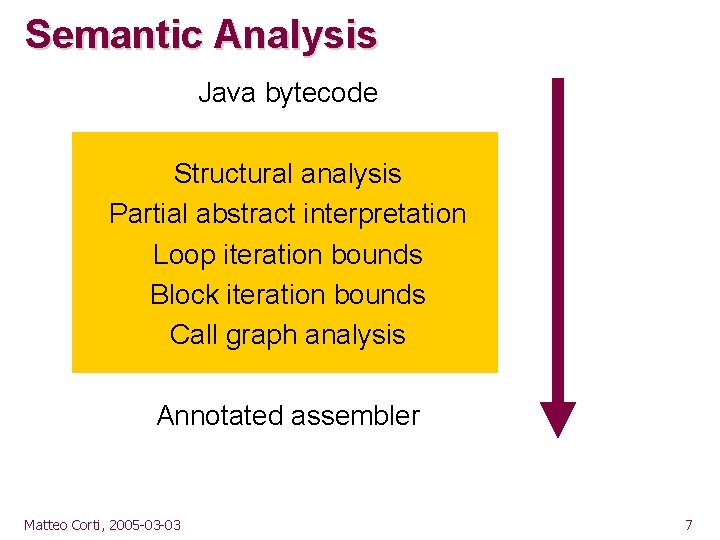
Semantic Analysis Java bytecode Structural analysis Partial abstract interpretation Loop iteration bounds Block iteration bounds Call graph analysis Annotated assembler Matteo Corti, 2005 -03 -03 7
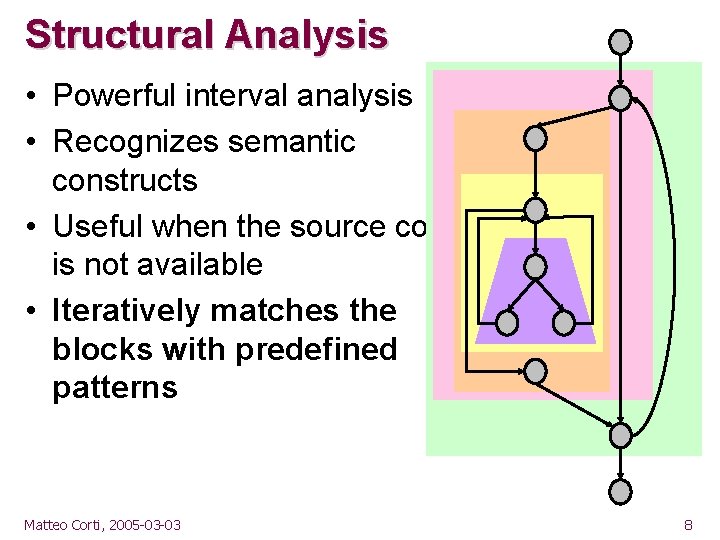
Structural Analysis • Powerful interval analysis • Recognizes semantic constructs • Useful when the source code is not available • Iteratively matches the blocks with predefined patterns Matteo Corti, 2005 -03 -03 8
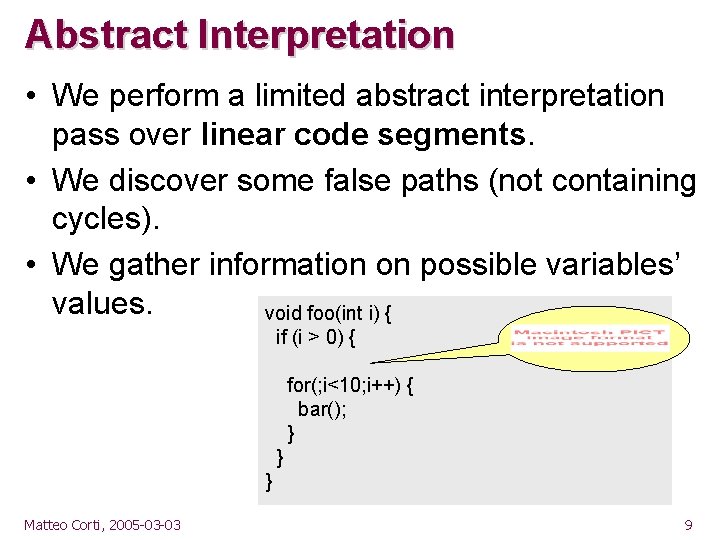
Abstract Interpretation • We perform a limited abstract interpretation pass over linear code segments. • We discover some false paths (not containing cycles). • We gather information on possible variables’ values. void foo(int i) { if (i > 0) { for(; i<10; i++) { bar(); } } } Matteo Corti, 2005 -03 -03 9
Loop Iteration Bounds • Bounds on the loop header computed similarly to C. Healy [RTAS’ 98]. • Each loop is handled in isolation by analyzing the behavior of induction variables. – we consider integer local variables – we handle loops with several induction variables and multiple exit points – computes the minimal and maximal number of iterations for each loop header Matteo Corti, 2005 -03 -03 10
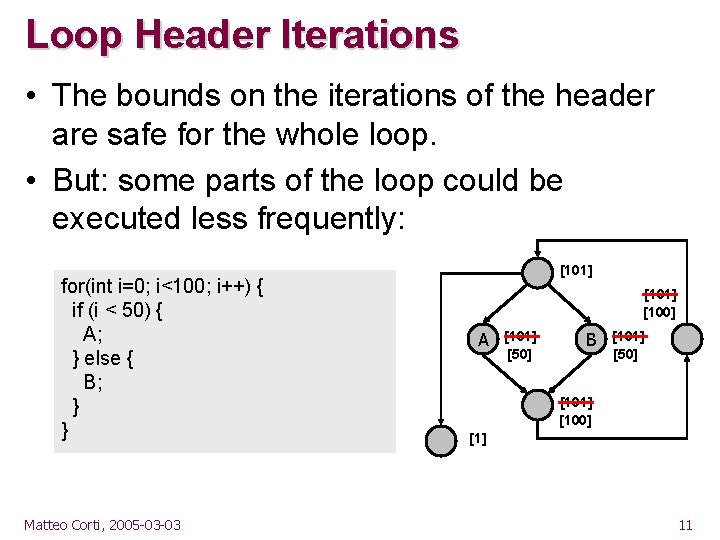
Loop Header Iterations • The bounds on the iterations of the header are safe for the whole loop. • But: some parts of the loop could be executed less frequently: for(int i=0; i<100; i++) { if (i < 50) { A; } else { B; } } Matteo Corti, 2005 -03 -03 [101] [100] A [101] [50] B [101] [50] [101] [100] [1] 11
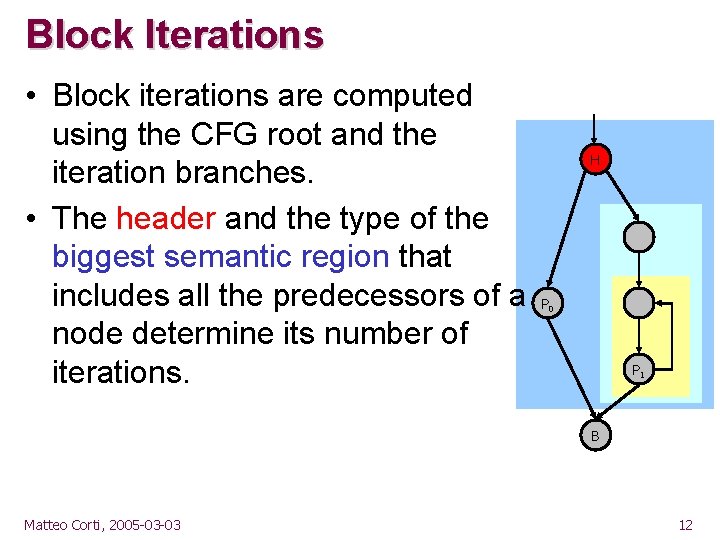
Block Iterations • Block iterations are computed using the CFG root and the iteration branches. • The header and the type of the biggest semantic region that includes all the predecessors of a node determine its number of iterations. H P 0 P 1 B Matteo Corti, 2005 -03 -03 12
Example void foo() { [1] int i, j; [101] for(i=0; i<100; i++) { [550] if (i < 50) { for(j=0; j<10; j++) ; [50] [500] } } [100] } [1] Matteo Corti, 2005 -03 -03 13
Contributions (Semantic Analysis) • We compute bounds on the iterations of basic blocks in quadratic time: – Structural analysis: O(B 2) – Loop bounds: O(B) – Block bounds: O(B) • Related work – Automatically detected value-dependent constraints [Healy, RTAS’ 99]: – Abstract interpretation based approaches Matteo Corti, 2005 -03 -03 14
Outline • • • Goal and thesis Semantic analysis Hardware-level analysis Environment Results Concluding remarks Matteo Corti, 2005 -03 -03 15
Instruction Duration Estimation • Goal: compute the duration of the single instructions • The maximum number of iteration for each instruction is known • The duration depends on the context • Limited computational context: We assume that the effects on the pipeline and caches of an instruction fade over time. Matteo Corti, 2005 -03 -03 16
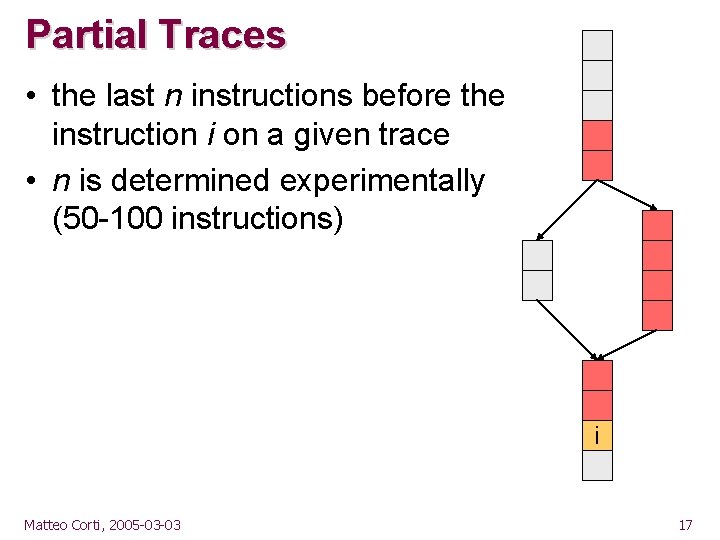
Partial Traces • the last n instructions before the instruction i on a given trace • n is determined experimentally (50 -100 instructions) i Matteo Corti, 2005 -03 -03 17
WCET Estimation • For every partial trace: – CPU behavior simulation (cycle precise) – duration according to the context • We account for all the incoming partial traces (contexts) according to their iteration counts • Block duration = ∑ instruction durations • WCET = longest path Matteo Corti, 2005 -03 -03 18
Data Caches • Partial traces are too short to gather enough information on data caches • Data caches are not simulated but estimated using run-time statistics • The average frequency of data cache misses is measured with a set of test runs of the program Matteo Corti, 2005 -03 -03 19
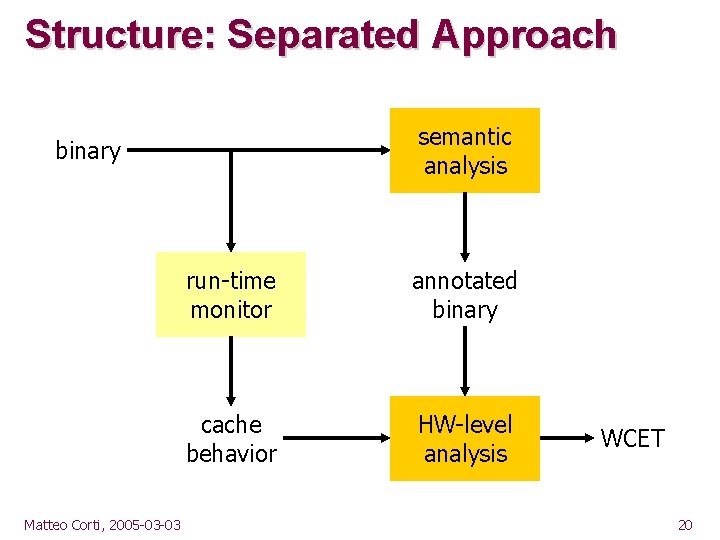
Structure: Separated Approach semantic analysis binary Matteo Corti, 2005 -03 -03 run-time monitor annotated binary cache behavior HW-level analysis WCET 20
Approximation • We approximate the duration of single instructions. • We do not approximate the number of times an instruction is executed. • Inaccuracies are only due to cache and pipeline effects. • No severe WCET underestimations are possible. Matteo Corti, 2005 -03 -03 21
Contributions (HW-level Analysis) • Partial traces evaluation – O(B) – analyze the instructions in their context – approximates the effects of instructions over time – includes run-time data for the analysis of data caches • Related work – abstract interpretation based – data flow analyses Matteo Corti, 2005 -03 -03 22
Outline • • • Goal and thesis Semantic analysis Hardware-level analysis Environment Results Concluding remarks Matteo Corti, 2005 -03 -03 23
Environment • Java ahead-of-time bytecode to native compiler • Linux • Intel Pentium Pro family • Semantic analysis: language independent • Hardware-level analysis: architecture independent Matteo Corti, 2005 -03 -03 24
Outline • • • Goal and thesis Semantic analysis Hardware-level analysis Environment Results Concluding remarks Matteo Corti, 2005 -03 -03 25
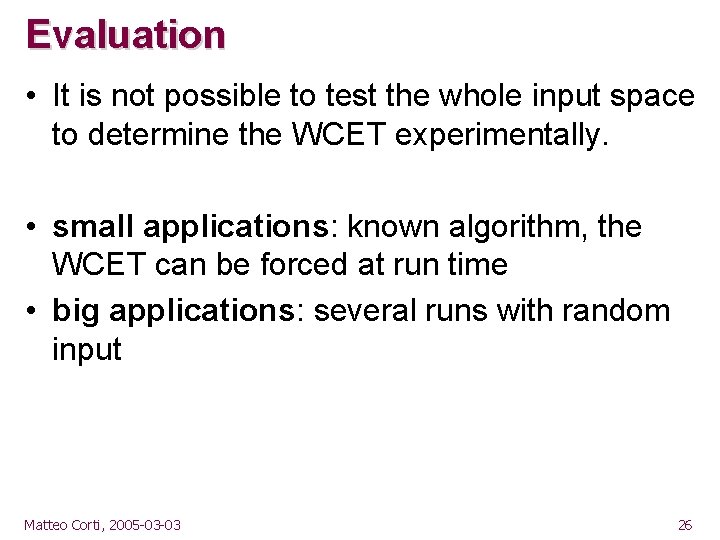
Evaluation • It is not possible to test the whole input space to determine the WCET experimentally. • small applications: known algorithm, the WCET can be forced at run time • big applications: several runs with random input Matteo Corti, 2005 -03 -03 26
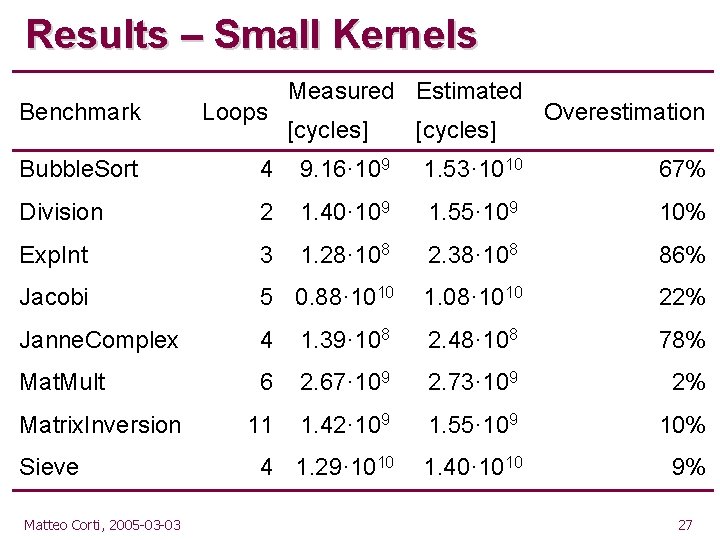
Results – Small Kernels Measured Estimated Benchmark Loops Bubble. Sort 4 9. 16· 109 1. 53· 1010 67% Division 2 1. 40· 109 1. 55· 109 10% Exp. Int 3 1. 28· 108 2. 38· 108 86% Jacobi 5 0. 88· 1010 1. 08· 1010 22% Janne. Complex 4 1. 39· 108 2. 48· 108 78% Mat. Mult 6 2. 67· 109 2. 73· 109 2% 11 1. 42· 109 1. 55· 109 10% 4 1. 29· 1010 1. 40· 1010 9% Matrix. Inversion Sieve Matteo Corti, 2005 -03 -03 [cycles] Overestimation 27
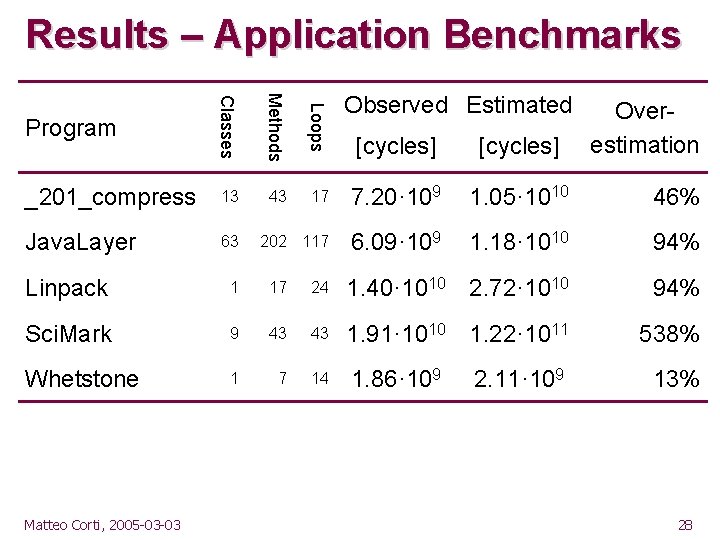
Results – Application Benchmarks 13 Java. Layer 63 Loops Classes _201_compress Methods Program Observed Estimated [cycles] 43 17 7. 20· 109 1. 05· 1010 46% 202 117 6. 09· 109 1. 18· 1010 94% Overestimation Linpack 1 17 24 1. 40· 1010 2. 72· 1010 94% Sci. Mark 9 43 43 1. 91· 1010 1. 22· 1011 538% Whetstone 1 7 14 1. 86· 109 Matteo Corti, 2005 -03 -03 2. 11· 109 13% 28
Outline • • • Goal and thesis Semantic analysis Hardware-level analysis Environment Results Concluding remarks Matteo Corti, 2005 -03 -03 29
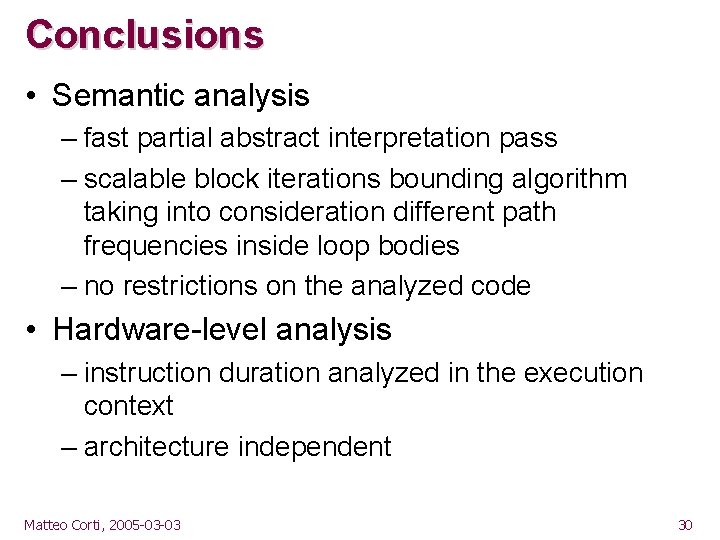
Conclusions • Semantic analysis – fast partial abstract interpretation pass – scalable block iterations bounding algorithm taking into consideration different path frequencies inside loop bodies – no restrictions on the analyzed code • Hardware-level analysis – instruction duration analyzed in the execution context – architecture independent Matteo Corti, 2005 -03 -03 30