
Approximate methods for large molecular systems Marcus Elstner

- Slides: 27
Approximate methods for large molecular systems Marcus Elstner Physical and Theoretical Chemistry, Technical University of Braunschweig
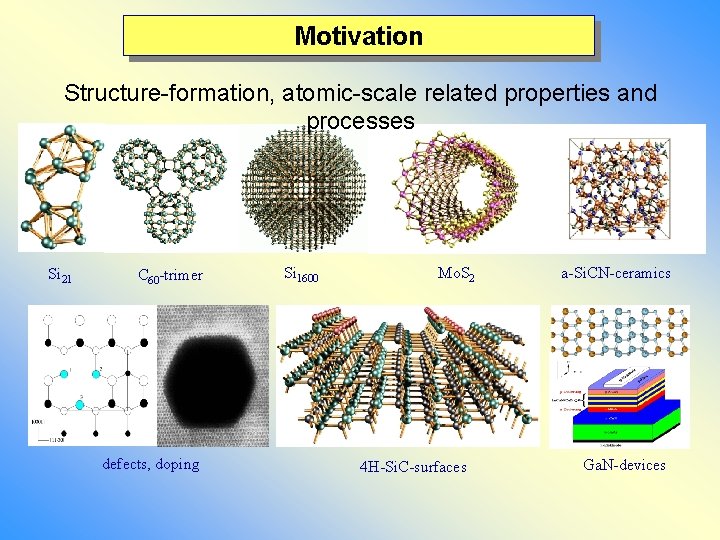
Motivation Structure-formation, atomic-scale related properties and processes Si 21 C 60 -trimer defects, doping Si 1600 Mo. S 2 4 H-Si. C-surfaces a-Si. CN-ceramics Ga. N-devices
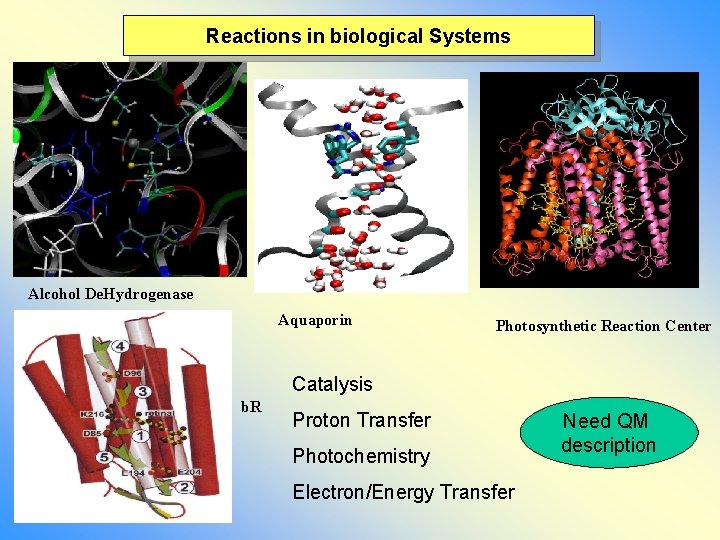
Reactions in biological Systems Alcohol De. Hydrogenase Aquaporin Photosynthetic Reaction Center Catalysis b. R Photochemistry Proton Transfer Photochemistry Electron/Energy Transfer Need QM description
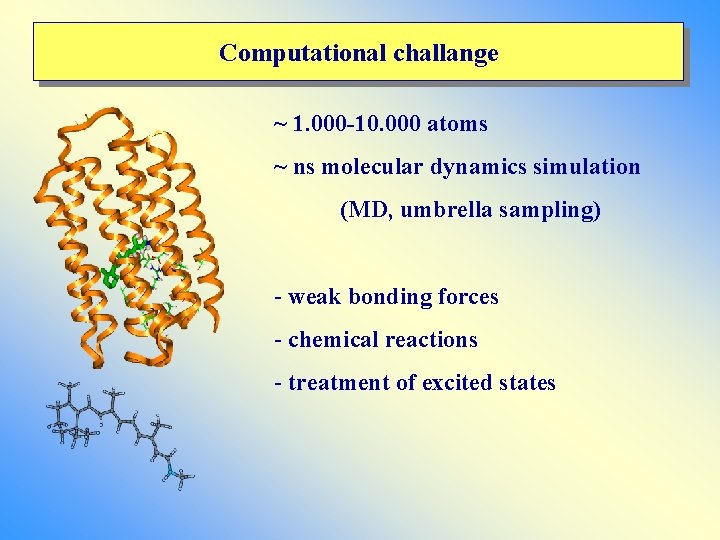
Computational challange ~ 1. 000 -10. 000 atoms ~ ns molecular dynamics simulation (MD, umbrella sampling) - weak bonding forces - chemical reactions - treatment of excited states
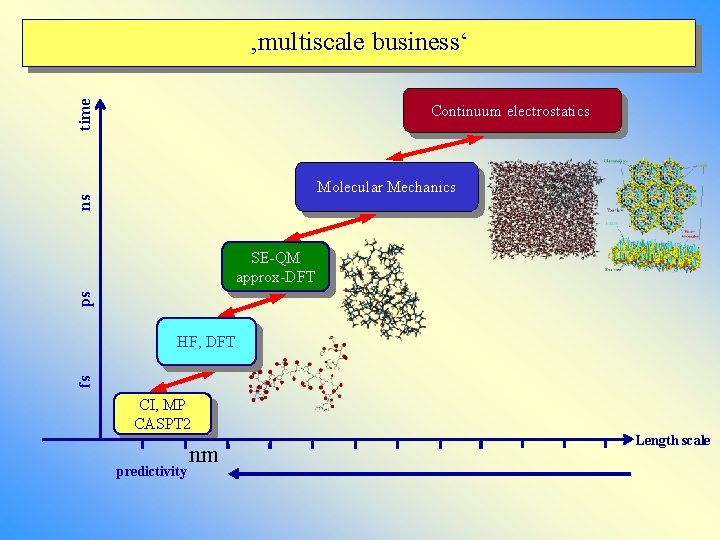
time ‚multiscale business‘ Continuum electrostatics ns Molecular Mechanics ps SE-QM approx-DFT fs HF, DFT CI, MP CASPT 2 predictivity nm Length scale
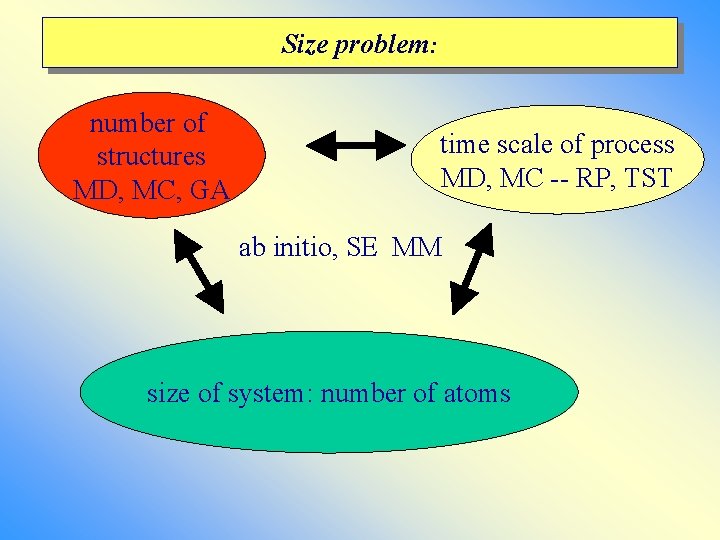
Size problem: number of structures MD, MC, GA time scale of process MD, MC -- RP, TST ab initio, SE MM size of system: number of atoms
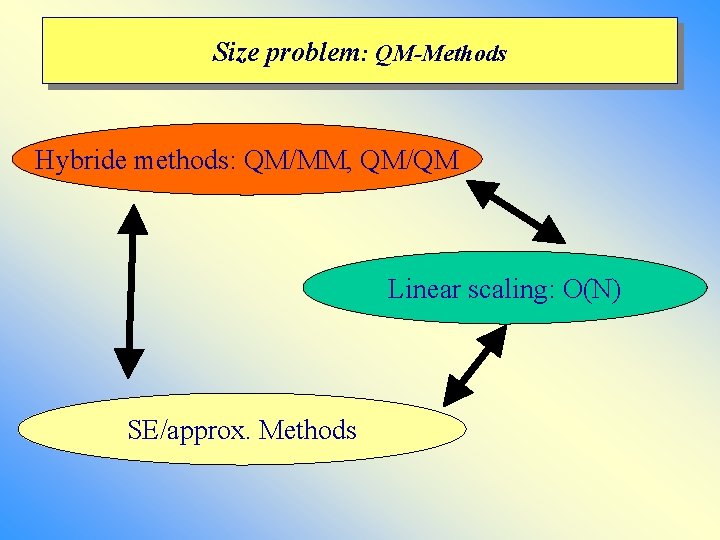
Size problem: QM-Methods Hybride methods: QM/MM, QM/QM Linear scaling: O(N) SE/approx. Methods
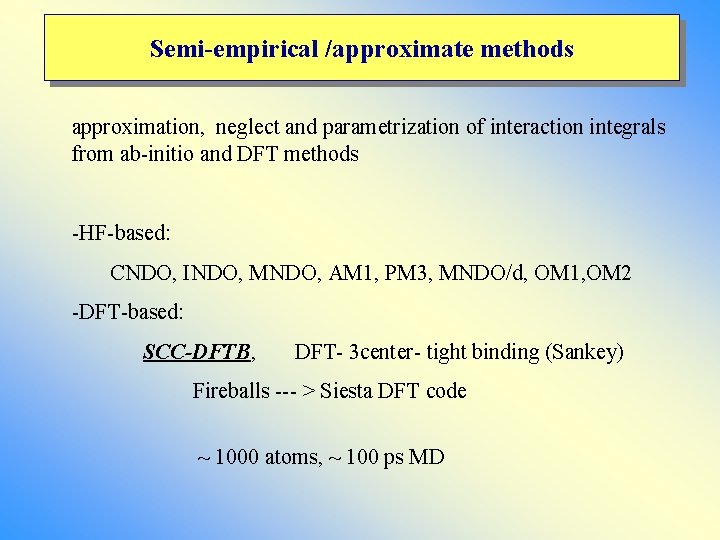
Semi-empirical /approximate methods approximation, neglect and parametrization of interaction integrals from ab-initio and DFT methods -HF-based: CNDO, INDO, MNDO, AM 1, PM 3, MNDO/d, OM 1, OM 2 -DFT-based: SCC-DFTB, DFT- 3 center- tight binding (Sankey) Fireballs --- > Siesta DFT code ~ 1000 atoms, ~ 100 ps MD
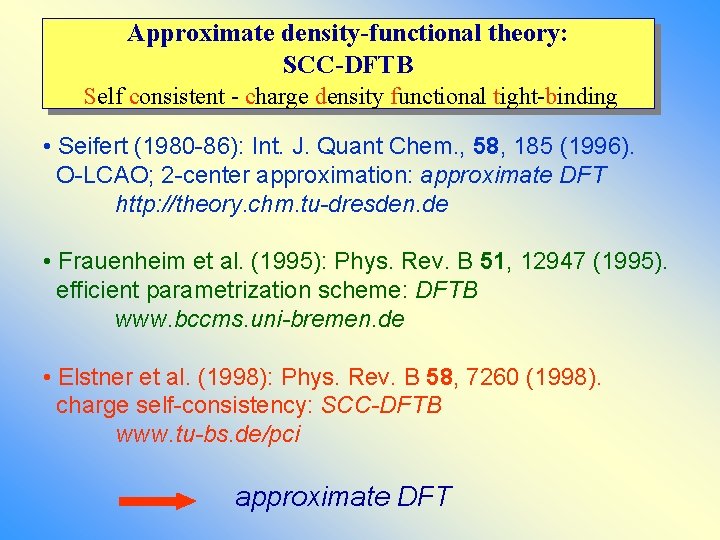
Approximate density-functional theory: SCC-DFTB Self consistent - charge density functional tight-binding • Seifert (1980 -86): Int. J. Quant Chem. , 58, 185 (1996). O-LCAO; 2 -center approximation: approximate DFT http: //theory. chm. tu-dresden. de • Frauenheim et al. (1995): Phys. Rev. B 51, 12947 (1995). efficient parametrization scheme: DFTB www. bccms. uni-bremen. de • Elstner et al. (1998): Phys. Rev. B 58, 7260 (1998). charge self-consistency: SCC-DFTB www. tu-bs. de/pci approximate DFT
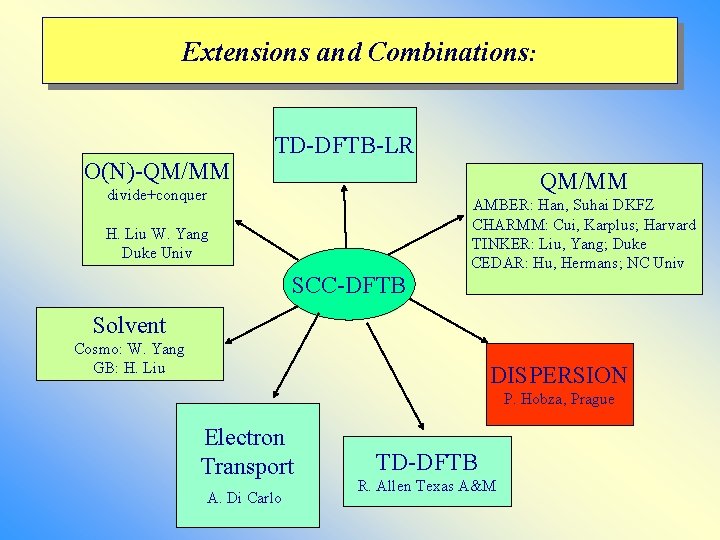
Extensions and Combinations: O(N)-QM/MM TD-DFTB-LR QM/MM divide+conquer H. Liu W. Yang Duke Univ SCC-DFTB AMBER: Han, Suhai DKFZ CHARMM: Cui, Karplus; Harvard TINKER: Liu, Yang; Duke CEDAR: Hu, Hermans; NC Univ Solvent Cosmo: W. Yang GB: H. Liu DISPERSION P. Hobza, Prague Electron Transport A. Di Carlo TD-DFTB R. Allen Texas A&M
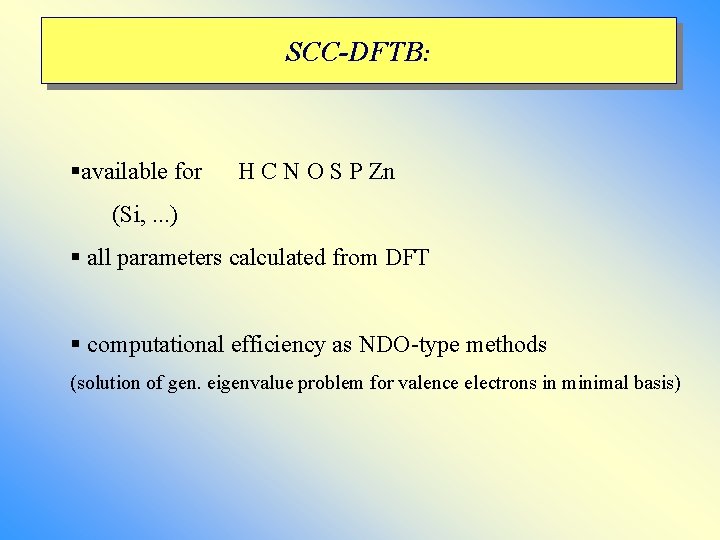
SCC-DFTB: §available for H C N O S P Zn (Si, . . . ) § all parameters calculated from DFT § computational efficiency as NDO-type methods (solution of gen. eigenvalue problem for valence electrons in minimal basis)
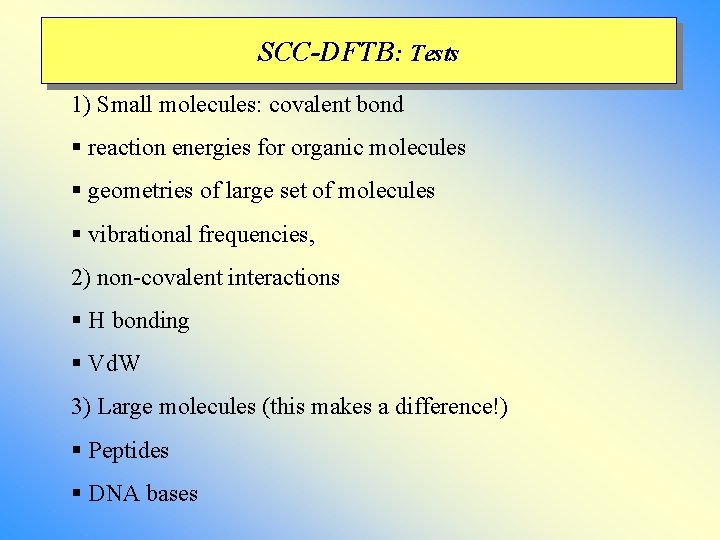
SCC-DFTB: Tests 1) Small molecules: covalent bond § reaction energies for organic molecules § geometries of large set of molecules § vibrational frequencies, 2) non-covalent interactions § H bonding § Vd. W 3) Large molecules (this makes a difference!) § Peptides § DNA bases
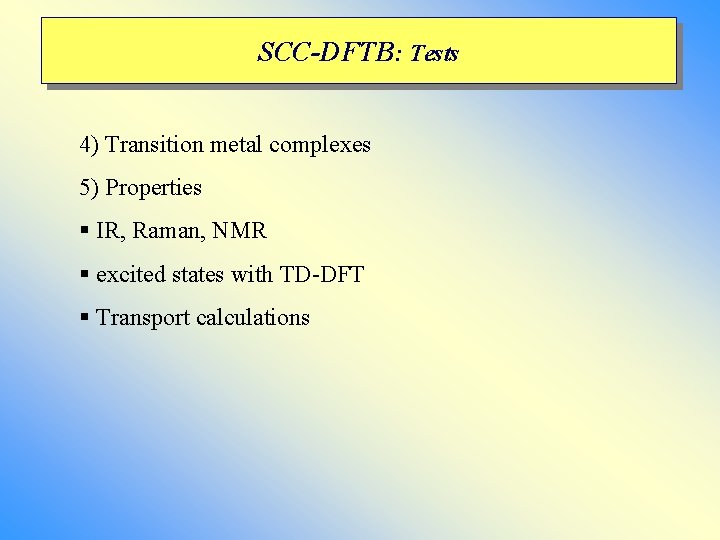
SCC-DFTB: Tests 4) Transition metal complexes 5) Properties § IR, Raman, NMR § excited states with TD-DFT § Transport calculations
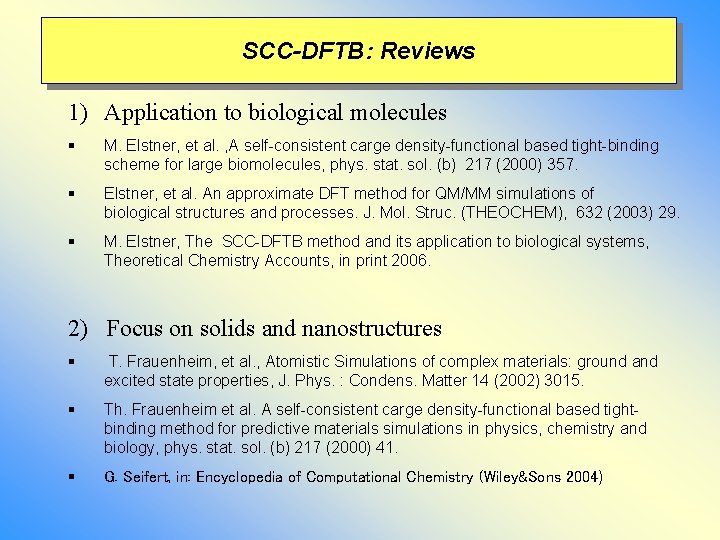
SCC-DFTB: Reviews 1) Application to biological molecules § M. Elstner, et al. , A self-consistent carge density-functional based tight-binding scheme for large biomolecules, phys. stat. sol. (b) 217 (2000) 357. § Elstner, et al. An approximate DFT method for QM/MM simulations of biological structures and processes. J. Mol. Struc. (THEOCHEM), 632 (2003) 29. § M. Elstner, The SCC-DFTB method and its application to biological systems, Theoretical Chemistry Accounts, in print 2006. 2) Focus on solids and nanostructures § T. Frauenheim, et al. , Atomistic Simulations of complex materials: ground and excited state properties, J. Phys. : Condens. Matter 14 (2002) 3015. § Th. Frauenheim et al. A self-consistent carge density-functional based tightbinding method for predictive materials simulations in physics, chemistry and biology, phys. stat. sol. (b) 217 (2000) 41. § G. Seifert, in: Encyclopedia of Computational Chemistry (Wiley&Sons 2004)
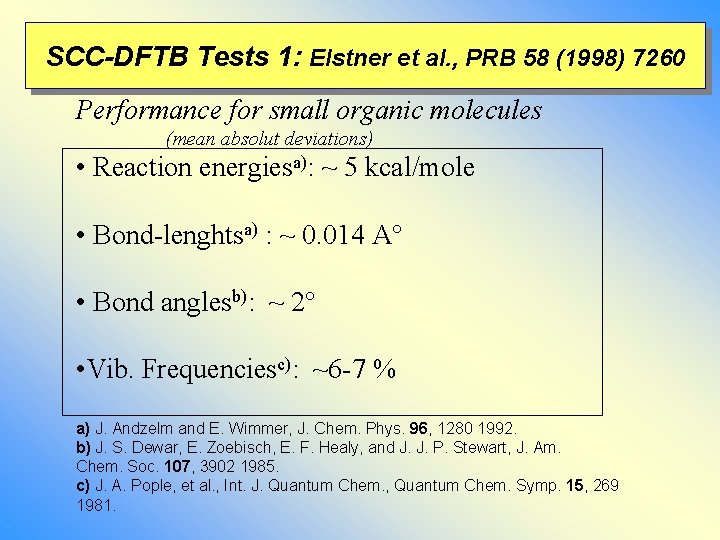
SCC-DFTB Tests 1: Elstner et al. , PRB 58 (1998) 7260 Performance for small organic molecules (mean absolut deviations) • Reaction energiesa): ~ 5 kcal/mole • Bond-lenghtsa) : ~ 0. 014 A° • Bond anglesb): ~ 2° • Vib. Frequenciesc): ~6 -7 % a) J. Andzelm and E. Wimmer, J. Chem. Phys. 96, 1280 1992. b) J. S. Dewar, E. Zoebisch, E. F. Healy, and J. J. P. Stewart, J. Am. Chem. Soc. 107, 3902 1985. c) J. A. Pople, et al. , Int. J. Quantum Chem. , Quantum Chem. Symp. 15, 269 1981.
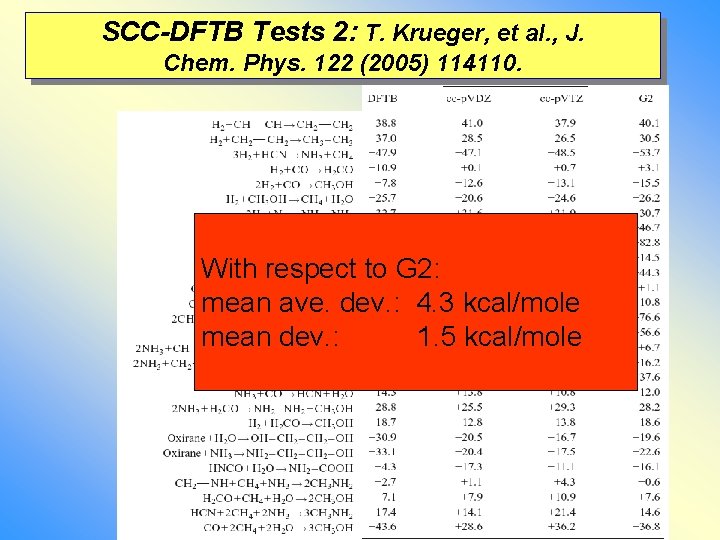
SCC-DFTB Tests 2: T. Krueger, et al. , J. Chem. Phys. 122 (2005) 114110. With respect to G 2: mean ave. dev. : 4. 3 kcal/mole mean dev. : 1. 5 kcal/mole
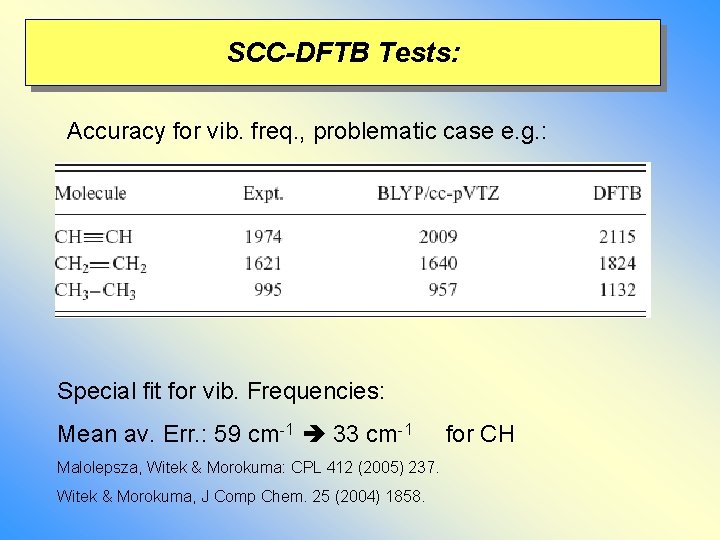
SCC-DFTB Tests: Accuracy for vib. freq. , problematic case e. g. : Special fit for vib. Frequencies: Mean av. Err. : 59 cm-1 33 cm-1 Malolepsza, Witek & Morokuma: CPL 412 (2005) 237. Witek & Morokuma, J Comp Chem. 25 (2004) 1858. for CH
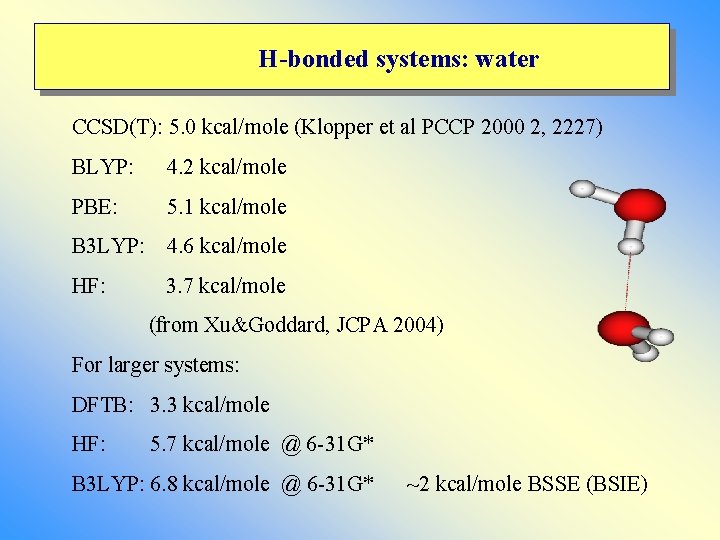
H-bonded systems: water CCSD(T): 5. 0 kcal/mole (Klopper et al PCCP 2000 2, 2227) BLYP: 4. 2 kcal/mole PBE: 5. 1 kcal/mole B 3 LYP: 4. 6 kcal/mole HF: 3. 7 kcal/mole (from Xu&Goddard, JCPA 2004) For larger systems: DFTB: 3. 3 kcal/mole HF: 5. 7 kcal/mole @ 6 -31 G* B 3 LYP: 6. 8 kcal/mole @ 6 -31 G* ~2 kcal/mole BSSE (BSIE)
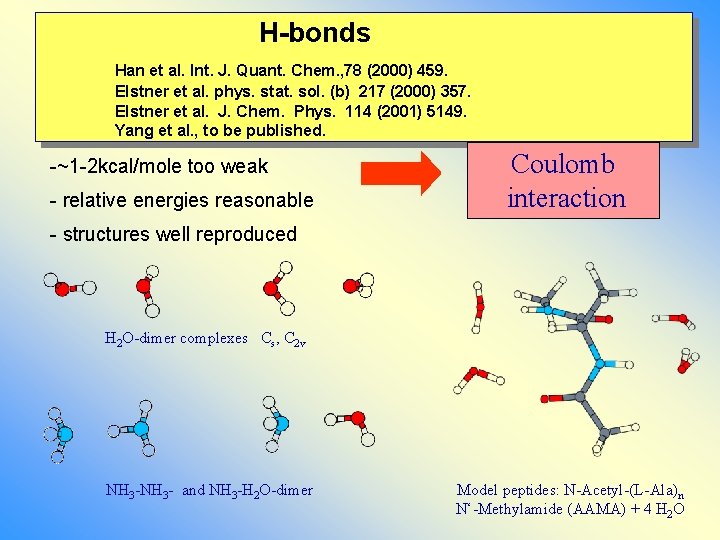
H-bonds Han et al. Int. J. Quant. Chem. , 78 (2000) 459. Elstner et al. phys. stat. sol. (b) 217 (2000) 357. Elstner et al. J. Chem. Phys. 114 (2001) 5149. Yang et al. , to be published. -~1 -2 kcal/mole too weak - relative energies reasonable Coulomb interaction - structures well reproduced H 2 O-dimer complexes Cs, C 2 v NH 3 - and NH 3 -H 2 O-dimer Model peptides: N-Acetyl-(L-Ala)n N‘-Methylamide (AAMA) + 4 H 2 O
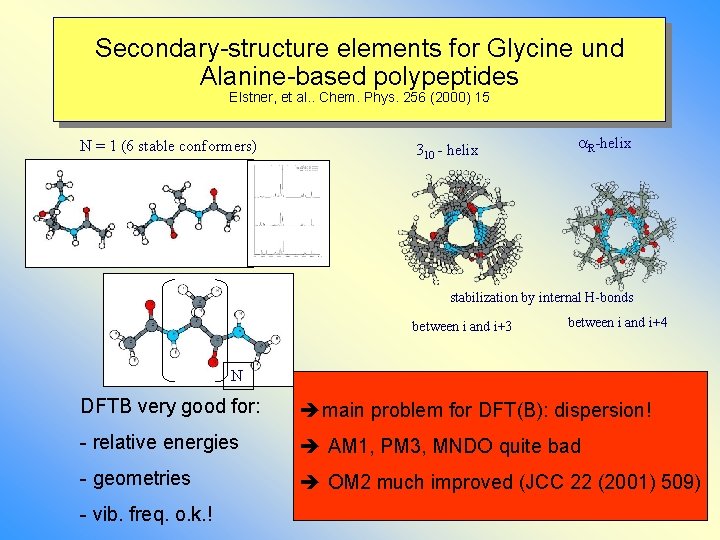
Secondary-structure elements for Glycine und Alanine-based polypeptides Elstner, et al. . Chem. Phys. 256 (2000) 15 N = 1 (6 stable conformers) 310 - helix a. R-helix stabilization by internal H-bonds between i and i+3 between i and i+4 N DFTB very good for: main problem for DFT(B): dispersion! - relative energies AM 1, PM 3, MNDO quite bad - geometries OM 2 much improved (JCC 22 (2001) 509) - vib. freq. o. k. !
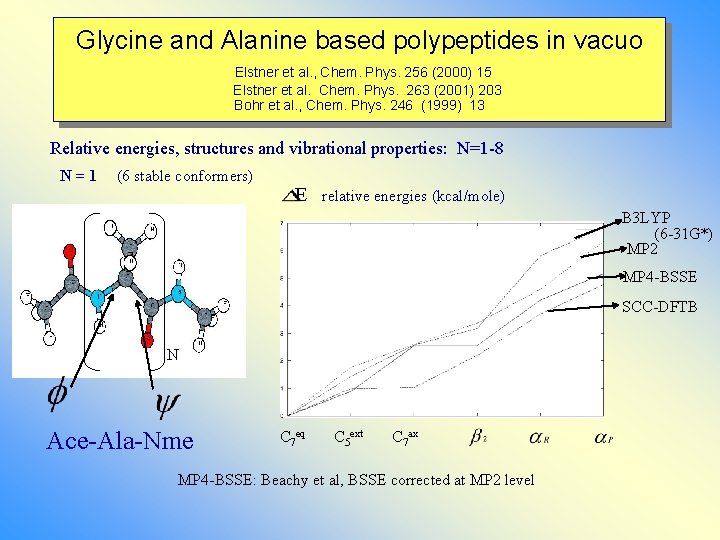
Glycine and Alanine based polypeptides in vacuo Elstner et al. , Chem. Phys. 256 (2000) 15 Elstner et al. Chem. Phys. 263 (2001) 203 Bohr et al. , Chem. Phys. 246 (1999) 13 Relative energies, structures and vibrational properties: N=1 -8 N=1 (6 stable conformers) E relative energies (kcal/mole) B 3 LYP (6 -31 G*) MP 2 MP 4 -BSSE SCC-DFTB N Ace-Ala-Nme C 7 eq C 5 ext C 7 ax MP 4 -BSSE: Beachy et al, BSSE corrected at MP 2 level
Strength of SCC-DFTB Structure of large molecules - dynamics - relative energies DNA: A. V. Shiskin, et al. , Int. J. Mol. Sci. 4 (2003) 537. O. V. Shishkin, et al. , J. Mol. Struc. (THEOCHEM) 625 (2003) 295.
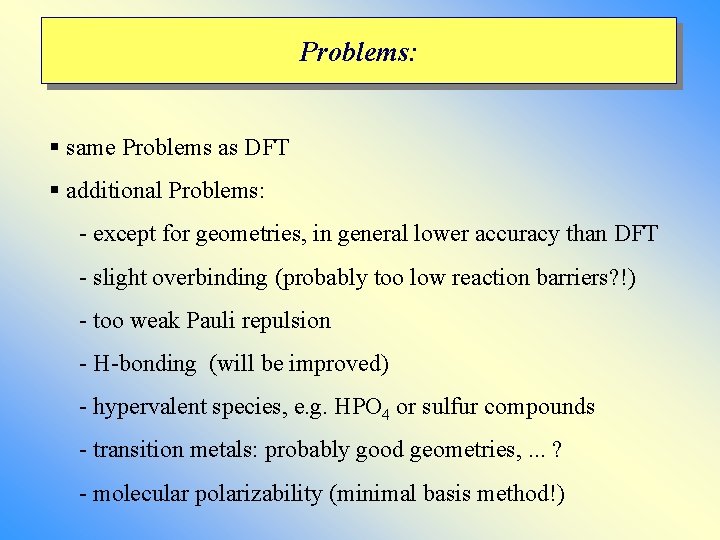
Problems: § same Problems as DFT § additional Problems: - except for geometries, in general lower accuracy than DFT - slight overbinding (probably too low reaction barriers? !) - too weak Pauli repulsion - H-bonding (will be improved) - hypervalent species, e. g. HPO 4 or sulfur compounds - transition metals: probably good geometries, . . . ? - molecular polarizability (minimal basis method!)
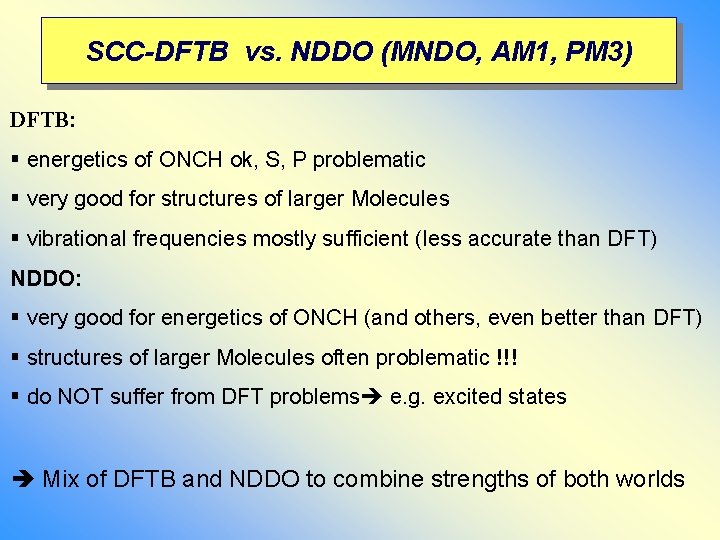
SCC-DFTB vs. NDDO (MNDO, AM 1, PM 3) DFTB: § energetics of ONCH ok, S, P problematic § very good for structures of larger Molecules § vibrational frequencies mostly sufficient (less accurate than DFT) NDDO: § very good for energetics of ONCH (and others, even better than DFT) § structures of larger Molecules often problematic !!! § do NOT suffer from DFT problems e. g. excited states Mix of DFTB and NDDO to combine strengths of both worlds
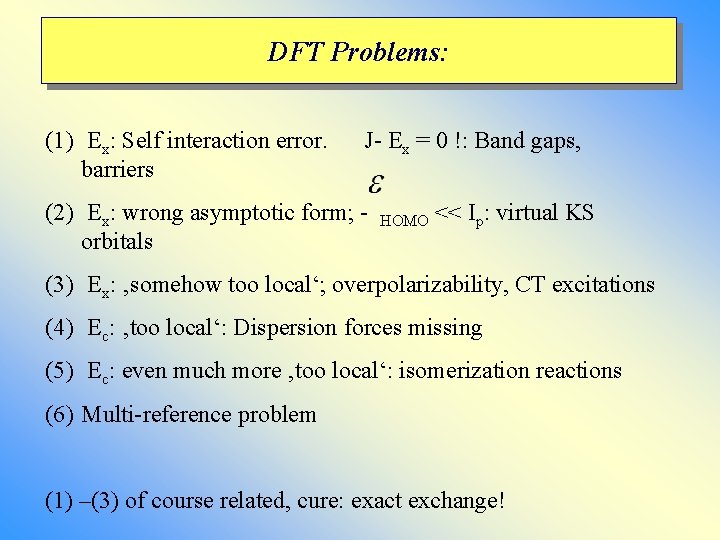
DFT Problems: (1) Ex: Self interaction error. barriers J- Ex = 0 !: Band gaps, (2) Ex: wrong asymptotic form; orbitals HOMO << Ip: virtual KS (3) Ex: ‚somehow too local‘; overpolarizability, CT excitations (4) Ec: ‚too local‘: Dispersion forces missing (5) Ec: even much more ‚too local‘: isomerization reactions (6) Multi-reference problem (1) –(3) of course related, cure: exact exchange!
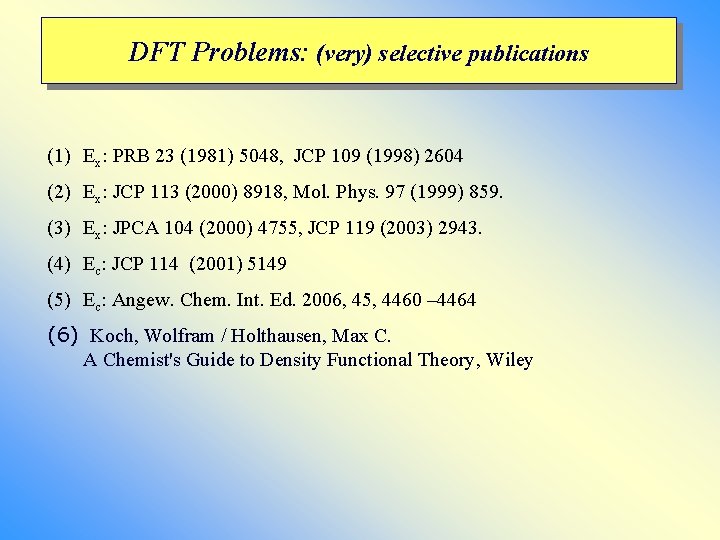
DFT Problems: (very) selective publications (1) Ex: PRB 23 (1981) 5048, JCP 109 (1998) 2604 (2) Ex: JCP 113 (2000) 8918, Mol. Phys. 97 (1999) 859. (3) Ex: JPCA 104 (2000) 4755, JCP 119 (2003) 2943. (4) Ec: JCP 114 (2001) 5149 (5) Ec: Angew. Chem. Int. Ed. 2006, 45, 4460 – 4464 (6) Koch, Wolfram / Holthausen, Max C. A Chemist's Guide to Density Functional Theory, Wiley
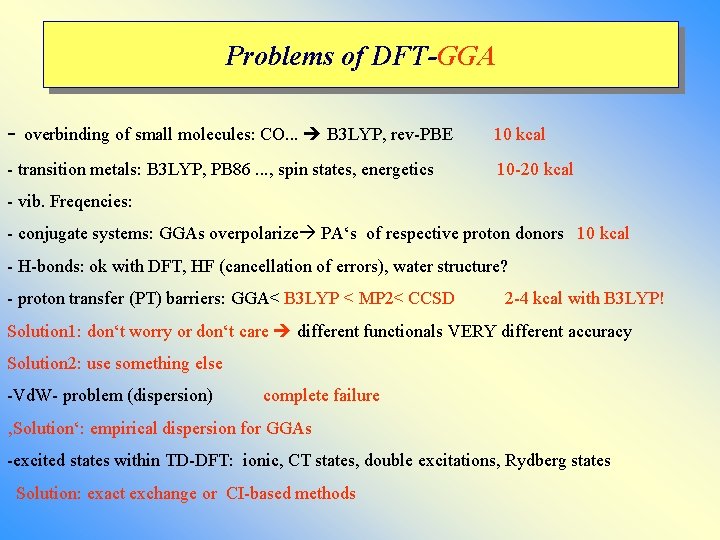
Problems of DFT-GGA - overbinding of small molecules: CO. . . B 3 LYP, rev-PBE 10 kcal - transition metals: B 3 LYP, PB 86. . . , spin states, energetics 10 -20 kcal - vib. Freqencies: - conjugate systems: GGAs overpolarize PA‘s of respective proton donors 10 kcal - H-bonds: ok with DFT, HF (cancellation of errors), water structure? - proton transfer (PT) barriers: GGA< B 3 LYP < MP 2< CCSD 2 -4 kcal with B 3 LYP! Solution 1: don‘t worry or don‘t care different functionals VERY different accuracy Solution 2: use something else -Vd. W- problem (dispersion) complete failure ‚Solution‘: empirical dispersion for GGAs -excited states within TD-DFT: ionic, CT states, double excitations, Rydberg states Solution: exact exchange or CI-based methods