
Approximate Measurement Invariance in CrossCultural and Comparative Research




- Slides: 65
Approximate Measurement Invariance in Cross-Cultural and Comparative Research: Results from four studies MPLUS USER MEETING UTRECHT 13. 1. 2016 Peter Schmidt University of Giessen
Overview �General Approach �Study 1: Attitude toward Immigration in the ESS �Study 2: Revised Value Scale with 19 values �Study 3: Invariance of Universalism Value over time and countries in the ESS �Study 4: Invariance of four Higher Order Factors of Values in the ESS �Outlook: Approximate Measurement Invariance, Robustness checks, Multilevel CFA/SEM as explanatory tool.
Measurement invariance - psychometric property of a questionnaire The questionnaire is measurement invariant when it measures - the same construct - in the same way - across different groups, such as countries, cultures or other geographical regions, conditions of data collection or time points Measurement invariance is a precondition for any meaningful comparison of means, correlates and regression coefficients of the measured construct across groups(Proof given by Meredith 1993, elaborated in Millsap 2011, Guenole/Brown 2015)
RECENT CONTROVERSY �Measurement Invariance in the World Value Study �Aleman/Woods (2015): „Our findings indicate that for the most part WVS orientations are not configural, metric and scalar invariant and hence comparable cross-nationally (over 89 nations), except among a small number of Western postindustrial societies“ (p. 21). �Welzel/Ingelhart(2016)
Approaches to measurement invariance 1) Assuming it ( dangerous) 2) Empirical assessment establishing full MI (rather seldom) in case of lack of MI - looking for partial MI (Byrne, Shavelson & Muthén 1989) - dropping groups or items - refraining from cross-group comparisons -looking for alternative appropriate methods to assess cross-group invariance - checking for robustness (Oberski 2014, Kouha/Moustaki 2015)
Most often used approach to test for measurement invariance: 1) Multigroup Confirmatory Factor Analysis - MGCFA (Bollen 1989, Jöreskog 1971) Group A 1) configural invariance 2) metric invariance Group B 3) scalar invariance α 1 B α 1 A Quest. a α 2 A Quest. b α 3 A Quest. c Quest. a 1 β 1 A β 2 A α 2 B Quest. b Latent variable α 3 B 1 β 1 B Latent variable β 2 B Quest. c 2) Evaluation based on differences in global model fit indices between models (Chen, 2007)
Alternative approaches in the framework of MGCFA: 1) Test for approximate (Bayesian) rather than exact measurement invariance (Muthén & Asparouhov, 2013, van der Schoot et al. 2014) 2) Evaluation of exact measurement invariance based on local misspecifications (Saris, Satorra & van der veld, 2009) Note! Similar assumption in both approaches: allowing for some „small” deviation
Study 1 The comparability of attitudes toward immigration in the European Social Survey: Exact versus approximate measurement equivalence (Public Opinion Quarterly 2015) Eldad Davidov – University of Zurich Jan Cieciuch – University of Zurich, University of Finance and Management in Warsaw Peter Schmidt – University of Giessen Bart Meuleman – University of Leuven René Algesheimer – University of Zurich
Data and Measurements �A total of 35 countries and 6 rounds of the ESS (2002/3, 2004/5, 2006/7, 2008/9, 2010/11, 2012/13) are included in the study. �Not all countries participated in all rounds. �Some joined early on in 2002/3 and did not participate in other later rounds. �Other countries were not part of the ESS at the beginning but joined later.
Data and Measurements �Table 1 summarizes the number of participants in each round, the percentage of female respondents, and the mean and standard deviations of the respondents’ age in each country. �Data in each country included both respondents with and without immigration background. �We excluded respondents with a migration background from our analysis to avoid positivity bias in the scores.
Data and Measurements �Thus, the total sample included 271, 220 respondents. �The data were retrieved from the ESS website, www. europeansocialsurvey. org �Further information on data collection procedures, the full questionnaire, response rates, and methodological documentation is available on the ESS website.
Data and Measurements �Three items in the ESS measured attitudes toward immigration. �They ask whether respondents prefer their country to allow more or fewer immigrants who belong to a certain group to come into the country.
Data and Measurements �The first group consists of people of the same race or ethnic group from most [country] people, �the second group consists of people of a different race or ethnic group from most [country] people, �and the third consists of people from poorer countries outside Europe. �Respondents record their responses to these three questions on 4 -point scales ranging from 1 (allow none) to 4 (allow many).
Data and Measurements Number of respondents (N) by country and ESS round with % of female (% F) and mean and standard deviation of age 1 st Round 2 nd Round 3 rd Round 4 th Round 5 th Round (2002/3) (2004/5) (2006/7) (2008/9) (2010/11) N % F Mage N % F Mage (SDage) (SDage) 1. Austria 2053 54. 0 46. 74 2074 53. 7 43. 65 2236 53. 7 44. 18 1987 54. 4 47. 13 (17. 19) (17. 91) (18. 52) 2. 1739 47. 7 44. 61 1619 51. 2 45. 17 1645 52. 6 46. 21 1586 51. 6 46. 43 1516 51. 1 47. 17 Belgium (18. 48) (18. 86) (19. 00) (19. 16) 3. 1387 60. 9 49. 83 2210 56. 1 51. 78 2412 56. 4 53. 30 Bulgaria (17. 80) (17. 64) (17. 84) 4. Croatia 1353 56. 2 46. 78 1474 56. 3 50. 58 (18. 25) (18. 99) 5. Cyprus 945 51. 9 46. 88 1119 49. 3 45. 38 1016 54. 3 48. 72 (17. 54) (18. 04) (18. 91) 6. Czech 1297 51. 6 51. 46 2890 53. 2 48. 08 1976 51. 2 46. 90 2339 50. 1 46. 79 Republic (17. 55) (17. 88) (17. 37) (17. 64) 7. 1422 48. 7 46. 74 1415 51. 1 47. 23 1403 50. 8 49. 90 1510 49. 6 49. 54 1475 48. 78 Denmark (17. 73) (17. 78) (17. 61) (18. 09) (18. 62) 8. 1615 57. 9 44. 66 1199 55. 8 44. 55 1305 56. 6 44. 94 1517 58. 0 46. 45 Estonia (19. 48) (19. 22) (18. 98) (19. 43) 9. 1937 51. 7 45. 95 1983 52. 8 47. 53 1838 51. 0 48. 73 2139 50. 9 48. 26 1813 51. 5 49. 20 Finland (18. 53) (18. 67) (19. 05) (18. 76) (19. 27) 10. 1353 54. 8 47. 16 1670 53. 8 48. 70 1791 53. 2 48. 15 1911 54. 3 48. 59 1573 53. 2 49. 24 France (18. 56) (18. 04) (17. 84) (18. 96) (18. 56) 6 th Round (2012/13) N % F Mage (SDage) 1606 50. 9 47. 71 (19. 47) 2247 57. 5 53. 95 (16. 95) 991 56. 2 48. 96 (18. 59) 1944 50. 7 47. 54 (17. 11) 1536 48. 94 (19. 22) 1991 56. 8 47. 01 (19. 41) 2103 51. 2 50. 24 (18. 92) 14
Data and Measurements Number of respondents (N) by country and ESS round with % of female (% F) and mean and standard deviation of age 11. Germany 12. Greece 13. Hungary 14. Iceland 15. Ireland 16. Israel 17. Italy 18. Kosovo 19. Latvia 20. Lithuania 1 st Round 2 nd Round 3 rd Round 4 th Round 5 th Round (2002/3) (2004/5) (2006/7) (2008/9) (2010/11) N % F Mage N % F Mage (SDage) (SDage) 2705 51. 7 47. 64 2625 51. 4 47. 27 2687 50. 7 48. 18 2518 47. 5 49. 40 2743 48. 09 (17. 95) (17. 97) (18. 12) (17. 43) (18. 53) 2302 57. 2 50. 59 2164 56. 4 51. 30 1950 54. 8 45. 59 2447 55. 9 48. 45 (19. 22) (18. 85) (16. 87) (19. 05) 1645 51. 9 45. 91 1465 56. 8 46. 58 1484 58. 8 51. 13 1514 54. 2 47. 70 1518 53. 8 47. 70 (18. 20) (18. 09) (18. 54) (19. 10) (18. 35) 554 51. 8 44. 54 (17. 71) 1890 53. 5 45. 98 2138 43. 3 48. 24 1561 52. 8 47. 16 1479 54. 5 49. 39 2170 54. 5 47. 82 (17. 84) (18. 08) (18. 35) (18. 29) (19. 12) 1626 50. 4 36. 13 1588 51. 9 38. 97 1529 51. 7 39. 48 (15. 79) (16. 07) (16. 87) 1181 54. 4 47. 01 1494 50. 7 48. 01 (17. 89) (18. 09) 6 th Round (2012/13) N % F Mage (SDage) 2658 49. 3 49. 17 (18. 74) 1989 55. 0 47. 14 (18. 20) 707 49. 8 44. 64 (18. 84) 2244 53. 0 48. 65 (18. 17) 1725 52. 9 39. 11 (16. 50) 1222 51. 2 43. 33 (17. 04) 1753 59. 1 40. 76 1706 61. 6 46. 52 (19. 06) (18. 56) 1916 49. 8 44. 59 1592 64. 1 51. 54 (18. 86) (19. 46) 15
Data and Measurements Number of respondents (N) by country and ESS round with % of female (% F) and mean and standard deviation of age 1 st Round 2 nd Round 3 rd Round 4 th Round 5 th Round (2002/3) (2004/5) (2006/7) (2008/9) (2010/11) N % F Mage N % F Mage (SDage) (SDage) 21. 1069 51. 7 43. 76 1147 48. 0 44. 07 Luxembo (19. 65) (18. 78) urg 22. 2207 56. 0 48. 20 1717 58. 8 49. 88 1711 53. 8 49. 30 1610 54. 3 49. 77 1688 54. 3 50. 71 Netherla (17. 13) (17. 49) (17. 87) (18. 00) (17. 66) nds 23. 1903 46. 12 1632 47. 8 46. 06 1625 48. 5 45. 94 1418 47. 5 46. 15 1373 47. 9 47. 14 Norway (17. 22) (17. 43) (18. 32) (18. 14) (18. 76) 24. 2079 51. 1 42. 57 1697 51. 5 41. 93 1696 52. 8 43. 53 1596 52. 7 44. 36 1723 51. 9 44. 04 Poland (18. 51) (17. 92) (18. 45) (18. 86) (18. 74) 25. 1421 58. 5 48. 52 1932 60. 6 50. 09 2078 61. 6 52. 22 2229 60. 7 53. 48 2004 60. 1 54. 81 Portugal (19. 11) (19. 48) (19. 02) (19. 87) (19. 19) 26. 2130 52. 4 46. 12 2088 54. 8 46. 03 Romania (18. 45) (17. 64) 27. 2280 59. 6 46. 19 2376 60. 9 47. 22 2435 59. 4 46. 29 Russia (19. 11) (19. 06) (18. 61) 28. 1465 48. 4 42. 15 1703 50. 7 42. 97 1760 61. 6 49. 95 1802 61. 3 50. 40 Slovakia (17. 83) (17. 79) (17. 16) (17. 39) 29. 1374 52. 4 44. 04 1320 52. 9 44. 89 1362 54. 8 46. 09 1178 53. 4 46. 05 1280 53. 5 46. 92 Slovenia (18. 58) (19. 21) (19. 06) (19. 08) (18. 73) 6 th Round (2012/13) N % F Mage (SDage) 1677 53. 1 51. 48 (18. 16) 1421 47. 4 46. 87 (18. 38) 1872 52. 1 45. 83 (18. 69) 2019 60. 1 52. 87 (19. 08) 2334 61. 6 45. 90 (18. 12) 1815 59. 2 49. 26 (16. 56) 16 1144 54. 5 47. 76 (19. 06)
Data and Measurements Number of respondents (N) by country and ESS round with % of female (% F) and mean and standard deviation of age 1 st Round 2 nd Round 3 rd Round 4 th Round 5 th Round 6 th Round (2002/3) (2004/5) (2006/7) (2008/9) (2010/11) (2012/13) N % F Mage N % F Mage (SDage) (SDage) 30. Spain 1648 52. 5 49. 01 1545 49. 0 45. 72 1730 52. 3 46. 48 2341 52. 8 47. 87 1693 51. 3 46. 65 1671 51. 5 48. 34 (19. 32) (18. 94) (19. 09) (19. 38) (18. 57) (18. 29) 31. 1785 49. 0 46. 44 1762 49. 4 47. 04 1710 50. 1 47. 21 1616 49. 8 47. 59 1324 50. 8 48. 77 1613 48. 2 48. 16 Sweden (18. 75) (19. 00) (18. 92) (19. 33) (19. 54) (19. 26) 32. 1696 51. 0 47. 58 1748 54. 9 48. 61 1464 53. 9 50. 15 1392 55. 8 49. 42 1155 49. 0 48. 00 1157 48. 7 47. 73 Switzerla (17. 67) (18. 50) (18. 32) (18. 89) (19. 38) (19. 32) nd 33. 1830 55. 4 39. 01 2389 53. 4 39. 47 Turkey (16. 74) (16. 39) 34. 1763 63. 2 48. 81 1759 61. 2 47. 75 1654 62. 2 47. 81 1717 62. 7 49. 32 Ukraine (18. 74) (18. 81) (18. 68) (18. 94) 35. UK 1860 53. 2 48. 94 1724 54. 9 48. 37 2158 55. 1 49. 93 2106 54. 6 49. 68 2151 56. 6 50. 76 2020 57. 8 52. 48 (18. 60) (18. 92) (19. 18) (18. 56) (18. 91) (19. 24) Total 38, 192 44, 988 43, 335 55, 520 47, 479 41, 706
Plan of Analysis 1. Testing for exact (full or partial) scalar equivalence �First, we ran 6 MGCFA analyses using the full information maximum likelihood (FIML) procedure (Schafer and Graham 2002), one for each round, with all the countries included in this round. �Each analysis contained three assessments for configural, metric, and scalar equivalence, respectively, with the corresponding constraints for the metric and scalar levels of measurement equivalence. �To identify the model we used the approach proposed by Little, Slegers, and Card (2006) and constrained the loading of one of the items to 1 and the intercept of this item to 0 in all countries.
Plan of Analysis 1. Testing for exact (full or partial) scalar equivalence �If it turned out that the loading and/or intercept of this item varied considerably across countries, we used a different reference item for identification. �When full measurement equivalence was not established, we tried to assess partial measurement equivalence. �We used the program Jrule (Saris, Satorra and van der Veld 2009; Oberski 2009) for the detection of local misspecifications of parameters whose equality constraint should be released according to the program.
Plan of Analysis 1. Testing for exact (full or partial) scalar equivalence �In order to establish partial scalar equivalence, only one item could be released, because partial scalar equivalence requires that parameters of at least two items are constrained to be equal across all groups. �However, results of analyses using Jrule indicated misspecifications for two or even three items in several countries. �This indicated that in these countries even partial scalar equivalence could not be established.
Plan of Analysis 2. Testing for approximate scalar equivalence �Assessing approximate measurement equivalence using Bayesian analysis requires imposing priors on specific parameters. �When testing for approximate measurement equivalence, the average difference between loadings and intercepts across countries is assumed to be zero as in MGCFA when one tests for exact measurement equivalence with one exception: Ø Approximate measurement equivalence permits ‘small’ differences between parameters otherwise constrained to be exactly equal in the classical approach for testing for measurement equivalence.
Plan of Analysis 2. Testing for approximate scalar equivalence �van de Schoot et al. (2013) demonstrated, using simulation studies, that variance as large as 0. 05 imposed on the difference between the loadings or the intercepts does not lead to biased conclusions when approximate equivalence is assessed. �We followed their recommendations and imposed the following priors on the difference parameters of the loadings and intercepts: mean difference = 0, variance of the difference = . 05.
Plan of Analysis 2. Testing for approximate scalar equivalence �We used similar constraints to identify the model as in the MGCFA: Ø We constrained the loading of one item to (exactly) 1 in all groups and the intercept of this item to (exactly) 0 in all groups. �If the loading and/or intercept of this item varied considerably across countries, we chose a different reference item to use for identification. �The latent mean was freely estimated in all countries.
Plan of Analysis Ø A measurement model with a latent variable measuring attitudes toward immigration with three items (Item 1 – Item 3) and three measurement errors (e 1 -e 3).
Results Global fit measures for the exact measurement equivalence test in each ESS round Chi 2 df RMSEA SRMR CFI 0. 0 0 . 000 1. 00 Metric 523. 5 42 . 083 [. 076 -. 089] . 057 . 993 Partial metric 200. 5 21 . 071 [. 062 -. 080] . 029 . 997 Partial scalar 465. 7 42 . 077 [. 071 -. 084] . 037 . 994 0. 0 0 . 000 1. 00 Metric 890. 3 50 . 100 [. 094 -. 106] . 075 . 989 Partial metric 167. 1 25 . 058 [. 050 -. 067] . 026 . 998 Partial scalar 860. 6 50 . 098 [. 092 -. 104] . 045 . 989 0. 0 0 . 000 1. 00 Metric 969. 8 48 . 107 [. 101 -. 113] . 071 . 987 Partial metric 282. 1 24 . 080 [. 072 -. 082] . 032 Partial scalar 1209. 1 48 . 120 [. 114 -. 126] . 055 . 996 25. 984 1 st Round of ESS Configural 2 nd Round of ESS Configural 3 rd Round of ESS Configural
Results Global fit measures for the exact measurement equivalence test in each ESS round Chi 2 df RMSEA SRMR CFI 0. 0 0 . 000 1. 00 Metric 1501. 2 60 . 118 [. 113 -. 123] . 083 . 985 Partial metric 289. 9 30 . 071 [. 063 -. 078] . 030 . 997 Partial scalar 1283. 0 60 . 108 [. 103 -. 114] . 050 . 987 0. 0 0 . 000 1. 00 Metric 1108. 9 52 . 109 [. 103 -. 115] . 074 . 987 Partial metric 150. 6 26 . 053 [. 045 -061] . 022 . 998 Partial scalar 1289. 3 52 . 118 [. 112 -. 123] . 048 . 985 0. 0 0 . 000 1. 00 Metric 964. 6 46 . 109 [. 103 -. 115] . 076 . 987 Partial metric 201. 0 23 . 068 [. 059 -. 076] . 032 Partial scalar 1353. 1 46 . 130 [. 124 -. 136] . 059 . 998 26. 982 4 rd Round of ESS Configural 5 th Round of ESS Configural 6 th Round of ESS Configural
Results Countries with misspecified two or three intercepts according to Jrule (criterion >. 01) with the percentage of countries that did not reach partial scalar equivalence on the second row ESS 1 ESS 2 ESS 3 ESS 4 ESS 5 ESS 6 9% countries 15% countries 40% countries 32% countries 37% countries Hungary Estonia Bulgaria Denmark Cyprus Israel Portugal Cyprus Denmark Estonia Slovenia Denmark Estonia Germany Ukraine Estonia Germany Hungary Israel Iceland Latvia Israel Lithuania Israel Russia Latvia Spain Lithuania Switzerland Ukraine Norway Ukraine 42% countries Netherlands Kosovo Spain Netherlands Switzerland Ukraine Portugal 27 Switzerland
Evaluation Criteria �Were based on the ppp and the 95% C. I. �Non significant ppp and a 95% C. I. that contained a zero were treated as indications of an acceptable model fit �Second in the difference output provided by Mplus we inspected the loadings or intercepts of those items that are significantly noninvariant (deviating significantly from the average parameter across groups)
Results Fit measures for the approximate measurement equivalence model in each ESS round ppp 95% Confidence Interval 1 st Round of ESS . 057 (-13. 517) - (+108. 288) 2 nd Round of ESS . 422 (-53. 57) - (+67. 905) 3 rd Round of ESS . 364 (-47. 766) - (+68. 527) 4 rd Round of ESS . 220 (-44. 291) - (+94. 843) 5 th Round of ESS . 340 (-52. 088) - (+71. 308) 6 th Round of ESS . 320 (-45. 631) - (+75. 837) 95% Confidence Interval = 95% Confidence Interval for the difference between the observed and the replicated chi-square values ppp = the posterior predictive p-value
Results Correlations of country rankings based on three methods (exact equivalence, approximate equivalence and raw scores) in six ESS rounds (ESS 1/ESS 2/ESS 3/ESS 4/ESS 5/ESS 6) Exact (partial scalar model) Approximate scalar model Approximate . 995 /. 998 /. 993 /. 988 /. 992 / scalar model . 973 Raw scores . 954 /. 971 /. 970 /. 956 /. 971 / . 966 /. 972 /. 975 /. 955 /. 966 / . 963 . 980
Study 2: Invariance of 19 Values 31
Schwartz’s theory of basic human values Basic values Beliefs about the importance of abstract goals as guiding principles in life 1) Structure: circumplex continuum 2) Content: 10 value types
Previous findings of values measurement invariance PVQ-21 (in the ESS) to measure 10 values with the „old” value model - a disappointing result (Davidov, Schmidt, & Schwartz, 2008) Most of the published analyses were conducted on the ESS data (PVQ-21) by Davidov and colleagues (e. g. , Davidov, 2008; Davidov, 2010; Davidov, Schmidt, & Schwartz, 2008) Lack of scalar measurement invariance PVQ-57 to measure 19 values based on the „new” value model - an encouraging result (Cieciuch et al. , 2014)
Schwartz’s refined theory of basic human values 1) Values are more narrowly defined (19). 2) There is greater homogeneity of items. 3) Each value is measured by three (rather than two) items.
Tolera e nc rn ing nce e tur Na Co Car Thoug ht Act ion Schwartz’s refined theory of basic human values The „new” value circle The „old” value circle Dependa bility Humility Rules Societal Personal er so rp te In m in a nc s ce ur so Face Re na l Do 10 values 19 values PVQ-40 PVQ-57 e
PVQ-57 to measure 19 values Sample – eight countries: Finland, Israel, Italy, New Zealand, Portugal, Switzerland, USA Country N Finland 334 Germany 325 Israel 394 Italy 382 New Zealand 141 Poland 545 Portugal 295 Switzerland 201 New PVQ 5 x developped to measure 19 values
Encouraging results of exact MGCFA Full metric invariance: 16 of the 19 values and 3 values - full or partial metric invariance across alomst all countries Full or partial scalar invariance: 10 of 19 values across almost all countries (with a few exceptions for single countries): • benevolence caring, • universalism tolerance, • universalism concern, • universalism nature, • hedonism, • power dominance, • power resources, • security personal, • security societal, • self-direction thought Cieciuch, Davidov, Vecchione, Beierlein, Schwartz, 2014
Results of the exact MGCFA - Metric: ok! - Scalar: better than with the earlier PVQ version BUT there is still room for improvement 10 values invariant and 9 values noninvariant Is the test too strict? ? Let’s focus on the scalar measurement invariance and look into methods = that allow for „small” deviations Cieciuch, Davidov, Vecchione, Beierlein, Schwartz, 2014
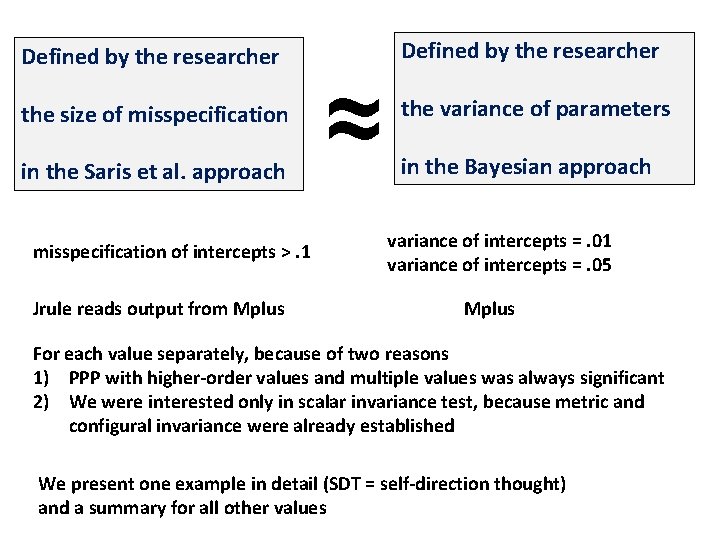
Defined by the researcher the size of misspecification in the Saris et al. approach misspecification of intercepts >. 1 Jrule reads output from Mplus Defined by the researcher ≈ the variance of parameters in the Bayesian approach variance of intercepts =. 01 variance of intercepts =. 05 Mplus For each value separately, because of two reasons 1) PPP with higher-order values and multiple values was always significant 2) We were interested only in scalar invariance test, because metric and configural invariance were already established We present one example in detail (SDT = self-direction thought) and a summary for all other values
Jrule Misspecification at. 1 Self-direction thought Mplus Priors: variance of intercepts =. 01 ppp =. 495; CI = (-30. 618) – (+32. 148) Conclusions: 1) The results are very similar 2) Only two exceptions: - SDT 1 in Israel: misspecified in Jrule, but not in Bayes - SDT 3 in Poland: misspecified in Bayes but not in Jrule
Jrule Misspecification at. 1 Self-direction thought Mplus Priors: variance of intercepts =. 05 ppp =. 502; CI = (-33. 555) – (+31. 803) ≈ Conclusions: 8 parameters misspecified in Jrule, while in Bayes 4 parameters are misspecified
Conclusion Detection for local misspecification Test for approximate measurement invariance Diagnosis of „ill” items is quite similar BUT the treatment (therapy) is different In order to reach an acceptable model, there is a need to release the misspecified parameters It can lead to - lack of measurement invariance There is no need to release the misspecified items, if the ppp indicates an acceptable model fit
Summary Opennes s Exact MI ** = full scalar MI * = partial scalar MI - = lack of scalar MI Approximate MI ok = scalar MI SDT SDA ST HE Finland * - - ** Germany * - - ** Israel * - - ** Italy * - - ** New Zealand * - - ** Poland * - - - Portugal * - - ** Switzerland * - - -
Summary Opennes s Exact MI ** = full scalar MI * = partial scalar MI - = lack of scalar MI Approximate MI ok = scalar MI SDT SDA ST HE Finland ok ok Germany ok ok Israel ok ok Italy ok ok New Zealand ok ok Portugal ok ok Switzerland ok ok
Summary Selfenhancement Exact MI ** = full scalar MI * = partial scalar MI - = lack of scalar MI Approximate MI ok = scalar MI AC POD POR Finland - ** ** Germany - ** ** Israel - * ** Italy - ** ** New Zealand - ** ** Poland - ** - Portugal - - ** Switzerland - ** **
Summary Selfenhancement Results of Bayesian analysis Variance =. 05 Value (number of 95% CI ppp Achievement (3) -24. 31; 43. 4 . 275 Power Resources (2) -25. 38; 25. 10 . 478 Power Dominance (2) -24. 72; 27. 14 . 466 items)
Summary Selfenhancement Exact MI ** = full scalar MI * = partial scalar MI - = lack of scalar MI Approximate MI ok = scalar MI AC POD POR Finland ok ok ok Germany ok ok ok Israel ok ok ok Italy ok ok ok New Zealand ok ok ok Portugal ok ok ok Switzerland ok ok ok
Summary Conservation Exact MI ** = full scalar MI * = partial scalar MI - = lack of scalar MI Approximate MI ok = scalar MI FA SEP SES TR C CO COI HU R Finland - ** * - - Germany - ** * - - Israel - - * - - Italy - ** * - - New - ** * - - Poland - ** * - - Portugal - ** * - - Zealand
Summary Conservation Exact MI ** = full scalar MI * = partial scalar MI - = lack of scalar MI Approximate MI ok = scalar MI FA SEP SES TR C CO COI HU R Finland ok ok Germany ok ok Israel ok ok Italy ok ok New ok ok Poland ok ok Portugal ok ok Zealand
Summary Selftranscendance Exact MI ** = full scalar MI * = partial scalar MI - = lack of scalar MI Approximate MI ok = scalar MI UN UNC UNT BEC BE N D Finland ** ** ** * - Germany ** - ** ** - Israel * ** ** ** - Italy * ** ** ** - New Zealand * * ** ** - Poland ** ** - Portugal ** * - ** -
Summary Selftranscendance Exact MI ** = full scalar MI * = partial scalar MI - = lack of scalar MI Approximate MI ok = scalar MI UN UNC UNT BEC BE N D Finland ok ok ok Germany ok ok ok Israel ok ok ok Italy ok ok ok New Zealand ok ok ok Portugal ok ok ok
ESS sample sizes for the selected 15 countries over six ESS rounds (2002 - 2012) Belgium Switzerland Germany Denmark Spain Finland United Kingdom Hungary Ireland Netherlands Norway Poland Portugal Sweden Slovenia N 1 st Round 2 nd Round (2002/3) (2004/5) 1, 899 1, 778 2, 040 2, 141 2, 919 2, 870 1, 506 1, 487 1, 729 1, 663 2, 000 2, 022 2, 052 1, 897 1, 685 1, 498 2, 046 2, 286 2, 364 1, 881 2, 036 1, 760 2, 110 1, 716 1, 511 2, 052 1, 999 1, 948 1, 519 1, 442 29, 415 28, 441 3 rd Round (2006/7) 1, 798 1, 804 2, 916 1, 505 1, 876 1, 896 2, 394 1, 518 1, 800 1, 889 1, 750 1, 721 2, 222 1, 927 1, 476 28, 492 4 th Round (2008/9) 1, 760 1, 819 2, 751 1, 610 2, 576 2, 195 2, 352 1, 544 1, 764 1, 778 1, 549 1, 619 2, 367 1, 830 1, 286 28, 800 5 th Round (2010/11) 1, 704 1, 506 3, 031 1, 576 1, 885 1, 878 2, 422 1, 561 2, 576 1, 829 1, 548 1, 751 2, 150 1, 497 1, 403 28, 317 6 th Round (2012/13) 1, 869 1, 493 2, 958 1, 650 1, 889 2, 197 2, 286 2, 014 2, 628 1, 845 1, 624 1, 898 2, 151 1, 847 1, 257 29, 606 N 10, 808 10, 803 17, 445 9, 334 11, 618 12, 188 13, 403 9, 820 13, 100 11, 586 10, 267 10, 815 12, 453 11, 048 8, 383 173, 071
STUDY 3 : UNIVERSALISM in the ESS over 15 countries and 6 time Points F. Zercher/P. Schmidt/E. Davidov/ J. Ciechuch, Frontiers in Psychology, 2015.
Analytical steps for the exact and the approximate measurement invariance approaches Steps Traditional exact approach Approximate approach 1. Configural model 2. Metric model 3. Scalar model 4. Partial scalar model 1. Setting different informative priors for all loadings and intercepts 2. Releasing constraints on those loadings and intercepts which are different Additional 5. Deleting groups 3. Deleting groups which are not steps which are not full or fully or partially approximately partial scalar invariant
Global fit measures of the traditional exact approach Configural Round 1 Metric Scalar Partial Scalar Round 2 Metric Scalar Partial Scalar Round 3 Metric Scalar Partial Scalar Round 4 Metric Scalar Partial Scalar Round 5 Metric Scalar Partial Scalar Round 6 Metric Scalar Partial Scalar All rounds simultaneously Configural Metric Scalar Partial Scalar [For Chi²(df) 0(0) RMSEA 0 SRMR 0 CFI 1 Countries/ Timepoints 15 54. 55(28) 1040. 47(56) 64. 89(24) 0. 023 0. 097 0. 029 0. 028 0. 074 0. 029 0. 995 0. 800 0. 985 15 15 8 45. 23(28) 1008. 78(56) 53. 28(28) 0. 019 0. 098 0. 022 0. 024 0. 070 0. 027 0. 996 0. 800 0. 992 15 15 9 49. 86(28) 611. 49(56) 53. 78(27) 0. 021 0. 074 0. 025 0. 061 0. 033 0. 995 0. 883 0. 988 15 15 8 93. 75(28) 968. 67(56) 87. 43(24) 0. 036 0. 094 0. 040 0. 035 0. 073 0. 041 0. 987 0. 823 0. 978 15 15 8 107. 04(28) 925. 79(56) 90. 10(21) 0. 039 0. 092 0. 044 0. 037 0. 074 0. 039 0. 985 0. 839 0. 972 15 15 7 73. 24(28) 956. 58(56) 69. 26(21) 0. 029 0. 091 0. 034 0. 030 0. 069 0. 036 0. 990 0. 808 0. 980 15 15 7 0. 395(0) 430. 05(178) 5723. 51(356) 348. 23(126) 0 0. 028 0. 090 0. 031 0. 001 0. 030 0. 072 0. 035 1 0. 992 0. 819 0. 983 90 90 90 37 the single rounds this refers to countries; for all rounds this is combination of country and time point. Countries still included are: Belgium 2002 -2012; Spain 2002 -2006; Finland 2006 -2010; United Kingdom 2012; Hungary 2002 -2008; Ireland 2008, 2010; Netherlands 2002 -2012; Norway 2004 -2012; Poland 2006; Portugal 2004 -2008; Sweden 2012; Slovenia 2002, 2006.
Global fit measures for the approximate invariance test ppp Round 1 0. 048 0. 049 Round 2 0. 097 0. 098 Round 3 0. 126 0. 127 Round 4 0. 004 0. 031 Round 5 0. 001 0. 005 Round 6 0. 002 90 groups 0. 000 73 groups 0. 026 0. 052 Note: ppp = posterior predictive probability ppp after releasing misspecified parameters
Correlations between latent means computed using sum scores (1), the exact (2) and the approximate (3) measurement invariance models for 73 county/time points Sum Exact scores test (2) (1) 1 1 2 . 997** 1 3 . 851** . 844** Approximate Bayesian test (3) 1
Study 4: Invariance of four Higher Order Factors of Values in the ESS(submitted) 1 st Round 2 nd Round 3 rd Round 4 th Round 5 th Round 6 th Round 2002 -3 2004 -5 2006 -7 2008 -9 2010 -11 2012 -13 1. Belgium 1, 819 1, 734 1, 767 1, 704 1, 674 1, 809 2. Denmark 1, 457 1, 451 1, 554 1, 548 1, 610 3. Finland 1, 758 1, 692 1, 645 1, 898 1, 638 2, 142 4. Germany 2, 785 2, 800 2, 828 2, 697 2, 943 2, 910 5. Hungary 1, 564 1, 407 1, 409 1, 388 1, 404 1, 919 6. Ireland 1, 838 1, 139 1, 582 1, 682 2, 295 2, 498 7. Netherlands 2, 301 1, 824 1, 814 1, 693 1, 754 1, 788 8. Norway 1, 806 1, 543 1, 533 1, 374 1, 518 1, 598 9. Poland 1, 982 1, 621 1, 629 1, 544 1, 675 1, 818 10. Portugal 1, 417 1, 987 2, 117 2, 220 2, 035 2, 062 11. Slovenia 1, 390 1, 297 1, 329 1, 172 1, 238 1, 159 12. Spain 1, 638 1, 544 1, 802 2, 520 1, 862 1, 820 13. Sweden 1, 677 1, 663 1, 585 1, 539 1, 457 1, 799 14. Switzerland 2, 009 2, 084 1, 758 1, 764 1, 467 1, 453
Global fit indices for the approximate measurement invariance tests across a subset of countries ppp 95% Credibility Interval Self-enhancement in 8 countries: Belgium, Denmark, Ireland, Netherlands, Portugal, Spain, Sweden 1 st Round of ESS . 113 -15. 78 – 64. 51 2 nd Round of ESS . 026 -0. 41 – 79. 23 3 rd Round of ESS . 274 -28. 11 – 51. 87 4 rd Round of ESS . 170 -20. 43 – 59. 37 5 th Round of ESS . 000 4. 98 – 84. 19 6 th Round of ESS . 000 48. 45 – 128. 75
Global fit indices for the approximate measurement invariance tests across a subset of countries ppp 95% Credibility Interval Self-transcendence in 12 countries: Belgium, Finland, Germany, Ireland, Netherlands, Norway, Poland, Portugal, Spain, Sweden, Switzerland, United Kingdom 1 st Round of ESS . 508 -50. 05 – 49. 46 2 nd Round of ESS . 419 -45. 17 – 55. 39 3 rd Round of ESS . 326 -38. 57 – 61. 99 4 rd Round of ESS . 419 -45. 13 – 55. 07 5 th Round of ESS . 273 -34. 72 – 65. 34 6 th Round of ESS . 505 -48. 32 – 47. 27
Global fit indices for the approximate measurement invariance tests across a subset of countries ppp 95% Credibility Interval Conservation in 10 countries: Belgium, Finland, Germany, Ireland, Netherlands, Poland, Portugal, Switzerland, United Kingdom, Slovenia 1 st Round of ESS . 173 -23. 70 – 67. 94 2 nd Round of ESS . 131 -19. 20 – 72. 09 3 rd Round of ESS . 135 -20. 07 – 71. 09 4 rd Round of ESS . 097 -15. 76 – 75. 66 5 th Round of ESS . 176 -23. 61 – 66. 82 6 th Round of ESS . 067 -10. 68 – 80. 66
Global fit indices for the approximate measurement invariance tests across a subset of countries ppp 95% Credibility Interval Conservation in 10 countries: Belgium, Finland, Germany, Ireland, Netherlands, Poland, Portugal, Switzerland, United Kingdom, Slovenia 1 st Round of ESS . 173 -23. 70 – 67. 94 2 nd Round of ESS . 131 -19. 20 – 72. 09 3 rd Round of ESS . 135 -20. 07 – 71. 09 4 rd Round of ESS . 097 -15. 76 – 75. 66 5 th Round of ESS . 176 -23. 61 – 66. 82 6 th Round of ESS . 067 -10. 68 – 80. 66
Conclusions �Approximate invariance testing seems to be a useful alternative especially in the case of testing for scalar invariance in cross-cultural studies with many groups. �There is a need for more empirical and simulation studies which contain: �Number of groups larger than 100 including many countries and several time points �Variation in the amount of misspecification �Inclusion of 2 and more latent variables and items with crossloadings and error correlations
Summary table Study 1 Study 2 Study 3 Study 4 Items 3 57 3 21 Constructs 1 19 1 4 N of groups < 31 8 90 15 Countries < 31 8 15 15 Time points 1 1 6 1 Exact scalar 9% 42% 10 of 19 37 0 All 73 8 12 Approx. scalar All
Thank you for your attention!