
Approximate Inference 2 Importance Sampling 1 Unnormalized Importance
![(Unnormalized) Importance Sampling • Generate samples x[1], …, x[M] from P • Then estimate:](https://slidetodoc.com/presentation_image_h/1cde03bc8d9e2e3bf80ceb45ceb2551f/image-4.jpg "(Unnormalized) Importance Sampling • Generate samples x[1], …, x[M] from P • Then estimate:")

![Normalized Importance Sampling With M samples D = {x[1], …, x[M]} from Q, we](https://slidetodoc.com/presentation_image_h/1cde03bc8d9e2e3bf80ceb45ceb2551f/image-12.jpg "Normalized Importance Sampling With M samples D = {x[1], …, x[M]} from Q, we")


- Slides: 28
Approximate Inference 2: Importance Sampling 1
(Unnormalized) Importance Sampling
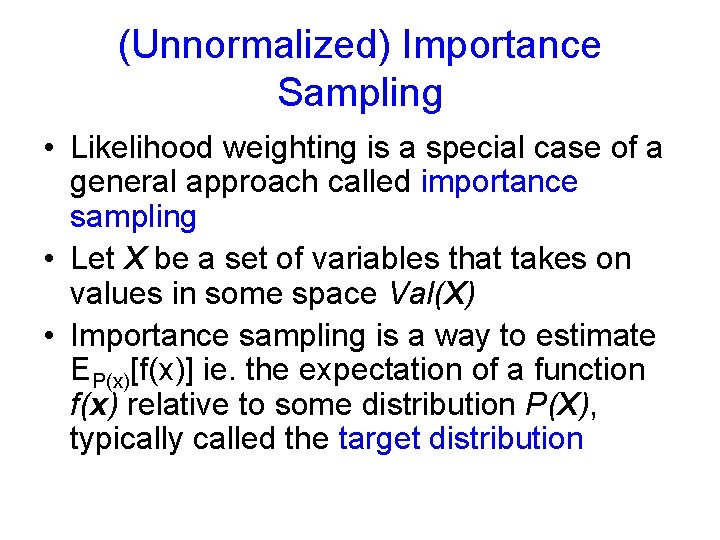
(Unnormalized) Importance Sampling • Likelihood weighting is a special case of a general approach called importance sampling • Let X be a set of variables that takes on values in some space Val(X) • Importance sampling is a way to estimate EP(x)[f(x)] ie. the expectation of a function f(x) relative to some distribution P(X), typically called the target distribution
(Unnormalized) Importance Sampling • Generate samples x[1], …, x[M] from P • Then estimate:
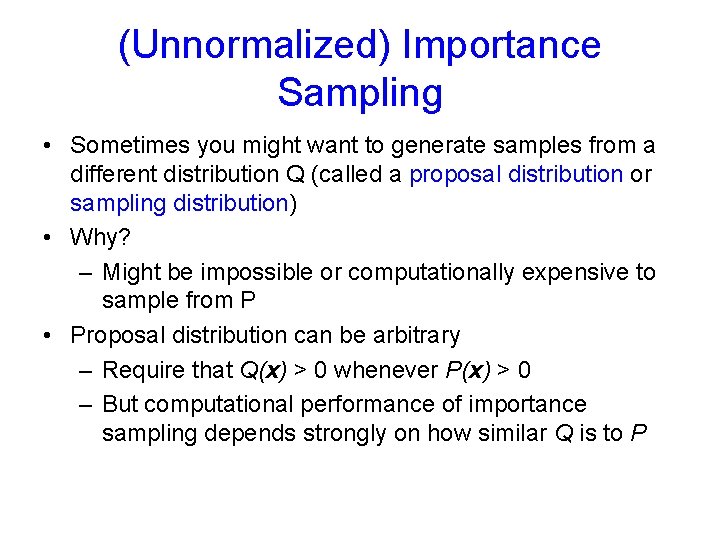
(Unnormalized) Importance Sampling • Sometimes you might want to generate samples from a different distribution Q (called a proposal distribution or sampling distribution) • Why? – Might be impossible or computationally expensive to sample from P • Proposal distribution can be arbitrary – Require that Q(x) > 0 whenever P(x) > 0 – But computational performance of importance sampling depends strongly on how similar Q is to P
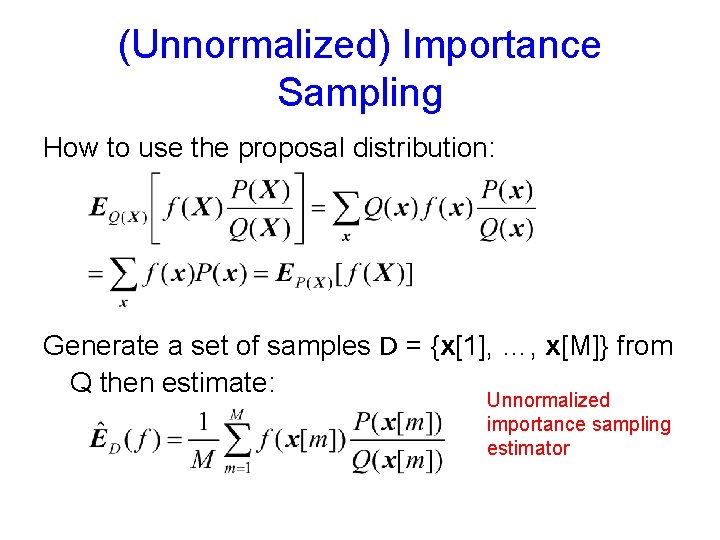
(Unnormalized) Importance Sampling How to use the proposal distribution: Generate a set of samples D = {x[1], …, x[M]} from Q then estimate: Unnormalized importance sampling estimator
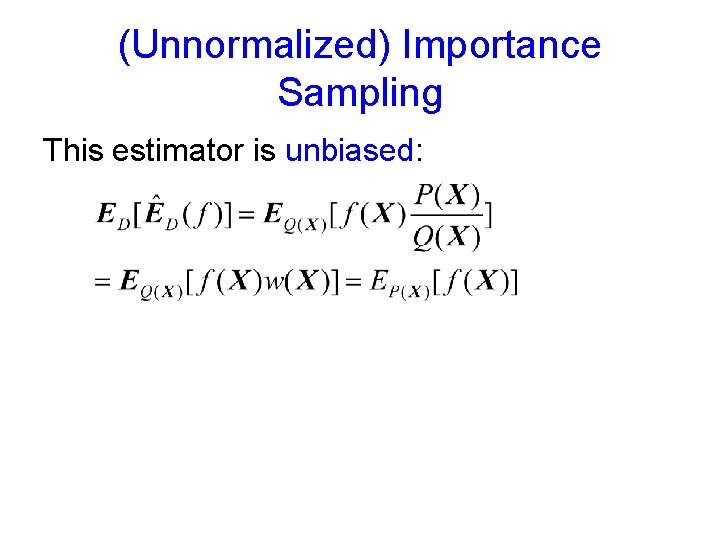
(Unnormalized) Importance Sampling This estimator is unbiased:
Normalized Importance Sampling
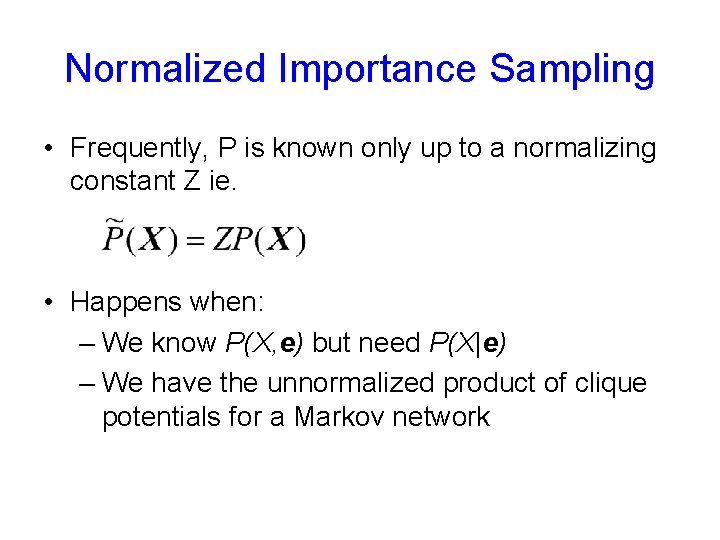
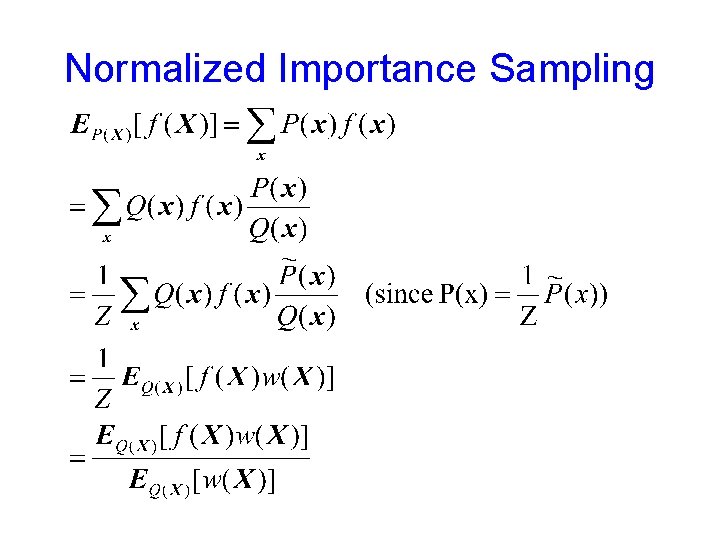
Normalized Importance Sampling • Frequently, P is known only up to a normalizing constant Z ie. • Happens when: – We know P(X, e) but need P(X|e) – We have the unnormalized product of clique potentials for a Markov network
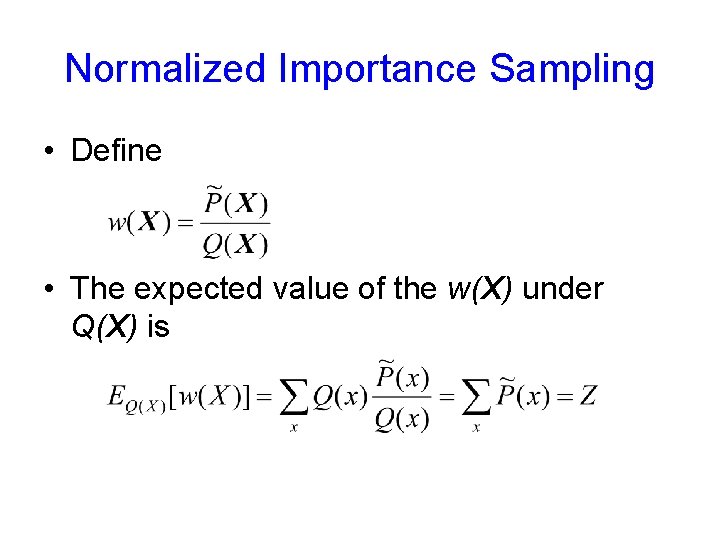
Normalized Importance Sampling • Define • The expected value of the w(X) under Q(X) is
Normalized Importance Sampling
Normalized Importance Sampling With M samples D = {x[1], …, x[M]} from Q, we can estimate: This is called the normalized importance sampling estimator or weighted importance sampling estimator
Importance Sampling for Bayesian Networks
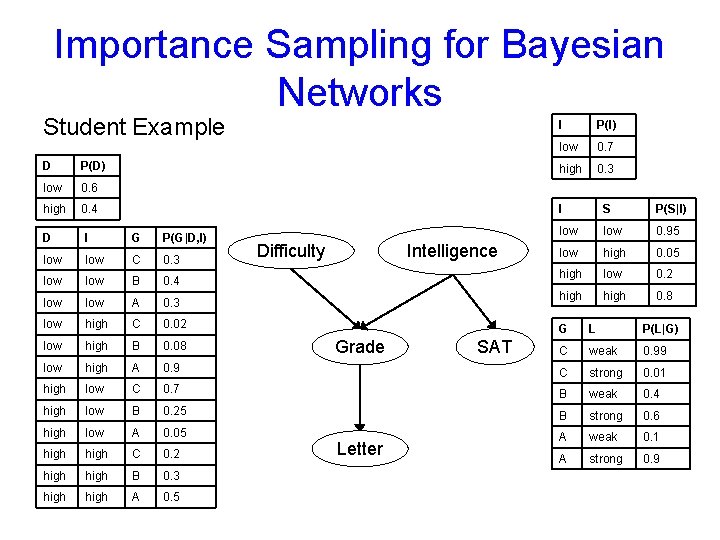
Importance Sampling for Bayesian Networks Student Example D P(D) low 0. 6 high 0. 4 D I G P(G|D, I) low C 0. 3 low B 0. 4 low A 0. 3 low high C 0. 02 low high B 0. 08 low high A high low high Intelligence Difficulty I P(I) low 0. 7 high 0. 3 I S P(S|I) low 0. 95 low high 0. 05 high low 0. 2 high 0. 8 G L P(L|G) C weak 0. 99 0. 9 C strong 0. 01 C 0. 7 B weak 0. 4 low B 0. 25 B strong 0. 6 low A 0. 05 A weak 0. 1 A strong 0. 9 high C 0. 2 high B 0. 3 high A 0. 5 Grade Letter SAT
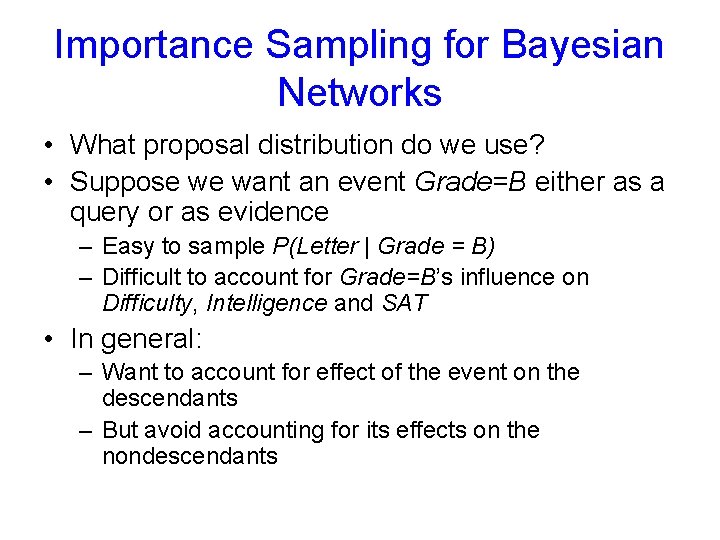
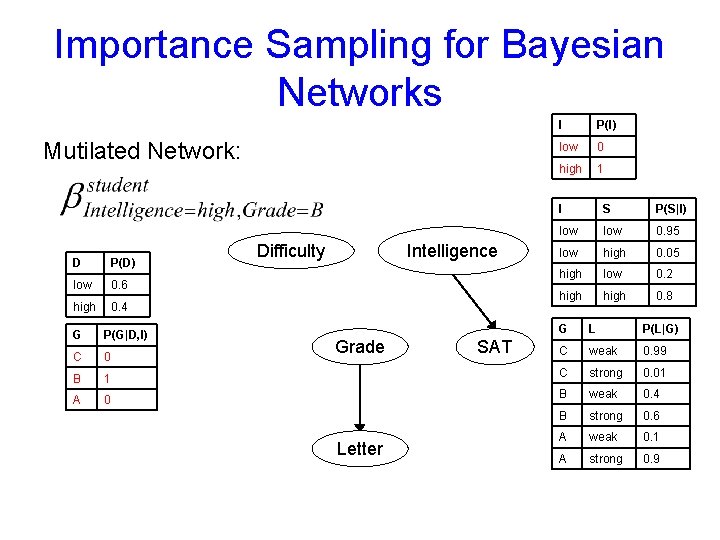
Importance Sampling for Bayesian Networks • What proposal distribution do we use? • Suppose we want an event Grade=B either as a query or as evidence – Easy to sample P(Letter | Grade = B) – Difficult to account for Grade=B’s influence on Difficulty, Intelligence and SAT • In general: – Want to account for effect of the event on the descendants – But avoid accounting for its effects on the nondescendants
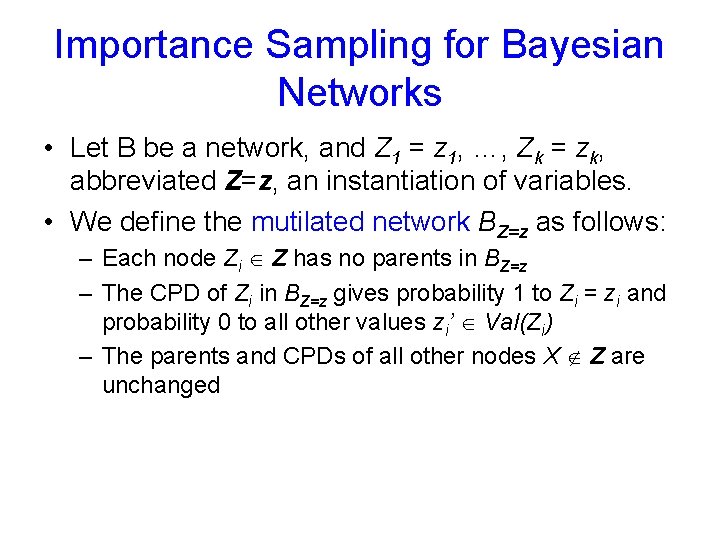
Importance Sampling for Bayesian Networks • Let B be a network, and Z 1 = z 1, …, Zk = zk, abbreviated Z=z, an instantiation of variables. • We define the mutilated network BZ=z as follows: – Each node Zi Z has no parents in BZ=z – The CPD of Zi in BZ=z gives probability 1 to Zi = zi and probability 0 to all other values zi’ Val(Zi) – The parents and CPDs of all other nodes X Z are unchanged
Importance Sampling for Bayesian Networks Mutilated Network: D P(D) low 0. 6 high 0. 4 Intelligence Difficulty I P(I) low 0 high 1 I S P(S|I) low 0. 95 low high 0. 05 high low 0. 2 high 0. 8 G L P(L|G) C weak 0. 99 1 C strong 0. 01 0 B weak 0. 4 B strong 0. 6 A weak 0. 1 A strong 0. 9 G P(G|D, I) C 0 B A Grade Letter SAT
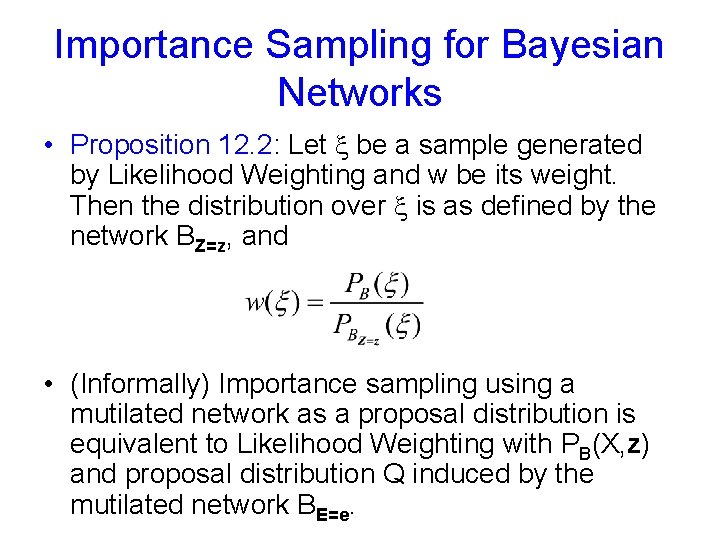
Importance Sampling for Bayesian Networks • Proposition 12. 2: Let be a sample generated by Likelihood Weighting and w be its weight. Then the distribution over is as defined by the network BZ=z, and • (Informally) Importance sampling using a mutilated network as a proposal distribution is equivalent to Likelihood Weighting with PB(X, z) and proposal distribution Q induced by the mutilated network BE=e.
Likelihood Weighting Revisited
Likelihood Weighting Revisited Two versions of likelihood weighting 1. Ratio Likelihood Weighting 2. Normalized Likelihood Weighting
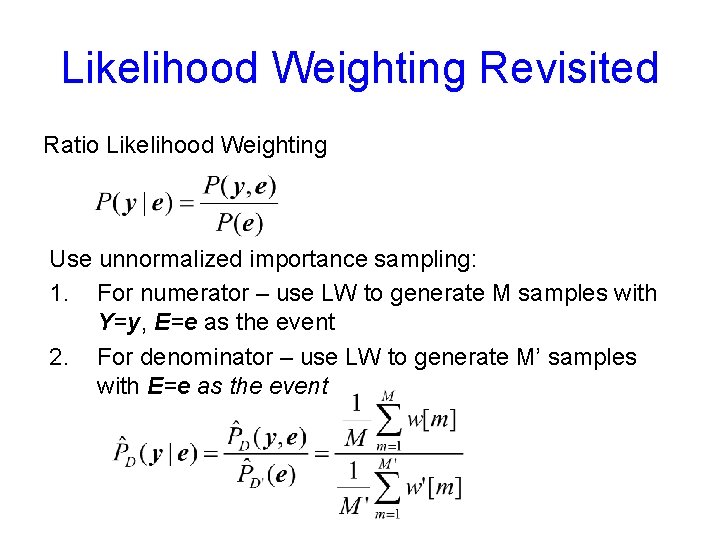
Likelihood Weighting Revisited Ratio Likelihood Weighting Use unnormalized importance sampling: 1. For numerator – use LW to generate M samples with Y=y, E=e as the event 2. For denominator – use LW to generate M’ samples with E=e as the event
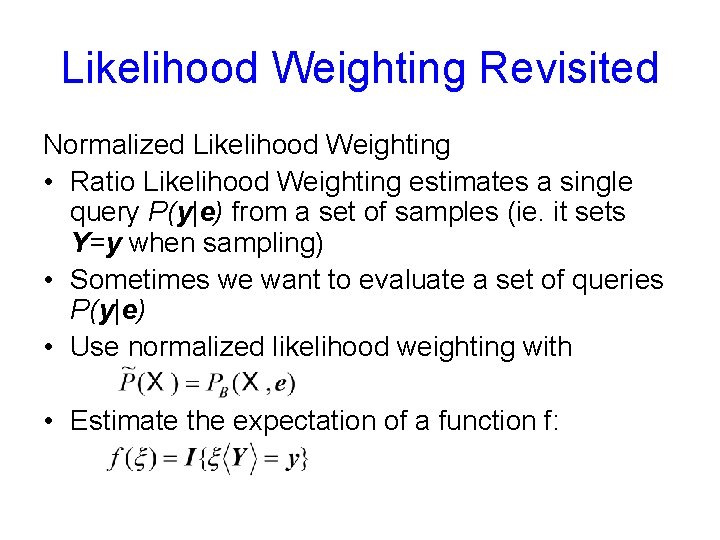
Likelihood Weighting Revisited Normalized Likelihood Weighting • Ratio Likelihood Weighting estimates a single query P(y|e) from a set of samples (ie. it sets Y=y when sampling) • Sometimes we want to evaluate a set of queries P(y|e) • Use normalized likelihood weighting with • Estimate the expectation of a function f:
Likelihood Weighting Revisited Quality of importance sampling depends on how close the proposal distribution Q is to the target distribution P. Consider the two extremes: 1. All evidence at the roots: – Proposal distribution is the posterior – Evidence affects samples all along the way and all samples have the same weight P(e)
Likelihood Weighting Revisited 2. All evidence at the leaves: – Proposal distribution is the prior distribution PB(X) – Evidence doesn’t affect samples, weights have to compensate. LW will only work well if prior is similar to the posterior
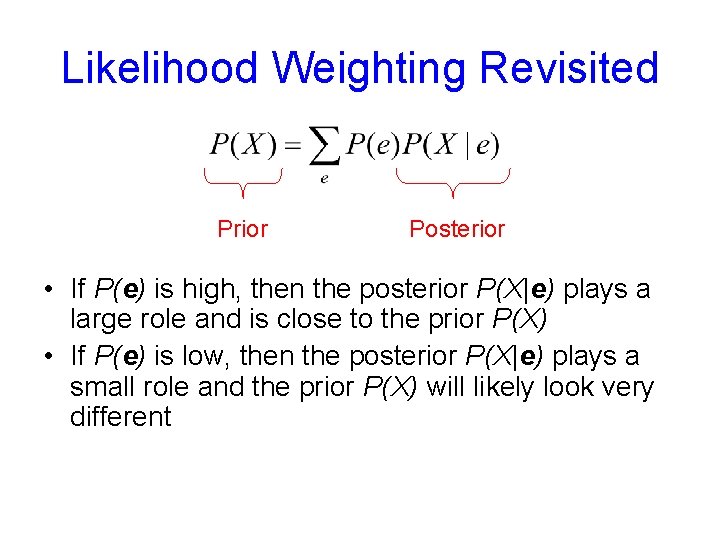
Likelihood Weighting Revisited Prior Posterior • If P(e) is high, then the posterior P(X|e) plays a large role and is close to the prior P(X) • If P(e) is low, then the posterior P(X|e) plays a small role and the prior P(X) will likely look very different
Likelihood Weighting Revisited Summary Ratio Likelihood Weighting • Sets the values of Y=y => results in lower variance in estimator • Theoretical analysis allows us to provide bounds (under very strong conditions) on number of samples to obtain a good estimate of P(y, e) and P(e) • Needs a new set of samples for each query y
Likelihood Weighting Revisited Summary Normalized Likelihood Weighting • Samples an assignment for Y, which introduces additional variance • Allows multiple queries y using the same set of samples (conditioned on evidence e)
Likelihood Weighting Revisted Problems with Likelihood Weighting: • If there a lot of evidence variables P( Y | E 1 = e 1, . . . , Ek = ek): – Many samples will have weight – Weighted estimate dominated by a small fraction of samples that have > • If evidence variables occur in the leaves, the samples drawn will not be affected much by the evidence