
Approximate algorithms for efficient indexing clustering and classification
![Related work LSP 2 P [TKDE 09] Unstructured P 2 P network Peers gossip](https://slidetodoc.com/presentation_image_h2/c7fd155f3f81157a46ac34a4205b9931/image-25.jpg "Related work LSP 2 P [TKDE 09] Unstructured P 2 P network Peers gossip")
![Related work HP 2 PC [TKDE 08] Peers organized in a hierarchy Each level](https://slidetodoc.com/presentation_image_h2/c7fd155f3f81157a46ac34a4205b9931/image-26.jpg "Related work HP 2 PC [TKDE 08] Peers organized in a hierarchy Each level")
![References [Gnu] I. J. Taylor. “Gnutella”. In From P 2 P to Web Services](https://slidetodoc.com/presentation_image_h2/c7fd155f3f81157a46ac34a4205b9931/image-44.jpg "References [Gnu] I. J. Taylor. “Gnutella”. In From P 2 P to Web Services")



- Slides: 58
Approximate algorithms for efficient indexing, clustering, and classification in Peer-to-peer networks Odysseas Papapetrou 18 April 2011 L 3 S Research Center, University of Hannover, Germany
Introduction Application scenarios of Peer-to-peer File sharing, IP telephony, video streaming, data analysis, collaborative spam filtering, … Frequent building blocks Information retrieval Data mining Challenges Large networks High churn High network cost Approximate Algorithms for Efficient Indexing, Clustering, and Classification in P 2 P networks 2
Introduction Information retrieval and data mining in P 2 P networks Information retrieval Maintaining an inverted index for keyword search Near-duplicate detection Data mining Clustering over a P 2 P network Classification over a P 2 P network Approximate Algorithms for Efficient Indexing, Clustering, and Classification in P 2 P networks 3
Outline Introduction PCIR: Maintaining the inverted index for keyword search PCP 2 P: P 2 P text clustering Related work PCP 2 P Experimental evaluation Brief summary Related work Basic PCIR Clustering-enhanced PCIR Experimental evaluation POND: P 2 P near duplicate detection CSVM: P 2 P classification Conclusions Approximate Algorithms for Efficient Indexing, Clustering, and Classification in P 2 P networks 4
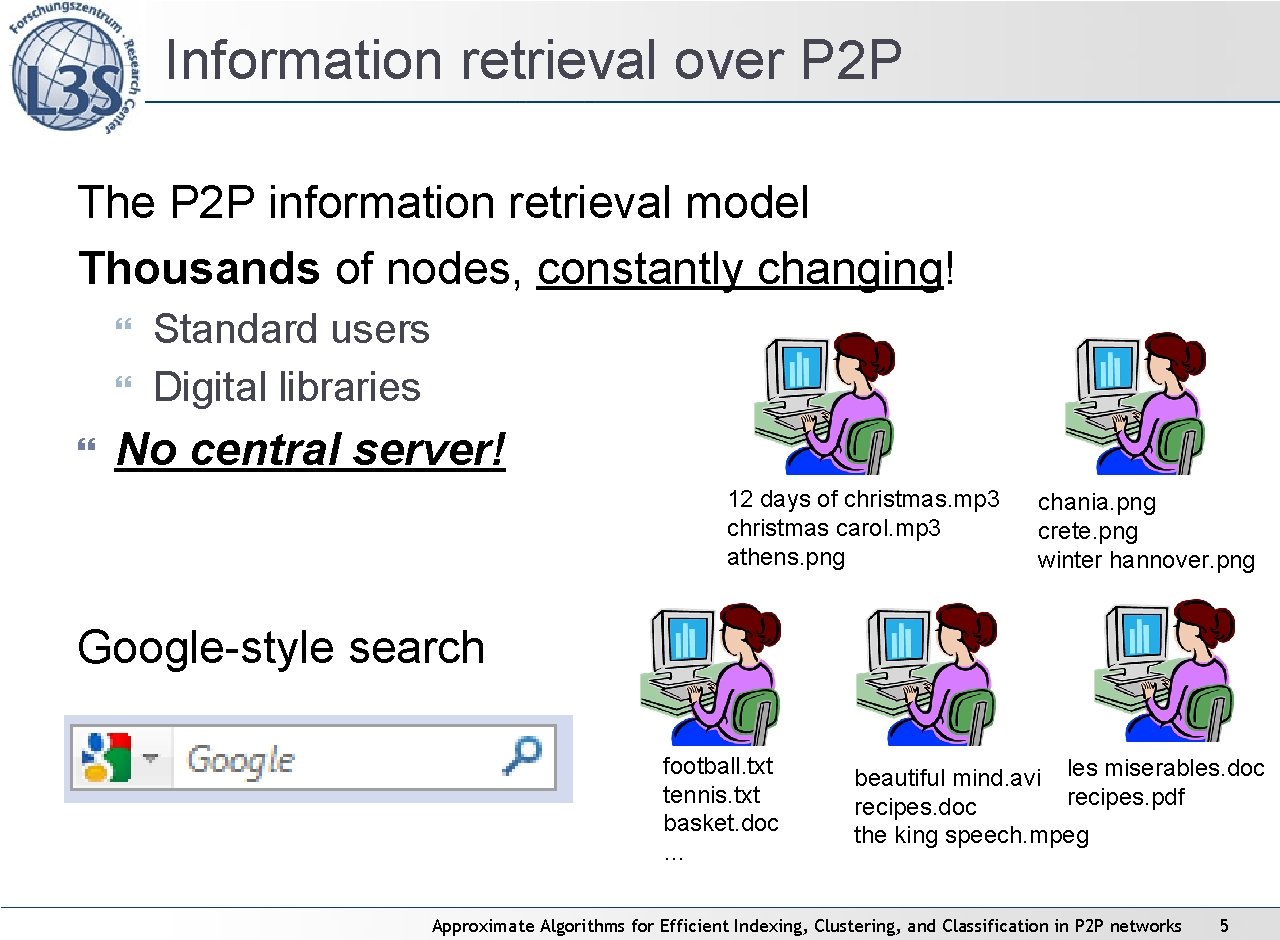
Information retrieval over P 2 P The P 2 P information retrieval model Thousands of nodes, constantly changing! Standard users Digital libraries No central server! 12 days of christmas. mp 3 christmas carol. mp 3 athens. png chania. png crete. png winter hannover. png Google-style search football. txt tennis. txt basket. doc … beautiful mind. avi les miserables. doc recipes. pdf recipes. doc the king speech. mpeg Approximate Algorithms for Efficient Indexing, Clustering, and Classification in P 2 P networks 5
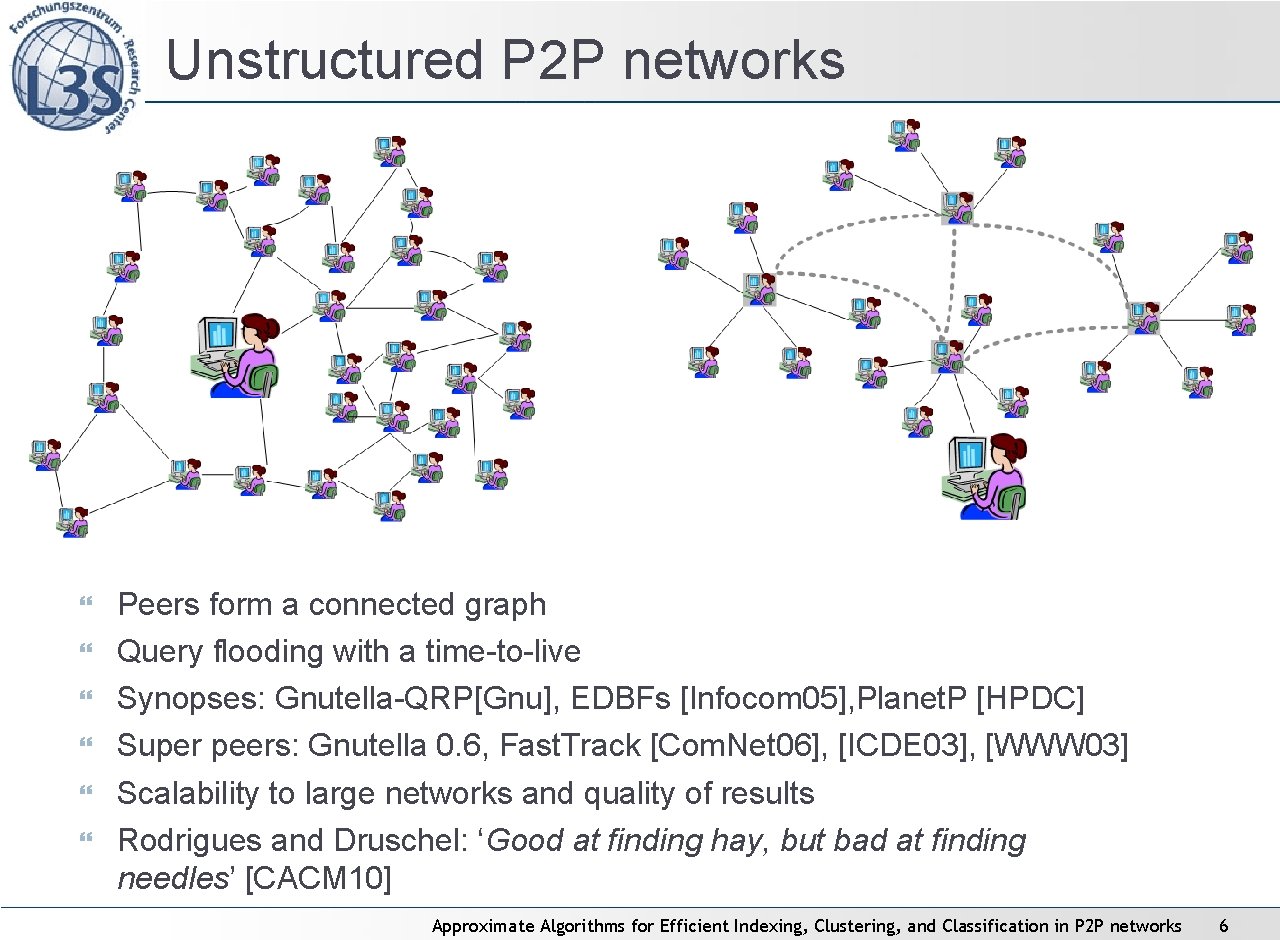
Unstructured P 2 P networks Peers form a connected graph Query flooding with a time-to-live Synopses: Gnutella-QRP[Gnu], EDBFs [Infocom 05], Planet. P [HPDC] Super peers: Gnutella 0. 6, Fast. Track [Com. Net 06], [ICDE 03], [WWW 03] Scalability to large networks and quality of results Rodrigues and Druschel: ‘Good at finding hay, but bad at finding needles’ [CACM 10] Approximate Algorithms for Efficient Indexing, Clustering, and Classification in P 2 P networks 6
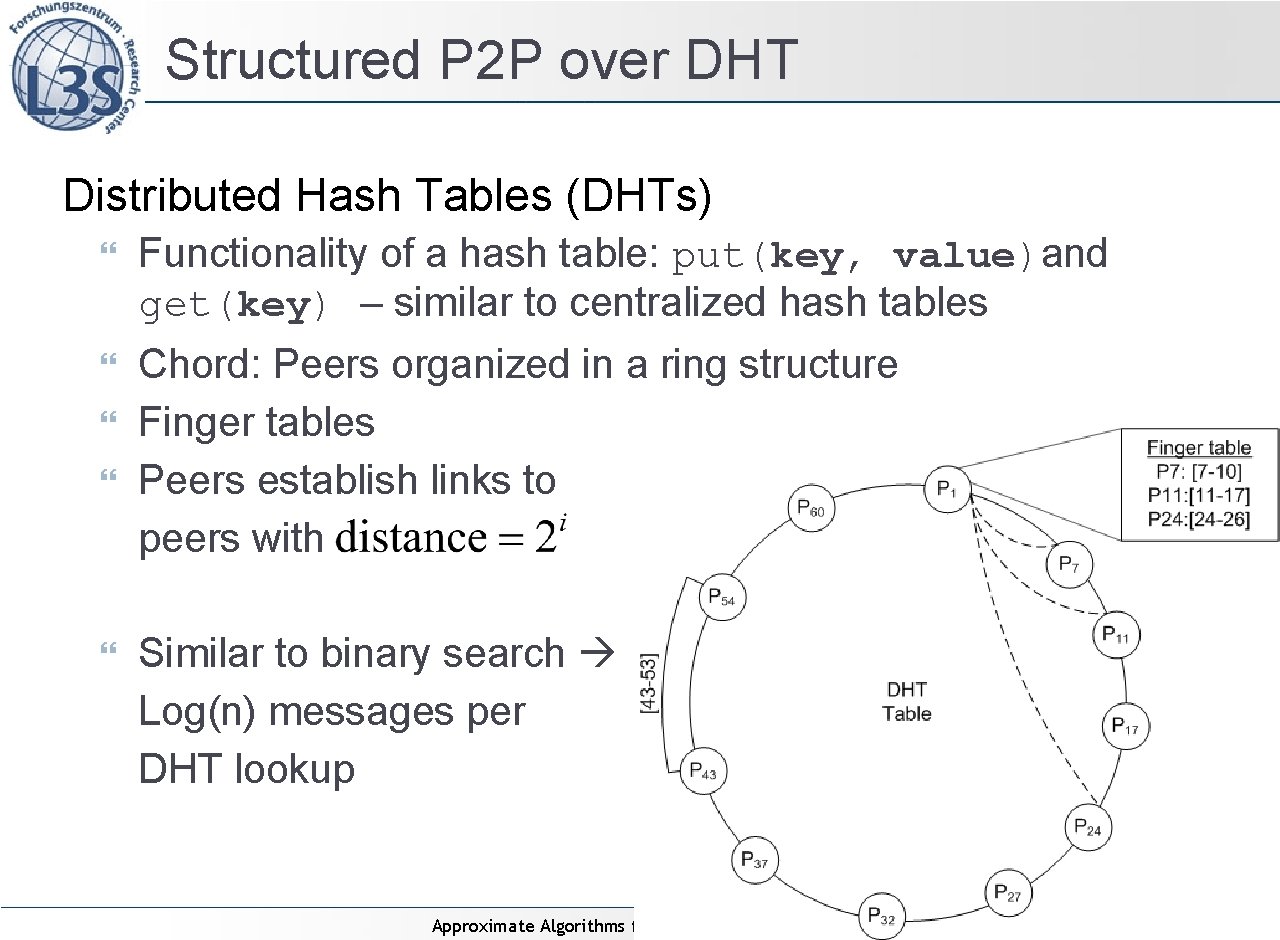
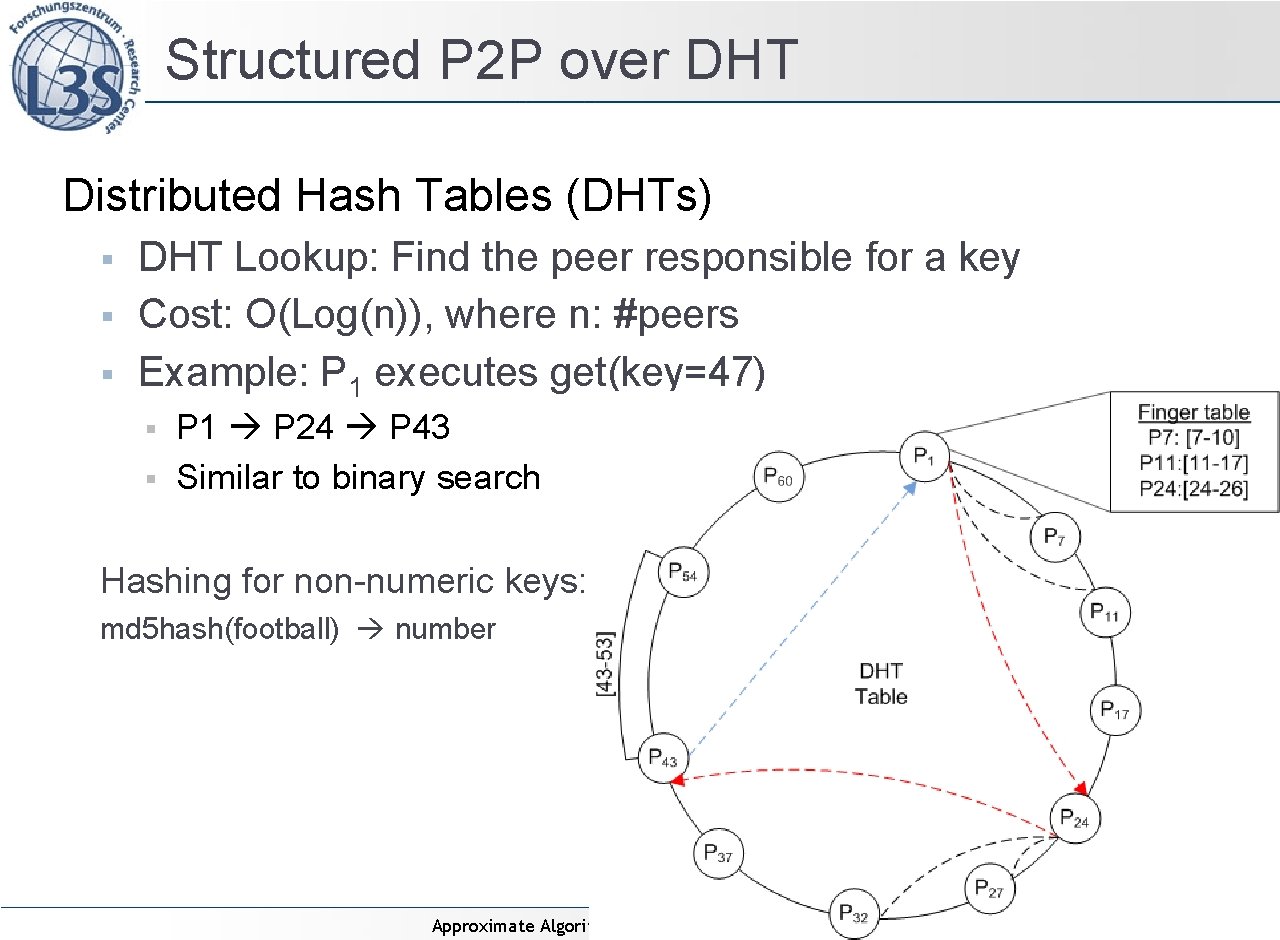
Structured P 2 P over DHT Distributed Hash Tables (DHTs) Functionality of a hash table: put(key, value)and get(key) – similar to centralized hash tables Chord: Peers organized in a ring structure Finger tables Peers establish links to peers with Similar to binary search Log(n) messages per DHT lookup Approximate Algorithms for Efficient Indexing, Clustering, and Classification in P 2 P networks 7
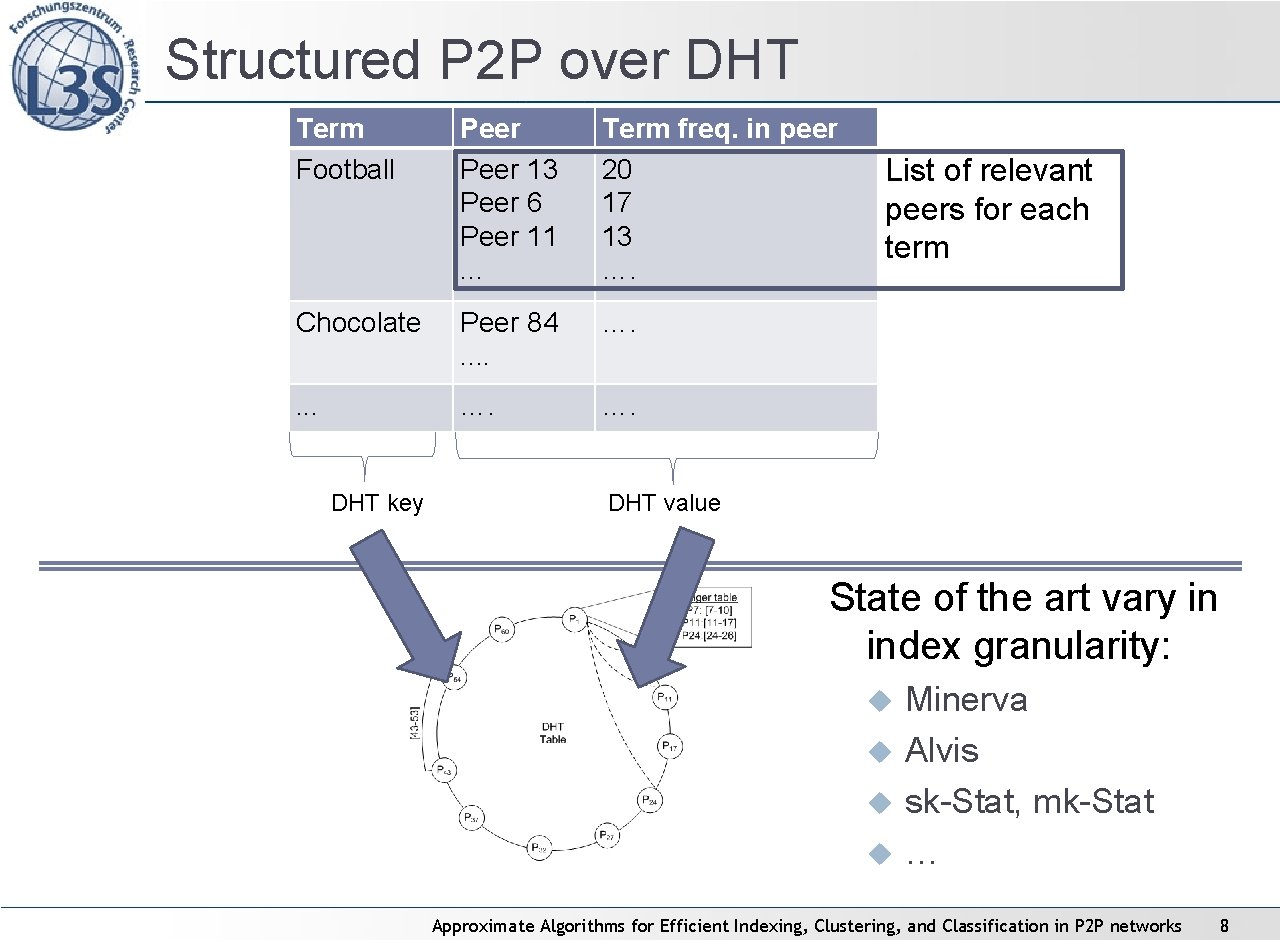
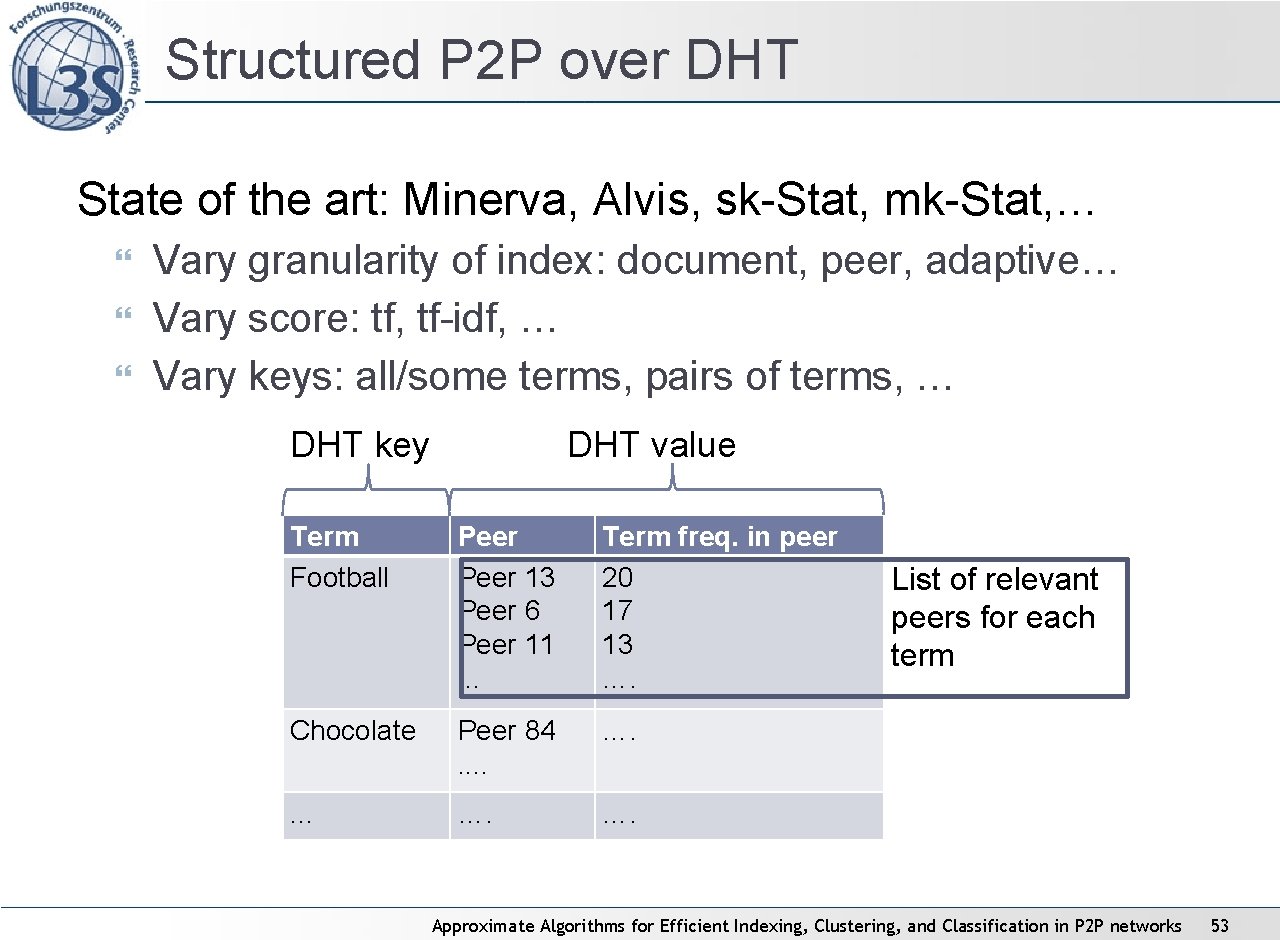
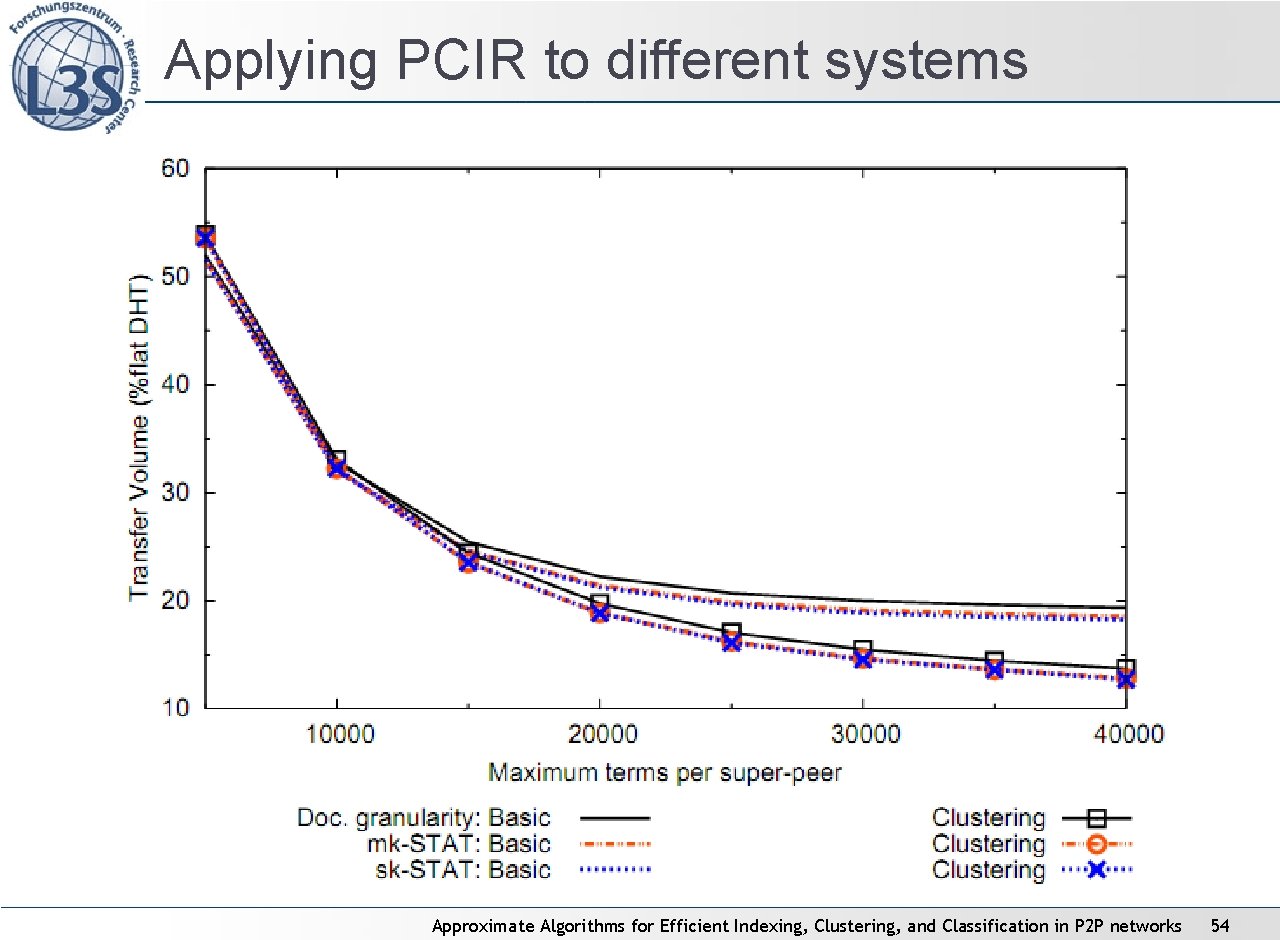
Structured P 2 P over DHT Term Football Peer 13 Peer 6 Peer 11. . . Term freq. in peer 20 17 13 …. Chocolate Peer 84. . . . …. …. DHT key List of relevant peers for each term DHT value State of the art vary in index granularity: Minerva Alvis sk-Stat, mk-Stat … Approximate Algorithms for Efficient Indexing, Clustering, and Classification in P 2 P networks 8
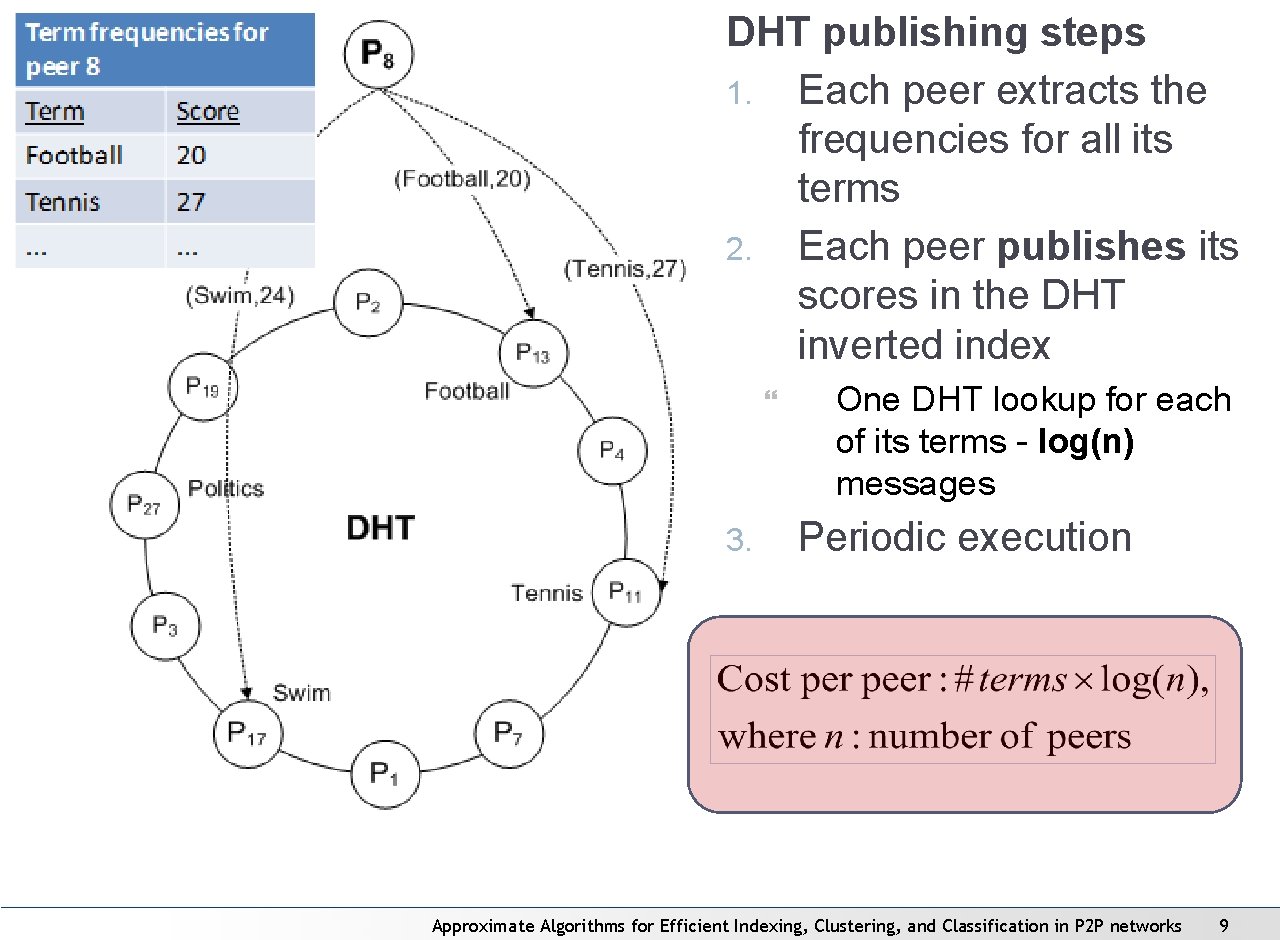
IR and P 2 P DHT publishing steps 1. Each peer extracts the frequencies for all its terms 2. Each peer publishes its scores in the DHT inverted index 3. One DHT lookup for each of its terms - log(n) messages Periodic execution Approximate Algorithms for Efficient Indexing, Clustering, and Classification in P 2 P networks 9
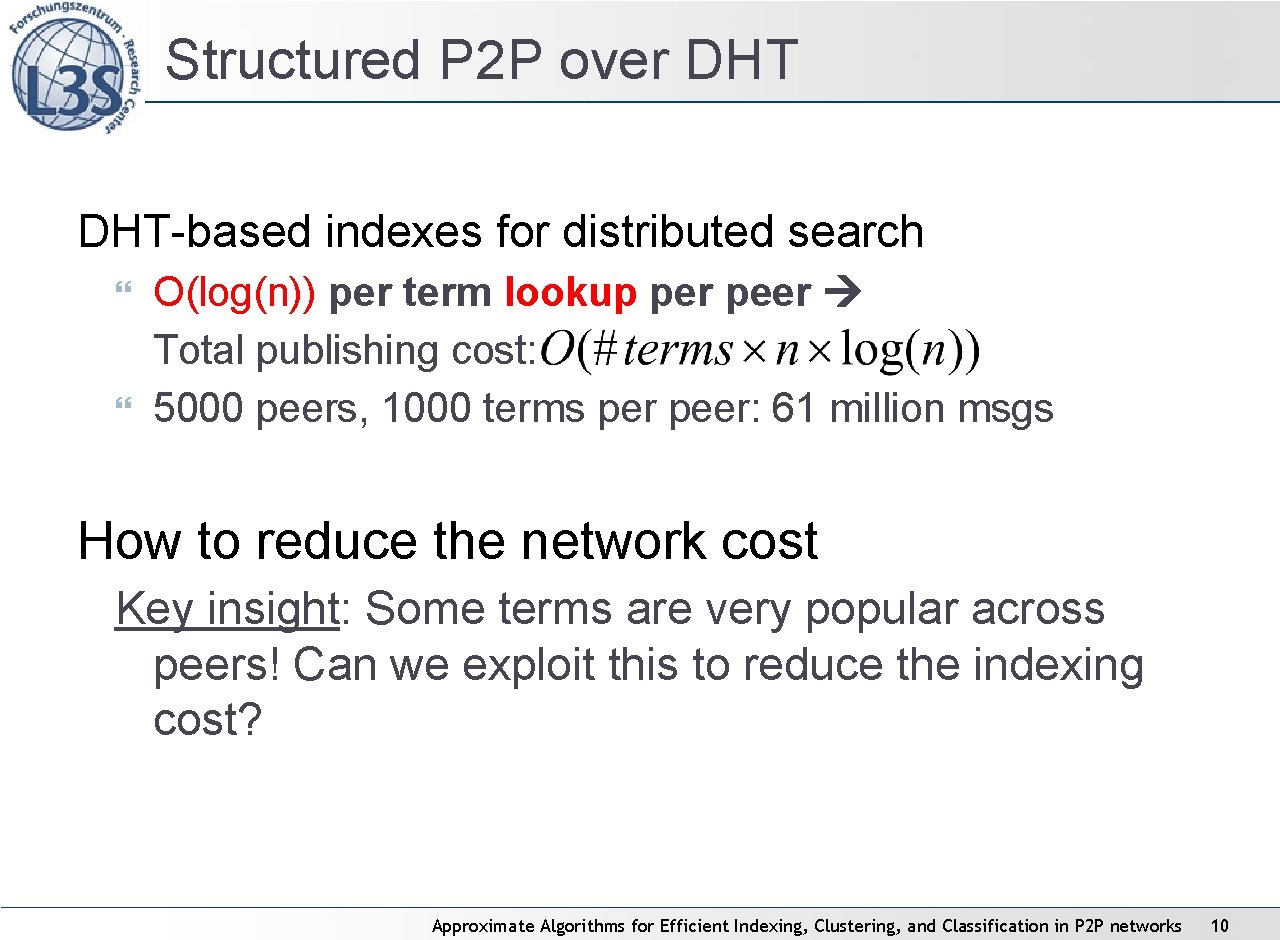
Structured P 2 P over DHT-based indexes for distributed search O(log(n)) per term lookup per peer Total publishing cost: 5000 peers, 1000 terms per peer: 61 million msgs How to reduce the network cost Key insight: Some terms are very popular across peers! Can we exploit this to reduce the indexing cost? Approximate Algorithms for Efficient Indexing, Clustering, and Classification in P 2 P networks 10
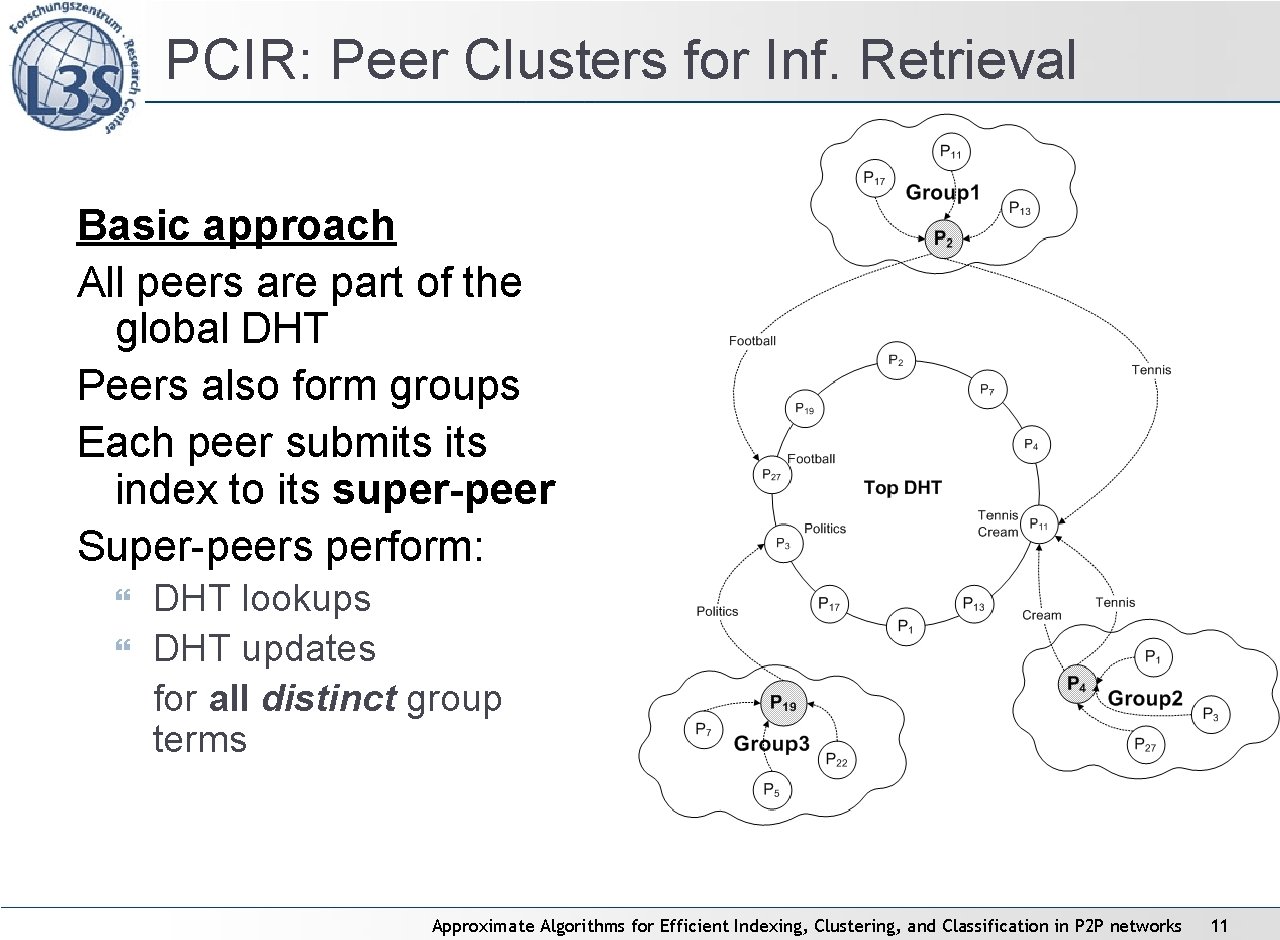
PCIR: Peer Clusters for Inf. Retrieval Basic approach All peers are part of the global DHT Peers also form groups Each peer submits index to its super-peer Super-peers perform: DHT lookups DHT updates for all distinct group terms Approximate Algorithms for Efficient Indexing, Clustering, and Classification in P 2 P networks 11
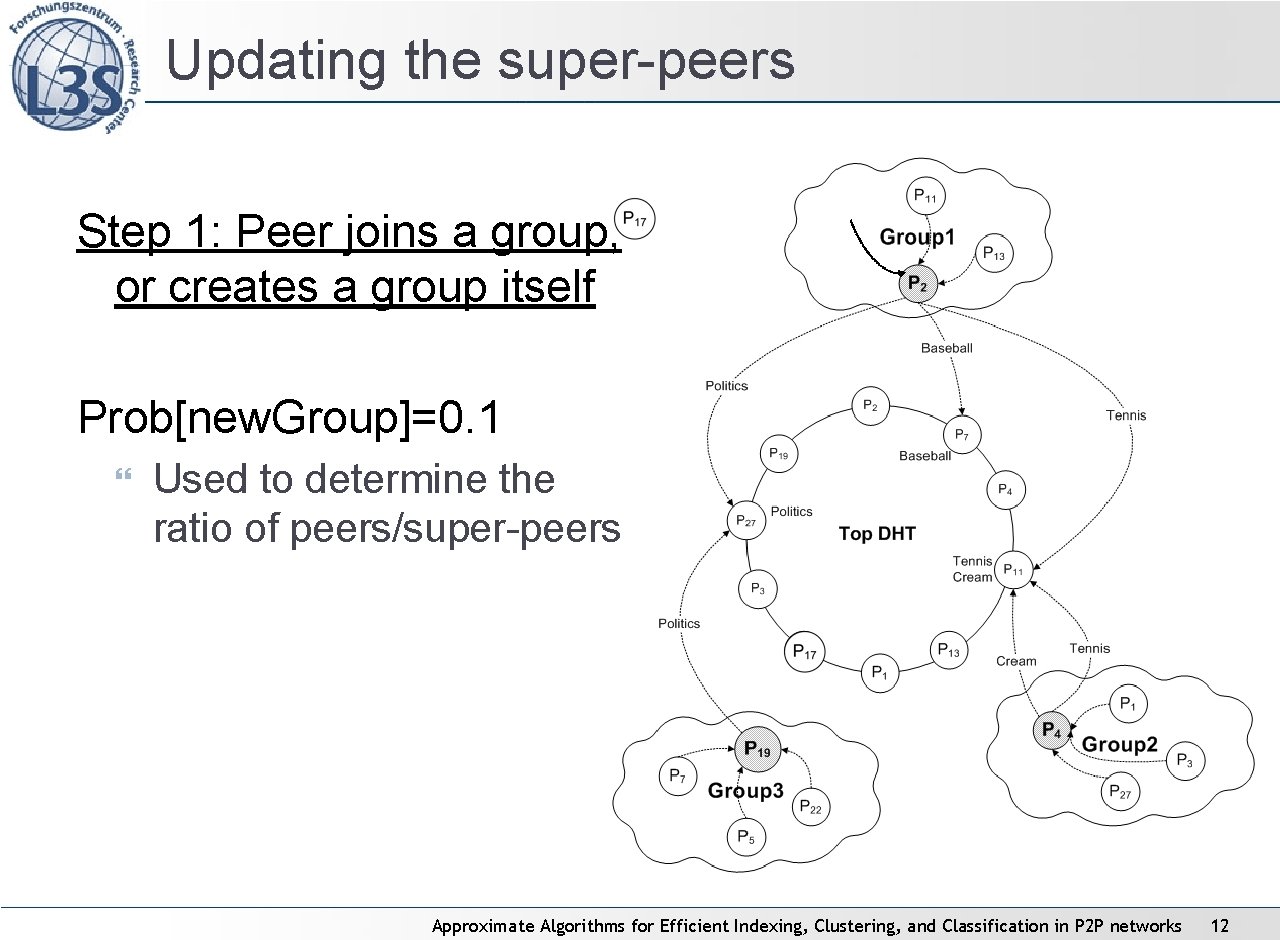
Updating the super-peers Step 1: Peer joins a group, or creates a group itself Prob[new. Group]=0. 1 Used to determine the ratio of peers/super-peers Approximate Algorithms for Efficient Indexing, Clustering, and Classification in P 2 P networks 12
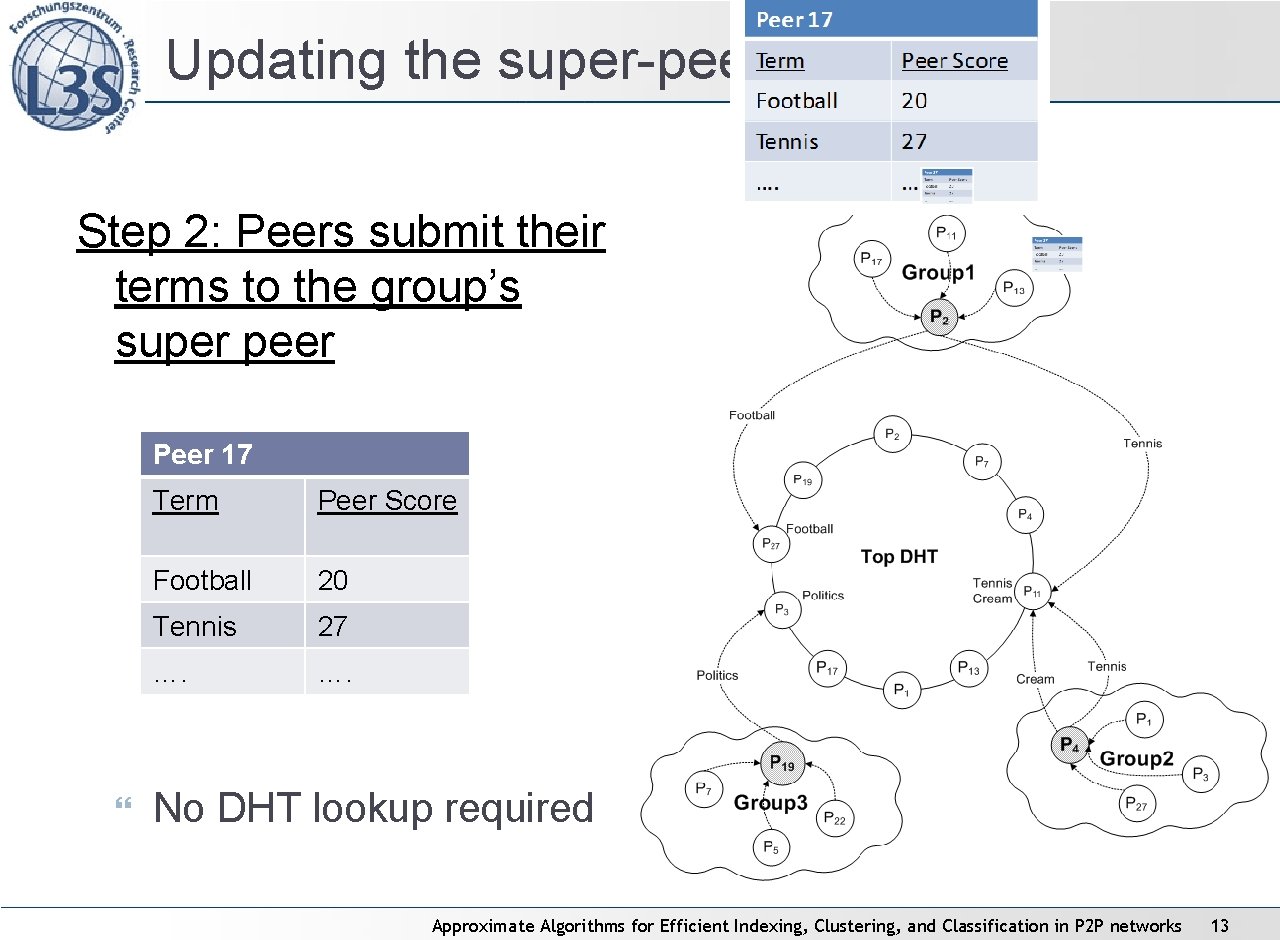
Updating the super-peers Step 2: Peers submit their terms to the group’s super peer Peer 17 Term Peer Score Football 20 Tennis 27 …. No DHT lookup required Approximate Algorithms for Efficient Indexing, Clustering, and Classification in P 2 P networks 13
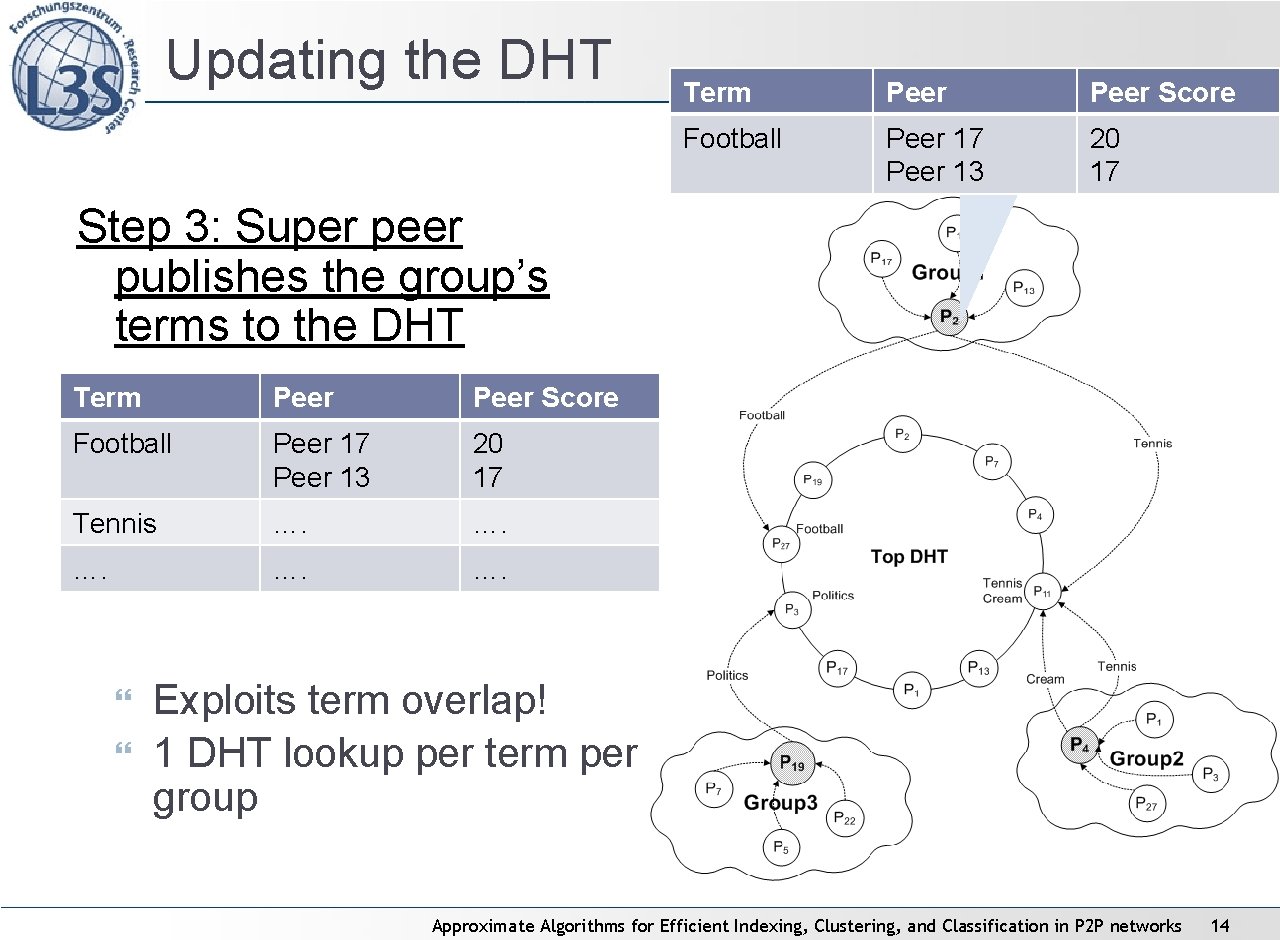
Updating the DHT Term Peer Score Football Peer 17 Peer 13 20 17 Step 3: Super peer publishes the group’s terms to the DHT Term Peer Score Football Peer 17 Peer 13 20 17 Tennis …. …. …. Exploits term overlap! 1 DHT lookup per term per group Approximate Algorithms for Efficient Indexing, Clustering, and Classification in P 2 P networks 14
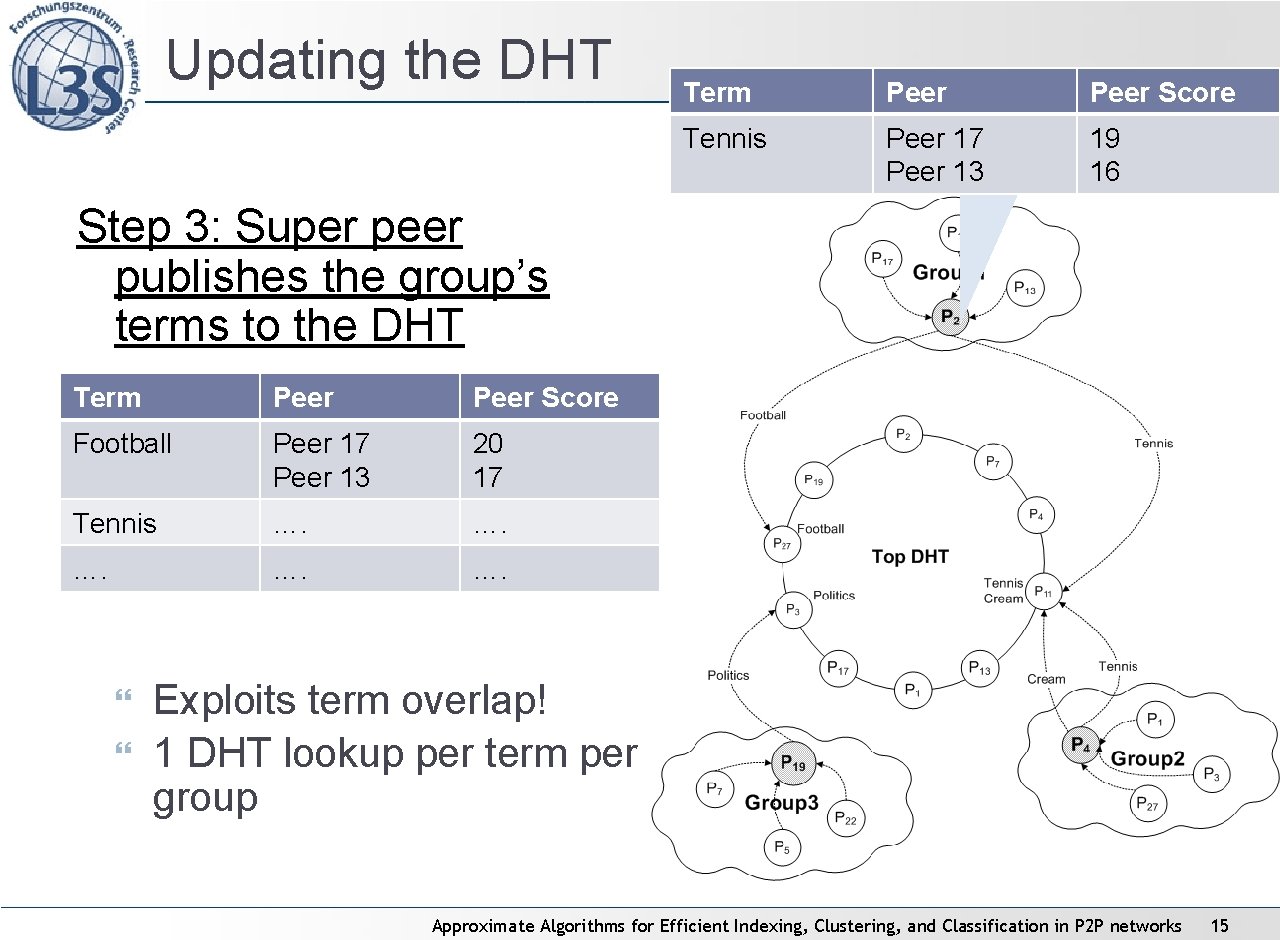
Updating the DHT Term Peer Score Tennis Peer 17 Peer 13 19 16 Step 3: Super peer publishes the group’s terms to the DHT Term Peer Score Football Peer 17 Peer 13 20 17 Tennis …. …. …. Exploits term overlap! 1 DHT lookup per term per group Approximate Algorithms for Efficient Indexing, Clustering, and Classification in P 2 P networks 15
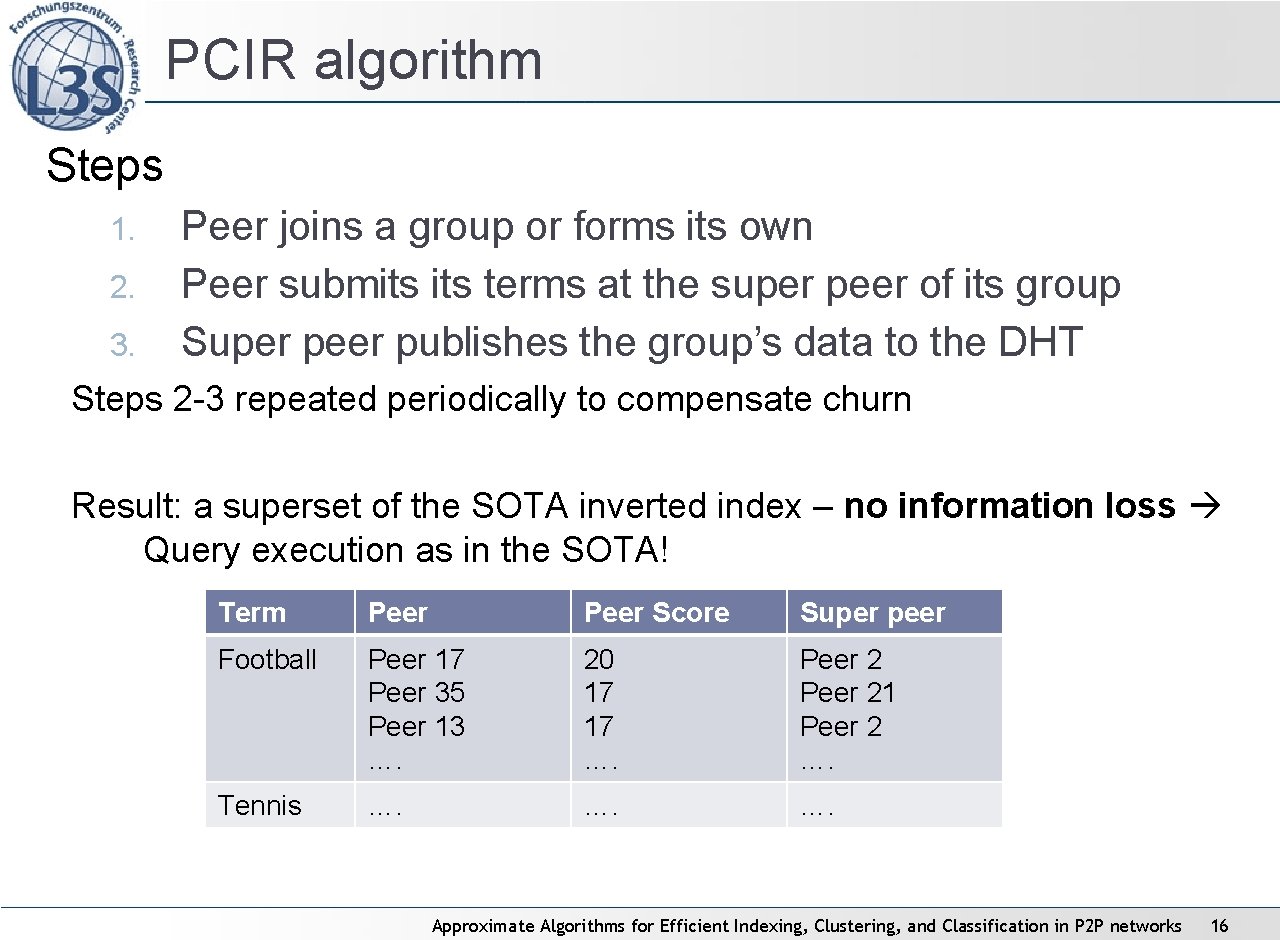
PCIR algorithm Steps 1. 2. 3. Peer joins a group or forms its own Peer submits terms at the super peer of its group Super peer publishes the group’s data to the DHT Steps 2 -3 repeated periodically to compensate churn Result: a superset of the SOTA inverted index – no information loss Query execution as in the SOTA! Term Peer Score Super peer Football Peer 17 Peer 35 Peer 13 …. 20 17 17 …. Peer 21 Peer 2 …. Tennis …. …. Approximate Algorithms for Efficient Indexing, Clustering, and Classification in P 2 P networks 16
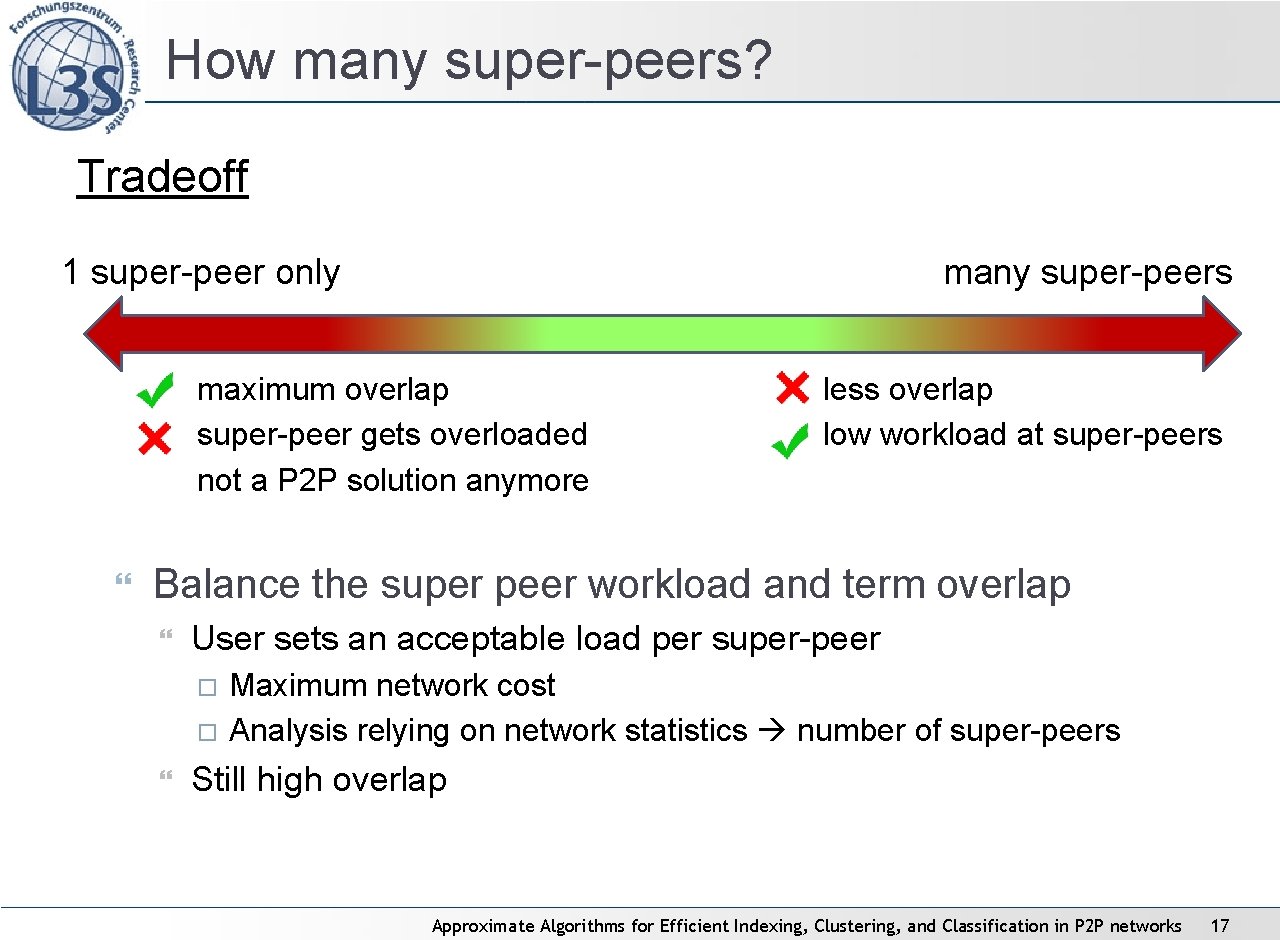
How many super-peers? Tradeoff 1 super-peer only many super-peers maximum overlap super-peer gets overloaded not a P 2 P solution anymore less overlap low workload at super-peers Balance the super peer workload and term overlap User sets an acceptable load per super-peer Maximum network cost Analysis relying on network statistics number of super-peers Still high overlap Approximate Algorithms for Efficient Indexing, Clustering, and Classification in P 2 P networks 17
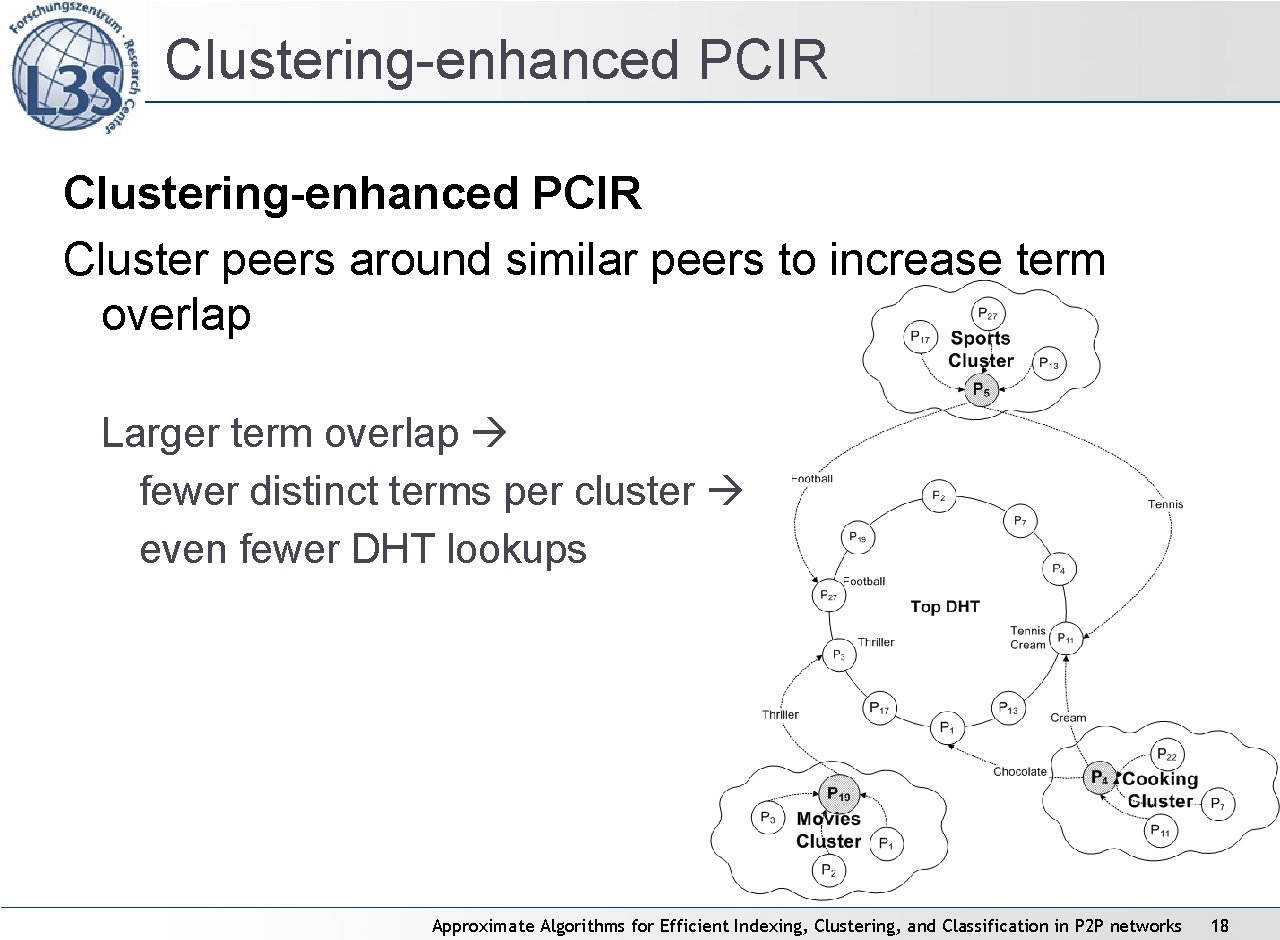
Clustering-enhanced PCIR Cluster peers around similar peers to increase term overlap Larger term overlap fewer distinct terms per cluster even fewer DHT lookups Approximate Algorithms for Efficient Indexing, Clustering, and Classification in P 2 P networks 18
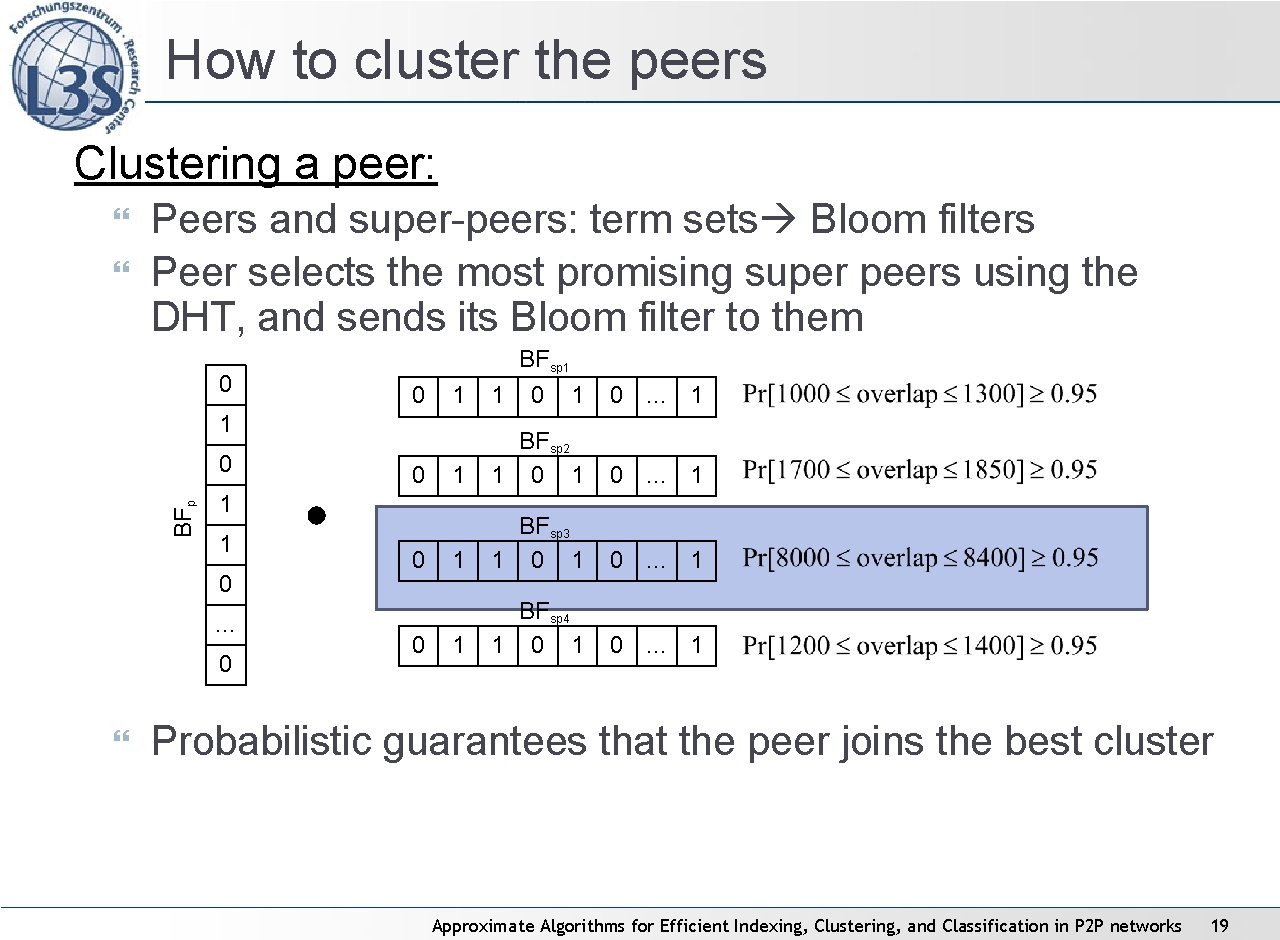
How to cluster the peers Clustering a peer: Peers and super-peers: term sets Bloom filters Peer selects the most promising super peers using the DHT, and sends its Bloom filter to them 0 BFsp 1 0 1 1 1 0 … 1 1 BFsp 2 1 0 … 1 1 BFsp 3 1 0 … 1 1 BFsp 4 1 0 … 1 1 BFp 0 1 1 0 … 0 0 0 Probabilistic guarantees that the peer joins the best cluster Approximate Algorithms for Efficient Indexing, Clustering, and Classification in P 2 P networks 19
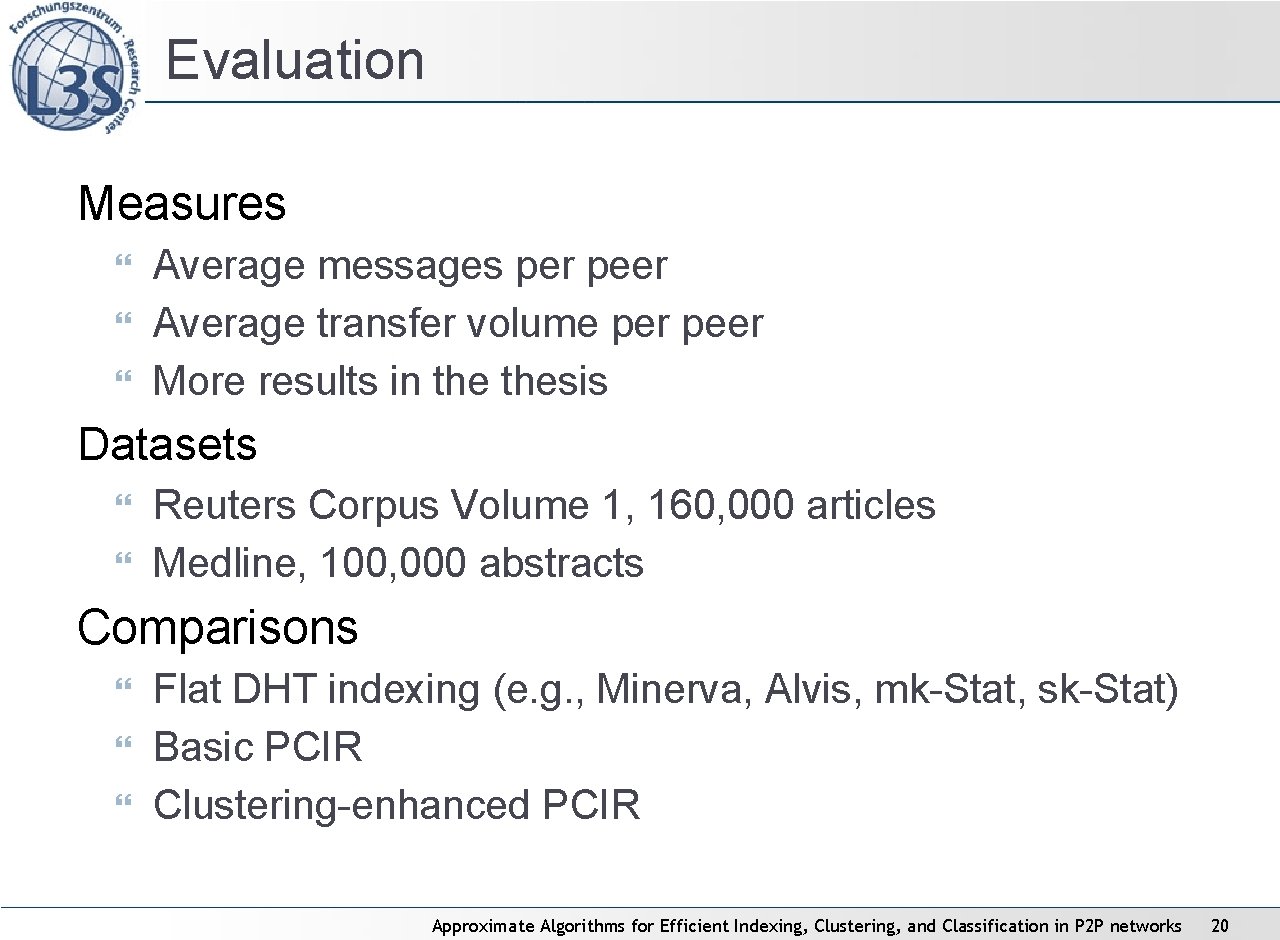
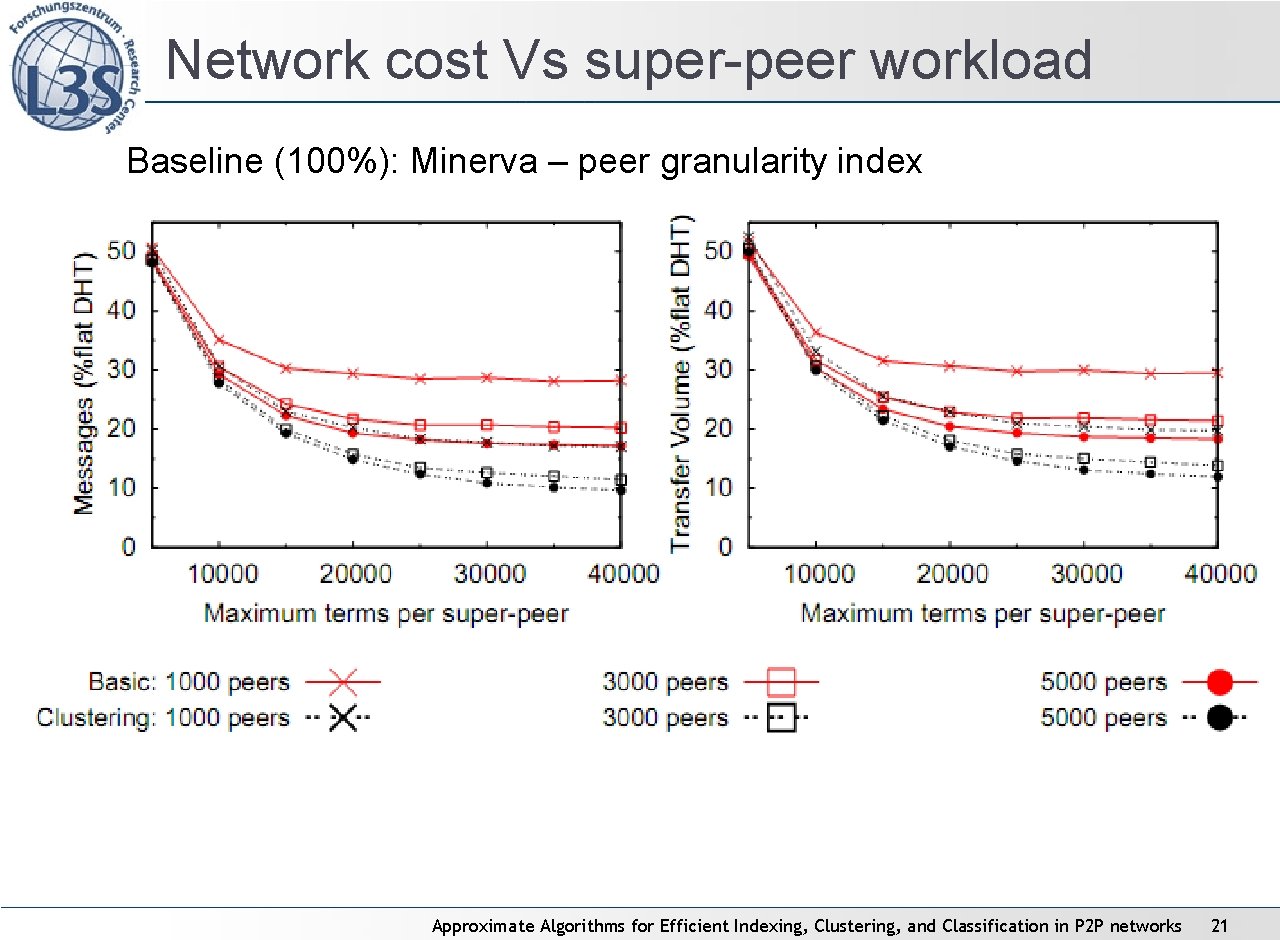
Evaluation Measures Average messages per peer Average transfer volume per peer More results in thesis Datasets Reuters Corpus Volume 1, 160, 000 articles Medline, 100, 000 abstracts Comparisons Flat DHT indexing (e. g. , Minerva, Alvis, mk-Stat, sk-Stat) Basic PCIR Clustering-enhanced PCIR Approximate Algorithms for Efficient Indexing, Clustering, and Classification in P 2 P networks 20
Network cost Vs super-peer workload Baseline (100%): Minerva – peer granularity index Approximate Algorithms for Efficient Indexing, Clustering, and Classification in P 2 P networks 21
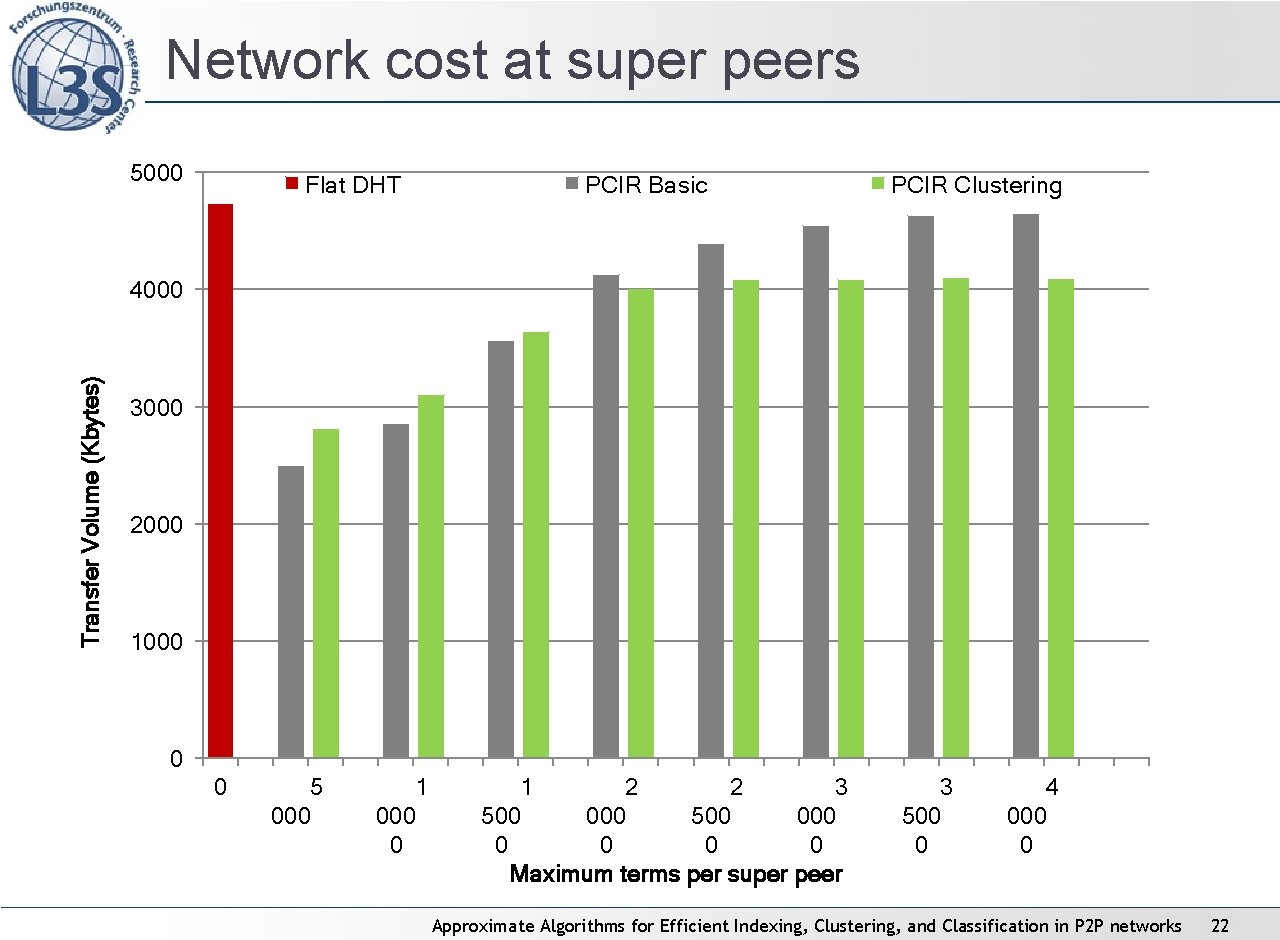
Network cost at super peers 5000 Flat DHT PCIR Basic PCIR Clustering Transfer Volume (Kbytes) 4000 3000 2000 1000 0 0 5 000 1 000 0 1 2 2 3 500 000 0 0 Maximum terms per super peer 3 500 0 4 000 0 Approximate Algorithms for Efficient Indexing, Clustering, and Classification in P 2 P networks 22
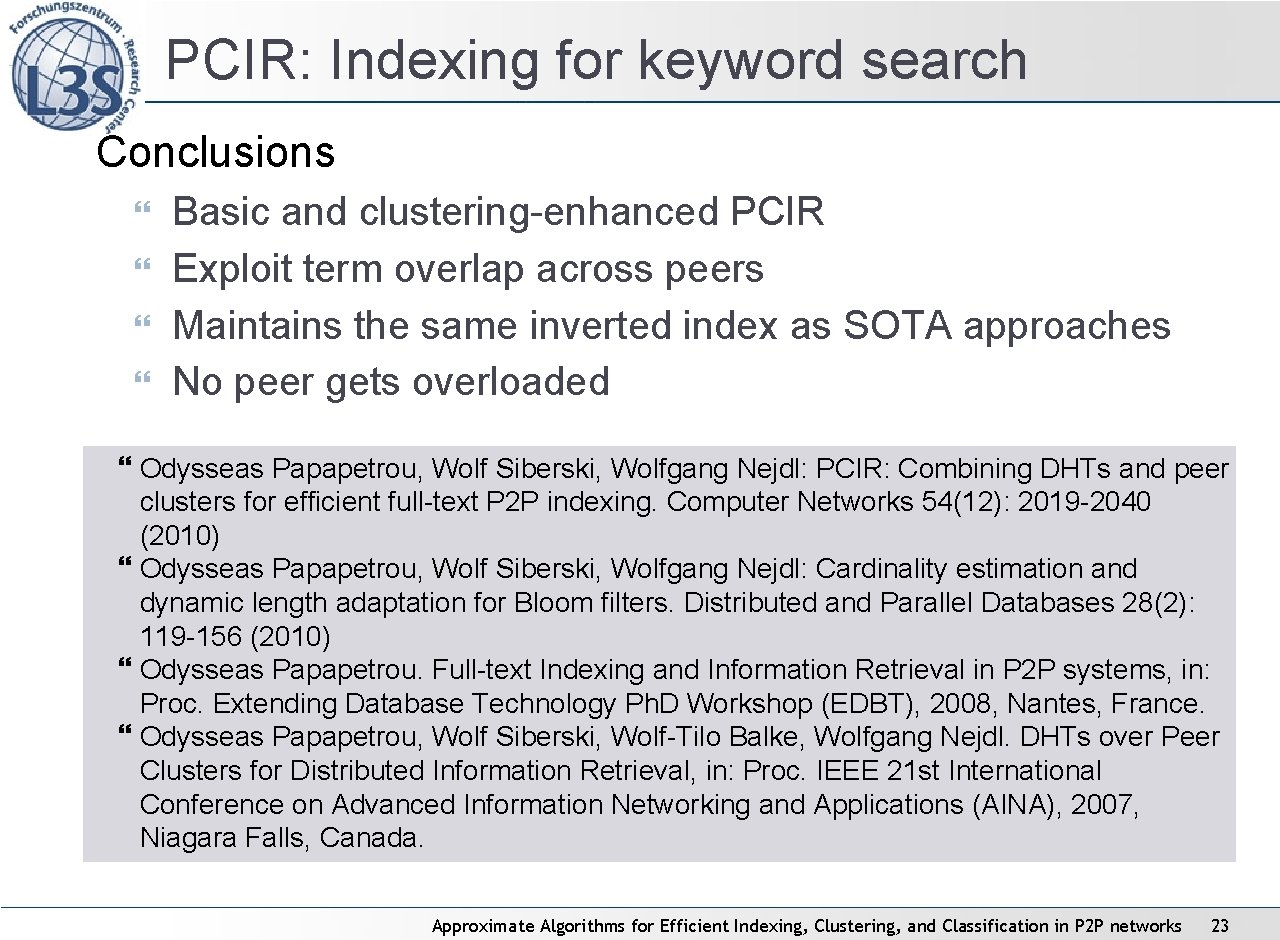
PCIR: Indexing for keyword search Conclusions Basic and clustering-enhanced PCIR Exploit term overlap across peers Maintains the same inverted index as SOTA approaches No peer gets overloaded Odysseas Papapetrou, Wolf Siberski, Wolfgang Nejdl: PCIR: Combining DHTs and peer clusters for efficient full-text P 2 P indexing. Computer Networks 54(12): 2019 -2040 (2010) Odysseas Papapetrou, Wolf Siberski, Wolfgang Nejdl: Cardinality estimation and dynamic length adaptation for Bloom filters. Distributed and Parallel Databases 28(2): 119 -156 (2010) Odysseas Papapetrou. Full-text Indexing and Information Retrieval in P 2 P systems, in: Proc. Extending Database Technology Ph. D Workshop (EDBT), 2008, Nantes, France. Odysseas Papapetrou, Wolf Siberski, Wolf-Tilo Balke, Wolfgang Nejdl. DHTs over Peer Clusters for Distributed Information Retrieval, in: Proc. IEEE 21 st International Conference on Advanced Information Networking and Applications (AINA), 2007, Niagara Falls, Canada. Approximate Algorithms for Efficient Indexing, Clustering, and Classification in P 2 P networks 23
P 2 P text clustering Clustering of documents without a central server Important data mining technique Useful for information retrieval Challenging because of network size, and high dimensionality of documents and cluster centroids! Approximate Algorithms for Efficient Indexing, Clustering, and Classification in P 2 P networks 24
Related work LSP 2 P [TKDE 09] Unstructured P 2 P network Peers gossip their centroids Algorithm repeats until convergence Assumption: Peers have documents from all classes! Approximate Algorithms for Efficient Indexing, Clustering, and Classification in P 2 P networks 25
Related work HP 2 PC [TKDE 08] Peers organized in a hierarchy Each level divided into neighborhoods Super-peers at each neighborhood Root . . Approximate Algorithms for Efficient Indexing, Clustering, and Classification in P 2 P networks 26
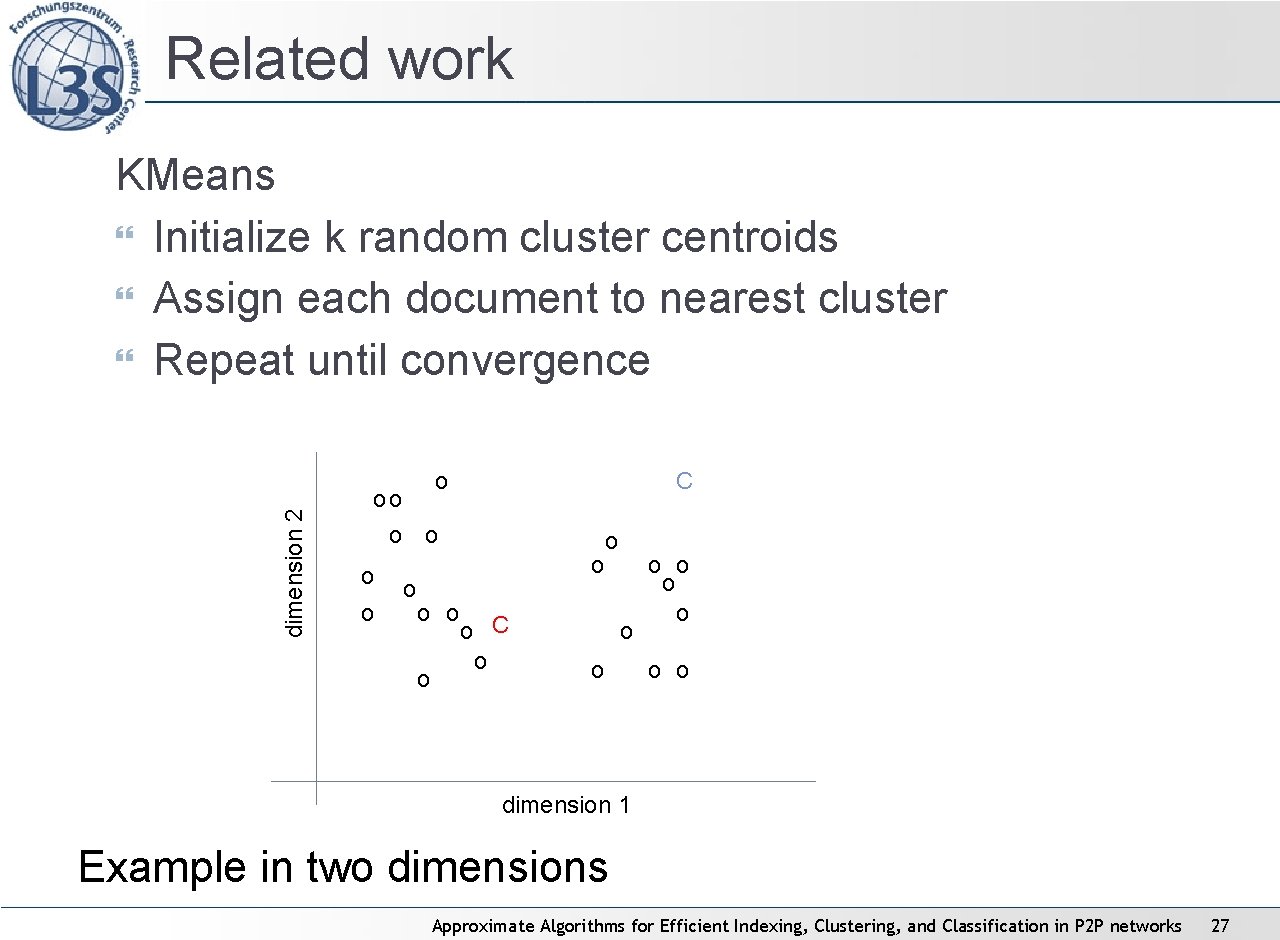
Related work dimension 2 KMeans Initialize k random cluster centroids Assign each document to nearest cluster Repeat until convergence o oo C o o o o o dimension 1 Example in two dimensions Approximate Algorithms for Efficient Indexing, Clustering, and Classification in P 2 P networks 27
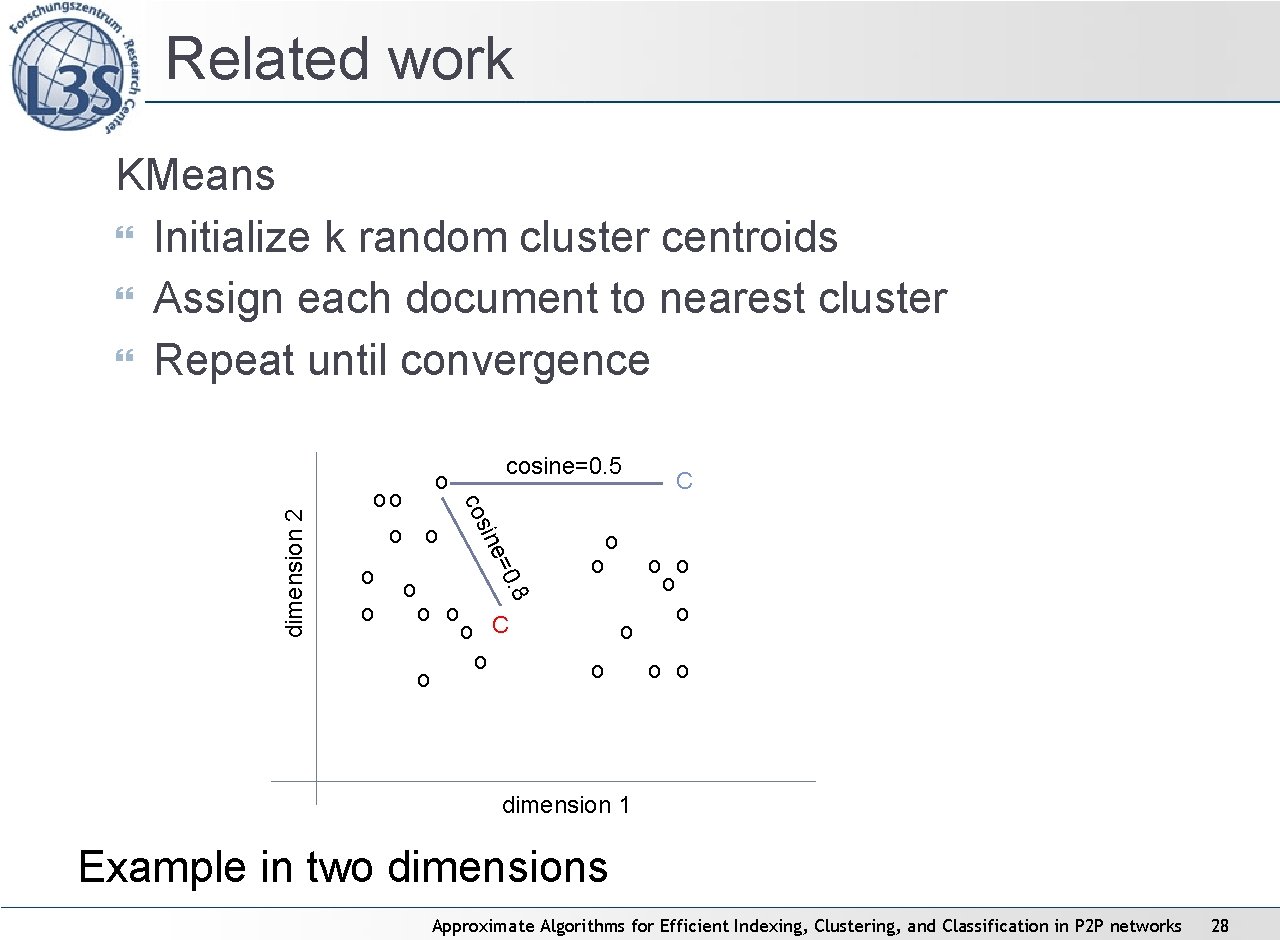
Related work o oo o o . 8 =0 o o ine o o o cosine=0. 5 cos dimension 2 KMeans Initialize k random cluster centroids Assign each document to nearest cluster Repeat until convergence o C o o o o dimension 1 Example in two dimensions Approximate Algorithms for Efficient Indexing, Clustering, and Classification in P 2 P networks 28
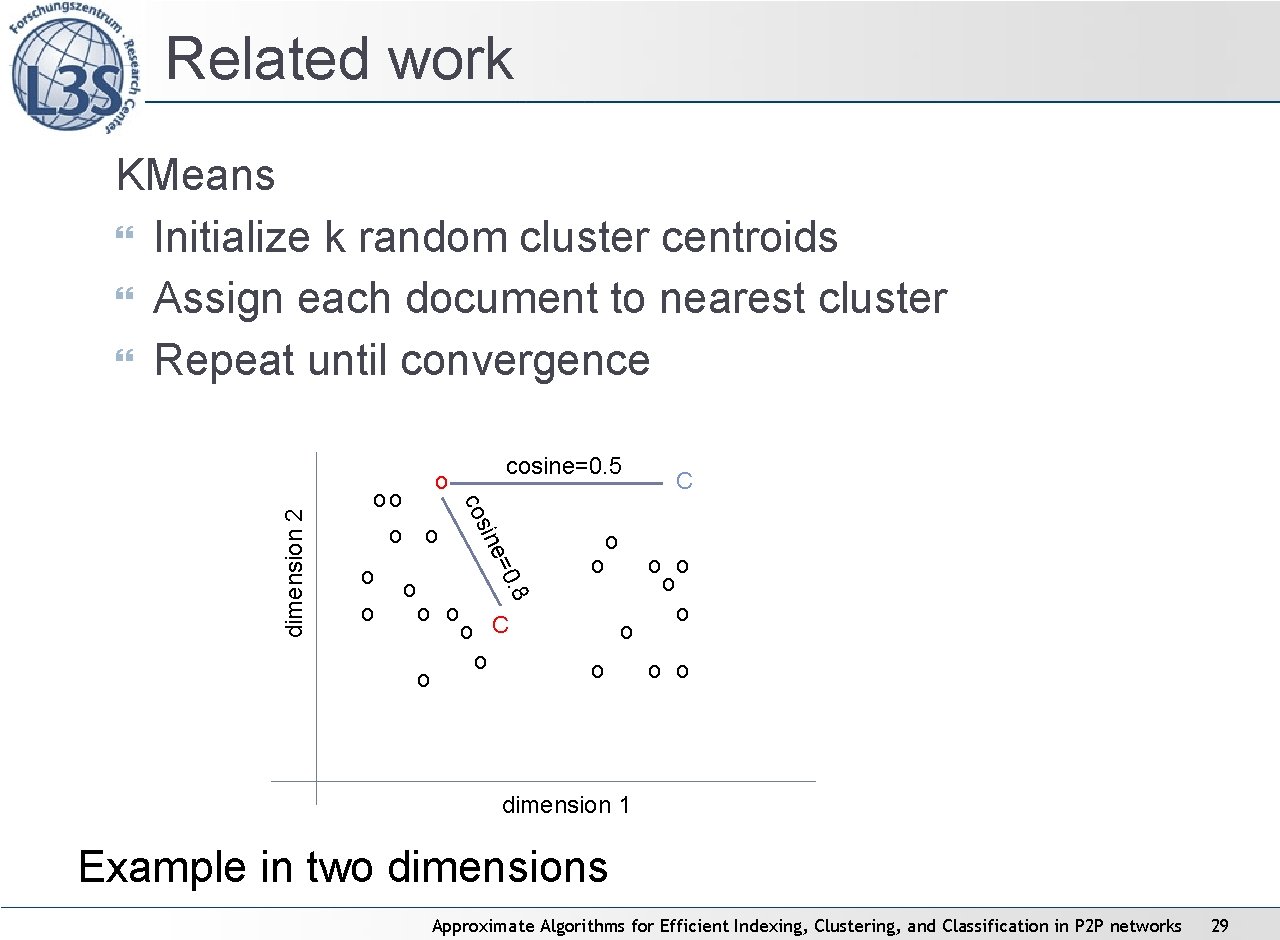
Related work o oo o o . 8 =0 o o ine o o o cosine=0. 5 cos dimension 2 KMeans Initialize k random cluster centroids Assign each document to nearest cluster Repeat until convergence o C o o o o dimension 1 Example in two dimensions Approximate Algorithms for Efficient Indexing, Clustering, and Classification in P 2 P networks 29
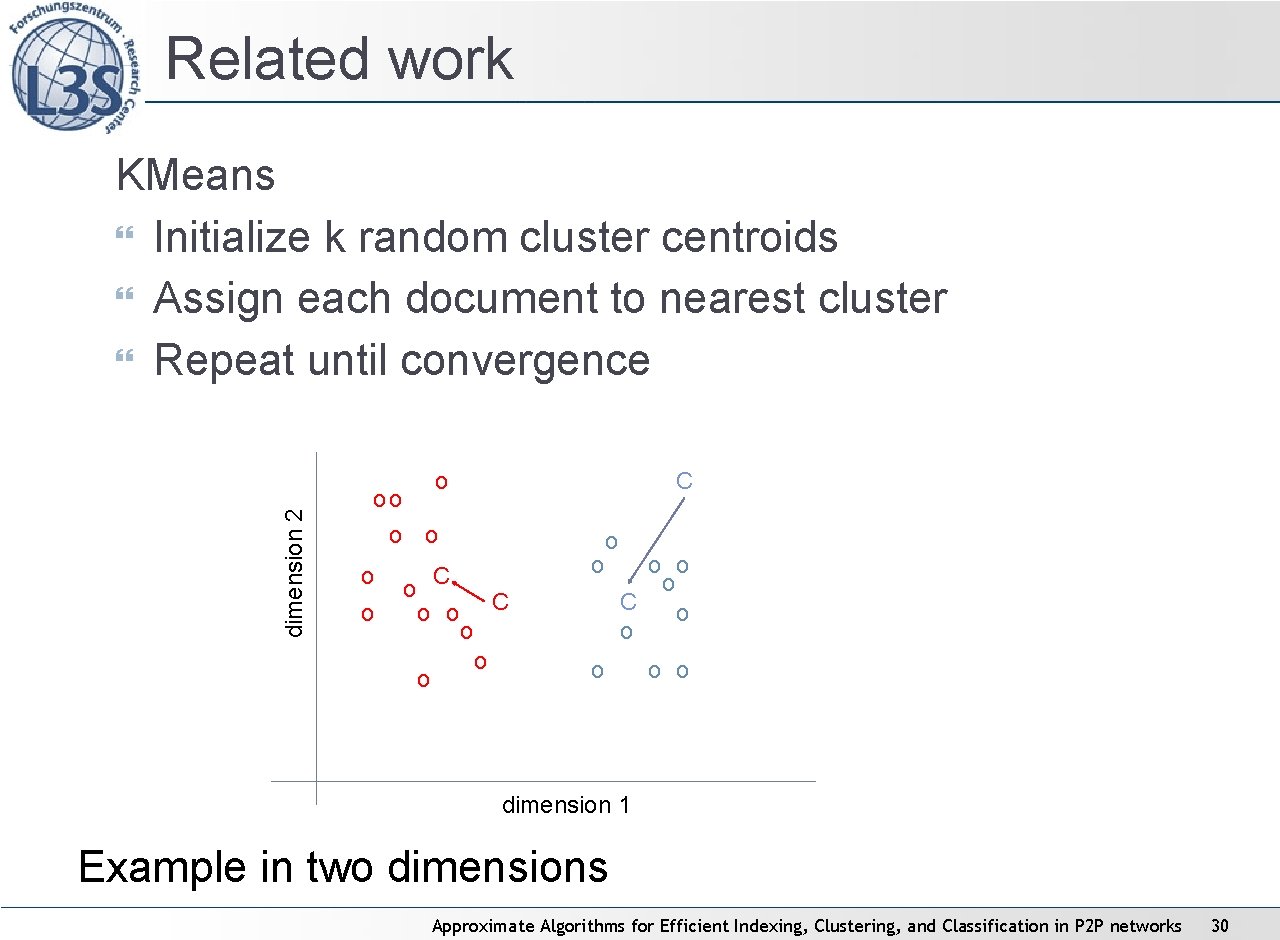
Related work dimension 2 KMeans Initialize k random cluster centroids Assign each document to nearest cluster Repeat until convergence o oo C o o o o o C o o o dimension 1 Example in two dimensions Approximate Algorithms for Efficient Indexing, Clustering, and Classification in P 2 P networks 30
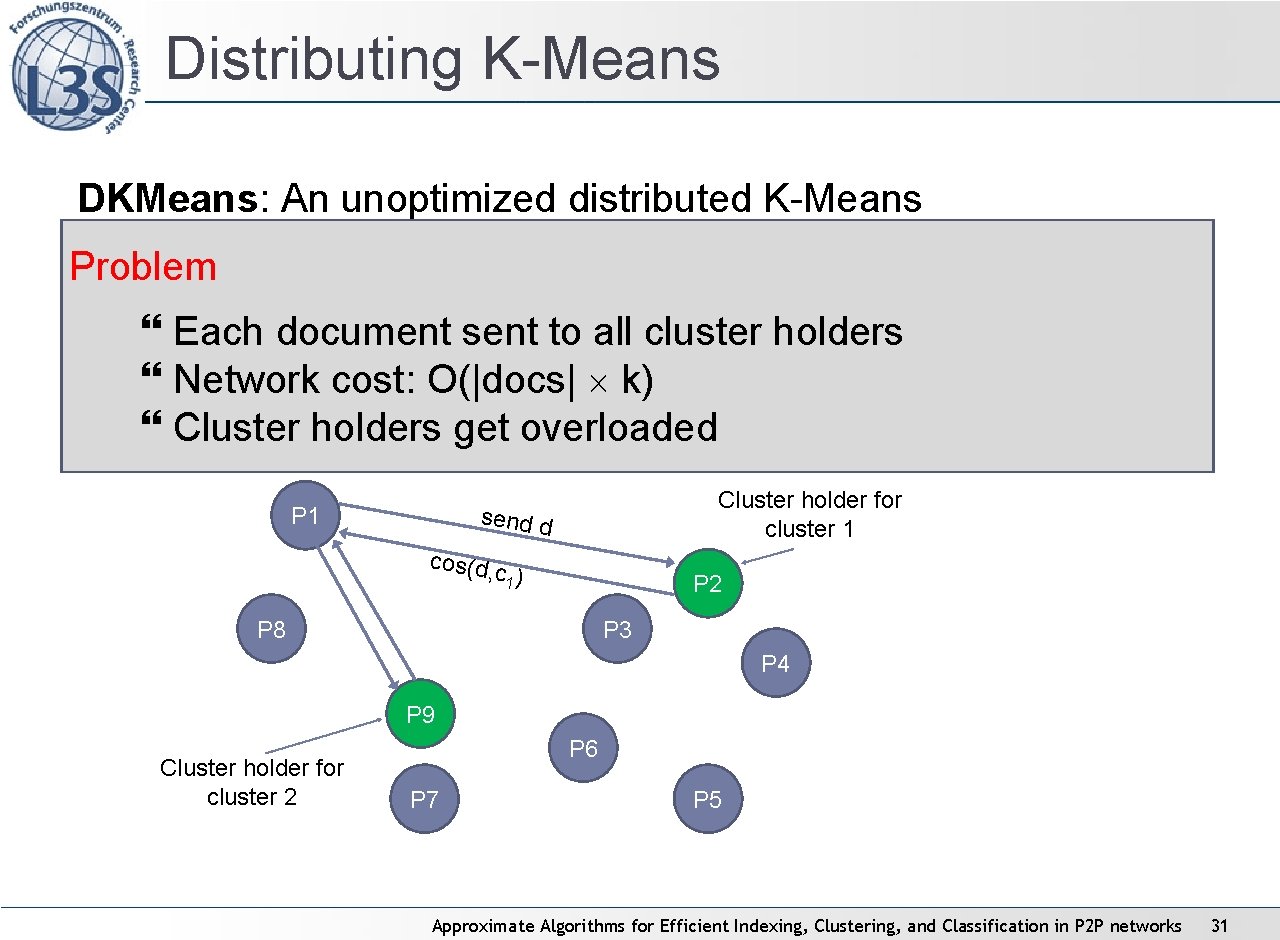
Distributing K-Means DKMeans: An unoptimized distributed K-Means Assign maintenance of each cluster to one peer: Cluster holders Problem Peer P 1 wants to cluster its document d Each document sent to all cluster holders Send d to all cluster holders Network cost: O(|docs| k) Cluster holders compute cosine(d, c) Cluster holders get P 1 assigns d to cluster withoverloaded max. cosine, and notifies the cluster holder Cluster holder for cluster 1 send d P 1 cos(d, c 1) P 2 P 3 P 8 P 4 P 9 Cluster holder for cluster 2 P 6 P 7 P 5 Approximate Algorithms for Efficient Indexing, Clustering, and Classification in P 2 P networks 31
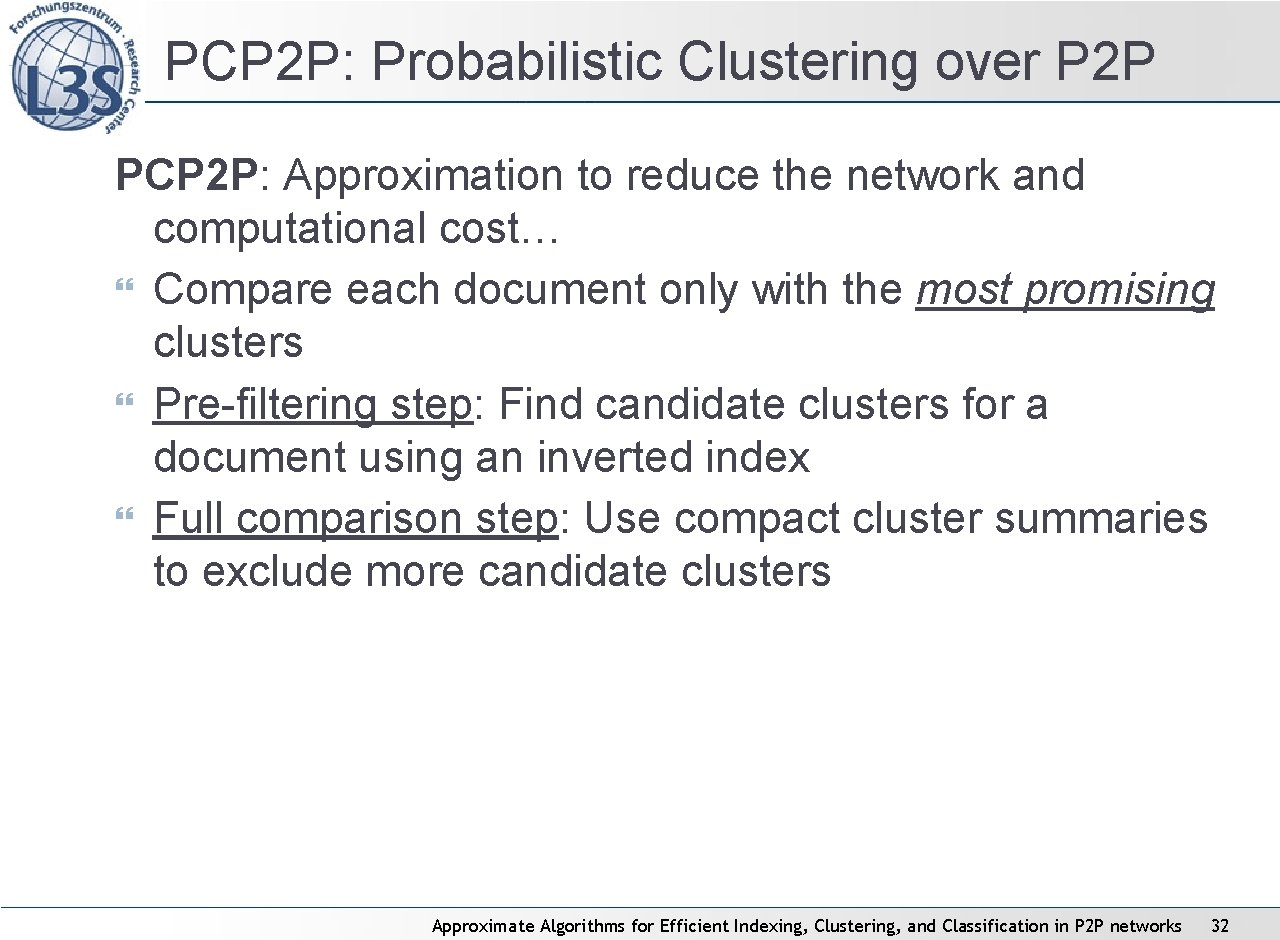
PCP 2 P: Probabilistic Clustering over P 2 P PCP 2 P: Approximation to reduce the network and computational cost… Compare each document only with the most promising clusters Pre-filtering step: Find candidate clusters for a document using an inverted index Full comparison step: Use compact cluster summaries to exclude more candidate clusters Approximate Algorithms for Efficient Indexing, Clustering, and Classification in P 2 P networks 32
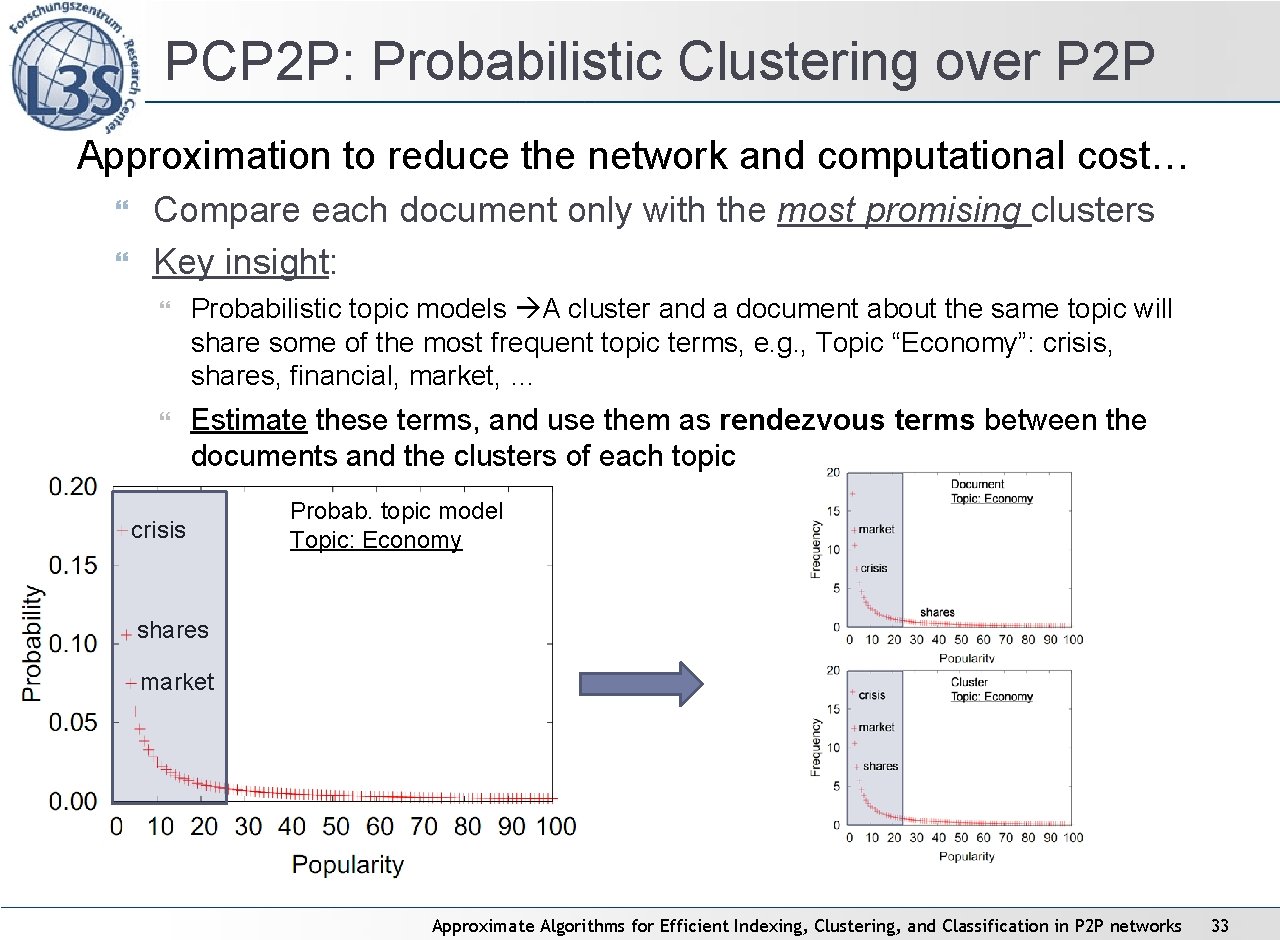
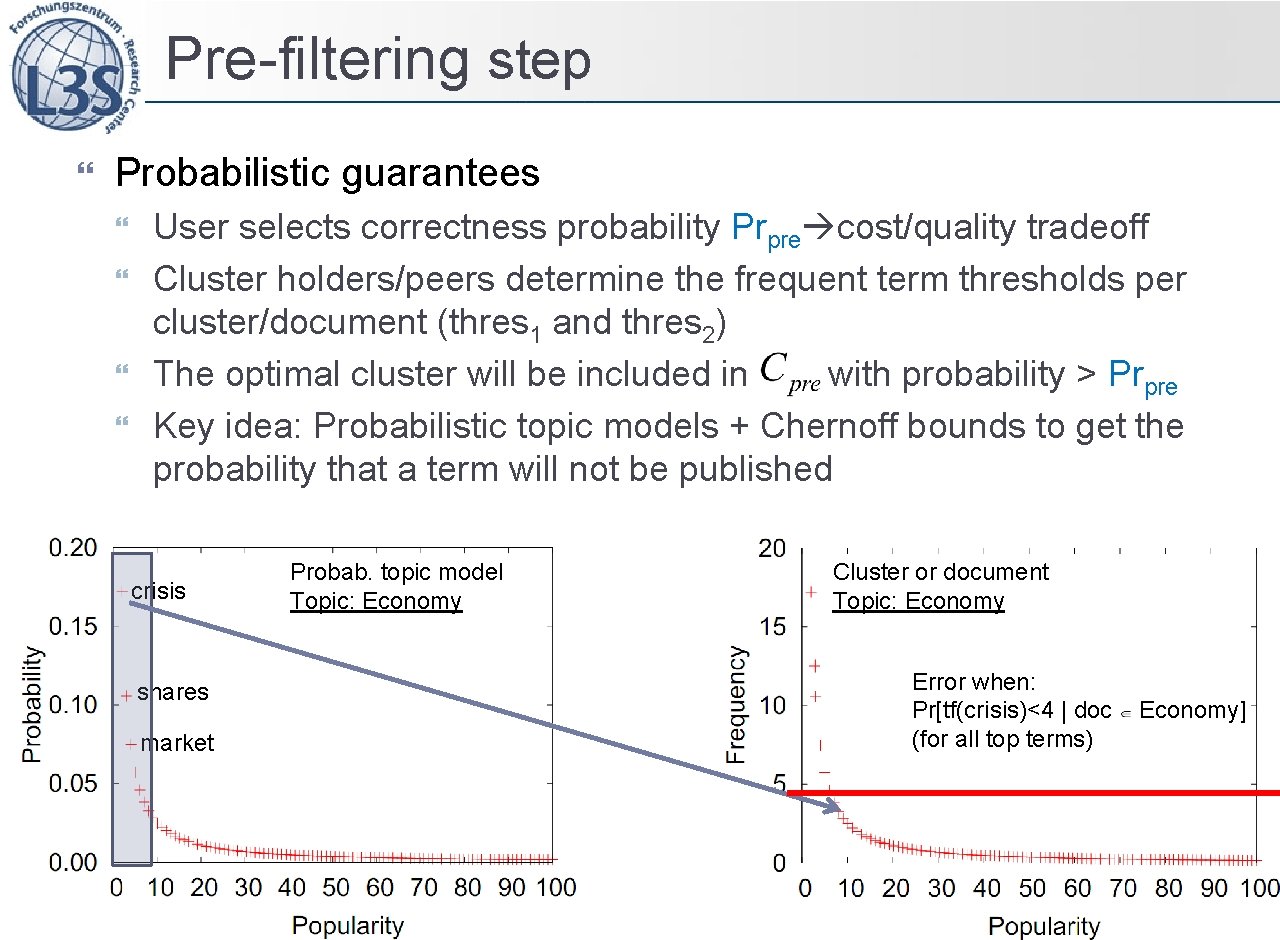
PCP 2 P: Probabilistic Clustering over P 2 P Approximation to reduce the network and computational cost… Compare each document only with the most promising clusters Key insight: Probabilistic topic models A cluster and a document about the same topic will share some of the most frequent topic terms, e. g. , Topic “Economy”: crisis, shares, financial, market, … Estimate these terms, and use them as rendezvous terms between the documents and the clusters of each topic crisis Probab. topic model Topic: Economy shares market Approximate Algorithms for Efficient Indexing, Clustering, and Classification in P 2 P networks 33
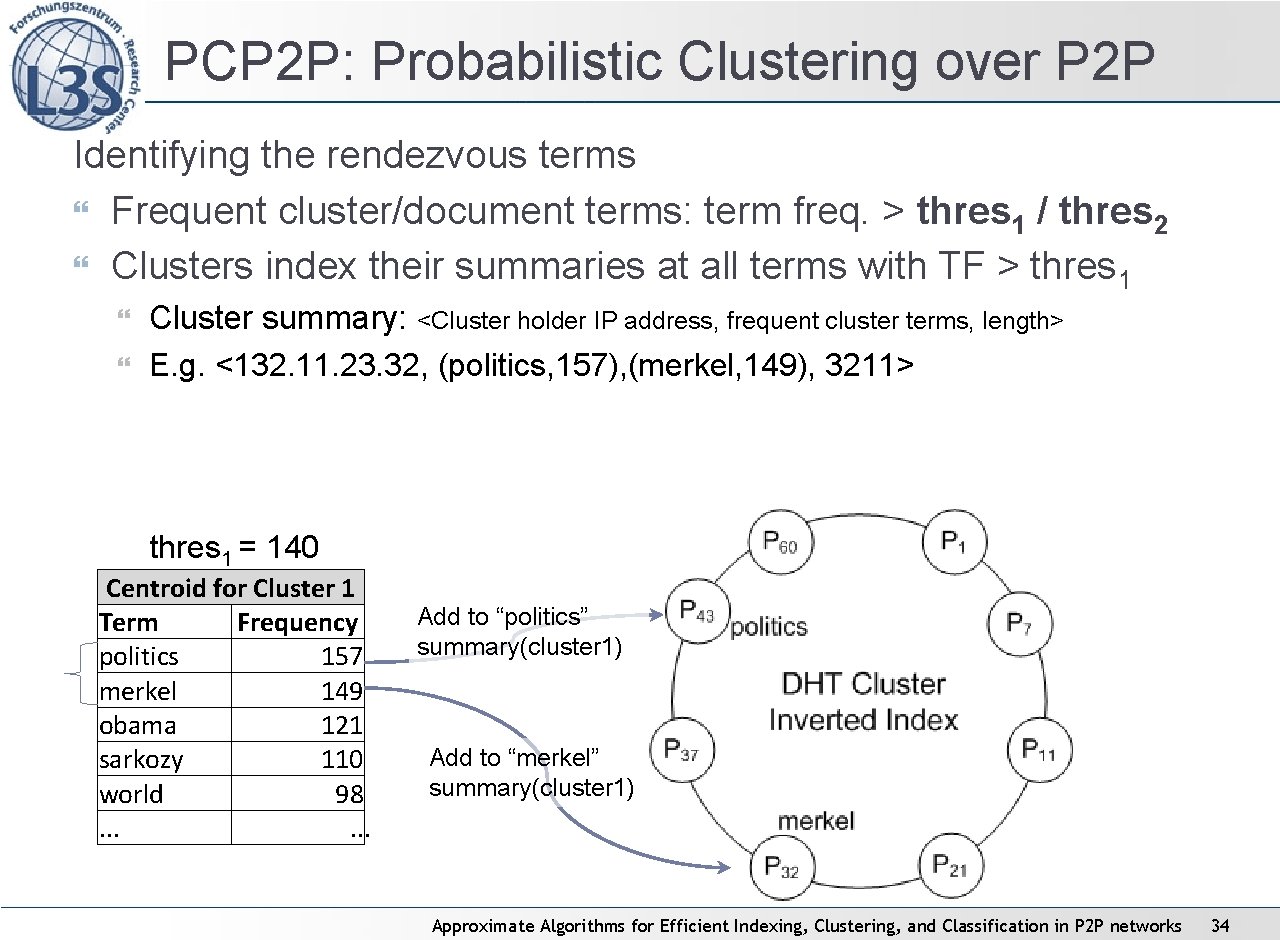
PCP 2 P: Probabilistic Clustering over P 2 P Identifying the rendezvous terms Frequent cluster/document terms: term freq. > thres 1 / thres 2 Clusters index their summaries at all terms with TF > thres 1 Cluster summary: <Cluster holder IP address, frequent cluster terms, length> E. g. <132. 11. 23. 32, (politics, 157), (merkel, 149), 3211> thres 1 = 140 Centroid for Cluster 1 Term Frequency politics 157 merkel 149 obama 121 sarkozy 110 world 98. . . Add to “politics” summary(cluster 1) Add to “merkel” summary(cluster 1) Approximate Algorithms for Efficient Indexing, Clustering, and Classification in P 2 P networks 34
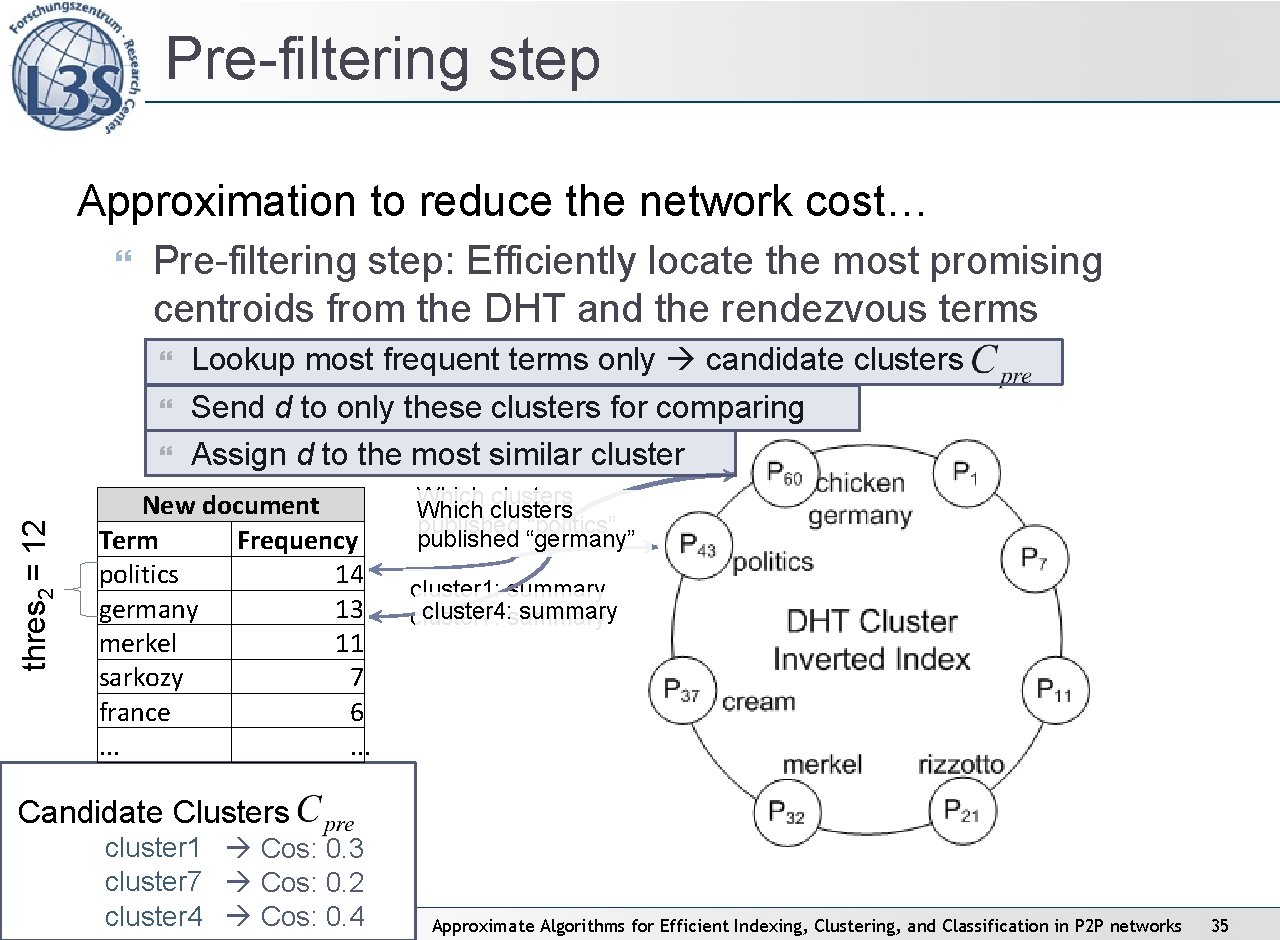
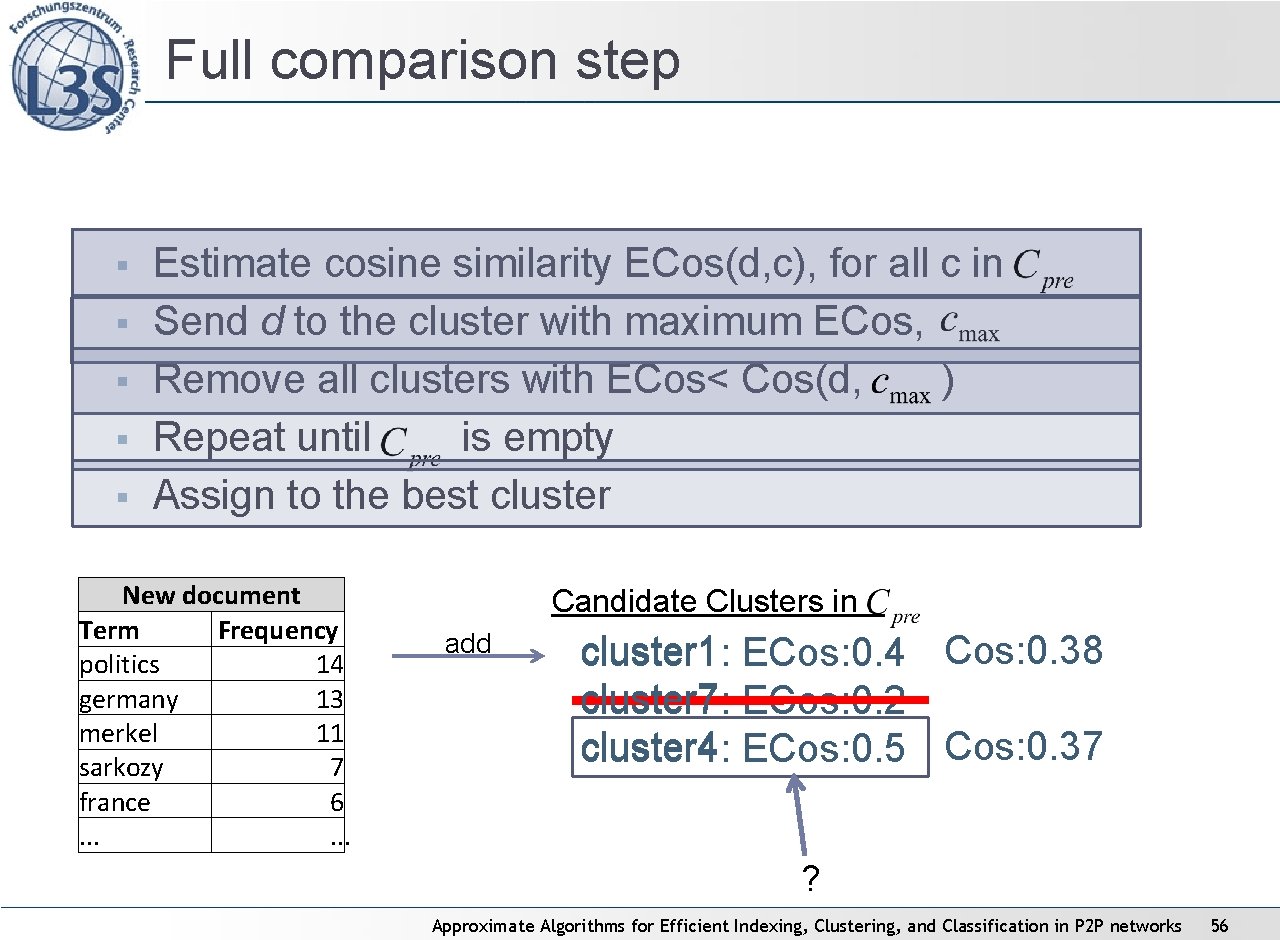
Pre-filtering step Approximation to reduce the network cost… Pre-filtering step: Efficiently locate the most promising centroids from the DHT and the rendezvous terms thres 2 = 12 Lookup most frequent terms only candidate clusters Send d to only these clusters for comparing Assign d to the most similar cluster New document Term Frequency politics 14 germany 13 merkel 11 sarkozy 7 france 6. . . Which clusters published “politics” published “germany” cluster 1: summary cluster 4: summary cluster 7: Candidate Clusters cluster 1 Cos: 0. 3 cluster 7 Cos: 0. 2 cluster 4 Cos: 0. 4 Approximate Algorithms for Efficient Indexing, Clustering, and Classification in P 2 P networks 35
Pre-filtering step Probabilistic guarantees User selects correctness probability Prpre cost/quality tradeoff Cluster holders/peers determine the frequent term thresholds per cluster/document (thres 1 and thres 2) The optimal cluster will be included in with probability > Prpre Key idea: Probabilistic topic models + Chernoff bounds to get the probability that a term will not be published crisis shares market Probab. topic model Topic: Economy Cluster or document Topic: Economy Error when: Pr[tf(crisis)<4 | doc (for all top terms) Economy] Approximate Algorithms for Efficient Indexing, Clustering, and Classification in P 2 P networks 36
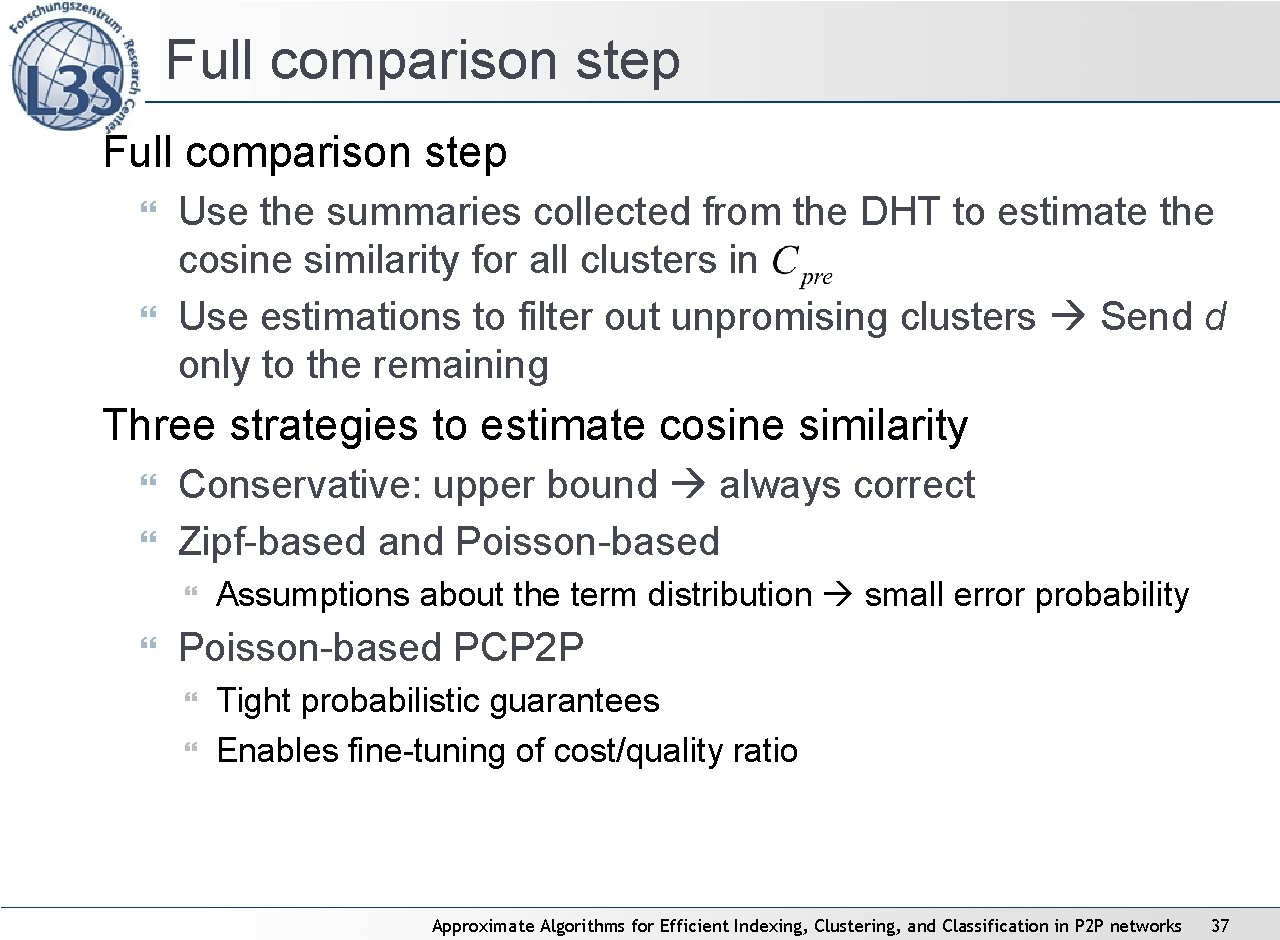
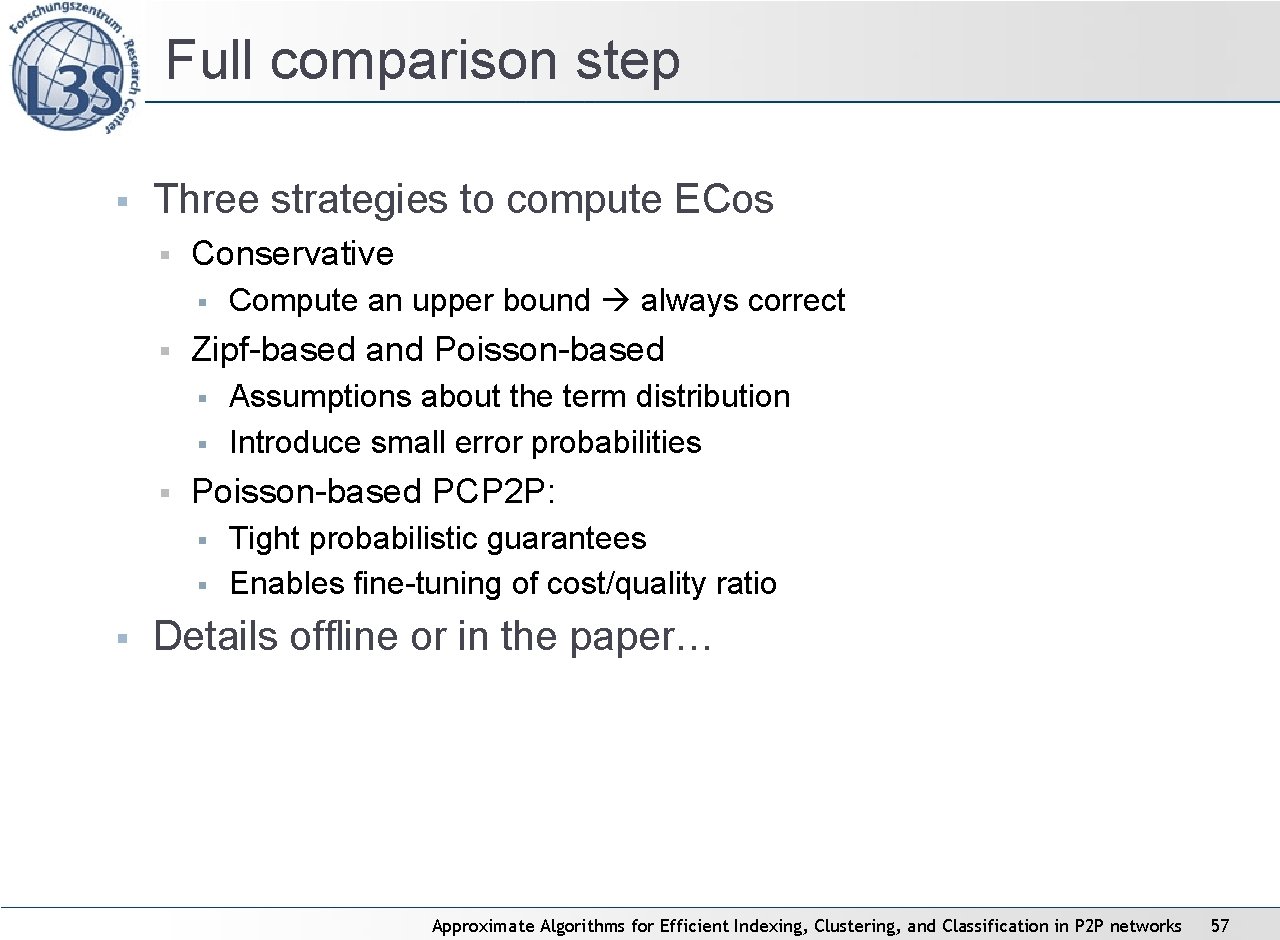
Full comparison step Use the summaries collected from the DHT to estimate the cosine similarity for all clusters in Use estimations to filter out unpromising clusters Send d only to the remaining Three strategies to estimate cosine similarity Conservative: upper bound always correct Zipf-based and Poisson-based Assumptions about the term distribution small error probability Poisson-based PCP 2 P Tight probabilistic guarantees Enables fine-tuning of cost/quality ratio Approximate Algorithms for Efficient Indexing, Clustering, and Classification in P 2 P networks 37
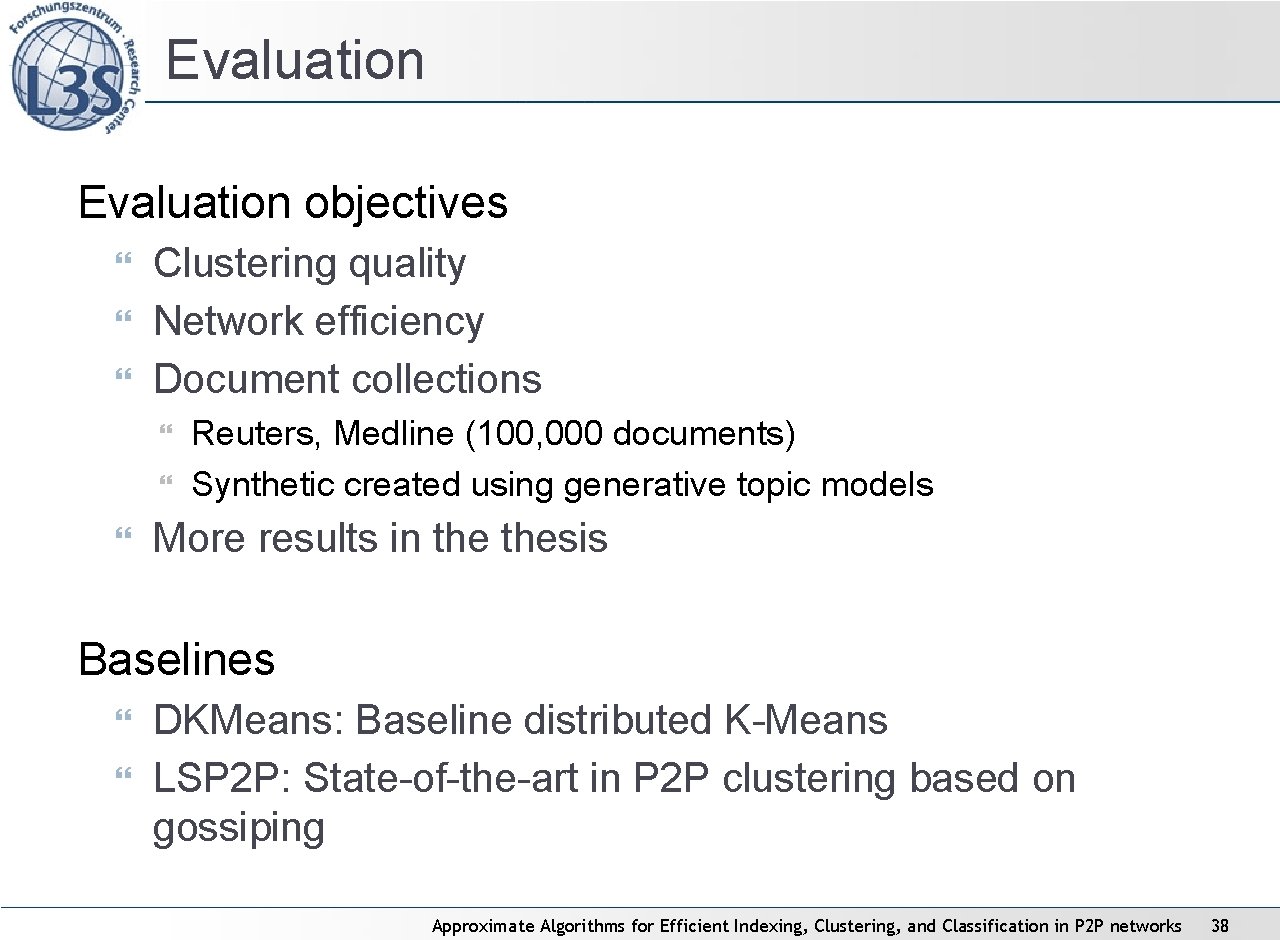
Evaluation objectives Clustering quality Network efficiency Document collections Reuters, Medline (100, 000 documents) Synthetic created using generative topic models More results in thesis Baselines DKMeans: Baseline distributed K-Means LSP 2 P: State-of-the-art in P 2 P clustering based on gossiping Approximate Algorithms for Efficient Indexing, Clustering, and Classification in P 2 P networks 38
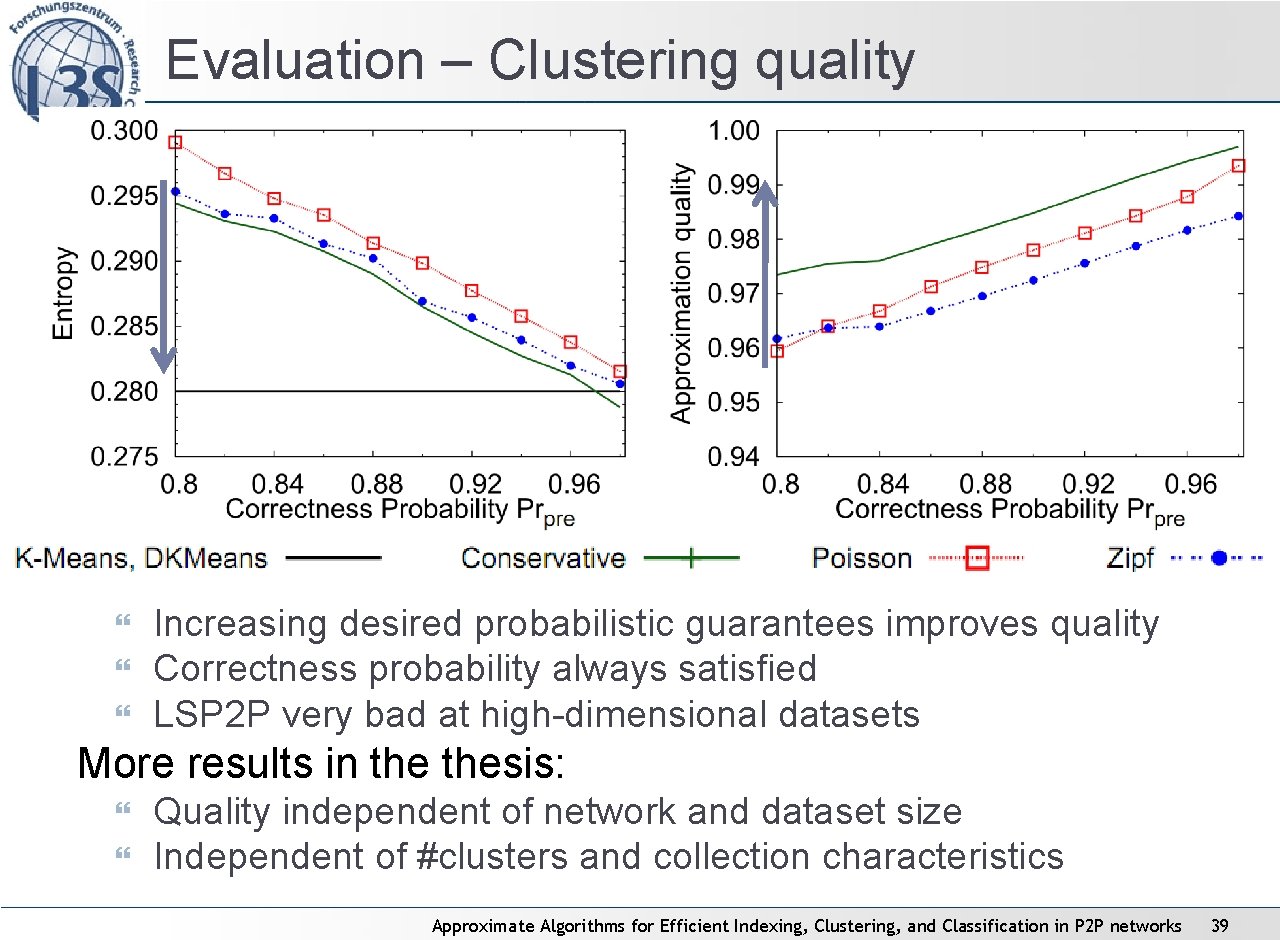
Evaluation – Clustering quality Increasing desired probabilistic guarantees improves quality Correctness probability always satisfied LSP 2 P very bad at high-dimensional datasets More results in thesis: Quality independent of network and dataset size Independent of #clusters and collection characteristics Approximate Algorithms for Efficient Indexing, Clustering, and Classification in P 2 P networks 39
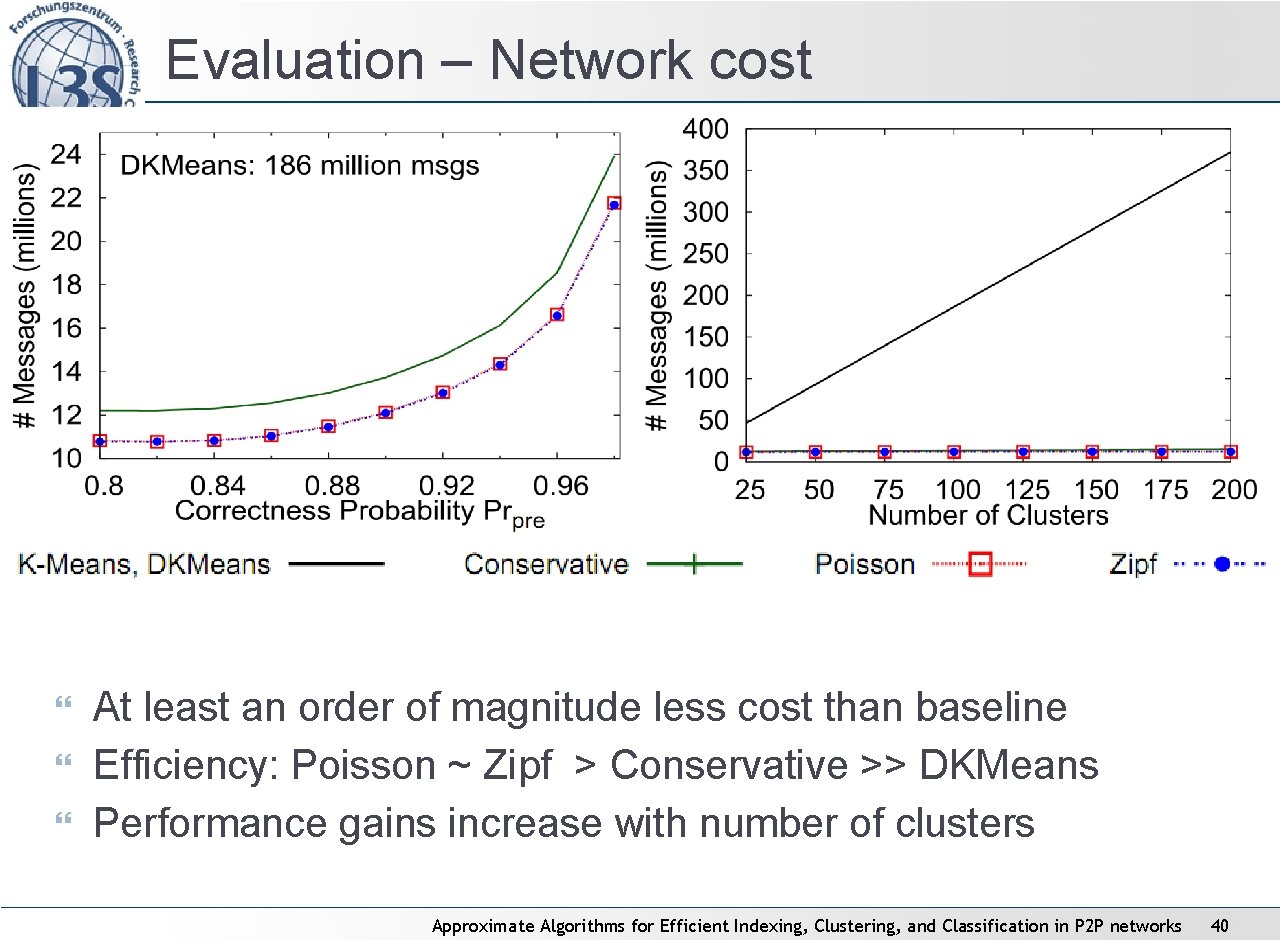
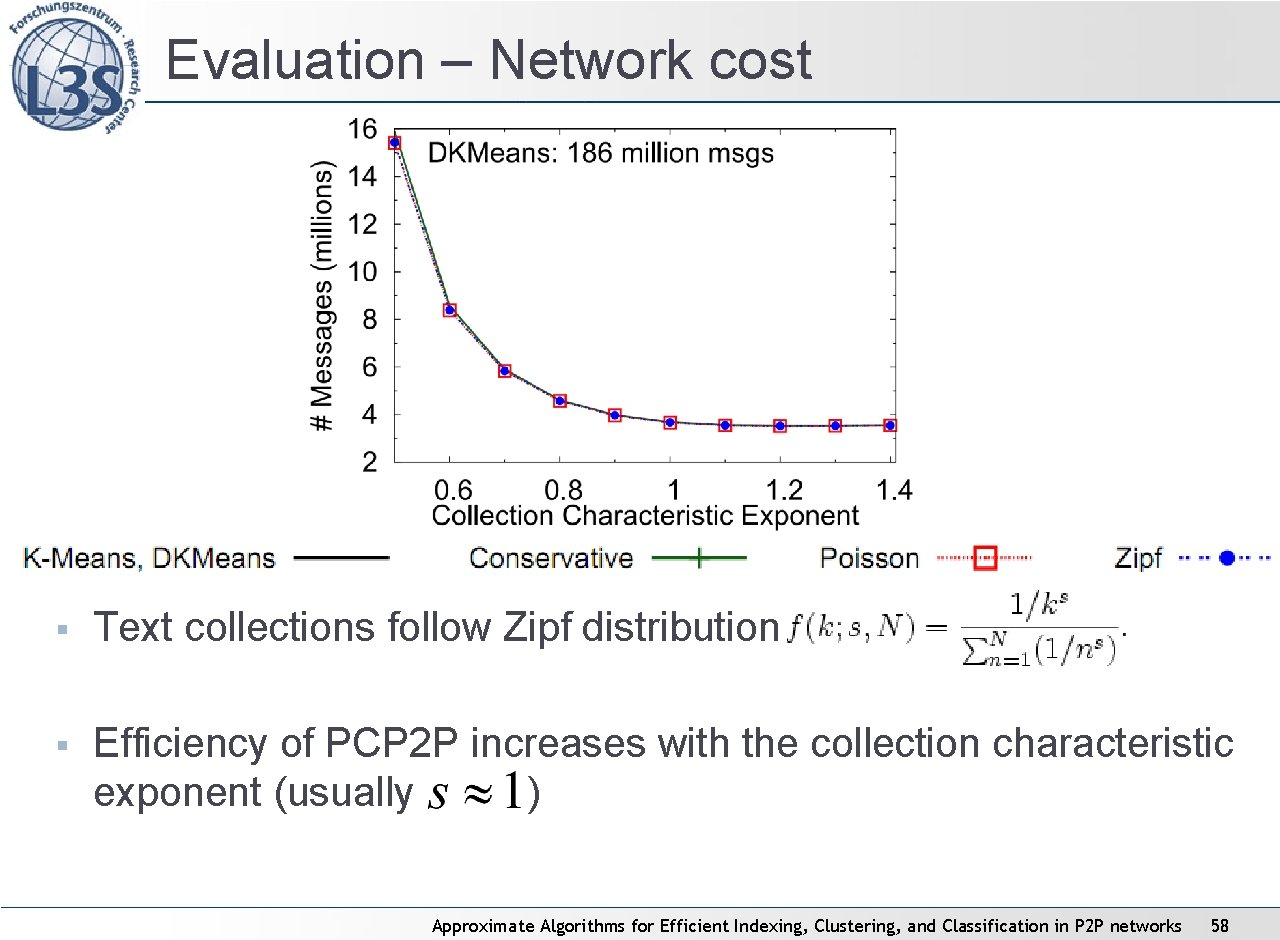
Evaluation – Network cost At least an order of magnitude less cost than baseline Efficiency: Poisson ~ Zipf > Conservative >> DKMeans Performance gains increase with number of clusters Approximate Algorithms for Efficient Indexing, Clustering, and Classification in P 2 P networks 40
P 2 P text clustering Conclusions Probabilistic text clustering over P 2 P networks using probabilistic topic models Pre-filtering step relying on inverted index Full comparison step: Conservative, Zipf-based, Poissonbased Odysseas Papapetrou, Wolf Siberski, Norbert Fuhr. Text Clustering for Peer-to-Peer Networks with Probabilistic Guarantees, in: Proc. ECIR 2010. Odysseas Papapetrou. Full-text Indexing and Information Retrieval in P 2 P systems, in: Proc. EDBT Ph. D workshop 2008. Odysseas Papapetrou, Wolf Siberski, Fabian Leitritz, Wolfgang Nejdl. Exploiting Distribution Skew for Scalable P 2 P Text Clustering Databases, in: Proc. DBISP 2 P 2008. Odysseas Papapetrou, Wolf Siberski, Norbert Fuhr. Decentralized Probabilistic Text Clustering, under revision at TKDE, 2010. Approximate Algorithms for Efficient Indexing, Clustering, and Classification in P 2 P networks 41
Additional work in thesis… POND: Efficient and effective near duplicate detection in P 2 P networks with probabilistic guarantees (P 2 P 2010: 1 -10) Locality Sensitive Hashing for NDD of multimedia and text files POND: Finding the most efficient configuration to satisfy the probabilistic guarantees CSVM: Collaborative classification in P 2 P networks (WWW (Companion Volume) 2011: 97 -98, extended version under submission) Dimensionality reduction Share classifiers to construct meta-classifiers Avoids privacy issues Closely approximates the centralized case without centralization Approximate Algorithms for Efficient Indexing, Clustering, and Classification in P 2 P networks 42
Future work PCIR and PCP 2 P extensions Apply the clustering core idea to different scenarios Consider difference in update rate: Some information is more ‘static’ than other Index-based clustering for streaming data Other clustering algorithms and other similarity measures Bloom filter extensions for different scenarios, e. g. , sensor networks A good synopsis is always useful Approximate Algorithms for Efficient Indexing, Clustering, and Classification in P 2 P networks 43
References [Gnu] I. J. Taylor. “Gnutella”. In From P 2 P to Web Services and Grids, Computer Communications and Networks, pages 101– 116. Springer London, 2005 [Infocom 05] A. Kumar, J. Xu, E. Zegura. “Efficient and scalable query routing for unstructured peer-to-peer networks”. INFOCOM’ 05 [HPDC] F. M. Cuenca-Acuna, C. Peery, R. P. Martin, and T. D. Nguyen. “Planet. P: Using gossiping to build content addressable peer-to-peer information sharing communities”. HPDC’ 03 [Com. Net 06] J. Liang, R. Kumar, and K. W. Ross. The fasttrack overlay: A measurement study. Computer Networks, 50(6): 842 – 858, 2006. [ICDE 03] B. Yang, H. Garcia-Molina, "Designing a Super-Peer Network, " ICDE'03 [WWW 03] W. Nejdl et al. Super-peer-based routing and clustering strategies for rdf-based peer-to-peer networks. WWW 2003. [CACM 10] R. Rodrigues and P. Druschel. Peer-to-peer systems. Commun. ACM, 53(10): 72– 82, 2010. Approximate Algorithms for Efficient Indexing, Clustering, and Classification in P 2 P networks 44
Support slides Approximate Algorithms for Efficient Indexing, Clustering, and Classification in P 2 P networks 45
Presented papers Journals Papers Computer Networks Distributed and Parallel Databases TKDE (in communication) WWW’ 11 poster ECIR’ 10 P 2 P’ 10 DBISP 2 P’ 08 EDBT Ph. D workshop 2008 AINA 2007 Total published 3 journals 19 peer-reviewed conferences 2 peer-reviewed workshops Approximate Algorithms for Efficient Indexing, Clustering, and Classification in P 2 P networks 46
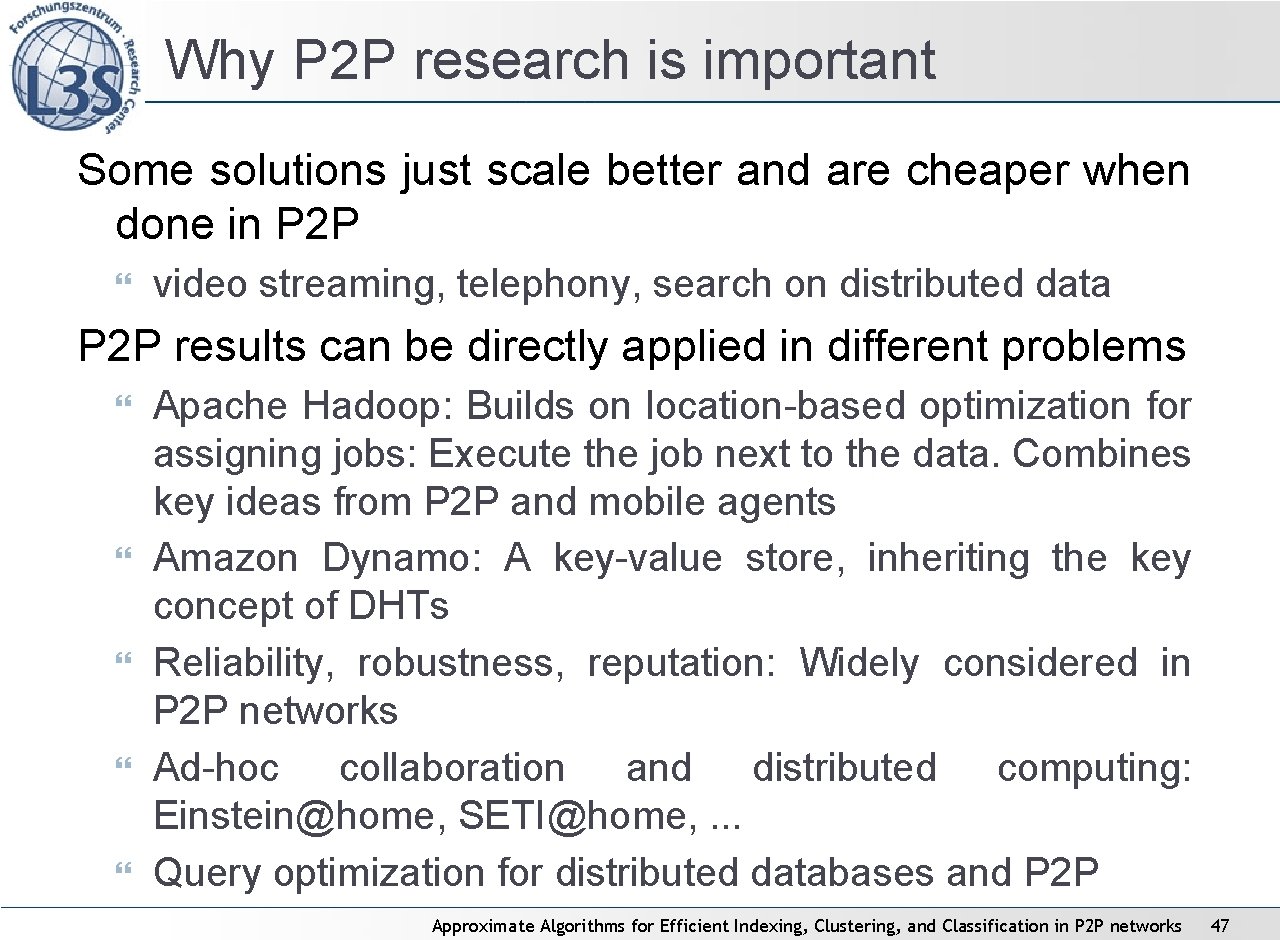
Why P 2 P research is important Some solutions just scale better and are cheaper when done in P 2 P video streaming, telephony, search on distributed data P 2 P results can be directly applied in different problems Apache Hadoop: Builds on location-based optimization for assigning jobs: Execute the job next to the data. Combines key ideas from P 2 P and mobile agents Amazon Dynamo: A key-value store, inheriting the key concept of DHTs Reliability, robustness, reputation: Widely considered in P 2 P networks Ad-hoc collaboration and distributed computing: Einstein@home, SETI@home, . . . Query optimization for distributed databases and P 2 P Approximate Algorithms for Efficient Indexing, Clustering, and Classification in P 2 P networks 47
PCIR Approximate Algorithms for Efficient Indexing, Clustering, and Classification in P 2 P networks 48
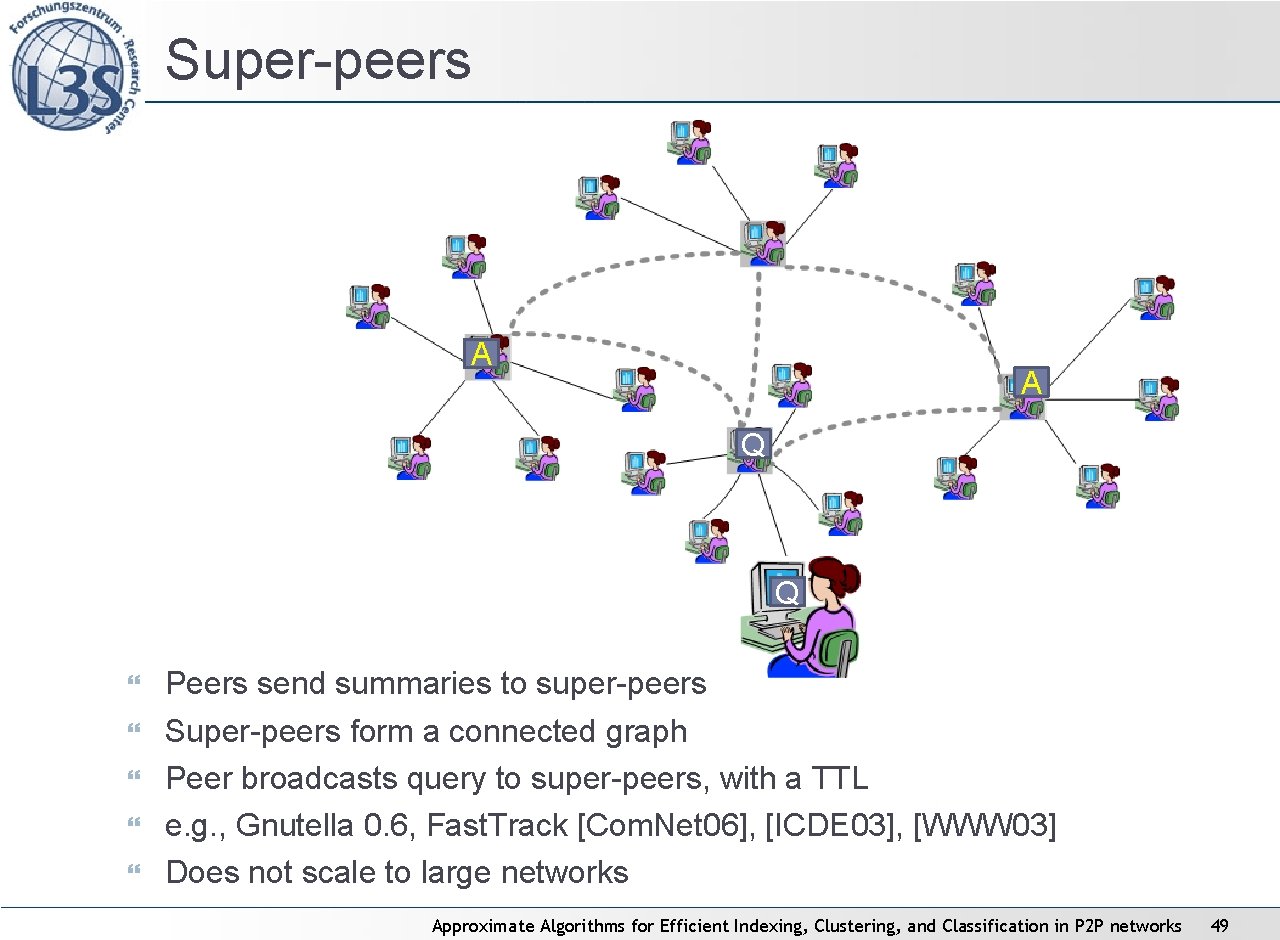
Super-peers A A Q Q Peers send summaries to super-peers Super-peers form a connected graph Peer broadcasts query to super-peers, with a TTL e. g. , Gnutella 0. 6, Fast. Track [Com. Net 06], [ICDE 03], [WWW 03] Does not scale to large networks Approximate Algorithms for Efficient Indexing, Clustering, and Classification in P 2 P networks 49
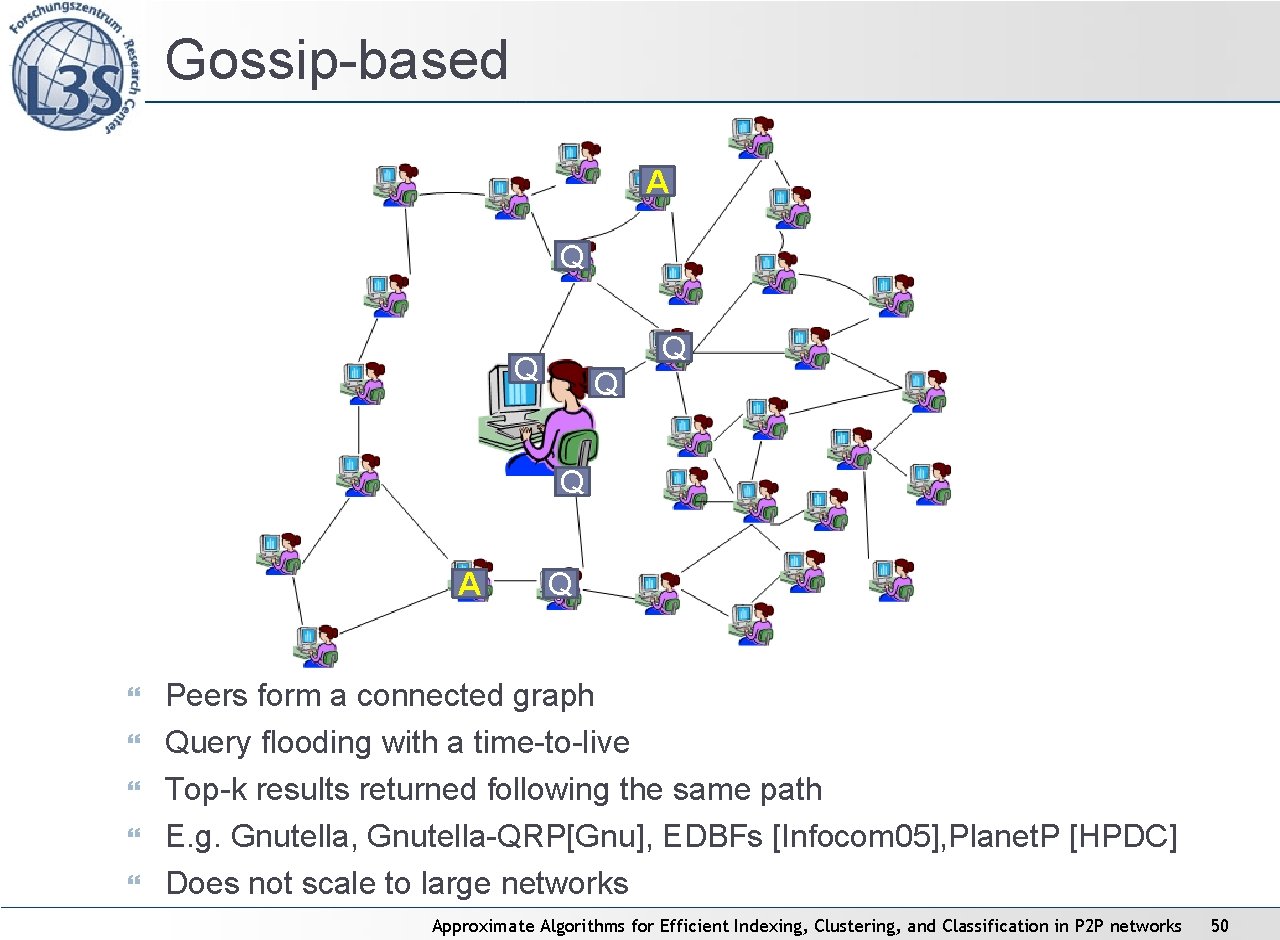
Gossip-based A Q Q Q A Q Peers form a connected graph Query flooding with a time-to-live Top-k results returned following the same path E. g. Gnutella, Gnutella-QRP[Gnu], EDBFs [Infocom 05], Planet. P [HPDC] Does not scale to large networks Approximate Algorithms for Efficient Indexing, Clustering, and Classification in P 2 P networks 50
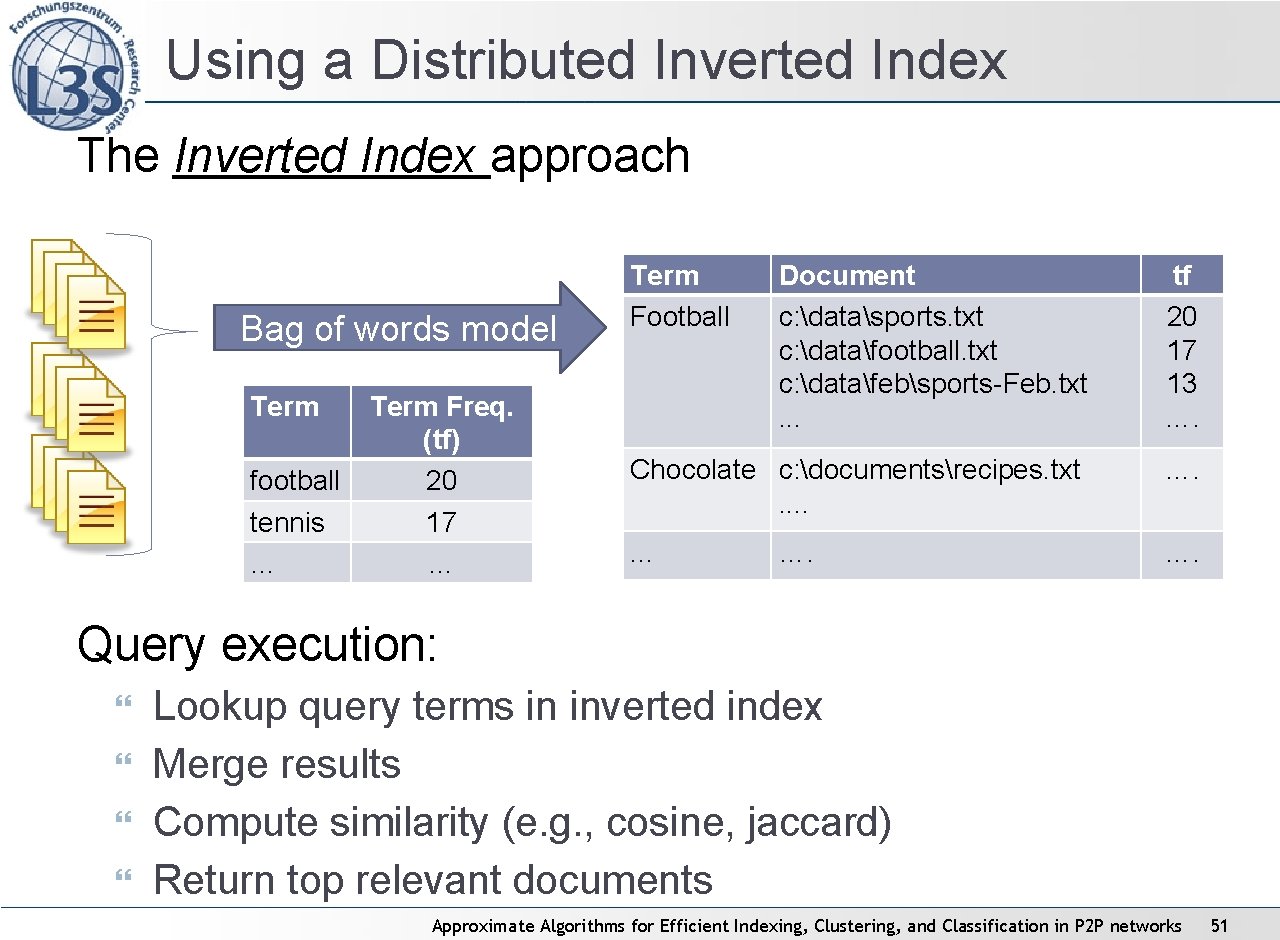
Using a Distributed Inverted Index The Inverted Index approach Bag of words model Term football tennis … Term Freq. (tf) 20 17 … Term Football Document c: datasports. txt c: datafootball. txt c: datafebsports-Feb. txt. . . tf 20 17 13 …. Chocolate c: documentsrecipes. txt. . . . …. …. Query execution: Lookup query terms in inverted index Merge results Compute similarity (e. g. , cosine, jaccard) Return top relevant documents Approximate Algorithms for Efficient Indexing, Clustering, and Classification in P 2 P networks 51
Structured P 2 P over DHT Distributed Hash Tables (DHTs) § § § DHT Lookup: Find the peer responsible for a key Cost: O(Log(n)), where n: #peers Example: P 1 executes get(key=47) § § P 1 P 24 P 43 Similar to binary search Hashing for non-numeric keys: md 5 hash(football) number Approximate Algorithms for Efficient Indexing, Clustering, and Classification in P 2 P networks 52
Structured P 2 P over DHT State of the art: Minerva, Alvis, sk-Stat, mk-Stat, … Vary granularity of index: document, peer, adaptive… Vary score: tf, tf-idf, … Vary keys: all/some terms, pairs of terms, … DHT key DHT value Term Football Peer 13 Peer 6 Peer 11. . . Term freq. in peer 20 17 13 …. Chocolate Peer 84. . . . …. …. List of relevant peers for each term Approximate Algorithms for Efficient Indexing, Clustering, and Classification in P 2 P networks 53
Applying PCIR to different systems Approximate Algorithms for Efficient Indexing, Clustering, and Classification in P 2 P networks 54
PCP 2 P Approximate Algorithms for Efficient Indexing, Clustering, and Classification in P 2 P networks 55
Full comparison step § § § Estimate cosine similarity ECos(d, c), for all c in Send d to the cluster with maximum ECos, Remove all clusters with ECos< Cos(d, ) Repeat until is empty Assign to the best cluster New document Term Frequency politics 14 germany 13 merkel 11 sarkozy 7 france 6. . . Candidate Clusters in add cluster 1: ECos: 0. 4 Cos: 0. 38 cluster 7: ECos: 0. 2 cluster 4: ECos: 0. 5 Cos: 0. 37 ? Approximate Algorithms for Efficient Indexing, Clustering, and Classification in P 2 P networks 56
Full comparison step § Three strategies to compute ECos § Conservative § § Zipf-based and Poisson-based § § § Assumptions about the term distribution Introduce small error probabilities Poisson-based PCP 2 P: § § § Compute an upper bound always correct Tight probabilistic guarantees Enables fine-tuning of cost/quality ratio Details offline or in the paper… Approximate Algorithms for Efficient Indexing, Clustering, and Classification in P 2 P networks 57
Evaluation – Network cost § Text collections follow Zipf distribution § Efficiency of PCP 2 P increases with the collection characteristic exponent (usually ) Approximate Algorithms for Efficient Indexing, Clustering, and Classification in P 2 P networks 58