
Approved for Public Release Launch Propulsion SMCLR Perspectives
Approved for Public Release Launch Propulsion: SMC/LR Perspectives Presented to Launch Propulsion Workshop Caltech Pasadena, CA Presented by Lt Col Toby Cavallari Chief Engineer Launch and Range Systems Directorate Space and Missile Systems Center 23 March 2011 Approved for Public Release
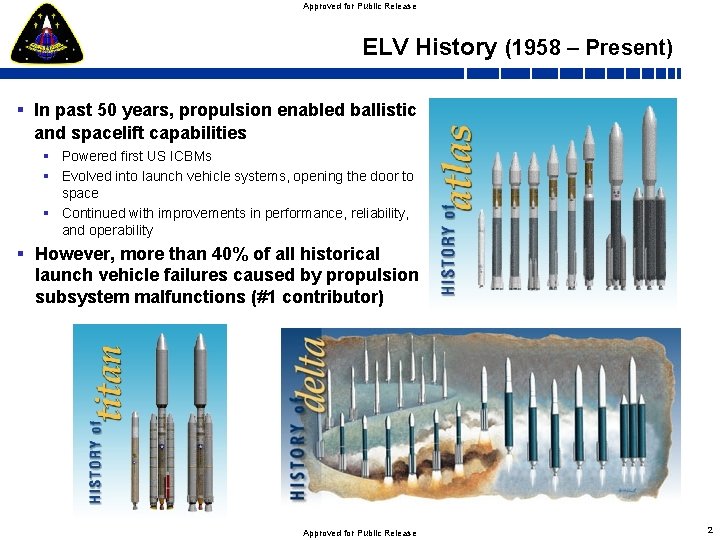
Approved for Public Release ELV History (1958 – Present) § Powered first US ICBMs § Evolved into launch vehicle systems, opening the door to space § Continued with improvements in performance, reliability, and operability Drawing courtesy of Boeing § In past 50 years, propulsion enabled ballistic and spacelift capabilities § However, more than 40% of all historical launch vehicle failures caused by propulsion subsystem malfunctions (#1 contributor) Approved for Public Release 2
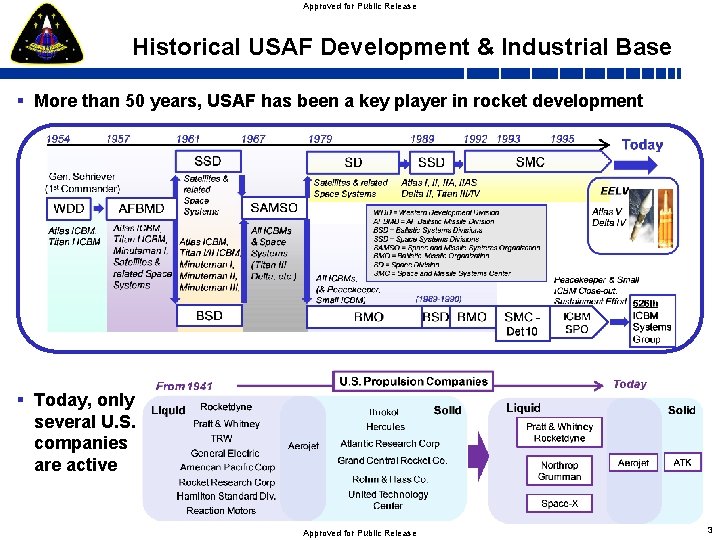
Approved for Public Release Historical USAF Development & Industrial Base § More than 50 years, USAF has been a key player in rocket development § Today, only several U. S. companies are active Approved for Public Release 3

Approved for Public Release EELV Families § Two families of launch vehicles (Atlas V and Delta IV) Atlas V Family Delta IV Family GTO Capability (lbs) 30, 000 25, 000 PWR RL 10 B-2 Engine PWR RL 10 -A 2 Engine 20, 000 15, 000 10, 000 5, 000 IOC GEM-60 SRB Russian RD-180 Engine PWR RS-68 Engine Atlas V (401) (4 XX Series) (5 XX Series) (Heavy) 8/02 7/03 Delta IV (Med) 3/03 Approved for Public Release Delta IV (Med+ 4 series) (Med+ 5 series) (Heavy) 11/02 12/04 4
Approved for Public Release Current EELV Propulsion Environment § § Escalating engine cost growth Must ensure engine availability for EELV until 2030 § Supplier obsolescence § Reliance on foreign suppliers for EELV mission assurance and sustainment § § § Payload mass-to-orbit expected to continue on an upward trend Declining U. S. industry capability in engine development and production Some specific concerns: § EELV Upper Stage Engines: § 50 -year-old craftsman-based manufacturing § Currently flying at reduced confidence margins § Running at twice original engine chamber pressure § Requiring highly selective screening per USG standards § Increased mission assurance costs § No further growth opportunity without major redesign § Kerosene Booster Engine: § Do. D reliance on Russian designed and built engine § Limiting opportunity for technology transfer to new U. S. engine effort § Also, ITAR restricts U. S. technology transfer into RD-180 program Approved for Public Release 5
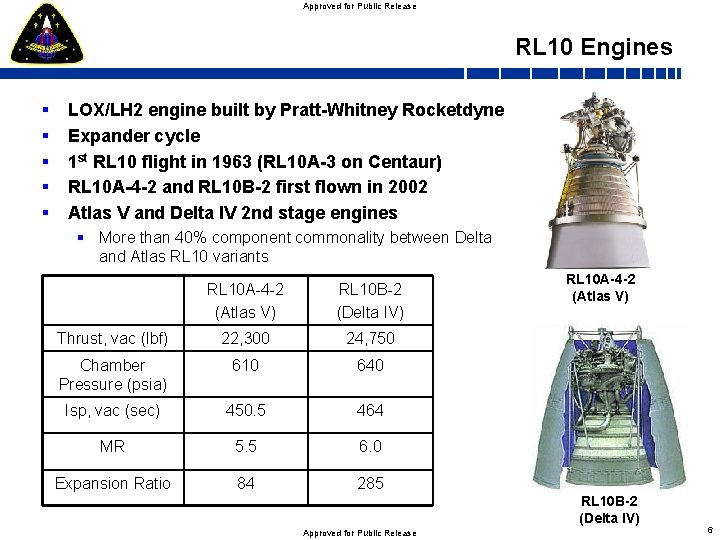
Approved for Public Release RL 10 Engines § § § LOX/LH 2 engine built by Pratt-Whitney Rocketdyne Expander cycle 1 st RL 10 flight in 1963 (RL 10 A-3 on Centaur) RL 10 A-4 -2 and RL 10 B-2 first flown in 2002 Atlas V and Delta IV 2 nd stage engines § More than 40% component commonality between Delta and Atlas RL 10 variants RL 10 A-4 -2 (Atlas V) RL 10 B-2 (Delta IV) Thrust, vac (lbf) 22, 300 24, 750 Chamber Pressure (psia) 610 640 Isp, vac (sec) 450. 5 464 MR 5. 5 6. 0 Expansion Ratio 84 285 RL 10 A-4 -2 (Atlas V) RL 10 B-2 (Delta IV) Approved for Public Release 6
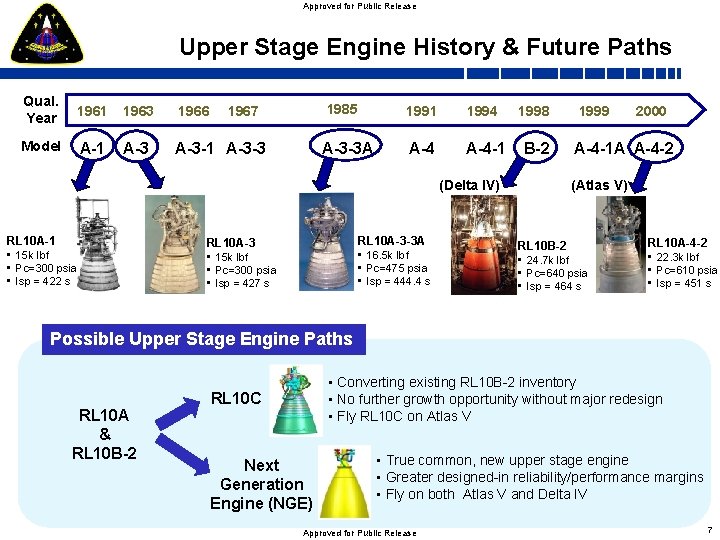
Approved for Public Release Upper Stage Engine History & Future Paths Qual. Year 1961 1963 1966 Model A-1 A-3 -1 A-3 -3 1967 1985 1991 1994 1998 A-3 -3 A A-4 -1 B-2 (Delta IV) RL 10 A-1 • 15 k lbf • Pc=300 psia • Isp = 422 s RL 10 A-3 -3 A • 16. 5 k lbf • Pc=475 psia • Isp = 444. 4 s RL 10 A-3 • 15 k lbf • Pc=300 psia • Isp = 427 s 1999 2000 A-4 -1 A A-4 -2 (Atlas V) RL 10 B-2 • 24. 7 k lbf • Pc=640 psia • Isp = 464 s RL 10 A-4 -2 • 22. 3 k lbf • Pc=610 psia • Isp = 451 s Possible Upper Stage Engine Paths RL 10 A & RL 10 B-2 • Converting existing RL 10 B-2 inventory • No further growth opportunity without major redesign • Fly RL 10 C on Atlas V RL 10 C Next Generation Engine (NGE) • True common, new upper stage engine • Greater designed-in reliability/performance margins • Fly on both Atlas V and Delta IV Approved for Public Release 7
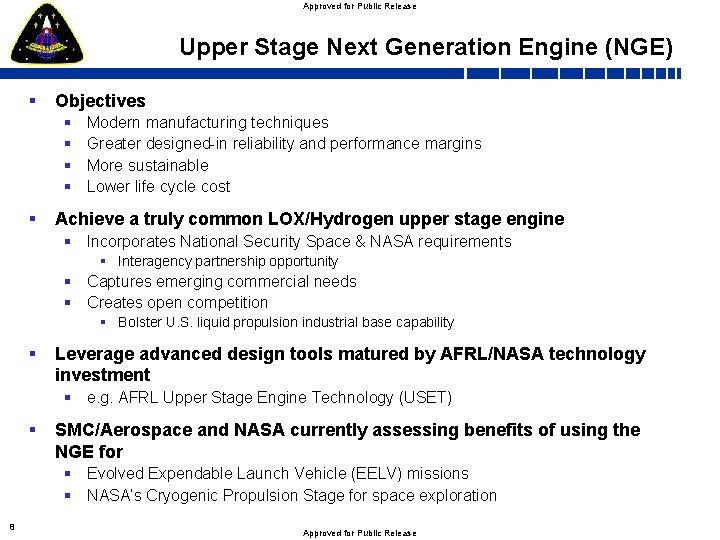
Approved for Public Release Upper Stage Next Generation Engine (NGE) § Objectives § § § Modern manufacturing techniques Greater designed-in reliability and performance margins More sustainable Lower life cycle cost Achieve a truly common LOX/Hydrogen upper stage engine § Incorporates National Security Space & NASA requirements § Interagency partnership opportunity § Captures emerging commercial needs § Creates open competition § Bolster U. S. liquid propulsion industrial base capability § Leverage advanced design tools matured by AFRL/NASA technology investment § e. g. AFRL Upper Stage Engine Technology (USET) § SMC/Aerospace and NASA currently assessing benefits of using the NGE for § Evolved Expendable Launch Vehicle (EELV) missions § NASA’s Cryogenic Propulsion Stage for space exploration 8 Approved for Public Release
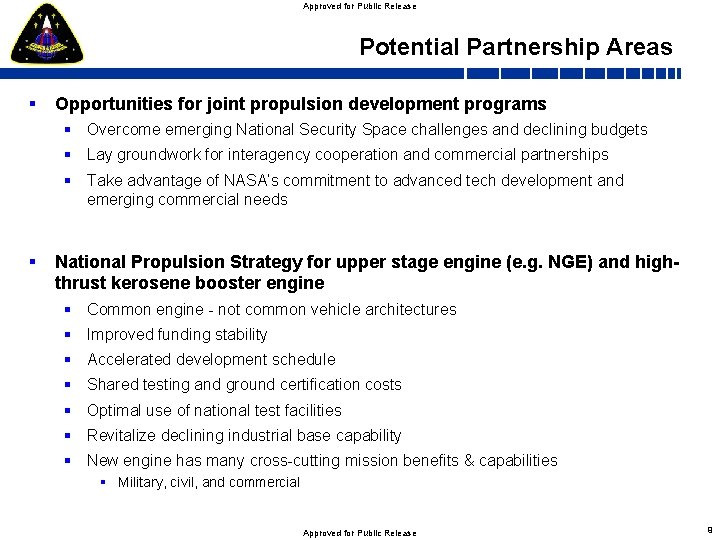
Approved for Public Release Potential Partnership Areas § Opportunities for joint propulsion development programs § Overcome emerging National Security Space challenges and declining budgets § Lay groundwork for interagency cooperation and commercial partnerships § Take advantage of NASA’s commitment to advanced tech development and emerging commercial needs § National Propulsion Strategy for upper stage engine (e. g. NGE) and highthrust kerosene booster engine § Common engine - not common vehicle architectures § Improved funding stability § Accelerated development schedule § Shared testing and ground certification costs § Optimal use of national test facilities § Revitalize declining industrial base capability § New engine has many cross-cutting mission benefits & capabilities § Military, civil, and commercial Approved for Public Release 9
Approved for Public Release Backup Charts Approved for Public Release 10
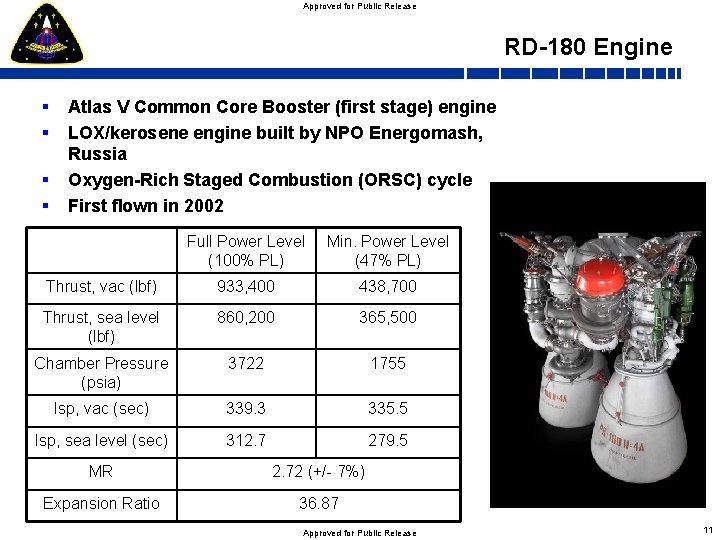
Approved for Public Release RD-180 Engine § § Atlas V Common Core Booster (first stage) engine LOX/kerosene engine built by NPO Energomash, Russia Oxygen-Rich Staged Combustion (ORSC) cycle First flown in 2002 Full Power Level (100% PL) Min. Power Level (47% PL) Thrust, vac (lbf) 933, 400 438, 700 Thrust, sea level (lbf) 860, 200 365, 500 Chamber Pressure (psia) 3722 1755 Isp, vac (sec) 339. 3 335. 5 Isp, sea level (sec) 312. 7 279. 5 MR 2. 72 (+/- 7%) Expansion Ratio 36. 87 Approved for Public Release 11
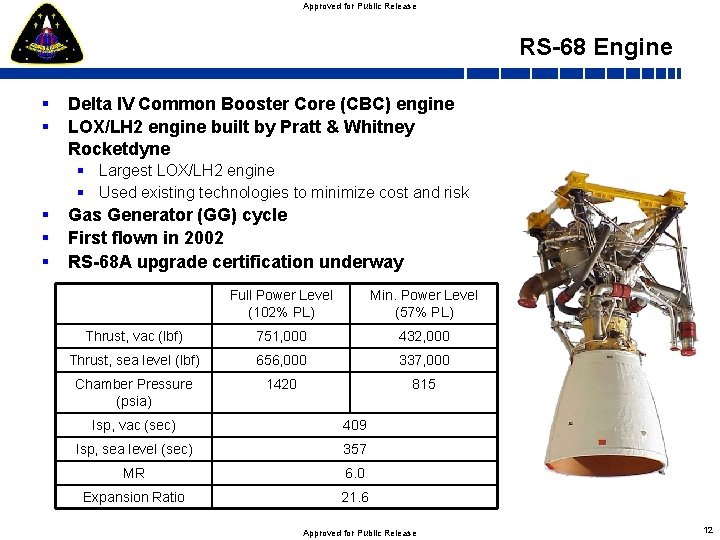
Approved for Public Release RS-68 Engine § § Delta IV Common Booster Core (CBC) engine LOX/LH 2 engine built by Pratt & Whitney Rocketdyne § Largest LOX/LH 2 engine § Used existing technologies to minimize cost and risk § § § Gas Generator (GG) cycle First flown in 2002 RS-68 A upgrade certification underway Full Power Level (102% PL) Min. Power Level (57% PL) Thrust, vac (lbf) 751, 000 432, 000 Thrust, sea level (lbf) 656, 000 337, 000 Chamber Pressure (psia) 1420 815 Isp, vac (sec) 409 Isp, sea level (sec) 357 MR 6. 0 Expansion Ratio 21. 6 Approved for Public Release 12
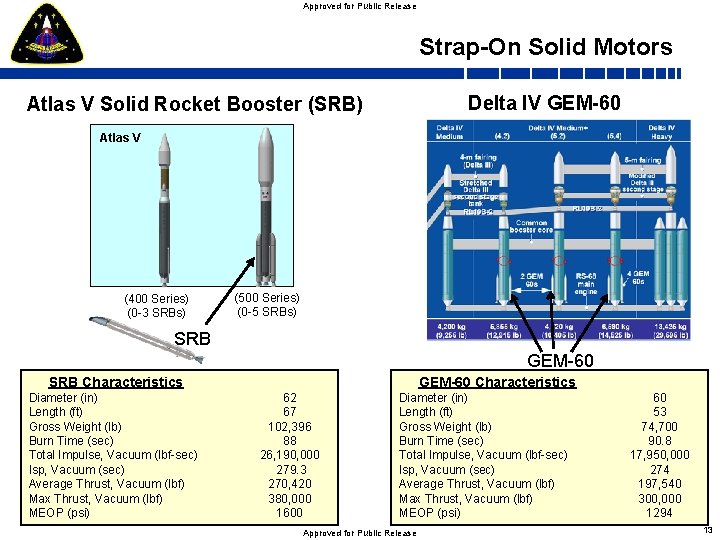
Approved for Public Release Strap-On Solid Motors Delta IV GEM-60 Atlas V Solid Rocket Booster (SRB) Atlas V (400 Series) (0 -3 SRBs) (500 Series) (0 -5 SRBs) SRB GEM-60 SRB Characteristics Diameter (in) Length (ft) Gross Weight (lb) Burn Time (sec) Total Impulse, Vacuum (lbf-sec) Isp, Vacuum (sec) Average Thrust, Vacuum (lbf) Max Thrust, Vacuum (lbf) MEOP (psi) GEM-60 Characteristics 62 67 102, 396 88 26, 190, 000 279. 3 270, 420 380, 000 1600 Diameter (in) Length (ft) Gross Weight (lb) Burn Time (sec) Total Impulse, Vacuum (lbf-sec) Isp, Vacuum (sec) Average Thrust, Vacuum (lbf) Max Thrust, Vacuum (lbf) MEOP (psi) Approved for Public Release 60 53 74, 700 90. 8 17, 950, 000 274 197, 540 300, 000 1294 13
- Slides: 13