
Appropriate Technology for Solar Tracking System Mr Pinij
- Slides: 23
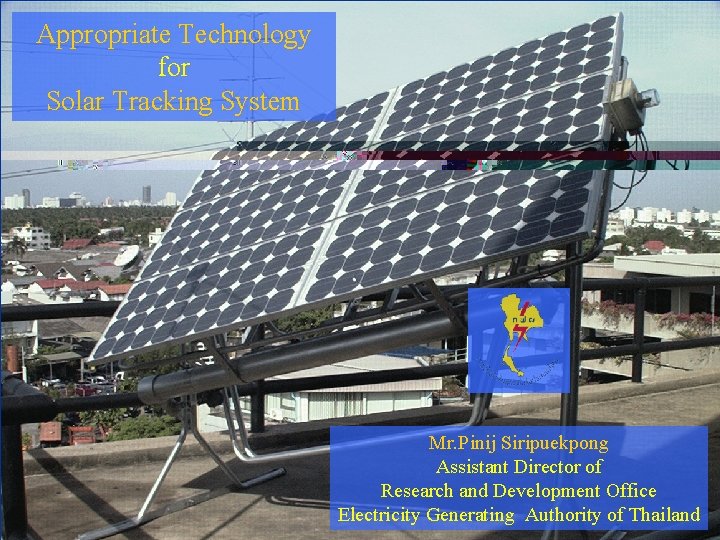
Appropriate Technology for Solar Tracking System Mr. Pinij Siripuekpong Assistant Director of Research and Development Office Electricity Generating Authority of Thailand
Outline • • • Background The Principle of Solar Tracking System Design and components Testing Conclusion
Background - PV solar water pumping system will be started at 9: 30 and stopped at 15: 00 - The most simple and principal way to get more energy output from the PV modules is rotating the modules following the sun as it orbits from the East to the West during the day. - The problems of solar tracking system are : * Imported tracking system (high investment cost) * No spare parts for maintenance * high energy consumption for tracking system
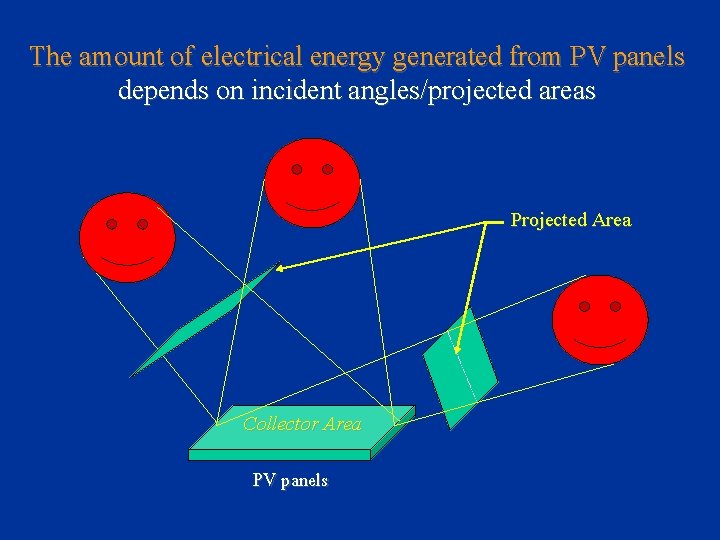
The amount of electrical energy generated from PV panels depends on incident angles/projected areas Projected Area Collector Area PV panels
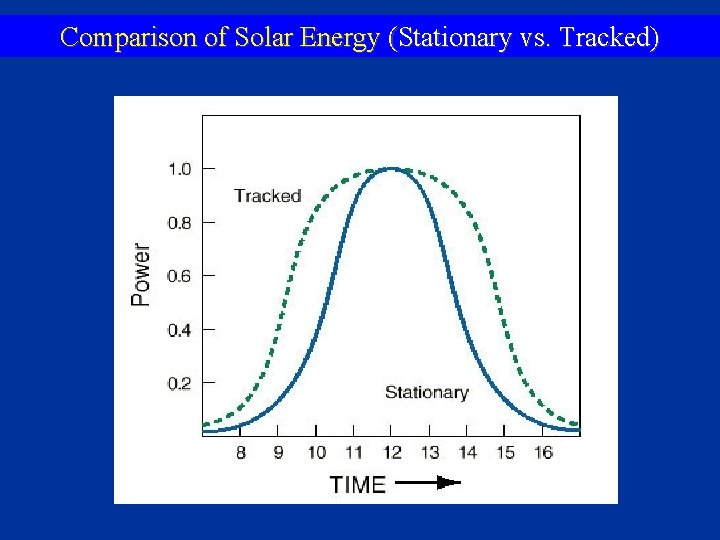
Comparison of Solar Energy (Stationary vs. Tracked)
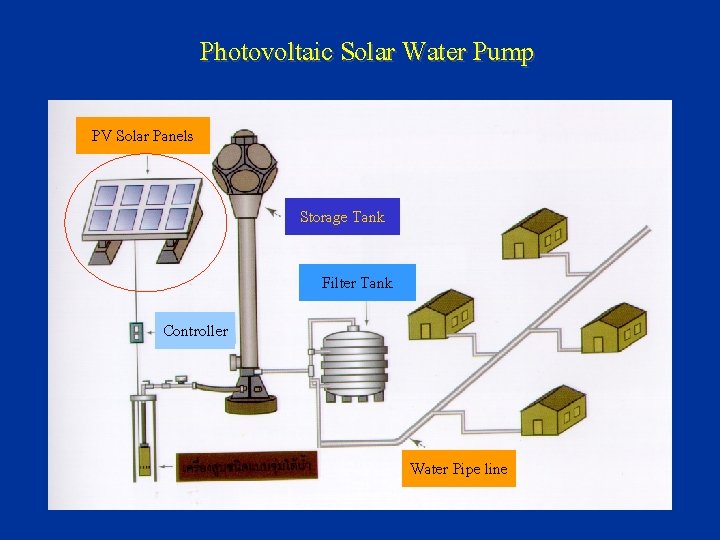
Photovoltaic Solar Water Pump PV Solar Panels Storage Tank Filter Tank Controller Water Pipe line
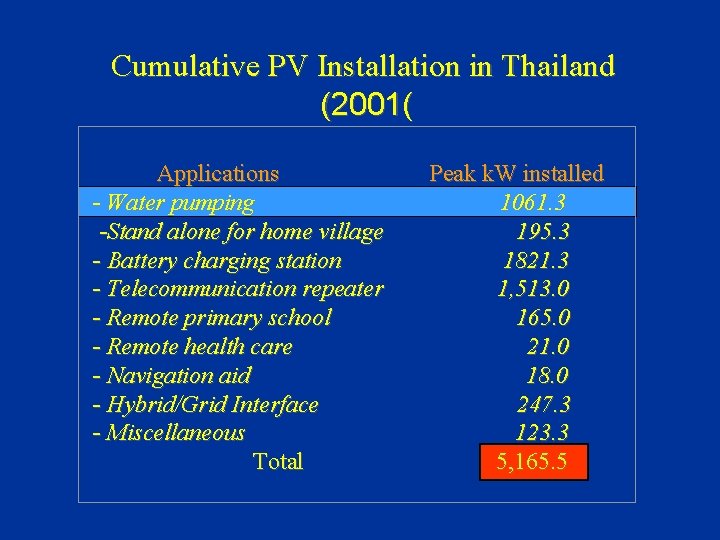
Cumulative PV Installation in Thailand (2001( Applications - Water pumping -Stand alone for home village - Battery charging station - Telecommunication repeater - Remote primary school - Remote health care - Navigation aid - Hybrid/Grid Interface - Miscellaneous Total Peak k. W installed 1061. 3 195. 3 1821. 3 1, 513. 0 165. 0 21. 0 18. 0 247. 3 123. 3 5, 165. 5
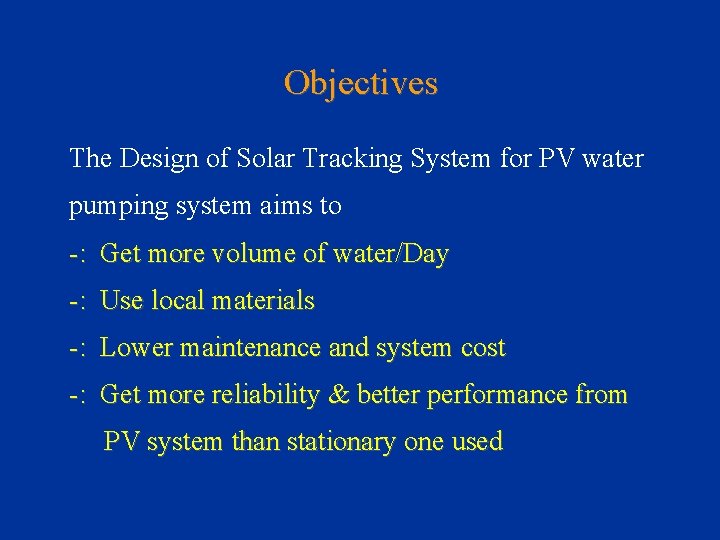
Objectives The Design of Solar Tracking System for PV water pumping system aims to -: Get more volume of water/Day -: Use local materials -: Lower maintenance and system cost -: Get more reliability & better performance from PV system than stationary one used
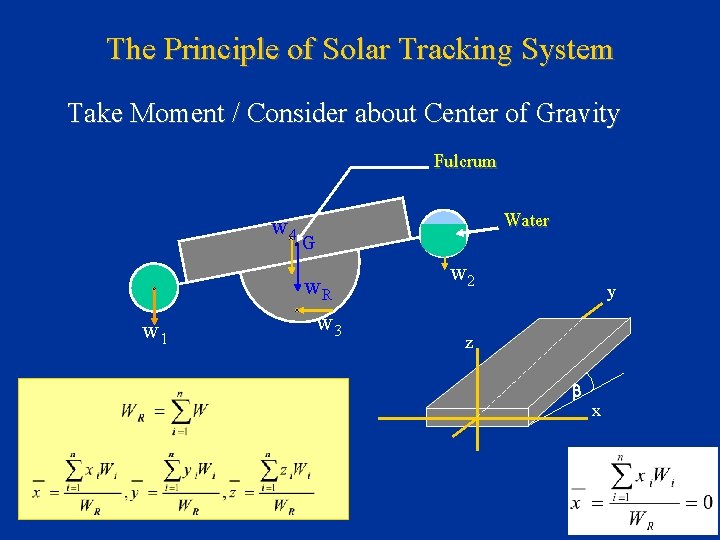
The Principle of Solar Tracking System Take Moment / Consider about Center of Gravity Fulcrum w 4 w 1 G w. R w 3 Water w 2 y z b x
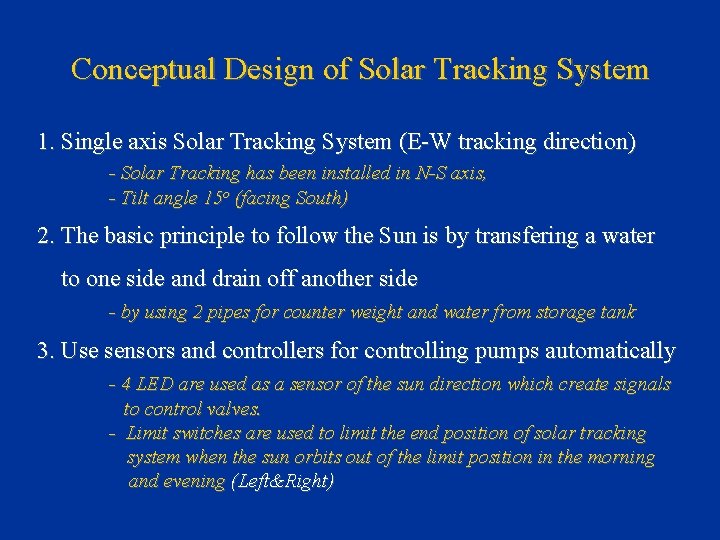
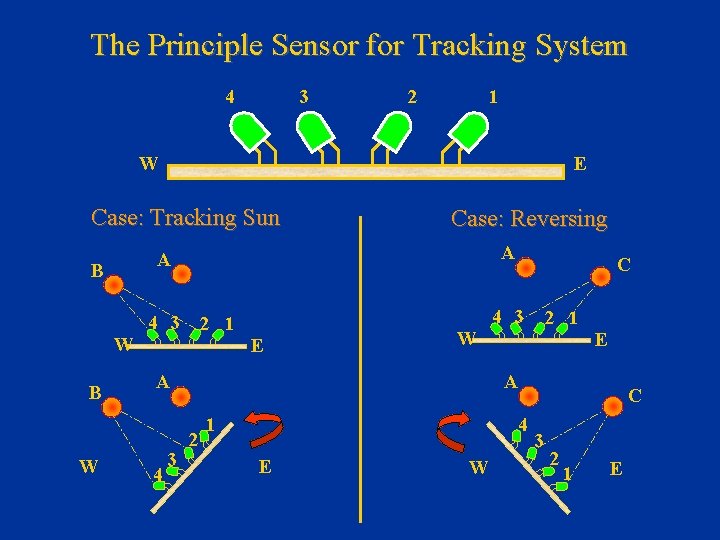
Conceptual Design of Solar Tracking System 1. Single axis Solar Tracking System (E-W tracking direction) - Solar Tracking has been installed in N-S axis, - Tilt angle 15 o (facing South) 2. The basic principle to follow the Sun is by transfering a water to one side and drain off another side - by using 2 pipes for counter weight and water from storage tank 3. Use sensors and controllers for controlling pumps automatically - 4 LED are used as a sensor of the sun direction which create signals to control valves. - Limit switches are used to limit the end position of solar tracking system when the sun orbits out of the limit position in the morning and evening (Left&Right)
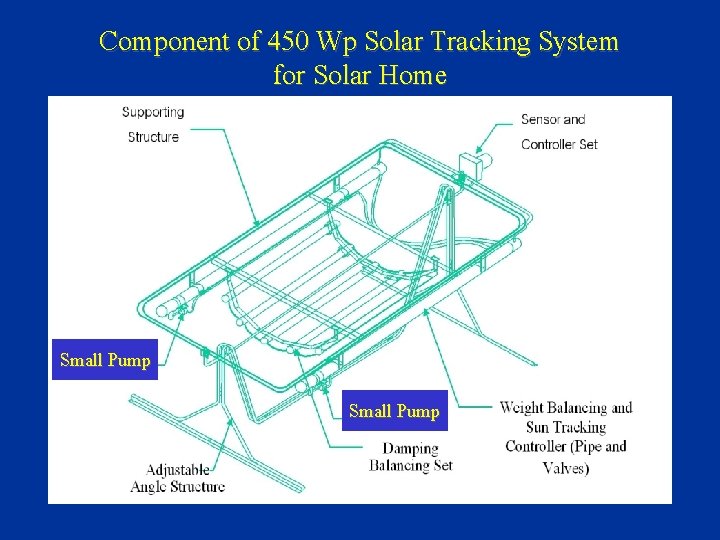
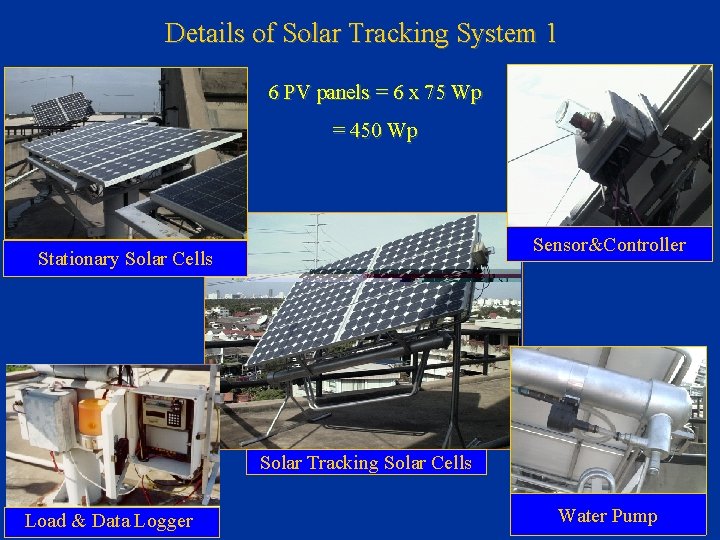
Component of 450 Wp Solar Tracking System for Solar Home Small Pump
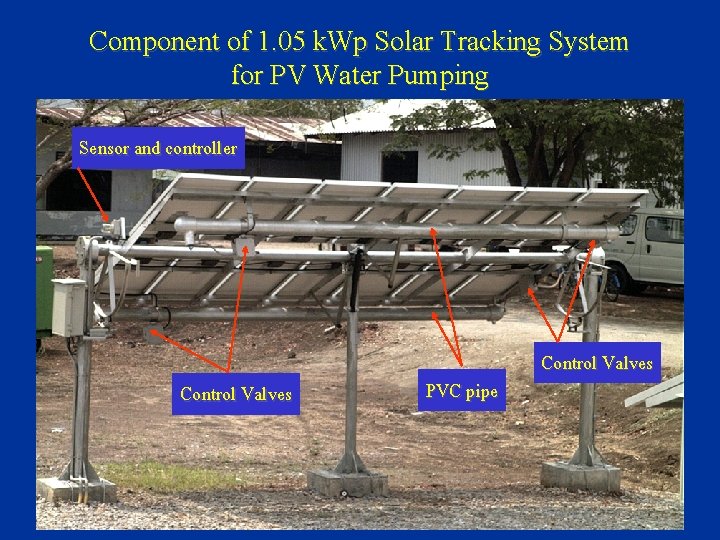
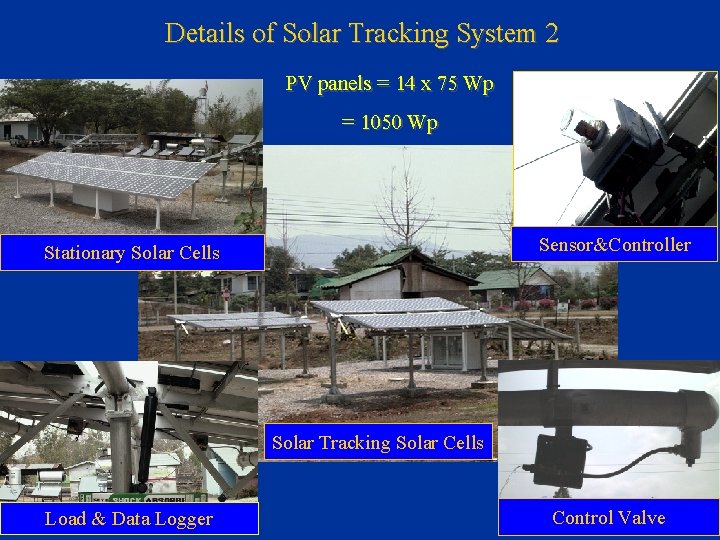
Component of 1. 05 k. Wp Solar Tracking System for PV Water Pumping Sensor and controller Control Valves PVC pipe Control Valves
The Principle Sensor for Tracking System 4 3 2 1 W E Case: Tracking Sun W W A A B B Case: Reversing 4 3 2 1 E W 4 4 3 2 1 E A A 3 C 2 1 4 E W C 3 2 1 E
Details of Solar Tracking System 1 6 PV panels = 6 x 75 Wp = 450 Wp Sensor&Controller Stationary Solar Cells Solar Tracking Solar Cells Load & Data Logger Water Pump
Details of Solar Tracking System 2 PV panels = 14 x 75 Wp = 1050 Wp Sensor&Controller Stationary Solar Cells Solar Tracking Solar Cells Load & Data Logger Control Valve
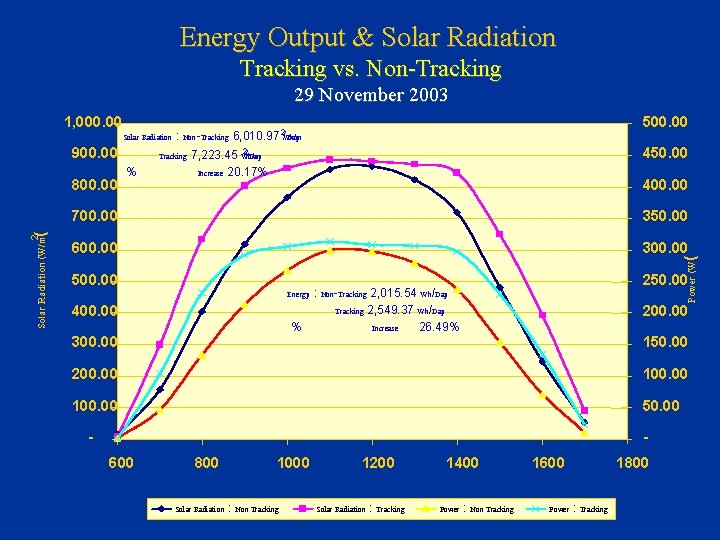
Energy Output & Solar Radiation Tracking vs. Non-Tracking 29 November 2003 1, 000. 00 900. 00 % 450. 00 2 Tracking 7, 223. 45 Wh/m /Day Increase 20. 17% 400. 00 700. 00 350. 00 600. 00 300. 00 500. 00 Power (W( Solar Radiation (W/m 2( 800. 00 500. 00 Solar Radiation : Non-Tracking 6, 010. 97 2 Wh/m /Day 250. 00 Energy : Non-Tracking 2, 015. 54 Wh/Day Tracking 2, 549. 37 Wh/Day % Increase 26. 49% 400. 00 300. 00 200. 00 150. 00 200. 00 100. 00 50. 00 - 600 800 1000 Solar Radiation : Non Tracking 1200 Solar Radiation : Tracking 1400 Power : Non Tracking 1600 Power : Tracking 1800
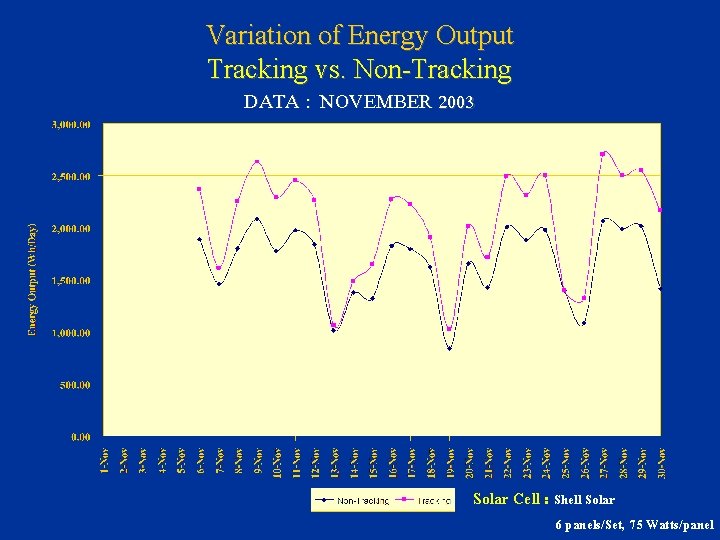
Variation of Energy Output Tracking vs. Non-Tracking DATA : NOVEMBER 2003 Solar Cell : Shell Solar 6 panels/Set, 75 Watts/panel
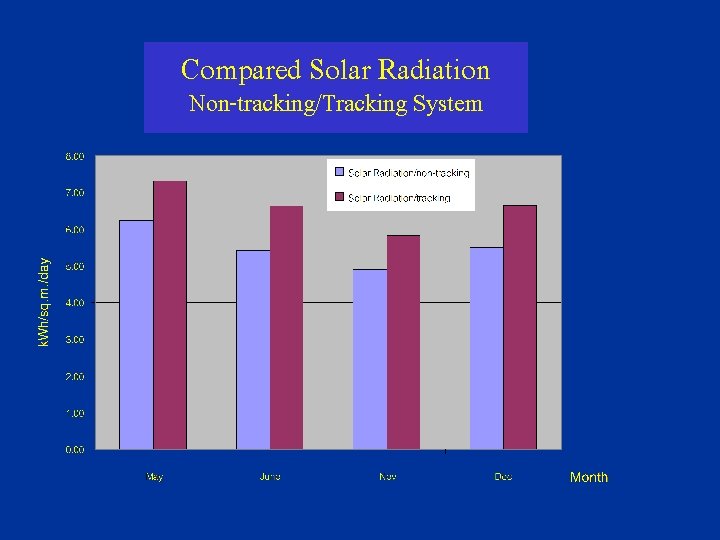
Compared Solar Radiation Non-tracking/Tracking System Second Model First Model
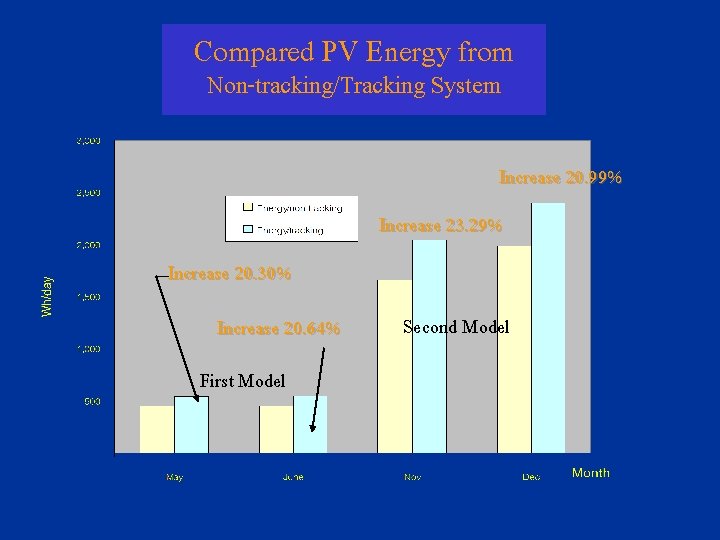
Compared PV Energy from Non-tracking/Tracking System Increase 20. 99% Increase 23. 29% Increase 20. 30% Increase 20. 64% First Model Second Model
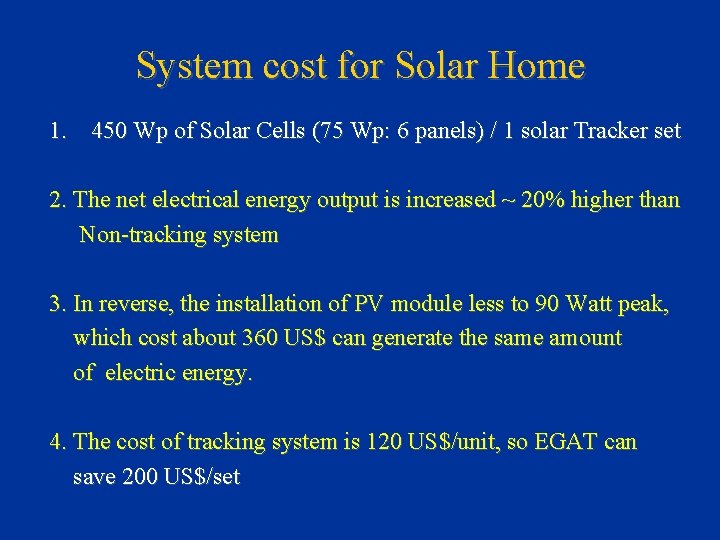
System cost for Solar Home 1. 450 Wp of Solar Cells (75 Wp: 6 panels) / 1 solar Tracker set 2. The net electrical energy output is increased ~ 20% higher than Non-tracking system 3. In reverse, the installation of PV module less to 90 Watt peak, which cost about 360 US$ can generate the same amount of electric energy. 4. The cost of tracking system is 120 US$/unit, so EGAT can save 200 US$/set
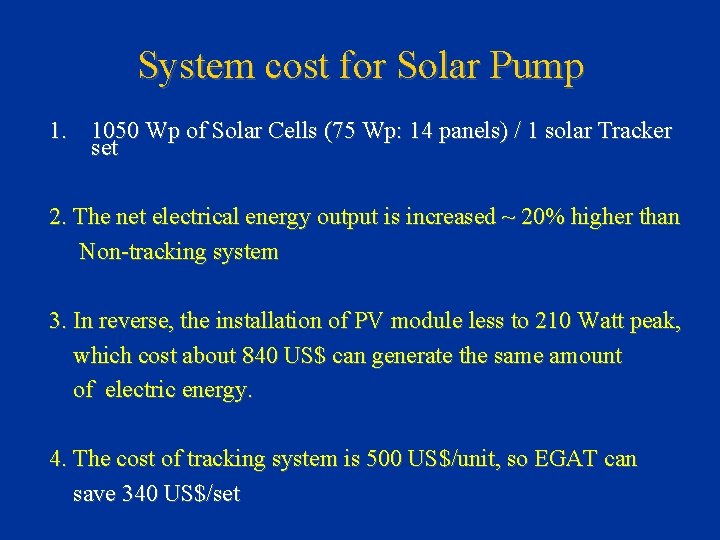
System cost for Solar Pump 1. 1050 Wp of Solar Cells (75 Wp: 14 panels) / 1 solar Tracker set 2. The net electrical energy output is increased ~ 20% higher than Non-tracking system 3. In reverse, the installation of PV module less to 210 Watt peak, which cost about 840 US$ can generate the same amount of electric energy. 4. The cost of tracking system is 500 US$/unit, so EGAT can save 340 US$/set
Conclusion The invention of Solar Tracking System helps us improve the performance of PV solar system in a simple way we can build the Solar Tracking System easily with cost effectiveness for the maximum energy or water output from any kind of PV Solar Home or Solar Water Pumping