
Approaching the Challenge of Disaster Risk Reduction Natural
![13 Planning Guide Outline (cont. ) [click to view Guide] Volume II – Reference](https://slidetodoc.com/presentation_image_h/f7f5a06881f48ea9480d0c15d861a66f/image-13.jpg "13 Planning Guide Outline (cont. ) [click to view Guide] Volume II – Reference")
- Slides: 43
Approaching the Challenge of Disaster Risk Reduction Natural Hazard Mitigation Association NIST Community Resilience Guide Stephen A. Cauffman Engineering Laboratory, NIST
2 Welcome! Steve Cauffman, NIST
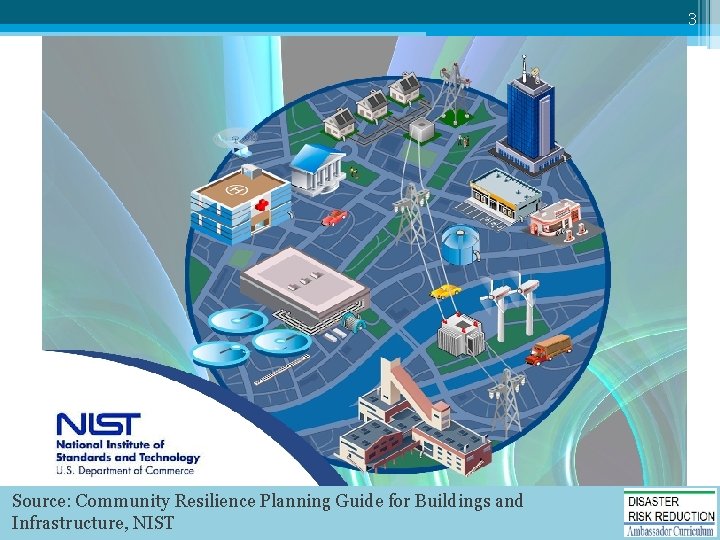
3 Purpose of Module • Discuss an approach to preventing hazards from becoming disasters • Describe the role of infrastructure and buildings in supporting social and economic function • Provide an overview of the NIST tools and guidance for: ▫ Measuring resilience ▫ Planning and implementing measures to enhance resilience Source: Community Resilience Planning Guide for Buildings and Infrastructure, NIST
4 Learning Objectives 1. Define resilience in the context of an entire community 2. Identify the six planning steps described in the NIST Community Resilience Planning Guide for Buildings and Infrastructure Systems 3. State the purpose of the NIST Community Resilience Economic Decision Guide for Buildings and Infrastructure Systems
5 Disaster Risk Reduction (DRR) • A systematic approach to identifying, assessing, and reducing the risks of disaster • Aims to reduce vulnerabilities to disaster, utilizing knowledge and experience developed by the natural hazard community of professionals and practitioners • DRR initiatives are in every sector of emergency management, planning and development, and humanitarian work Disaster Risk Reduction is a foundation of Community Resilience
6 Why Community Resilience? • Communities are socio-technical systems • Buildings and infrastructure enable social and economic function • Therefore, social and economic needs and functions should drive the goals for performance of buildings and physical infrastructure
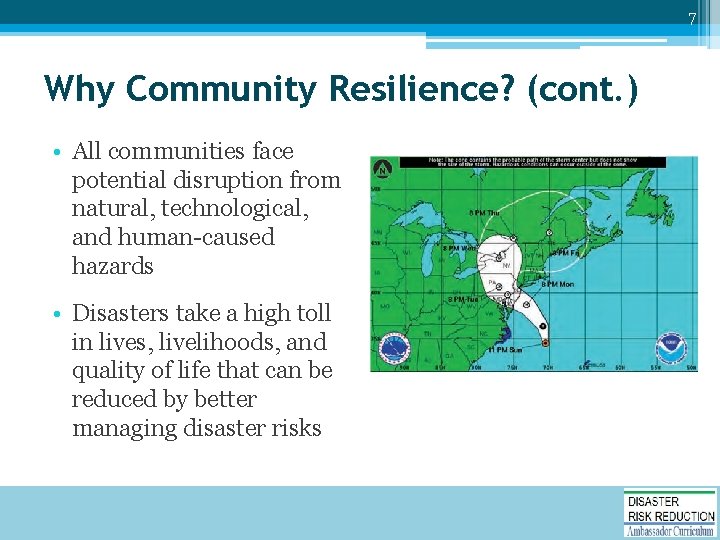
7 Why Community Resilience? (cont. ) • All communities face potential disruption from natural, technological, and human-caused hazards • Disasters take a high toll in lives, livelihoods, and quality of life that can be reduced by better managing disaster risks
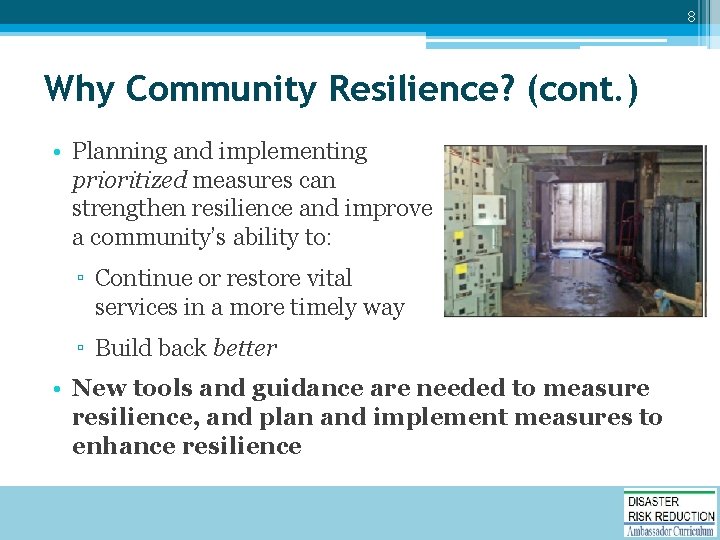
8 Why Community Resilience? (cont. ) • Planning and implementing prioritized measures can strengthen resilience and improve a community’s ability to: ▫ Continue or restore vital services in a more timely way ▫ Build back better • New tools and guidance are needed to measure resilience, and plan and implement measures to enhance resilience
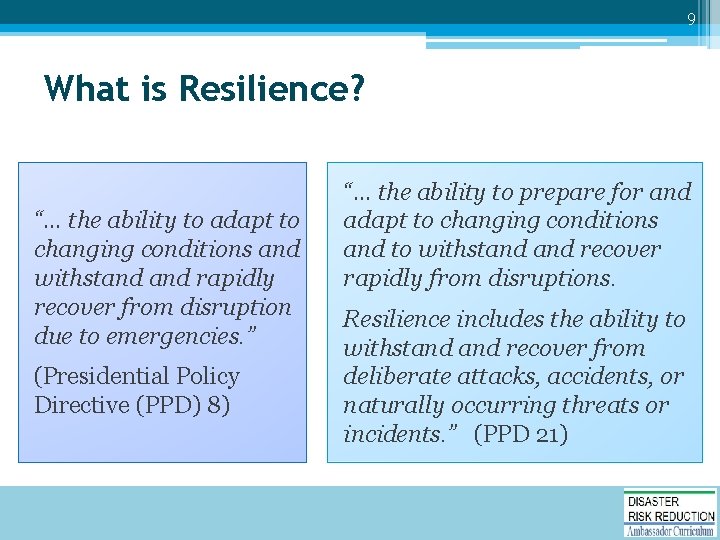
9 What is Resilience? “… the ability to adapt to changing conditions and withstand rapidly recover from disruption due to emergencies. ” (Presidential Policy Directive (PPD) 8) “… the ability to prepare for and adapt to changing conditions and to withstand recover rapidly from disruptions. Resilience includes the ability to withstand recover from deliberate attacks, accidents, or naturally occurring threats or incidents. ” (PPD 21)
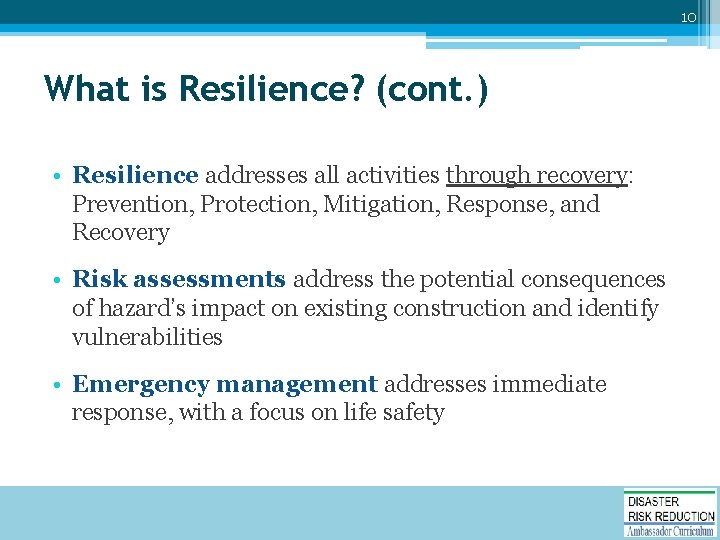
10 What is Resilience? (cont. ) • Resilience addresses all activities through recovery: Prevention, Protection, Mitigation, Response, and Recovery • Risk assessments address the potential consequences of hazard’s impact on existing construction and identify vulnerabilities • Emergency management addresses immediate response, with a focus on life safety
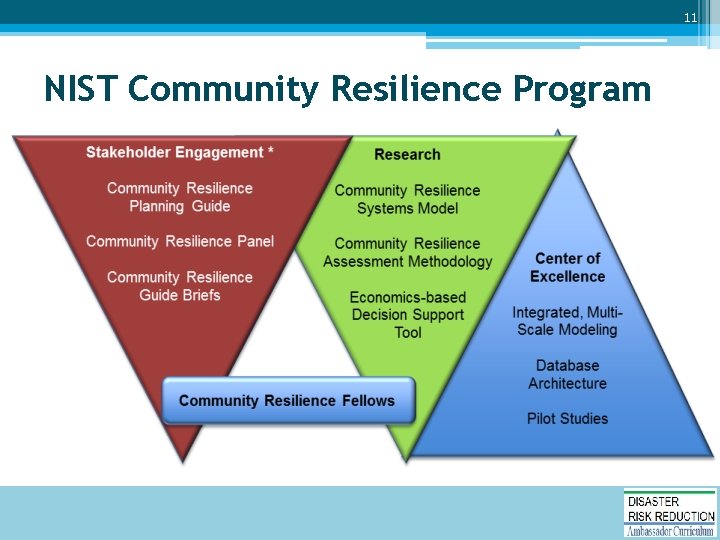
11 NIST Community Resilience Program
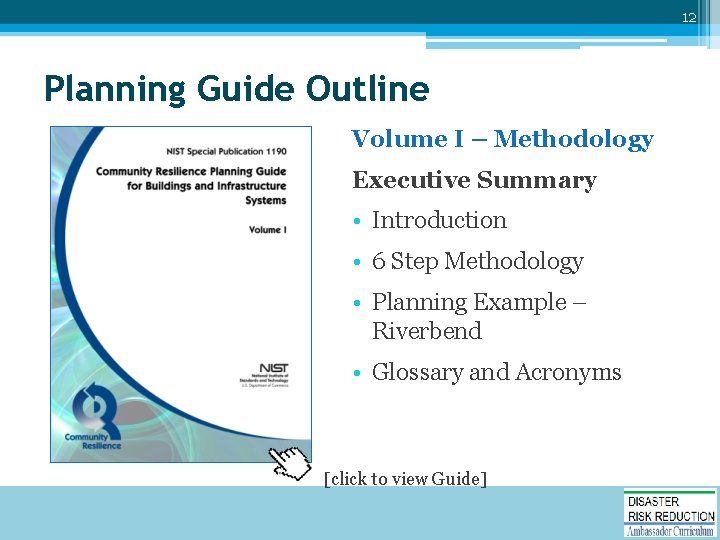
12 Planning Guide Outline Volume I – Methodology Executive Summary • Introduction • 6 Step Methodology • Planning Example – Riverbend • Glossary and Acronyms [click to view Guide]
13 Planning Guide Outline (cont. ) [click to view Guide] Volume II – Reference Executive Summary • Social Community • Dependencies and Cascading Effects • Buildings • Transportation Systems • Energy Systems • Communications Systems • Water & Wastewater Systems • Community Resilience Metrics
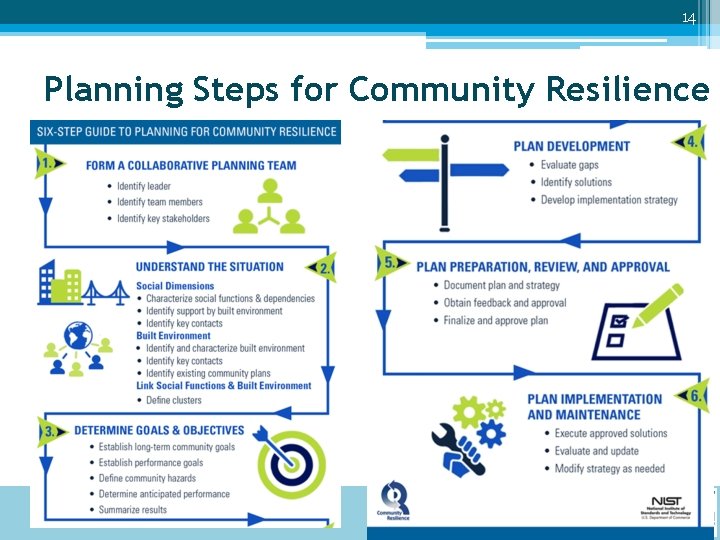
14 Planning Steps for Community Resilience
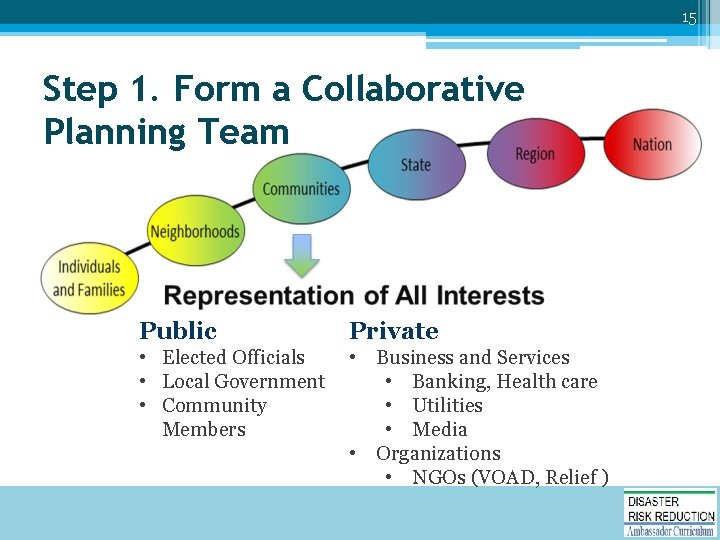
15 Step 1. Form a Collaborative Planning Team Public Private • Elected Officials • Local Government • Community Members • Business and Services • Banking, Health care • Utilities • Media • Organizations • NGOs (VOAD, Relief )
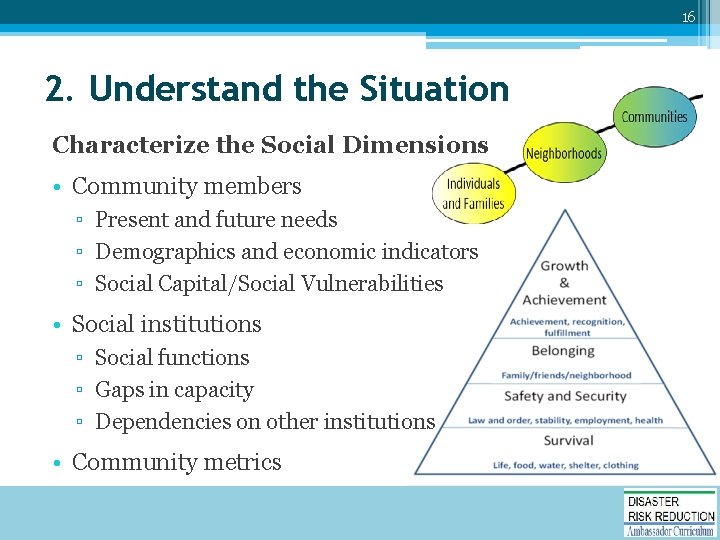
16 2. Understand the Situation Characterize the Social Dimensions • Community members ▫ Present and future needs ▫ Demographics and economic indicators ▫ Social Capital/Social Vulnerabilities • Social institutions ▫ Social functions ▫ Gaps in capacity ▫ Dependencies on other institutions • Community metrics
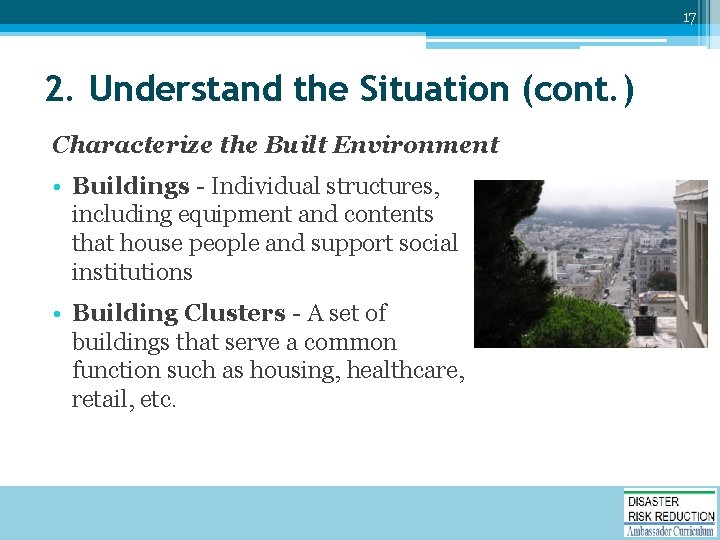
17 2. Understand the Situation (cont. ) Characterize the Built Environment • Buildings - Individual structures, including equipment and contents that house people and support social institutions • Building Clusters - A set of buildings that serve a common function such as housing, healthcare, retail, etc.
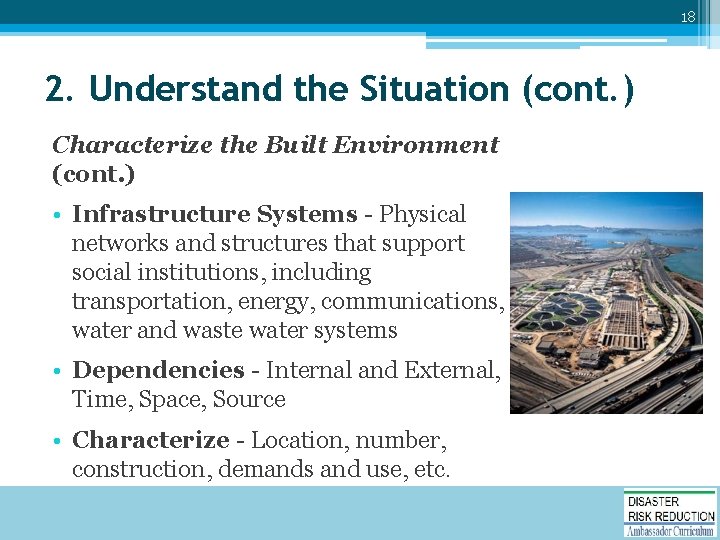
18 2. Understand the Situation (cont. ) Characterize the Built Environment (cont. ) • Infrastructure Systems - Physical networks and structures that support social institutions, including transportation, energy, communications, water and waste water systems • Dependencies - Internal and External, Time, Space, Source • Characterize - Location, number, construction, demands and use, etc.
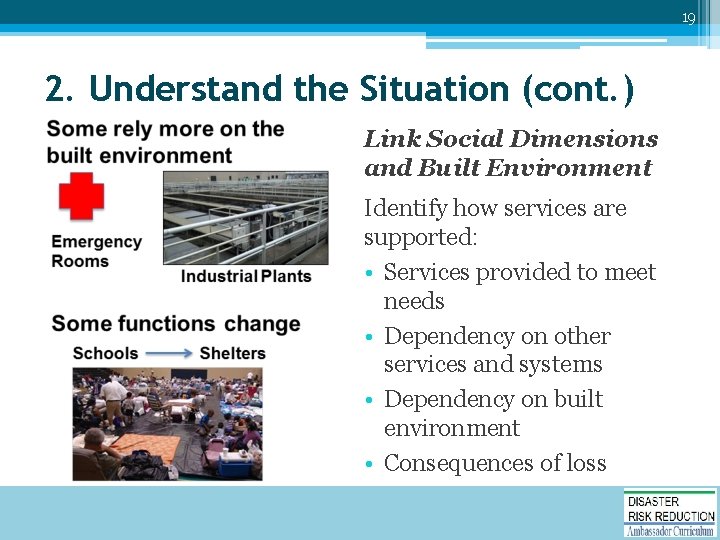
19 2. Understand the Situation (cont. ) Link Social Dimensions and Built Environment Identify how services are supported: • Services provided to meet needs • Dependency on other services and systems • Dependency on built environment • Consequences of loss
20 3. Determine Goals and Objectives Establish Long Term Community Goals • Long term goals to improve the community can guide the prioritization and implementation process ▫ Improve reliability of infrastructure systems ▫ Enhance community functions ▫ Reduce travel time impacts to residents and businesses ▫ Revitalize an existing blighted area
21 3. Determine Goals and Objectives (cont. ) Establish Long Term Community Goals (cont. ) • Community resilience is achieved over time ▫ Resilience can be achieved with resources for current maintenance and capital improvements
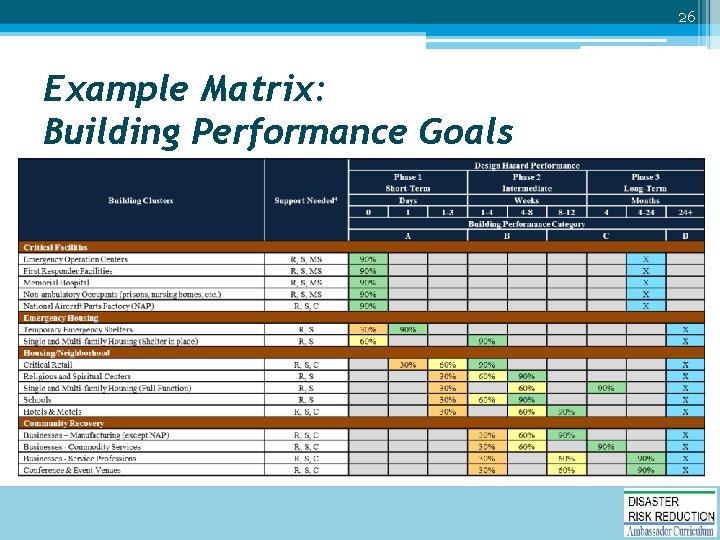
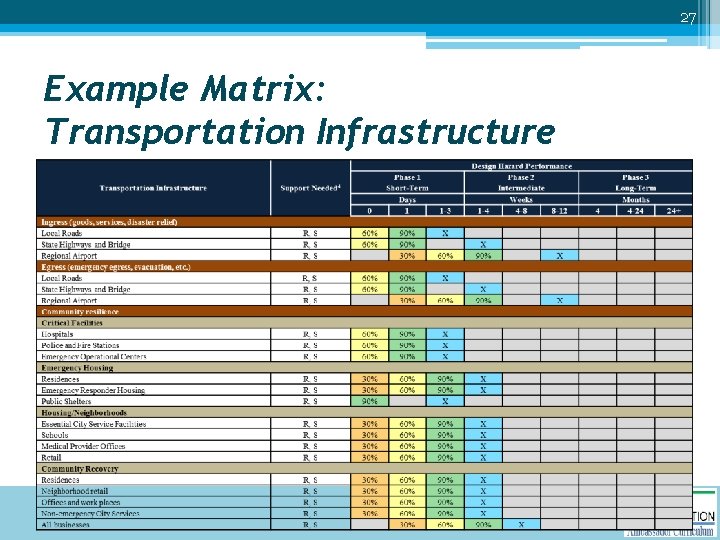
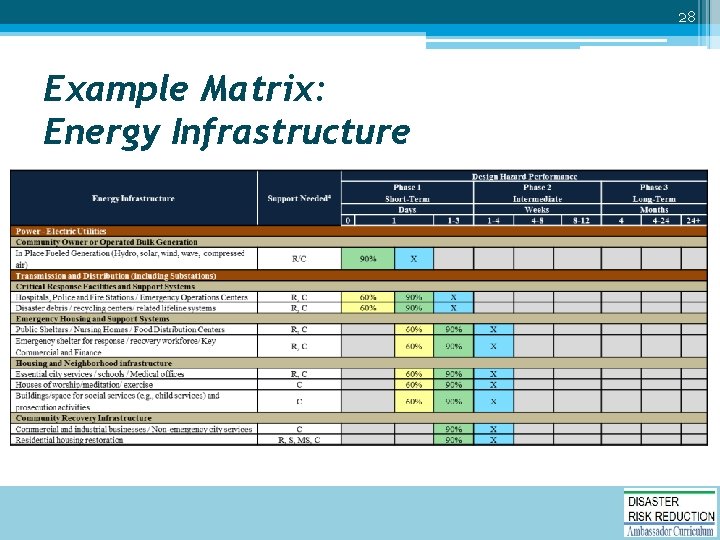
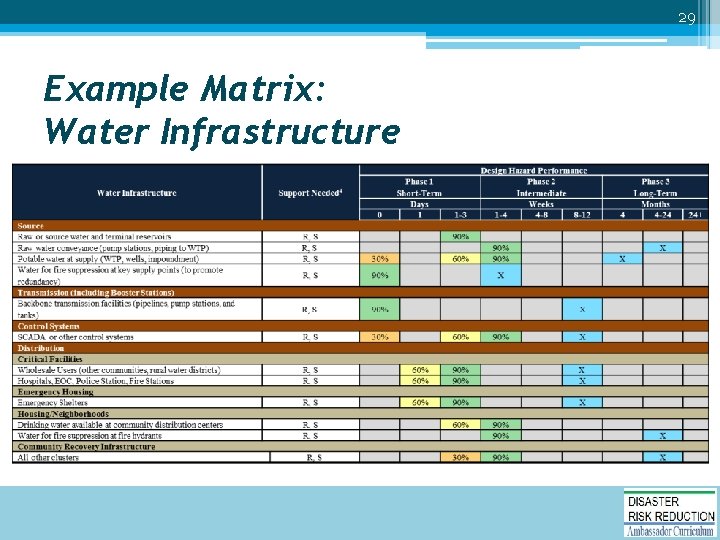
22 3. Determine Goals and Objectives (cont. ) Establish Desired Performance Goals for the Built Environment • Performance goals are independent of hazard events ▫ Community functions are needed during recovery, such as acute health care, 911 call centers, emergency response ▫ Consider role of a facility or system that impacts others outside the community
23 3. Determine Goals and Objectives (cont. ) Establish Desired Performance Goals for the Built Environment (cont. ) • Define goals in terms of ‘time needed to restore functionality’ • Use goals to help prioritize repair and reconstruction efforts • Goals may suggests criteria for new construction and retrofit of existing construction
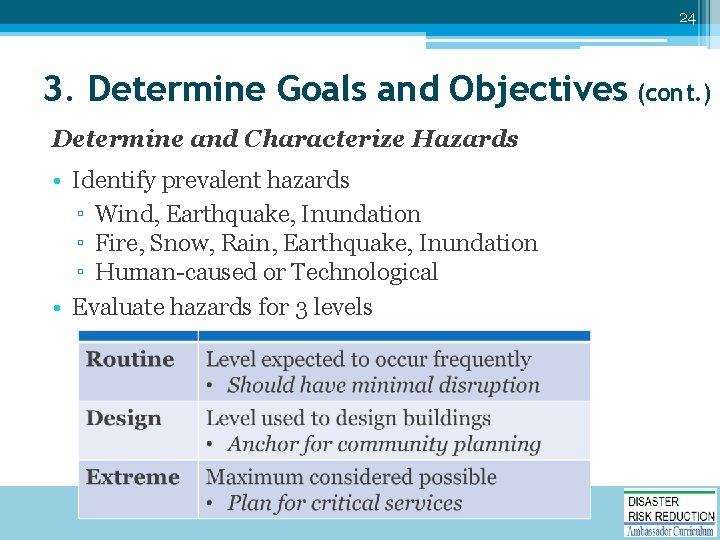
24 3. Determine Goals and Objectives (cont. ) Determine and Characterize Hazards • Identify prevalent hazards ▫ Wind, Earthquake, Inundation ▫ Fire, Snow, Rain, Earthquake, Inundation ▫ Human-caused or Technological • Evaluate hazards for 3 levels
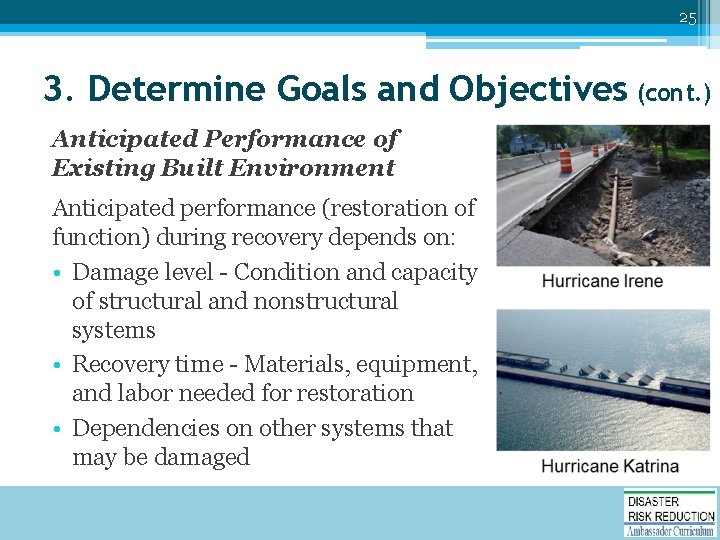
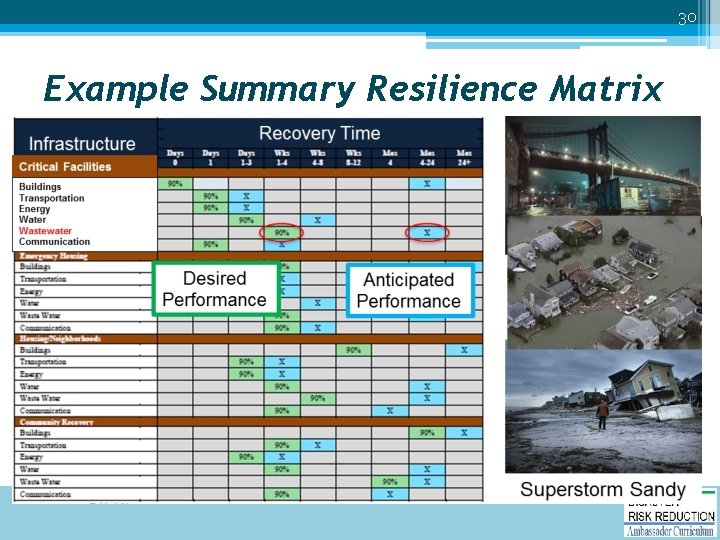
25 3. Determine Goals and Objectives (cont. ) Anticipated Performance of Existing Built Environment Anticipated performance (restoration of function) during recovery depends on: • Damage level - Condition and capacity of structural and nonstructural systems • Recovery time - Materials, equipment, and labor needed for restoration • Dependencies on other systems that may be damaged
26 Example Matrix: Building Performance Goals
27 Example Matrix: Transportation Infrastructure
28 Example Matrix: Energy Infrastructure
29 Example Matrix: Water Infrastructure
30 Example Summary Resilience Matrix
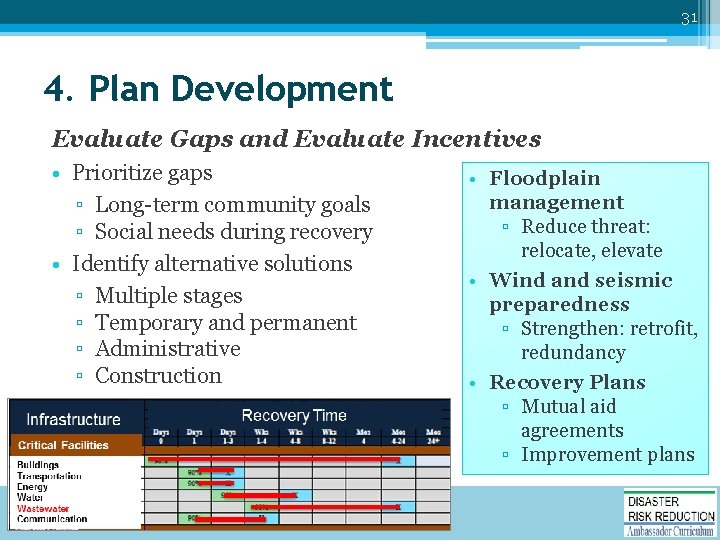
31 4. Plan Development Evaluate Gaps and Evaluate Incentives • Prioritize gaps ▫ Long-term community goals ▫ Social needs during recovery • Identify alternative solutions ▫ Multiple stages ▫ Temporary and permanent ▫ Administrative ▫ Construction • Floodplain management ▫ Reduce threat: relocate, elevate • Wind and seismic preparedness ▫ Strengthen: retrofit, redundancy • Recovery Plans ▫ Mutual aid agreements ▫ Improvement plans
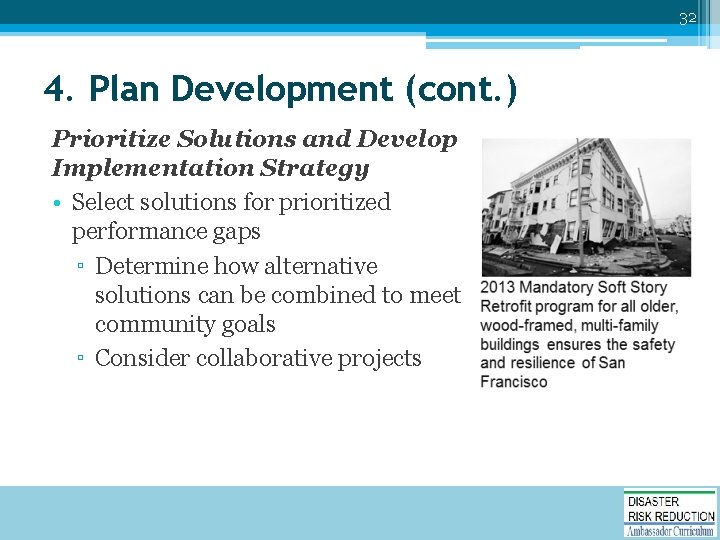
32 4. Plan Development (cont. ) Prioritize Solutions and Develop Implementation Strategy • Select solutions for prioritized performance gaps ▫ Determine how alternative solutions can be combined to meet community goals ▫ Consider collaborative projects
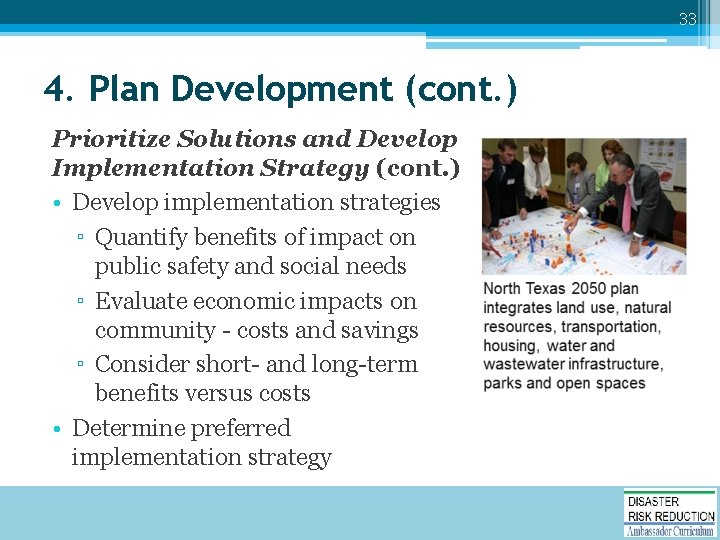
33 4. Plan Development (cont. ) Prioritize Solutions and Develop Implementation Strategy (cont. ) • Develop implementation strategies ▫ Quantify benefits of impact on public safety and social needs ▫ Evaluate economic impacts on community - costs and savings ▫ Consider short- and long-term benefits versus costs • Determine preferred implementation strategy
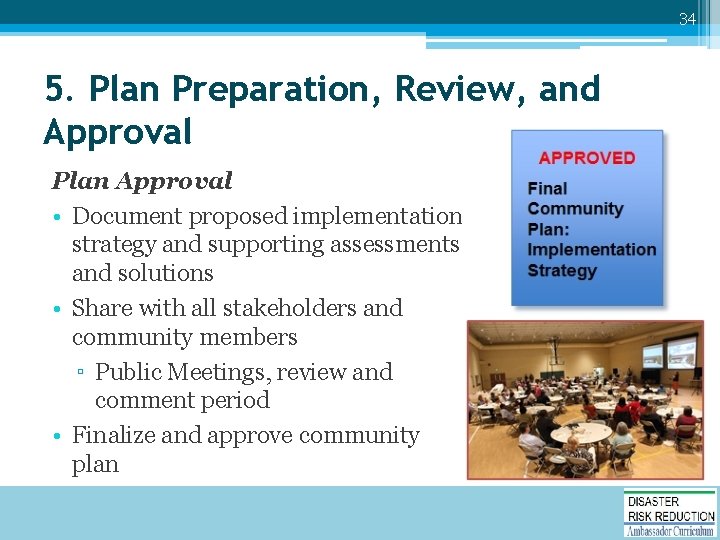
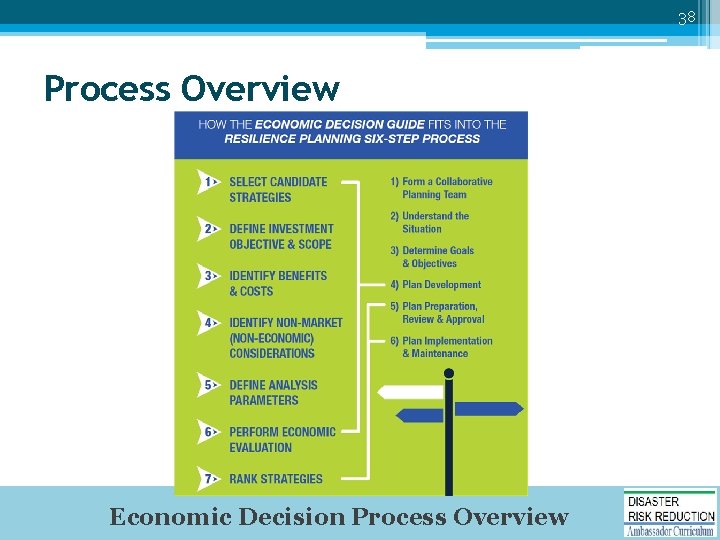
34 5. Plan Preparation, Review, and Approval Plan Approval • Document proposed implementation strategy and supporting assessments and solutions • Share with all stakeholders and community members ▫ Public Meetings, review and comment period • Finalize and approve community plan
35 6. Plan Implementation and Maintenance • Implementation ▫ Formally adopt community plan to guide local government and agencies ▫ Identify and obtain resources to implement solutions ▫ Track and communicate progress to stakeholders • Plan Maintenance ▫ Review strategy and solutions on a regular basis ▫ Modify or update as needed
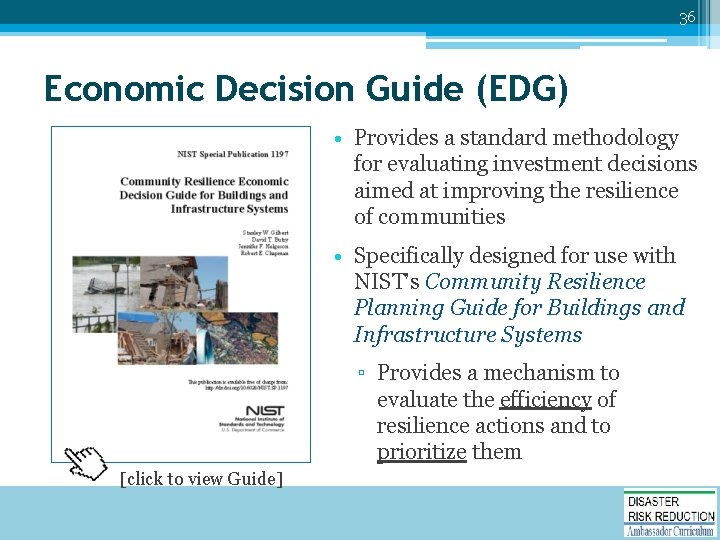
36 Economic Decision Guide (EDG) • Provides a standard methodology for evaluating investment decisions aimed at improving the resilience of communities • Specifically designed for use with NIST’s Community Resilience Planning Guide for Buildings and Infrastructure Systems ▫ Provides a mechanism to evaluate the efficiency of resilience actions and to prioritize them [click to view Guide]
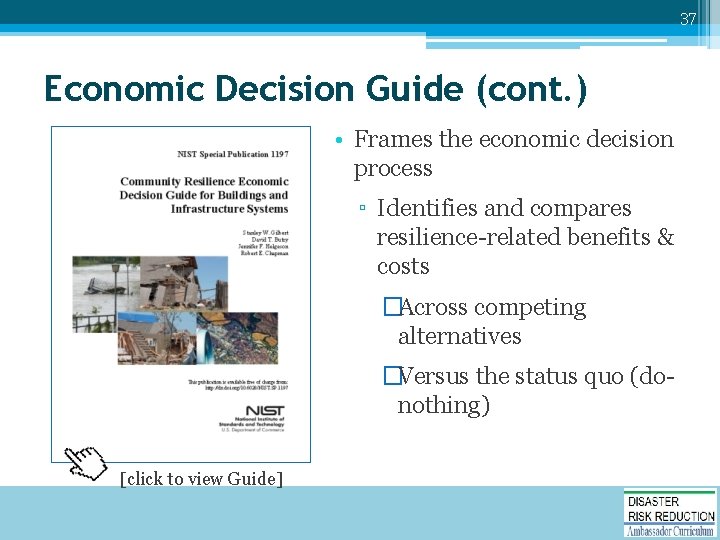
37 Economic Decision Guide (cont. ) • Frames the economic decision process ▫ Identifies and compares resilience-related benefits & costs �Across competing alternatives �Versus the status quo (donothing) [click to view Guide]
38 Process Overview Economic Decision Process Overview
39 Community Resilience Panel • Engage and connect community and crossdiscipline stakeholders • Identify policy and standards-related gaps and impediments to community resilience • Develop and maintain a Resilience Knowledge Base
40 Community Resilience Panel (cont. ) • Panel meets twice per year at locations around the country • Standing committees and Panel Coordinating Committee meet monthly by phone • Membership is open to all interested parties • There approximately 390 members currently including: ▫ State, local, and federal government representatives ▫ Utility owners and operators ▫ Insurance/re-insurance ▫ Engineers and Architects ▫ Economists ▫ Social scientists [click to visit website]
41 Implementation of the Guide • Encourage use of the Guide for community resilience plans • Collect data on implementation of resilience planning to inform future versions of the Guide and other products
42 NIST Contact Website: http: //www. nist. gov/el/resilience/ Guide: http: //www. nist. gov/el/resilience/guide. cfm Or google “NIST Resilience Planning Guide” General E-mail: resilience@nist. gov
43 Thank You! • Questions and/or comments • Contact information Natural Hazard Mitigation Association P. O. Box 170984 Boston, MA 02117 Email: nathazma@gmail. com www. nhma. info