
Approaches to violence prevention stemming from research Ottawa
- Slides: 11
Approaches to violence prevention stemming from research Ottawa, 2014 Prevent violence in schools or improve the school quality of life? What reveal the global and positive approach regarding prevention Claire Beaumont, Ph. D. , Professeure titulaire Faculté des sciences de l’éducation
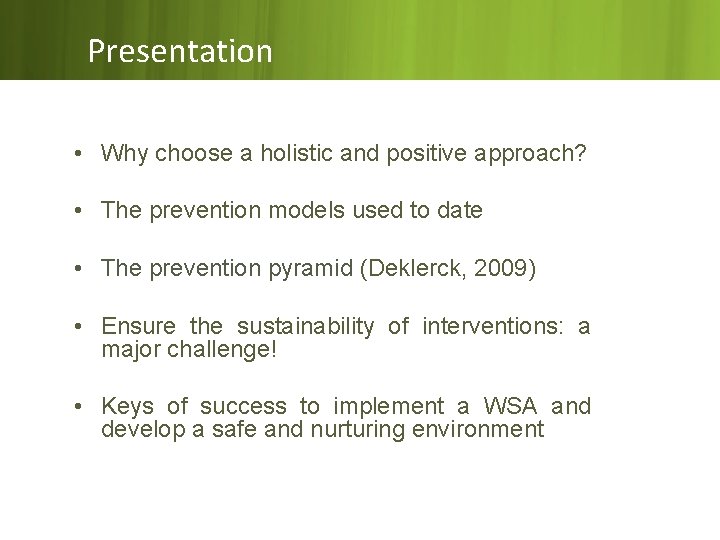
Presentation • Why choose a holistic and positive approach? • The prevention models used to date • The prevention pyramid (Deklerck, 2009) • Ensure the sustainability of interventions: a major challenge! • Keys of success to implement a WSA and develop a safe and nurturing environment
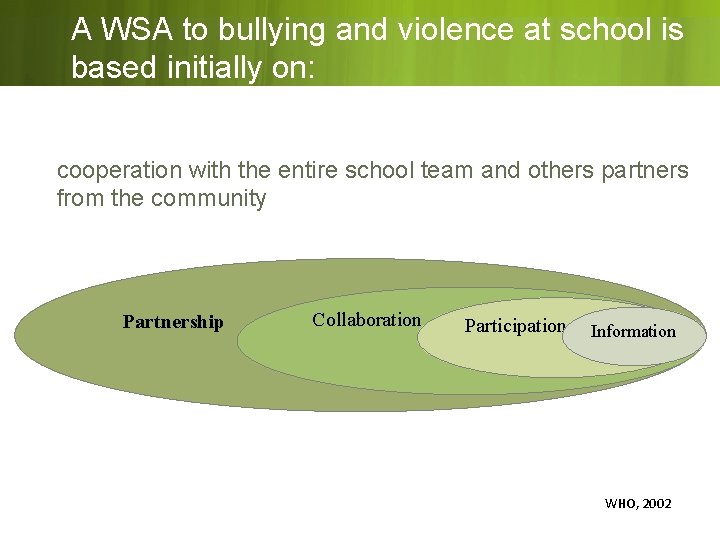
A WSA to bullying and violence at school is based initially on: cooperation with the entire school team and others partners from the community Partnership Collaboration Participation Information WHO, 2002
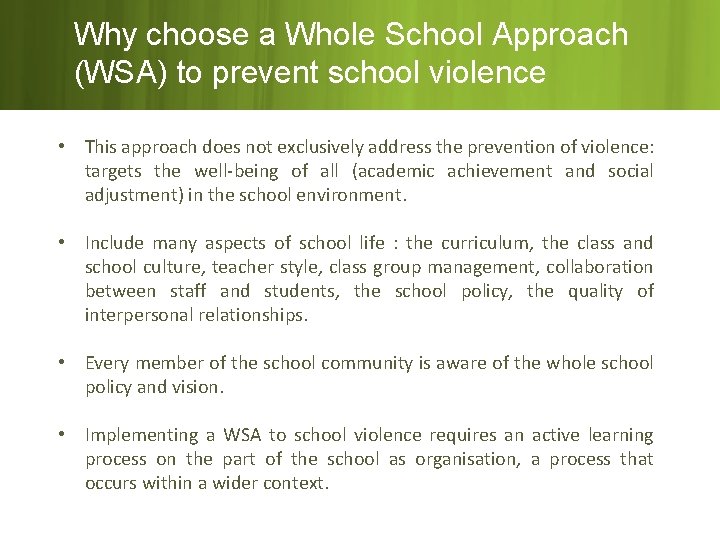
Why choose a Whole School Approach (WSA) to prevent school violence • This approach does not exclusively address the prevention of violence: targets the well-being of all (academic achievement and social adjustment) in the school environment. • Include many aspects of school life : the curriculum, the class and school culture, teacher style, class group management, collaboration between staff and students, the school policy, the quality of interpersonal relationships. • Every member of the school community is aware of the whole school policy and vision. • Implementing a WSA to school violence requires an active learning process on the part of the school as organisation, a process that occurs within a wider context.
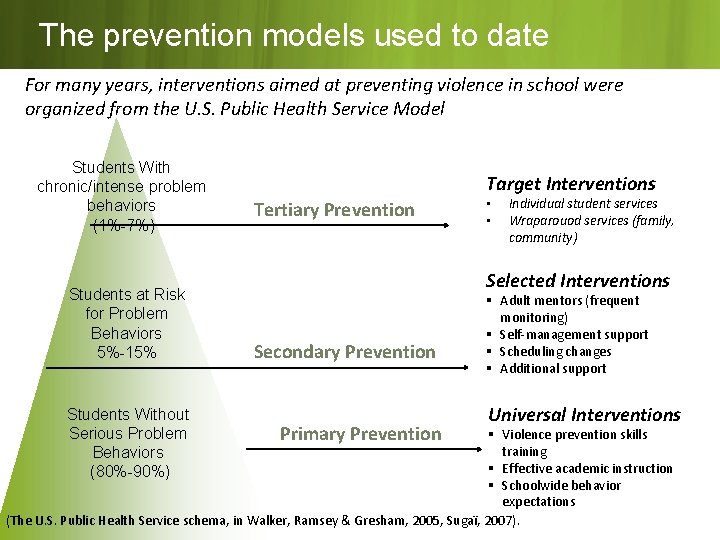
The prevention models used to date For many years, interventions aimed at preventing violence in school were organized from the U. S. Public Health Service Model Students With chronic/intense problem behaviors (1%-7%) Students at Risk for Problem Behaviors 5%-15% Students Without Serious Problem Behaviors (80%-90%) Target Interventions Tertiary Prevention • • Individual student services Wraparouod services (family, community) Selected Interventions Secondary Prevention Primary Prevention § Adult mentors (frequent monitoring) § Self-management support § Scheduling changes § Additional support Universal Interventions § Violence prevention skills training § Effective academic instruction § Schoolwide behavior expectations (The U. S. Public Health Service schema, in Walker, Ramsey & Gresham, 2005, Sugaï, 2007).
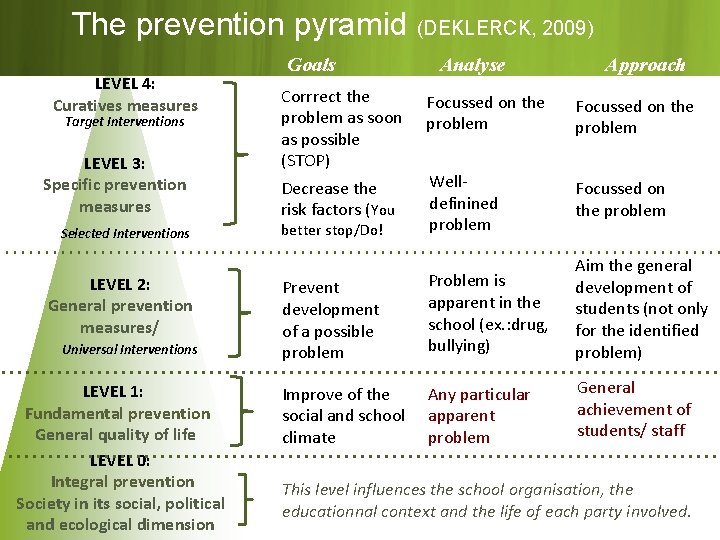
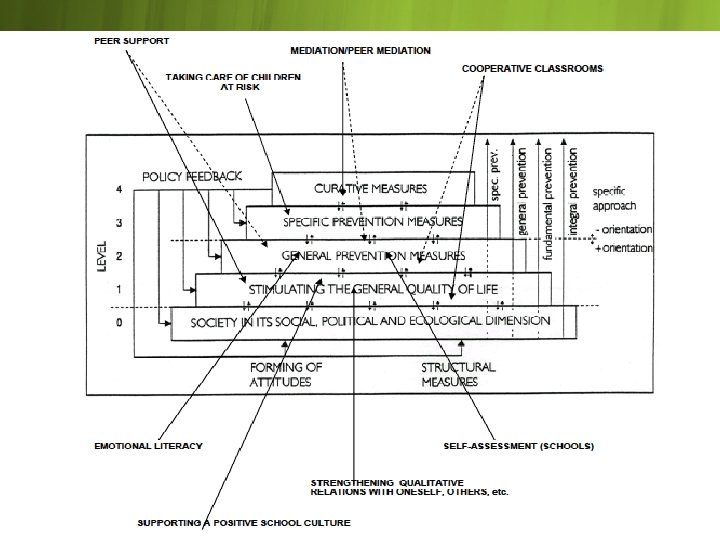
The prevention pyramid (DEKLERCK, 2009) LEVEL 4: Curatives measures Target Interventions LEVEL 3: Specific prevention measures Selected Interventions LEVEL 2: General prevention measures/ Universal Interventions LEVEL 1: Fundamental prevention General quality of life LEVEL 0: Integral prevention Society in its social, political and ecological dimension Goals Corrrect the problem as soon as possible (STOP) Analyse Approach Focussed on the problem Welldefinined problem Focussed on the problem Prevent development of a possible problem Problem is apparent in the school (ex. : drug, bullying) Aim the general development of students (not only for the identified problem) Improve of the social and school climate Any particular apparent problem General achievement of students/ staff Decrease the risk factors (You better stop/Do! This level influences the school organisation, the educationnal context and the life of each party involved.
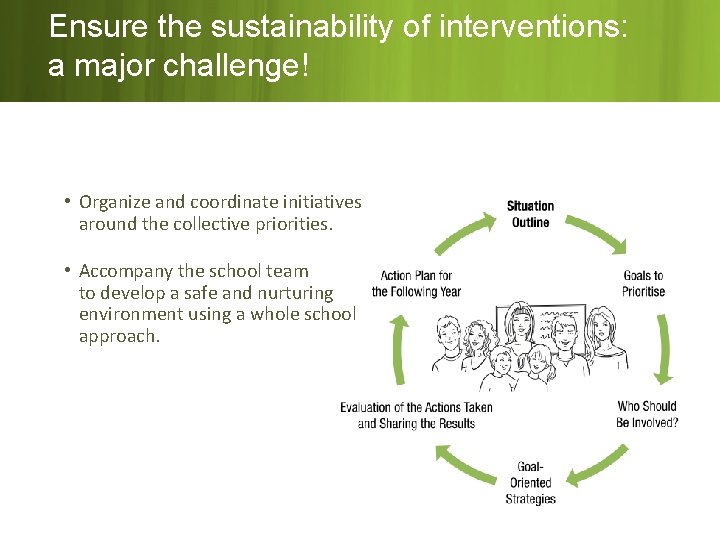
Ensure the sustainability of interventions: a major challenge! • Organize and coordinate initiatives around the collective priorities. • Accompany the school team to develop a safe and nurturing environment using a whole school approach.
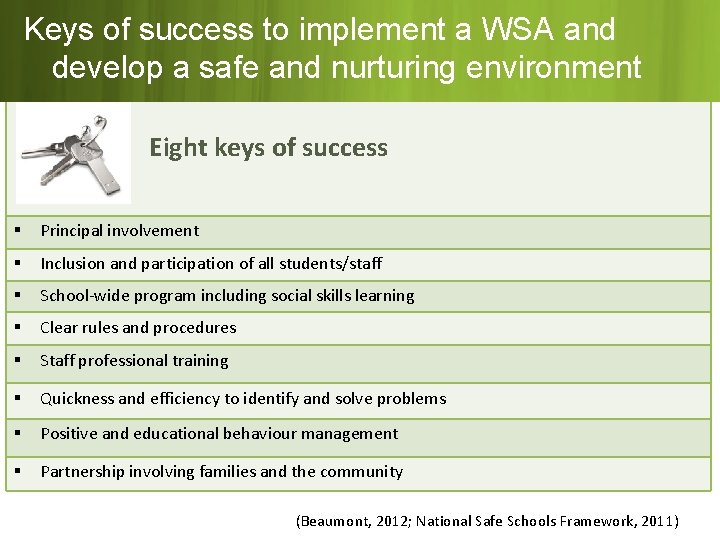
Keys of success to implement a WSA and develop a safe and nurturing environment Eight keys of success § Principal involvement § Inclusion and participation of all students/staff § School-wide program including social skills learning § Clear rules and procedures § Staff professional training § Quickness and efficiency to identify and solve problems § Positive and educational behaviour management § Partnership involving families and the community (Beaumont, 2012; National Safe Schools Framework, 2011)
Merci! Claire. beaumont@fse. ulaval. ca
triangle de Sugaï (2007)Walker ci-dessous