
Approaches to Treatment and Therapy Chapter 17 Copyright
- Slides: 39
Approaches to Treatment and Therapy Chapter 17 Copyright © 2010 Pearson Education Canada 17 -1
Chapter Outline • Biological Treatments for Mental Disorders • Kinds of Psychotherapy • Evaluating Psychotherapy • The Value and Values of Psychotherapy Copyright © 2010 Pearson Education Canada 17 -2
Biological Treatments • Contemporary view alternates between mental disorders as diseases (medical treatment) & emotional problems (psychological treatment) • Drug treatments on the rise with growing recognition of biological and genetic components to disorders – Medications that alter the production of or response to neurotransmitters in the brain Copyright © 2010 Pearson Education Canada 17 -3
Antipsychotic Drugs • Antipsychotic drugs (neuroleptics) – Drugs used primarily in the treatment of schizophrenia & other psychotic disorders – Most designed to block or reduce the sensitivity of brain receptors that respond to dopamine – Reduce agitation, delusions, and hallucinations – Side effects such as muscular rigidity, tremors, and involuntary muscle movements (tardive dyskinesia) Copyright © 2010 Pearson Education Canada 17 -4
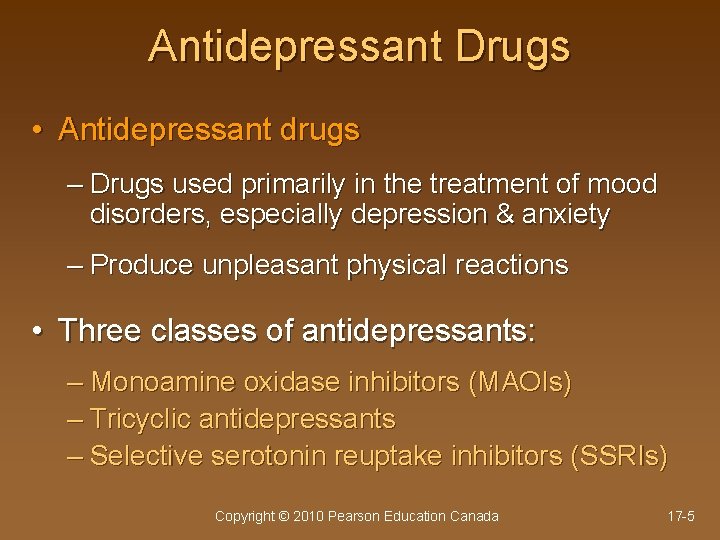
Antidepressant Drugs • Antidepressant drugs – Drugs used primarily in the treatment of mood disorders, especially depression & anxiety – Produce unpleasant physical reactions • Three classes of antidepressants: – Monoamine oxidase inhibitors (MAOIs) – Tricyclic antidepressants – Selective serotonin reuptake inhibitors (SSRIs) Copyright © 2010 Pearson Education Canada 17 -5
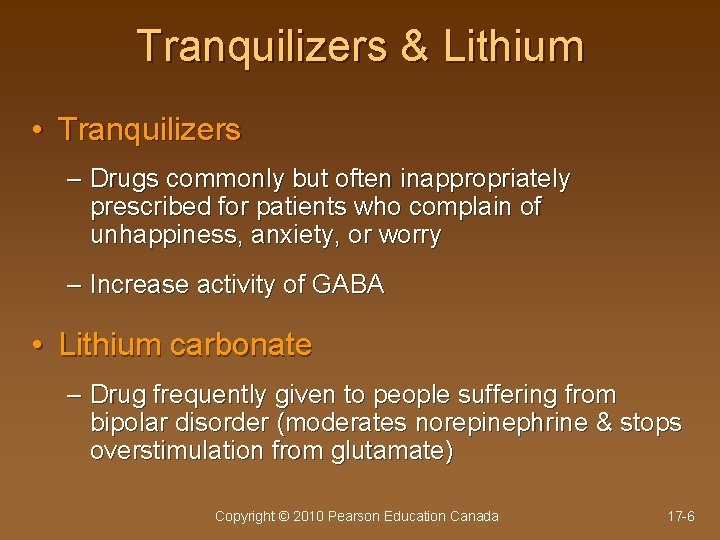
Tranquilizers & Lithium • Tranquilizers – Drugs commonly but often inappropriately prescribed for patients who complain of unhappiness, anxiety, or worry – Increase activity of GABA • Lithium carbonate – Drug frequently given to people suffering from bipolar disorder (moderates norepinephrine & stops overstimulation from glutamate) Copyright © 2010 Pearson Education Canada 17 -6
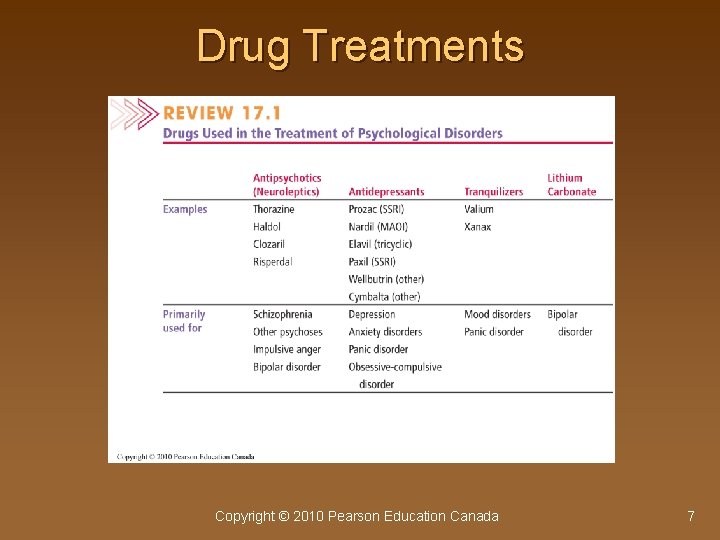
Drug Treatments Copyright © 2010 Pearson Education Canada 7
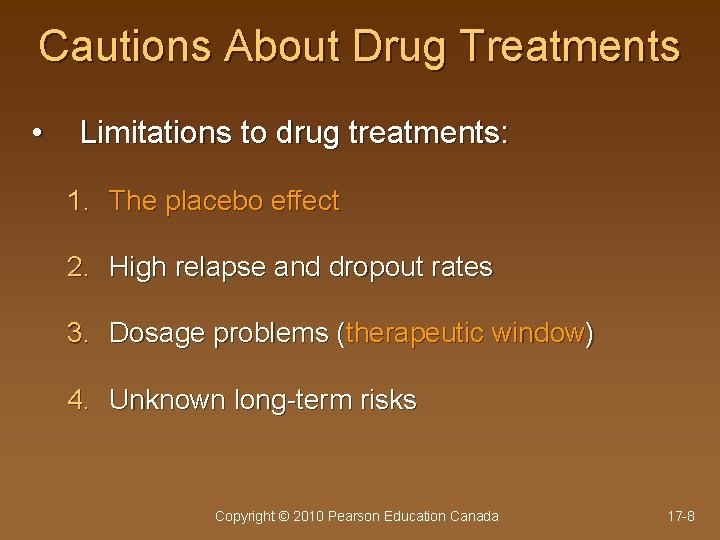
Cautions About Drug Treatments • Limitations to drug treatments: 1. The placebo effect 2. High relapse and dropout rates 3. Dosage problems (therapeutic window) 4. Unknown long-term risks Copyright © 2010 Pearson Education Canada 17 -8
Direct Brain Intervention • Psychosurgery – Any surgical procedure that destroys selected areas of the brain believed to be involved in emotional disorders or violent, impulsive behaviour (e. g. , prefrontal lobotomy) • Electroconvulsive therapy (ECT) – A procedure used in cases of prolonged and severe major depression, in which a brief brain seizure is induced – Newer alternatives like transcranial magnetic stimulation (TMS) used for milder stimulation Copyright © 2010 Pearson Education Canada 17 -9
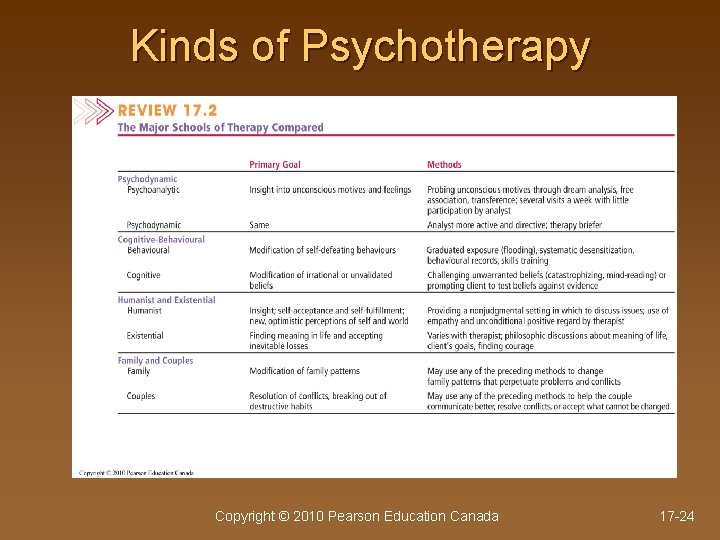
Kinds of Psychotherapy • Major schools of psychotherapy: 1. 2. 3. 4. 5. 6. Psychodynamic therapy Behavioural therapy Cognitive therapy Humanist therapy Existential therapy Family & couples therapy Copyright © 2010 Pearson Education Canada 17 -10
Psychodynamic Therapy • Relied on Freud’s method of psychoanalysis & traditionally involved free association • Evolved into many psychodynamic or “depth” therapies – Major element of transference: process where client transfers unconscious emotions or reactions (e. g. , feelings about parents) onto therapist Copyright © 2010 Pearson Education Canada 17 -11
Behavioural Therapy • Behaviour therapy – Therapy that applies principles of classical and operant conditioning to help people change selfdefeating or problematic behaviours • Use a variety of methods depending on the problem or situations – Exposure, systematic desensitization, behavioural self-monitoring, skills training Copyright © 2010 Pearson Education Canada 17 -12
Behavioural Techniques 1. Exposure – Graduated exposure: method where a person suffering from a phobia or panic attacks is gradually taken into the feared situation or exposed to a traumatic memory until the fear subsides – Flooding: a form of exposure treatment in which the client is taken directly into the feared situation until his or her anxiety subsides Copyright © 2010 Pearson Education Canada 17 -13
Behavioural Techniques 2. Systematic desensitization – Systematic desensitization: step-by-step process of desensitizing a client to a feared object or experience – Based on counterconditioning: process of pairing a conditioned stimulus with a stimulus that elicits a response that is incompatible with an unwanted conditioned response Copyright © 2010 Pearson Education Canada 17 -14
Behavioural Techniques 3. Behavioural self-monitoring – A method of keeping careful data on the frequency and consequences of the behaviour to be changed 4. Skills training – An effort to teach the client skills the he or she may lack, as well as new constructive behaviours to replace self-defeating ones Copyright © 2010 Pearson Education Canada 17 -15
Cognitive Therapy • Cognitive therapy – Form of therapy designed to identify and change irrational, unproductive ways of thinking and, hence, to reduce negative emotions – Rational emotive behaviour therapy (REBT): designed to challenge client’s unrealistic thoughts (e. g. , overgeneralizations, catastrophizing) (Ellis) – Other forms include cognitive therapy for depression (Beck) and stress inoculation for anxiety (Meichenbaum) Copyright © 2010 Pearson Education Canada 17 -16
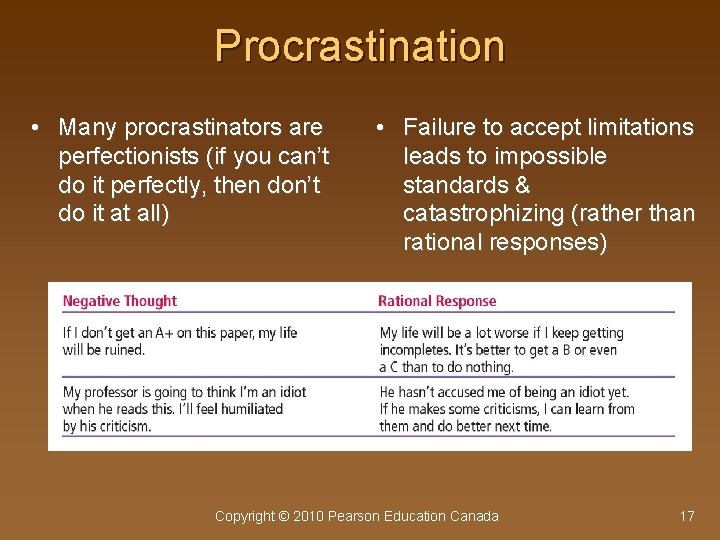
Procrastination • Many procrastinators are perfectionists (if you can’t do it perfectly, then don’t do it at all) • Failure to accept limitations leads to impossible standards & catastrophizing (rather than rational responses) Copyright © 2010 Pearson Education Canada 17
Bandura’s Therapies • Self-control therapy – Designed to help people overcome problem habits – Required self-observation, environmental planning, and self-contracts • Modeling therapy – People can overcome disorders by observing another person who is dealing with the same problem in a productive fashion Copyright © 2010 Pearson Education Canada 17 -18
Humanist Therapy • Humanist therapy – Form of psychotherapy based on the philosophy of humanism, which emphasizes the client’s free will to change rather than past conflicts – Client-centred therapy: emphasizes therapist’s empathy with the client and the use of unconditional positive regard (Rogers) • Empathy refers to ability of therapist to understand & accept what the client says Copyright © 2010 Pearson Education Canada 17 -19
Existential Therapy • Existential therapy – Form of therapy designed to help clients explore the meaning of existence and face the great questions of life, such as death, freedom, alienation, and loneliness – Crucial step to take self-responsibility for circumstances – Helps clients cope with inescapable realities of life and death and struggle for meaning Copyright © 2010 Pearson Education Canada 17 -20
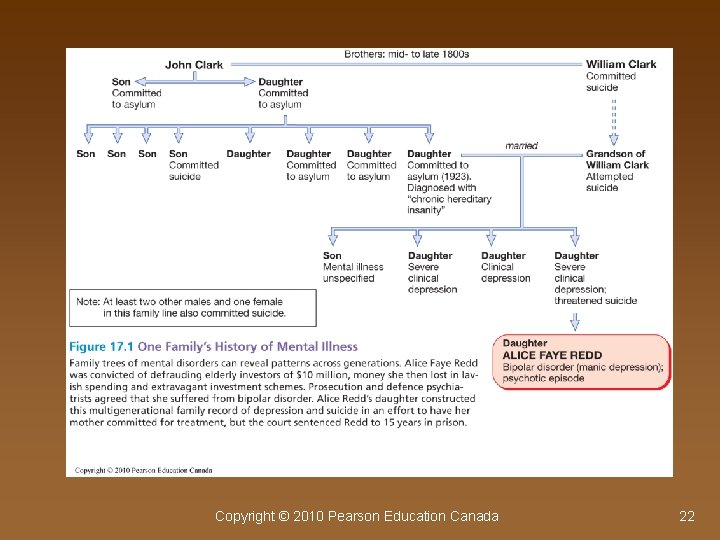
Family & Couples Therapy • Family therapy – Perspective that holds than an individual’s problem develops in the context of the family, sustained by family dynamics, and that changes affect all members of the family • Family-systems perspective – Approach that identifies how each family member forms a larger part of an interacting system Copyright © 2010 Pearson Education Canada 17 -21
Copyright © 2010 Pearson Education Canada 22
Couples Therapy • Couples therapy – Approach where therapist sees both partners in a couple and helps them to manage inevitable conflicts that occur in all relationships – May use psychodynamic, behavioural, cognitive, or humanist approaches in their work • In practice, many therapists take an integrative approach to psychology Copyright © 2010 Pearson Education Canada 17 -23
Kinds of Psychotherapy Copyright © 2010 Pearson Education Canada 17 -24
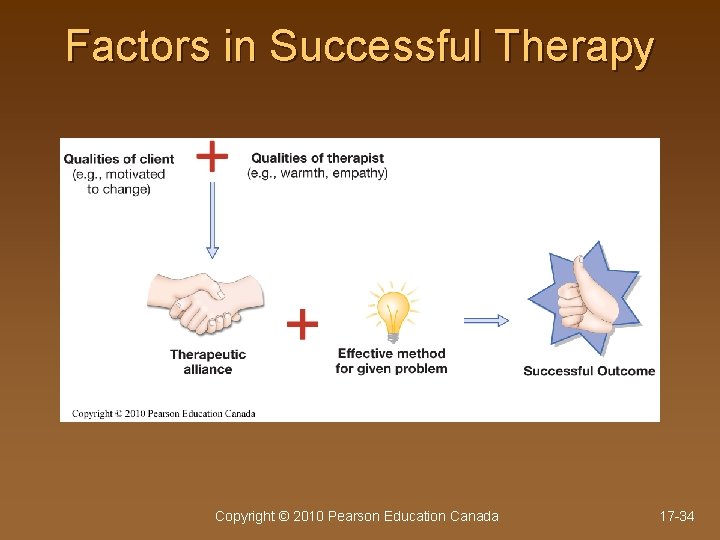
Evaluating Psychotherapy • Success of therapy depends on quality of relationship between therapist & client – Therapeutic alliance: bond of confidence and mutual understanding established between therapist and client, which allows them to work together to solve the client’s problems – Client’s motivation to improve important in success – Cultural “match” may help with client disclosure & mutual trust relationships (cultural group therapy also a popular approach) Copyright © 2010 Pearson Education Canada 17 -25
Scientist-Practitioner Gap • Debate between practitioners & scientists as to how psychotherapy can be evaluated? • Scientist-practitioner gap – Breach between scientists & therapists over different assumptions held by researchers and many clinicians regarding the value of empirical research for doing psychotherapy and for assessing its effectiveness Copyright © 2010 Pearson Education Canada 17 -26
“New” Therapies • Gap has widened with the continued generation or “repackaging” of new therapies • Some claim to be highly successful, yet lack any empirical evidence to suggest they are any better than standardized techniques – Examples: Neurolinguistic Programming (NLP), Eye Movement Desensitization and Reprocessing (EMDR) Copyright © 2010 Pearson Education Canada 17 -27
Problems in Assessing Therapy • Economic pressures (insurers) require empirical assessment of therapies – Often use testimonials are problematic due to justification of effort effect • Randomized controlled trials used to overcome some of these problems – People with a given problem or disorder are randomly assigned to one or more treatment groups or to a control group; designed to evaluate effectiveness of new medication or form of therapy Copyright © 2010 Pearson Education Canada 17 -28
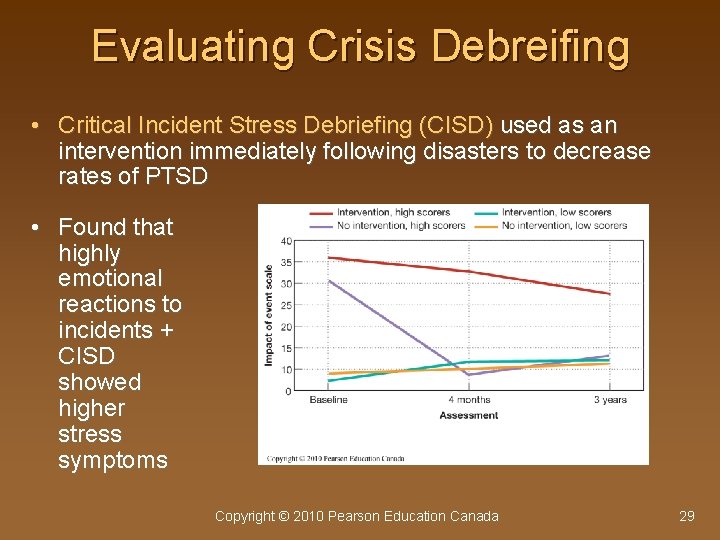
Evaluating Crisis Debreifing • Critical Incident Stress Debriefing (CISD) used as an intervention immediately following disasters to decrease rates of PTSD • Found that highly emotional reactions to incidents + CISD showed higher stress symptoms Copyright © 2010 Pearson Education Canada 29
When Therapy Helps • Many benefits to psychotherapy & certain therapies may work best for certain types of problems or disorders • For many problems and most emotional disorders, cognitive and behaviour therapies are the method of choice Copyright © 2010 Pearson Education Canada 17 -30
When Therapy Helps • Depression: cognitive therapy • Prevention of suicide: cognitive therapy • Anxiety disorders: exposure techniques (PTSD, agoraphobia, specific phobias), cognitive-behaviour therapy (panic, generalized anxiety, obsessive-compulsive disorders) • Anger and impulsive violence: cognitive therapy • Health problems: cognitive & behaviour therapies • Childhood & adolescent problems: behaviour therapy • Relapse prevention: cognitive-behavioural approaches Copyright © 2010 Pearson Education Canada 17 -31
Motivational Interviewing • Motivational interviewing – Therapy for treating alcohol abuse that focuses specifically on increasing a client’s motivation to change problem drinking – Some evidence suggests this can be very effective early on in therapy process – May be combined with other techniques for integrated approach Copyright © 2010 Pearson Education Canada 17 -32
Multisystemic Therapy • Special or problem populations may be addressed with multisystemic therapy (MST) – Community intervention that combines family systems techniques with behavioural methods – Applied in context of forming “neighbourhood partnerships” with local leaders, residents, parents, and teachers to help prevent or reduce teenagers problems – Used for teen violence, criminal activity, drug abuse and school problems Copyright © 2010 Pearson Education Canada 17 -33
Factors in Successful Therapy Copyright © 2010 Pearson Education Canada 17 -34
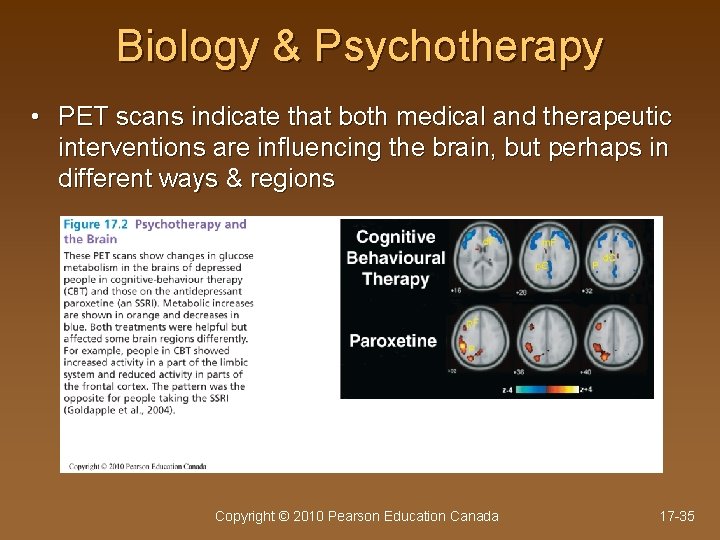
Biology & Psychotherapy • PET scans indicate that both medical and therapeutic interventions are influencing the brain, but perhaps in different ways & regions Copyright © 2010 Pearson Education Canada 17 -35
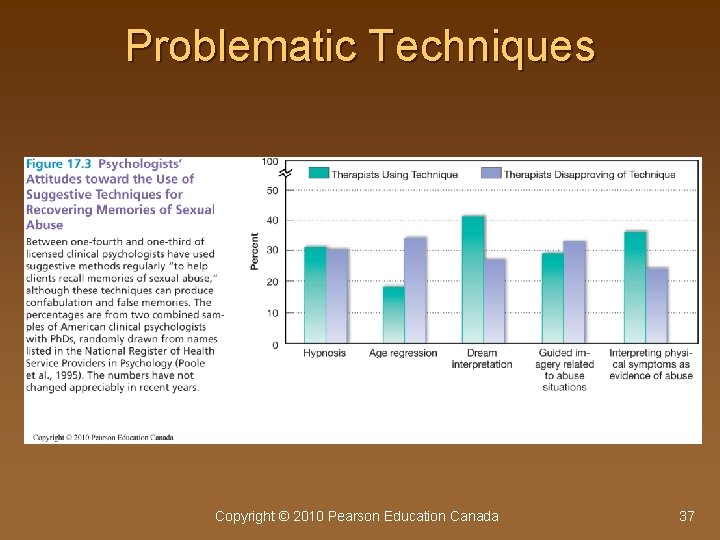
When Therapy Harms • Risks to clients increase under these conditions: 1. The use of empirically unsupported, potentially dangerous techniques (e. g. , rebirthing, recovered memory therapies) 2. Inappropriate or coercive influence, which can create new problems for the client 3. Prejudice or cultural ignorance on the part of therapist 4. Sexual intimacies or other unethical behaviour on the part of therapist Copyright © 2010 Pearson Education Canada 17 -36
Problematic Techniques Copyright © 2010 Pearson Education Canada 37
Values of Psychotherapy • Most people get the help they need for ‘regular’ challenges from family & peers • Consumers thinking about psychotherapy should carefully consider how they go about: – Choosing a therapist – Choosing a therapy – Deciding when to leave Copyright © 2010 Pearson Education Canada 17 -38
End of Chapter 17 Copyright © 2010 Pearson Education Canada 17 -39