
Approaches to Reading Instruction Amber Allen Dawn Hermann
Approaches to Reading Instruction Amber Allen Dawn Hermann Jamie Milanowski
History of Reading • Textbooks were created to teach reading – Mc. Guffey Readers – now the basal reading series – Teacher centered – students rote memorization • Progressive Education Movement – Interests of students, science • Dick and Jane books – “Whole Word” approach • 1955 Why Johnny Can’t Read (1955) – Attacked the whole word approach • Children’s stories with controlled vocabularies • Children need to be able to sound out words. • Whole Language started in Late 70 s – Popular in 80 s/90 s – Students struggling with Whole Language approach • Decoding of words was not taught • Each child learns differently • Balanced Literacy approach to reading (Brown, 2011; Reyhner, 2008)
Whole Language Approach • Example: – Learning to read through Whole Language approach
Whole Language Approach • Focus on meaning and strategy instruction rather than decoding • Looks at language as a whole rather than individual parts • Teaches reading and writing through oral language experiences of the child
Components of Whole Language Approach • Top-down approach • Literate Environment • Oral Language and Literacy used across all content areas • Student-Centered • Reading and writing for real purposes
Cons of Whole Language • No focus on language structure • Literacy Sub-skills are taught as the need arises
SLP Role with Whole Language • Provide services consistent with school’s approach to literacy • Ideal program for SLP-Focus on oral language • Assessment procedures-ongoing in natural environment • Service Delivery-classroom based model • Provide teachers with suggestions for using oral language to promote literacy learning • Help students acquire oral language skills • Help students acquire written language skills
Phonics Approach • Focuses on the relationship between the letter (or grapheme) and the sound it makes. – Direct, explicit, and systematic teaching • Teaches reading in a hierarchy type of fashion – Teaches each letter sound – Sight words also taught • my, the, at, to – Sentences – Paragraphs • Bottom up approach (Byrd, 2008)
Phonics Approach • Cons – No one-to-one sound symbol relationship – English homonyms create difficulties for spelling (even college level) • E. g. , too, two; Their, there, they’re – “Outlaw words” need to be memorized – About half of the English language cannot be pronounced correctly using phonics – Differing vocabulary sizes – Differing dialects of English that vary in pronunciation (e. g. , Minnesota vs. Texas) – Children with articulation disorders struggle
Phonics Approach • SLP Role – Phonological awareness – Teaching specific sounds – Service delivery: • Pull-out • Small groups • Collaboration with teacher or co-teach – Speech groups or whole group teaching
Phonics Example • http: //www. youtube. com/watch? v=BELl. ZKpi 1 Zs • Reading Mastery
The Great Debate • Whole-Language vs. Phonics • California implemented whole language in the 1980 s, but then offered school districts financial incentives to return to the phonics method in 1996. • The National Research Council made a public statement in 1998, asking to end the “reading wars. ” The Council cited for more than two decades bouncing back and forth between the two methods resulted in little academic gain.
The Great Debate • The “reading wars” were not just about academics, they were also political. – Conservatives saw whole language as a freewheeling approach that was missing standards and rules needed in education. – Liberals said phonics perpetuated patronizing “drill and kill” strategies which turned kids into reading robots and turned them away from wanting to learn. – Whole language was used in more liberal states, phonics in conservative states.
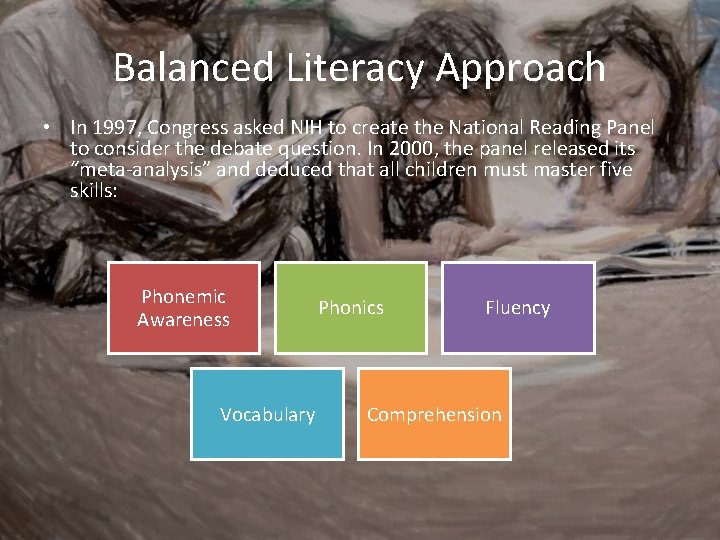
Balanced Literacy Approach • In 1997, Congress asked NIH to create the National Reading Panel to consider the debate question. In 2000, the panel released its “meta-analysis” and deduced that all children must master five skills: Phonemic Awareness Vocabulary Phonics Fluency Comprehension
Balanced Literacy Approach
Balanced Literacy Approach • Children need to learn to both sound out words and look at context to become effective readers. • The 1998 National Research Council report stated, “ If we have learned anything from this effort, it is that effective teachers are able to craft a special mix of instructional ingredients for every child they work with. ”
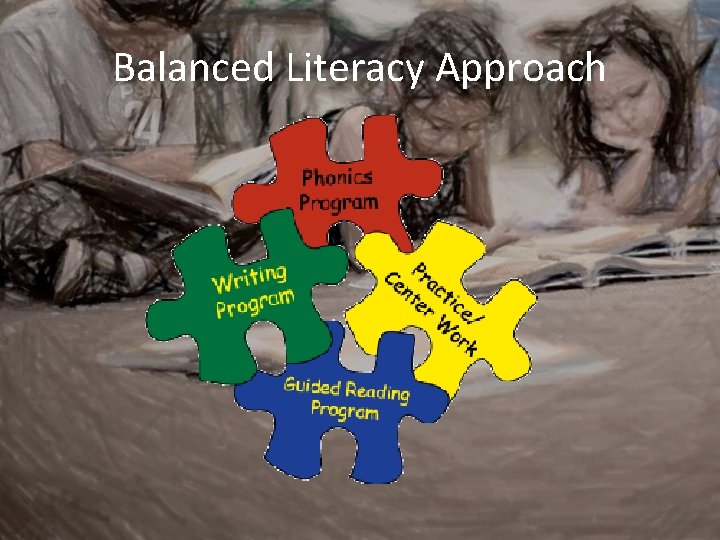
Balanced Literacy Approach • In a balanced literacy approach how you teach and what you teach are equally important. • Some sound-letter patterns are more consistent, and should be taught early as a foundation for literacy. • Books such as kindergarten standards like “Chicka Boom” work well to introduce blended literacy.
Balanced Literacy Approach • Example: • http: //www. youtube. com/watch? v=Nv 6 j. KXQ 6 Voo
Children with Language Delays/Disorders • While both methods can be effective with normally-developing readers, choosing one method over the other could harm children’s development, especially those with language impairments (LI). • Children with LI tended to benefit most from phonics, while gifted children did well with the whole language approach. – The whole language approach has been found to be particularly detrimental to children with dyslexia.
Take Away Points • Important to know literacy approach school uses. – To collaborate your services • Not one approach works for all children • Take both interests and skills into consideration
References • • Brown, E. (2011). History of reading instruction. The Phonics Page. Retrieved on July 27, 2013 from http: //thephonicspage. org/On%20 Phonics/historyofreading. html. Byrd, C. M. (2008). Reading instruction beliefs and practices of early elementary school teachers. Psi Chi, The National Honor Society in Psychology, 13(2), 76 -85. Chaney, Carolyn. (1990). Evaluating the Whole Language Approach to Language Arts: The Pros and Cons. Language, Speech, and Hearing Services in Schools, 21, 244 -249. Dahms, Joel (2006). Spelling out dyslexia: Northwest researchers shed light on spelling problems in dyslexic children, provide hope for new treatment. Northwest Science & Technology. Retrieved on July 28 from https: //depts. washington. edu/nwst/issues/index. php? issue. ID=fall_2006&story. ID=800. Kolker, Robert (2006). A is for apple, B is for Brawl. New York. Retrieved on July 28, 2013 from http: //nymag. com/news/features/16775/index 1. html. Reyhner, J. (2008). The reading wars: Phonics versus whole language. Retrieved on July 26, 2013 from http: //jan. ucc. nau. edu/~jar/Reading_Wars. html. Schory, M. E. (1990). Whole Language and the Speech-Language Pathologist. Language, Speech, and Hearing Services in Schools, 21, 206 -211. Strickland, Dorothy. Practical strategies to help you build a truly balanced classroom literacy program. Scholastic Instructor. Retrieved on July 28, 2013 from http: //www. scholastic. com/teachers/article/balanced-literacy.
- Slides: 21