
Approaches to PFM reform Module 1 4 Conditions


- Slides: 22
Approaches to PFM reform Module 1. 4 Conditions for successful reforms 1
Day 1: Approaches to PFM reform • Module 1. 1. PFM objectives and budgetary approaches • Module 1. 2. Why reform PFM systems? Why establish a sequence? • Module 1. 3. The starting point: assessing PFM systems • Module 1. 4. Conditions for successful reform 2
Module 1. 4. Objectives of the module • Many reform programmes do not achieve expected results • This module identifies some of the causes for failure or difficulties, as well as the conditions for success 3
Module 1. 4. Outline • Possible causes for failure or difficulties • The conditions for a successful reform • Beware of pitfalls 4
Possible causes for failure (1) The causes for the failure of a reform are various & numerous, but often contain the following: Reforms carried out without a strong internal demand (e. g. Reforms pushed by an external party) • Little political support • External parties &/or political push for reforms, but resistance form administration Reform measures are technically questionable • Copying a more advanced & complex reform from another country (‘best practice’) - not viable in country context • Technically questionable measures (eg. Sectorial MTEFs not compliant to financial constraints) 5
Possible causes for failure (2) • Insufficient capacity o Institutional capacities: separation of Plan and Finances, difficult Finance-sectors relations, etc. o Human Resources • Insufficient reform steering mechanisms o Fragmentation of the steering force • According to lender projects, themes, etc. o Deficient steering capacities (eg. Large, badly carried out IT projects) 6
Facades of reforms Some reforms may not produce results because they are purely formal. For example : • Formal procedure for drafting budget have been modernised, but systems stays flawed • Budget as theatre: ‘Formal & informal institutional makings of budget process in Malawi’ (DFID 2004) • “Reforms” that seek solely to satisfy external pressures or to comply to a trend • Potemkin Villages: 'The Medium-Term Expenditure Framework in Developing Countries’ (Schiavo. Campo: Public budgeting and finance, Summer 2009) 7
Module 1. 4. Outline • Possible causes for failure or difficulties • The conditions for a successful reform • Beware of pitfalls 8
Conditions for success: Gleicher’s equation SDx. Vx. FS>R • Shared dissatisfaction • Vision • First successful steps • Resistance to change There must be: • SD>0 dissatisfaction regarding current system • V>0 a vision • FS>0 visible short-term gains • Combination of SD, V, & FS must overcome resistances. FS: cf. exercises on quick wins 9
Conditions for success: what does experience tell us? (1) • Cf. Lawson 2012. Evaluation of PFM reform in Burkina Faso, Ghana & Malawi • Three conditions: • Strong political commitment to implement reforms • Reform conception & implementation models adapted to institutional context & capacities • Strong coordination arrangements, carried out by government representatives in order to monitor and stir the reforms 10
Conditions for success: what does experience tell us? (2) • Strong technical leadership important: helps in a context of political commitment, but does not replace it • External pressure (civil society, donor, etc. ) may strengthen political commitment, but not enough to create it • Learning process is necessary, in order to adapt reform conception & implementation models • Influence of NGOs & legislative power must not be overestimated 11
Donor support: what effect? cf. Lawson • Considerable influence in countries benefitting, or if external resources are funding a government programme • Attempts to openly influence contents & rhythm of reforms through ‘conditionality’ have been inefficient & often counterproductive • Efficient only if focuses on specific & clearly defined objectives • Many reform programmes suffer from bad advice & promotion of inadequate reform models from external agencies 12
Module 1. 4. Outline • Possible causes for failure or difficulties • The conditions for a successful reform • Beware of pitfalls o Leading edge practices o Other pitfalls 13
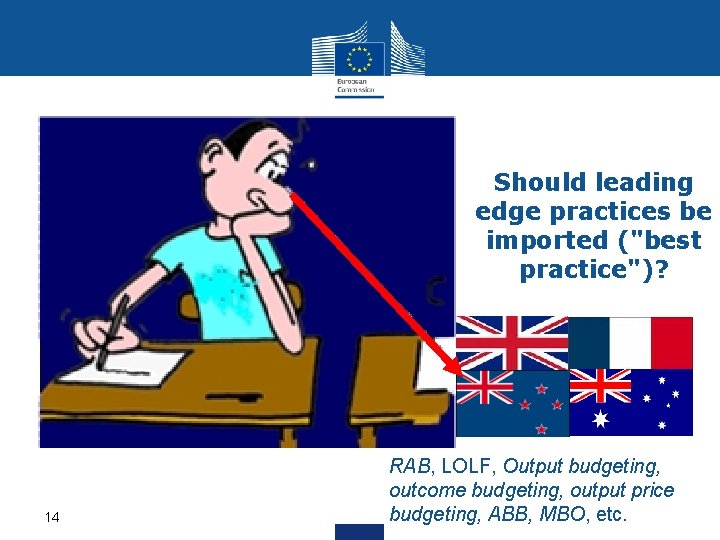
Should leading edge practices be imported ("best practice")? 14 RAB, LOLF, Output budgeting, outcome budgeting, output price budgeting, ABB, MBO, etc.
An imported product: NPM In the 90 s: New Public Management (NPM): focussed on greater performance & lightening of state apparatus Some instruments • Separation between decision-makers & managers contracts, public service contracts, etc. • Output-based budget & accrual accounting (commercial) • Autonomous agency reporting on results • Considerable administrative reorganisation • Manager granted greater flexibility in terms of resource management, then accountable for results • Competition • Public-private partnerships, concessions 15
Can NPM be copy/pasted from one country? Concerns in OECD countries • Risks re: dilution of responsibility, overly autonomous agencies • Lack of ethics & sense of public service • Too little assessment of results • Change required in administrative culture: can be major impediment in many countries • Inadequate for most DC (cf. Allen Schick ‘basics’) • Some aspects useful, depending on country context, • Semi-autonomous revenue agencies • public-private partnerships (But budgetary risks!) • Contractual approaches (if adapted to the country) 16
Can LOLF be copy/pasted from a country to another? (1) Advantages of applying LOLF in Africa: • This is relatively prudent compared to Anglo-Saxon ones, & offers opportunity of rationalising a currently heavy & inefficient control system • Organic laws inspired by LOLF create a framework in which to rationalise more or less disordered reforms: For e. g. , WAEMU reform could enable elimination of MTEF/multiannual programme budget duplication encountered in some Francophone countries 17
Can LOLF be copy/pasted from a country to another? (2) Risks in applying LOLF in African countries • Imposition of different systems emphasises bureaucratisation or/and generates conflicts • Administrative hierarchy vs programme management • Much fruitless paperwork • Unmanageable theoretical construction • Capacity problem 18
Other pitfalls • Promptness does not mean efficiency • Reform is a long-term, continuous process • Deadlines should not be too short & must take into account that similar reforms took years in more developed countries • Accumulation of micro-measures not = reform • ‘Reform fatigue’ may develop, or scepticism due to changing recommendations 19
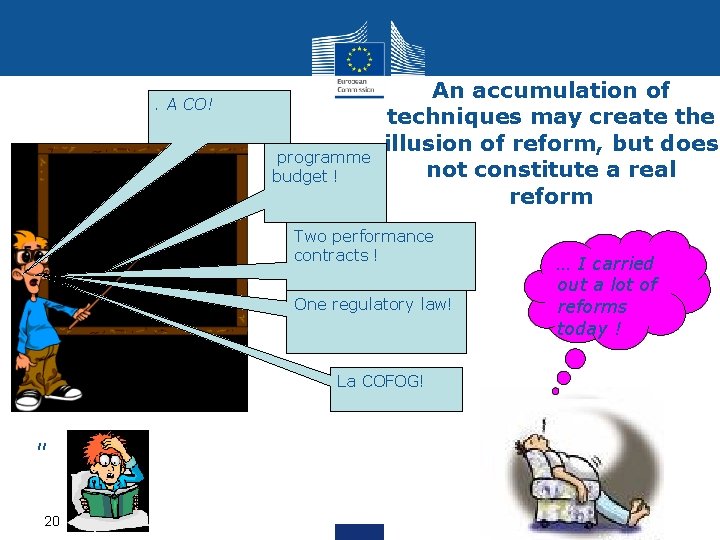
. A CO! programme budget ! An accumulation of techniques may create the illusion of reform, but does not constitute a real reform Two performance contracts ! One regulatory law! La COFOG! " 20 … I carried out a lot of reforms today !
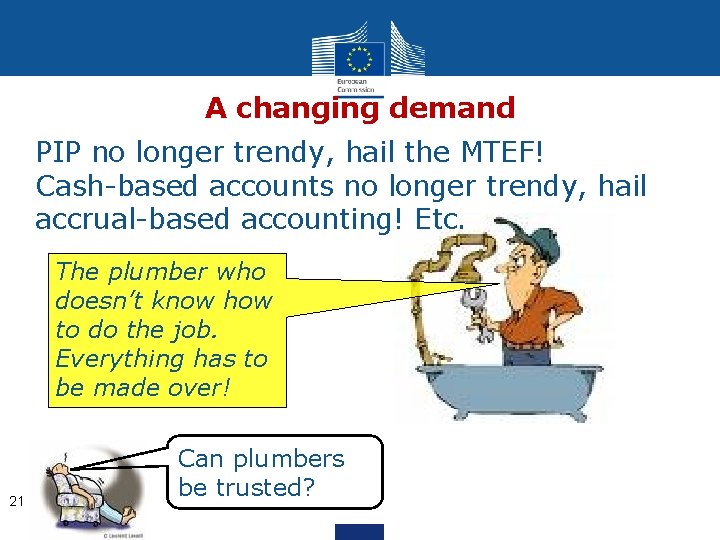
A changing demand PIP no longer trendy, hail the MTEF! Cash-based accounts no longer trendy, hail • accrual-based accounting! Etc. The plumber who doesn’t know how to do the job. Everything has to be made over! 21 Can plumbers be trusted?
Key messages • Success of a reform relies on strong national commitment & country’s capacity to respond to dissatisfaction with public finance management • Reforms must be adapted to country context: unlikely to be successful if mechanical copies of “best practices” 22