
Approaches to Homelessness and Mental Health in Occupational
- Slides: 1
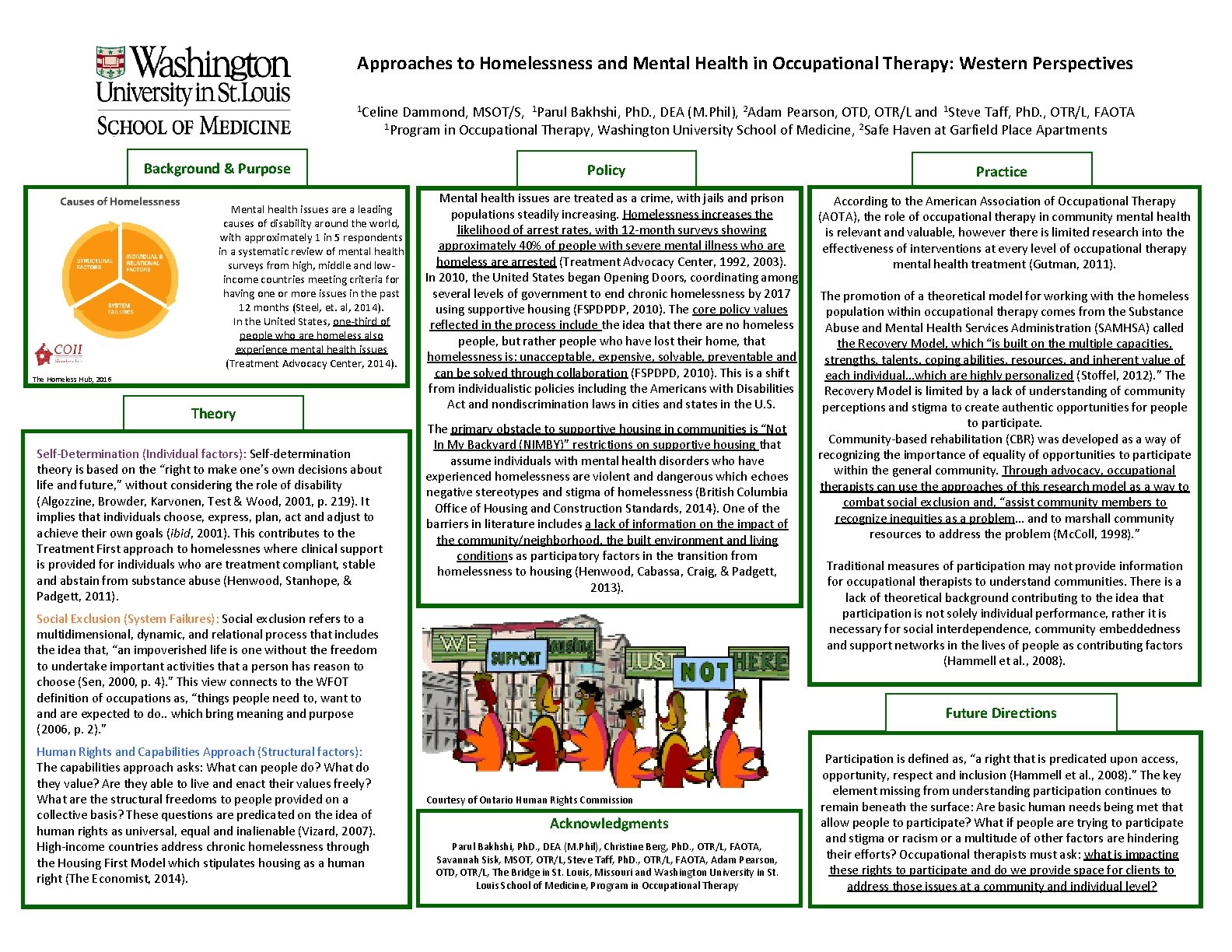
Approaches to Homelessness and Mental Health in Occupational Therapy: Western Perspectives 1 Celine Dammond, MSOT/S, 1 Parul Bakhshi, Ph. D. , DEA (M. Phil), 2 Adam Pearson, OTD, OTR/L and 1 Steve Taff, Ph. D. , OTR/L, FAOTA 1 Program in Occupational Therapy, Washington University School of Medicine, 2 Safe Haven at Garfield Place Apartments , Background & Purpose Mental health issues are a leading causes of disability around the world, with approximately 1 in 5 respondents in a systematic review of mental health surveys from high, middle and lowincome countries meeting criteria for having one or more issues in the past 12 months (Steel, et. al, 2014). In the United States, one-third of people who are homeless also experience mental health issues (Treatment Advocacy Center, 2014). The Homeless Hub, 2016 Theory Self-Determination (Individual factors): Self-determination theory is based on the “right to make one’s own decisions about life and future, ” without considering the role of disability (Algozzine, Browder, Karvonen, Test & Wood, 2001, p. 219). It implies that individuals choose, express, plan, act and adjust to achieve their own goals (ibid, 2001). This contributes to the Treatment First approach to homelessnes where clinical support is provided for individuals who are treatment compliant, stable and abstain from substance abuse (Henwood, Stanhope, & Padgett, 2011). Policy Mental health issues are treated as a crime, with jails and prison populations steadily increasing. Homelessness increases the likelihood of arrest rates, with 12 -month surveys showing approximately 40% of people with severe mental illness who are homeless are arrested (Treatment Advocacy Center, 1992, 2003). In 2010, the United States began Opening Doors, coordinating among several levels of government to end chronic homelessness by 2017 using supportive housing (FSPDPDP, 2010). The core policy values reflected in the process include the idea that there are no homeless people, but rather people who have lost their home, that homelessness is: unacceptable, expensive, solvable, preventable and can be solved through collaboration (FSPDPD, 2010). This is a shift from individualistic policies including the Americans with Disabilities Act and nondiscrimination laws in cities and states in the U. S. The primary obstacle to supportive housing in communities is “Not In My Backyard (NIMBY)” restrictions on supportive housing that assume individuals with mental health disorders who have experienced homelessness are violent and dangerous which echoes negative stereotypes and stigma of homelessness (British Columbia Office of Housing and Construction Standards, 2014). One of the barriers in literature includes a lack of information on the impact of the community/neighborhood, the built environment and living conditions as participatory factors in the transition from homelessness to housing (Henwood, Cabassa, Craig, & Padgett, 2013). Social Exclusion (System Failures): Social exclusion refers to a multidimensional, dynamic, and relational process that includes the idea that, “an impoverished life is one without the freedom to undertake important activities that a person has reason to choose (Sen, 2000, p. 4). ” This view connects to the WFOT definition of occupations as, “things people need to, want to and are expected to do. . which bring meaning and purpose (2006, p. 2). ” Human Rights and Capabilities Approach (Structural factors): The capabilities approach asks: What can people do? What do they value? Are they able to live and enact their values freely? What are the structural freedoms to people provided on a collective basis? These questions are predicated on the idea of human rights as universal, equal and inalienable (Vizard, 2007). High-income countries address chronic homelessness through the Housing First Model which stipulates housing as a human right (The Economist, 2014). Practice According to the American Association of Occupational Therapy (AOTA), the role of occupational therapy in community mental health is relevant and valuable, however there is limited research into the effectiveness of interventions at every level of occupational therapy mental health treatment (Gutman, 2011). The promotion of a theoretical model for working with the homeless population within occupational therapy comes from the Substance Abuse and Mental Health Services Administration (SAMHSA) called the Recovery Model, which “is built on the multiple capacities, strengths, talents, coping abilities, resources, and inherent value of each individual…which are highly personalized (Stoffel, 2012). ” The Recovery Model is limited by a lack of understanding of community perceptions and stigma to create authentic opportunities for people to participate. Community-based rehabilitation (CBR) was developed as a way of recognizing the importance of equality of opportunities to participate within the general community. Through advocacy, occupational therapists can use the approaches of this research model as a way to combat social exclusion and, “assist community members to recognize inequities as a problem… and to marshall community resources to address the problem (Mc. Coll, 1998). ” Traditional measures of participation may not provide information for occupational therapists to understand communities. There is a lack of theoretical background contributing to the idea that participation is not solely individual performance, rather it is necessary for social interdependence, community embeddedness and support networks in the lives of people as contributing factors (Hammell et al. , 2008). Future Directions Courtesy of Ontario Human Rights Commission Acknowledgments Parul Bakhshi, Ph. D. , DEA (M. Phil), Christine Berg, Ph. D. , OTR/L, FAOTA, Savannah Sisk, MSOT, OTR/L, Steve Taff, Ph. D. , OTR/L, FAOTA, Adam Pearson, OTD, OTR/L, The Bridge in St. Louis, Missouri and Washington University in St. Louis School of Medicine, Program in Occupational Therapy Participation is defined as, “a right that is predicated upon access, opportunity, respect and inclusion (Hammell et al. , 2008). ” The key element missing from understanding participation continues to remain beneath the surface: Are basic human needs being met that allow people to participate? What if people are trying to participate and stigma or racism or a multitude of other factors are hindering their efforts? Occupational therapists must ask: what is impacting these rights to participate and do we provide space for clients to address those issues at a community and individual level?