
APPROACHES TO ENVIRONMEN TAL EDUCATION Environmentalism Original history



- Slides: 52
APPROACHES TO ENVIRONMEN TAL EDUCATION
Environmentalism ØOriginal/ history ØMeaning ØSupporters ØCriticism
History/origin of environmentalism • A concern for environmental protection has occurred in diverse forms, in different parts of the world, throughout history. Example origin of Environmentalism in USA during the dust bowl period. • In late 1960 s and early 1970 s many events such as Civil Rights, the Vietnam War, and the Cold War – placed Americans at odds with one another and the U. S. government.
• Many people began to fear the fallout from bombs and other radiations, the chemical pesticides , and the significant amounts of air pollution and waste. • The public’s concern for their health and the health of their natural environment led to a unifying phenomenon known as environmentalism.
MEANING OF ENVIRONMENTALISM • Environmentalism is a broad philosophy, ideology and social movement regarding concerns for environmental conservation and improvement of the health of the environment, Gipson (2003). • Environmentalism is a movement to control pollution (Merriam-website 201206 -20).
• For this reason, concepts such as a land ethic, environmental ethics, biodiversity, and ecology are predominant. • Environmentalism is a social movement that seeks to influence the political process by lobbying/influencing, activism, and education in order to protect natural resources and ecosystems.
SUPPORTERS OF ENVIRONMENTALISM • Free market environmentalism Is a theory that argues that the free market, property rights, and tort law provide the best tools to preserve the health and sustainability of the environment? It considers environment to be in its natural way as a property right of every one, as well as the expulsion of polluters and other aggressors through individual and class action.
• For markets to work in the environmental field, as in any other, each important resource must be clearly defined easily defended against invasion , and divestible (transferable) by owners on terms agreeable to buyer and seller. Well-functioning markets, in short, require “ 3 -D” property rights. • When the first two are present—clear definition and easy defense of one’s rights—no one is forced to accept pollution beyond the standard acceptable to the community.
Evangelical environmentalism • It has focus of addressing climate action from a biblically grounded or theological perspective. • Argues that human-induced climate change will have severe consequences and impact the poor. • God's mandate to Adam was to care for the Garden of Eden. • It is therefore a moral obligation to work to mitigate climate impacts and support communities in adapting climate change.
(Conservation movement) • Is viewed as the setting aside of natural resources to prevent damage caused by contact with humans or by certain human activities, such as logging, mining, hunting, and fishing, often to replace them with new human activities such as tourism and recreation. • Regulations and laws may be enacted for the preservation of natural resources.
• As environmental concern grew, so did distrust of business institutions, which were seen to be the cause of environmental problems such as air and water pollution. Governments worldwide responded with new forms of comprehensive environmental legislation aimed at regulating and constraining environmentally damaging business activities.
ENVIRONMENTALISM • Environmentalists typically believe that human interference with 'nature' should be restricted or minimized as a matter of urgency (for the sake of life, or the planet, or just for the benefit of the human species). Both environmental skeptics and anti-environmentalists do not believe that there is such a need.
Environmental skepticism • Is the belief that claims by environmentalists, and the environmental scientists who support them, are false or exaggerated. • Environmental skeptics have argued that the extent of harm coming from human activities is less certain than some scientists and scientific bodies claim (Environmentalists). • One of the focus themes in the environmental skeptics movement is the idea that environmentalism is a growing threat to social and economic progress and the civil liberties.
• The popularity of the term was enhanced by Bjørn Lomborg's book The Skeptical Environmentalist (2004). ( Statistician economist) • He summarized his position, saying "Global warming is real - it is man-made and it is an important problem. But it is not the end of the world. " • They argue that it is too soon to be introducing complains in human economic (Industrial) activities on the basis of existing evidence, or that further discussion is needed regarding who should pay for such environmental initiatives. (Escapism)
Anti-environmentalists/Green Backlash • On the other hand, accept many of the claims made by environmentalists while simultaneously accepting that change is inevitable (impossible to avoid or to prevent from happening) regardless of cause and speed. • They do not deny the impact of humanity, but they dispute/disagree the argument that humanity can kill the planet, citing life's several billion year history as evidence that it is more resilient than many environmentalists realize.
• Anti-environmentalism has been a response to the rise of environmental consciousness and awareness first in the late 1960 s and early 1970. It is a backlash against the success of environmentalists in raising public concern and pressuring governments to protect the environment.
ENVIRONMENTALISM • There are two approaches/philosophical thoughts which Environmentalists illuminate to environmental improvement and means to achieve it. • These are: qshallow and q deep ecology
Shallow Ecology • a) This view is completely self / human centered view. • Shallow ecology wants to save the world, but only for us. Examples; • It wants us to preserve the rainforests so our children can enjoy them or because we need the oxygen from the trees. Save the ecosystems, but only if they are of value to us. Some day we might want or need them.
• Shallow ecology participates in that myth which puts man as a king of the world, somebody who needs to conquer and master the environment. • b) It looks on the outcomes of the environmental problems rather than the cause and find the solutions basing on these outcomes. Examples; • -landfills are problems, so let’s recycle instead, • -depending on oil is a problem so let’s drive electric cars instead. • - buy energy saving light bulbs, don't use plastic bags, plant trees, the list goes on.
• None of these programs questions the fundamental beliefs of our culture and how our society is operating. • No environmentalist can prevent destruction if a culture believes the world belongs to him/her by right.
• c) Shallow ecology consider human and nature are different and that human dominate the world around them. • It does not consider the interaction between living and non living world to let the earth as an ecosystem to function well.
DEEP ECOLOGY • Deep Ecology is about changing minds. Every action is the result of a prior thought. Change a mind, you change the outcome. • It involves culture, human societies, individuals, and values, life styles to emphasize respect and cooperation with nature. • It looks to non-humans for advice on how to participate in an ecosystem without destroying it and seeks to implement that advice by the modification of culture.
• Deep ecology argues that the natural world is made up of complex inter-relationships in which the existence of organisms is dependent on the existence of others within ecosystems. Example • - Animals depend on plants to get their food, plants depend on animals to make their food through the photosynthesis, and plants again depend on microorganisms to get minerals / decomposition. Microorganisms depend on plants and animals to get their food.
• Human interference with or destruction of the natural world lead to a threat not only to humans but to all organisms constituting the natural order. • Deep ecology's core principle is the belief that the living environment as a whole should be respected and regarded as having certain legal rights to live and flourish. • It describes itself as "deep" because it regards itself as looking more deeply into the actual reality of humanity's relationship with the natural world.
• In contrast to the shallow ecology which is concerned with conservation of the environment only for exploitation by and for human purposes; deep ecology takes a more holistic view of the world human beings live in and seeks to understand the non human parts of the earth ecosystem. • Deep ecology is a part of green movement/environmentalism movement and it supports the Gaia hypothesis/theory (By James Lovelock 1960 s) which states that; • “The earth is like single super living organism in which living organisms interact with the non living organisms to form a self-regulating, complex system”
• The system includes the nearsurface rocks and atmosphere. In particular, it regulates the chemistry of the oceans, composition of the atmosphere and surface temperature comfortable for living organisms.
Temperature: • there has been a 25% increase in heat from the sun since life began but surface temperature has remained approximately constant.
Atmosphere: • the present highly unstable mixture of reactive gases (79% nitrogen, 20. 7% oxygen, 0. 03% carbon dioxide with traces of methane and other gases) could not be maintained without constant replacement or removal by the biota
Ocean salinity: • has been maintained at about 3. 4% for billions of years. Cells cannot tolerate salt concentrations much above 5%. Salinity is at least partly controlled by evaporate beds/lagoons where marine life causes limestone deposits, later buried.
QUIZ 5 MINUTES • Highlight the 12 principles of Environmental Education
Technocentrism • Means values centered in Technology • Also called shallow ecology or human centered ecology. • Has a strong belief that humans have control over nature and that through technology and industrial advancement have the ability to control and protect the environment.
• Although technocentrics may accept that environmental problems exist, they do not see them as problems to be solved by a reduction in industry. • Rather, environmental problems are seen as problems to be solved using science and technology. • Technocentrics see the way forward for both developed and developing countries, and the solutions to environmental problems, as lying in scientific and technological advancement.
Ecocentrism • Means value centre in ecology (Deep Ecology) • Regard themselves as being subject to nature, rather than in control of it. • They lack faith in modern technology and the bureaucracy attached to it • Argue that the natural world should be respected for its processes and products, and that low impact technology and selfsufficiency is more desirable than technological control of nature.
Approaches toward environmental Reforms • The challenges facing society today is to arrive at a consensus of options through a global discussion about what is best not only for humans but also what is best for the rest of nature as well. • As a result there ideas lead to different principles/approaches through which environmental reform can be adapted as follows. q. Conservation reform q. Radical reforms
Conservation Reform • They talk on two major themes; a) Technical approach It believes that scientific a technological expertise can provide the basis for solving quality of life resources without the need for social and economic changes.
b) Political approach • Involve working within the present political system to reduce the impact of human activity on the environment. • These reformers foresee a need for improving legal, political, economic and technological decision making but without addressing the structure of the social and economic institutions. • Typical concerns are the preservation of open space and wilderness areas and the understanding of miserable development projects.
Radical reforms a) Socially critical approach • It treats environmental crisis as symptoms of a larger problem in the society • Regard major economic re-organization as the only way to rectify violations of both environmental quality and social justice. • Most Marxists and Neo-Marxists attribute the problem to capitalism (private ownership of production) while others point out equality serious nature of environmental destruction in the socialist countries. • This disagreement on the means of reforms tends to be accompanied by a lack of clear vision of an alternative economic and political system.
• b) Alternative approach • Rejects traditional reforms of society and advocates a virtually pre-industrial life style involving a close relationship with nature in a small self sufficient (usual rural) communities.
The Gaia Principle/Hypothesis (Now Gaia Theory) • Proposed by James Lovelock in 1979 • The idea of the Earth as a single living super organism • With all its biological, geological, chemical and hydrological processes acting in concert, to regulate the planet and ensure its survival through an exquisite array of feedback loops. • An example of a Gaia feedback loop is the relationship between plants and carbon dioxide
GAIA HYPOTHESIS • “The earth is like single super living organism in which living organisms interact with the non living organisms to form a selfregulating, complex system”
Main Idea • In that same year, Lovelock began to think that such an unlikely combination of gases such as the Earth had, indicated a homeostatic control of the Earth biosphere to maintain environmental conditions conducive for life, in a sort of cybernetic feedback loop, an active (but non-teleological) control system.
Example: ATMOSPHERE • "Life, or the biosphere, regulates or maintains the climate and the atmospheric composition at an optimum for itself. “ • Loveland states that our atmosphere can be considered to be “like the fur of a cat and shell of a snail, not living but made by living cells so as to protect them against the environment.
• Inherent in this explanation is the idea that biosphere, the atmosphere, the lithosphere and the hydrosphere are in some kind of balance -- that they maintain a homeostatic condition. • This homeostasis is much like the internal maintenance of our own bodies; processes within our body insure a constant temperature, blood p. H, electrochemical balance, etc.
• The inner workings of Gaia, therefore, can be viewed as a study of the physiology of the Earth, where the oceans and rivers are the Earth's blood, the atmosphere is the Earth's lungs, the land is the Earth's bones, and the living organisms are the Earth's senses. • Lovelock calls this the science of geophysiology - the physiology of the Earth (or any other planet).
GAIAN ATTRIBUTES • Earth is a super-organism • Biota and physical environment are so tightly coupled they are considered a single organism. • The climate and chemical composition of Earth are kept in homeostatic at an optimum by and for the biosphere. • Recognizes emergent properties.
Examples of GAIAN PROCESSES • Oxygen • Air temperature • Salinity • Atmospheric carbon dioxide
SUMMARY • Biological agents play a vital role in creating Earth’s physical and chemical environment • Gaia suggests processes which are testable by which biota help maintain earth’s climate • Emphasizes interdisciplinary work • Colorful, engaging metaphor • Hypotheses are ill-defined, not falsifiable
CRITICISMS OF THE GAIA PRINCIPLE • After initially being largely ignored by most scientists, (from 1969 until 1977), thereafter for a period, the initial Gaia hypothesis was ridiculed by a number of scientists, such as Ford Doolittle, Richard Dawkins and Stephen Jay Gould a. The Gaia hypothesis was derided as some kind of neo-Pagan New Age religion ( mainly after being named Gaia a Greek goddess
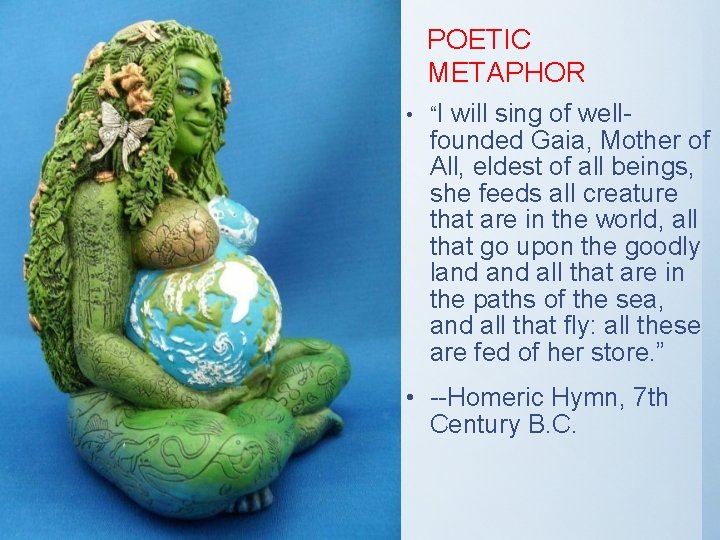
POETIC METAPHOR • “I will sing of well- founded Gaia, Mother of All, eldest of all beings, she feeds all creature that are in the world, all that go upon the goodly land all that are in the paths of the sea, and all that fly: all these are fed of her store. ” • --Homeric Hymn, 7 th Century B. C.
b. The approach taken in his popular book "Gaia, a New look at Life on Earth“ is criticized for being teleological; (a belief that all things have a predetermined purpose) c. Gaia is criticized as merely a metaphorical description of Earth processes as the actual mechanisms by which self-regulating homeostasis was regulated was not known d. The theory does not recognize crucial intermediate positions like volcanic eruption which can lead to same landscapes to disappear and others to be formed.
"I'm a generally practitioner in a world where there's nothing but specialists. . . ” Lovelock