
Approaches to bounding the exponent of matrix multiplication
Approaches to bounding the exponent of matrix multiplication Chris Umans Caltech Based on joint work with Noga Alon, Henry Cohn, Bobby Kleinberg, Amir Shpilka, Balazs Szegedy Simons Institute Nov. 12, 2014
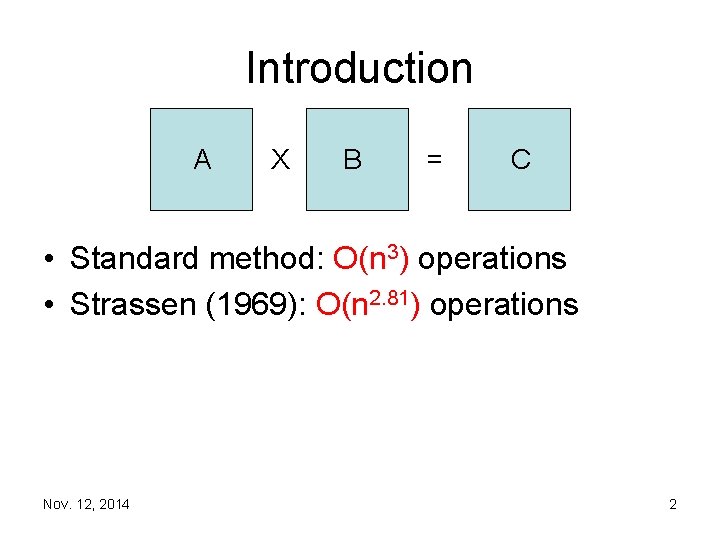
Introduction A X B = C • Standard method: O(n 3) operations • Strassen (1969): O(n 2. 81) operations Nov. 12, 2014 2
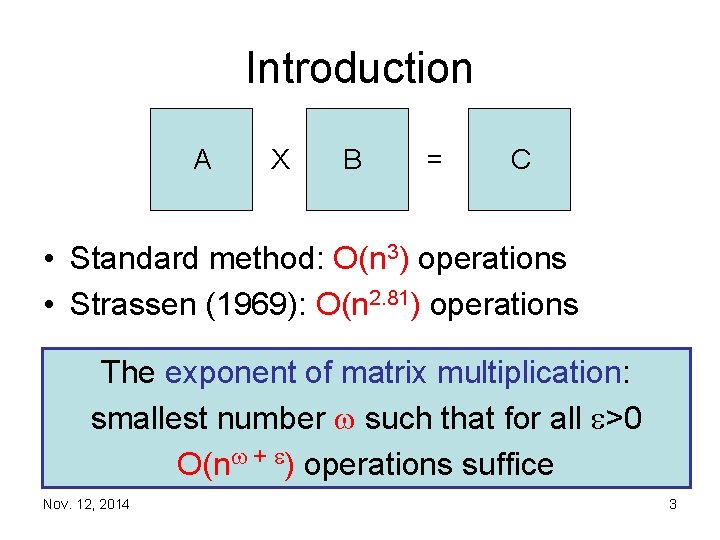
Introduction A X B = C • Standard method: O(n 3) operations • Strassen (1969): O(n 2. 81) operations The exponent of matrix multiplication: smallest number such that for all >0 O(n + ) operations suffice Nov. 12, 2014 3
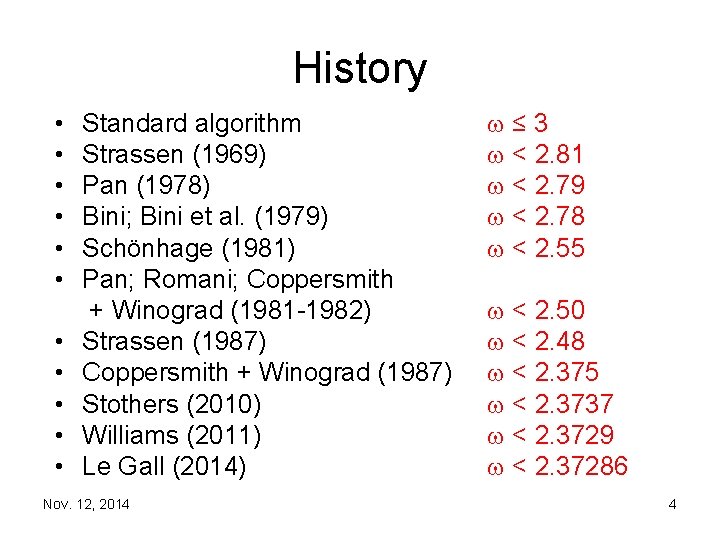
History • • • Standard algorithm Strassen (1969) Pan (1978) Bini; Bini et al. (1979) Schönhage (1981) Pan; Romani; Coppersmith + Winograd (1981 1982) Strassen (1987) Coppersmith + Winograd (1987) Stothers (2010) Williams (2011) Le Gall (2014) Nov. 12, 2014 ≤ 3 < 2. 81 < 2. 79 < 2. 78 < 2. 55 < 2. 50 < 2. 48 < 2. 375 < 2. 3737 < 2. 3729 < 2. 37286 4
Outline 1. main ideas from Strassen 1969 through Le Gall 2014 2. approach via embedding into semi simple algebra multiplication – – groups coherent configurations/association schemes Nov. 12, 2014 5
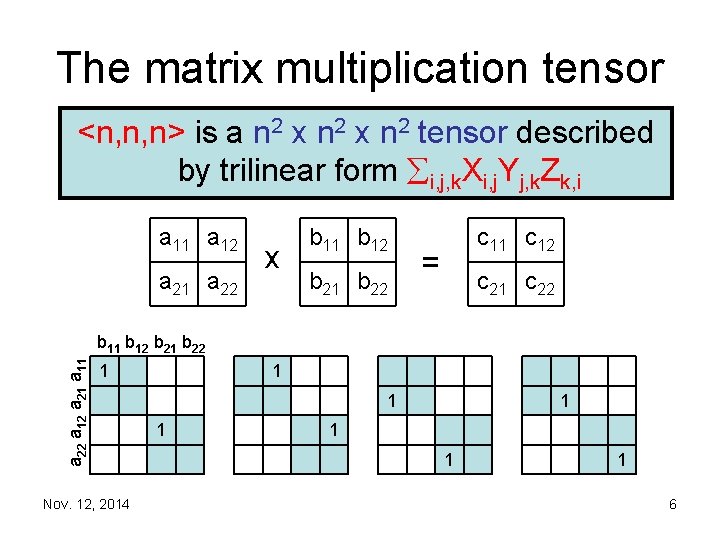
The matrix multiplication tensor <n, n, n> is a n 2 x n 2 tensor described by trilinear form i, j, k. Xi, j. Yj, k. Zk, i a 11 a 12 a 21 a 22 x b 11 b 12 b 21 b 22 c 11 c 12 = c 21 c 22 a 12 a 21 a 11 b 12 b 21 b 22 1 Nov. 12, 2014 1 1 1 1 6
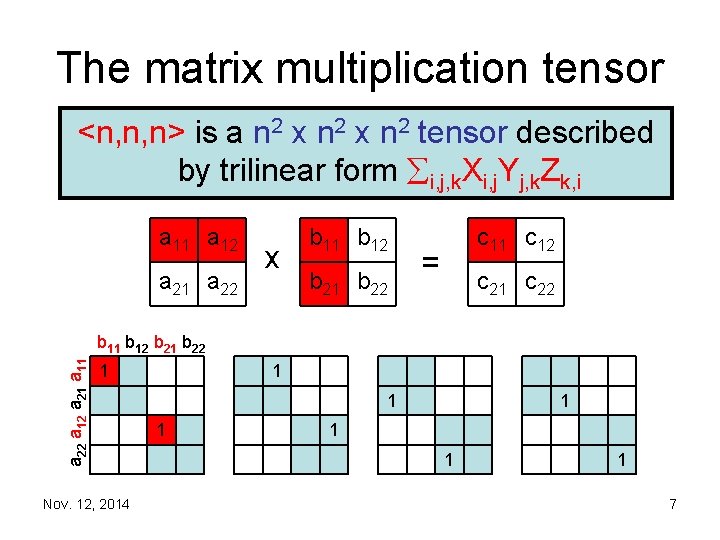
The matrix multiplication tensor <n, n, n> is a n 2 x n 2 tensor described by trilinear form i, j, k. Xi, j. Yj, k. Zk, i a 11 a 12 a 21 a 22 x b 11 b 12 b 21 b 22 c 11 c 12 = c 21 c 22 a 12 a 21 a 11 b 12 b 21 b 22 1 Nov. 12, 2014 1 1 1 1 7
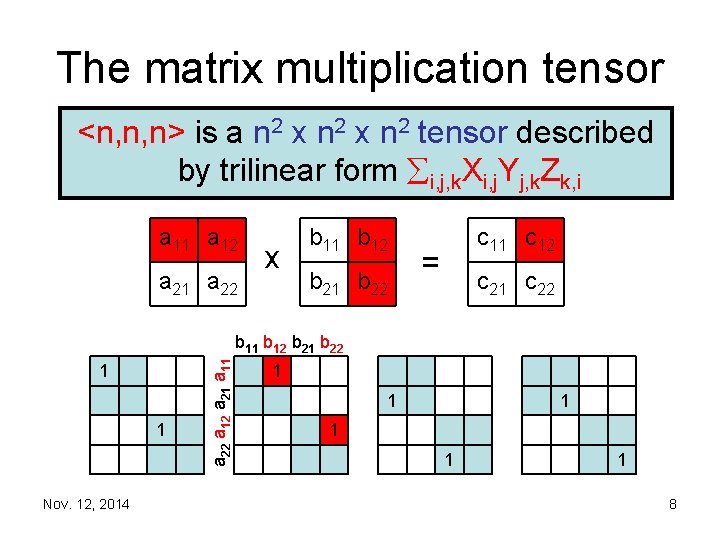
The matrix multiplication tensor <n, n, n> is a n 2 x n 2 tensor described by trilinear form i, j, k. Xi, j. Yj, k. Zk, i a 11 a 12 a 21 a 22 x b 11 b 12 b 21 b 22 c 11 c 12 = c 21 c 22 1 1 Nov. 12, 2014 a 22 a 12 a 21 a 11 b 12 b 21 b 22 1 1 1 8
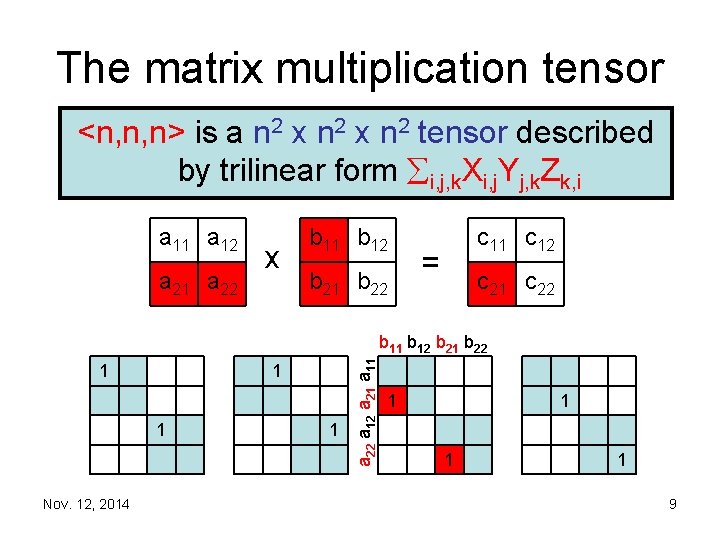
The matrix multiplication tensor <n, n, n> is a n 2 x n 2 tensor described by trilinear form i, j, k. Xi, j. Yj, k. Zk, i a 11 a 12 a 21 a 22 x b 11 b 12 b 21 b 22 c 11 c 12 = c 21 c 22 1 1 1 Nov. 12, 2014 1 a 22 a 12 a 21 a 11 b 12 b 21 b 22 1 1 9
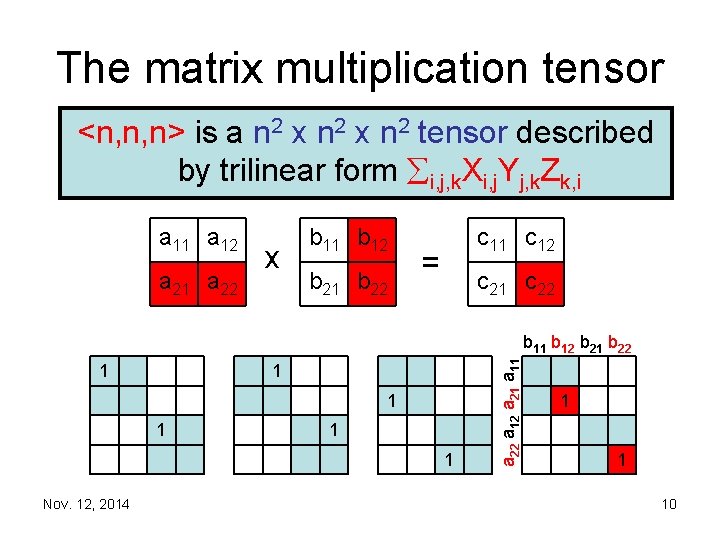
The matrix multiplication tensor <n, n, n> is a n 2 x n 2 tensor described by trilinear form i, j, k. Xi, j. Yj, k. Zk, i a 11 a 12 a 21 a 22 x b 11 b 12 b 21 b 22 c 11 c 12 = c 21 c 22 1 1 1 Nov. 12, 2014 a 22 a 12 a 21 a 11 b 12 b 21 b 22 1 1 10
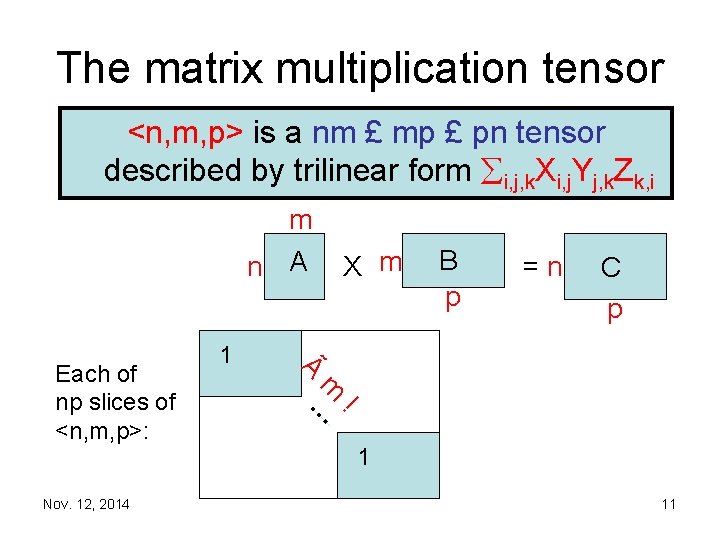
The matrix multiplication tensor <n, m, p> is a nm £ mp £ pn tensor described by trilinear form i, j, k. Xi, j. Yj, k. Zk, i m X m n A C p m ! Nov. 12, 2014 =n à Each of np slices of <n, m, p>: 1 B p 1 11
Strategies for upper bounding the rank of the matrix multiplication tensor Nov. 12, 2014 12
Upper bounds on rank • Observation: <n, n, n> i = <ni, ni> ) R(<ni, ni>) · R(<n, n, n>)i • Strategy I: bound rank for small n by hand – R(<2, 2, 2>) = 7 – R(<3, 3, 3>) 2 [19. . 23] ! < 2. 81 (worse bound) – even computer search infeasible… Nov. 12, 2014 13
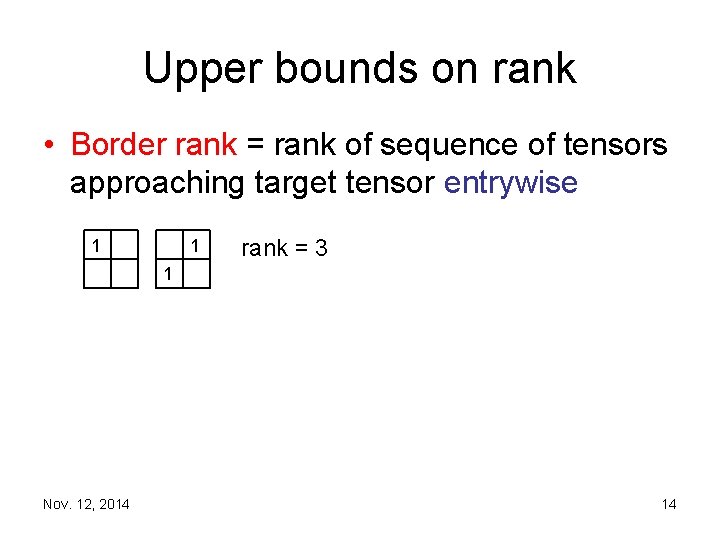
Upper bounds on rank • Border rank = rank of sequence of tensors approaching target tensor entrywise 1 1 rank = 3 1 Nov. 12, 2014 14
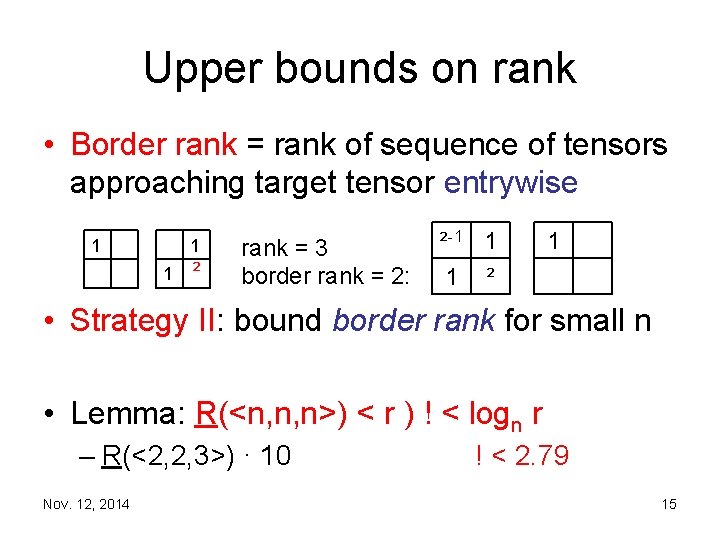
Upper bounds on rank • Border rank = rank of sequence of tensors approaching target tensor entrywise 1 1 1 ² rank = 3 border rank = 2: ² 1 1 1 ² 1 • Strategy II: bound border rank for small n • Lemma: R(<n, n, n>) < r ) ! < logn r – R(<2, 2, 3>) · 10 Nov. 12, 2014 ! < 2. 79 15
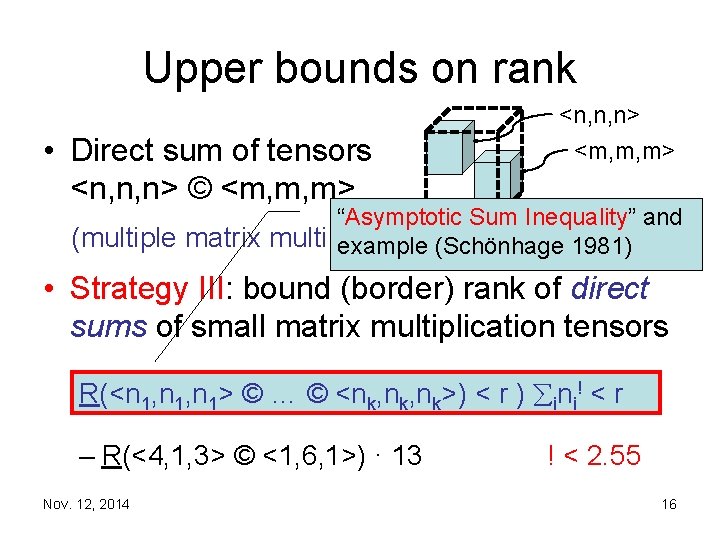
Upper bounds on rank <n, n, n> • Direct sum of tensors <n, n, n> © <m, m, m> “Asymptotic Sum Inequality” and (multiple matrix multiplications in parallel)1981) example (Schönhage • Strategy III: bound (border) rank of direct sums of small matrix multiplication tensors R(<n 1, n 1> © … © <nk, nk>) < r ) ini! < r – R(<4, 1, 3> © <1, 6, 1>) · 13 Nov. 12, 2014 ! < 2. 55 16
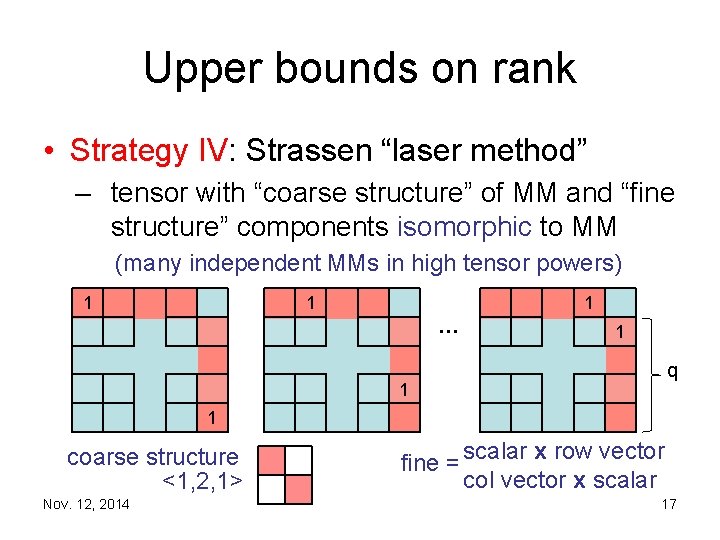
Upper bounds on rank • Strategy IV: Strassen “laser method” – tensor with “coarse structure” of MM and “fine structure” components isomorphic to MM (many independent MMs in high tensor powers) 1 1 1 … 1 q 1 1 coarse structure <1, 2, 1> Nov. 12, 2014 fine = scalar x row vector col vector x scalar 17
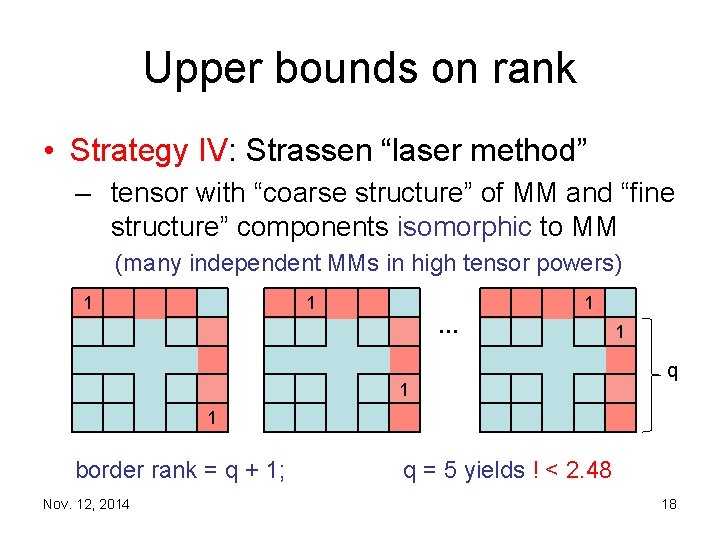
Upper bounds on rank • Strategy IV: Strassen “laser method” – tensor with “coarse structure” of MM and “fine structure” components isomorphic to MM (many independent MMs in high tensor powers) 1 1 1 … 1 1 q 1 border rank = q + 1; Nov. 12, 2014 q = 5 yields ! < 2. 48 18
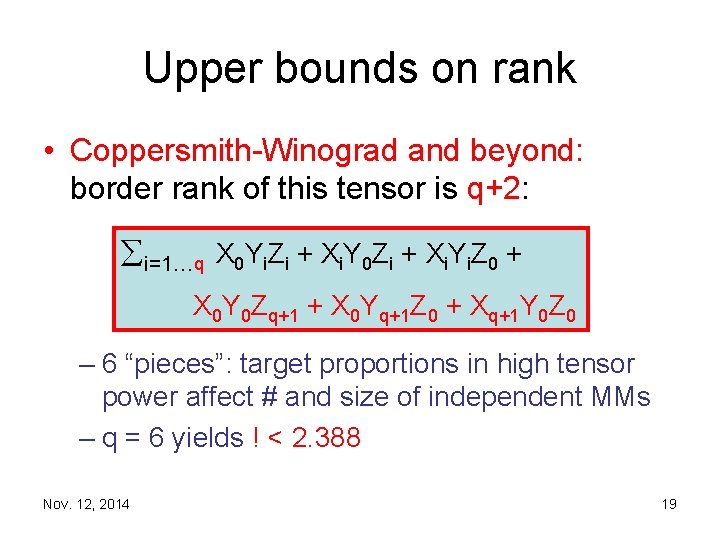
Upper bounds on rank • Coppersmith Winograd and beyond: border rank of this tensor is q+2: i=1…q X 0 Yi. Zi + Xi. Y 0 Zi + Xi. Yi. Z 0 + X 0 Y 0 Zq+1 + X 0 Yq+1 Z 0 + Xq+1 Y 0 Z 0 – 6 “pieces”: target proportions in high tensor power affect # and size of independent MMs – q = 6 yields ! < 2. 388 Nov. 12, 2014 19
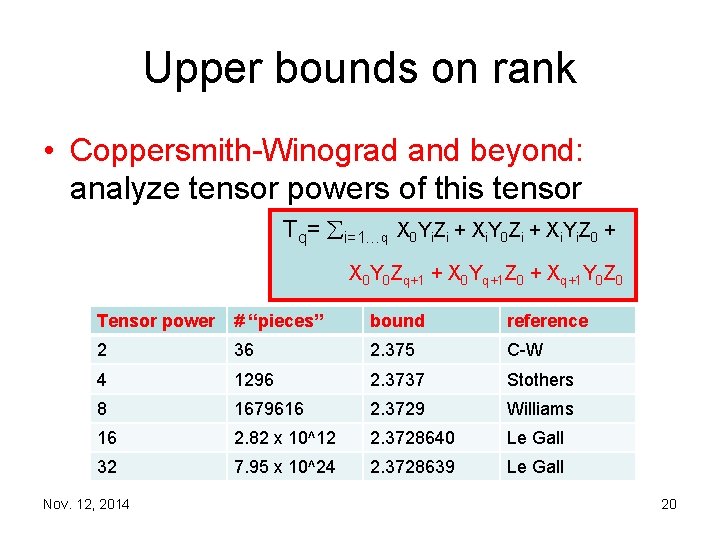
Upper bounds on rank • Coppersmith Winograd and beyond: analyze tensor powers of this tensor Tq= i=1…q X 0 Yi. Zi + Xi. Y 0 Zi + Xi. Yi. Z 0 + X 0 Y 0 Zq+1 + X 0 Yq+1 Z 0 + Xq+1 Y 0 Z 0 Tensor power # “pieces” bound reference 2 36 2. 375 C W 4 1296 2. 3737 Stothers 8 1679616 2. 3729 Williams 16 2. 82 x 10^12 2. 3728640 Le Gall 32 7. 95 x 10^24 2. 3728639 Le Gall Nov. 12, 2014 20
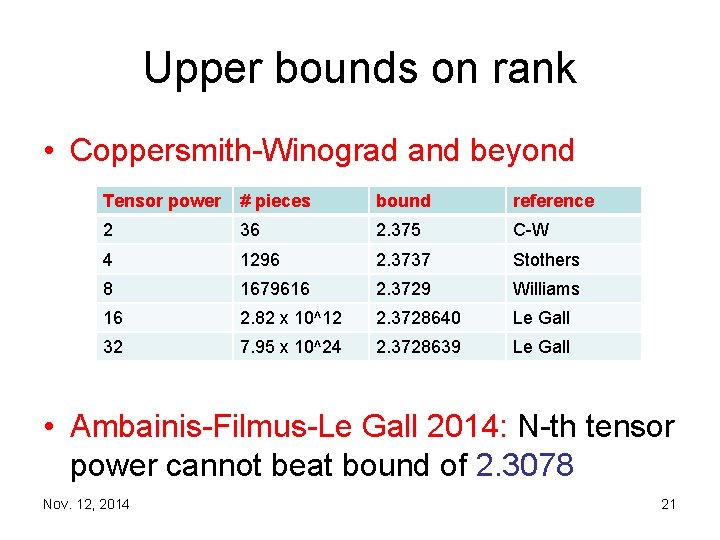
Upper bounds on rank • Coppersmith Winograd and beyond Tensor power # pieces bound reference 2 36 2. 375 C W 4 1296 2. 3737 Stothers 8 1679616 2. 3729 Williams 16 2. 82 x 10^12 2. 3728640 Le Gall 32 7. 95 x 10^24 2. 3728639 Le Gall • Ambainis Filmus Le Gall 2014: N th tensor power cannot beat bound of 2. 3078 Nov. 12, 2014 21
![“Asymptotic Rank” conjecture [CW 90] T = i=1, 2 X 0 Yi. Zi +](http://slidetodoc.com/presentation_image_h2/bb398f30c26baf256df854bf59097109/image-22.jpg "“Asymptotic Rank” conjecture [CW 90] T = i=1, 2 X 0 Yi. Zi +")
“Asymptotic Rank” conjecture [CW 90] T = i=1, 2 X 0 Yi. Zi + Xi. Y 0 Zi + Xi. Yi. Z 0 T slices 1 1 1 – border rank = 4 – asymptotic rank of T = lim n ! 1 R(T n)1/n conjecture: asymptotic rank of T is 3 Nov. 12, 2014 22
![Strong Uniquely Solvable Puzzle Conjecture [CKSU 05] T T’ 1 1 rank = 4](http://slidetodoc.com/presentation_image_h2/bb398f30c26baf256df854bf59097109/image-23.jpg "Strong Uniquely Solvable Puzzle Conjecture [CKSU 05] T T’ 1 1 rank = 4")
Strong Uniquely Solvable Puzzle Conjecture [CKSU 05] T T’ 1 1 rank = 4 1 1 1 rank = 3 1 1 1 Strong Uniquely Solvable Puzzle: gives a way to zero out variables leaving many independent MMs in high tensor power of T’ (instead of T) Nov. 12, 2014 23
![Strong Uniquely Solvable Puzzle Conjecture [CKSU 05] Uniquely Solvable Puzzle: every unintended way of](http://slidetodoc.com/presentation_image_h2/bb398f30c26baf256df854bf59097109/image-24.jpg "Strong Uniquely Solvable Puzzle Conjecture [CKSU 05] Uniquely Solvable Puzzle: every unintended way of")
Strong Uniquely Solvable Puzzle Conjecture [CKSU 05] Uniquely Solvable Puzzle: every unintended way of assembling pieces has overlap of 2 or 3 in some cell Strong Uniquely Solvable Puzzle: every unintended way of assembling pieces has overlap of exactly 2 in some cell 0 0 1 1 1 2 0 1 2 1 0 1 1 1 2 2 1 0 0 2 1 1 1 0 1 2 1 1 0 2 2 1 Ãw! N rows conjecture: Strong USPs exist with N = (w choose w/3)1 o(1) rows
(fortune from fortune cookie at dinner Sunday)
A different approach • So far. . . – bound border rank of small tensor (by hand) – asymptotic bound from high tensor powers • Disadvantages – limited universe of “starting” tensors – high tensor powers hard to analyze Nov. 12, 2014 26
matrix multiplication via groups and coherent configurations / association schemes Nov. 12, 2014 27
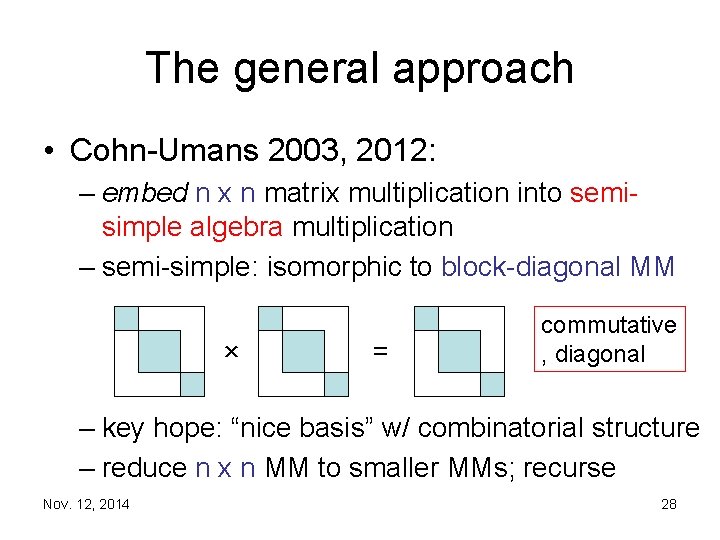
The general approach • Cohn Umans 2003, 2012: – embed n x n matrix multiplication into semi simple algebra multiplication – semi simple: isomorphic to block diagonal MM × = commutative , diagonal – key hope: “nice basis” w/ combinatorial structure – reduce n x n MM to smaller MMs; recurse Nov. 12, 2014 28
![The Group Algebra • given finite group G, group algebra C[G] has elements Σg](http://slidetodoc.com/presentation_image_h2/bb398f30c26baf256df854bf59097109/image-29.jpg "The Group Algebra • given finite group G, group algebra C[G] has elements Σg")
The Group Algebra • given finite group G, group algebra C[G] has elements Σg agg with multiplication (Σgagg)(Σhbhh) = Σf (Σgh = f agbh)f • structure: C[G] ' (Cd 1×d 1) × … × (Cdk×dk) • group elements are “nice basis” Nov. 12, 2014 29
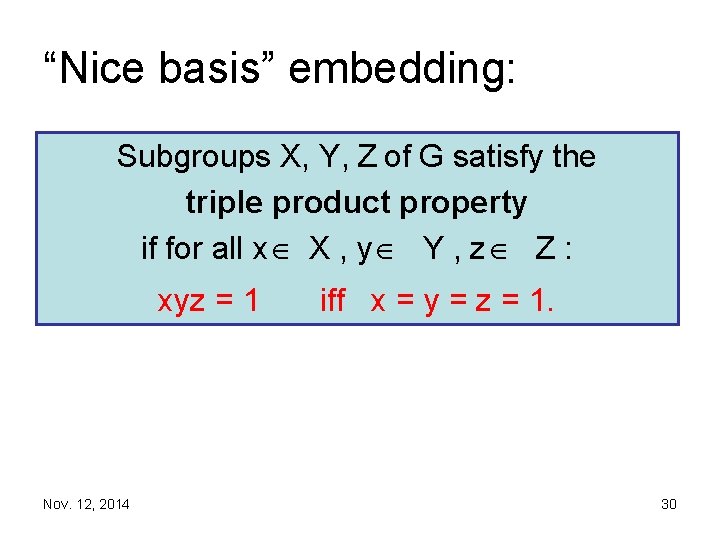
“Nice basis” embedding: Subgroups X, Y, Z of G satisfy the triple product property if for all x X , y Y , z Z : xyz = 1 Nov. 12, 2014 iff x = y = z = 1. 30
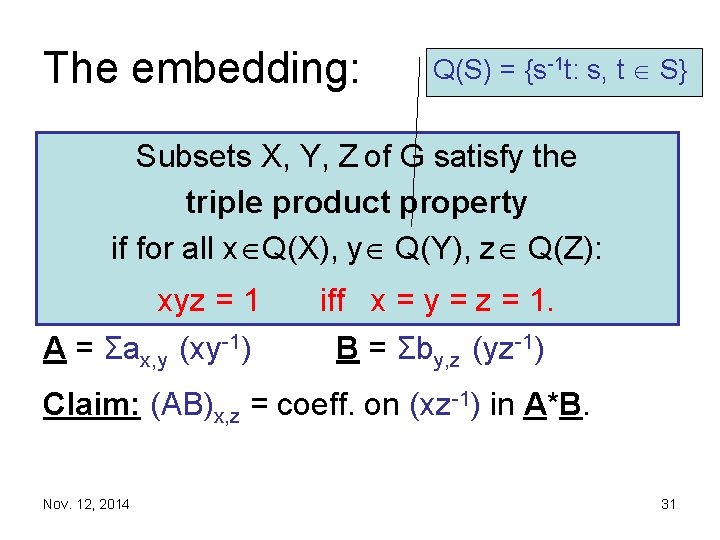
The embedding: Q(S) = {s 1 t: s, t S} Subsets X, Y, Z of G satisfy the triple product property if for all x Q(X), y Q(Y), z Q(Z): xyz = 1 A = Σax, y 1(xy 1) iff x = y = z = 1. B = Σby, z 2(yz 1) Claim: (AB)x, z = coeff. on (xz 1) in A*B. Nov. 12, 2014 31
![How many multiplications? Embedding + structure of C[G] yields bound on rank (´ #](http://slidetodoc.com/presentation_image_h2/bb398f30c26baf256df854bf59097109/image-32.jpg "How many multiplications? Embedding + structure of C[G] yields bound on rank (´ #")
How many multiplications? Embedding + structure of C[G] yields bound on rank (´ # multiplications): × • we use m ≤ Σdi 3 mults • really m = Σdi! mults • at least m ≥ Σdi 2 = |G| mults = First Challenge: embed k × k matrix multiplication in group of size ¼ k 2 Nov. 12, 2014 32
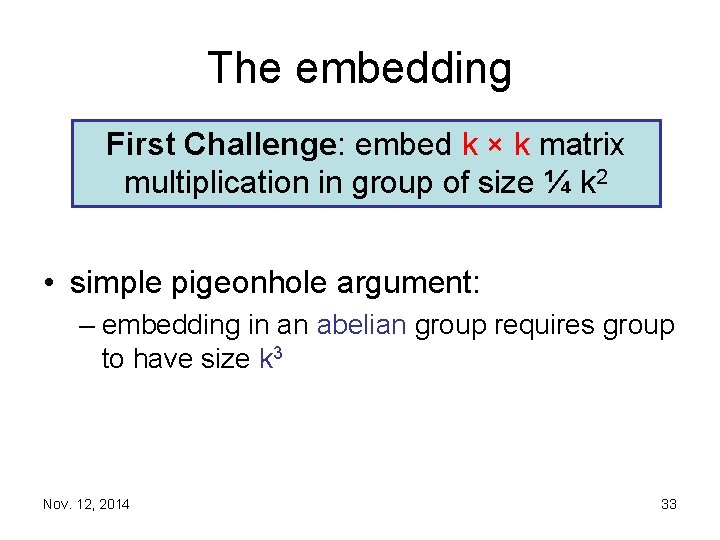
The embedding First Challenge: embed k × k matrix multiplication in group of size ¼ k 2 • simple pigeonhole argument: – embedding in an abelian group requires group to have size k 3 Nov. 12, 2014 33
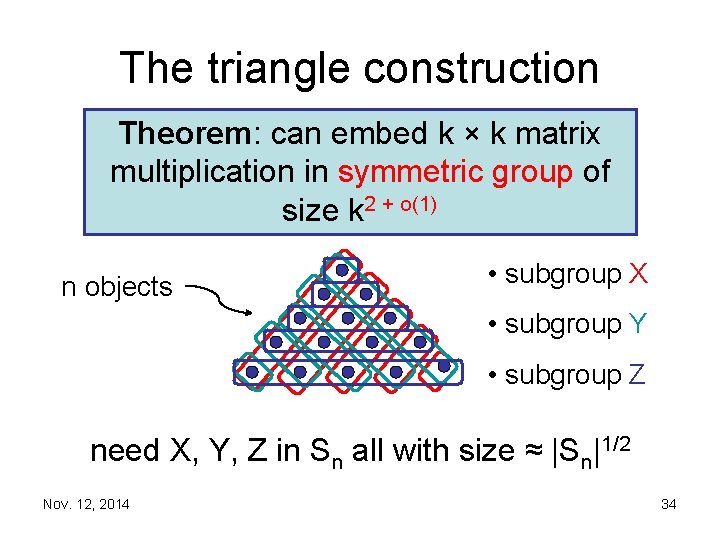
The triangle construction Theorem: can embed k × k matrix multiplication in symmetric group of size k 2 + o(1) n objects • subgroup X • subgroup Y • subgroup Z need X, Y, Z in Sn all with size ≈ |Sn|1/2 Nov. 12, 2014 34
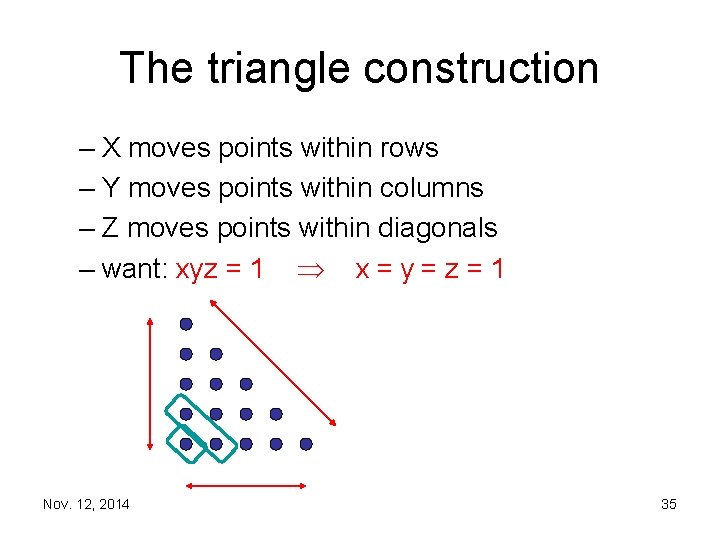
The triangle construction – X moves points within rows – Y moves points within columns – Z moves points within diagonals – want: xyz = 1 x = y = z = 1 Nov. 12, 2014 35
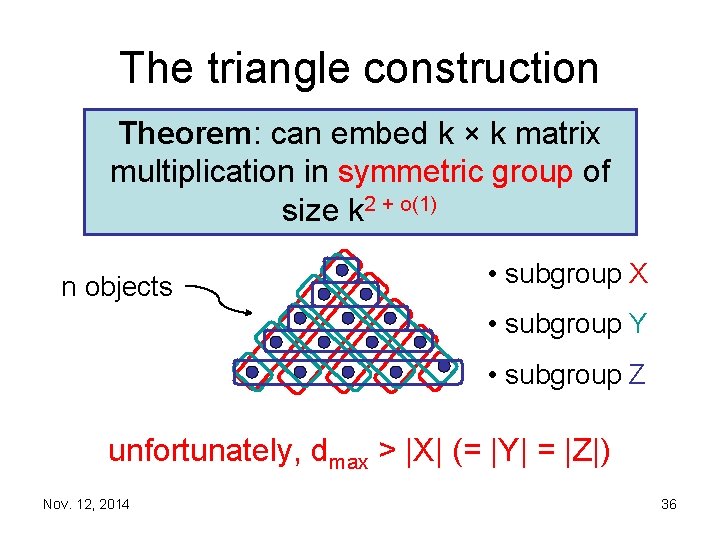
The triangle construction Theorem: can embed k × k matrix multiplication in symmetric group of size k 2 + o(1) n objects • subgroup X • subgroup Y • subgroup Z unfortunately, dmax > |X| (= |Y| = |Z|) Nov. 12, 2014 36
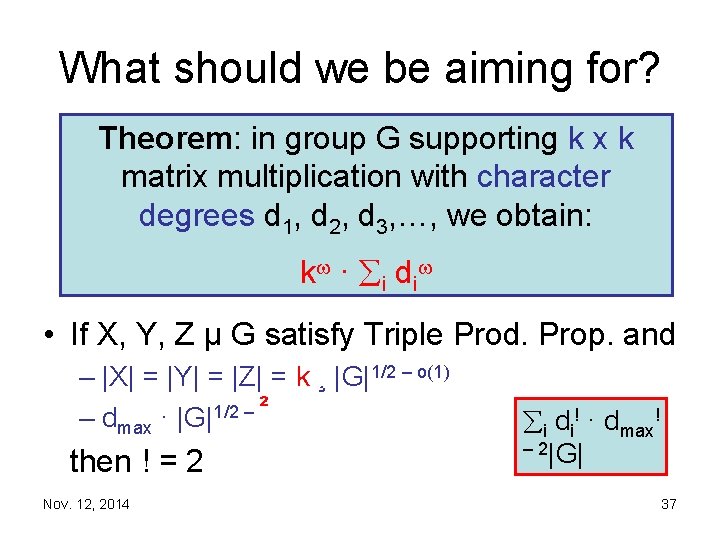
What should we be aiming for? Theorem: in group G supporting k x k matrix multiplication with character degrees d 1, d 2, d 3, …, we obtain: k · i di • If X, Y, Z µ G satisfy Triple Prod. Prop. and – |X| = |Y| = |Z| = k ¸ |G|1/2 – o(1) – dmax · |G|1/2 – ² then ! = 2 Nov. 12, 2014 i di! · dmax! – 2|G| 37
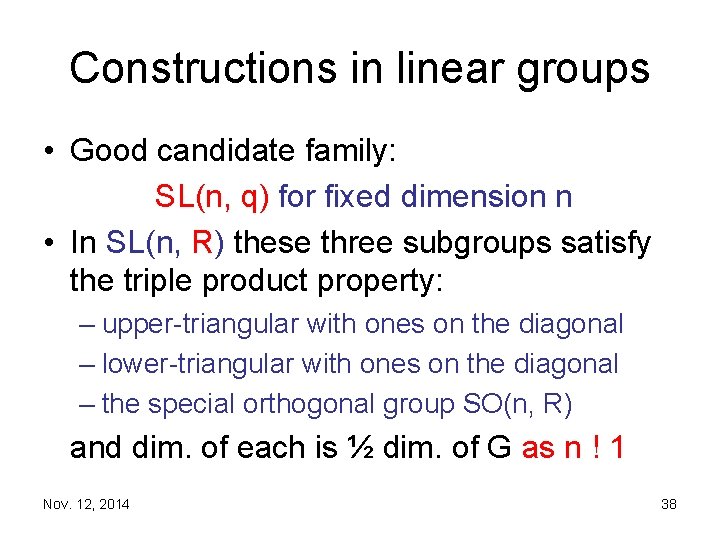
Constructions in linear groups • Good candidate family: SL(n, q) for fixed dimension n • In SL(n, R) these three subgroups satisfy the triple product property: – upper triangular with ones on the diagonal – lower triangular with ones on the diagonal – the special orthogonal group SO(n, R) and dim. of each is ½ dim. of G as n ! 1 Nov. 12, 2014 38
![Group algebra approach • [CKSU 2005] wreath product groups yield : – ! <](http://slidetodoc.com/presentation_image_h2/bb398f30c26baf256df854bf59097109/image-39.jpg "Group algebra approach • [CKSU 2005] wreath product groups yield : – ! <")
Group algebra approach • [CKSU 2005] wreath product groups yield : – ! < 2. 48, ! < 2. 41 – key part of construction is combinatorial – two conjectures implying ! = 2 • Main disadvantage: – non trivial results require non abelian groups – most ideas foiled by too large char. degrees Nov. 12, 2014 39
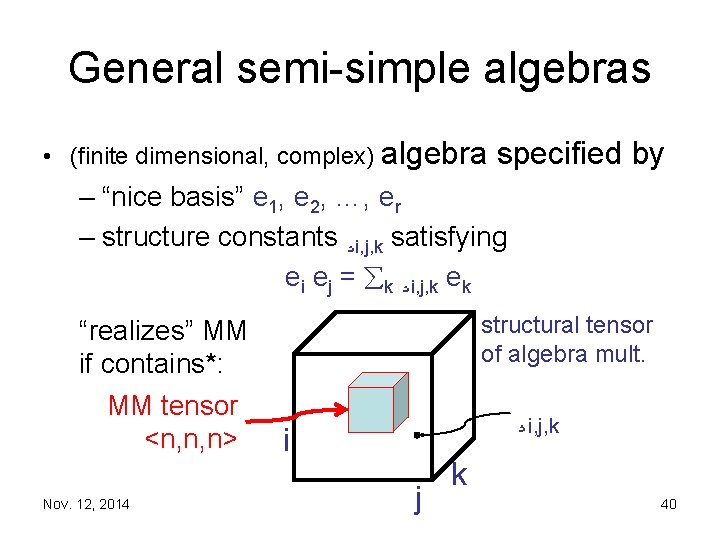
General semi simple algebras • (finite dimensional, complex) algebra specified by – “nice basis” e 1, e 2, …, er – structure constants ¸i, j, k satisfying ei ej = k ¸i, j, k ek “realizes” MM if contains*: MM tensor <n, n, n> Nov. 12, 2014 structural tensor of algebra mult. ¸i, j, k i j k 40
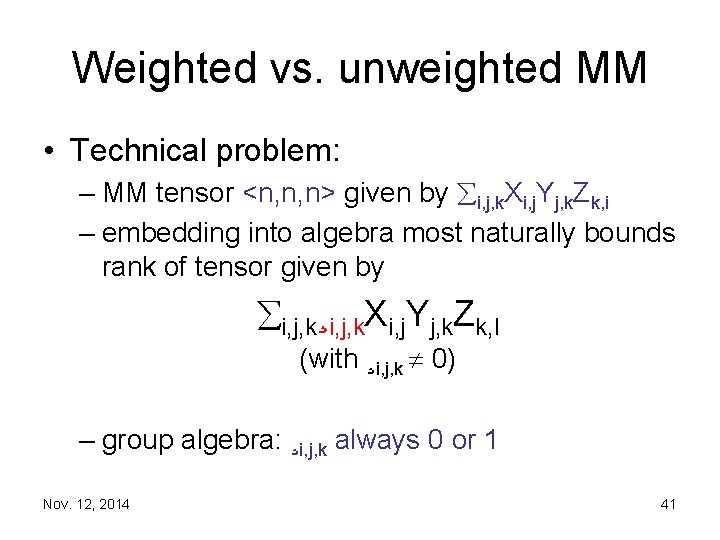
Weighted vs. unweighted MM • Technical problem: – MM tensor <n, n, n> given by i, j, k. Xi, j. Yj, k. Zk, i – embedding into algebra most naturally bounds rank of tensor given by i, j, k¸i, j, k. Xi, j. Yj, k. Zk, I (with ¸i, j, k 0) – group algebra: ¸i, j, k always 0 or 1 Nov. 12, 2014 41
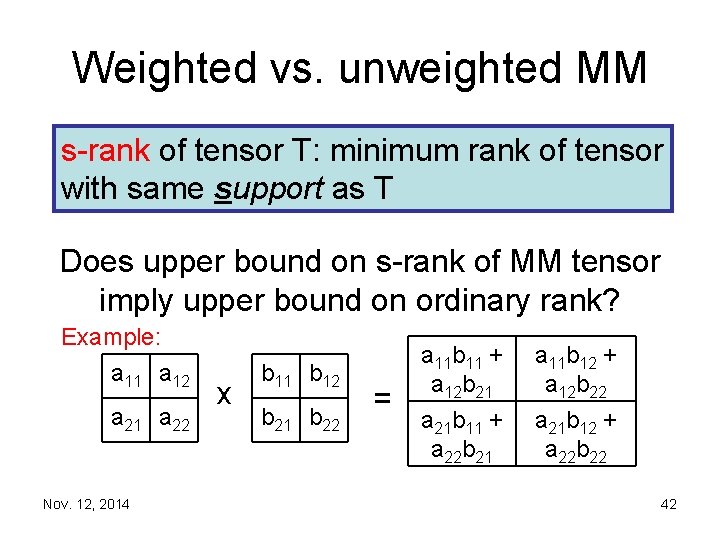
Weighted vs. unweighted MM s rank of tensor T: minimum rank of tensor with same support as T Does upper bound on s rank of MM tensor imply upper bound on ordinary rank? Example: a 11 a 12 a 21 a 22 Nov. 12, 2014 x b 11 b 12 b 21 b 22 = a 11 b 11 + a 12 b 21 a 11 b 12 + a 12 b 22 a 21 b 11 + a 22 b 21 a 21 b 12 + a 22 b 22 42
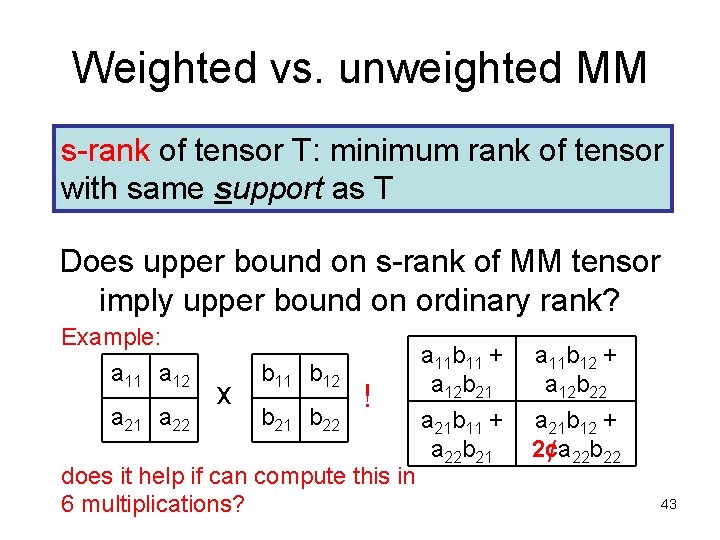
Weighted vs. unweighted MM s rank of tensor T: minimum rank of tensor with same support as T Does upper bound on s rank of MM tensor imply upper bound on ordinary rank? Example: a 11 a 12 a 21 a 22 x b 11 b 12 b 21 b 22 ! does it help if can compute this in 6 multiplications? a 11 b 11 + a 12 b 21 a 11 b 12 + a 12 b 22 a 21 b 11 + a 22 b 21 a 21 b 12 + 2¢a 22 b 22 43
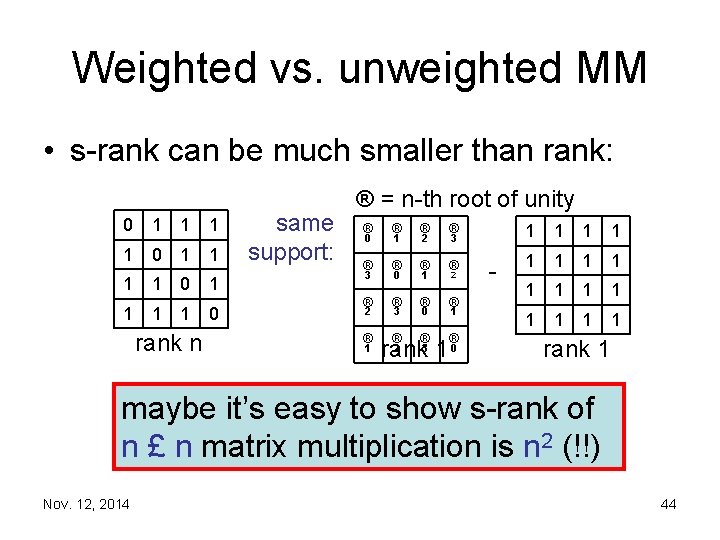
Weighted vs. unweighted MM • s rank can be much smaller than rank: 0 1 1 1 1 0 rank n same support: ® = n th root of unity ® ® ® ® 0 3 2 1 1 0 3 2 1 rank 1 0 2 3 1 1 1 1 rank 1 maybe it’s easy to show s rank of n £ n matrix multiplication is n 2 (!!) Nov. 12, 2014 44
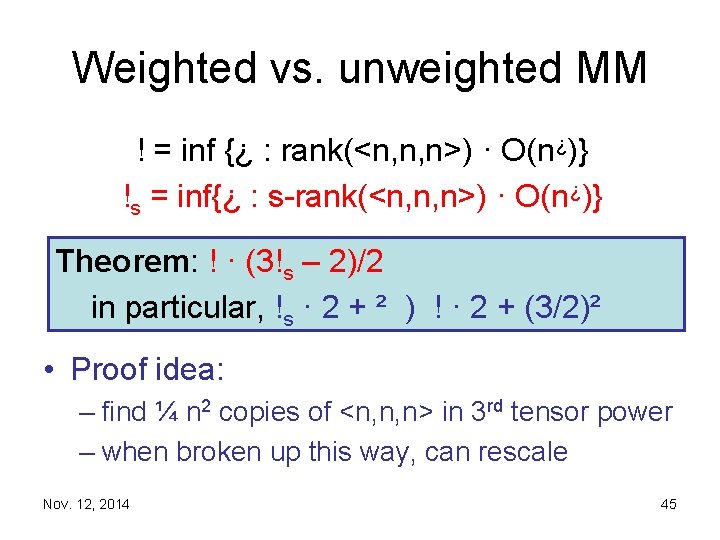
Weighted vs. unweighted MM ! = inf {¿ : rank(<n, n, n>) · O(n¿)} !s = inf{¿ : s rank(<n, n, n>) · O(n¿)} Theorem: ! · (3!s – 2)/2 in particular, !s · 2 + ² ) ! · 2 + (3/2)² • Proof idea: – find ¼ n 2 copies of <n, n, n> in 3 rd tensor power – when broken up this way, can rescale Nov. 12, 2014 45
A promising family of semisimple algebras Nov. 12, 2014 46
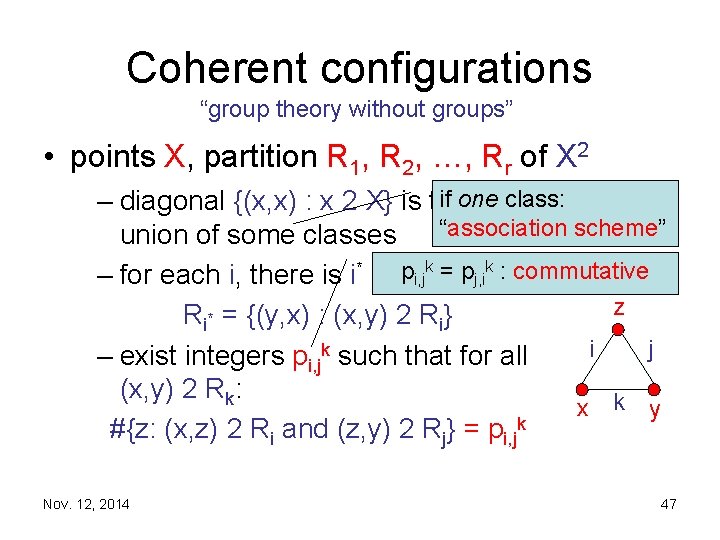
Coherent configurations “group theory without groups” • points X, partition R 1, R 2, …, Rr of X 2 if one class: – diagonal {(x, x) : x 2 X} is the “association scheme” union of some classes pi, jk that = pj, ik : commutative – for each i, there is i* such z Ri* = {(y, x) : (x, y) 2 Ri} i j – exist integers pi, jk such that for all (x, y) 2 Rk: x k y #{z: (x, z) 2 Ri and (z, y) 2 Rj} = pi, jk Nov. 12, 2014 47
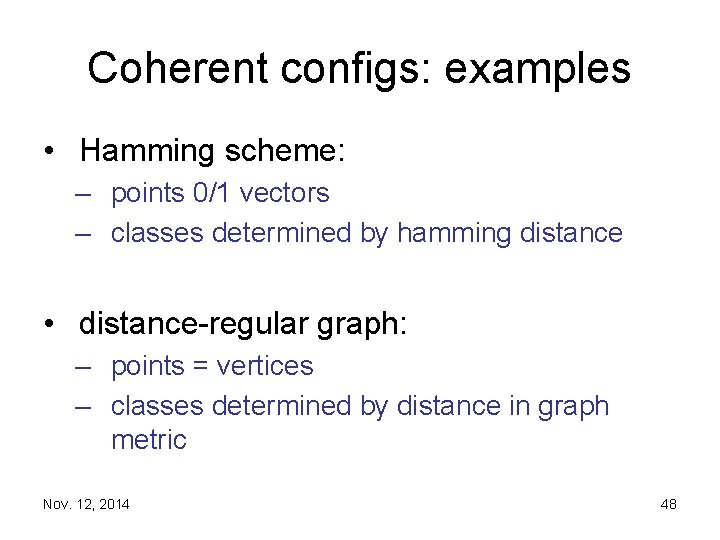
Coherent configs: examples • Hamming scheme: – points 0/1 vectors – classes determined by hamming distance • distance regular graph: – points = vertices – classes determined by distance in graph metric Nov. 12, 2014 48
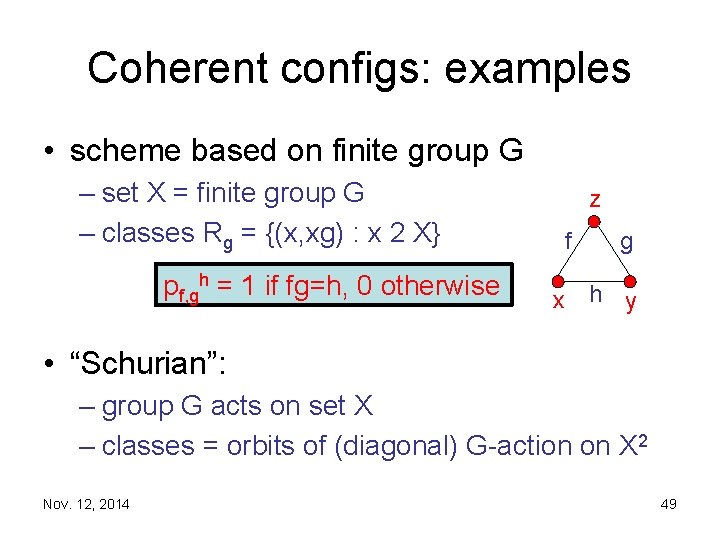
Coherent configs: examples • scheme based on finite group G – set X = finite group G – classes Rg = {(x, xg) : x 2 X} pf, gh = 1 if fg=h, 0 otherwise z f g x h y • “Schurian”: – group G acts on set X – classes = orbits of (diagonal) G action on X 2 Nov. 12, 2014 49
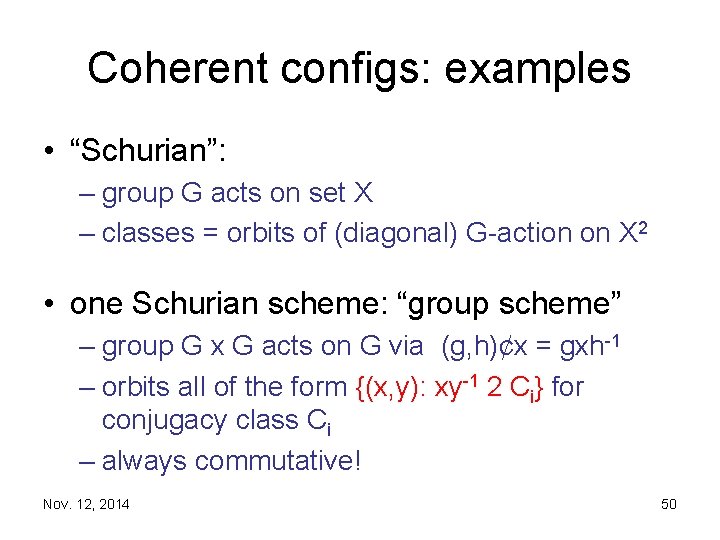
Coherent configs: examples • “Schurian”: – group G acts on set X – classes = orbits of (diagonal) G action on X 2 • one Schurian scheme: “group scheme” – group G x G acts on G via (g, h)¢x = gxh 1 – orbits all of the form {(x, y): xy 1 2 Ci} for conjugacy class Ci – always commutative! Nov. 12, 2014 50
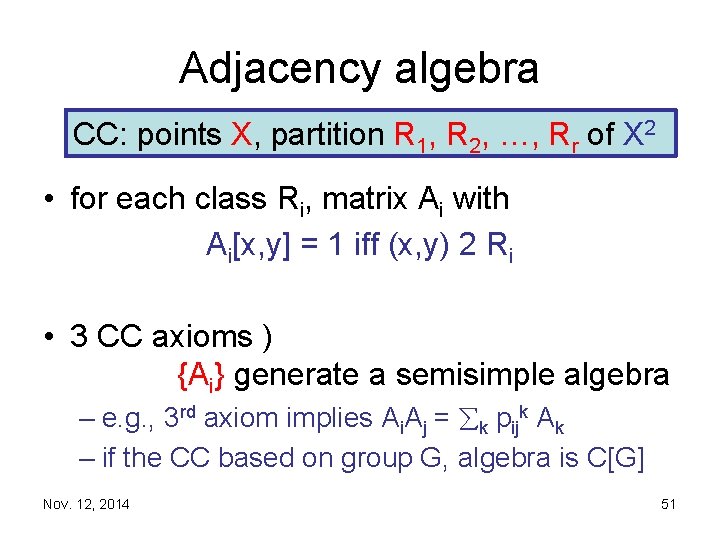
Adjacency algebra CC: points X, partition R 1, R 2, …, Rr of X 2 • for each class Ri, matrix Ai with Ai[x, y] = 1 iff (x, y) 2 Ri • 3 CC axioms ) {Ai} generate a semisimple algebra – e. g. , 3 rd axiom implies Ai. Aj = k pijk Ak – if the CC based on group G, algebra is C[G] Nov. 12, 2014 51
![Nice basis conditions • group algebra C[G]: “nice basis” yields triple product property •](http://slidetodoc.com/presentation_image_h2/bb398f30c26baf256df854bf59097109/image-52.jpg "Nice basis conditions • group algebra C[G]: “nice basis” yields triple product property •")
Nice basis conditions • group algebra C[G]: “nice basis” yields triple product property • adjacency algebras of CCs: “nice basis” yields triangle condition: ¯(j, k’) ®(i, j’) class names Nov. 12, 2014 °(k, i’) can look like iff i = i’, j = j’, k = k’ 52
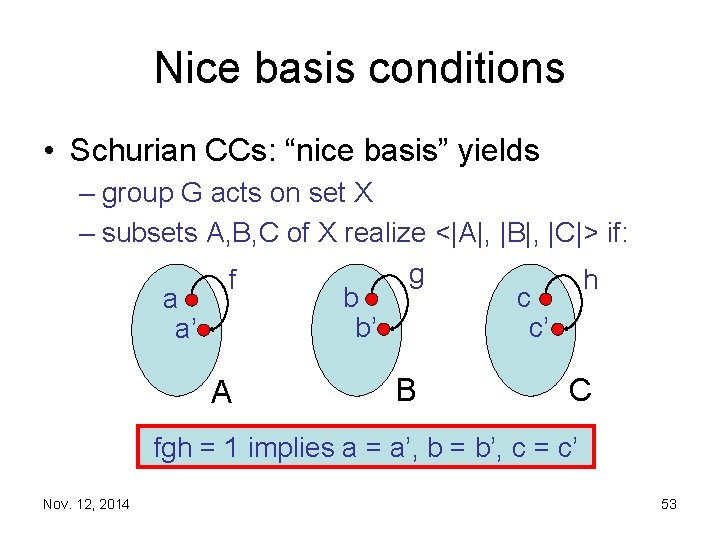
Nice basis conditions • Schurian CCs: “nice basis” yields – group G acts on set X – subsets A, B, C of X realize <|A|, |B|, |C|> if: g f h b c a b’ c’ a’ A B C fgh = 1 implies a = a’, b = b’, c = c’ Nov. 12, 2014 53
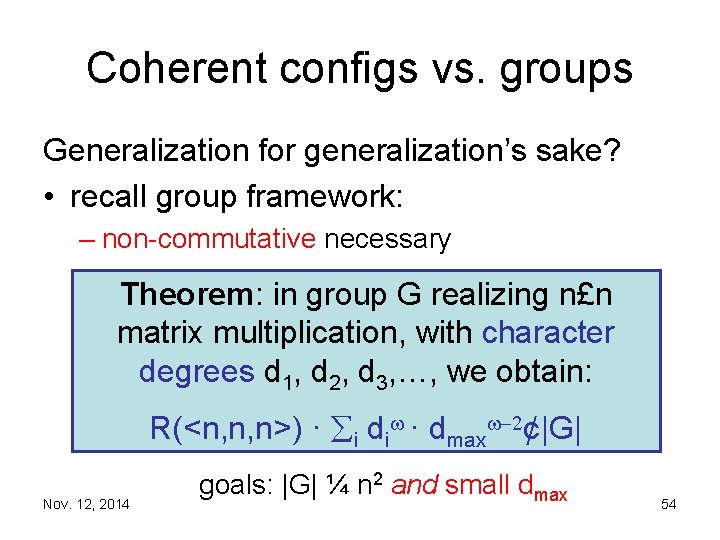
Coherent configs vs. groups Generalization for generalization’s sake? • recall group framework: – non commutative necessary Theorem: in group G realizing n£n matrix multiplication, with character degrees d 1, d 2, d 3, …, we obtain: R(<n, n, n>) · i di · dmax -2¢|G| Nov. 12, 2014 goals: |G| ¼ n 2 and small dmax 54
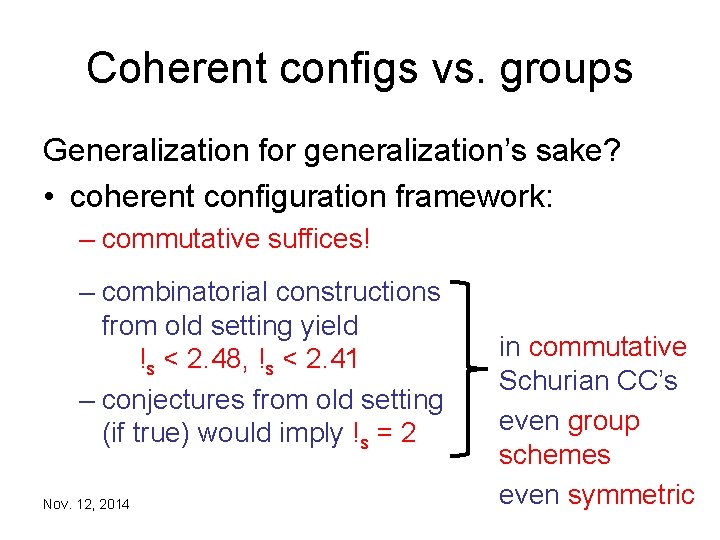
Coherent configs vs. groups Generalization for generalization’s sake? • coherent configuration framework: – commutative suffices! – combinatorial constructions from old setting yield !s < 2. 48, !s < 2. 41 – conjectures from old setting (if true) would imply !s = 2 Nov. 12, 2014 in commutative Schurian CC’s even group schemes even symmetric
Commutative CCs suffice Main point embedding n x n matrix multiplication into a commutative coherent config uration of rank ¼ n 2 is a viable route to ! =2 (no representation theory needed) Nov. 12, 2014 56
Open problems • find a construction in new framework that – proves non trivial bound on !s – is not based on constructions from old setting • is the (border) s rank of <2, 2, 2> = 6? • embed n £ n MM into commutative coherent configuration of rank ¼ n 2 Nov. 12, 2014 57
- Slides: 57