
Approaches in psychology Posters Origins of psychology Wundt
- Slides: 24
Approaches in psychology: Posters Origins of psychology: Wundt, introspection and the emergence of psychology as a science. The basic assumptions of the following approaches: Learning approaches: the behaviourist approach, including classical conditioning and Pavlov’s research, operant conditioning, types of reinforcement and Skinner’s research; social learning theory including imitation, identification, modelling, vicarious reinforcement, the role of mediational processes and Bandura’s research. The cognitive approach: the study of internal mental processes, the role of schema, the use of theoretical and computer models to explain and make inferences about mental processes. The emergence of cognitive neuroscience. The biological approach: the influence of genes, biological structures and neurochemistry on behaviour. Genotype and phenotype, genetic basis of behaviour, evolution and behaviour. The psychodynamic approach: the role of the unconscious, the structure of personality, that is ID, ego and superego, defence mechanisms including repression, denial and displacement, psychosexual stages. Humanistic psychology: free will, self-actualisation and Maslow’s hierarchy of needs, focus on the self, congruence, the role of conditions of worth. The influence on counselling psychology. Comparison of approaches.
The biological approach: • The influence of genes, biological structures and neurochemistry on behaviour. Genotype and phenotype, genetic basis of behaviour, evolution and behaviour. • Gene, A part of the chromosome of an organism that carries information in the form of DNA.
The influence of genes • Personality • Development • Psychopathology • Intelligence • What type of studies do you think have influenced this research? • Link
So let us say yes. Face validity • What are the problems. • Other influences.
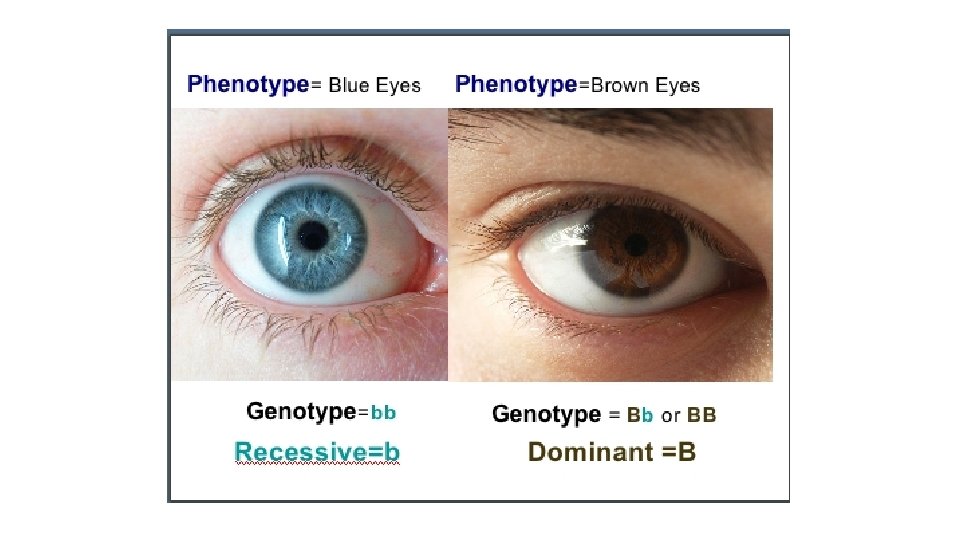
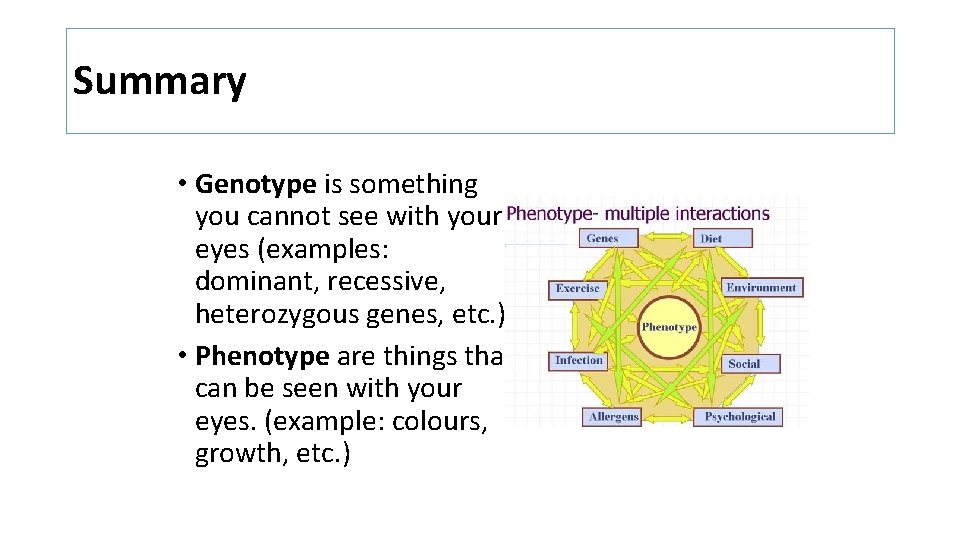
Genes, the mechanisms of heredity. • Heredity is the passing of characteristics from one generation to the next through the genes and is the reason why offspring take after their parents in terms of psychological characteristics. • Genotype- the genetic code that is written in the DNA of an individuals cells. • Phenotype- the physical appearance that results from this inherited information. • Natural Selection - The process by which inherited characteristics that enhance an individuals reproductive success (fitness) are passed onto the next generation, and so become more widespread in the population over time.
Methods of investigating the genetic basis of behaviour ʘ ʘ Twin studies Family studies Adoption studies Selective breeding
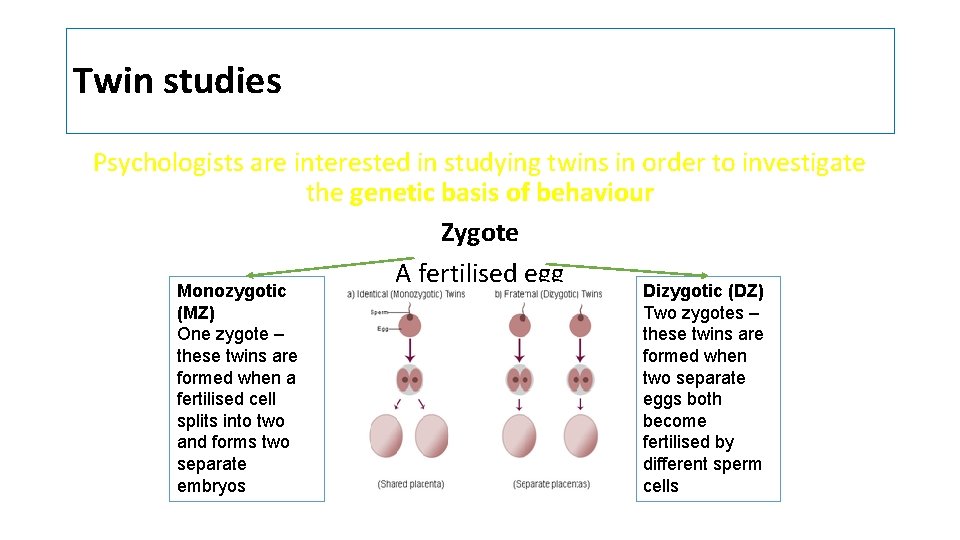
Twin studies Psychologists are interested in studying twins in order to investigate the genetic basis of behaviour Zygote A fertilised egg Monozygotic (MZ) One zygote – these twins are formed when a fertilised cell splits into two and forms two separate embryos Dizygotic (DZ) Two zygotes – these twins are formed when two separate eggs both become fertilised by different sperm cells
Family studies • 1869 - Francis Galton ‘…all natural abilities are inherited’ • This is a simplistic viewpoint – Galton later had to agree that any resemblance between family relatives could be a result of both genes and shared environment • However, with alcoholism for example, there is a suggestion of a biological predisposition to the addiction
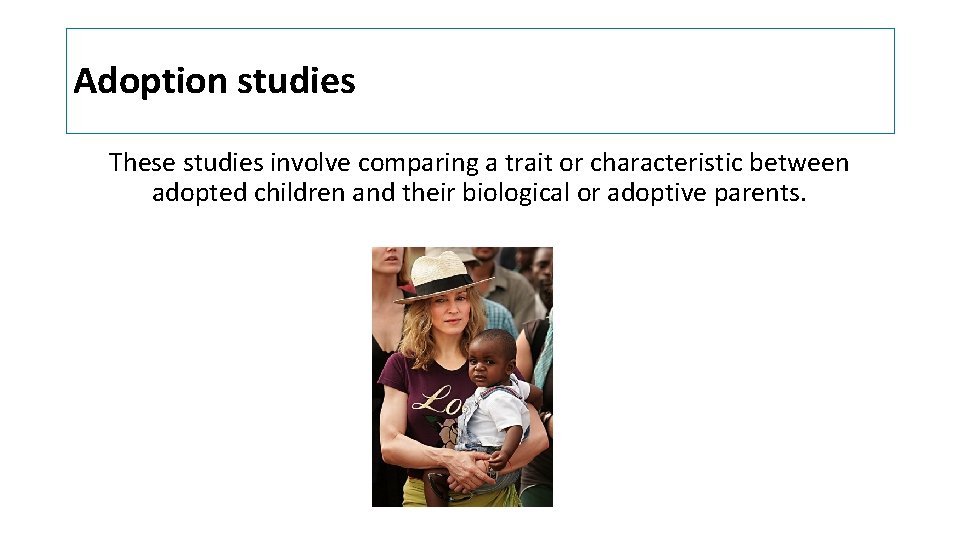
Adoption studies These studies involve comparing a trait or characteristic between adopted children and their biological or adoptive parents.
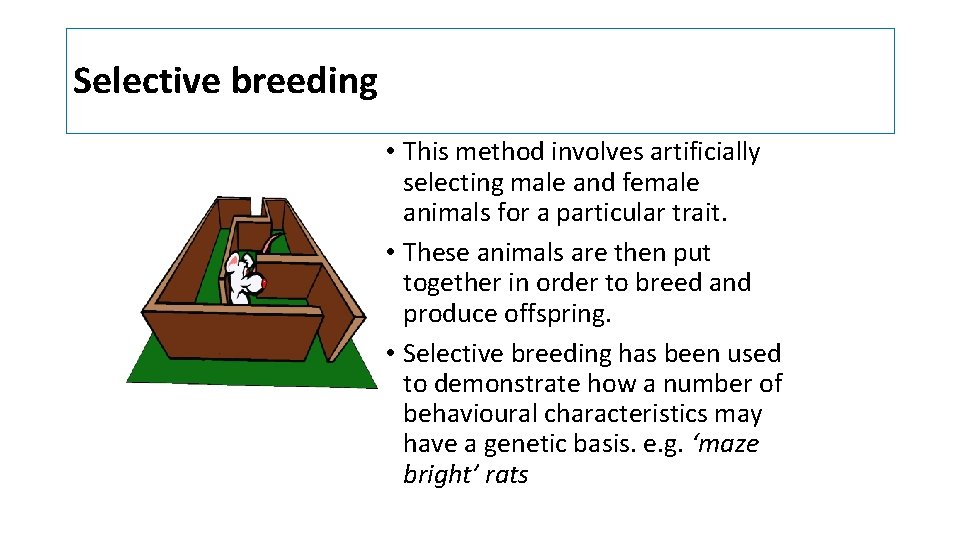
Selective breeding • This method involves artificially selecting male and female animals for a particular trait. • These animals are then put together in order to breed and produce offspring. • Selective breeding has been used to demonstrate how a number of behavioural characteristics may have a genetic basis. e. g. ‘maze bright’ rats
Stress • Fight or Flight • We will cover in detail. • Aggression too much testosterone!
Some questions? Explain what is meant by genotype and phenotype. Outline the influence of genes on behaviour. Outline the influence of biological structures and neurochemistry on behaviour. Explain the difference between genotype and phenotype. Outline the relationship between evolution and behaviour.
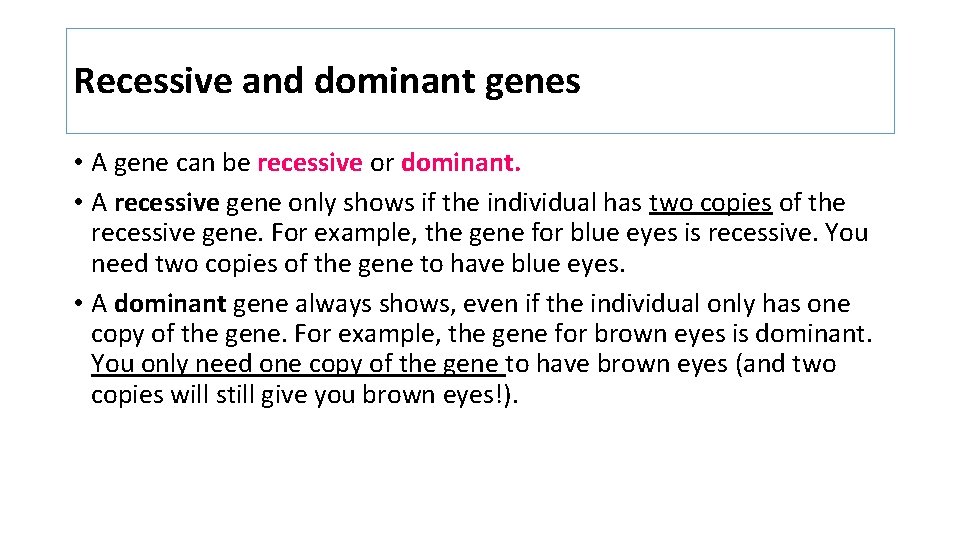
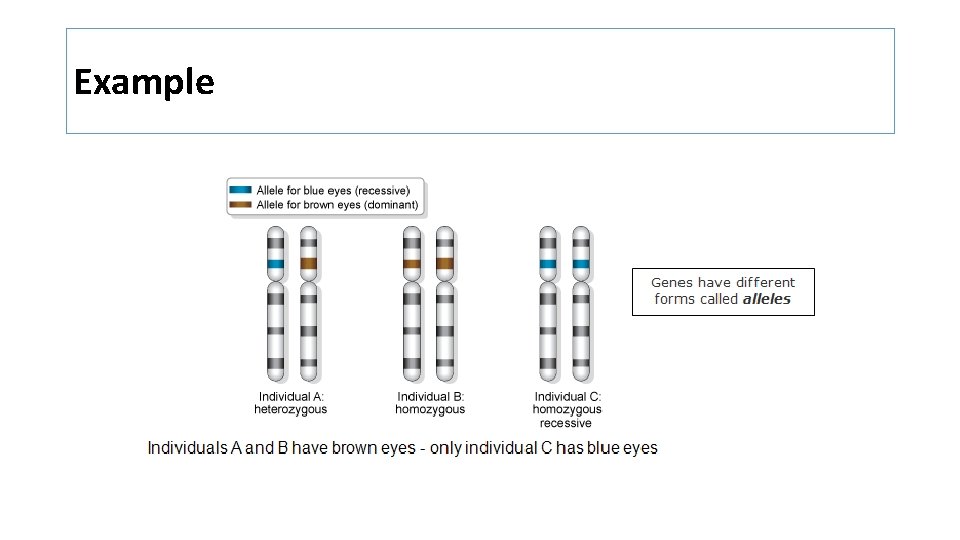
Recessive and dominant genes • A gene can be recessive or dominant. • A recessive gene only shows if the individual has two copies of the recessive gene. For example, the gene for blue eyes is recessive. You need two copies of the gene to have blue eyes. • A dominant gene always shows, even if the individual only has one copy of the gene. For example, the gene for brown eyes is dominant. You only need one copy of the gene to have brown eyes (and two copies will still give you brown eyes!).
Example
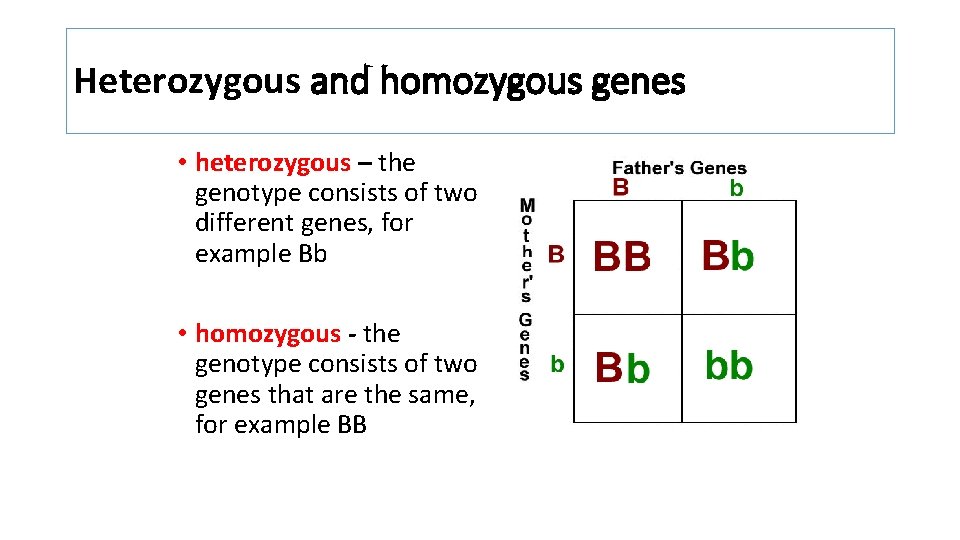
Heterozygous and homozygous genes • heterozygous – the genotype consists of two different genes, for example Bb • homozygous - the genotype consists of two genes that are the same, for example BB
Summary • Genotype is something you cannot see with your eyes (examples: dominant, recessive, heterozygous genes, etc. ) • Phenotype are things that can be seen with your eyes. (example: colours, growth, etc. )
Debate about nature and nurture.
Research methods • The biological approach draws on concepts from the hard sciences and research tends to be highly scientific in nature • The most common methods include laboratory experiments and observations • Objective brain recording and scanning techniques are also used, Psychopatholgy
Strengths of biological approach • It is a scientific approach. This suggests that we can find cause and effect relationships of both physiology and behaviour. • Scientific approach lends credence to study of psychology – establishes psychology as a respectable science • Impact of biology on behaviour can lead to treatment and intervention to those suffering • Understanding how an abnormal brain works can shed light on normal brain functioning • Measurements can be objective as it can be performed by machines which have no vested interest in the outcome e. g. PET scans, EEGs etc. Use of complex machinery allows accurate and precise measurements
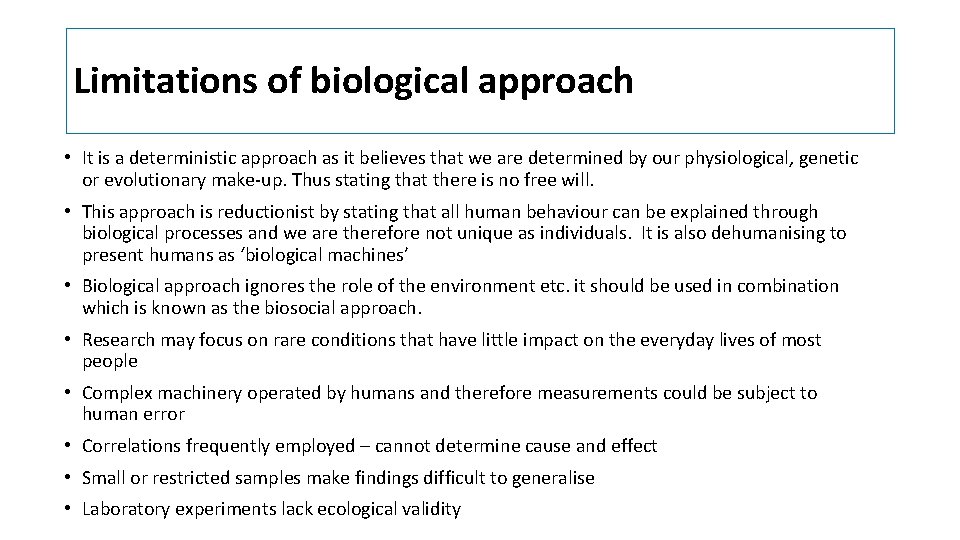
Limitations of biological approach • It is a deterministic approach as it believes that we are determined by our physiological, genetic or evolutionary make-up. Thus stating that there is no free will. • This approach is reductionist by stating that all human behaviour can be explained through biological processes and we are therefore not unique as individuals. It is also dehumanising to present humans as ‘biological machines’ • Biological approach ignores the role of the environment etc. it should be used in combination which is known as the biosocial approach. • Research may focus on rare conditions that have little impact on the everyday lives of most people • Complex machinery operated by humans and therefore measurements could be subject to human error • Correlations frequently employed – cannot determine cause and effect • Small or restricted samples make findings difficult to generalise • Laboratory experiments lack ecological validity
Can you? 1. Explain what is meant by genotype and phenotype (2 marks each) 2. Outline the influence of genes on behaviour (3 marks) 3. Using an example, explain how neurochemistry can influence behaviour (3 marks) 4. Outline the relationship between evolution and behaviour (4 marks) 5. Outline two weaknesses of the biological approach in psychology (4 marks)
Essay title Can you answer the question? Discuss the biological approach in psychology. Refer to at least one other approach in your answer (12 marks)
Homework Ensure you have written up your class notes to include the following: • The assumptions of the biological approach • the influence of genes, biological structures and neurochemistry on behaviour, • genotype and phenotype, • genetic basis of behaviour, • evolution and behaviour. • The strengths and weaknesses of the approach