
Approaches in centrality measurements of heavy ion collisions
![2 D-linear fit method (linear approach) Single event Fitted event E [Me. V] E](https://slidetodoc.com/presentation_image_h2/915ae3e20f8a8ab872224bef2fb9728a/image-6.jpg "2 D-linear fit method (linear approach) Single event Fitted event E [Me. V] E")
![LA-QGSM Edep [a. u] σb/b Edep [a. Centrality resolution for Edep vs Emax [a.](https://slidetodoc.com/presentation_image_h2/915ae3e20f8a8ab872224bef2fb9728a/image-8.jpg "LA-QGSM Edep [a. u] σb/b Edep [a. Centrality resolution for Edep vs Emax [a.")
![2 D linear fit method Single event E [Me. V] E [Ge. V] (with](https://slidetodoc.com/presentation_image_h2/915ae3e20f8a8ab872224bef2fb9728a/image-9.jpg "2 D linear fit method Single event E [Me. V] E [Ge. V] (with")
![[Me. V] Evaluation of pion energy contribution Pion energy distribution LA-QGSM y=kx+b 2 D-case](https://slidetodoc.com/presentation_image_h2/915ae3e20f8a8ab872224bef2fb9728a/image-10.jpg "[Me. V] Evaluation of pion energy contribution Pion energy distribution LA-QGSM y=kx+b 2 D-case")

![counts Et [Ge. V] Correlation between transverse and longitudinal energies in FHCal DCM-SMM 11](https://slidetodoc.com/presentation_image_h2/915ae3e20f8a8ab872224bef2fb9728a/image-25.jpg "counts Et [Ge. V] Correlation between transverse and longitudinal energies in FHCal DCM-SMM 11")
- Slides: 26
Approaches in centrality measurements of heavy ion collisions with forward calorimeters at MPD/NICA facility Volkov Vadim INR RAS 17/09/2020 PWG 1 1
Overview • Can FHCal measure the centrality with spectators? • FHCal detects not only energies but the space distribution of energies! • A few methods for centrality determination are discussed: • a) Correlations of transverse and longitudinal energy components, • b) 2 D-fit of FHCal energy distributions, • c) Subtraction of pion energy contamination and evaluation of spectator’s energy. Tools: • Simulations in Mpd. Root; • Au-Au at ; • Two, LA-QGSM and DCM-SMM fragmentation models are used and compared. 2
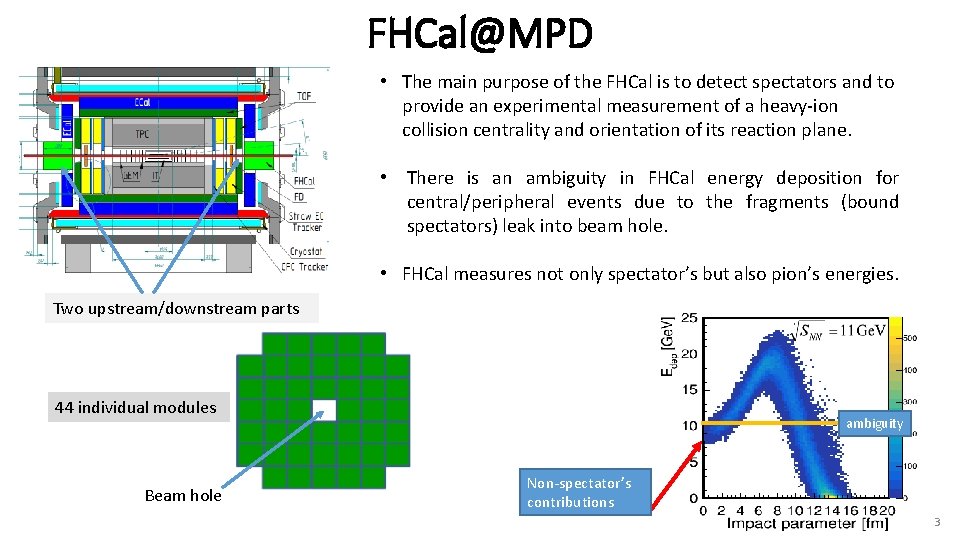
FHCal@MPD • The main purpose of the FHCal is to detect spectators and to provide an experimental measurement of a heavy-ion collision centrality and orientation of its reaction plane. • There is an ambiguity in FHCal energy deposition for central/peripheral events due to the fragments (bound spectators) leak into beam hole. • FHCal measures not only spectator’s but also pion’s energies. Two upstream/downstream parts 44 individual modules Beam hole ambiguity Non-spectator’s contributions 3
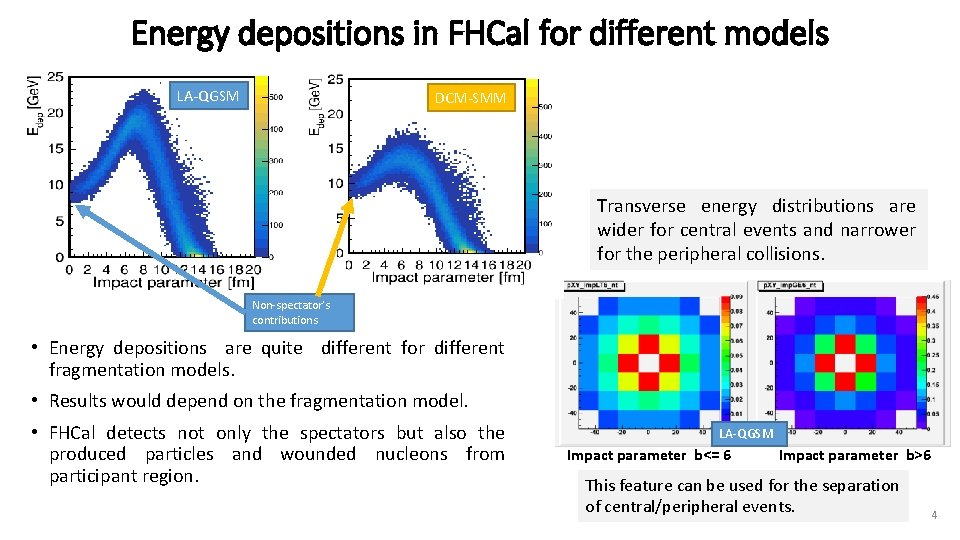
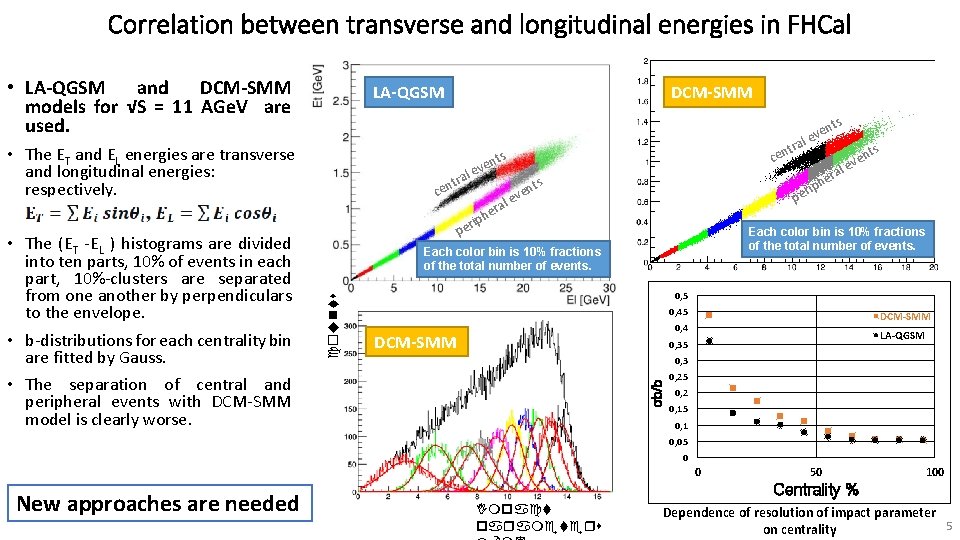
Energy depositions in FHCal for different models LA-QGSM DCM-SMM Transverse energy distributions are wider for central events and narrower for the peripheral collisions. Non-spectator’s contributions • Energy depositions are quite different for different fragmentation models. • Results would depend on the fragmentation model. • FHCal detects not only the spectators but also the produced particles and wounded nucleons from participant region. LA-QGSM Impact parameter b<= 6 Impact parameter b>6 This feature can be used for the separation of central/peripheral events. 4
Correlation between transverse and longitudinal energies in FHCal • LA-QGSM and DCM-SMM models for √S = 11 AGe. V are used. LA-QGSM ts • The ET and EL energies are transverse and longitudinal energies: respectively. e ral t n ce ven e l a tr cen s ent v nts era h rip eve l a er iph pe r pe en l ev ts Each color bin is 10% fractions of the total number of events. 0, 5 0, 45 DCM-SMM 0, 4 DCM-SMM LA-QGSM 0, 35 0, 3 σb/b counts • The (ET -EL ) histograms are divided into ten parts, 10% of events in each part, 10%-clusters are separated from one another by perpendiculars to the envelope. • b-distributions for each centrality bin are fitted by Gauss. • The separation of central and peripheral events with DCM-SMM model is clearly worse. DCM-SMM 0, 25 0, 2 0, 15 0, 1 0, 05 0 0 New approaches are needed 50 100 Centrality % Impact parameters Dependence of resolution of impact parameter 5 on centrality
2 D-linear fit method (linear approach) Single event Fitted event E [Me. V] E [Ge. V] Energy distribution in FHCal modules • In this method the space energy distribution in FHCal modules is used. • The energy in the histogram is uniformly distributed in FHCal modules according to the polar angle. • The histogram is fitted by a symmetrical cone (linear approximation). • Weight of each bin is proportional of the energy deposited in corresponding FHCal module. • This fit provides the new observables: radius, height of the cone. Volume of cone corresponds to the reconstructed energy (Erec). 6
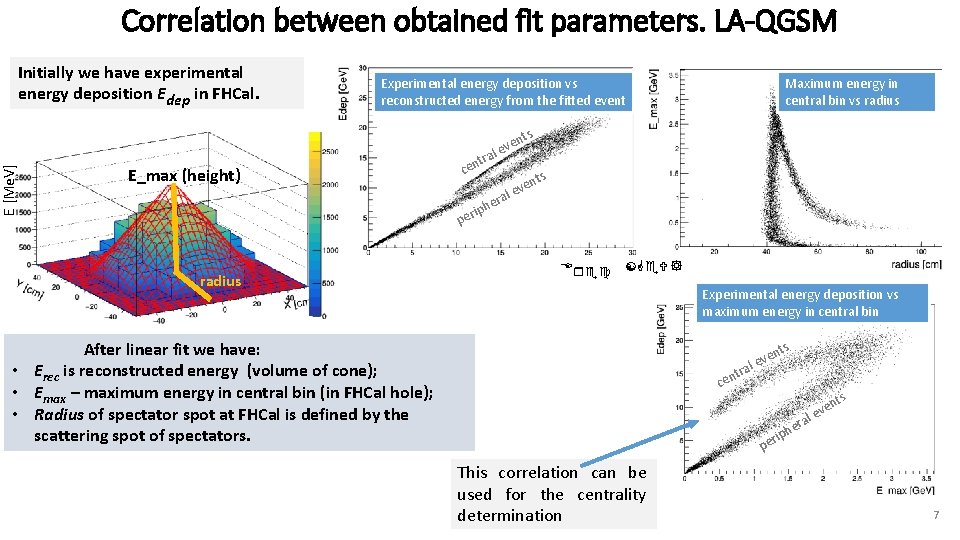
Correlation between obtained fit parameters. LA-QGSM Initially we have experimental energy deposition Edep in FHCal. Experimental energy deposition vs reconstructed energy from the fitted event Maximum energy in central bin vs radius ts E [Me. V] en l ev E_max (height) tra cen he rip nt e v le s ra pe radius Erec [Ge. V] Experimental energy deposition vs maximum energy in central bin After linear fit we have: • Erec is reconstructed energy (volume of cone); • Emax – maximum energy in central bin (in FHCal hole); • Radius of spectator spot at FHCal is defined by the scattering spot of spectators. s ent v e al tr cen era h rip pe This correlation can be used for the centrality determination en l ev ts 7
LA-QGSM Edep [a. u] σb/b Edep [a. Centrality resolution for Edep vs Emax [a. u] 0, 45 0, 4 0, 35 0, 3 0, 25 0, 2 0, 15 0, 1 0, 05 0 DCM-SMM LA-QGSM 0 20 40 60 80 100 Centrality % DCM-SMM Dependence of resolution of impact parameter on centrality DCM-SMM Emax [a. u] 8
2 D linear fit method Single event E [Me. V] E [Ge. V] (with subtraction of pion contribution) Fitted and uniformly distributed event Experimental energy deposition vs reconstructed energy from the fitted event ts ven e l a tr cen s a er iph per ent v e l Pion contribution Erec • Narrow cone radius indicates that the outer FHCal modules detect the pions mainly, while the spectators are detected by inner modules. • Energy in outer modules can be regarded as pure non-spectator (pion) contribution. • Let’s try to evaluate pion contribution in full FHCal. 9 [G
[Me. V] Evaluation of pion energy contribution Pion energy distribution LA-QGSM y=kx+b 2 D-case E 1 D-case Pion energy distribution DCM-SMM y=-kx+b • Linear fit with y=kx+b background, [Me. V] • b is known from outer FHCal modules, E b • k is taken from simulation and quite similar for LA-QGSM and DCM Pion contribution is subtracted -SMM models • The ratio of edge and central energies is almost the same for different models (2. 4609 for LA-QGSM, 2. 45876 for DCM-SMM) 10
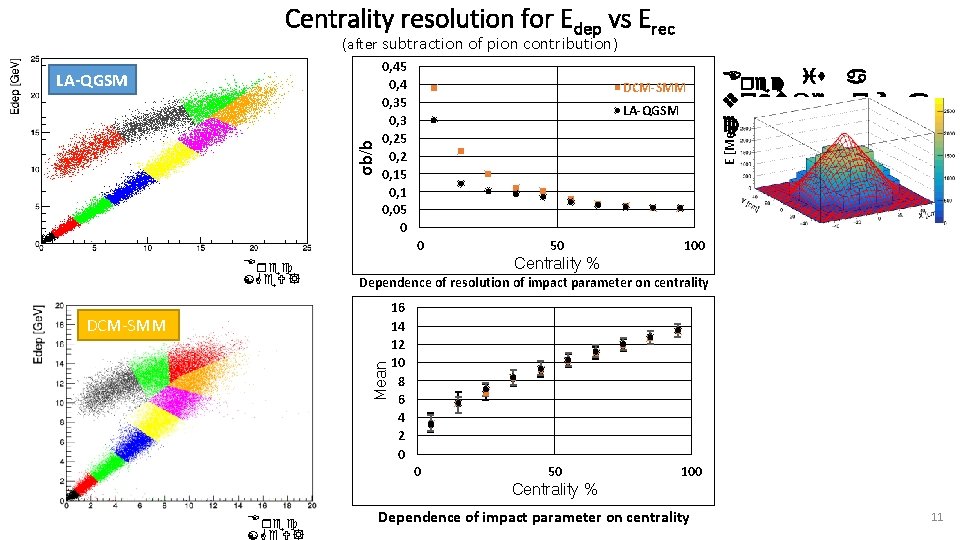
Centrality resolution for Edep vs Erec (after subtraction of pion contribution) DCM-SMM LA-QGSM 0 Erec [Ge. V] Erec is a volume of cone a E [Me. V] σb/b LA-QGSM 0, 45 0, 4 0, 35 0, 3 0, 25 0, 2 0, 15 0, 1 0, 05 0 50 100 Centrality % Dependence of resolution of impact parameter on centrality Mean DCM-SMM 16 14 12 10 8 6 4 2 0 0 50 100 Centrality % Erec [Ge. V] Dependence of impact parameter on centrality 11
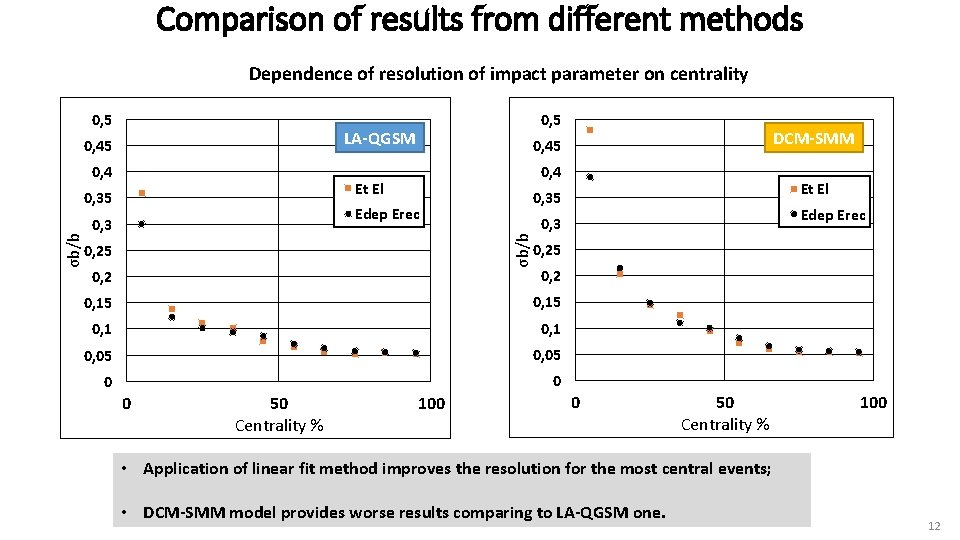
Comparison of results from different methods Dependence of resolution of impact parameter on centrality 0, 5 LA-QGSM 0, 45 0, 4 σb/b 0, 25 0, 2 0, 15 0, 1 0, 05 0 0 50 Centrality % 100 Edep Erec 0, 3 0, 15 0 Et El 0, 35 Edep Erec 0, 3 DCM-SMM 0, 45 Et El 0, 35 σb/b 0, 5 0 50 Centrality % 100 • Application of linear fit method improves the resolution for the most central events; • DCM-SMM model provides worse results comparing to LA-QGSM one. 12
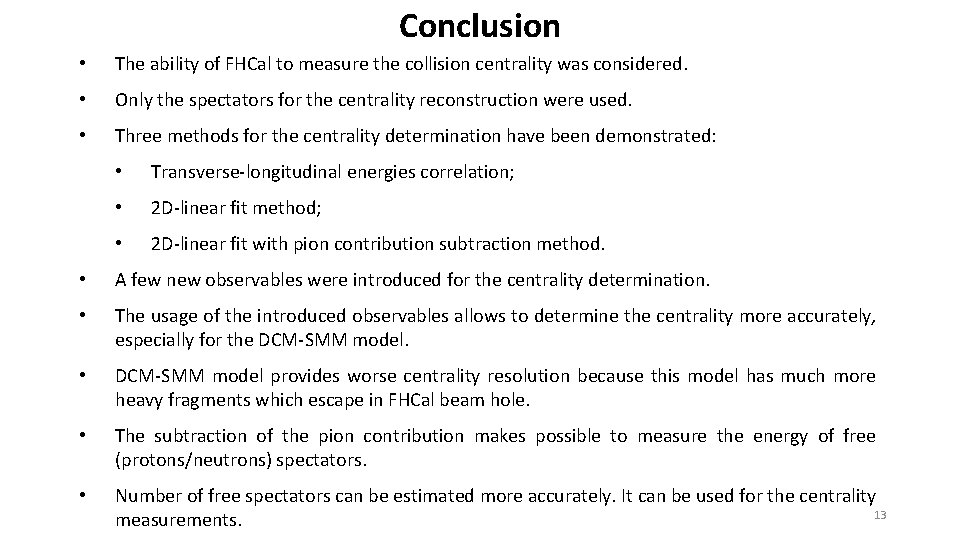
Conclusion • The ability of FHCal to measure the collision centrality was considered. • Only the spectators for the centrality reconstruction were used. • Three methods for the centrality determination have been demonstrated: • Transverse-longitudinal energies correlation; • 2 D-linear fit method; • 2 D-linear fit with pion contribution subtraction method. • A few new observables were introduced for the centrality determination. • The usage of the introduced observables allows to determine the centrality more accurately, especially for the DCM-SMM model. • DCM-SMM model provides worse centrality resolution because this model has much more heavy fragments which escape in FHCal beam hole. • The subtraction of the pion contribution makes possible to measure the energy of free (protons/neutrons) spectators. • Number of free spectators can be estimated more accurately. It can be used for the centrality 13 measurements.
Thank you for your attention! This work was supported by the RFBR 18 -02 -40065 mega grant 14
BACKUPS 15
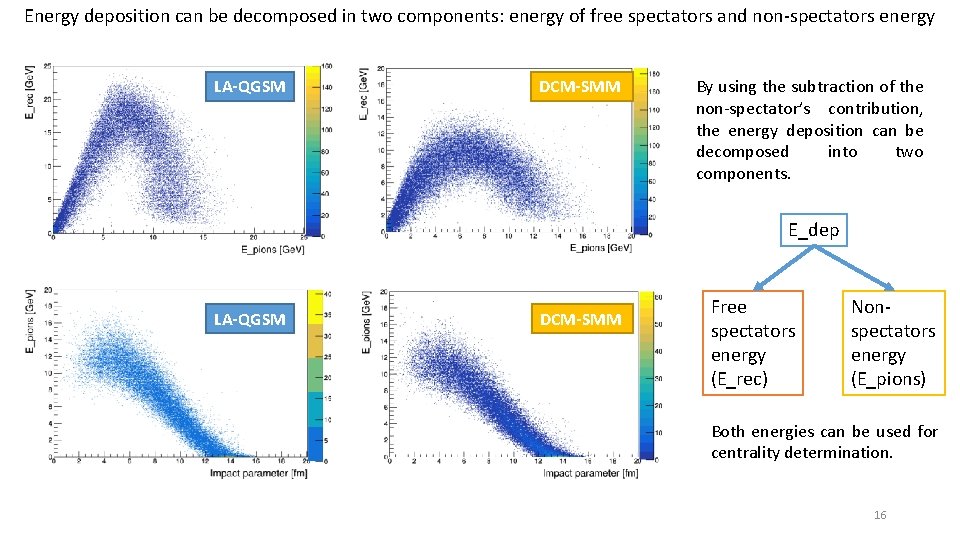
Energy deposition can be decomposed in two components: energy of free spectators and non-spectators energy LA-QGSM DCM-SMM By using the subtraction of the non-spectator’s contribution, the energy deposition can be decomposed into two components. E_dep LA-QGSM DCM-SMM Free spectators energy (E_rec) Nonspectators energy (E_pions) Both energies can be used for centrality determination. 16
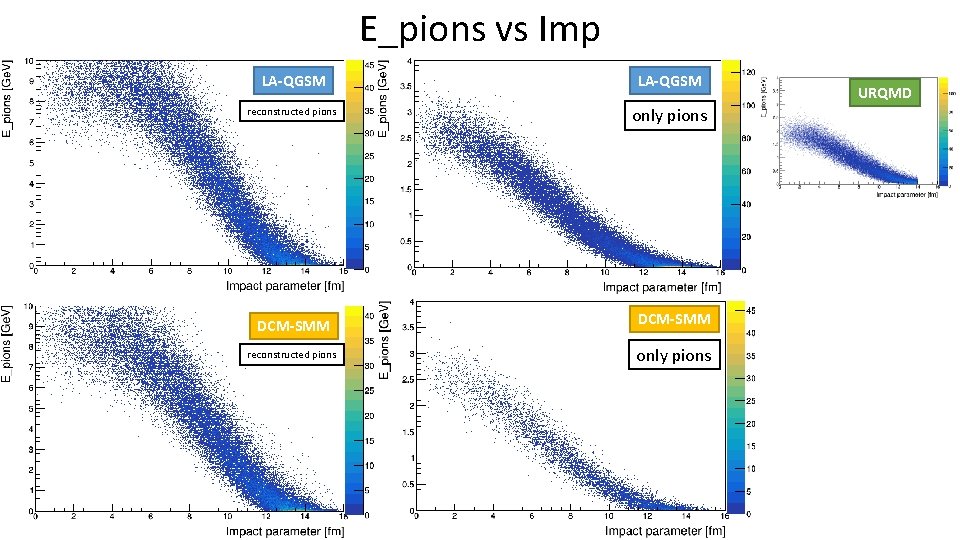
E_pions vs Imp LA-QGSM reconstructed pions only pions DCM-SMM reconstructed pions DCM-SMM only pions URQMD
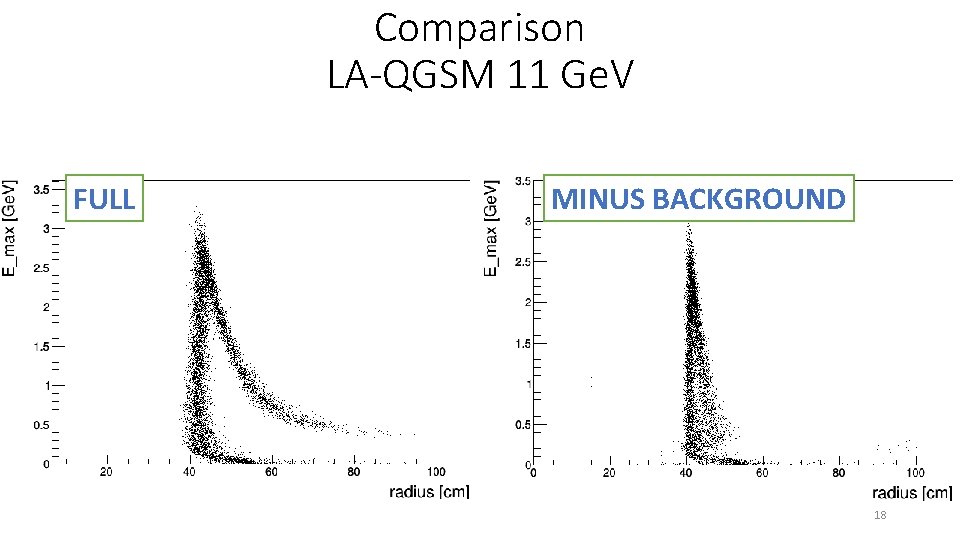
Comparison LA-QGSM 11 Ge. V FULL MINUS BACKGROUND 18
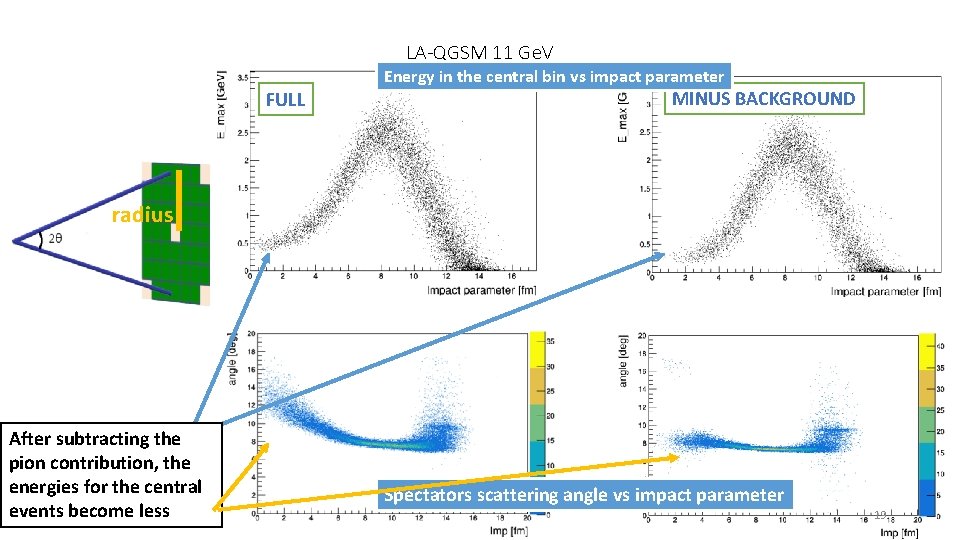
LA-QGSM 11 Ge. V Energy in the central bin vs impact parameter FULL MINUS BACKGROUND radius After subtracting the pion contribution, the energies for the central events become less Spectators scattering angle vs impact parameter 19
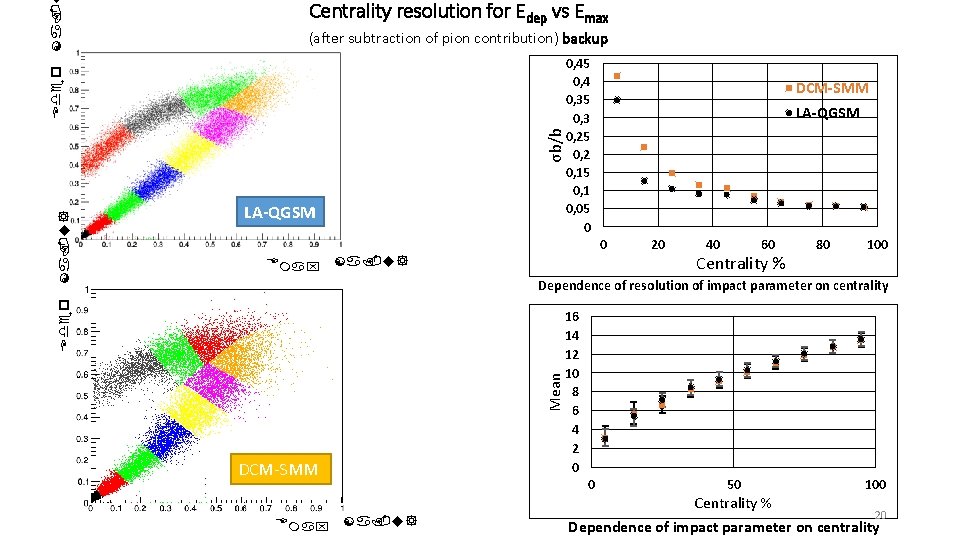
(after subtraction of pion contribution) backup LA-QGSM 0, 45 0, 4 0, 35 0, 3 0, 25 0, 2 0, 15 0, 1 0, 05 0 DCM-SMM LA-QGSM 0 Emax [a. u] 20 40 60 Centrality % 80 100 Dependence of resolution of impact parameter on centrality Mean Edep [a. u] σb/b Edep [a. Centrality resolution for Edep vs Emax DCM-SMM Emax 16 14 12 10 8 6 4 2 0 0 [a. u] 50 100 Centrality % 20 Dependence of impact parameter on centrality
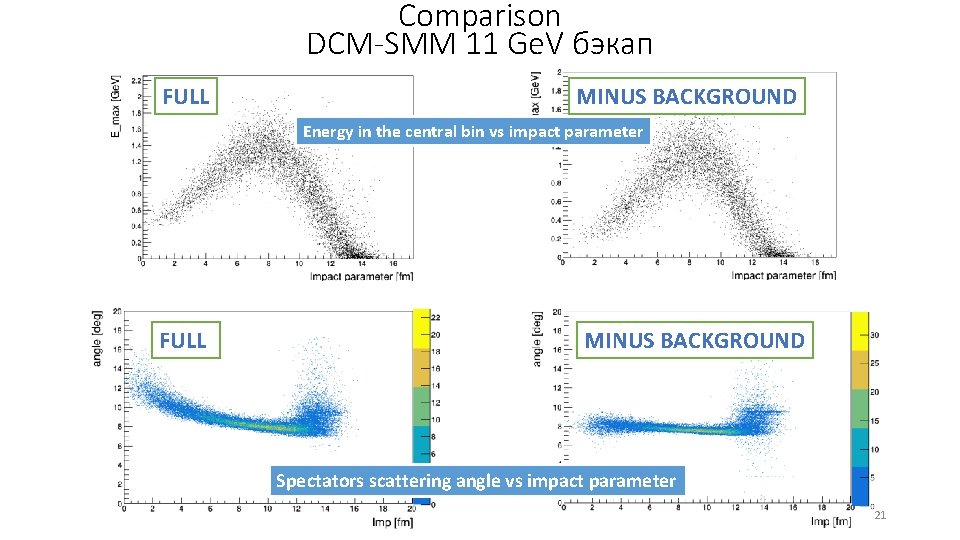
Comparison DCM-SMM 11 Ge. V бэкап FULL MINUS BACKGROUND Energy in the central bin vs impact parameter FULL MINUS BACKGROUND Spectators scattering angle vs impact parameter 21
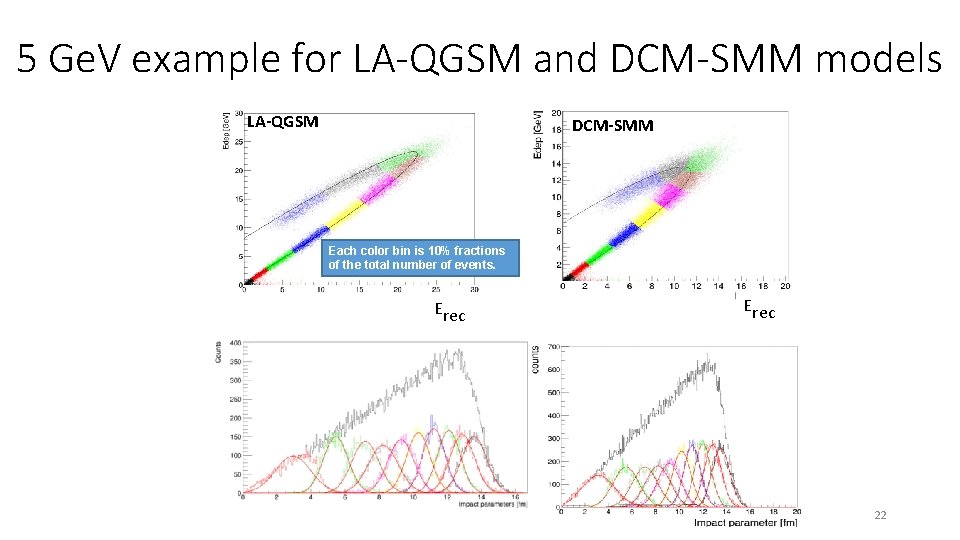
5 Ge. V example for LA-QGSM and DCM-SMM models LA-QGSM DCM-SMM Each color bin is 10% fractions of the total number of events. Erec 22
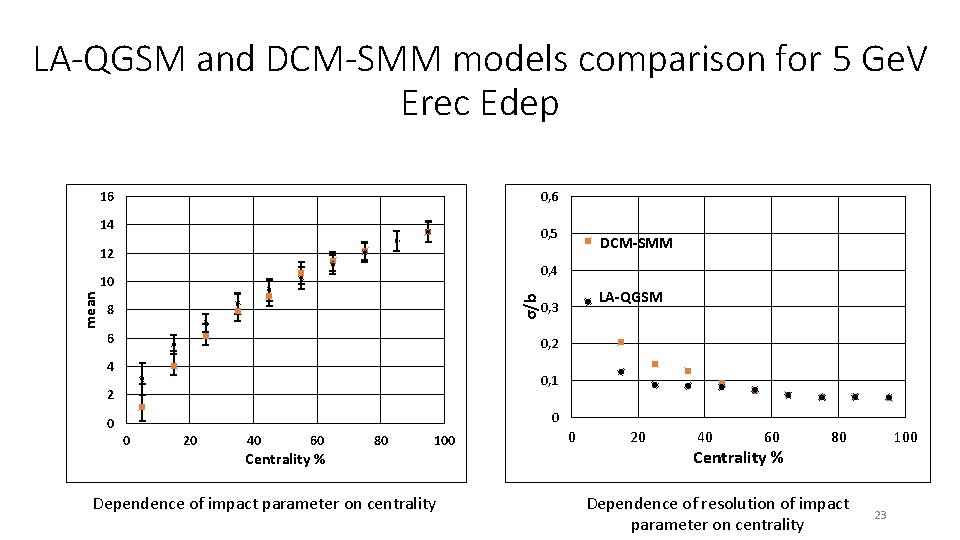
LA-QGSM and DCM-SMM models comparison for 5 Ge. V Erec Edep 16 0, 6 14 0, 5 12 0, 4 σ/b 10 mean DCM-SMM 8 6 LA-QGSM 0, 3 0, 2 4 0, 1 2 0 0 0 20 40 60 Centrality % 80 100 Dependence of impact parameter on centrality 0 20 40 60 Centrality % 80 Dependence of resolution of impact parameter on centrality 100 23
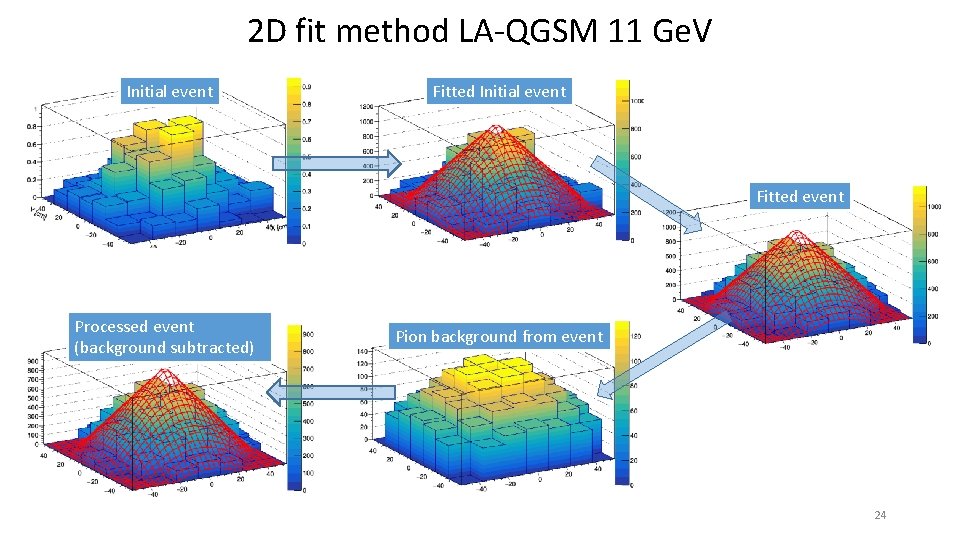
2 D fit method LA-QGSM 11 Ge. V Initial event Fitted event Processed event (background subtracted) Pion background from event 24
counts Et [Ge. V] Correlation between transverse and longitudinal energies in FHCal DCM-SMM 11 Ge. V backup DCM-SMM The separation of central and peripheral events with this model is clearly worse. This approach is not suited for DCM -SMM model DCM-SMM Each color bin is 10% fractions of the total number of events. El [Ge. V] Impact parameters [fm] 0, 5 DCM-SMM LA-QGSM 0, 3 Mean σ/b 0, 4 0, 2 0, 1 0 0 50 Centrality % 100 16 14 12 10 8 6 4 2 0 0 New approaches are needed 20 40 60 Centrality % 80 100 25
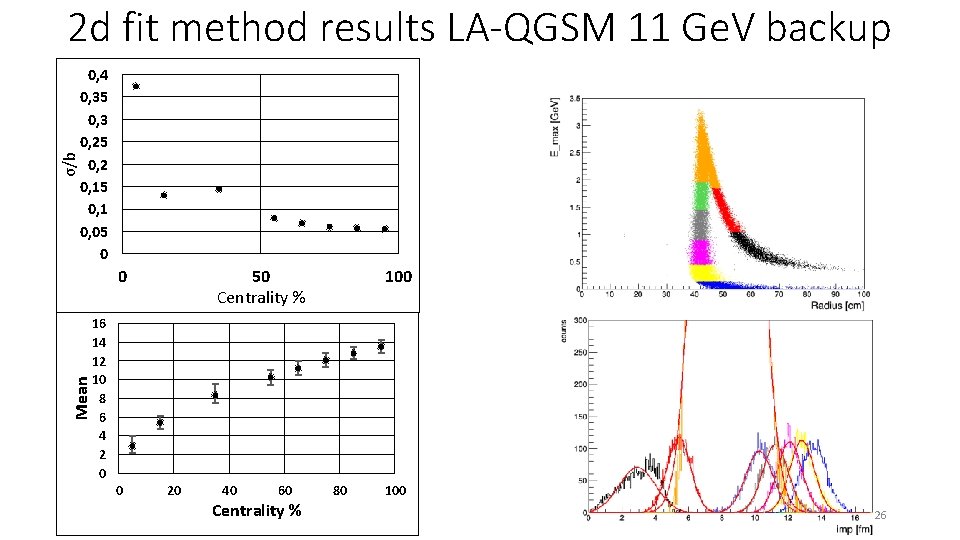
σ/b 2 d fit method results LA-QGSM 11 Ge. V backup 0, 4 0, 35 0, 3 0, 25 0, 2 0, 15 0, 1 0, 05 0 Mean 0 50 Centrality % 100 16 14 12 10 8 6 4 2 0 0 20 40 60 Centrality % 80 100 26