
Approaches AS D A Gajic CPsychol AFBPs S
Approaches (AS) D A Gajic (CPsychol, AFBPs. S) d. gajic@thepolesworthschool. com Revision
Revision Tips • Before you begin, check your own level of knowledge and understanding using PLCs (Psychology Learning checklists) so you know where to focus your revision. • Be active – reading notes doesn’t work • Look at the specimen assessment materials and mark schemes, practice exam style questions. • Find what works for you: - flash cards, mindmaps, posters, quizzes, rewriting notes etc. • Take breaks, 20 minutes revision and then a 5 minute break. • Make a revision timetable – but be realistic.
General Tips • Use the size of the response box and number of marks as a guide as to how much to write • Answer all the questions • Refer to the stimulus material in your answers (AO 2) – Read it carefully. • Use key terms. • Read and check your answers when you have finished • You have 30 minutes per section (24 marks)
AO 3 - Evaluation • PEEL • Point • Example • Explain • Link
AO 3 - Evaluation • E. g. Outline and evaluate the behavioural approach. • Point: -The behavioural approach to explaining behaviour has practical applications. • Example: - Systematic desensitisation uses the principles of classical conditioning to treat phobias. • Explain: - People with specific phobias are taught relaxation techniques and then construct a fear hierarchy. Whilst using relaxation techniques they gradually expose themselves to the items on their hierarchy. Eventually they become counter conditioned and no longer have a specific phobia. • Link: -This is an advantage of the approach as it can be used therapeutically.
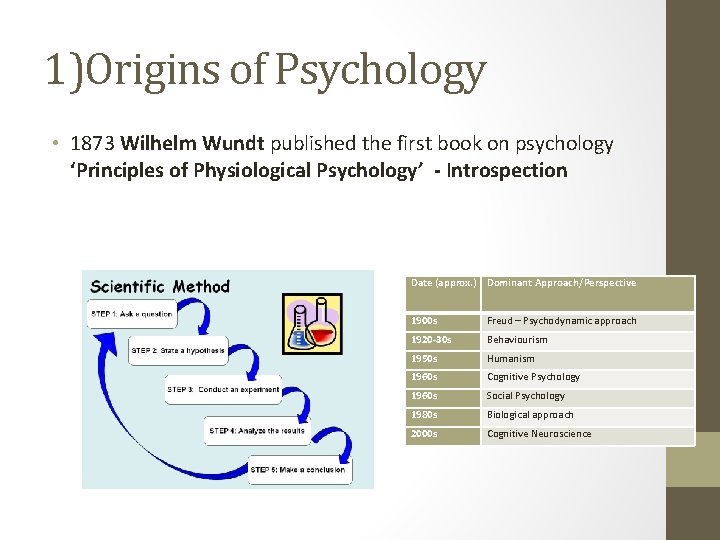
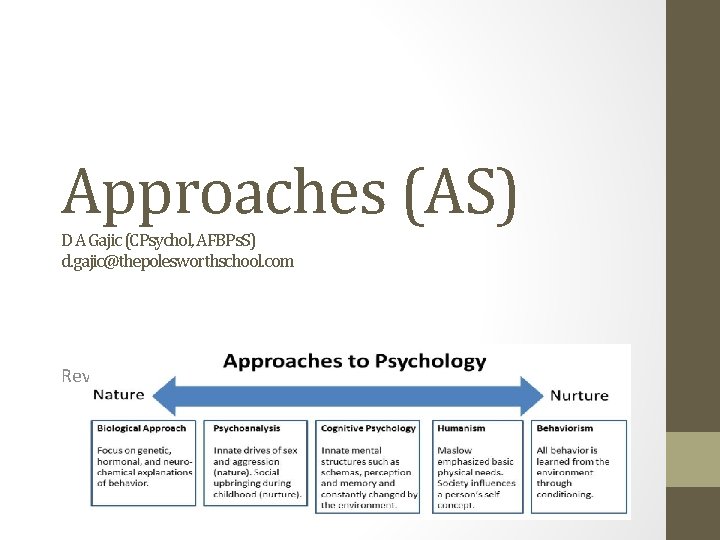
1)Origins of Psychology • 1873 Wilhelm Wundt published the first book on psychology ‘Principles of Physiological Psychology’ - Introspection Date (approx. ) Dominant Approach/Perspective 1900 s Freud – Psychodynamic approach 1920 -30 s Behaviourism 1950 s Humanism 1960 s Cognitive Psychology 1960 s Social Psychology 1980 s Biological approach 2000 s Cognitive Neuroscience
2) Learning Theory (Behaviourism: just Classical & Operant Conditioning!) • • All behaviour is learnt: Classical Conditioning – Association (Pavlov) Operant Conditioning – Reinforcement (Skinner) Social learning Theory – Imitation (Bandura)
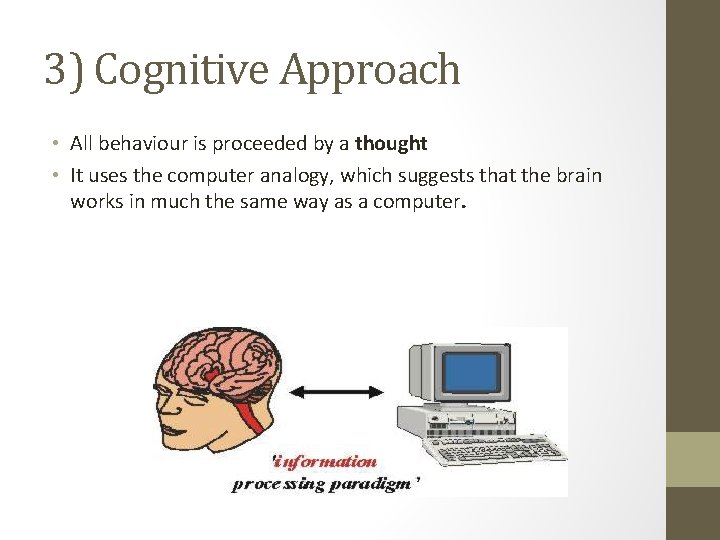
3) Cognitive Approach • All behaviour is proceeded by a thought • It uses the computer analogy, which suggests that the brain works in much the same way as a computer.
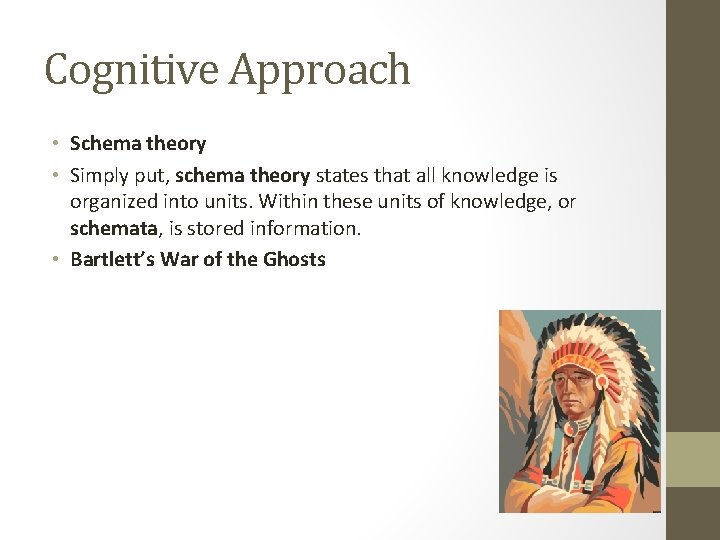
Cognitive Approach • Schema theory • Simply put, schema theory states that all knowledge is organized into units. Within these units of knowledge, or schemata, is stored information. • Bartlett’s War of the Ghosts
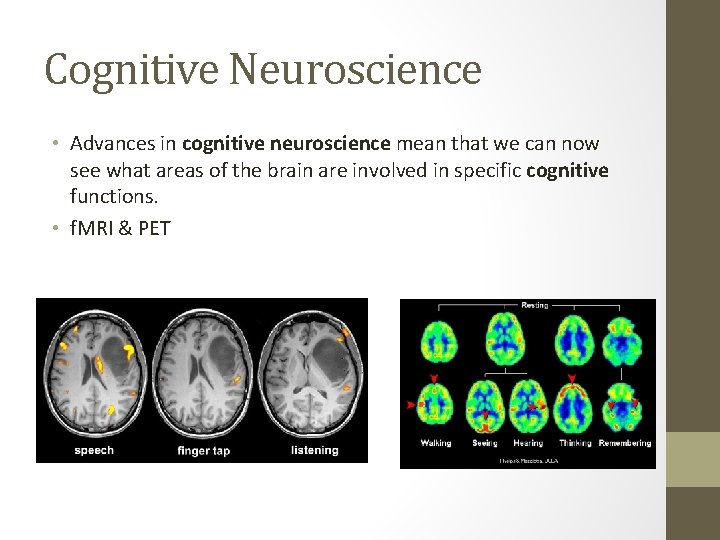
Cognitive Neuroscience • Advances in cognitive neuroscience mean that we can now see what areas of the brain are involved in specific cognitive functions. • f. MRI & PET
4)Biological Approach • This approach, as the name suggests, focuses on biological explanations of human behaviour. Of particular importance are the influences of genes, biological structures, neurochemistry and evolution. • The biological approach is firmly on the nature side of the nature/nurture debate. It is often criticized as being reductionist as it ignores social and cultural influences on behaviour.

Biological Approach • Genetic Inheritance - Our genetic inheritance comes from our parents we have 50% of our mother’s genes and 50% of our father’s genes. • The genotype is the genetic code written into the DNA of individual cells, the phenotype is physical appearance of that in the individual. In most cases, the two things will coincide, but, not always!
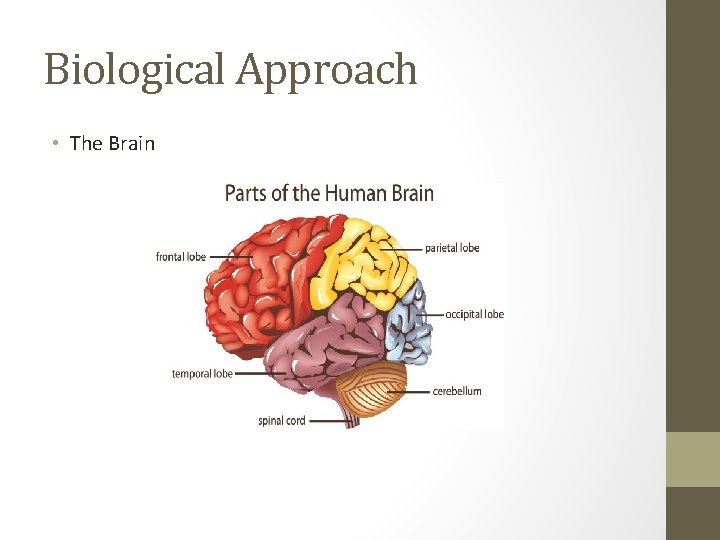
Biological Approach • The Brain
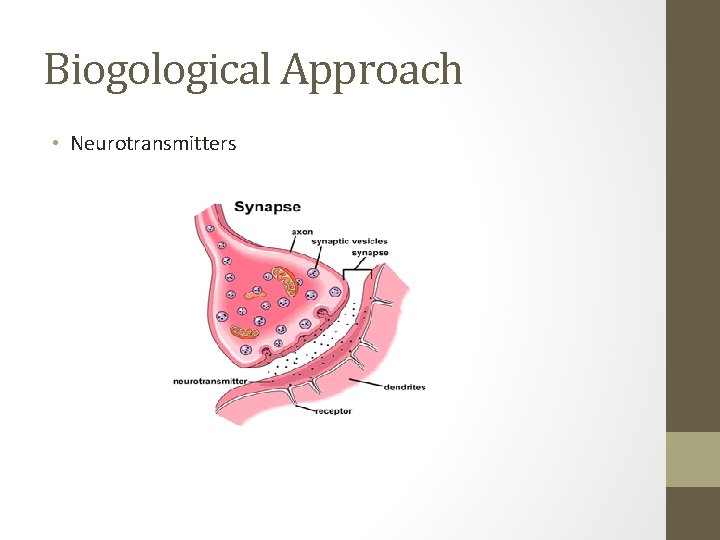
Biogological Approach • Neurotransmitters
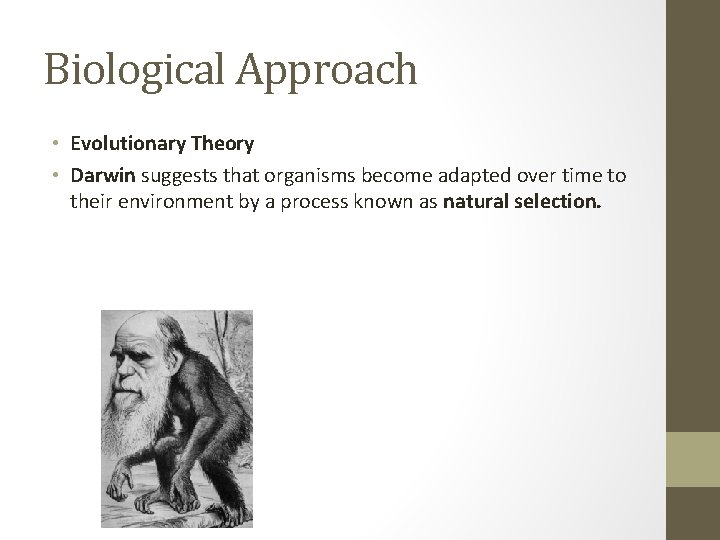
Biological Approach • Evolutionary Theory • Darwin suggests that organisms become adapted over time to their environment by a process known as natural selection.
- Slides: 15