
Approach to the Wind Resource Assessment for the
- Slides: 18
Approach to the Wind Resource Assessment for the Sixth Power Plan Northwest Power & Conservation Council Generating Resources Advisory Committee August 21, 2008
Objective • Estimate a supply curve of wind power plausibly available to the Northwest over the next 20 years • Considering: Transmission feasibility Competition from other load centers
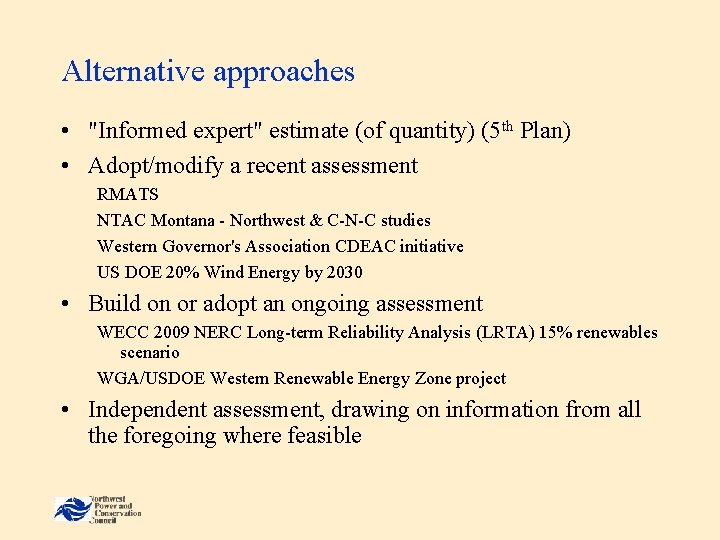
Alternative approaches • "Informed expert" estimate (of quantity) (5 th Plan) • Adopt/modify a recent assessment RMATS NTAC Montana - Northwest & C-N-C studies Western Governor's Association CDEAC initiative US DOE 20% Wind Energy by 2030 • Build on or adopt an ongoing assessment WECC 2009 NERC Long-term Reliability Analysis (LRTA) 15% renewables scenario WGA/USDOE Western Renewable Energy Zone project • Independent assessment, drawing on information from all the foregoing where feasible
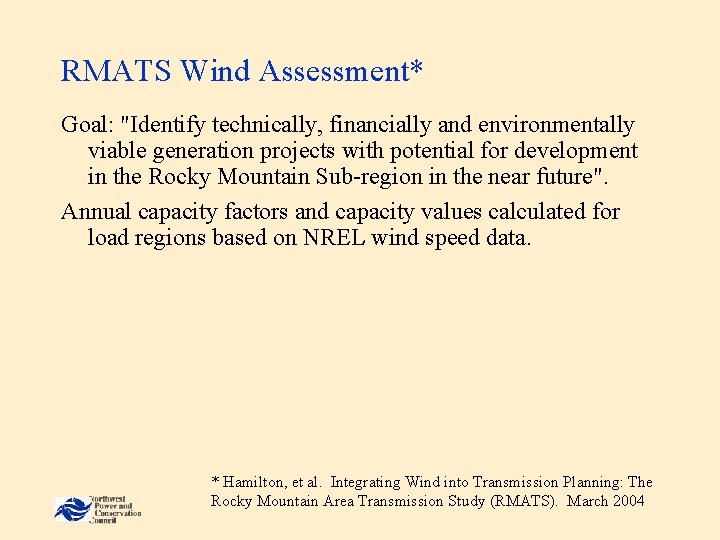
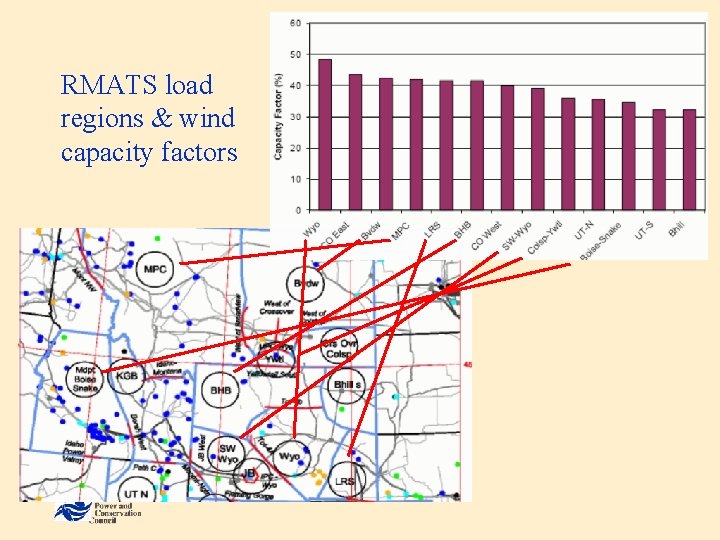
RMATS Wind Assessment* Goal: "Identify technically, financially and environmentally viable generation projects with potential for development in the Rocky Mountain Sub-region in the near future". Annual capacity factors and capacity values calculated for load regions based on NREL wind speed data. * Hamilton, et al. Integrating Wind into Transmission Planning: The Rocky Mountain Area Transmission Study (RMATS). March 2004
RMATS load regions & wind capacity factors
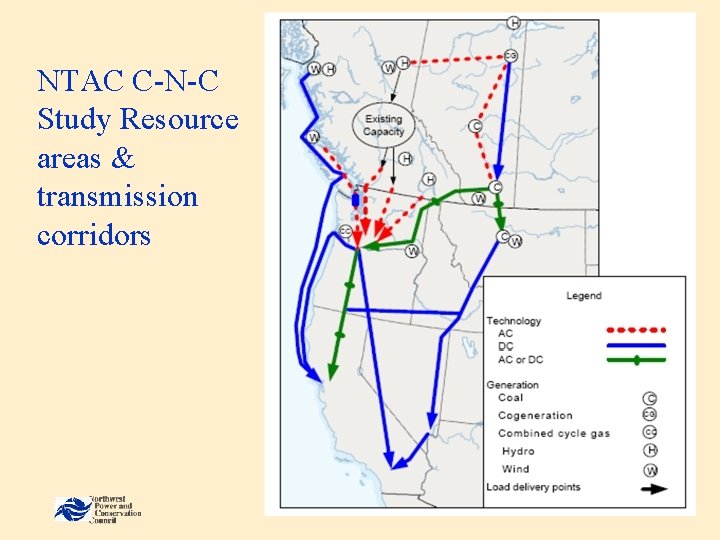
NTAC C-N-C Study Resource areas & transmission corridors
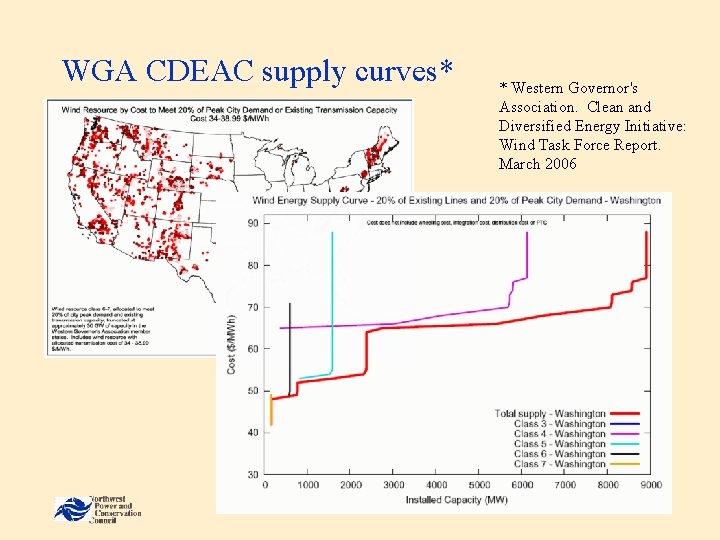
WGA CDEAC supply curves* * Western Governor's Association. Clean and Diversified Energy Initiative: Wind Task Force Report. March 2006
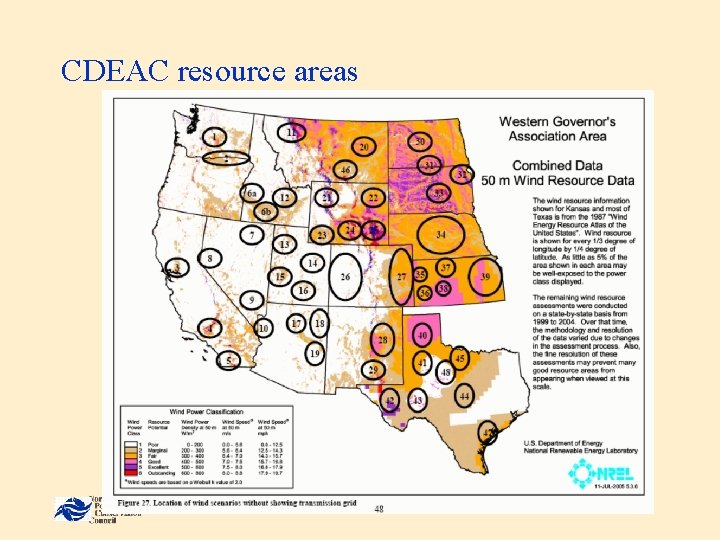
CDEAC resource areas
US DOE: 20% Wind Energy by 2030 • Published May 2008; EOY 2006 data • PNW wind characteristics based on 2002 NREL state wind power maps. • Wind capacity expansion estimated usign NREL Win. DS GIS/Linear programming capacity expansion model 136 Balancing areas (load centers) 358 Wind resource regions Transmission linkages (10% of existing capacity assumed available for wind) Seeks "Cost-optimal" buildout • Wind project and transmission capital and operating costs from Black & Veatch study (to be published). Terrestrial and shallow offshore technology.
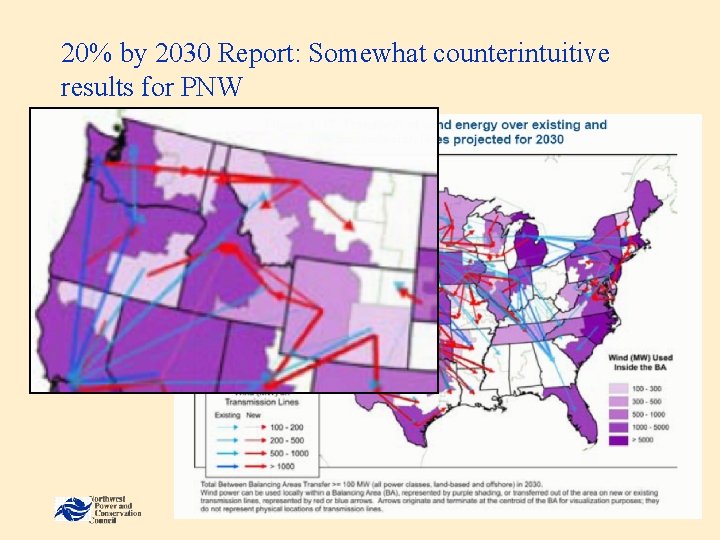
20% by 2030 Report: Somewhat counterintuitive results for PNW
Application of existing studies • RMATS Resource area annual capacity factors • NTAC Transmission cost information (needs escalation) No original resource information • CDEAC State-level wind resource supply curves No Canadian information • USDOE 20% Wind project and transmission cost estimates Questionable development patterns at regional scale • WECC/TEPPC 15% renewables scenario Resource characteristics based on new NREL mesoscale data Insufficient wind resource • WREZ Resource characteristics based on new NREL mesoscale data Realistic resource areas and transmission corridors Unlikely to be available in time
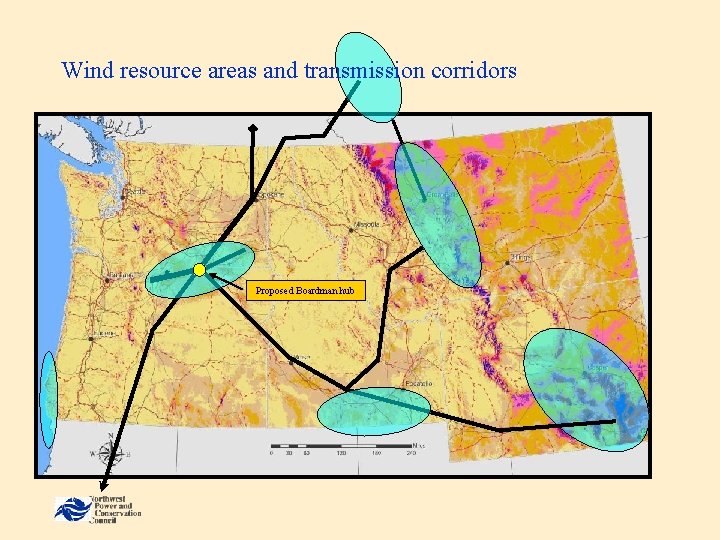
Proposed approach - Regional wind supply curve • Identify principal wind resource areas available to Northwest utilities Substantial developable wind resource Actual transmission initiatives Available information regarding wind characteristics • Estimate production characteristics of each WRA Seasonal and diurnal hourly output (12 mo x 24 hr) Incremental demand for regulation & load-following (? ) • Estimate component costs Wind plant (i. e. , busbar + local interconnection) • Terrestrial • Shallow off-shore New transmission to proposed Boardman hub (unit cost x circuit miles) Point-to-point transmission, Boardman to LSE (to establish parity w/energy-efficiency) Regulation & load-following
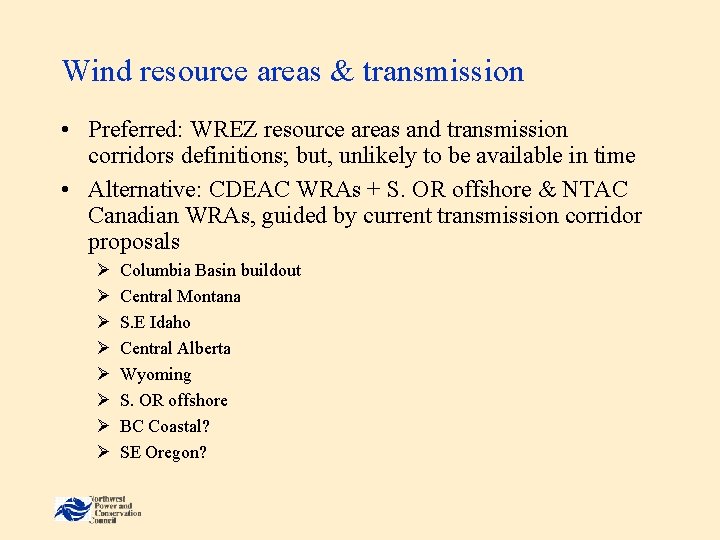
Wind resource areas & transmission • Preferred: WREZ resource areas and transmission corridors definitions; but, unlikely to be available in time • Alternative: CDEAC WRAs + S. OR offshore & NTAC Canadian WRAs, guided by current transmission corridor proposals Ø Ø Ø Ø Columbia Basin buildout Central Montana S. E Idaho Central Alberta Wyoming S. OR offshore BC Coastal? SE Oregon?
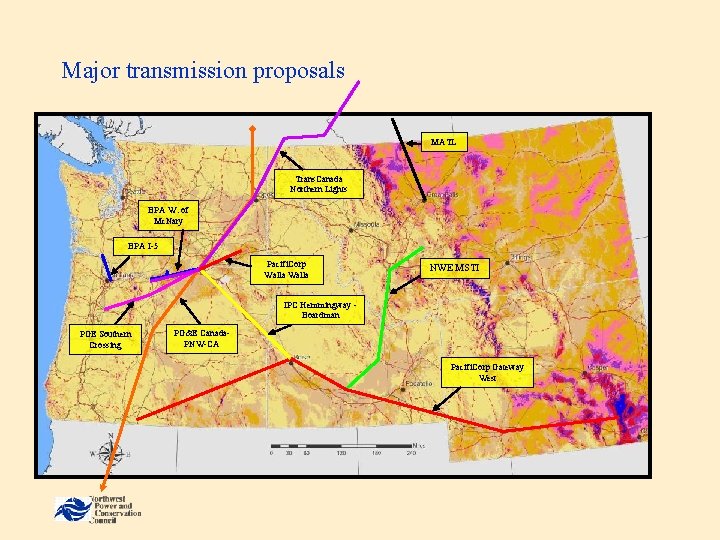
Major transmission proposals MATL Trans. Canada Northern Lights BPA W. of Mc. Nary BPA I-5 Pacifi. Corp Walla NWE MSTI IPC Hemmingway Boardman PGE Southern Crossing PG&E Canada. PNW-CA Pacifi. Corp Gateway West
Wind resource areas and transmission corridors Proposed Boardman hub
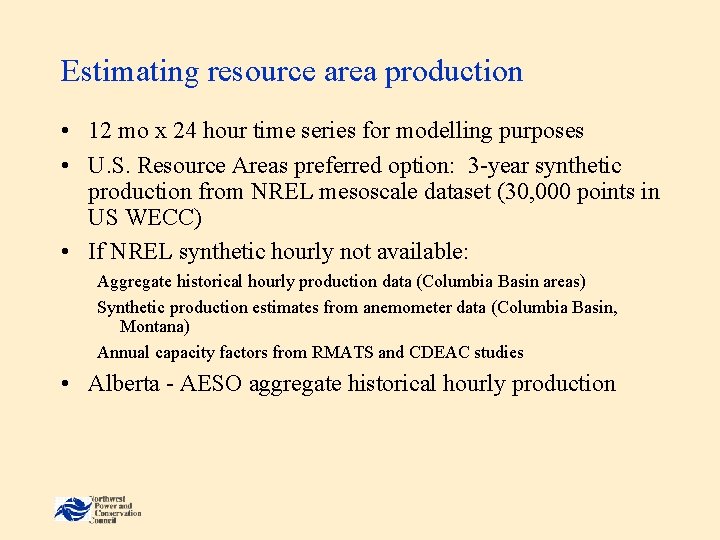
Estimating resource area production • 12 mo x 24 hour time series for modelling purposes • U. S. Resource Areas preferred option: 3 -year synthetic production from NREL mesoscale dataset (30, 000 points in US WECC) • If NREL synthetic hourly not available: Aggregate historical hourly production data (Columbia Basin areas) Synthetic production estimates from anemometer data (Columbia Basin, Montana) Annual capacity factors from RMATS and CDEAC studies • Alberta - AESO aggregate historical hourly production
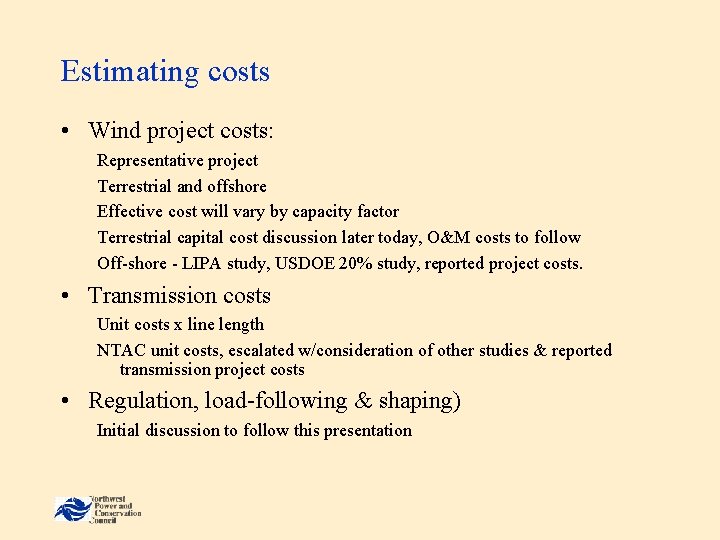
Estimating costs • Wind project costs: Representative project Terrestrial and offshore Effective cost will vary by capacity factor Terrestrial capital cost discussion later today, O&M costs to follow Off-shore - LIPA study, USDOE 20% study, reported project costs. • Transmission costs Unit costs x line length NTAC unit costs, escalated w/consideration of other studies & reported transmission project costs • Regulation, load-following & shaping) Initial discussion to follow this presentation
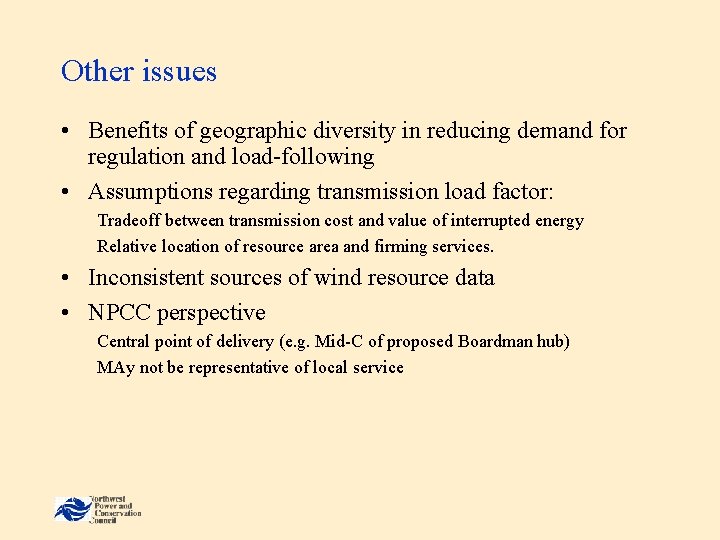
Other issues • Benefits of geographic diversity in reducing demand for regulation and load-following • Assumptions regarding transmission load factor: Tradeoff between transmission cost and value of interrupted energy Relative location of resource area and firming services. • Inconsistent sources of wind resource data • NPCC perspective Central point of delivery (e. g. Mid-C of proposed Boardman hub) MAy not be representative of local service