
Approach to the reviews of the Third Biennial
Approach to the reviews of the Third Biennial Reports and Seventh National Communications 5 th BRs and NCs lead reviewers meeting 28 February – 1 March, 2018 Ruta Bubniene, Team Lead, International Assessment and Review Unit Mitigation Data Analysis programme, UNFCCC secretariat
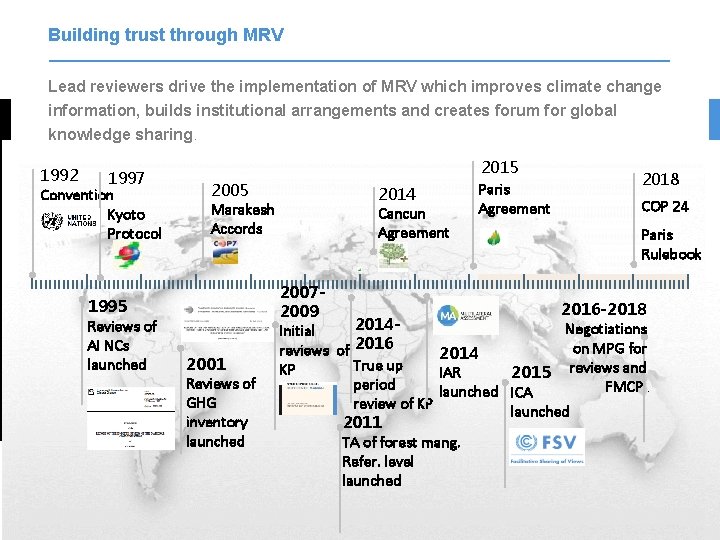
Building trust through MRV Lead reviewers drive the implementation of MRV which improves climate change information, builds institutional arrangements and creates forum for global knowledge sharing. 1992 1997 Convention Kyoto Protocol 1995 Reviews of AI NCs launched 2005 Marakesh Accords 2001 Reviews of GHG inventory launched 2014 Cancun Agreement 2015 Paris Agreement 2018 COP 24 Paris Rulebook 20072016 -2018 2009 2014 Negotiations Initial on MPG for reviews of 2016 2014 True up KP IAR 2015 reviews and period FMCP. launched ICA review of KP launched 2011 TA of forest mang. Refer. level launched
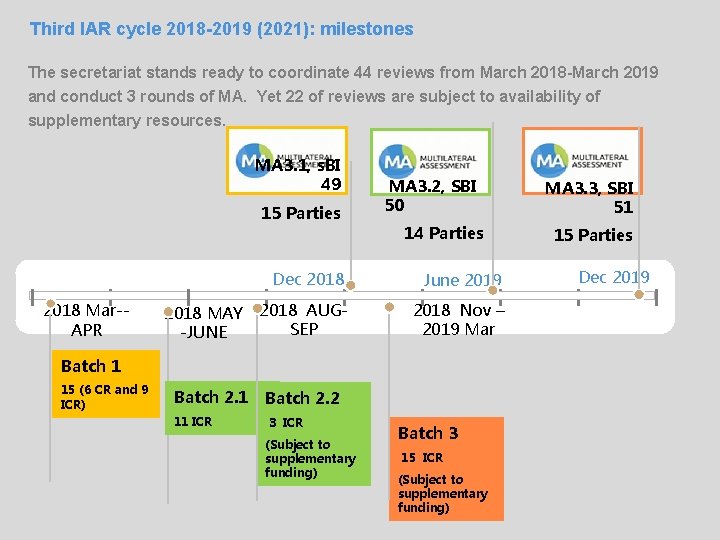
Third IAR cycle 2018 -2019 (2021): milestones The secretariat stands ready to coordinate 44 reviews from March 2018 -March 2019 and conduct 3 rounds of MA. Yet 22 of reviews are subject to availability of supplementary resources. MA 3. 1, s. BI 49 15 Parties 2018 Mar-APR 2018 MAY -JUNE MA 3. 2, SBI 50 14 Parties Dec 2018 June 2019 2018 AUGSEP 2018 Nov – 2019 Mar Batch 1 15 (6 CR and 9 ICR) Batch 2. 1 Batch 2. 2 11 ICR 3 ICR (Subject to supplementary funding) Batch 3 15 ICR (Subject to supplementary funding) MA 3. 3, SBI 51 15 Parties Dec 2019
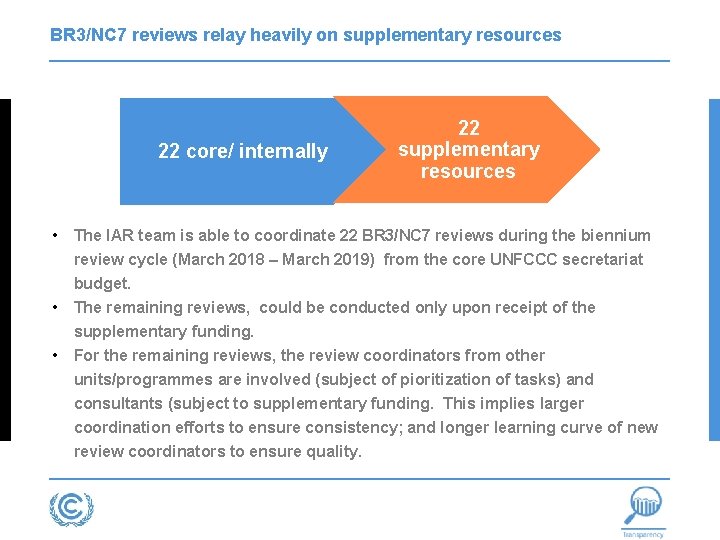
BR 3/NC 7 reviews relay heavily on supplementary resources 22 core/ internally 22 supplementary resources • The IAR team is able to coordinate 22 BR 3/NC 7 reviews during the biennium review cycle (March 2018 – March 2019) from the core UNFCCC secretariat budget. • The remaining reviews, could be conducted only upon receipt of the supplementary funding. • For the remaining reviews, the review coordinators from other units/programmes are involved (subject of pioritization of tasks) and consultants (subject to supplementary funding. This implies larger coordination efforts to ensure consistency; and longer learning curve of new review coordinators to ensure quality.
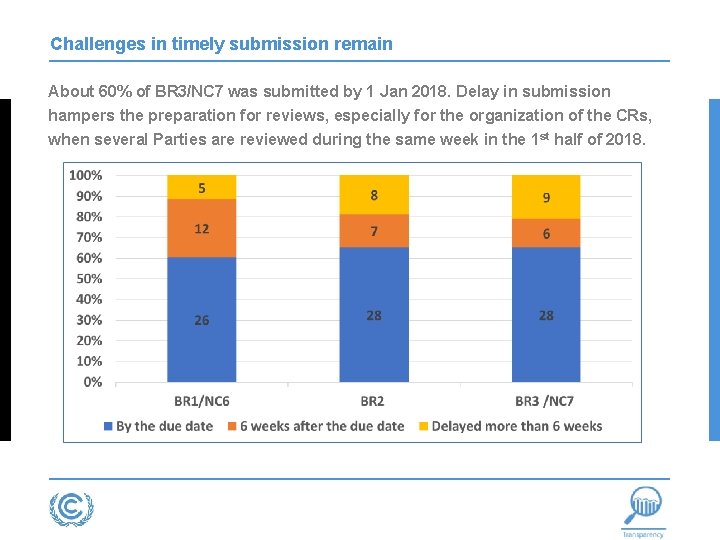
Challenges in timely submission remain About 60% of BR 3/NC 7 was submitted by 1 Jan 2018. Delay in submission hampers the preparation for reviews, especially for the organization of the CRs, when several Parties are reviewed during the same week in the 1 st half of 2018.
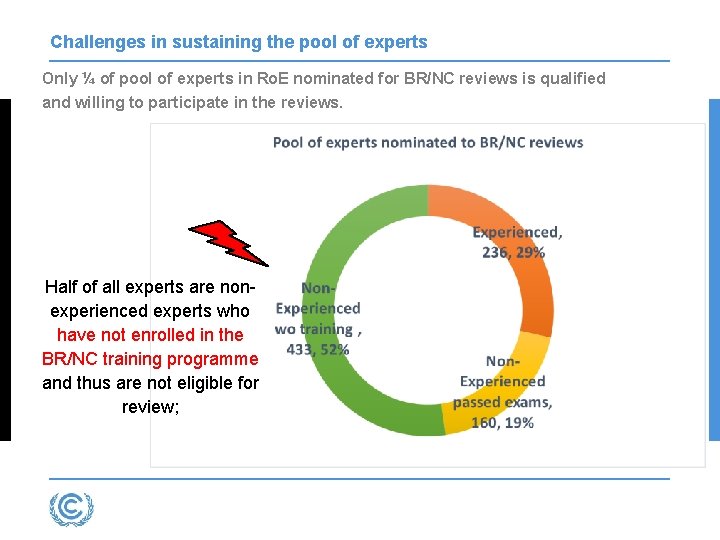
Challenges in sustaining the pool of experts Only ¼ of pool of experts in Ro. E nominated for BR/NC reviews is qualified and willing to participate in the reviews. Half of all experts are nonexperienced experts who have not enrolled in the BR/NC training programme and thus are not eligible for review;
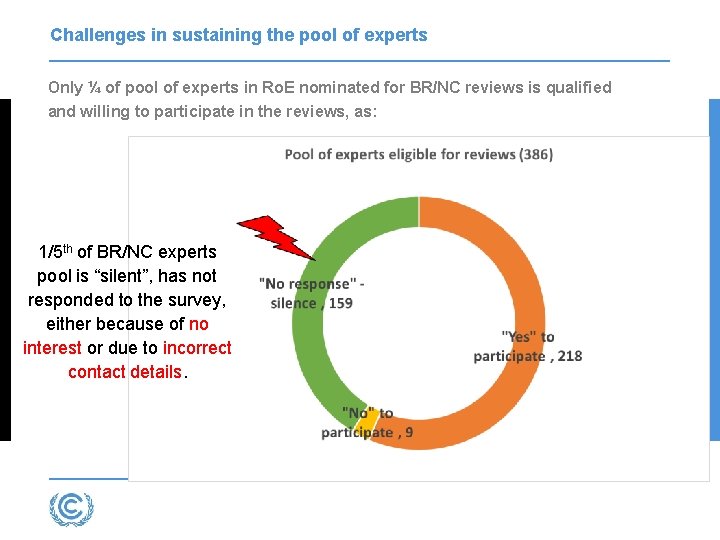
Challenges in sustaining the pool of experts Only ¼ of pool of experts in Ro. E nominated for BR/NC reviews is qualified and willing to participate in the reviews, as: 1/5 th of BR/NC experts pool is “silent”, has not responded to the survey, either because of no interest or due to incorrect contact details.
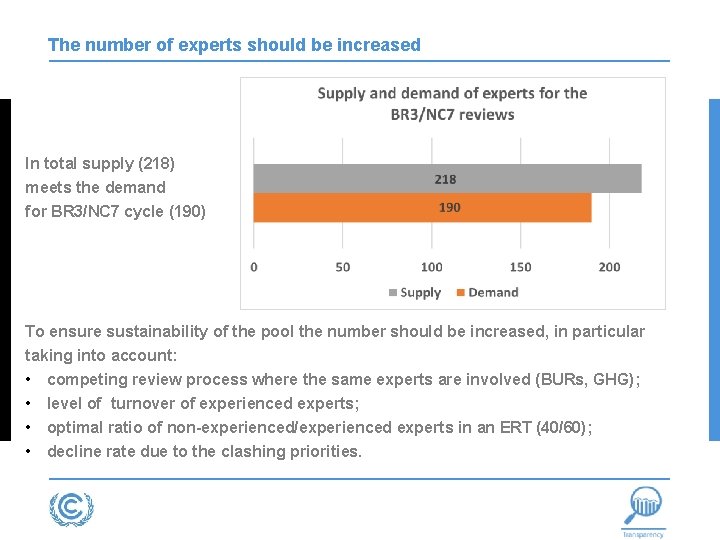
The number of experts should be increased In total supply (218) meets the demand for BR 3/NC 7 cycle (190) To ensure sustainability of the pool the number should be increased, in particular taking into account: • competing review process where the same experts are involved (BURs, GHG); • level of turnover of experienced experts; • optimal ratio of non-experienced/experienced experts in an ERT (40/60); • decline rate due to the clashing priorities.
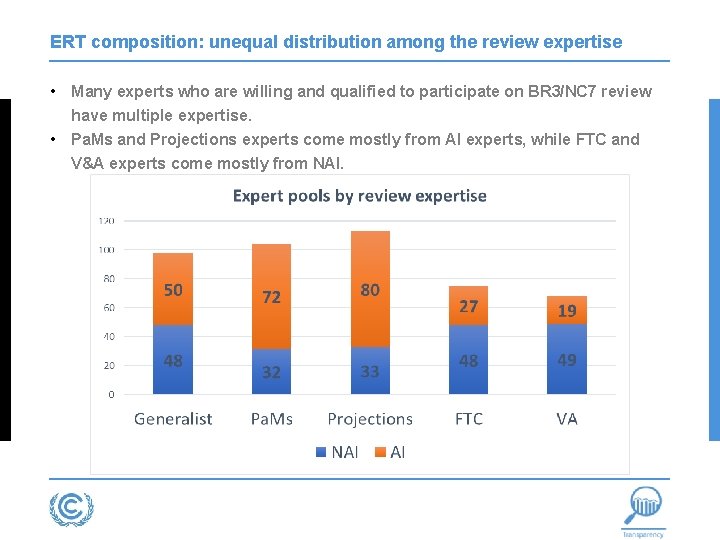
ERT composition: unequal distribution among the review expertise • Many experts who are willing and qualified to participate on BR 3/NC 7 review have multiple expertise. • Pa. Ms and Projections experts come mostly from AI experts, while FTC and V&A experts come mostly from NAI.
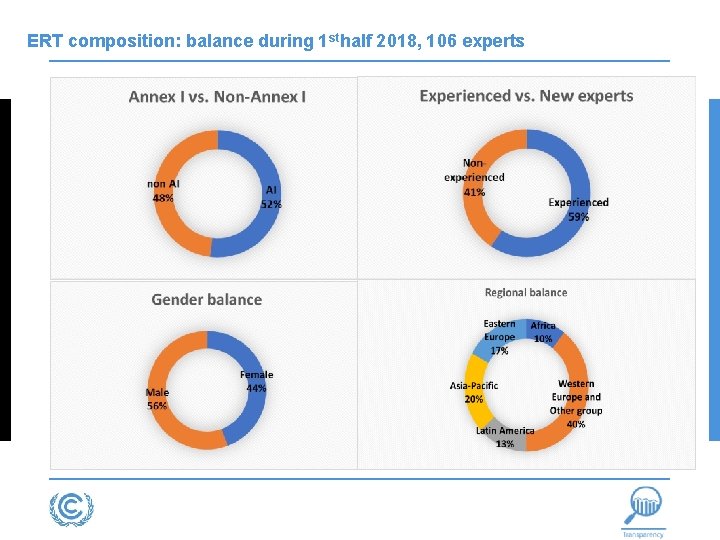
ERT composition: balance during 1 sthalf 2018, 106 experts
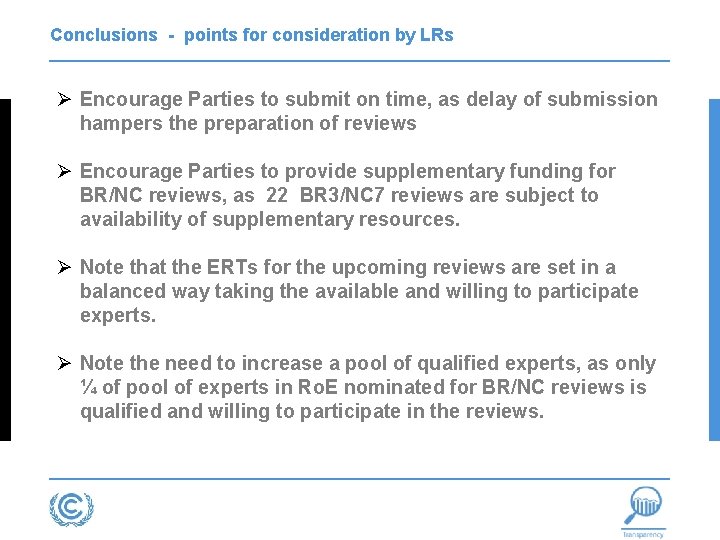
Conclusions - points for consideration by LRs Ø Encourage Parties to submit on time, as delay of submission hampers the preparation of reviews Ø Encourage Parties to provide supplementary funding for BR/NC reviews, as 22 BR 3/NC 7 reviews are subject to availability of supplementary resources. Ø Note that the ERTs for the upcoming reviews are set in a balanced way taking the available and willing to participate experts. Ø Note the need to increase a pool of qualified experts, as only ¼ of pool of experts in Ro. E nominated for BR/NC reviews is qualified and willing to participate in the reviews.
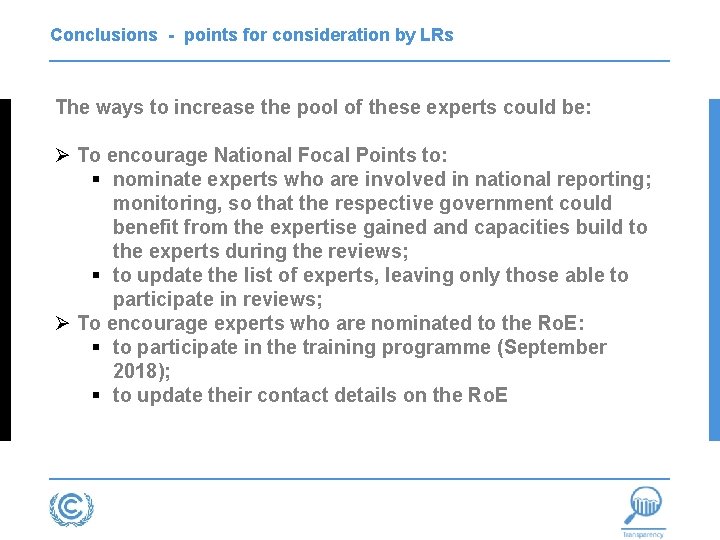
Conclusions - points for consideration by LRs The ways to increase the pool of these experts could be: Ø To encourage National Focal Points to: § nominate experts who are involved in national reporting; monitoring, so that the respective government could benefit from the expertise gained and capacities build to the experts during the reviews; § to update the list of experts, leaving only those able to participate in reviews; Ø To encourage experts who are nominated to the Ro. E: § to participate in the training programme (September 2018); § to update their contact details on the Ro. E
Thank you very much for your attention!
- Slides: 13