
Approach to Sound System Design Sound a little
- Slides: 58
Approach to Sound System Design • • • Sound: a little bit of Physics SPL and sound propagation in free field Room Acoustic: some useful definitions Intelligibility Sound System Design: some suggestions Q&A
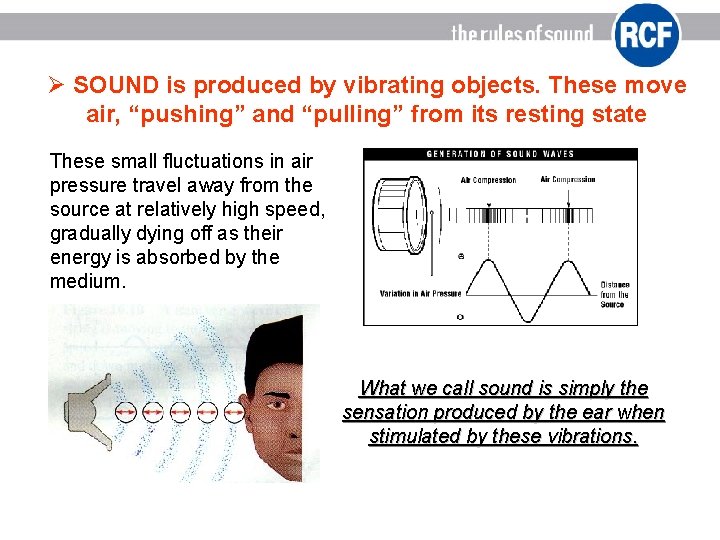
Ø SOUND is produced by vibrating objects. These move air, “pushing” and “pulling” from its resting state These small fluctuations in air pressure travel away from the source at relatively high speed, gradually dying off as their energy is absorbed by the medium. What we call sound is simply the sensation produced by the ear when stimulated by these vibrations.
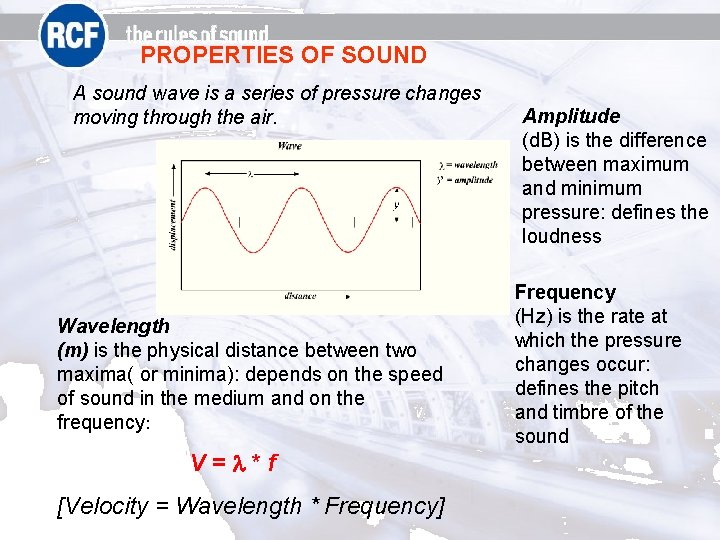
PROPERTIES OF SOUND A sound wave is a series of pressure changes moving through the air. Wavelength (m) is the physical distance between two maxima( or minima): depends on the speed of sound in the medium and on the frequency: V=l*f [Velocity = Wavelength * Frequency] Amplitude (d. B) is the difference between maximum and minimum pressure: defines the loudness Frequency (Hz) is the rate at which the pressure changes occur: defines the pitch and timbre of the sound
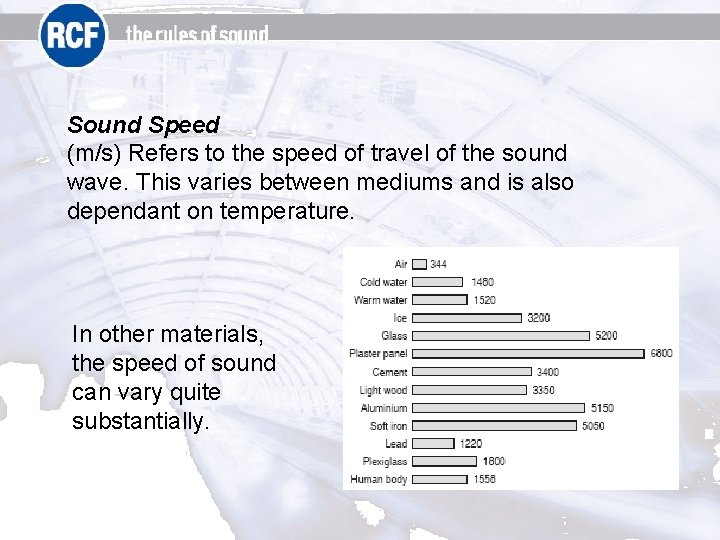
Sound Speed (m/s) Refers to the speed of travel of the sound wave. This varies between mediums and is also dependant on temperature. In other materials, the speed of sound can vary quite substantially.
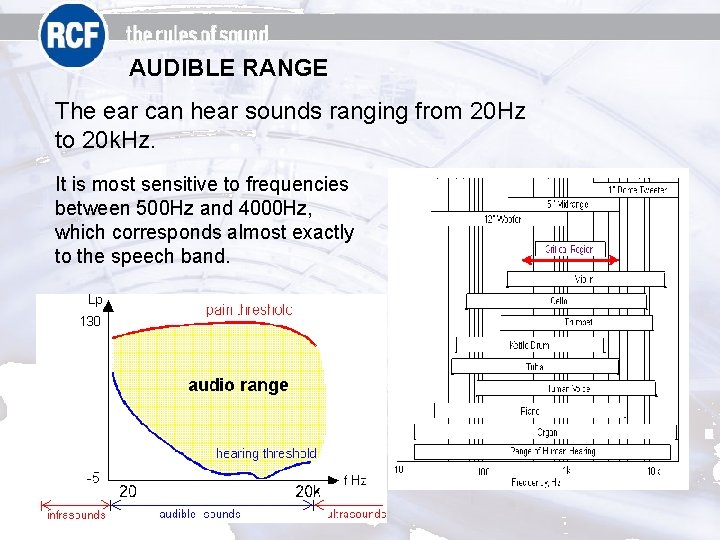
AUDIBLE RANGE The ear can hear sounds ranging from 20 Hz to 20 k. Hz. It is most sensitive to frequencies between 500 Hz and 4000 Hz, which corresponds almost exactly to the speech band.
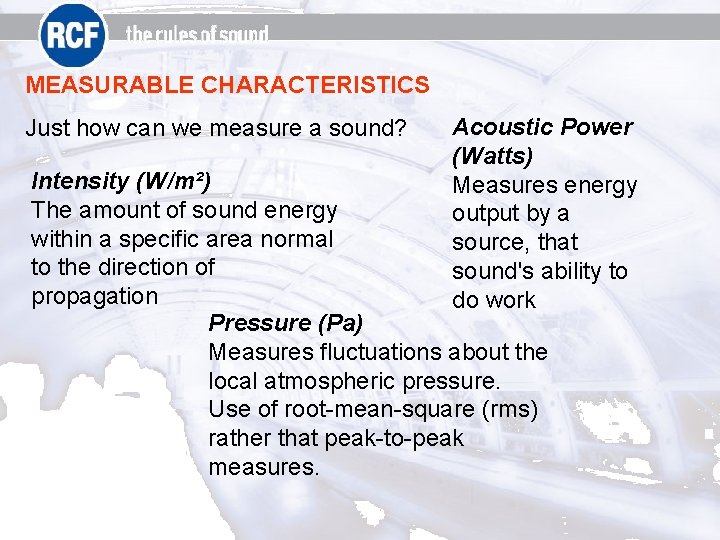
MEASURABLE CHARACTERISTICS Just how can we measure a sound? Acoustic Power (Watts) Measures energy output by a source, that sound's ability to do work Intensity (W/m²) The amount of sound energy within a specific area normal to the direction of propagation Pressure (Pa) Measures fluctuations about the local atmospheric pressure. Use of root-mean-square (rms) rather that peak-to-peak measures.
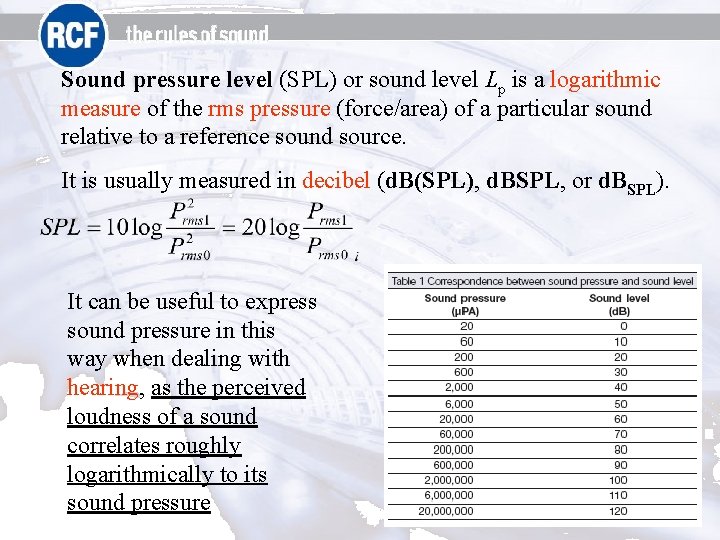
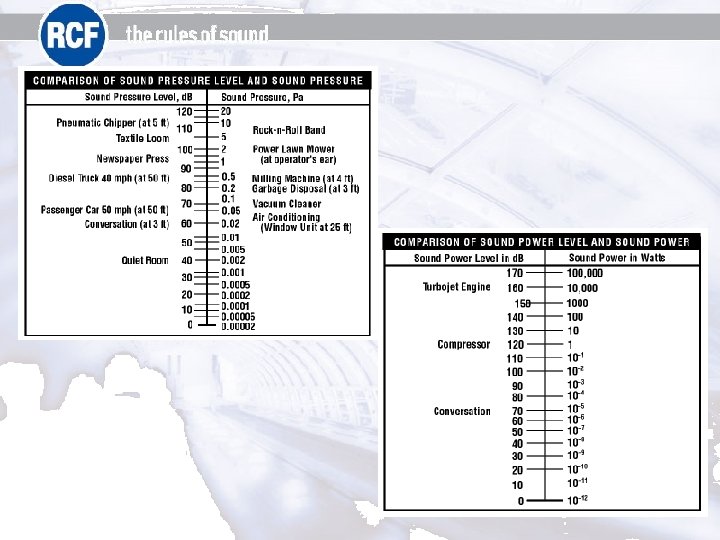
Sound pressure level (SPL) or sound level Lp is a logarithmic measure of the rms pressure (force/area) of a particular sound relative to a reference sound source. It is usually measured in decibel (d. B(SPL), d. BSPL, or d. BSPL). It can be useful to express sound pressure in this way when dealing with hearing, as the perceived loudness of a sound correlates roughly logarithmically to its sound pressure
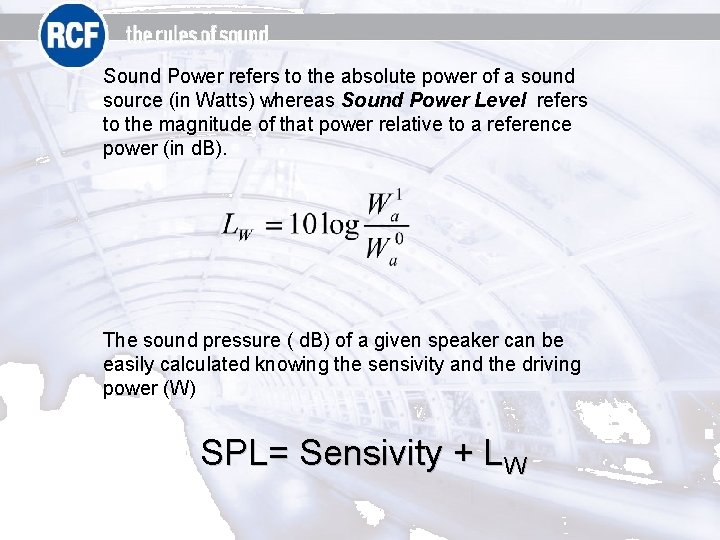
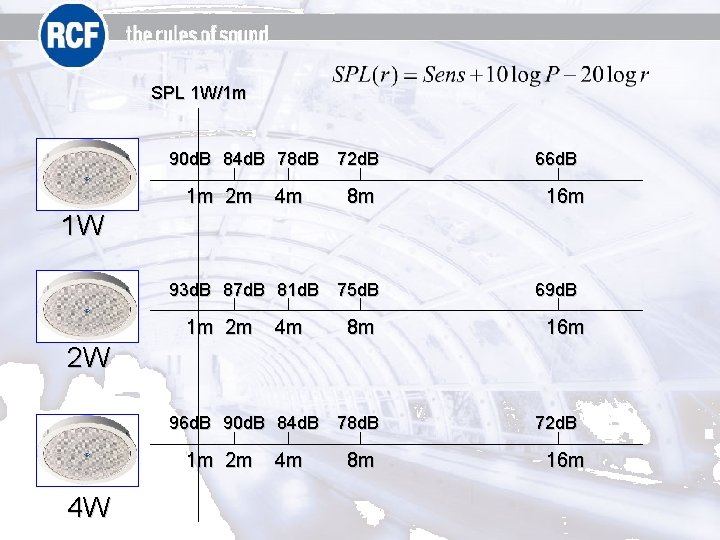
Sound Power refers to the absolute power of a sound source (in Watts) whereas Sound Power Level refers to the magnitude of that power relative to a reference power (in d. B). The sound pressure ( d. B) of a given speaker can be easily calculated knowing the sensivity and the driving power (W) SPL= Sensivity + LW
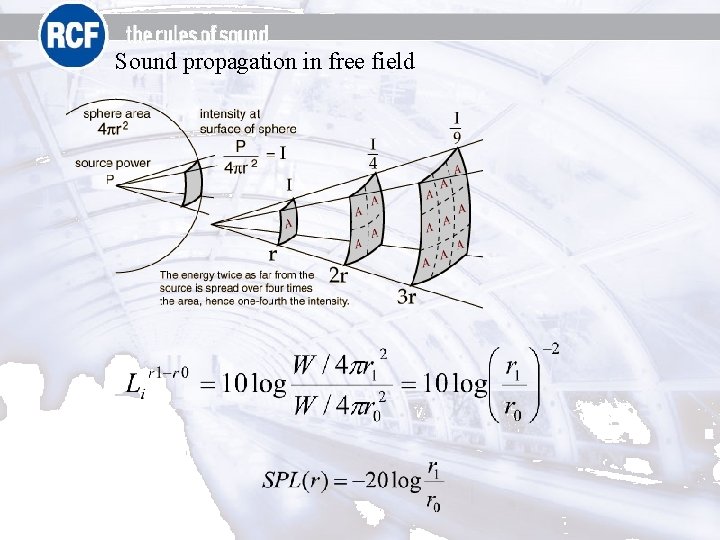
Sound propagation in free field
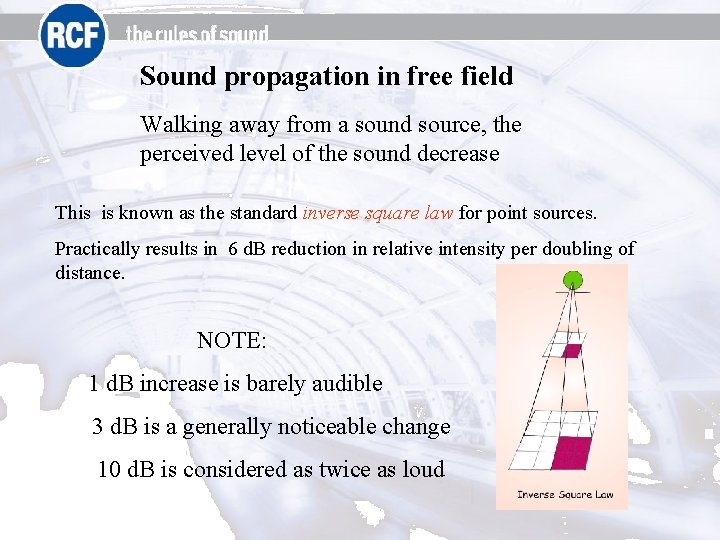
Sound propagation in free field Walking away from a sound source, the perceived level of the sound decrease This is known as the standard inverse square law for point sources. Practically results in 6 d. B reduction in relative intensity per doubling of distance. NOTE: 1 d. B increase is barely audible 3 d. B is a generally noticeable change 10 d. B is considered as twice as loud
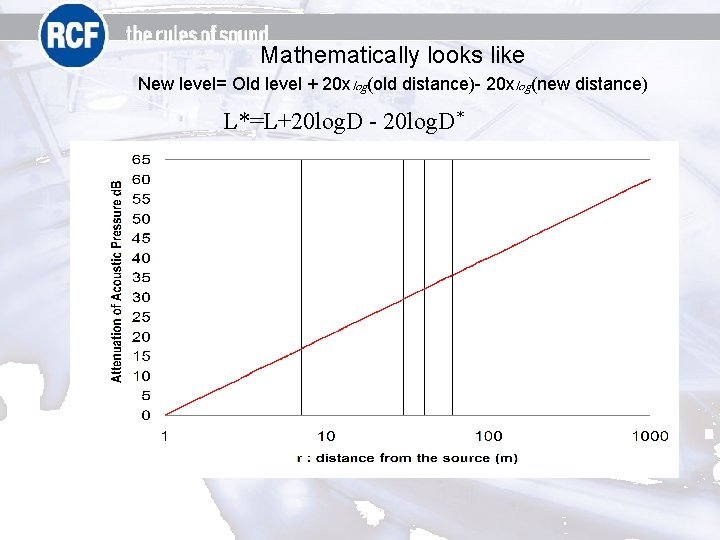
Mathematically looks like New level= Old level + 20 xlog(old distance)- 20 xlog(new distance) L*=L+20 log. D - 20 log. D*
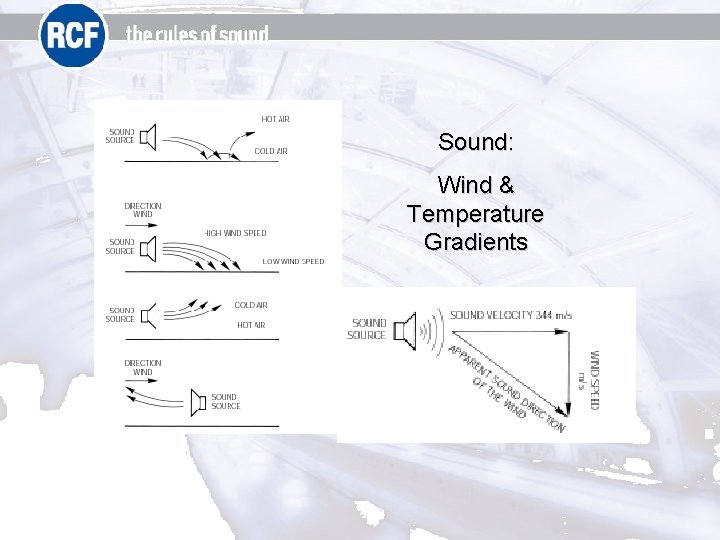
Sound: Wind & Temperature Gradients
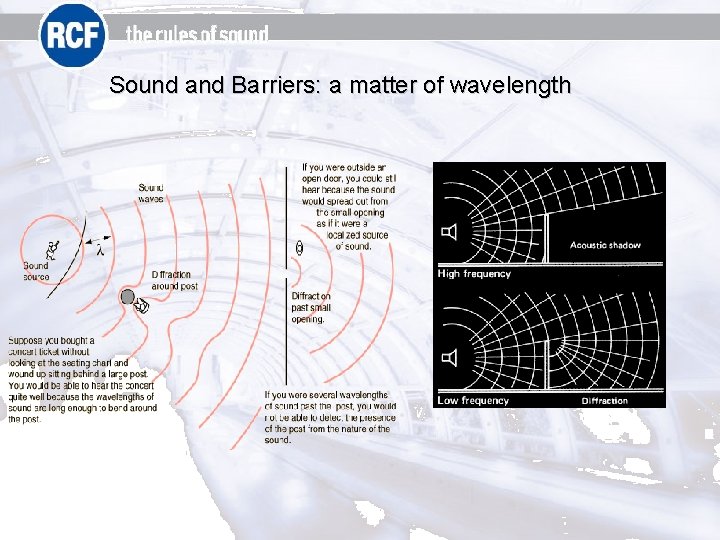
Sound and Barriers: a matter of wavelength
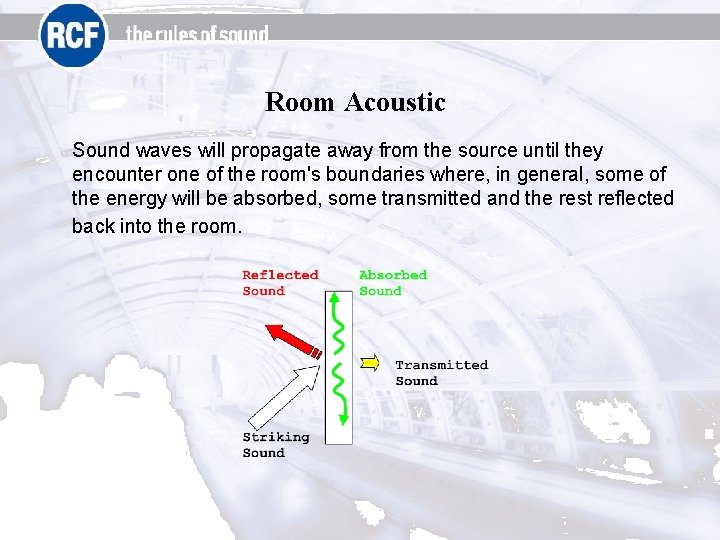
Room Acoustic Sound waves will propagate away from the source until they encounter one of the room's boundaries where, in general, some of the energy will be absorbed, some transmitted and the rest reflected back into the room.
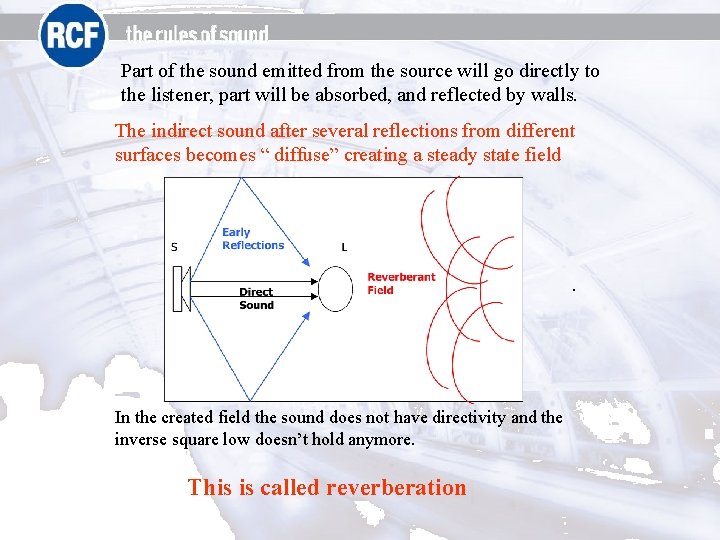
Part of the sound emitted from the source will go directly to the listener, part will be absorbed, and reflected by walls. The indirect sound after several reflections from different surfaces becomes “ diffuse” creating a steady state field . In the created field the sound does not have directivity and the inverse square low doesn’t hold anymore. This is called reverberation
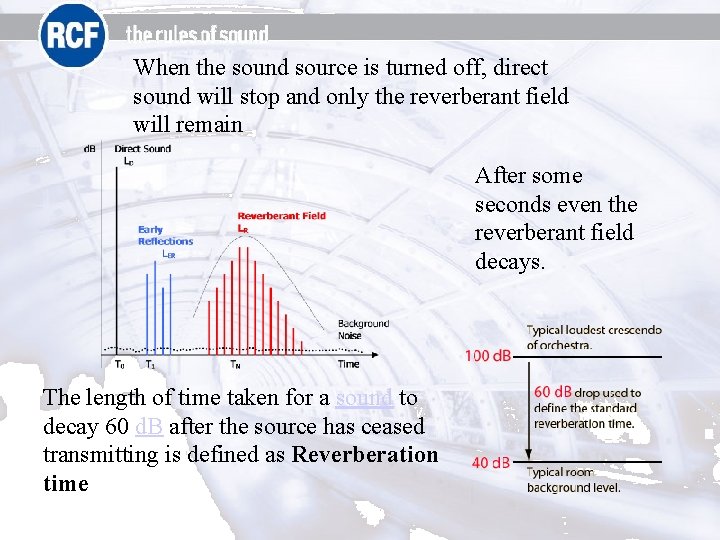
When the sound source is turned off, direct sound will stop and only the reverberant field will remain After some seconds even the reverberant field decays. The length of time taken for a sound to decay 60 d. B after the source has ceased transmitting is defined as Reverberation time
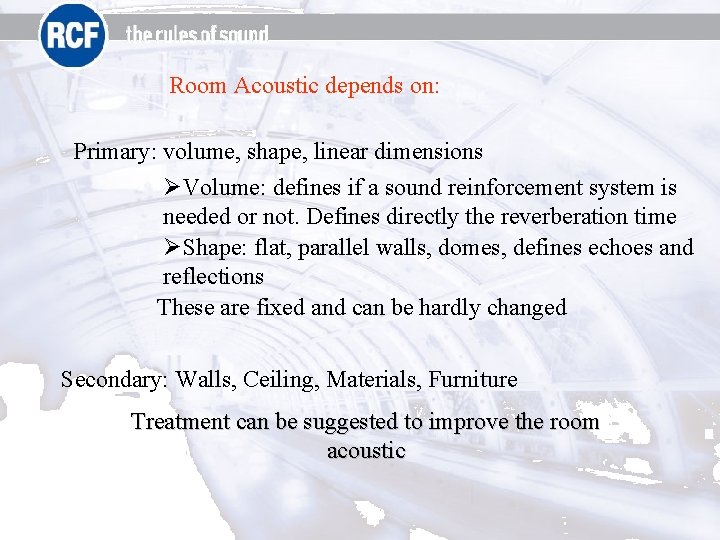
Room Acoustic depends on: Primary: volume, shape, linear dimensions ØVolume: defines if a sound reinforcement system is needed or not. Defines directly the reverberation time ØShape: flat, parallel walls, domes, defines echoes and reflections These are fixed and can be hardly changed Secondary: Walls, Ceiling, Materials, Furniture Treatment can be suggested to improve the room acoustic
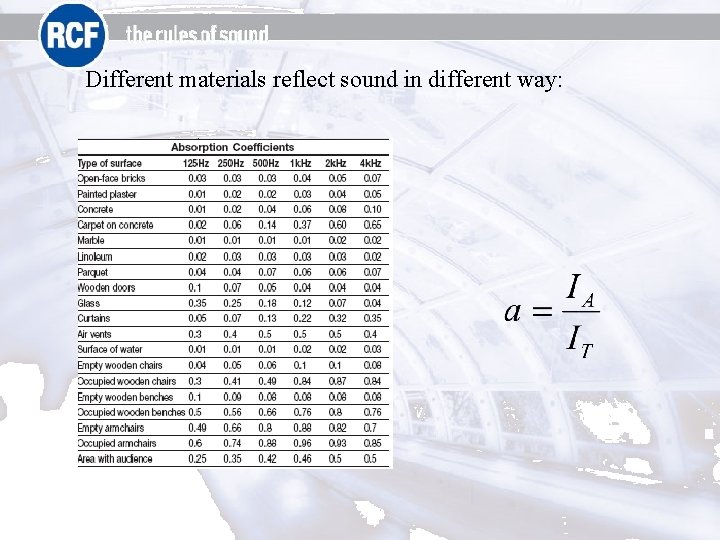
Different materials reflect sound in different way:
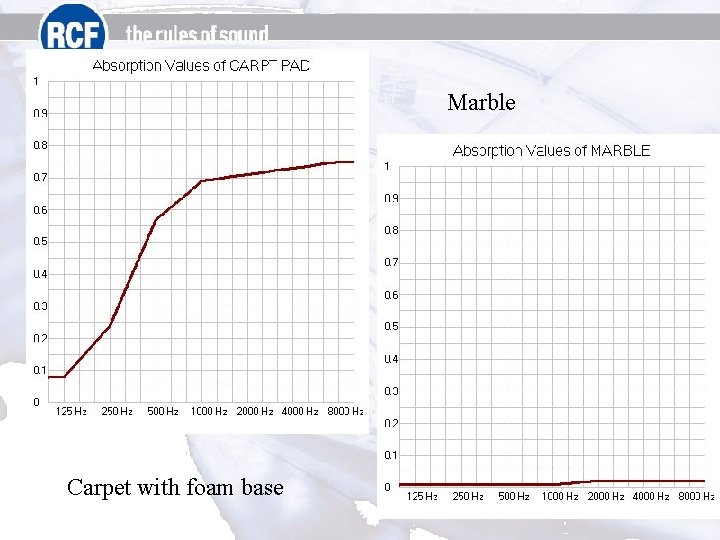
Marble Carpet with foam base
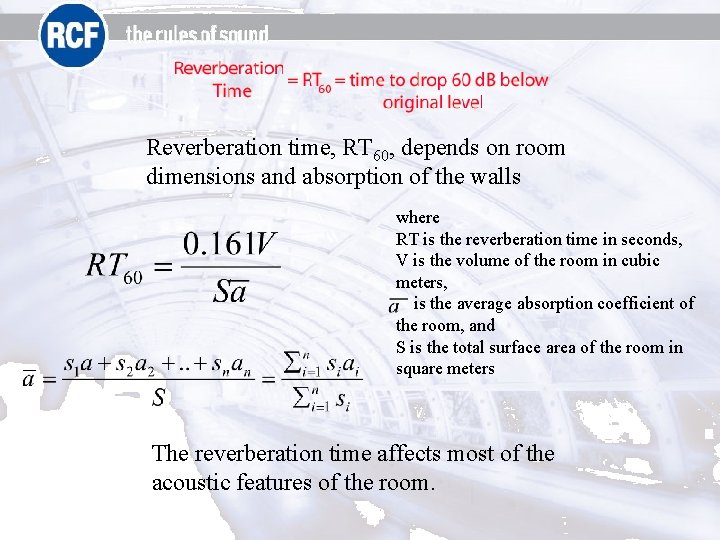
Reverberation time, RT 60, depends on room dimensions and absorption of the walls where RT is the reverberation time in seconds, V is the volume of the room in cubic meters, is the average absorption coefficient of the room, and S is the total surface area of the room in square meters The reverberation time affects most of the acoustic features of the room.
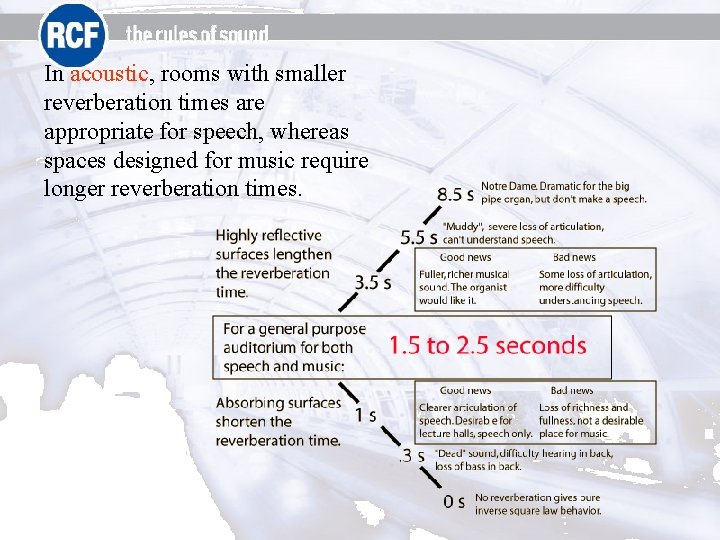
In acoustic, rooms with smaller reverberation times are appropriate for speech, whereas spaces designed for music require longer reverberation times.
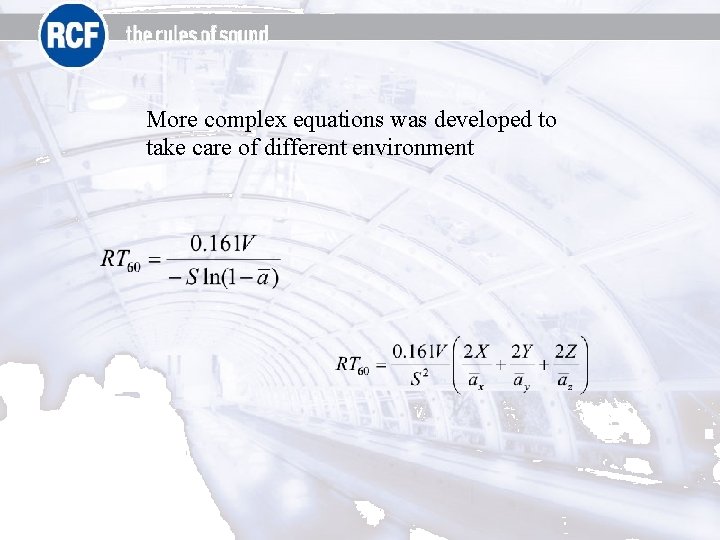
More complex equations was developed to take care of different environment
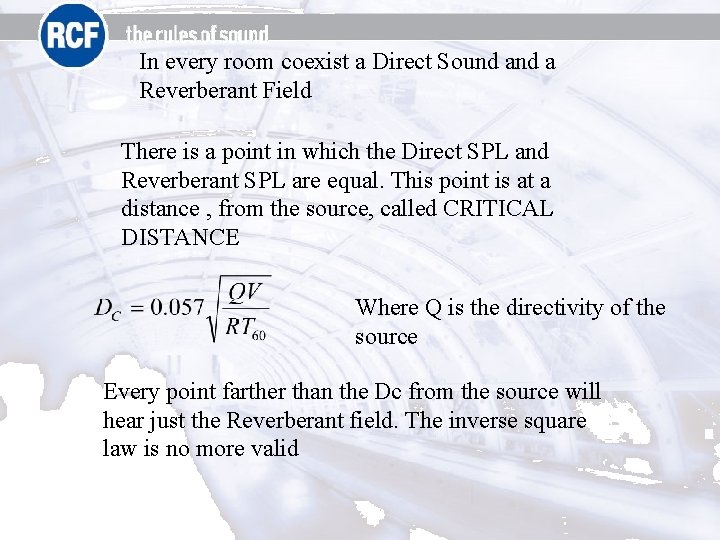
In every room coexist a Direct Sound a Reverberant Field There is a point in which the Direct SPL and Reverberant SPL are equal. This point is at a distance , from the source, called CRITICAL DISTANCE Where Q is the directivity of the source Every point farther than the Dc from the source will hear just the Reverberant field. The inverse square law is no more valid
What is a “good sound? Fidelity. Is given by the frequency response. It depends on each item of the audio chain Loudness: must be sufficient to achieve the required effect. Is determined by the dynamic range of the sound system Intelligibility: is linked by the signal/noise ratio and the direct-toreverberant sound ratio at listener’s ear. It depends directly on room acoustic Room Acoustic is as important as the sound system itself.
Audibility Clarity ability to hear a sound ability to detect the structure of a sound This distinction is more important in speech than in music
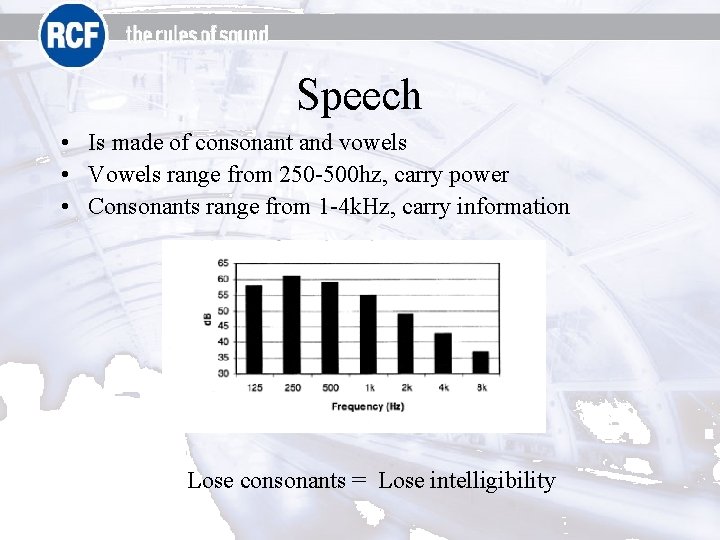
Speech • Is made of consonant and vowels • Vowels range from 250 -500 hz, carry power • Consonants range from 1 -4 k. Hz, carry information Lose consonants = Lose intelligibility
Intelligibility Is not a physical quantity as Ampere, Volt, Watt Measure of the degree of understanding spoken language There are many index to express this degree, many way to measure, and predict it
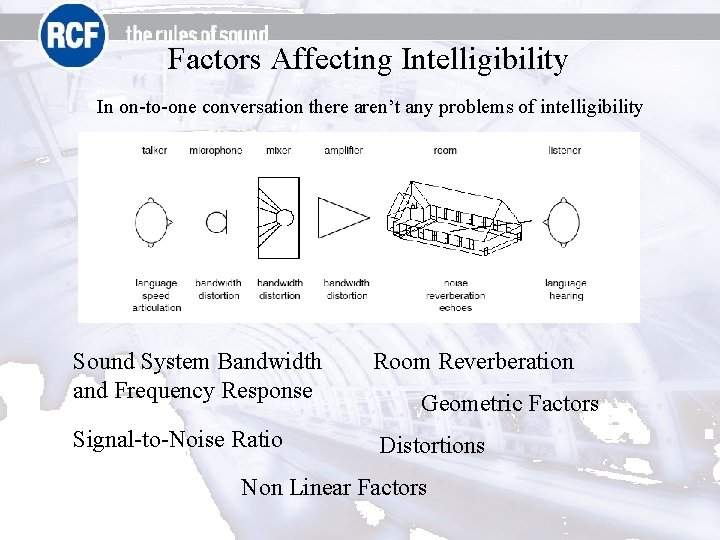
Factors Affecting Intelligibility In on-to-one conversation there aren’t any problems of intelligibility Sound System Bandwidth and Frequency Response Room Reverberation Signal-to-Noise Ratio Distortions Geometric Factors Non Linear Factors
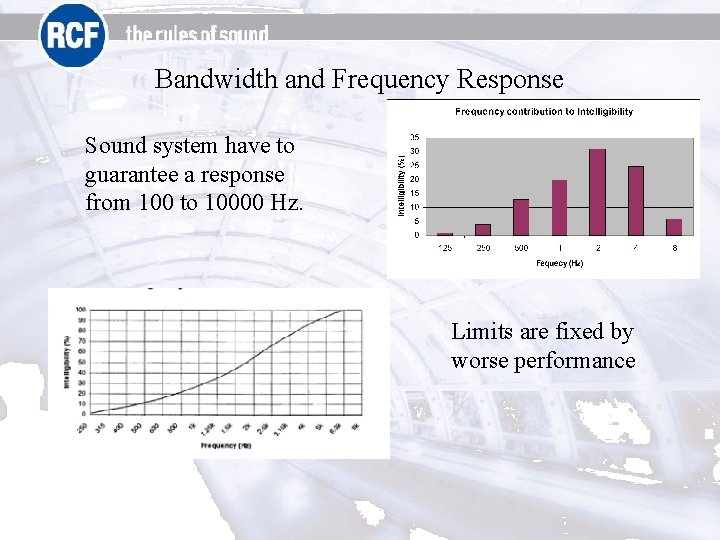
Bandwidth and Frequency Response Sound system have to guarantee a response from 100 to 10000 Hz. Limits are fixed by worse performance
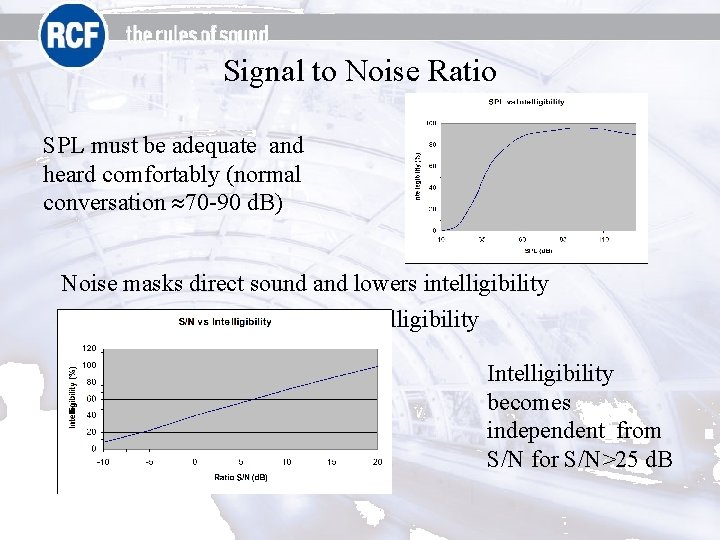
Signal to Noise Ratio SPL must be adequate and heard comfortably (normal conversation 70 -90 d. B) Noise masks direct sound and lowers intelligibility Increasing S/N ratio increases intelligibility Intelligibility becomes independent from S/N for S/N>25 d. B
Reverberation and Reflections Long RT 60’s decrease intelligibility Late reflections (> 50 ms) smear and blur direct speech Early reflections ( < 35 -50 ms) are perceived as reinforce
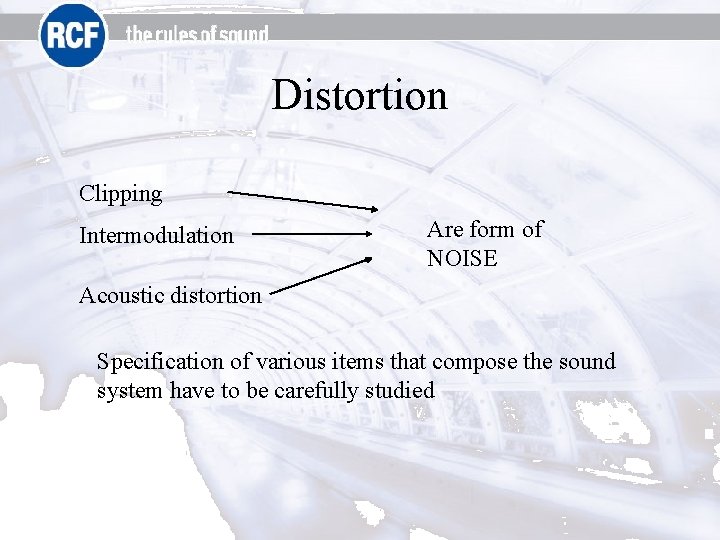
Distortion Clipping Intermodulation Are form of NOISE Acoustic distortion Specification of various items that compose the sound system have to be carefully studied
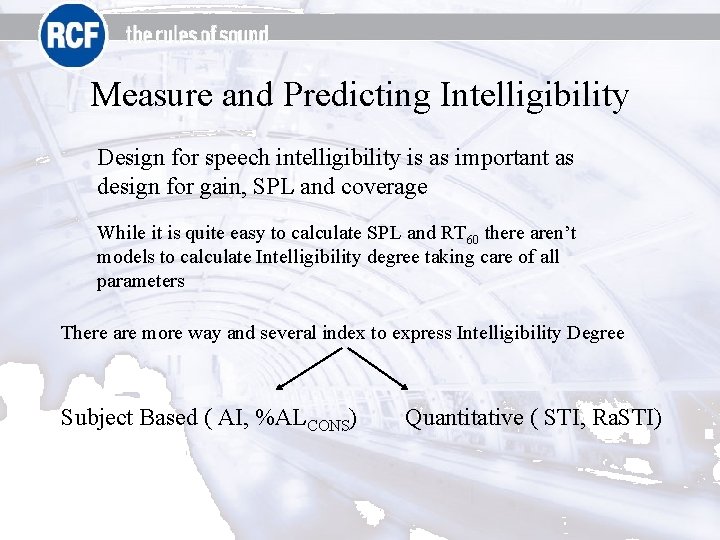
Measure and Predicting Intelligibility Design for speech intelligibility is as important as design for gain, SPL and coverage While it is quite easy to calculate SPL and RT 60 there aren’t models to calculate Intelligibility degree taking care of all parameters There are more way and several index to express Intelligibility Degree Subject Based ( AI, %ALCONS) Quantitative ( STI, Ra. STI)
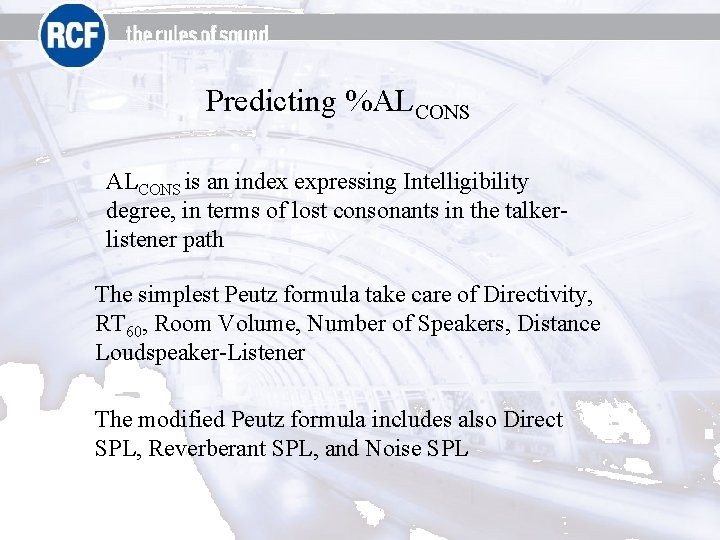
Predicting %ALCONS is an index expressing Intelligibility degree, in terms of lost consonants in the talkerlistener path The simplest Peutz formula take care of Directivity, RT 60, Room Volume, Number of Speakers, Distance Loudspeaker-Listener The modified Peutz formula includes also Direct SPL, Reverberant SPL, and Noise SPL
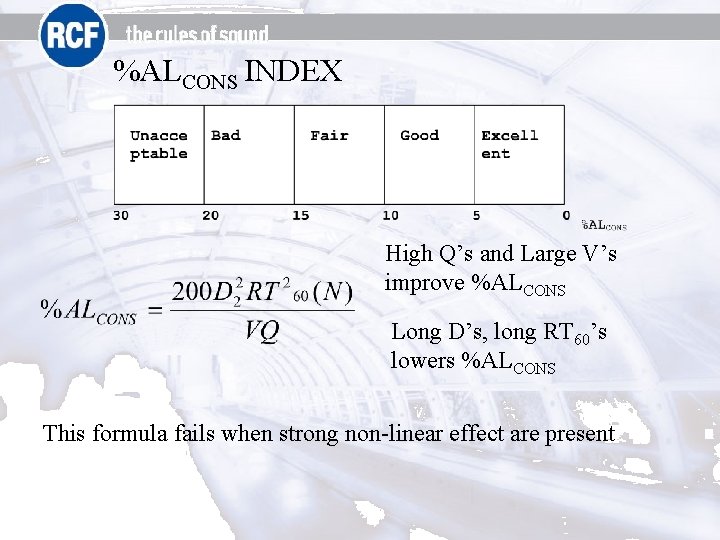
%ALCONS INDEX High Q’s and Large V’s improve %ALCONS Long D’s, long RT 60’s lowers %ALCONS This formula fails when strong non-linear effect are present
STI and Ra. STI These methods are fully independent of human being and are fully quantitative Take care of all factors affecting the intelligibility because measures the corruption of a speech based signal during the talker-to-listener path Varies from 0 = no intelligibility to 1= perfect intelligibility
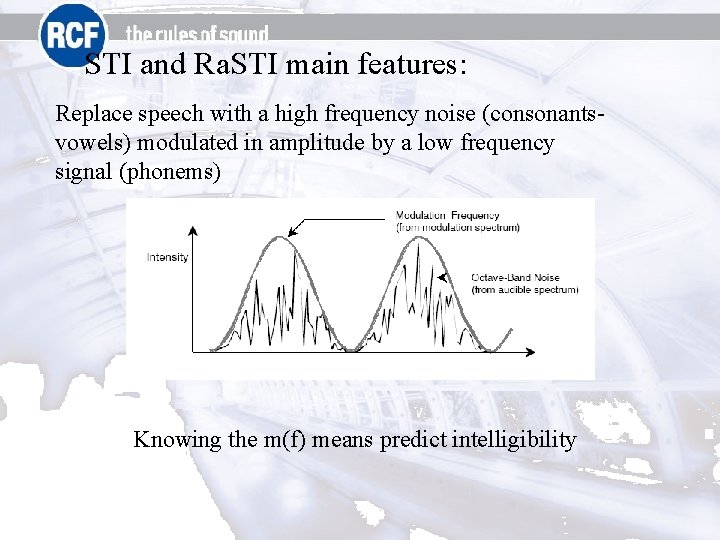
STI and Ra. STI main features: Replace speech with a high frequency noise (consonantsvowels) modulated in amplitude by a low frequency signal (phonems) Knowing the m(f) means predict intelligibility
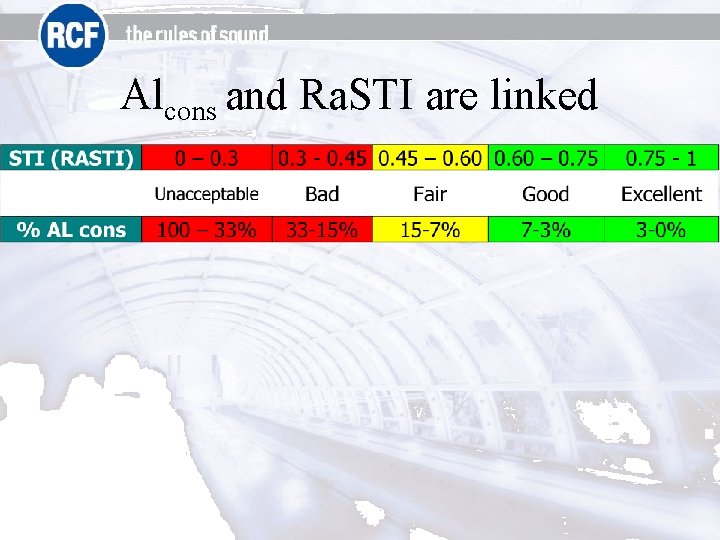
Alcons and Ra. STI are linked
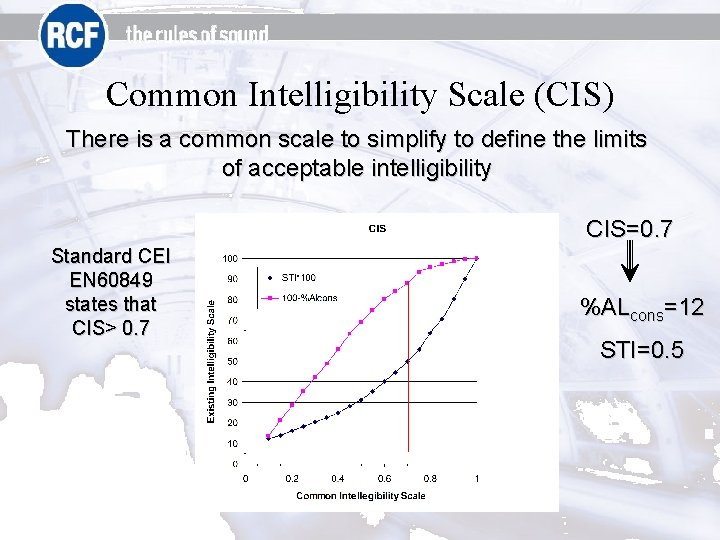
Common Intelligibility Scale (CIS) There is a common scale to simplify to define the limits of acceptable intelligibility CIS=0. 7 Standard CEI EN 60849 states that CIS> 0. 7 %ALcons=12 STI=0. 5
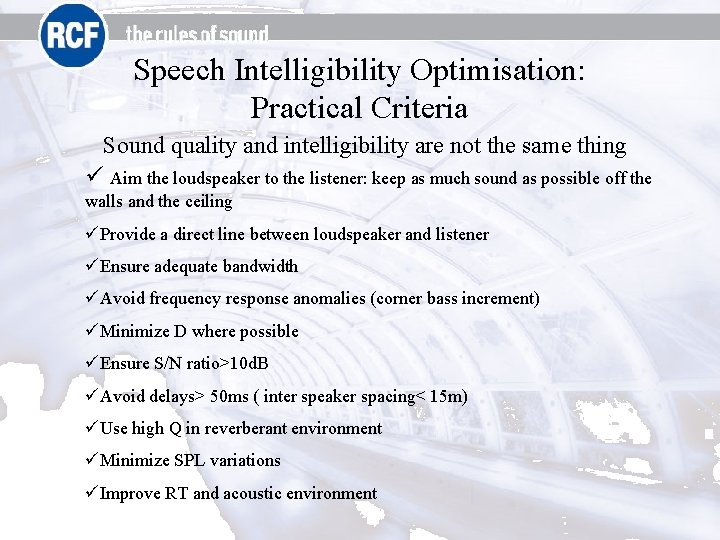
Speech Intelligibility Optimisation: Practical Criteria Sound quality and intelligibility are not the same thing ü Aim the loudspeaker to the listener: keep as much sound as possible off the walls and the ceiling üProvide a direct line between loudspeaker and listener üEnsure adequate bandwidth üAvoid frequency response anomalies (corner bass increment) üMinimize D where possible üEnsure S/N ratio>10 d. B üAvoid delays> 50 ms ( inter speaker spacing< 15 m) üUse high Q in reverberant environment üMinimize SPL variations üImprove RT and acoustic environment
A sound system is basically composed of 1) Electro-Acoustic components ( speakers, microphones detectors) 2) Electronic items (mixer, amplifier, digital processors, music/message sources) 3) Environment ( Room Acoustic, RT 60) Any result is a mesh of these components, and the lower quality component will lower the performance of all the others together
A Sound Reinforcement system is a system for accurately amplifying, reproducing, and sometimes recording audio, so that persons not near the original source may experience the sound as if they were. PA system, controls to mix the signals coming from the various microphones or other input sources (such as Tuner, CD, MP 3 and so on).
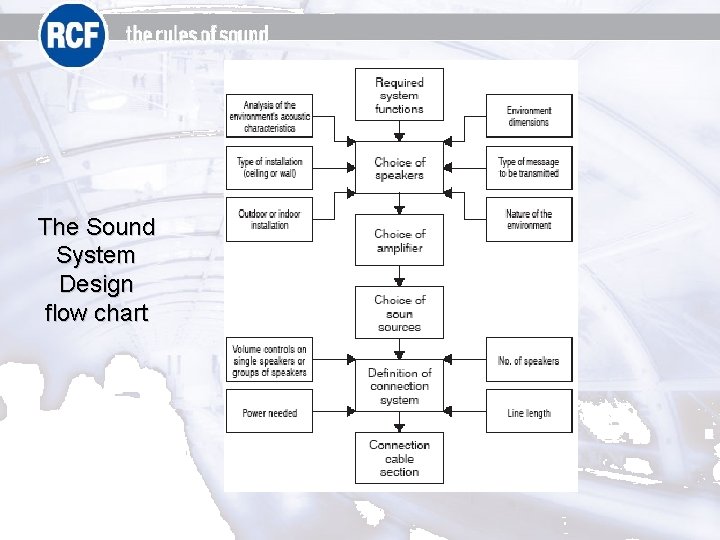
How to approach a study of a sound system It is advisable to begin your study of a sound system with the loudspeakers, after which the amplifier power and model can be defined, and finally the sound sources and appropriate connection system can be selected. Specifically, you need to 1) Establish the required system functions on the basis of the user’s needs. 2) Analyse the characteristics of the environment 3) Choose the loudspeakers on the basis of the nature and dimensions of the space, the type of message to be transmitted (speech/music), and the noise level of the environment. 4) Choose amplifiers that are suitable for driving the speakers selected and with a sufficient number of inputs for all the sounds sources. 5) Define the sound sources (microphones, tuners, cassette, players, etc. ). 6) Evaluate the connection system for the speakers and establish cable sections.
The Sound System Design flow chart
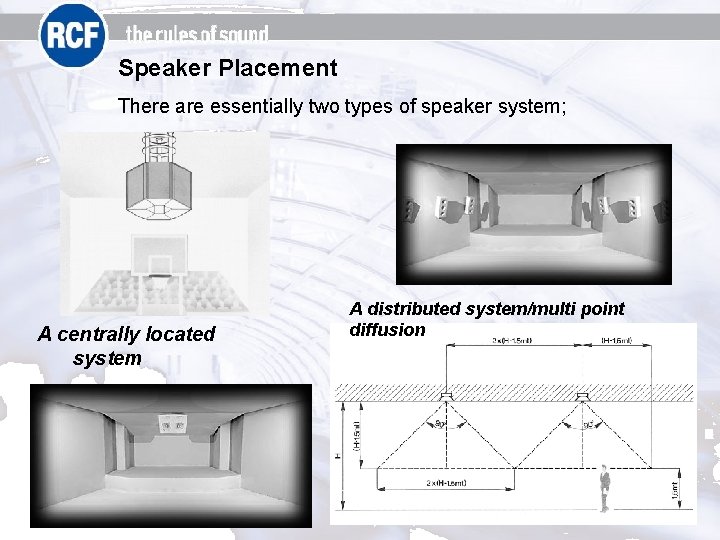
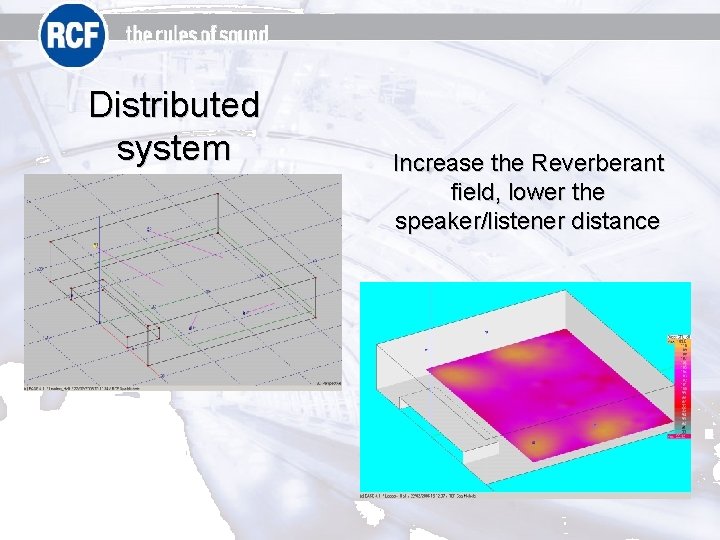
Speaker Placement There are essentially two types of speaker system; A centrally located system A distributed system/multi point diffusion
Centrally Located System Minimize the Reverberant field but can result in long speaker/listener distances Need for Loudness Calculation Need for Coverage Calculation
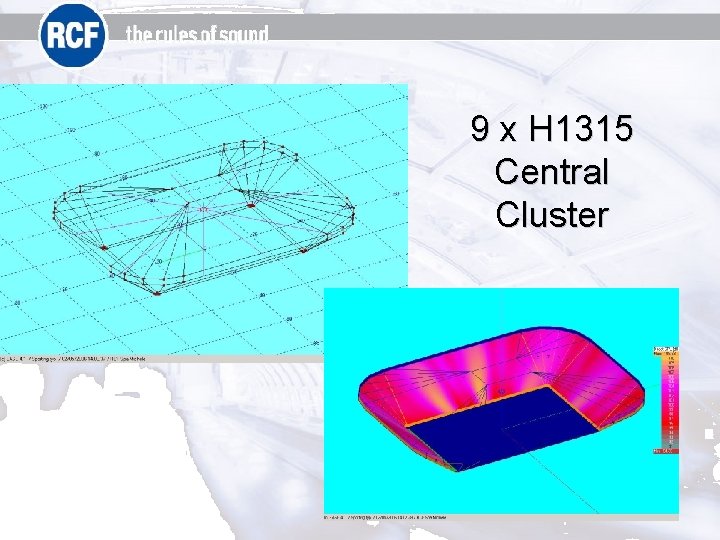
9 x H 1315 Central Cluster
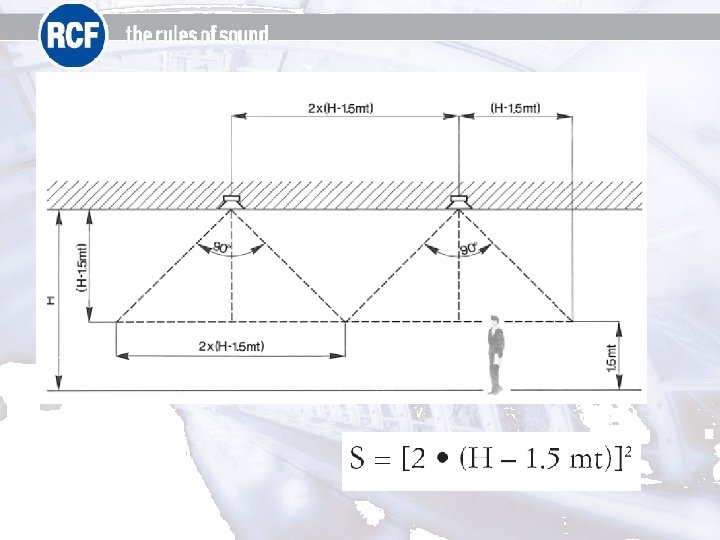
Distributed system Increase the Reverberant field, lower the speaker/listener distance
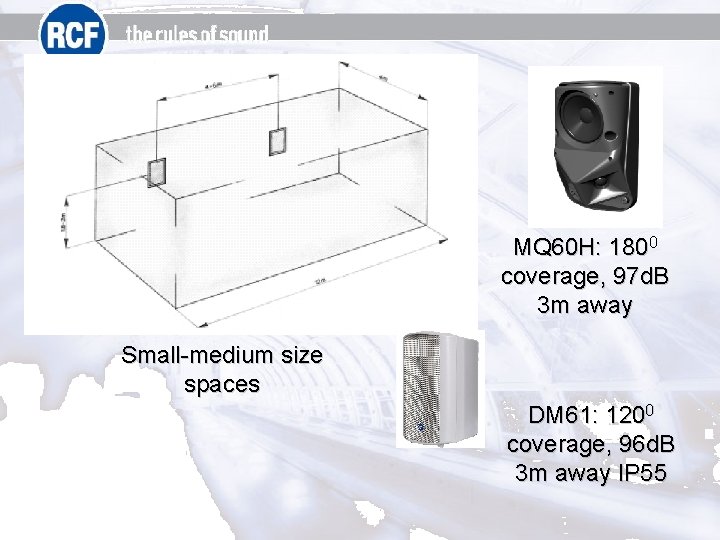
MQ 60 H: 1800 coverage, 97 d. B 3 m away Small-medium size spaces DM 61: 1200 coverage, 96 d. B 3 m away IP 55
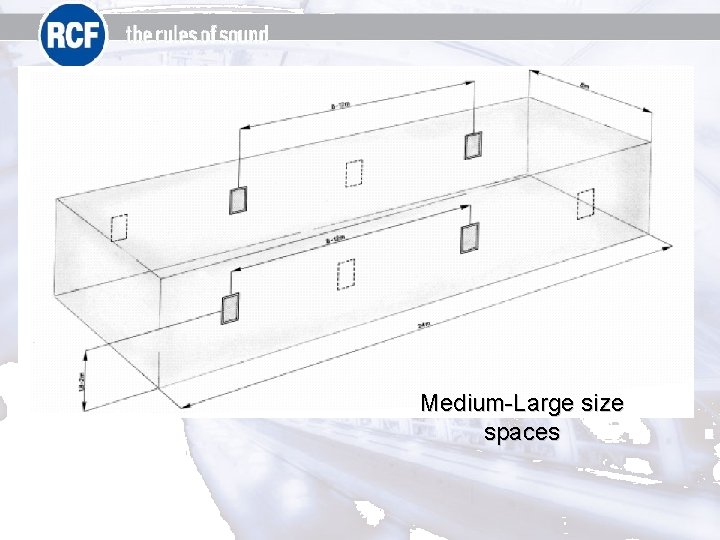
Medium-Large size spaces
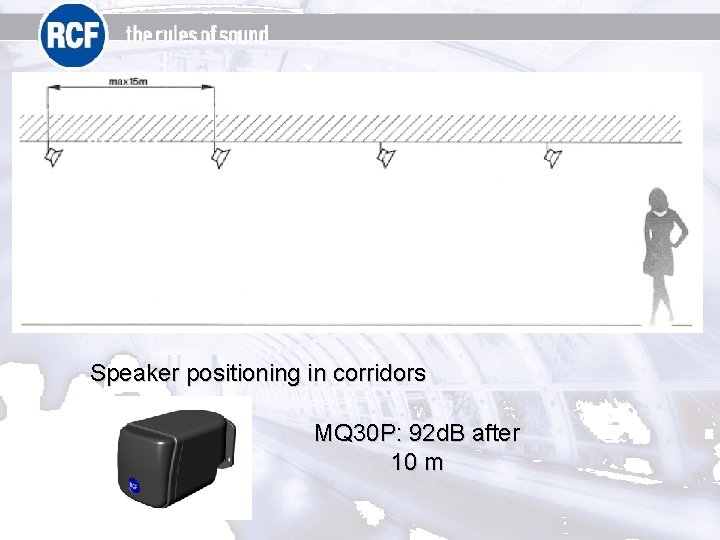
Speaker positioning in corridors MQ 30 P: 92 d. B after 10 m
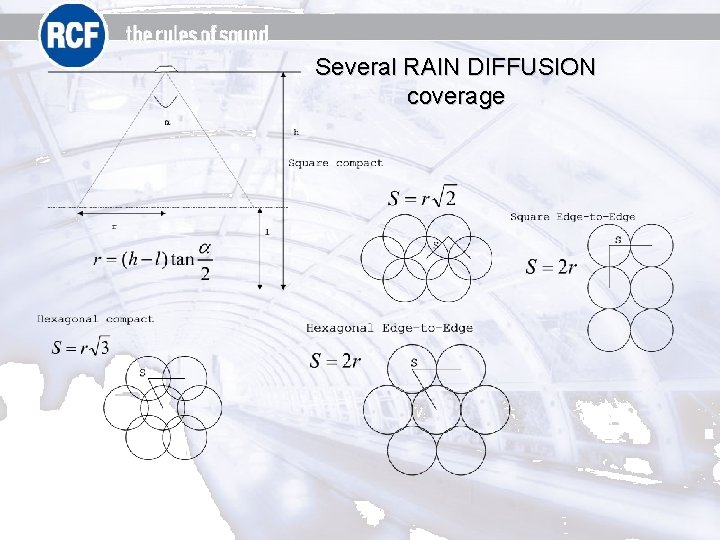
Several RAIN DIFFUSION coverage
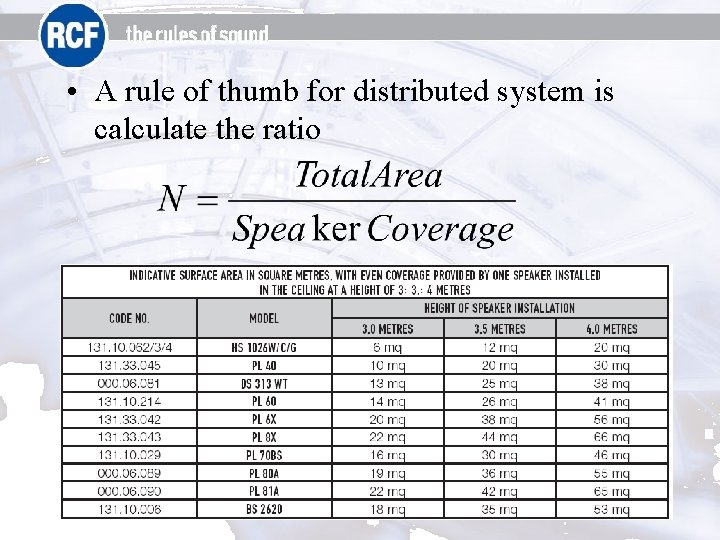
• A rule of thumb for distributed system is calculate the ratio
SPL 1 W/1 m 90 d. B 84 d. B 78 d. B 72 d. B 1 m 2 m 4 m 8 m 66 d. B 16 m 1 W 93 d. B 87 d. B 81 d. B 75 d. B 1 m 2 m 4 m 8 m 69 d. B 16 m 2 W 96 d. B 90 d. B 84 d. B 78 d. B 1 m 2 m 4 W 4 m 8 m 72 d. B 16 m
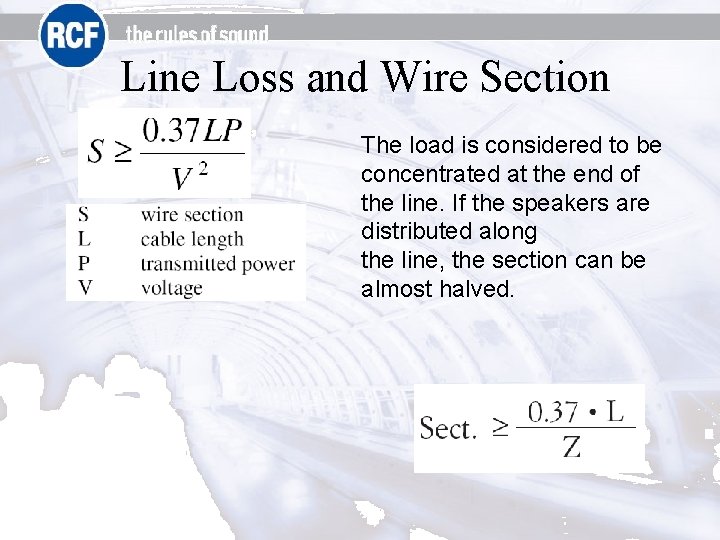
Line Loss and Wire Section The load is considered to be concentrated at the end of the line. If the speakers are distributed along the line, the section can be almost halved.
Thank you for your kind attention! Dear listener, please find more suggestion in RCF Sound System Design and Installation Guide The Rules of Sound