
Approach to FEVER Dr Bilal Natiq Nuaman Lecturer
Approach to FEVER Dr. Bilal Natiq Nuaman Lecturer at Ibn-Sina Medical College C. A. B. M. , F. I. B. M. S. , D. I. M. , M. B. Ch. B. 2013 -2014

Thermoregulation • Because Temperature affects how the enzymes work in your body , People should maintain a normal body temperature of about 37°C despite wide variations in both their metabolic activity and the temperature of their environment. Enzymes are proteins that catalyze chemical reactions in living cells. • Almost all enzymes have an "optimal" temperature. For example, most human derived enzymes will function best at around 37 ° C. If it gets too hot or cold the enzymes might denature and lose the shape of their active site, which means the substrate may no longer fit and this decreases the rate of the chemical reactions. HOMEOSTASIS
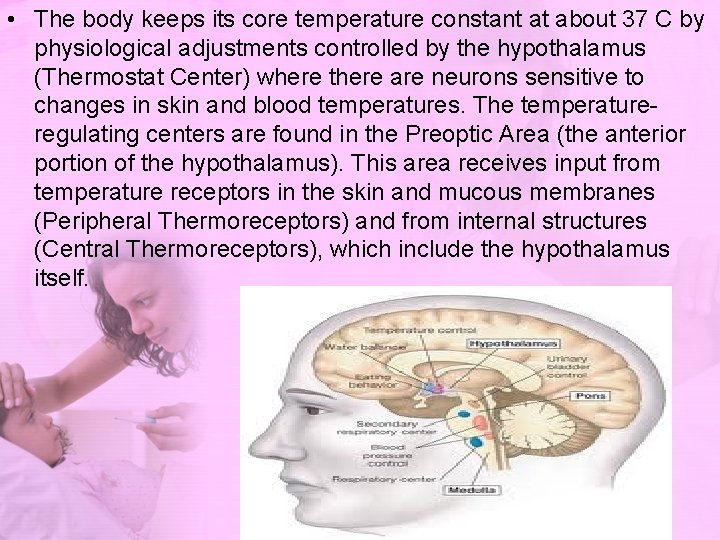
• The body keeps its core temperature constant at about 37 C by physiological adjustments controlled by the hypothalamus (Thermostat Center) where there are neurons sensitive to changes in skin and blood temperatures. The temperatureregulating centers are found in the Preoptic Area (the anterior portion of the hypothalamus). This area receives input from temperature receptors in the skin and mucous membranes (Peripheral Thermoreceptors) and from internal structures (Central Thermoreceptors), which include the hypothalamus itself.
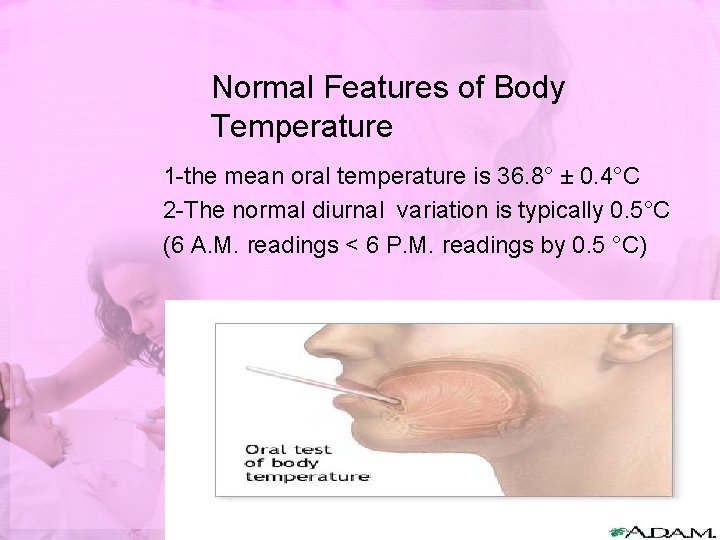
Normal Features of Body Temperature 1 -the mean oral temperature is 36. 8° ± 0. 4°C 2 -The normal diurnal variation is typically 0. 5°C (6 A. M. readings < 6 P. M. readings by 0. 5 °C)

Fever (Pyrexia) definition: Fever is an elevation of body temperature that exceeds the normal daily range and occurs in conjunction with an increase in the hypothalamic set point—for example, from 37 ˚ C to 39 ˚ C. an A. M. temperature of >37. 2 ˚ C (98. 9 F ) or a P. M. temperature of >37. 7 ˚ C (99. 9 F)

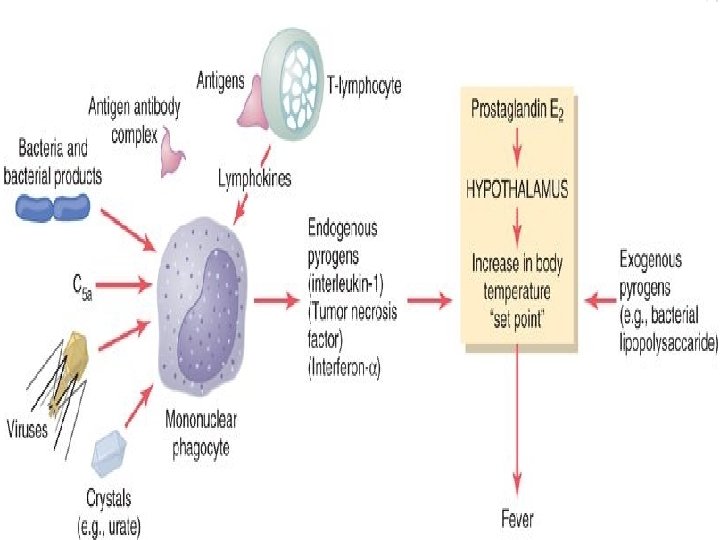
Mechanisms of fever • (1) Exogenous pyrogens (micro-organism , toxin …) induce host cells, such as blood leukocytes and tissue macrophages, to produce fever-producing mediators called Endogenous pyrogens (e. g. , interleukin-1). • (2) resetting of hypothalamus thermostatic set point to a higher level through the action of prostaglandin E 2. (prodrome); • (3) generation of hypothalamic mediated responses that raise body temperature (chill); • (4) development of fever with elevation of body to new thermostatic set point; • (5) production of temperature lowering responses (defervescence-sweating) and return of body temperature to a lower level.
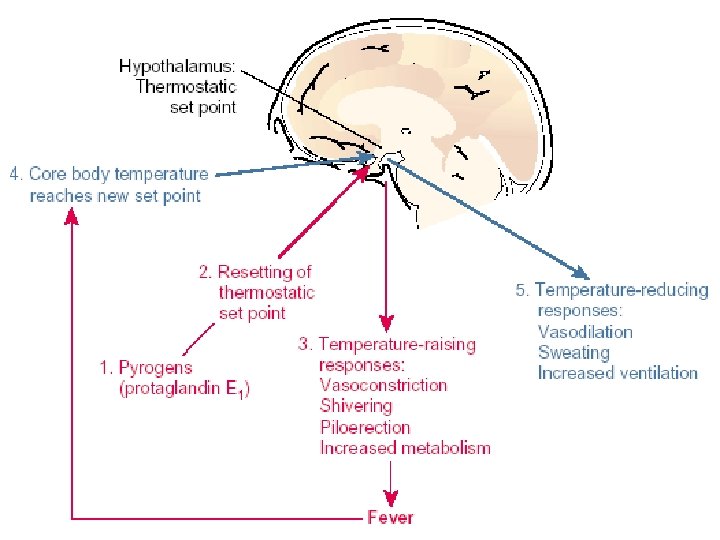

• Exogenous pyrogens induce host cells, such as blood leukocytes and tissue macrophages, to produce feverproducing mediators called endogenous pyrogens (e. g. , interleukin-1). • The endogenous pyrogens mediate a number of other responses. For example, interleukin-1 is an inflammatory mediator that produces other signs of inflammation, such as leukocytosis, anorexia, and malaise. • The phagocytosis of bacteria and breakdown products of bacteria that are present in the blood lead to the release of endogenous pyrogens into the circulation. • The endogenous pyrogens are increase the set point of the hypothalamic thermoregulatory center through the action of prostaglandin E 2. • In response to the sudden increase in set point, the hypothalamus initiates heat production behaviors (shivering and vasoconstriction) that increase the core body temperature to the new set point, and fever is established.
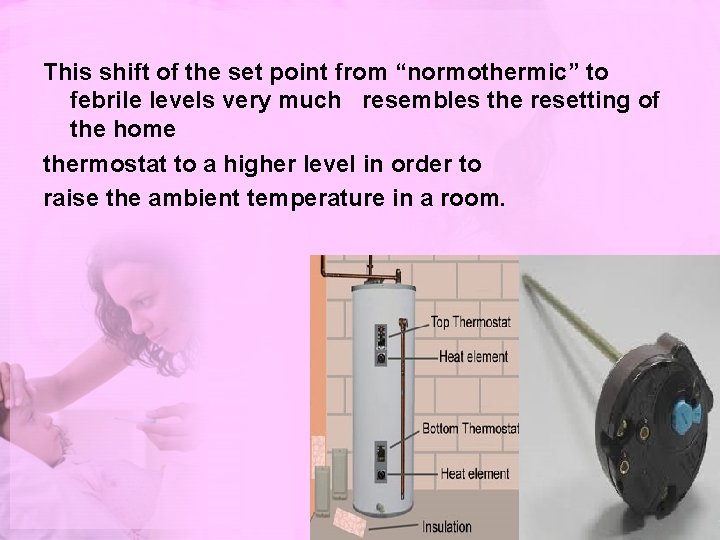
This shift of the set point from “normothermic” to febrile levels very much resembles the resetting of the home thermostat to a higher level in order to raise the ambient temperature in a room.
Benefits of fever • 1 -It enhance immune function; • Increases motility and activity of the white blood cells (T cells and B cells ). • Stimulates the interferon production. • Increase phagocytic activity • 2 -Inhibits growth of some microbial agents: • Many of the microbial agents that cause infection grow best at normal body temperatures, and their growth is inhibited by temperatures in the fever range
Adverse effects of fever • Dehydration occurs because of sweating. • Metabolic effects: • Increased need for oxygen (13 % for every 1 ˚ C increase in body temp. ). • Increases the heart rate (10 /min. for every 1 ˚ C increase in body temp. ). • Increases the respiration rate (4/min. for every 1 ˚ C increase in body temp. ). • Increased use of body proteins as an energy source (catabolism) • With prolonged fever, there is increased breakdown of endogenous fat stores. (metabolic acidosis) • Precipitates febrile convulsions
Some Features of Fever Ø Relative bradycardia: (rising of HR <5 /min. for each 1˚C rise ) Causes : Typhoid, Brucellosis, Leptospirosis, and Factitious fever Ø Relative tachycardia (rising of HR >15/min. for each 1˚C rise ) Causes : Myocarditis, rheumatic fever Ø Reversed diurnal pattern : (AM Temp. >PM Temp. ) Causes: Typhoid , disseminated TB Ø Failure to have fever Cause: Elderly, CRF, Corticosteroid
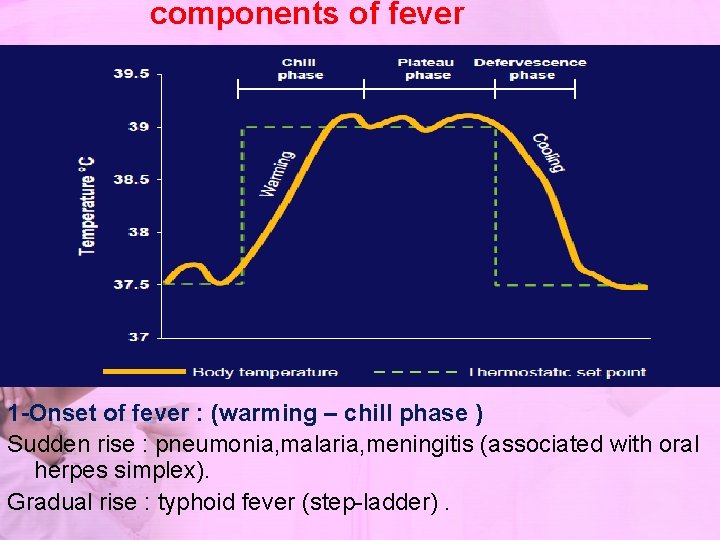
components of fever 1 -Onset of fever : (warming – chill phase ) Sudden rise : pneumonia, malaria, meningitis (associated with oral herpes simplex). Gradual rise : typhoid fever (step-ladder).
2 -Main (pattern-plateau phase) v Continuous: fever does not fluctuate more than 1˚C during 24 hrs, but at no time touches the normal. e. g. pneumonia, typhoid fever, urinary tract infection, brucellosis v Remitent : daily fluctuations exceed 2˚C but at no time touches the normal. It is associated with viral upper respiratory tract, legionella, and mycoplasma infections v Intermittent : fever reaches normal level ü Quotidian : wn. Paroxysms of fever occur daily(P. Falciparum) ü Tertian : wn. Paroxysms of fever on alternate days(P. Vivax , Ovale) ü Quartan : every 72 hrs (P. Malaiae)
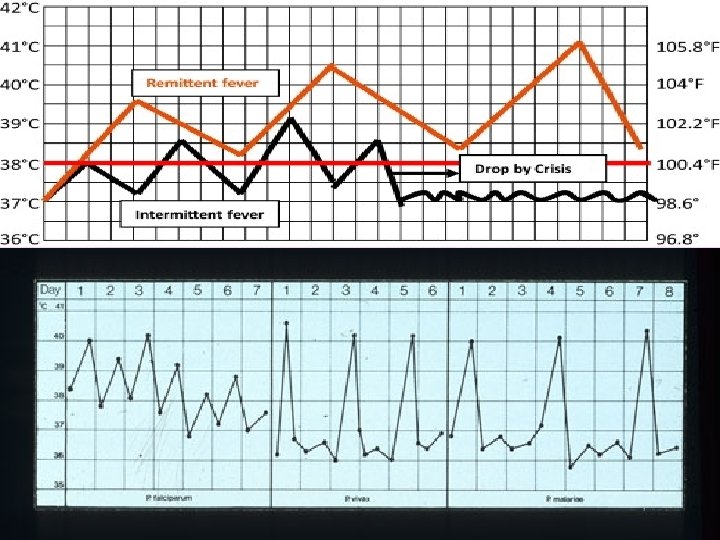
3 -End of fever : Crisis (sudden reduction ){associated with sweating} e. g. pneumonia Lysis ( gradual reduction) e. g. Typhoid

Interesting, right? This is just a sneak preview of the full presentation. We hope you like it! To see the rest of it, just click here to view it in full on Power. Show. com. Then, if you’d like, you can also log in to Power. Show. com to download the entire presentation for free.
- Slides: 19