
APPROACH TO DEVELOPMENTAL DELAY PROF RASHMI KUMAR DEPARTMENT


- Slides: 35
APPROACH TO DEVELOPMENTAL DELAY PROF RASHMI KUMAR DEPARTMENT OF PEDIATRICS KGMU
Normal Developmental Testing Screening Formal Testing Differential Diagnosis of delay Mental Retardation • Prevalence • Classification • Etiology • Evaluation -Confirm diagnosis -Cause -Associated problems -Investigation -Management Special types
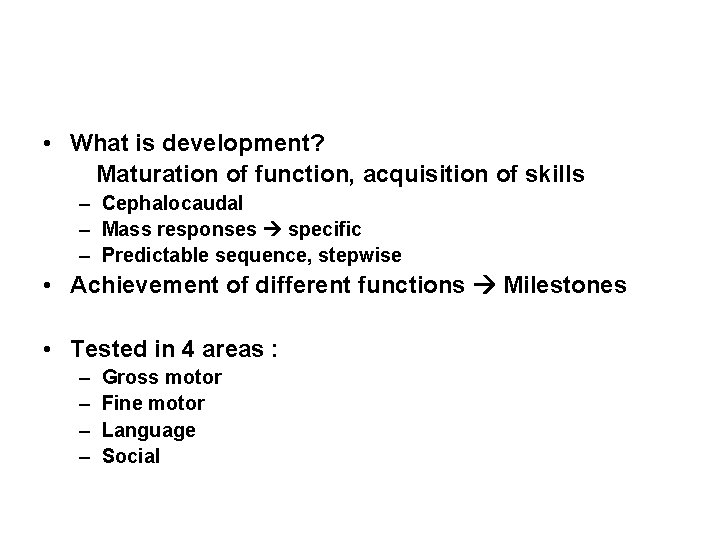
• What is development? Maturation of function, acquisition of skills – Cephalocaudal – Mass responses specific – Predictable sequence, stepwise • Achievement of different functions Milestones • Tested in 4 areas : – – Gross motor Fine motor Language Social
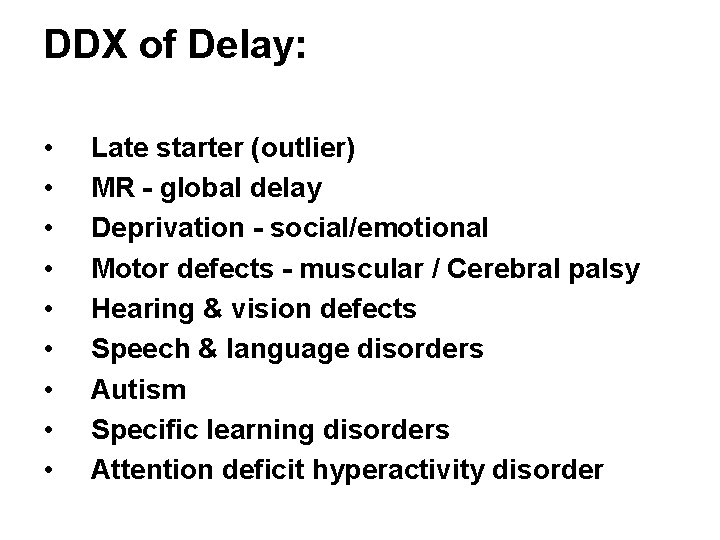
DDX of Delay: • • • Late starter (outlier) MR - global delay Deprivation - social/emotional Motor defects - muscular / Cerebral palsy Hearing & vision defects Speech & language disorders Autism Specific learning disorders Attention deficit hyperactivity disorder
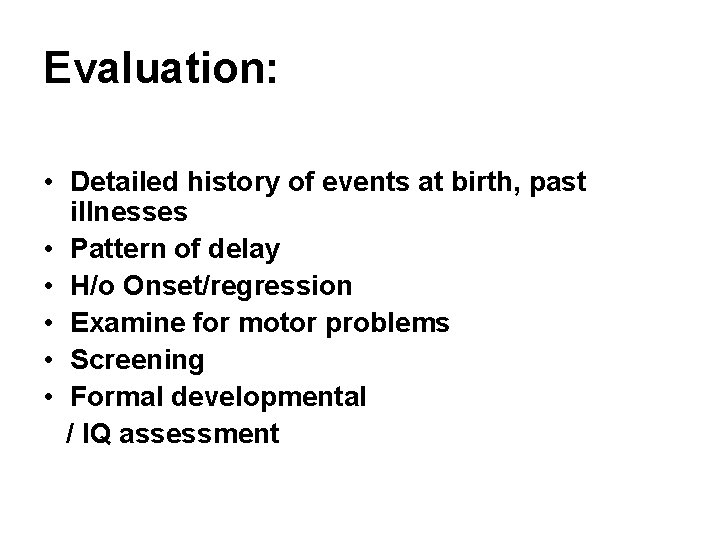
Evaluation: • Detailed history of events at birth, past illnesses • Pattern of delay • H/o Onset/regression • Examine for motor problems • Screening • Formal developmental / IQ assessment
3 step process • Clinical evaluation • Screening • Formal assessment
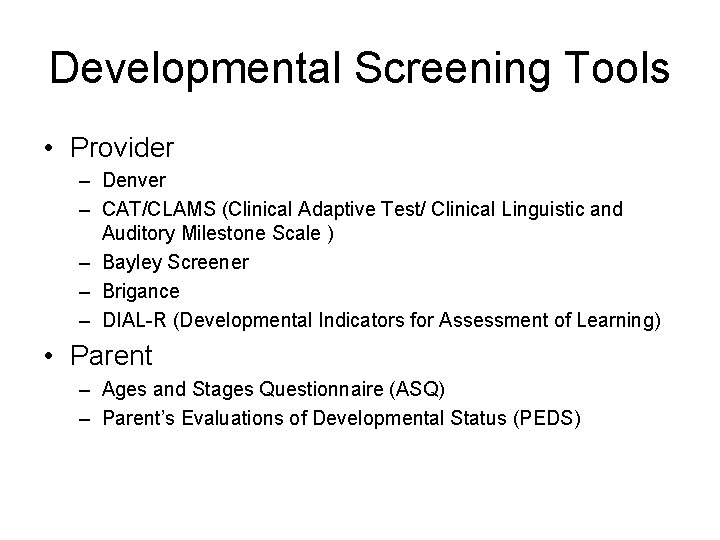
Developmental Screening Tools • Provider – Denver – CAT/CLAMS (Clinical Adaptive Test/ Clinical Linguistic and Auditory Milestone Scale ) – Bayley Screener – Brigance – DIAL-R (Developmental Indicators for Assessment of Learning) • Parent – Ages and Stages Questionnaire (ASQ) – Parent’s Evaluations of Developmental Status (PEDS)
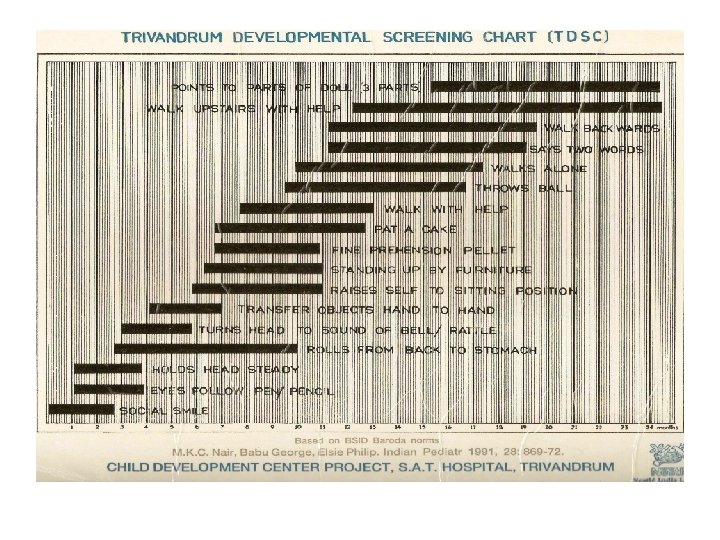
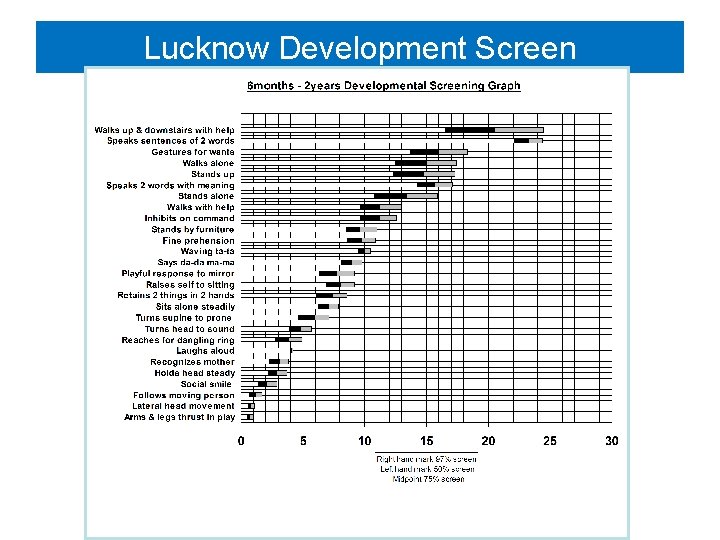
Developmental Screening Tools: India • Baroda Development Screening Test • Trivandrum Development Screening Test • Lucknow Development Screen • Indian norms used
Lucknow Development Screen
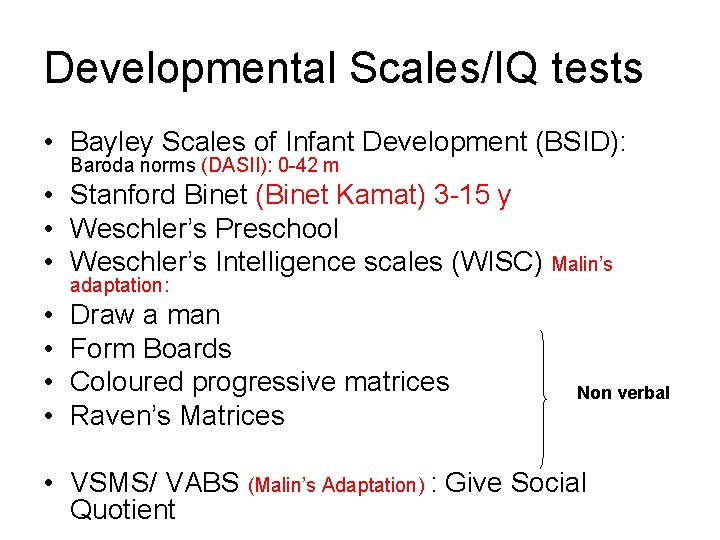
Developmental Scales/IQ tests • Bayley Scales of Infant Development (BSID): Baroda norms (DASII): 0 -42 m • Stanford Binet (Binet Kamat) 3 -15 y • Weschler’s Preschool • Weschler’s Intelligence scales (WISC) Malin’s adaptation: • • Draw a man Form Boards Coloured progressive matrices Raven’s Matrices Non verbal • VSMS/ VABS (Malin’s Adaptation) : Give Social Quotient
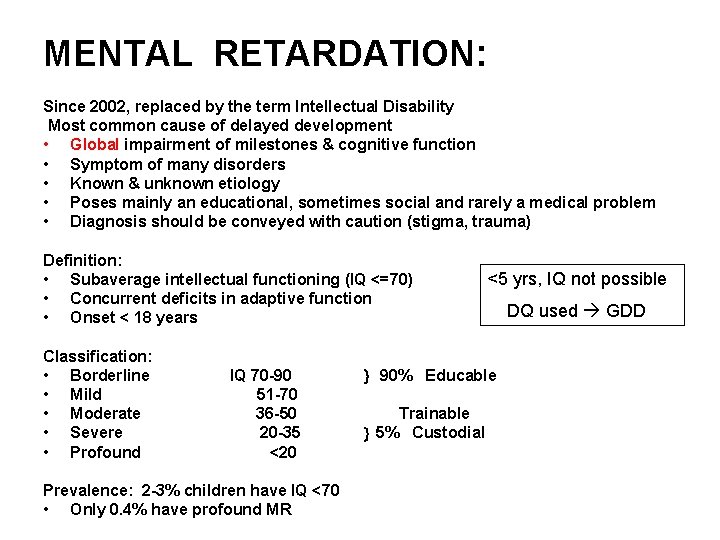
MENTAL RETARDATION: Since 2002, replaced by the term Intellectual Disability Most common cause of delayed development • Global impairment of milestones & cognitive function • Symptom of many disorders • Known & unknown etiology • Poses mainly an educational, sometimes social and rarely a medical problem • Diagnosis should be conveyed with caution (stigma, trauma) Definition: • Subaverage intellectual functioning (IQ <=70) • Concurrent deficits in adaptive function • Onset < 18 years Classification: • Borderline • Mild • Moderate • Severe • Profound IQ 70 -90 51 -70 36 -50 20 -35 <20 Prevalence: 2 -3% children have IQ <70 • Only 0. 4% have profound MR <5 yrs, IQ not possible 90% Educable Trainable 5% Custodial DQ used GDD
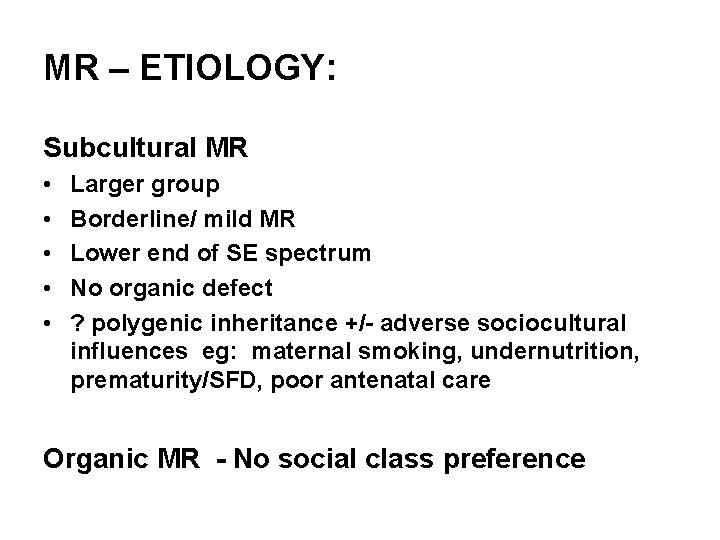
MR – ETIOLOGY: Subcultural MR • • • Larger group Borderline/ mild MR Lower end of SE spectrum No organic defect ? polygenic inheritance +/- adverse sociocultural influences eg: maternal smoking, undernutrition, prematurity/SFD, poor antenatal care Organic MR - No social class preference
Organic MR: Etiology • Prenatal: – Inherited metabolic defects eg: Aminoacidurias, CHO disorders, lipidoses, MPS, leukodystrophies, inherited degenerative disorders, hormonal (cretinism, hypoparathyroid) – Nonbiochemical genetic defects eg. Hydrocephalus, Soto’s, Lissencephaly, Pradervilli, Laurence Moon Beidl, Cockayne’s etc. – Neurodermatoses – Tuberous sclerosis, Sturge Weber etc, neurofibromatosis. – Chromosomal – Down’s, Fragile X, subtelomeric defects – Maternal – TORCH infections, placental dysfunction, radiation, alcohol, teratogens, Iodine
Organic MR: Etiology • Perinatal – – Prematurity SFD Asphyxia, trauma, infection Bilirubin toxicity • Postnatal – – CNS infections Trauma Anoxia Metabolic – hypoglycemia, hyponatremia etc
• Etiology: Diagnosis of etiology often not possible • Important questions: – ? organic – ? progressive – ? treatable
MR – Treatable causes • Cretinism • Some inborn errors: Galactosemia, PKU etc • Toxoplasma/syphilis: if detected early • Hydrocephalus
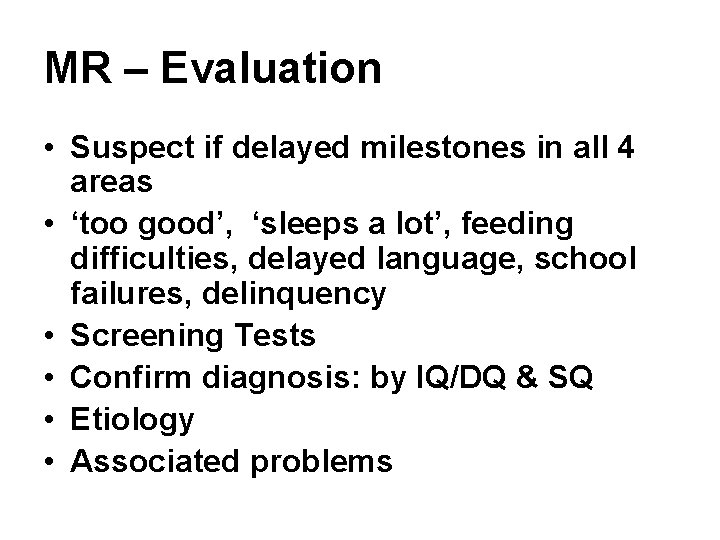
MR – Evaluation • Suspect if delayed milestones in all 4 areas • ‘too good’, ‘sleeps a lot’, feeding difficulties, delayed language, school failures, delinquency • Screening Tests • Confirm diagnosis: by IQ/DQ & SQ • Etiology • Associated problems
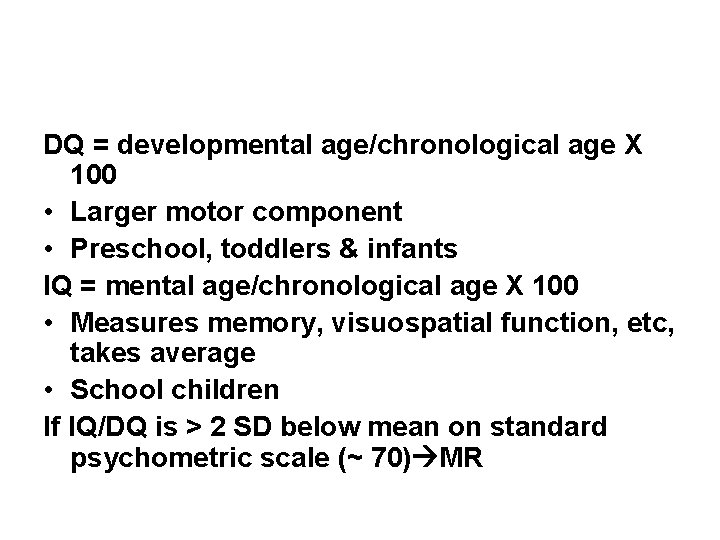
DQ = developmental age/chronological age X 100 • Larger motor component • Preschool, toddlers & infants IQ = mental age/chronological age X 100 • Measures memory, visuospatial function, etc, takes average • School children If IQ/DQ is > 2 SD below mean on standard psychometric scale (~ 70) MR
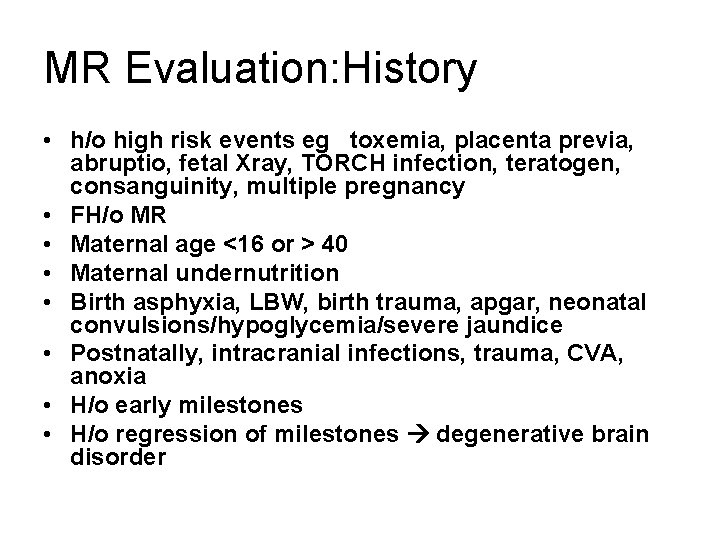
MR Evaluation: History • h/o high risk events eg toxemia, placenta previa, abruptio, fetal Xray, TORCH infection, teratogen, consanguinity, multiple pregnancy • FH/o MR • Maternal age <16 or > 40 • Maternal undernutrition • Birth asphyxia, LBW, birth trauma, apgar, neonatal convulsions/hypoglycemia/severe jaundice • Postnatally, intracranial infections, trauma, CVA, anoxia • H/o early milestones • H/o regression of milestones degenerative brain disorder
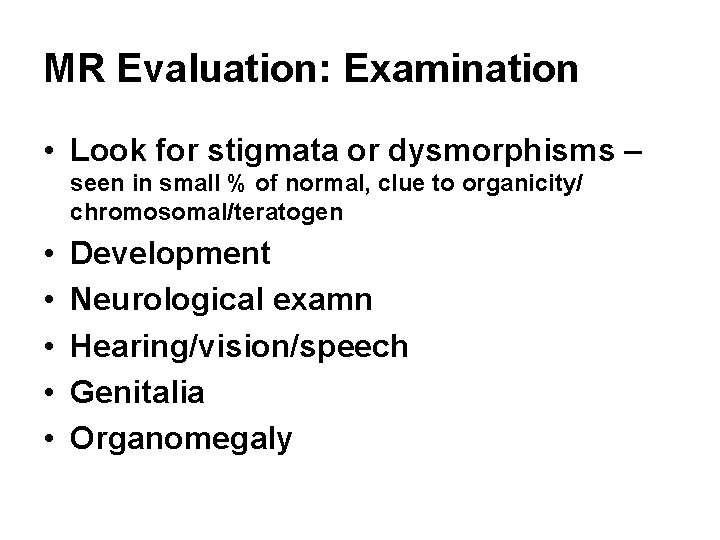
MR Evaluation: Examination • Look for stigmata or dysmorphisms – seen in small % of normal, clue to organicity/ chromosomal/teratogen • • • Development Neurological examn Hearing/vision/speech Genitalia Organomegaly
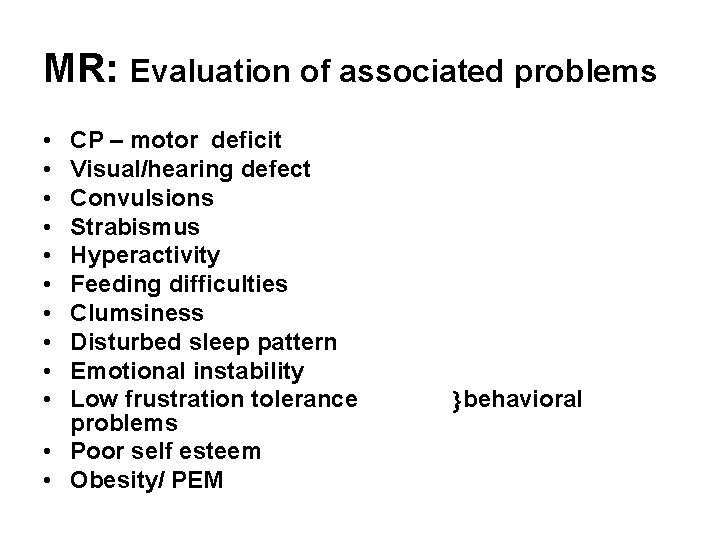
MR: Evaluation of associated problems • • • CP – motor deficit Visual/hearing defect Convulsions Strabismus Hyperactivity Feeding difficulties Clumsiness Disturbed sleep pattern Emotional instability Low frustration tolerance problems • Poor self esteem • Obesity/ PEM behavioral
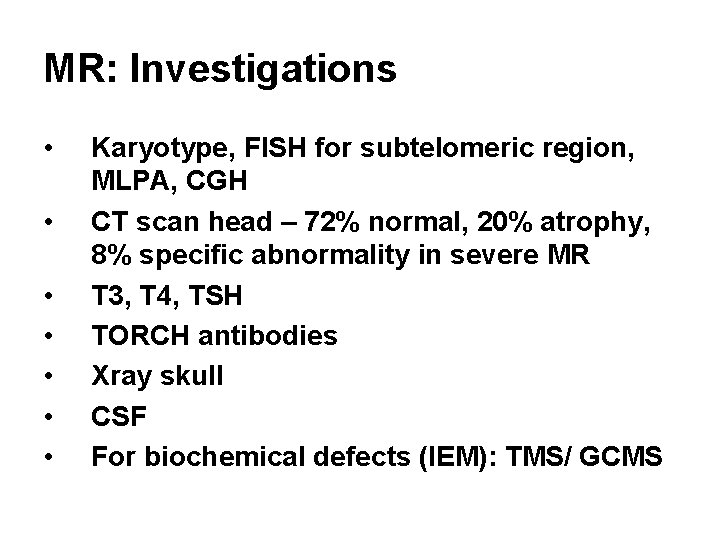
MR: Investigations • • Karyotype, FISH for subtelomeric region, MLPA, CGH CT scan head – 72% normal, 20% atrophy, 8% specific abnormality in severe MR T 3, T 4, TSH TORCH antibodies Xray skull CSF For biochemical defects (IEM): TMS/ GCMS
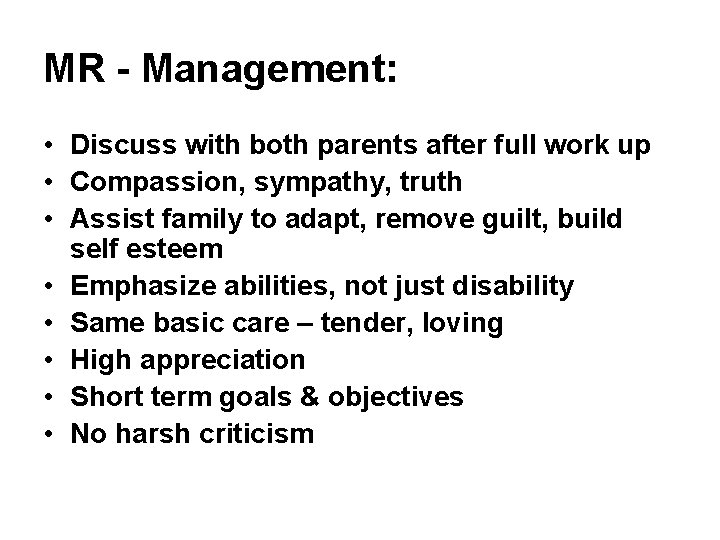
MR - Management: • Discuss with both parents after full work up • Compassion, sympathy, truth • Assist family to adapt, remove guilt, build self esteem • Emphasize abilities, not just disability • Same basic care – tender, loving • High appreciation • Short term goals & objectives • No harsh criticism
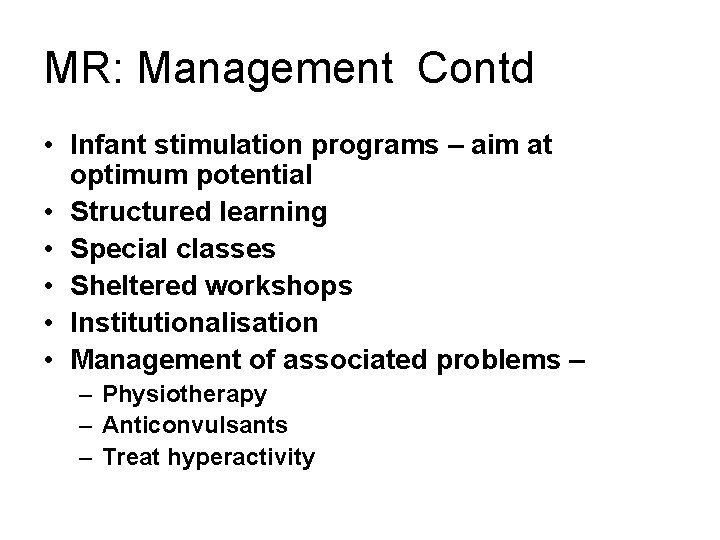
MR: Management Contd • Infant stimulation programs – aim at optimum potential • Structured learning • Special classes • Sheltered workshops • Institutionalisation • Management of associated problems – – Physiotherapy – Anticonvulsants – Treat hyperactivity
MR - Prevention: • • Genetic counseling Rubella vaccine Folic acid Good antenatal & perinatal care. High risk approach • Early recognition & management of infections, metabolic derangements, hyperbilirubinemia • Metabolic screening for PKU, cretin • Prenatal diagnosis of Down’s
Down’s syndrome • Most common chromosomal disorder 1: 800 1: 1000 newborns • Trisomy 21 • Extra chromosome may be maternal or paternal • Advanced maternal age – – – 15 -29 yrs 1: 1550 30 -34 yrs 1: 800 35 -39 yrs 1: 270 40 -45 yrs 1: 100 >45 yrs 1: 50 • Regular trisomy in 94%; 5% translocations; 1% mosaic
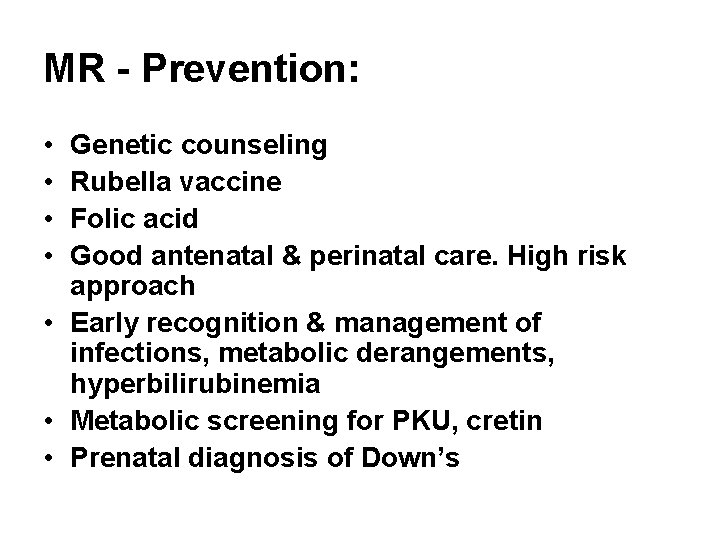
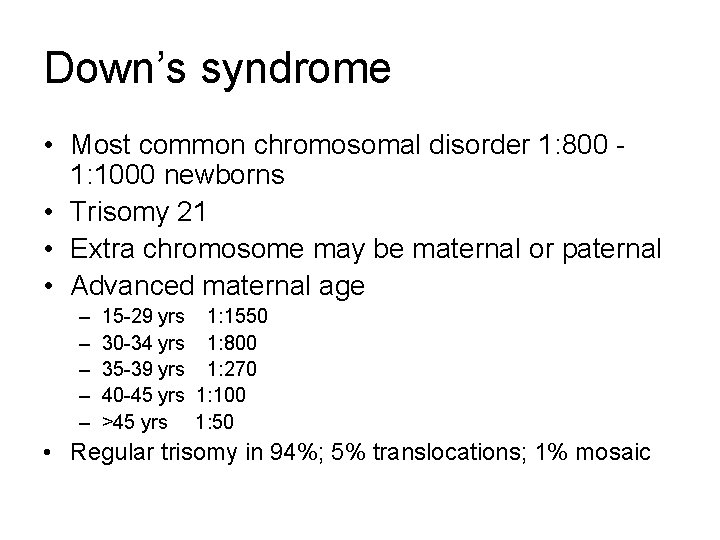
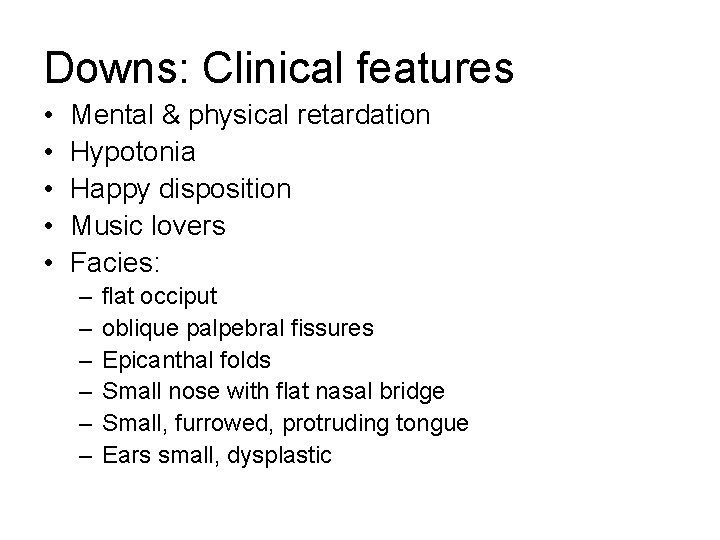
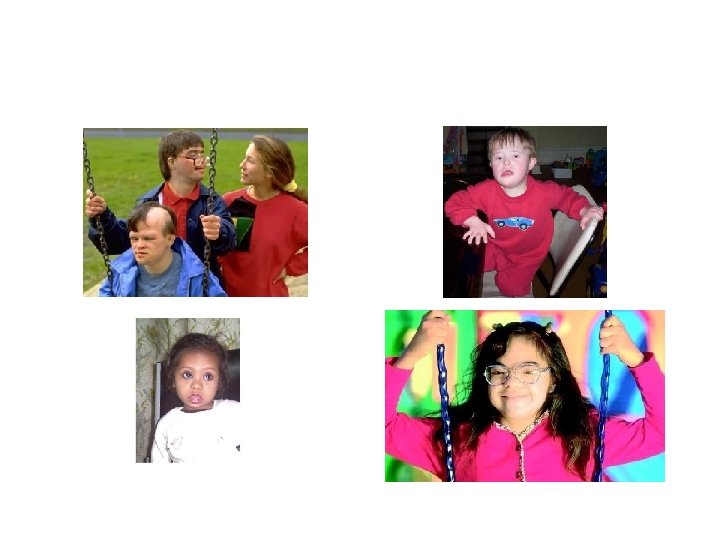
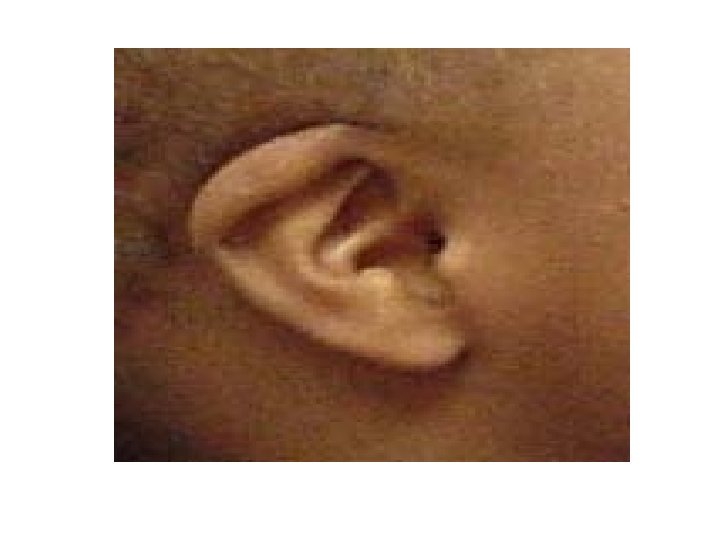
Downs: Clinical features • • • Mental & physical retardation Hypotonia Happy disposition Music lovers Facies: – – – flat occiput oblique palpebral fissures Epicanthal folds Small nose with flat nasal bridge Small, furrowed, protruding tongue Ears small, dysplastic
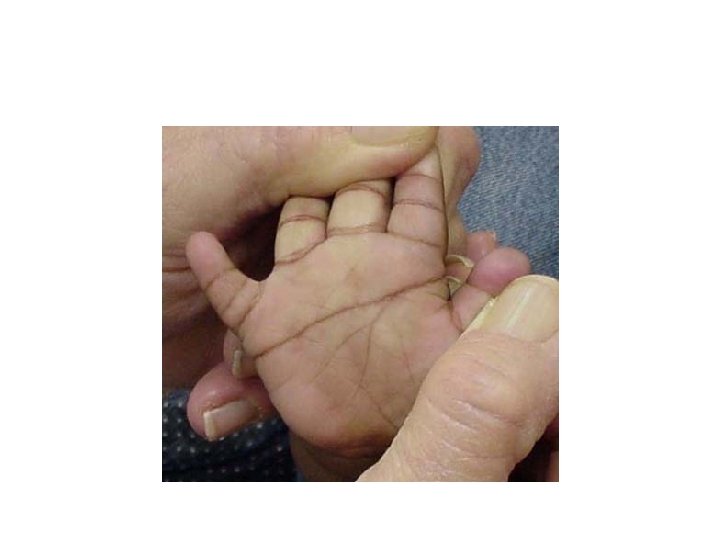
Downs: Clinical features • • • Short, broad hands Clinodactyly Simian crease Wide gap between 1 st and 2 nd toes Brushfield spots in iris - in light skinned people • Typical dermatoglyphics: distal triradius, ulnar loops
Downs: Other problems • Congenital heart disease: endocardial cushion defect, VSD, PDA • Hypothyroidism in 13 -54% of older patients • Higher risk of chronic myeloid leukemia, anorectal malformations, duodenal atresia • Frequent lower respiratory infection, chronic rhinitis
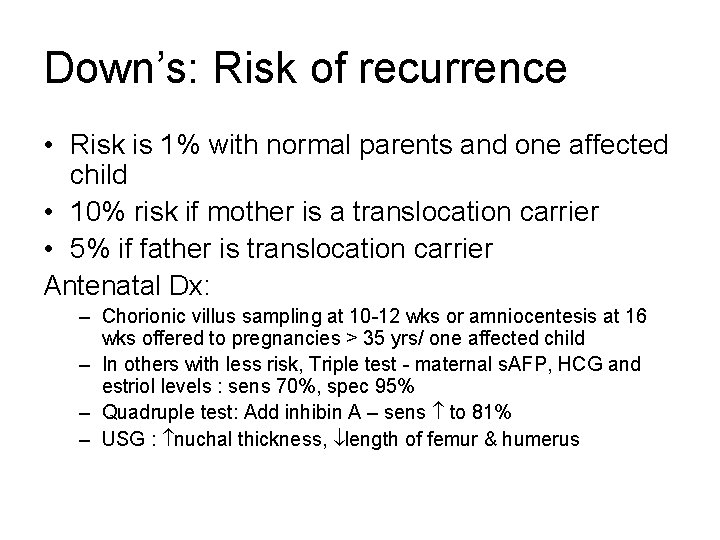
Down’s: Risk of recurrence • Risk is 1% with normal parents and one affected child • 10% risk if mother is a translocation carrier • 5% if father is translocation carrier Antenatal Dx: – Chorionic villus sampling at 10 -12 wks or amniocentesis at 16 wks offered to pregnancies > 35 yrs/ one affected child – In others with less risk, Triple test - maternal s. AFP, HCG and estriol levels : sens 70%, spec 95% – Quadruple test: Add inhibin A – sens to 81% – USG : nuchal thickness, length of femur & humerus
THANK YOU