
APPROACH TO ACUTE ABDOMINAL PAIN YiSheng Kam D
APPROACH TO ACUTE ABDOMINAL PAIN Yi-Sheng Kam, D. O. CPT MC USA Dept. of Family Medicine Eisenhower Army Medical Center
� � Abdominal pain is a common presentation in outpatient and ER visit. Is a challenging diagnose � Most are benign but as many as 10% have sever lifethreatening cause or require surgery. � Necessary for a thorough and system approach
TRIAGE � Stable vs. unstable � Unstable sign and symptoms � � � Severe Rapidly worsening Rigidity Guarding Rebound tenderness Absence bowel sounds Tachycardia and hypotension Acute vs. chronic Assessment of their airway, breathing, and circulation, followed by appropriate resuscitation Once stable, the differential diagnosis can be considered in terms of symptom clusters in order to guide further management and investigation.
History � Location pain, radiation, factors, nausea, vomiting, associated symptoms, duration, previous abd pain � Signs and symptoms are predictive of certain causes of abdominal pain and can narrow the differential diagnose � Alcohol intake � OTC medications � Duration � Bloody stool or melena
History � Sign and symptoms that require urgent surgical intervention or care � Rapidly worsening condition � Unstable vitals � Pain is severe Obstruction �anorexia, bloating, nausea, vomiting (may be bilious or feculent), distension and high-pitched or absent bowel sound Peritonitis �Ill appearing, lie still, rigid abd, rebound tenderness
Physical Examination Key focus � Vitals � Eye and skin jaundice � Lung � Rectal and pelvic exam recommended for lower abd pain and pelvic pain � Including testing stool for occult blood
Physical Examination � Abd exam Palpation of abdomen for masses, tenderness, and peritoneal signs � E. g � Murphy’s sign with cholecystitis �Less reliable in older patients Psoas, Obturator , Rovsing’s sign for appendicitis �Psoas sign--pain on extension of right thigh (retroperitoneal retrocecal appendix) �Obturator sign--pain on internal rotation of right thigh (pelvic appendix) �Rovsing's sign--pain in right lower quadrant with palpation of left lower quadrant Fullness and tenderness on right side of rectum suggest may retrocecal appendix
Laboratory if indicated � CBC, renal, hepatic, lipase, UA, pregnancy test � Important but not sufficient to r/o surgical abdomen Three out of four appendicitis have elevated WBC � Surgical � abd is a clinic diagnosis Cultures in presence of fever or unstable vital signs
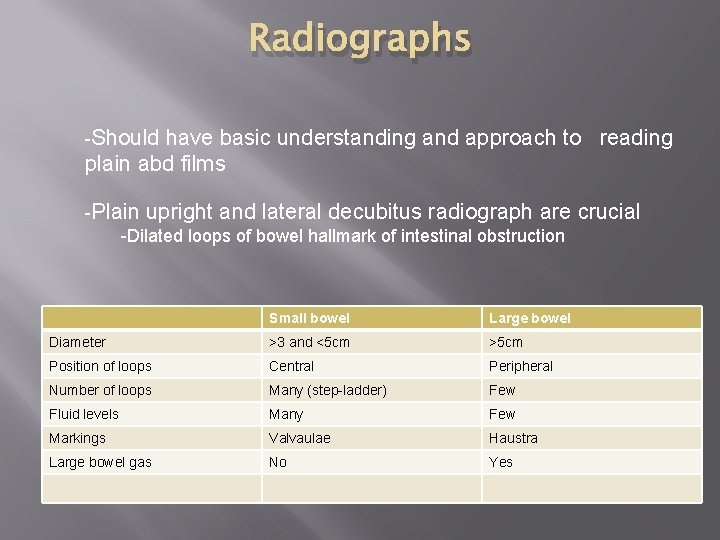
Radiographs -Should have basic understanding and approach to reading plain abd films -Plain upright and lateral decubitus radiograph are -Dilated loops of bowel hallmark of intestinal obstruction Small bowel Large bowel Diameter >3 and <5 cm >5 cm Position of loops Central Peripheral Number of loops Many (step-ladder) Few Fluid levels Many Few Markings Valvaulae Haustra Large bowel gas No Yes crucial
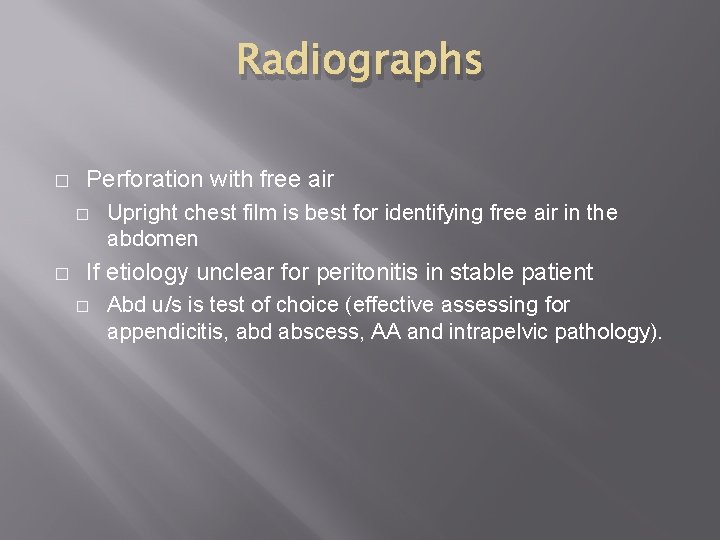
Radiographs � Perforation with free air � � Upright chest film is best for identifying free air in the abdomen If etiology unclear for peritonitis in stable patient � Abd u/s is test of choice (effective assessing for appendicitis, abd abscess, AA and intrapelvic pathology).
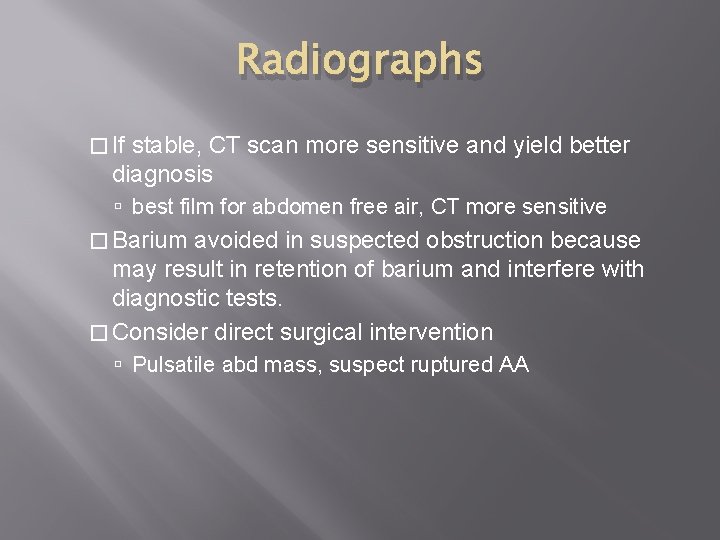
Radiographs � If stable, CT scan more sensitive and yield better diagnosis best film for abdomen free air, CT more sensitive � Barium avoided in suspected obstruction because may result in retention of barium and interfere with diagnostic tests. � Consider direct surgical intervention Pulsatile abd mass, suspect ruptured AA
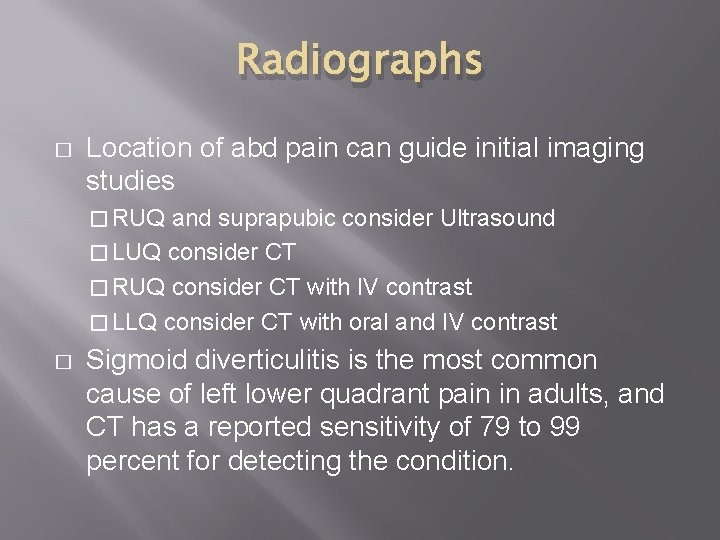
Radiographs � Location of abd pain can guide initial imaging studies � RUQ and suprapubic consider Ultrasound � LUQ consider CT � RUQ consider CT with IV contrast � LLQ consider CT with oral and IV contrast � Sigmoid diverticulitis is the most common cause of left lower quadrant pain in adults, and CT has a reported sensitivity of 79 to 99 percent for detecting the condition.

Evaluate RUQ pain � � Common right upper quadrant pain Obtain History and physical exam � Pulmonary symptoms consider PE (pulmonary embolism) and pneumonia Signs/symptoms; tachypnea, hypoxia orcrackles decrease air sound Consider chest x-ray, D-dimer and helical CT to r/o PE � Urinary symptoms UTI vs. nephrolitiasis CVA tenderness or suprapubic tenderness Obtain UA; if pyuria consider UTI or pyelonephritis Hematuria consider nephrolithiasis and consider obtain CT � Colic consider hepatobiliary cause or nephrolithiasis Perform U/S of abd, if nondiagnostic consider nephrolithiasis
Evaluation of RLQ pain � � Right lower quadrant pain is guided by the patient’s history of pain or signs (e. g. , psoas sign, rigidity, rebound, guarding) suggestive of appendicitis should receive CT and urgent surgical consultation. Normal CT findings should trigger additional urine, colon, or pelvic examination.
Evaluation of LLQ pain � Consider diverticulitis if fever and history of diverticular disease � CT with oral and IV contrast or consider empiric treatment � If no fever and diverticular disease � Consider UTI or GYN evaluation � Consider CT if abd distension, tenderness and consider rectal bleeding
Evaluation for special population � � � Certain populations in which the spectrum of disease is significantly different than the majority of patients. Extra attention is warranted when evaluating women and older persons with abdominal pain Female patient is challenging Perform a pregnancy test for childbearing age Positive pregnancy test consider transvaginal u/s to evaluate for ectopic pregnancy or pregnancy related complications � Negative pregnancy teset consider genitourinary infection with general work up for abd pain including pelvic exam. � � � Older patients with abdominal pain present a particular diagnostic challenge. Disease frequency and severity may be exaggerated in this population (e. g. , a higher incidence of diverticular disease or sepsis in those with urinary tract infection). � General abd pain work-up if low risk (stable vital signs, limited comorbidities) and consider UTI and diverticulitis � Perform CT and consider hospitalization if unstable vital signs or significant comorbidities and consider sepsis, perforated viscus or ischemic bowel �
Some of DDX for life-threatening conditions � AAA (abd aortic aneurysm) � Over 60, rapid onset of severe periumbilical pain and out of proportion findings � Risk factors include advance age, COPD, PVD, HTN, smoking and FHX � 6 cm is considered a threshold for surgical intervention � Mesenteric ischemia � Often out of proportion to findings on physical examination � Risk factors include advance age, atherosclerosis, cardiac arrhythmias, severe cardiac valvular disease, recent MI and intraabdominal malignancy
� Bowel perforation � peptic ulcer disease is the most common etiology � Sudden severe abd pain with initially local then rapidly diffuse � Tympanitic is drum like resonance obtained by percussing over a large space filled with air � Acute bowel obstruction � majority of bowel obstructions involve the small intestine � Common symptoms of SBO (small bowl obstruction) are abdominal distention, vomiting, crampy abdominal pain, and inability to pass flatus. � Most common cause of SBO is adhesions, other common causes are hernia and neoplasm
� Volvulus � Cecal similar presentation to SBO Pain usually steady with superimposed colicky component � Sigmoid Accounts for majority of volvulus vomiting less common abdomen is usually distended and tympanitic Risk factor includes excessive use of laxatives and anticholinergic medications
� Ectopic pregnancy � consider the diagnosis of ectopic pregnancy in any female of childbearing age with abdominal pain and should obtain h. CG test � Risk factors include a history of PID, previous tubal pregnancy and surgery, endometriosis, and IUD. � Symptoms classically include amenorrhea, abdominal pain, and vaginal bleeding � Placental abruption � painful vaginal bleeding, abdominal or back pain, and uterine contractions. � uterus may be rigid and tender � acute disseminated intravascular coagulation (DIC) can develop
Common conditions � � � � Appendicitis Pancreatitis Peptic ulcer disease Gastroenteritis Irritable bowel syndrome (IBS) Pyelpnephritis Inflammatory bowel disease cholecystitis, cholelithiasis Ectopic pregnancy Ovarian torison nephrolithiasis PID Hepatitis Spontaneous bacterial peritonitis (SBP) Colitis
- Slides: 21