
Approach Methods Techniques Edward Anthony There are three




















- Slides: 58
Approach, Methods, Techniques
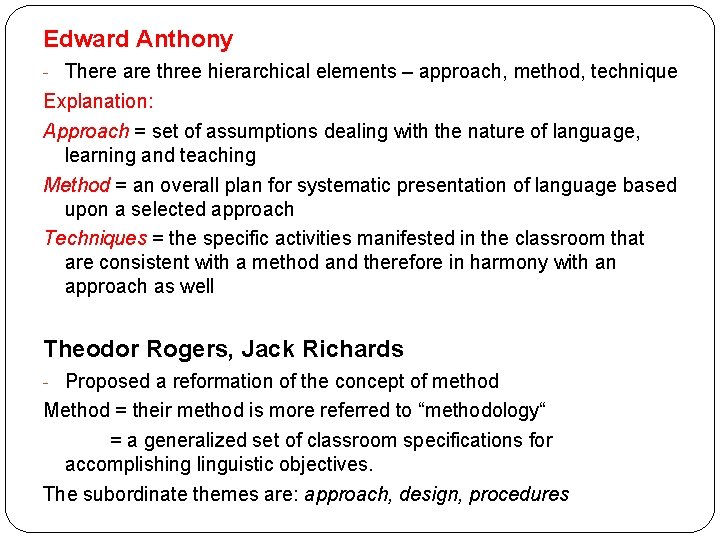
Edward Anthony - There are three hierarchical elements – approach, method, technique Explanation: Approach = set of assumptions dealing with the nature of language, learning and teaching Method = an overall plan for systematic presentation of language based upon a selected approach Techniques = the specific activities manifested in the classroom that are consistent with a method and therefore in harmony with an approach as well Theodor Rogers, Jack Richards - Proposed a reformation of the concept of method Method = their method is more referred to “methodology“ = a generalized set of classroom specifications for accomplishing linguistic objectives. The subordinate themes are: approach, design, procedures
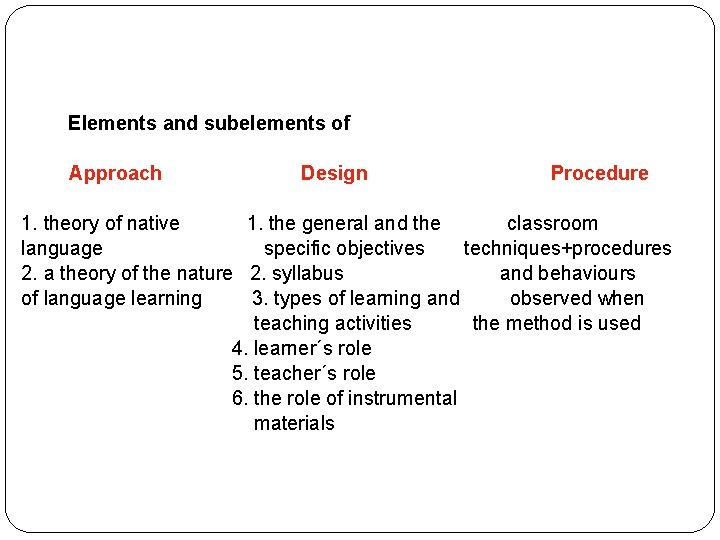
Elements and subelements of method – Richards and Rogers Approach Design Procedure 1. theory of native 1. the general and the classroom language specific objectives techniques+procedures 2. a theory of the nature 2. syllabus and behaviours of language learning 3. types of learning and observed when teaching activities the method is used 4. learner´s role 5. teacher´s role 6. the role of instrumental materials
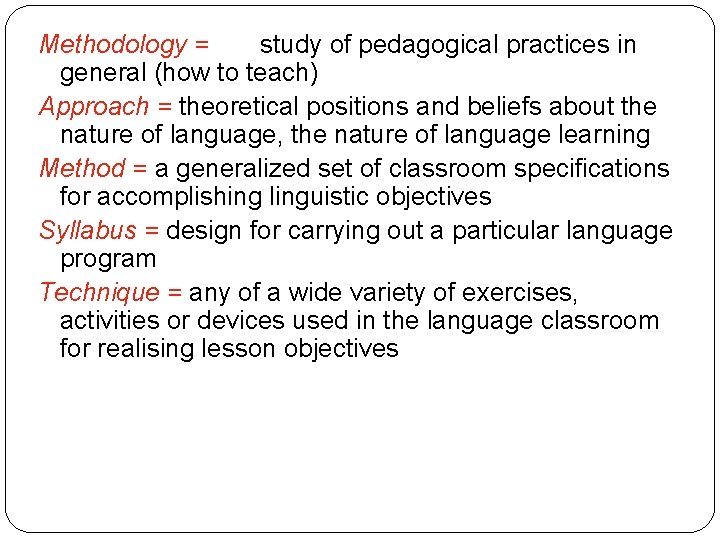
Definitions that reflect current usage: Methodology = the study of pedagogical practices in general (how to teach) Approach = theoretical positions and beliefs about the nature of language, the nature of language learning Method = a generalized set of classroom specifications for accomplishing linguistic objectives Syllabus = design for carrying out a particular language program Technique = any of a wide variety of exercises, activities or devices used in the language classroom for realising lesson objectives
Repka´s model Approach Planning Programming – syllabus (specification of objective) Method operation selection of tasks – dynamization of techniques Stern – 3 theories 1. Theory of teaching foreign language 2. Approaches and methods 3. Proved hypotheses concerning approaches and methods
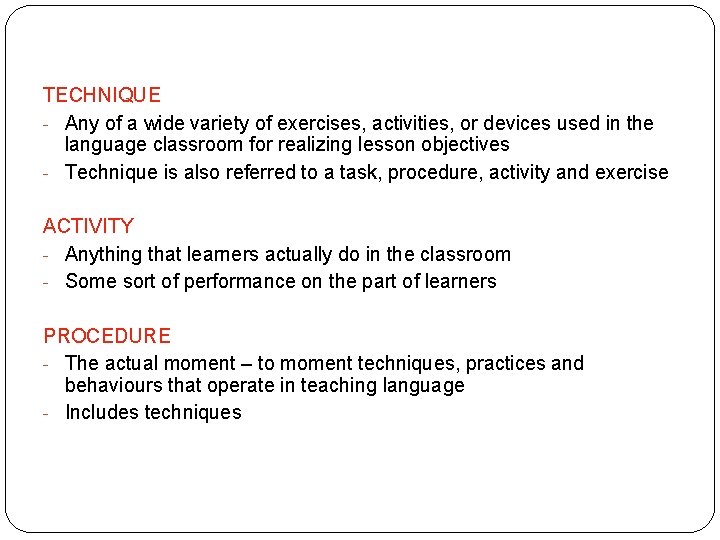
TECHNIQUE - Any of a wide variety of exercises, activities, or devices used in the language classroom for realizing lesson objectives - Technique is also referred to a task, procedure, activity and exercise ACTIVITY - Anything that learners actually do in the classroom - Some sort of performance on the part of learners PROCEDURE - The actual moment – to moment techniques, practices and behaviours that operate in teaching language - Includes techniques
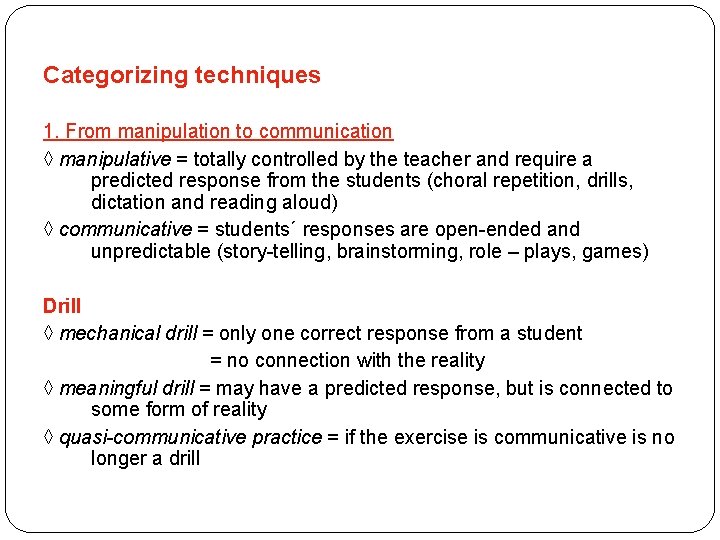
Categorizing techniques 1. From manipulation to communication ◊ manipulative = totally controlled by the teacher and require a predicted response from the students (choral repetition, drills, dictation and reading aloud) ◊ communicative = students´ responses are open-ended and unpredictable (story-telling, brainstorming, role – plays, games) Drill ◊ mechanical drill = only one correct response from a student = no connection with the reality ◊ meaningful drill = may have a predicted response, but is connected to some form of reality ◊ quasi-communicative practice = if the exercise is communicative is no longer a drill
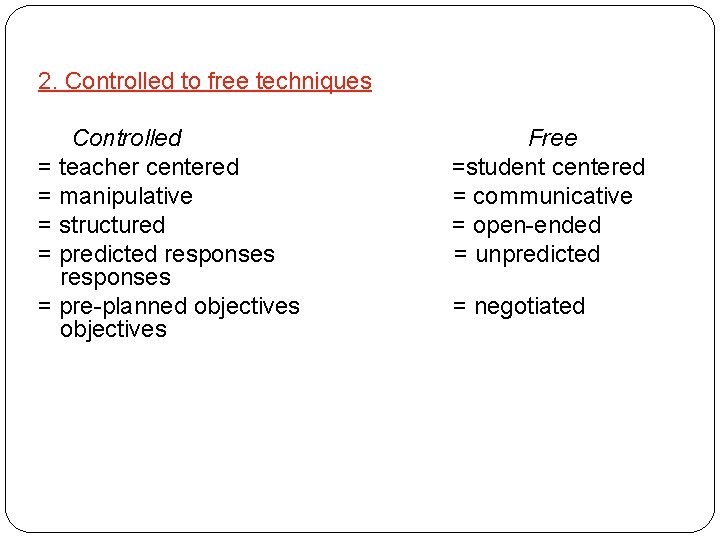
2. Controlled to free techniques Controlled = teacher centered = manipulative = structured = predicted responses = pre-planned objectives Free =student centered = communicative = open-ended = unpredicted = negotiated
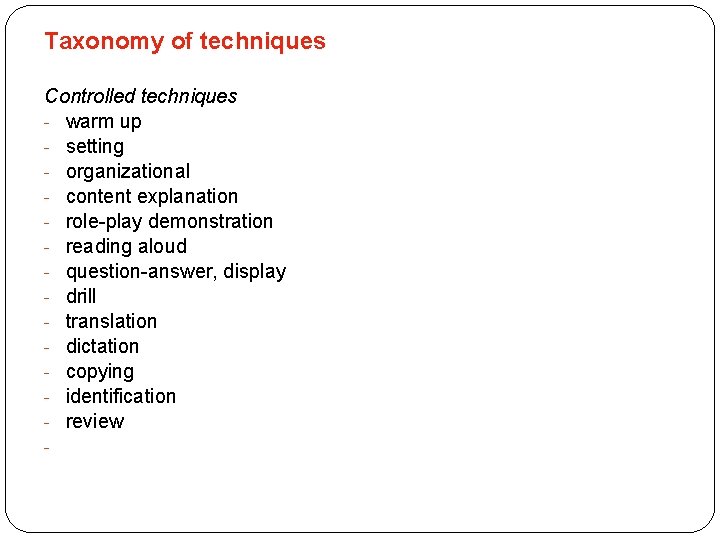
Taxonomy of techniques Controlled techniques - warm up - setting - organizational - content explanation - role-play demonstration - reading aloud - question-answer, display - drill - translation - dictation - copying - identification - review - testing
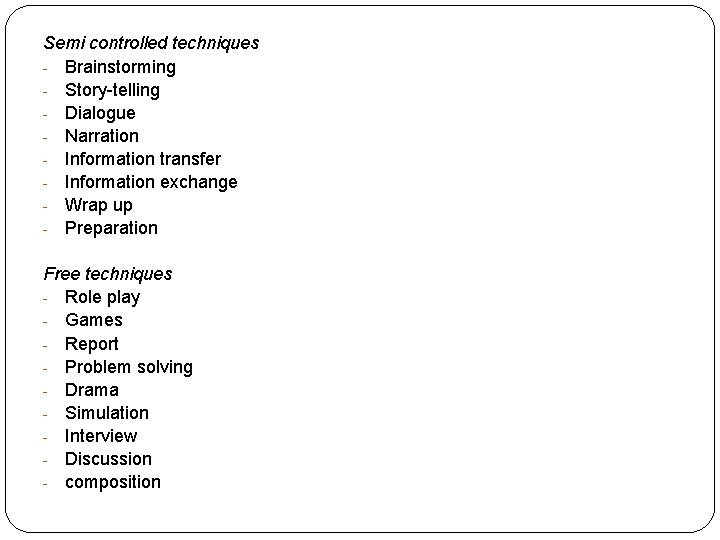
Semi controlled techniques - Brainstorming - Story-telling - Dialogue - Narration - Information transfer - Information exchange - Wrap up - Preparation Free techniques - Role play - Games - Report - Problem solving - Drama - Simulation - Interview - Discussion - composition
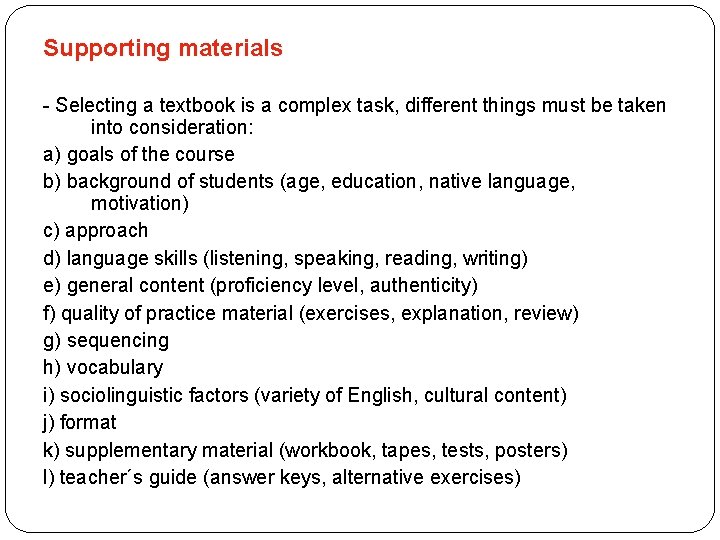
Supporting materials Textbooks - Selecting a textbook is a complex task, different things must be taken into consideration: a) goals of the course b) background of students (age, education, native language, motivation) c) approach d) language skills (listening, speaking, reading, writing) e) general content (proficiency level, authenticity) f) quality of practice material (exercises, explanation, review) g) sequencing h) vocabulary i) sociolinguistic factors (variety of English, cultural content) j) format k) supplementary material (workbook, tapes, tests, posters) l) teacher´s guide (answer keys, alternative exercises)
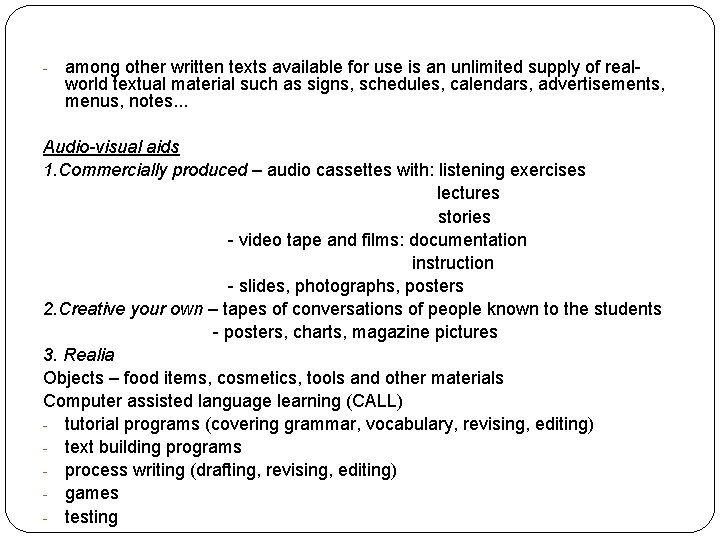
Other written texts - among other written texts available for use is an unlimited supply of realworld textual material such as signs, schedules, calendars, advertisements, menus, notes. . . Audio-visual aids 1. Commercially produced – audio cassettes with: listening exercises lectures stories - video tape and films: documentation instruction - slides, photographs, posters 2. Creative your own – tapes of conversations of people known to the students - posters, charts, magazine pictures 3. Realia Objects – food items, cosmetics, tools and other materials Computer assisted language learning (CALL) - tutorial programs (covering grammar, vocabulary, revising, editing) - text building programs - process writing (drafting, revising, editing) - games - testing
The Revised Bloom’s Taxonomy: An Overview Shared by: Lorain Anderson University of South Carolina
A Fundamental Truth We don’t see the world as it is; we see the world through the lens through which we look at it.
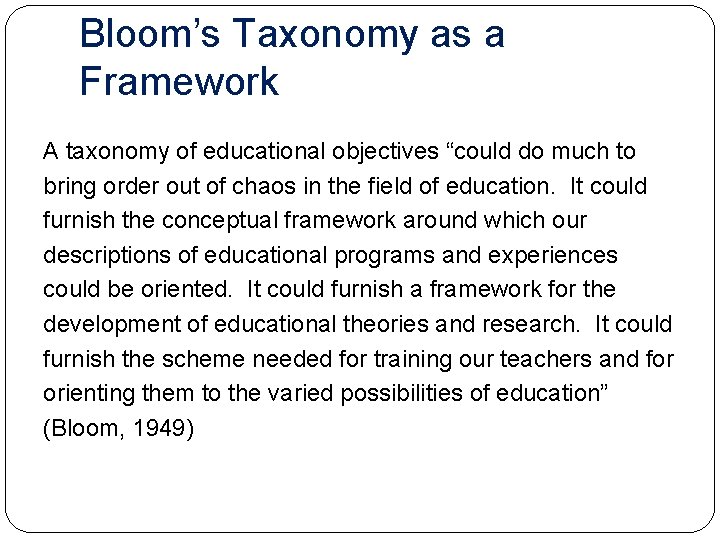
Bloom’s Taxonomy as a Framework A taxonomy of educational objectives “could do much to bring order out of chaos in the field of education. It could furnish the conceptual framework around which our descriptions of educational programs and experiences could be oriented. It could furnish a framework for the development of educational theories and research. It could furnish the scheme needed for training our teachers and for orienting them to the varied possibilities of education” (Bloom, 1949)
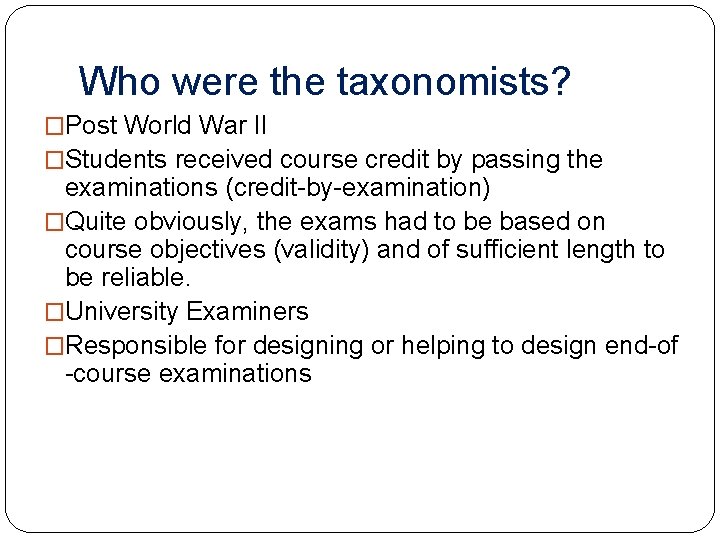
Who were the taxonomists? �Post World War II �Students received course credit by passing the examinations (credit-by-examination) �Quite obviously, the exams had to be based on course objectives (validity) and of sufficient length to be reliable. �University Examiners �Responsible for designing or helping to design end-of -course examinations
They Needed a Set of Categories that Cut-Across Subject Areas “Although the objectives … may be specified in an almost unlimited number of ways, the student behaviors involved in these objectives can be represented by a relatively small number of classes. Therefore, the taxonomy is designed to be a classification of the student behaviors which represent the intended outcomes of the educational process” (p. 18).
Looking Through a New Lens
Evaluation Synthesis Analysis Application Comprehension Knowledge The Original Bloom’s “Bloom’s. Taxonomy
Without the Lens The student will recall the names of the parts of a flower.
With the Lens The student will recall the names of the parts of a flower. This is a knowledge objective.
Objectives were used to form categories; then categories were used to classify objectives. 80 % of the objectives fell into the Knowledge category
The Revision �Began in November 1996 �Led by David Krathwohl �Involved cognitive psychologists, curriculum theorists, teacher educators, and measurement and assessment specialists. �Group met twice a year four years. �Draft completed in 2000; text published in 2001. �Two books – soft cover for teachers and other “practitioners” and hard cover for academicians.
In education, objectives are statements of what we want students to learn as a result of the instruction we provide. Standards are simply mandated objectives.
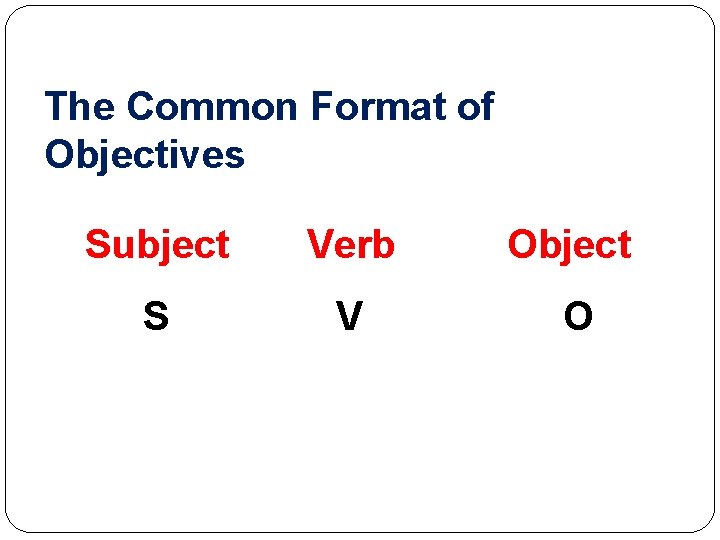
The Common Format of Objectives Subject Verb Object S V O
The SUBJECT is the Learner or the Student. The student (will) The student (should) The students (might) Quite often, the subject is implicit or understood.
The verbs provide clues as to the cognitive process category intended by the person or persons writing the standard. Adopted from the original Bloom’s taxonomy of educational objectives, there are six cognitive process categories.
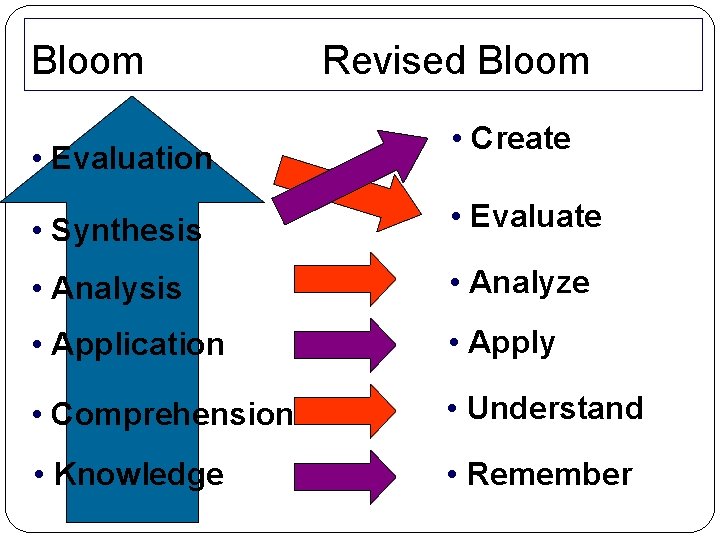
Bloom • Evaluation Revised Bloom • Create • Synthesis • Evaluate • Analysis • Analyze • Application • Apply • Comprehension • Understand • Knowledge • Remember
Each of the six cognitive process categories was divided into specific cognitive processes. Nineteen (19) specific cognitive processes were identified.
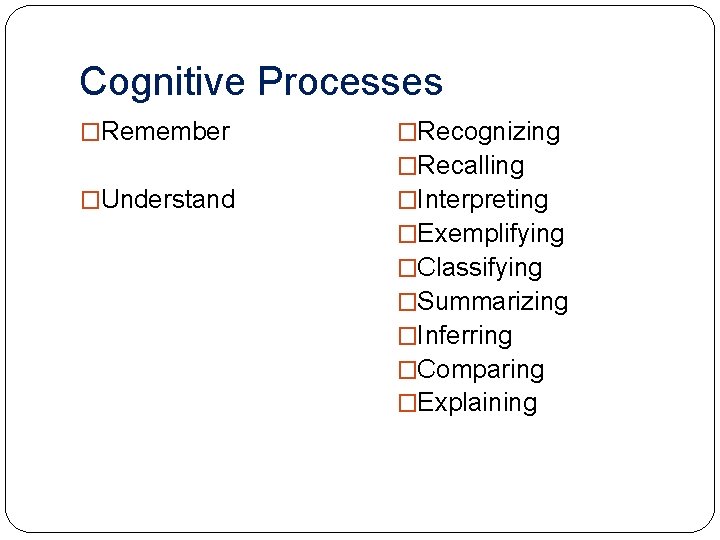
Cognitive Processes �Remember �Understand �Recognizing �Recalling �Interpreting �Exemplifying �Classifying �Summarizing �Inferring �Comparing �Explaining
Cognitive Processes (continued) � Apply � Executing � Implementing � Analyze � Differentiating � Organizing � Attributing � Evaluate � Checking � Critiquing � Create � Generating � Planning � Producing
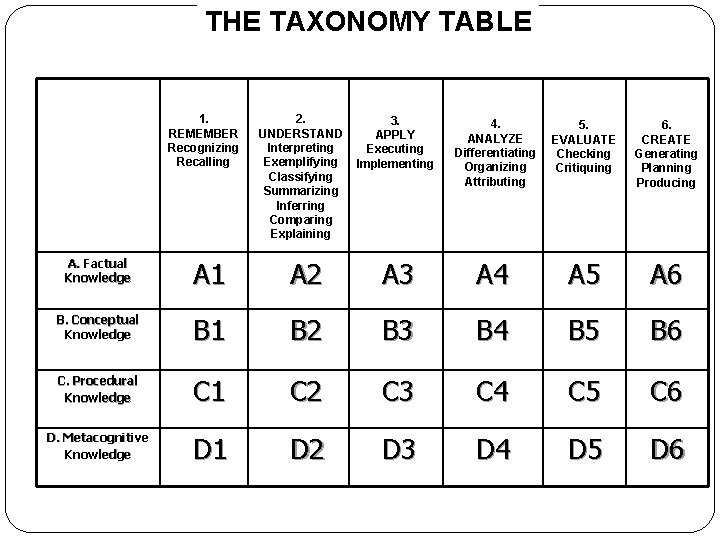
THE TAXONOMY TABLE COGNITIVE PROCESS DIMENSION 1. REMEMBER Recognizing Recalling 2. UNDERSTAND Interpreting Exemplifying Classifying Summarizing Inferring Comparing Explaining 3. APPLY Executing Implementing 4. ANALYZE Differentiating Organizing Attributing 5. EVALUATE Checking Critiquing 6. CREATE Generating Planning Producing
Unlike the verbs, the objects of the standards are subject-specific (e. g. , math, science, social studies). The objects specify the CONTENT of the standard. For several reasons, CONTENT was replaced by KNOWLEDGE.
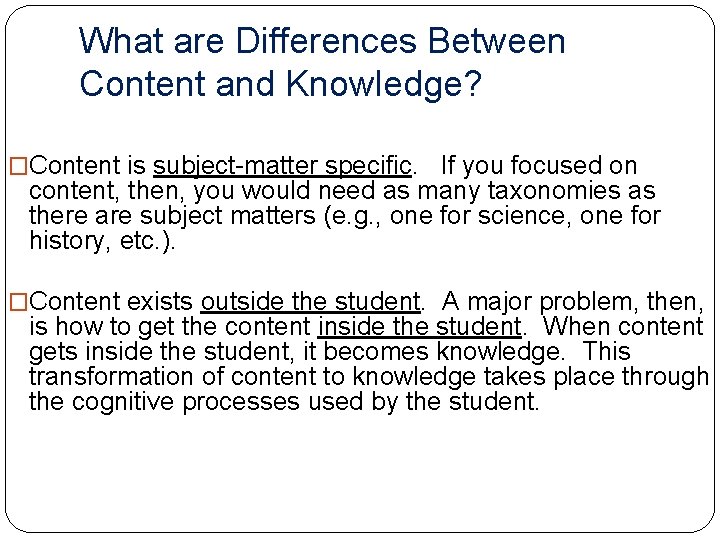
What are Differences Between Content and Knowledge? �Content is subject-matter specific. If you focused on content, then, you would need as many taxonomies as there are subject matters (e. g. , one for science, one for history, etc. ). �Content exists outside the student. A major problem, then, is how to get the content inside the student. When content gets inside the student, it becomes knowledge. This transformation of content to knowledge takes place through the cognitive processes used by the student.
Four Types of Knowledge �Factual Knowledge �Conceptual Knowledge �Procedural Knowledge �Metacognitive Knowledge
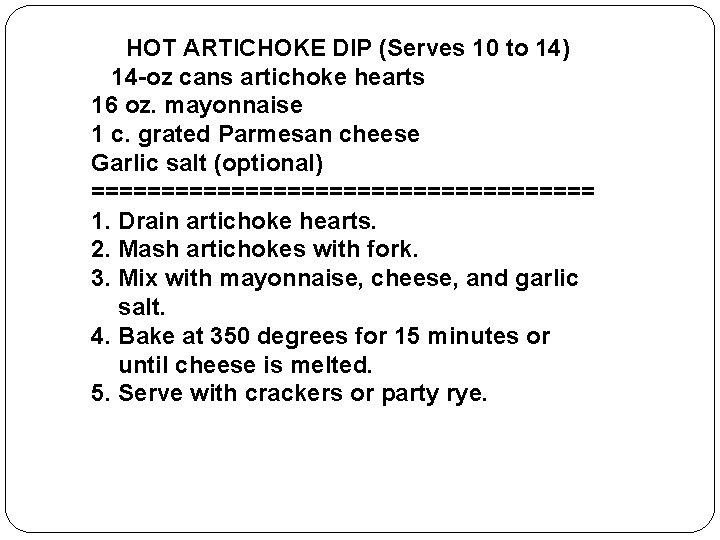
HOT ARTICHOKE DIP (Serves 10 to 14) 2 14 -oz cans artichoke hearts 16 oz. mayonnaise 1 c. grated Parmesan cheese Garlic salt (optional) ================== 1. Drain artichoke hearts. 2. Mash artichokes with fork. 3. Mix with mayonnaise, cheese, and garlic salt. 4. Bake at 350 degrees for 15 minutes or until cheese is melted. 5. Serve with crackers or party rye.
THE TAXONOMY TABLE COGNITIVE PROCESS DIMENSION KNOWLEDGE DIMENSION FACTUAL KNOWLEDGE CONCEPTU AL KNOWLED PROCEDURA GE L KNOWLEDGE METACOGNIT IVE KNOWLEDGE 1. REMEMBER Recognizing Recalling 2. UNDERSTAND Interpreting Exemplifying Classifying Summarizing Inferring Comparing Explaining 3. APPLY Executing Implementing 4. ANALYZE Differentiating Organizing Attributing 5. EVALUATE Checking Critiquing 6. CREATE Generating Planning Producing
THE TAXONOMY TABLE 1. REMEMBER Recognizing Recalling 2. UNDERSTAND Interpreting Exemplifying Classifying Summarizing Inferring Comparing Explaining 3. APPLY Executing Implementing 4. ANALYZE Differentiating Organizing Attributing 5. EVALUATE Checking Critiquing 6. CREATE Generating Planning Producing A. Factual Knowledge A 1 A 2 A 3 A 4 A 5 A 6 B. Conceptual Knowledge B 1 B 2 B 3 B 4 B 5 B 6 C. Procedural Knowledge C 1 C 2 C 3 C 4 C 5 C 6 D. Metacognitive Knowledge D 1 D 2 D 3 D 4 D 5 D 6
How it Works
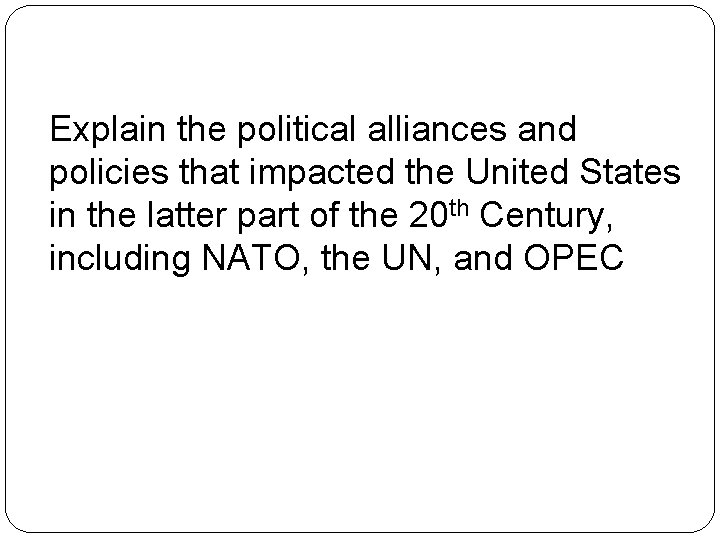
Explain the political alliances and policies that impacted the United States in the latter part of the 20 th Century, including NATO, the UN, and OPEC
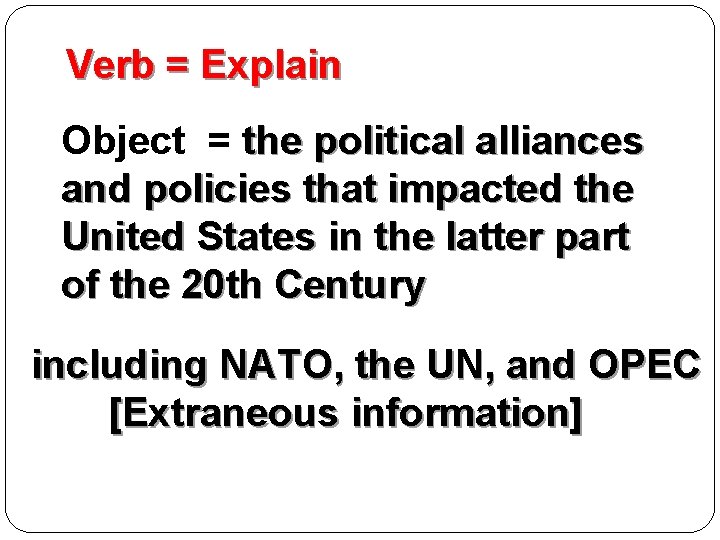
Verb = Explain Object = the political alliances and policies that impacted the United States in the latter part of the 20 th Century including NATO, the UN, and OPEC [Extraneous information]
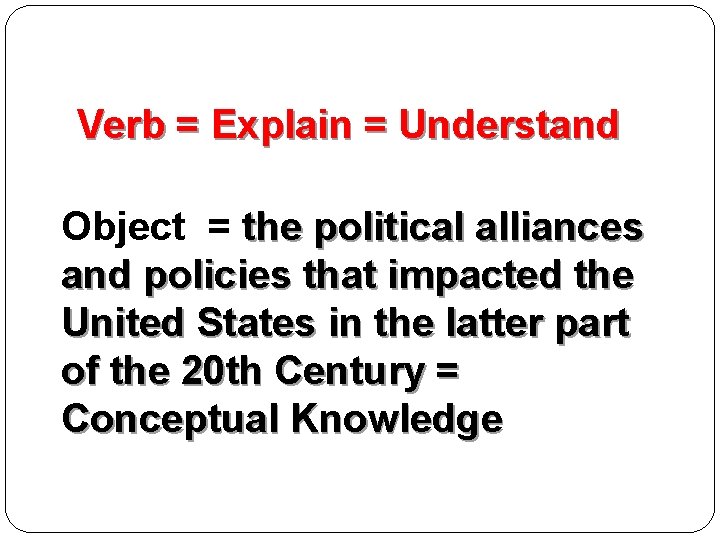
Verb = Explain = Understand Object = the political alliances and policies that impacted the United States in the latter part of the 20 th Century = Conceptual Knowledge
Summarize the provisions of the 13 th, 14 th, and 15 th Amendments to the Constitution, including how the amendments protected the rights of African Americans and sought to enhance their political, social, and economic opportunities
Verb = Summarize Object = Provisions of the 13 th, 14 th, and 15 th Amendments to the Constitution Including how the amendments protected the rights of African Americans and sought to enhance their political, social, and economic opportunities [Extraneous information]
Verb = Summarize = Understand Object = Provisions of the 13 th, 14 th, and 15 th Amendments to the Constitution = Factual Knowledge
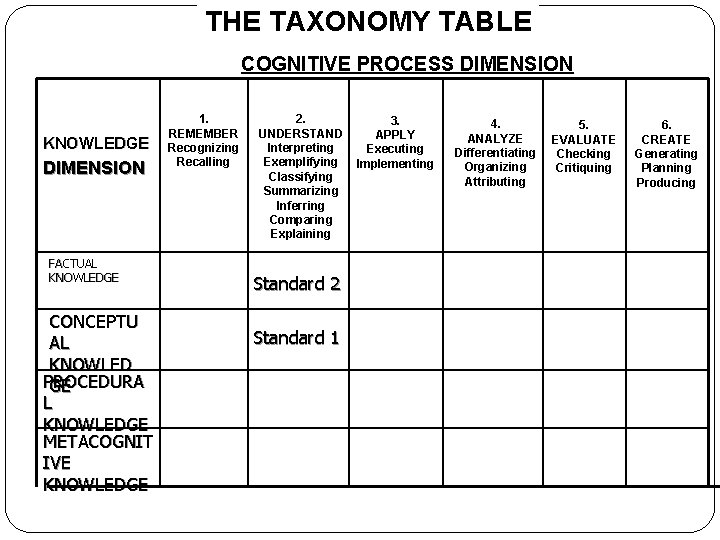
THE TAXONOMY TABLE COGNITIVE PROCESS DIMENSION KNOWLEDGE DIMENSION FACTUAL KNOWLEDGE CONCEPTU AL KNOWLED PROCEDURA GE L KNOWLEDGE METACOGNIT IVE KNOWLEDGE 1. REMEMBER Recognizing Recalling 2. UNDERSTAND Interpreting Exemplifying Classifying Summarizing Inferring Comparing Explaining Standard 2 Standard 1 3. APPLY Executing Implementing 4. ANALYZE Differentiating Organizing Attributing 5. EVALUATE Checking Critiquing 6. CREATE Generating Planning Producing
The SVO format of standards in combination with the two-dimensional structure of the Taxonomy Table allows us to classify standards so we better understand their intent and meaning in terms of student learning.
Additional Benefits �Increase curriculum alignment �Improve validity of assessments �Improve quality of instruction
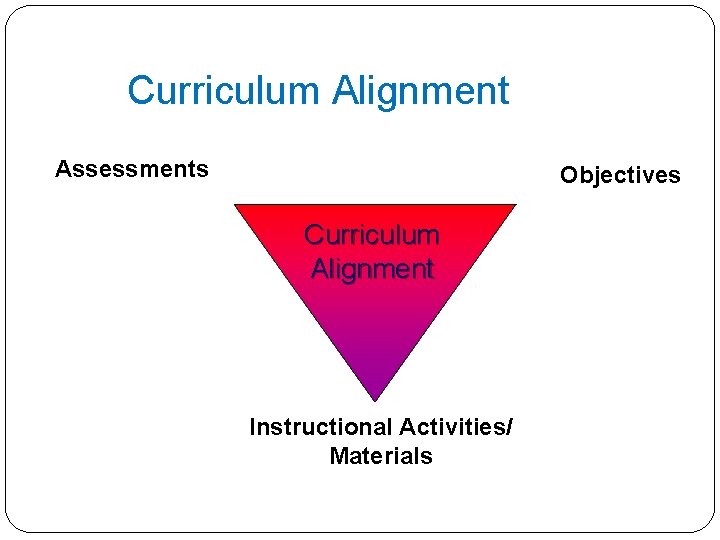
Curriculum Alignment Assessments Objectives Curriculum Alignment Instructional Activities/ Materials
Why is Alignment Important? �Increases validity of assessment �Increases students’ opportunity to learn �Provides more accurate estimates of teaching effectiveness �Permits better instructional decisions to be made
Traditional Alignment �What content is included in the objective? �What content is included on the assessment(s)? �Is the content included in the objective and/or on the assessment included in the instructional materials? �If the content is the same, there is a high level of alignment.
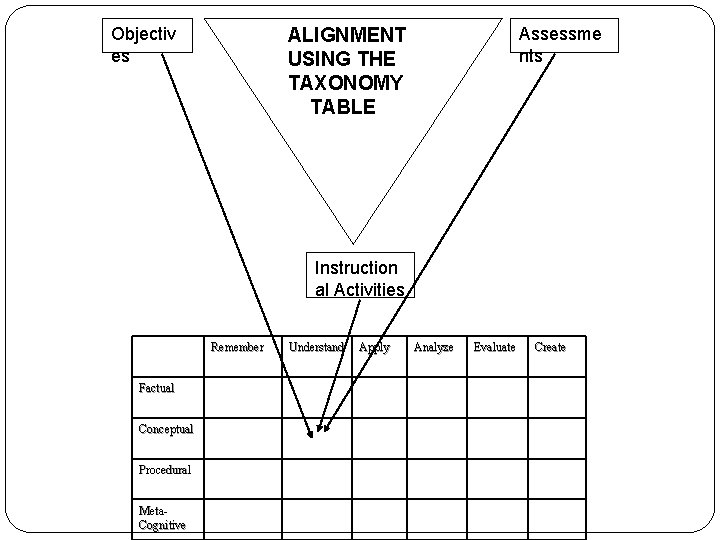
Objectiv es Assessme nts ALIGNMENT USING THE TAXONOMY TABLE Instruction al Activities Remember Factual Conceptual Procedural Meta. Cognitive Understand Apply Analyze Evaluate Create
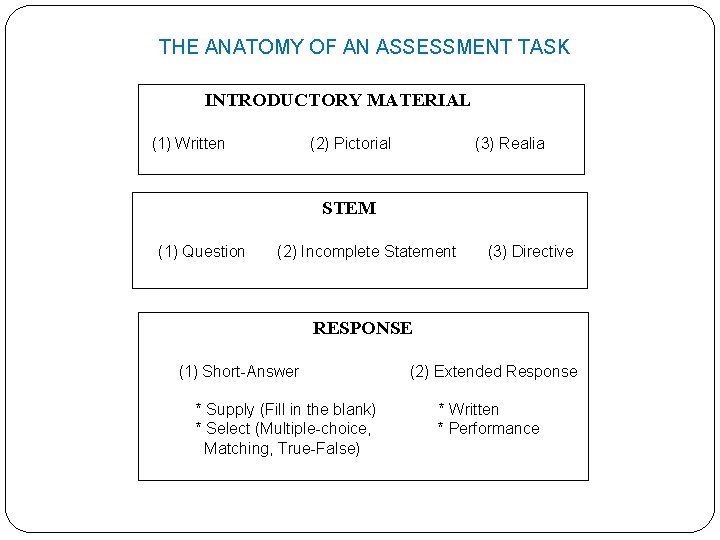
THE ANATOMY OF AN ASSESSMENT TASK INTRODUCTORY MATERIAL (1) Written (2) Pictorial (3) Realia STEM (1) Question (2) Incomplete Statement (3) Directive RESPONSE (1) Short-Answer * Supply (Fill in the blank) * Select (Multiple-choice, Matching, True-False) (2) Extended Response * Written * Performance
Remember Factual Knowledge �No Introductory Material �Stem as Question or Incomplete Statement �Supply (Recall) or Select (Recognize) Format
Apply Procedural Knowledge �Introductory Material is Present �Stem as Directive �Extended Response Format
Teaching Students to "Remember Factual Knowledge" 1. Focus students’ attention on important facts and terms, using, among other things, study guides, colors, and verbal markers. 2. Structure the information to be remembered (e. g. , outlines, diagrams, pictures). 3. Use repetition, incorporating songs and rhythmic activities (e. g. , clapping, chanting, cheering). 4. Use mnemonic devices & acronyms; teach memory strategies (e. g. , rehearsal, elaboration, making connections with familiar places and things). 5. Use distributed practice.
Teaching Students to "Understand Conceptual Knowledge“ 1. 2. 3. 4. 5. Emphasize defining features or key characteristics; ask "what makes X, X? " Give examples, non-examples, and “near” examples. Teach concepts in relation to one another; show connections and relationships using visual representations and graphic organizers. Use metaphors and similes. Use “hands-on” activities and manipulatives; build models.
Why the Revised Taxonomy? �Historical link (1949 to the present) �Two dimensions match the structure of all objectives: subject-verb-object. �Complete “crossing” of rows with columns makes knowledge and cognitive processes equally important �The use of verbs is critical since the verbs represent the cognitive processes that students use on or with the content so that learning occurs