
Approach Methods Techniques Edward Anthony There are three

- Slides: 13
Approach, Methods, Techniques
Edward Anthony - There are three hierarchical elements – approach, method, technique Explanation: Approach = set of assumptions dealing with the nature of language, learning and teaching Method = an overall plan for systematic presentation of language based upon a selected approach Techniques = the specific activities manifested in the classroom that are consistent with a method and therefore in harmony with an approach as well Theodor Rogers, Jack Richards - Proposed a reformation of the concept of method Method = their method is more referred to “methodology“ = a generalized set of classroom specifications for accomplishing linguistic objectives. The subordinate themes are: approach, design, procedures
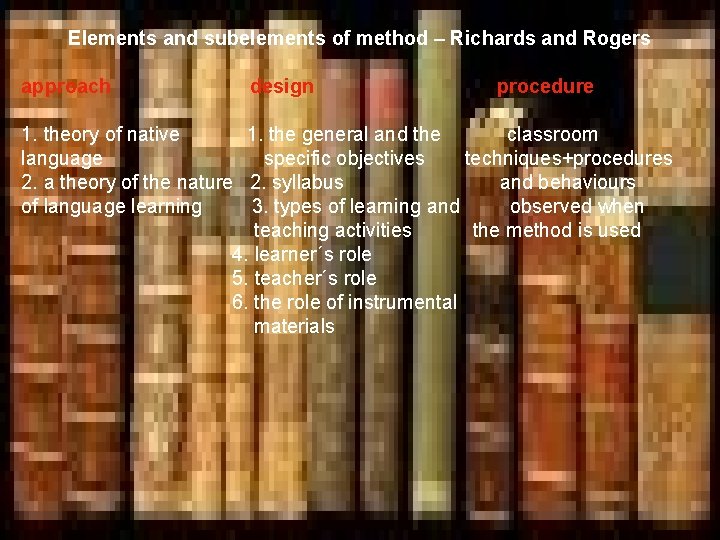
Elements and subelements of method – Richards and Rogers approach design procedure 1. theory of native 1. the general and the classroom language specific objectives techniques+procedures 2. a theory of the nature 2. syllabus and behaviours of language learning 3. types of learning and observed when teaching activities the method is used 4. learner´s role 5. teacher´s role 6. the role of instrumental materials
Definitions that reflect current usage: Methodology = the study of pedagogical practices in general (how to teach) Approach = theoretical positions and beliefs about the nature of language, the nature of language learning Method = a generalized set of classroom specifications for accomplishing linguistic objectives Syllabus = design for carrying out a particular language program Technique = any of a wide variety of exercises, activities or devices used in the language classroom for realising lesson objectives
Repka´s model Approach Planning Programming – syllabus (specification of objective) Method operation selection of tasks – dynamization of techniques Stern – 3 theories 1. Theory of teaching foreign language 2. Approaches and methods 3. Proved hypotheses concerning approaches and methods
TECHNIQUE - Any of a wide variety of exercises, activities, or devices used in the language classroom for realizing lesson objectives - Technique is also referred to a task, procedure, activity and exercise ACTIVITY - Anything that learners actually do in the classroom - Some sort of performance on the part of learners PROCEDURE - The actual moment – to moment techniques, practices and behaviours that operate in teaching language - Includes techniques
Categorizing techniques 1. From manipulation to communication ◊ manipulative = totally controlled by the teacher and require a predicted response from the students (choral repetition, drills, dictation and reading aloud) ◊ communicative = students´ responses are open-ended and unpredictable (story-telling, brainstorming, role – plays, games) Drill ◊ mechanical drill = only one correct response from a student = no connection with the reality ◊ meaningful drill = may have a predicted response, but is connected to some form of reality ◊ quasi-communicative practice = if the exercise is communicative is no longer a drill
2. Controlled to free techniques Controlled = teacher centered = manipulative = structured = predicted responses = pre-planned objectives Free =student centered = communicative = open-ended = unpredicted = negotiated
Taxonomy of techniques Controlled techniques - warm up - setting - organizational - content explanation - role-play demonstration - reading aloud - question-answer, display - drill - translation - dictation - copying - identification - review - testing
Semi controlled techniques - Brainstorming - Story-telling - Dialogue - Narration - Information transfer - Information exchange - Wrap up - Preparation Free techniques - Role play - Games - Report - Problem solving - Drama - Simulation - Interview - Discussion - composition
Supporting materials Textbooks - Selecting a textbook is a complex task, different things must be taken into consideration: a) goals of the course b) background of students (age, education, native language, motivation) c) approach d) language skills (listening, speaking, reading, writing) e) general content (proficiency level, authenticity) f) quality of practice material (exercises, explanation, review) g) sequencing h) vocabulary i) sociolinguistic factors (variety of English, cultural content) j) format k) supplementary material (workbook, tapes, tests, posters) l) teacher´s guide (answer keys, alternative exercises)
Other written texts - among other written texts available for use is an unlimited supply of realworld textual material such as signs, schedules, calendars, advertisements, menus, notes. . . Audio-visual aids 1. Commercially produced – audio cassettes with: listening exercises lectures stories - video tape and films: documentation instruction - slides, photographs, posters 2. Creative your own – tapes of conversations of people known to the students - posters, charts, magazine pictures 3. Realia Objects – food items, cosmetics, tools and other materials Computer assisted language learning (CALL) - tutorial programs (covering grammar, vocabulary, revising, editing) - text building programs - process writing (drafting, revising, editing) - games - testing
Thank you for your attention.