
Approach Charts Overview Surface Safety and Departure Safety
- Slides: 38
Approach Charts
Overview • Surface Safety and Departure Safety • Standard Departure Procedures • Takeoff Minimums • Alternate Minimums • SIDs • ODPs • VCOA Departures • RNAV Departures • VFR Departures © 2015 Coast Flight Training. All Rights Reserved.
The Standard IAP • Instrument Approach Procedure (IAP) • Allows to descend from enroute altitude to a point near runway where landing may be made visually • Comes in 3 types: • Precision Approach • Approach with Vertical Guidance • Nonprecision Approach © 2015 Coast Flight Training. All Rights Reserved. JIC 7 -1
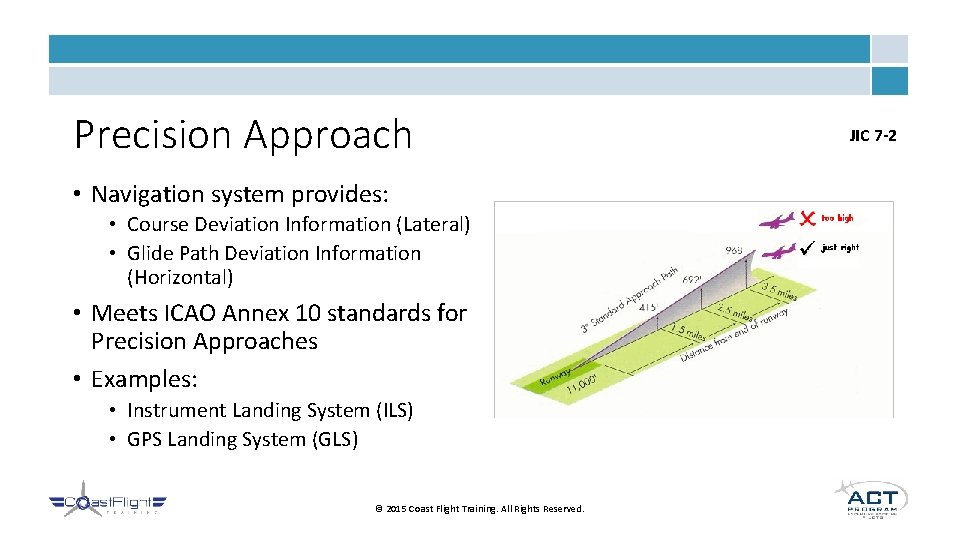
Precision Approach • Navigation system provides: • Course Deviation Information (Lateral) • Glide Path Deviation Information (Horizontal) • Meets ICAO Annex 10 standards for Precision Approaches • Examples: • Instrument Landing System (ILS) • GPS Landing System (GLS) © 2015 Coast Flight Training. All Rights Reserved. JIC 7 -2
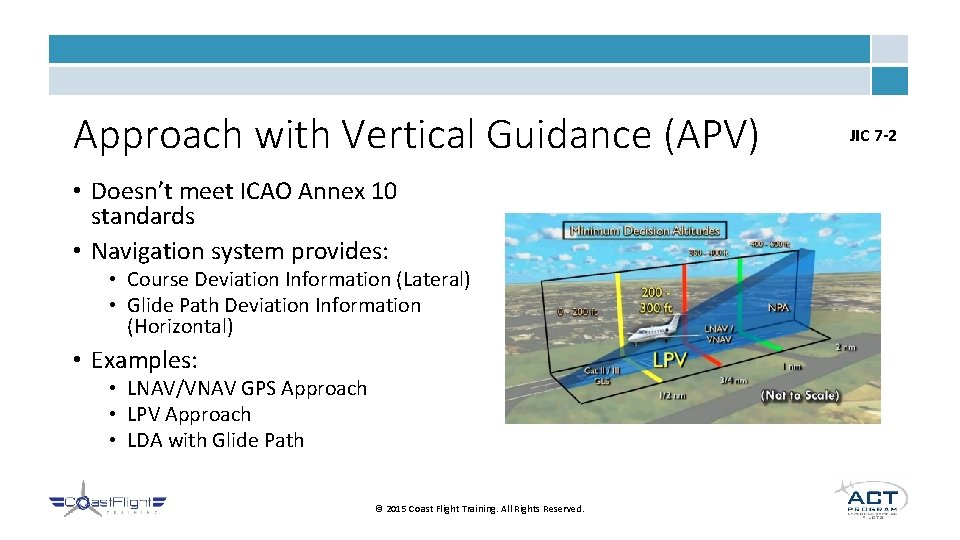
Approach with Vertical Guidance (APV) • Doesn’t meet ICAO Annex 10 standards • Navigation system provides: • Course Deviation Information (Lateral) • Glide Path Deviation Information (Horizontal) • Examples: • LNAV/VNAV GPS Approach • LPV Approach • LDA with Glide Path © 2015 Coast Flight Training. All Rights Reserved. JIC 7 -2
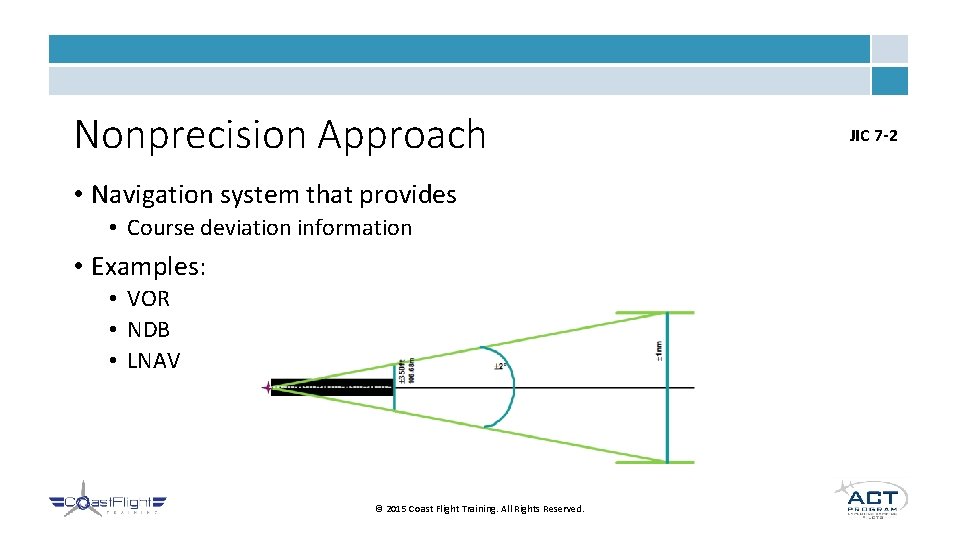
Nonprecision Approach • Navigation system that provides • Course deviation information • Examples: • VOR • NDB • LNAV © 2015 Coast Flight Training. All Rights Reserved. JIC 7 -2
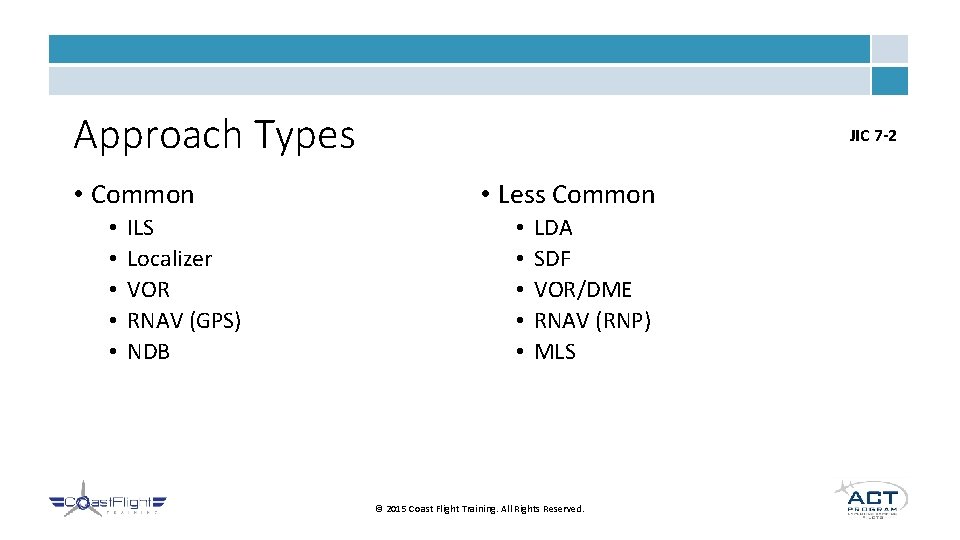
Approach Types • Common • • • ILS Localizer VOR RNAV (GPS) NDB JIC 7 -2 • Less Common • • • LDA SDF VOR/DME RNAV (RNP) MLS © 2015 Coast Flight Training. All Rights Reserved.
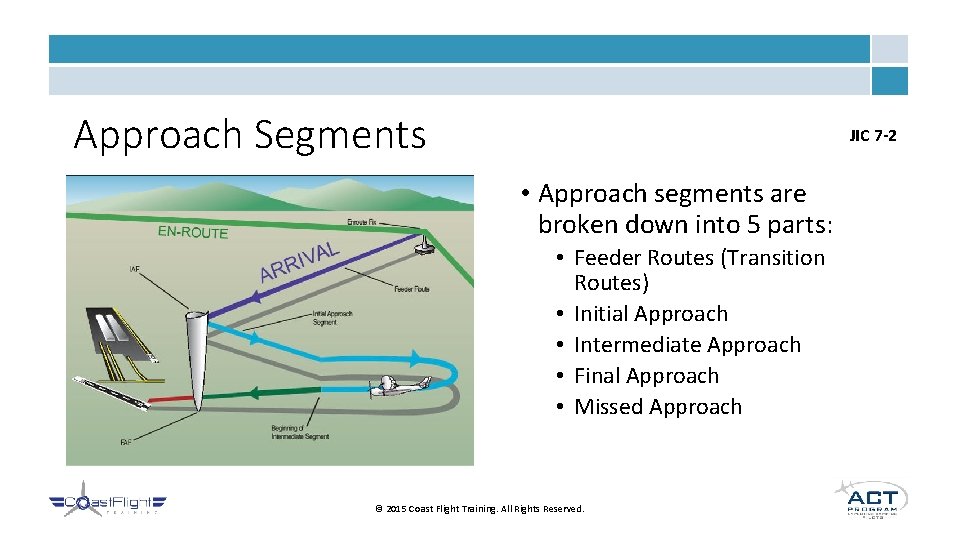
Approach Segments JIC 7 -2 • Approach segments are broken down into 5 parts: • Feeder Routes (Transition Routes) • Initial Approach • Intermediate Approach • Final Approach • Missed Approach © 2015 Coast Flight Training. All Rights Reserved.
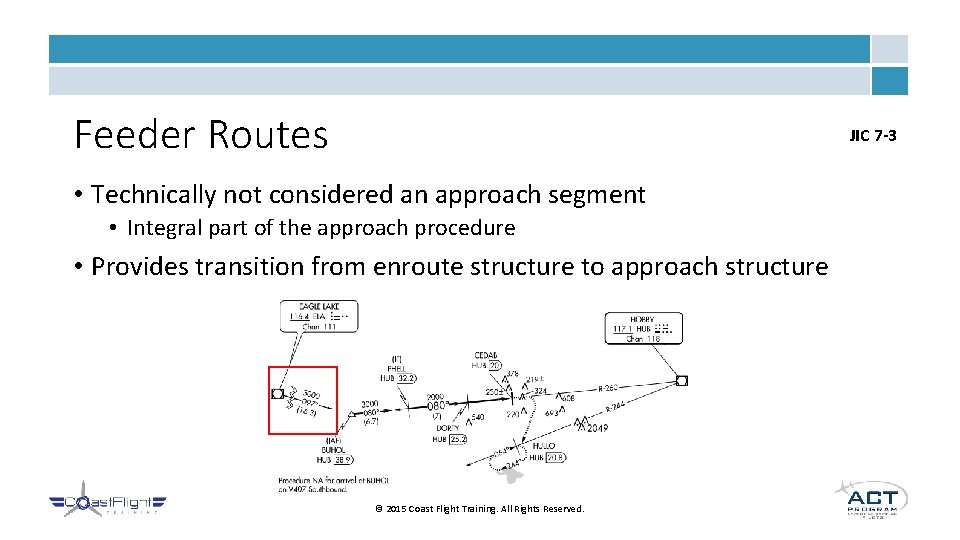
Feeder Routes JIC 7 -3 • Technically not considered an approach segment • Integral part of the approach procedure • Provides transition from enroute structure to approach structure © 2015 Coast Flight Training. All Rights Reserved.
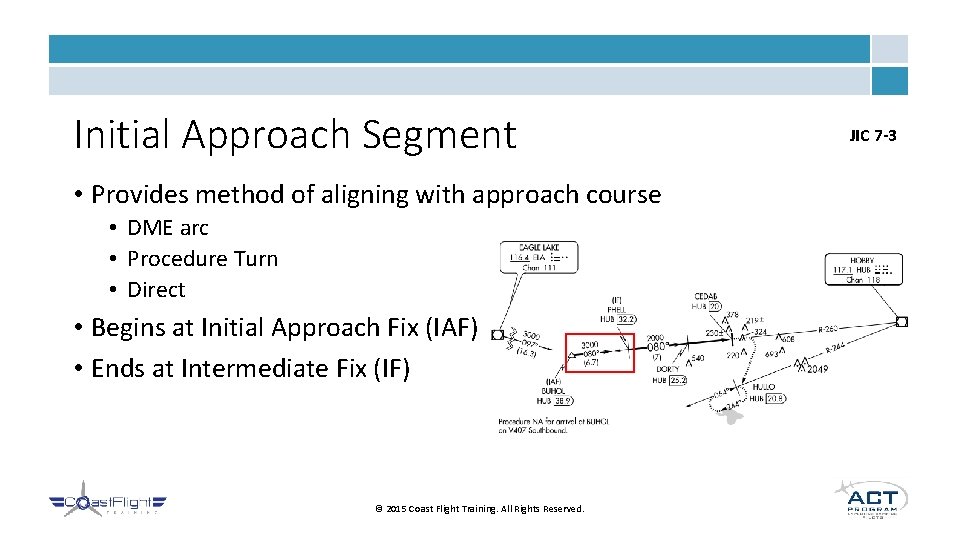
Initial Approach Segment • Provides method of aligning with approach course • DME arc • Procedure Turn • Direct • Begins at Initial Approach Fix (IAF) • Ends at Intermediate Fix (IF) © 2015 Coast Flight Training. All Rights Reserved. JIC 7 -3
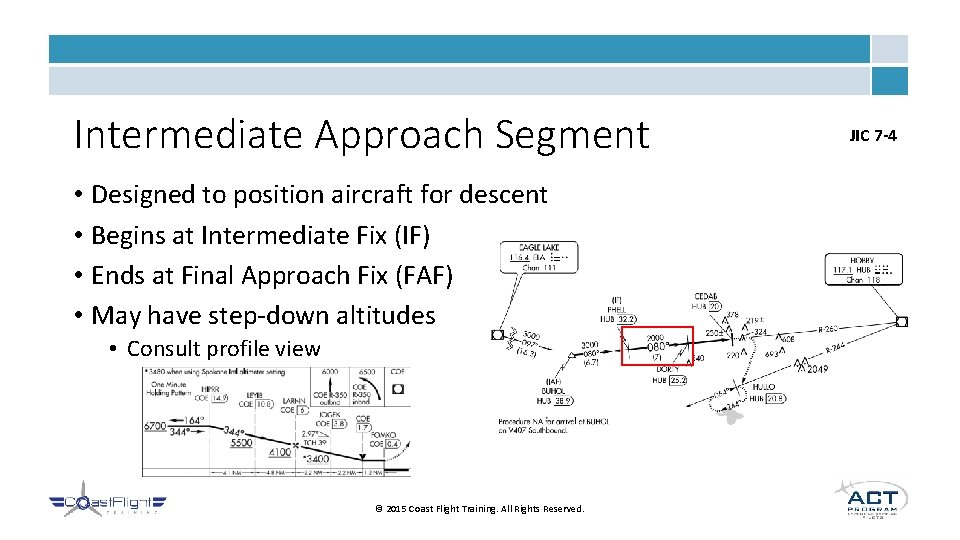
Intermediate Approach Segment • Designed to position aircraft for descent • Begins at Intermediate Fix (IF) • Ends at Final Approach Fix (FAF) • May have step-down altitudes • Consult profile view © 2015 Coast Flight Training. All Rights Reserved. JIC 7 -4
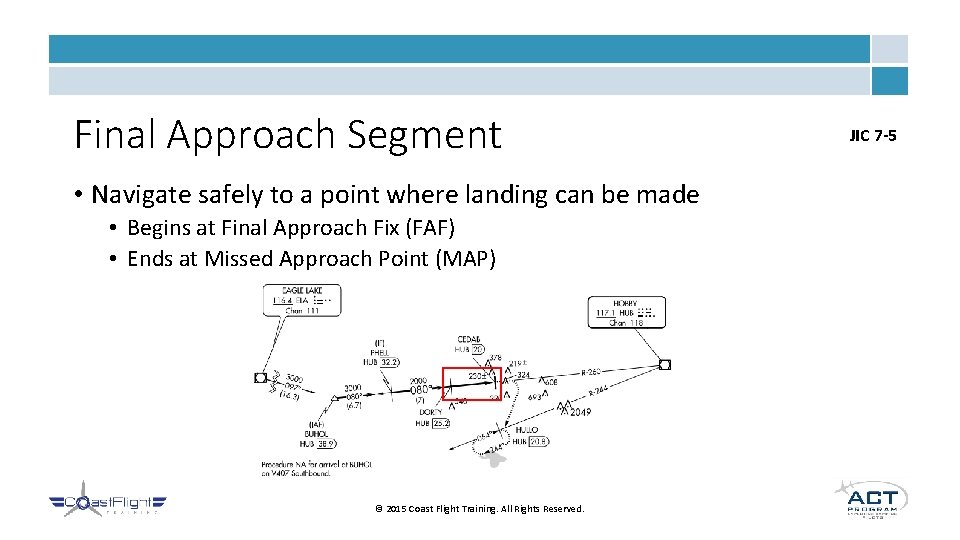
Final Approach Segment • Navigate safely to a point where landing can be made • Begins at Final Approach Fix (FAF) • Ends at Missed Approach Point (MAP) © 2015 Coast Flight Training. All Rights Reserved. JIC 7 -5
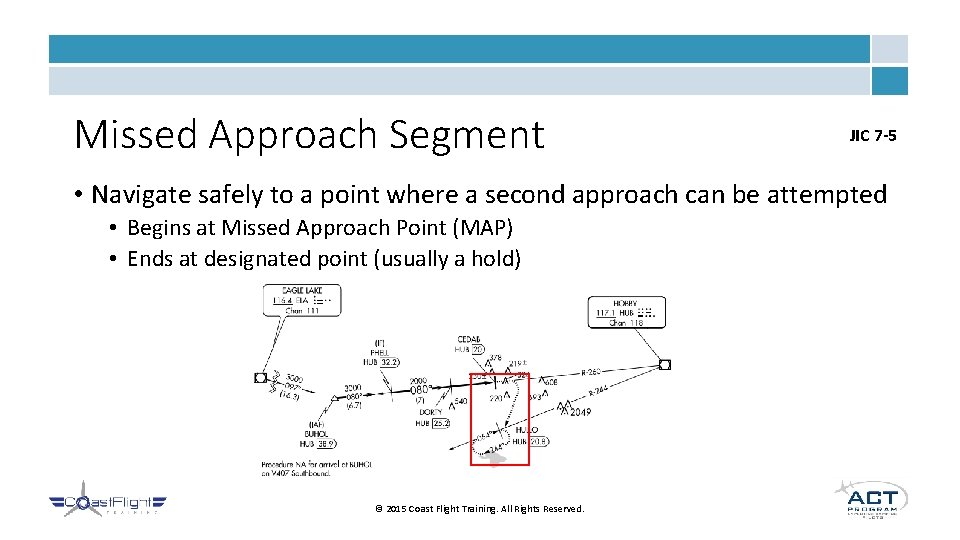
Missed Approach Segment JIC 7 -5 • Navigate safely to a point where a second approach can be attempted • Begins at Missed Approach Point (MAP) • Ends at designated point (usually a hold) © 2015 Coast Flight Training. All Rights Reserved.
Chart Layout JIC 7 -6 • Heading Section • Communications/Briefing Section • Minimum Safe Altitudes • Plan View • Profile View • Airport Plan View © 2015 Coast Flight Training. All Rights Reserved.
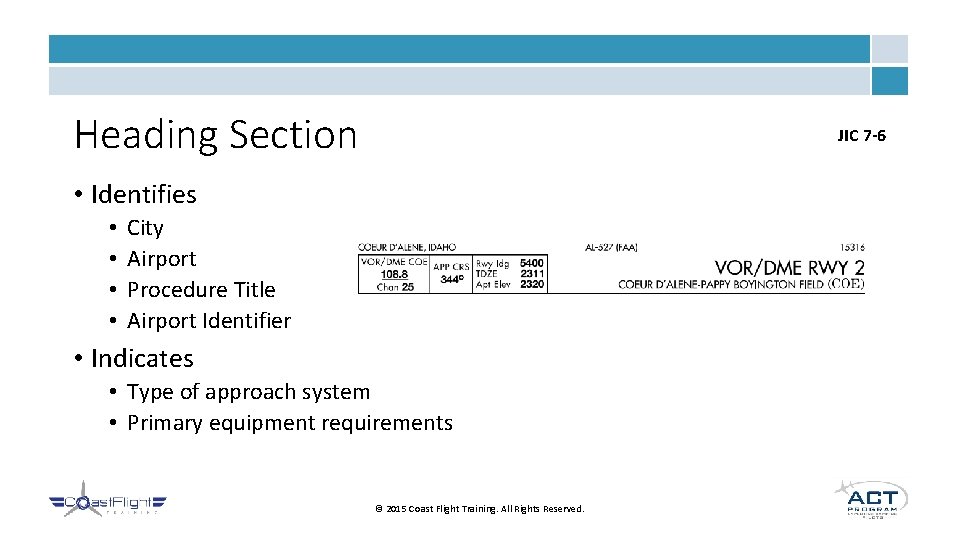
Heading Section JIC 7 -6 • Identifies • • City Airport Procedure Title Airport Identifier • Indicates • Type of approach system • Primary equipment requirements © 2015 Coast Flight Training. All Rights Reserved.
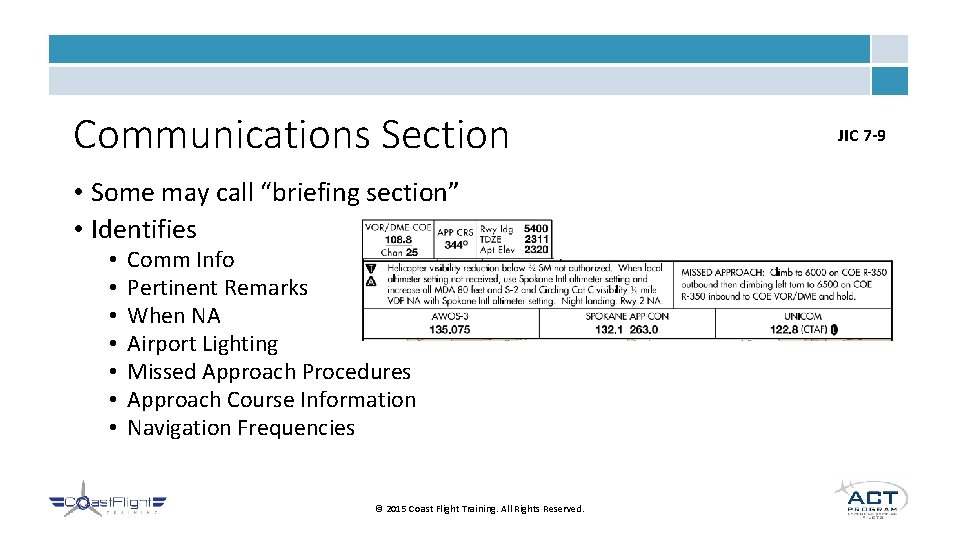
Communications Section • Some may call “briefing section” • Identifies • • Comm Info Pertinent Remarks When NA Airport Lighting Missed Approach Procedures Approach Course Information Navigation Frequencies © 2015 Coast Flight Training. All Rights Reserved. JIC 7 -9
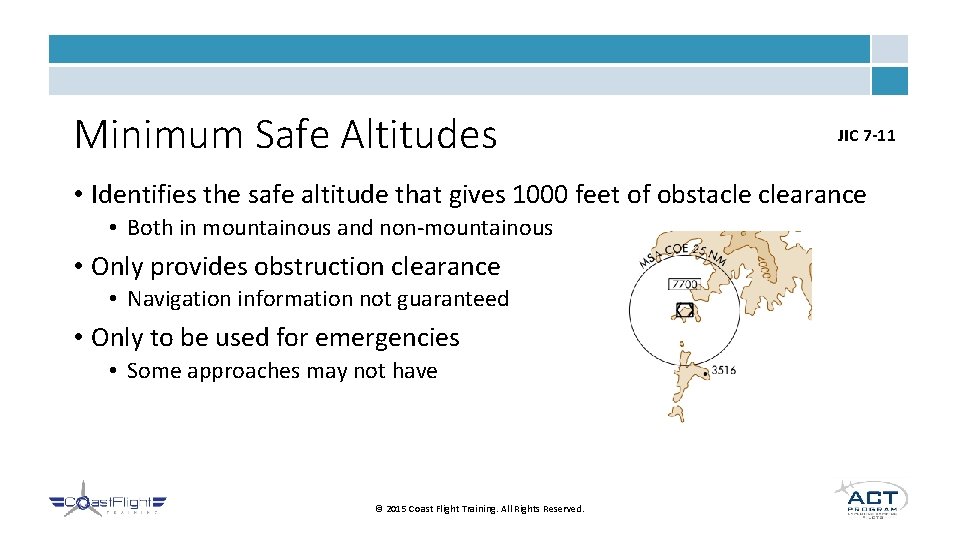
Minimum Safe Altitudes JIC 7 -11 • Identifies the safe altitude that gives 1000 feet of obstacle clearance • Both in mountainous and non-mountainous • Only provides obstruction clearance • Navigation information not guaranteed • Only to be used for emergencies • Some approaches may not have © 2015 Coast Flight Training. All Rights Reserved.
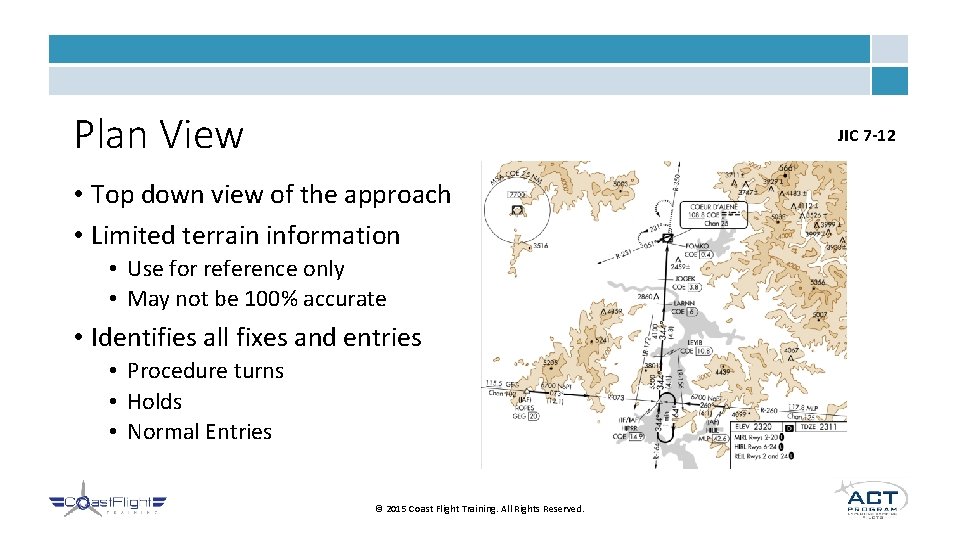
Plan View JIC 7 -12 • Top down view of the approach • Limited terrain information • Use for reference only • May not be 100% accurate • Identifies all fixes and entries • Procedure turns • Holds • Normal Entries © 2015 Coast Flight Training. All Rights Reserved.
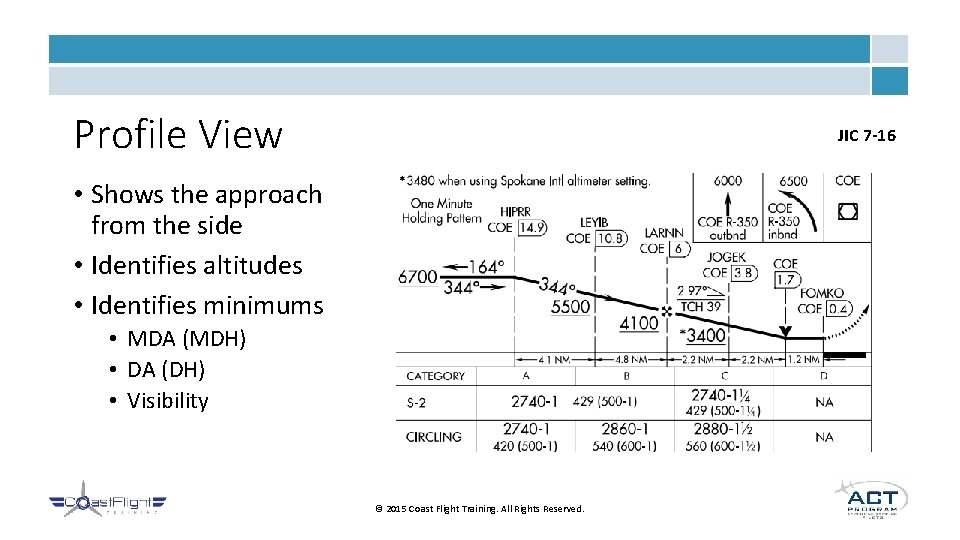
Profile View JIC 7 -16 • Shows the approach from the side • Identifies altitudes • Identifies minimums • MDA (MDH) • DA (DH) • Visibility © 2015 Coast Flight Training. All Rights Reserved.
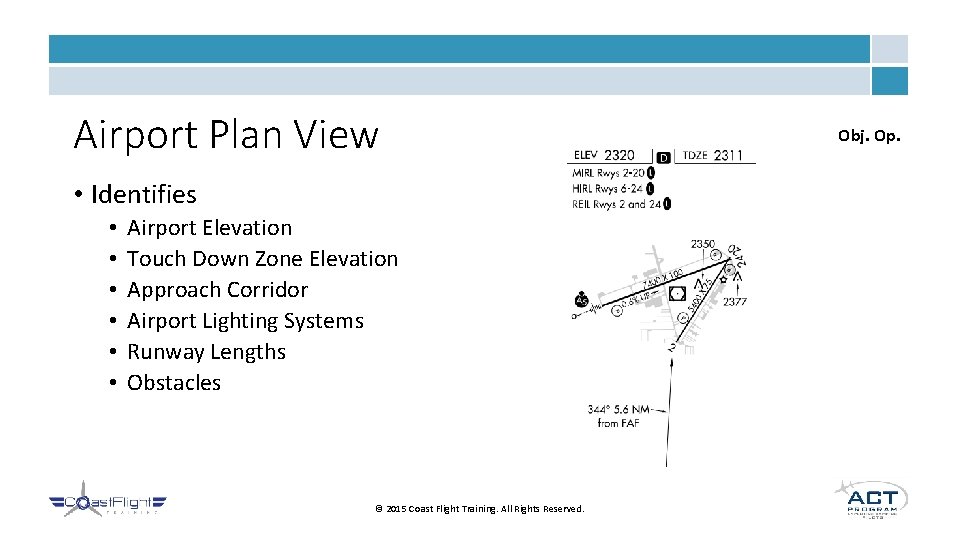
Airport Plan View • Identifies • • • Airport Elevation Touch Down Zone Elevation Approach Corridor Airport Lighting Systems Runway Lengths Obstacles © 2015 Coast Flight Training. All Rights Reserved. Obj. Op.
Altitudes Obj. Op. • Decision Altitude (Height) • Minimum Descent Altitude (Height) • Touchdown Zone Elevation (TDZE) • Height Above Touchdown (HAT) • Height Above Airport (HAA) • Airport Elevation • Threshold Crossing Height (TCH) © 2015 Coast Flight Training. All Rights Reserved.
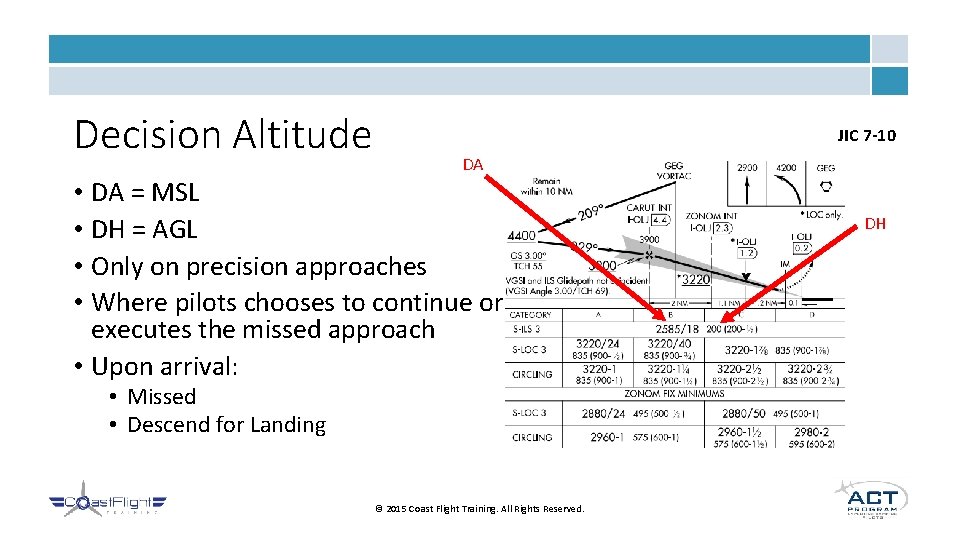
Decision Altitude JIC 7 -10 DA • DA = MSL • DH = AGL • Only on precision approaches • Where pilots chooses to continue or executes the missed approach • Upon arrival: • Missed • Descend for Landing © 2015 Coast Flight Training. All Rights Reserved. DH
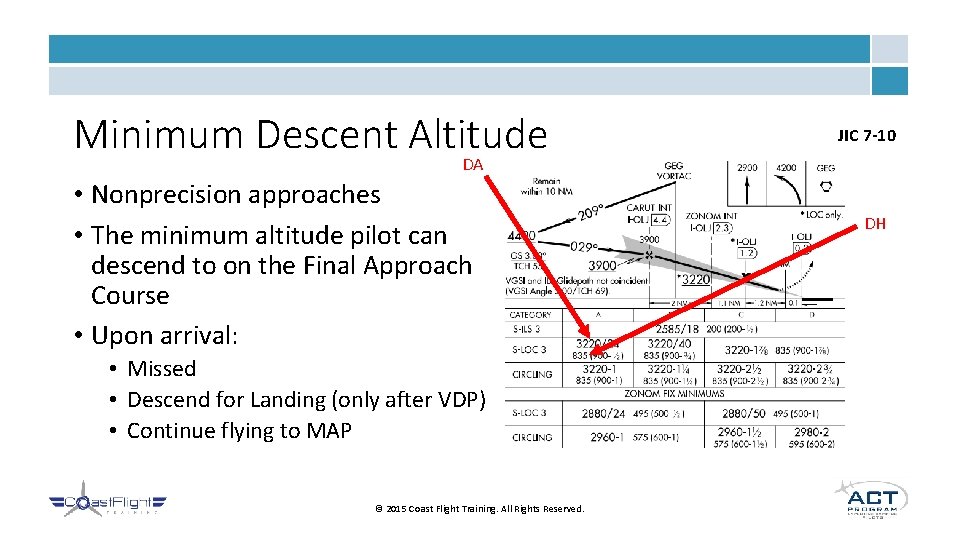
Minimum Descent Altitude JIC 7 -10 DA • Nonprecision approaches • The minimum altitude pilot can descend to on the Final Approach Course • Upon arrival: • Missed • Descend for Landing (only after VDP) • Continue flying to MAP © 2015 Coast Flight Training. All Rights Reserved. DH
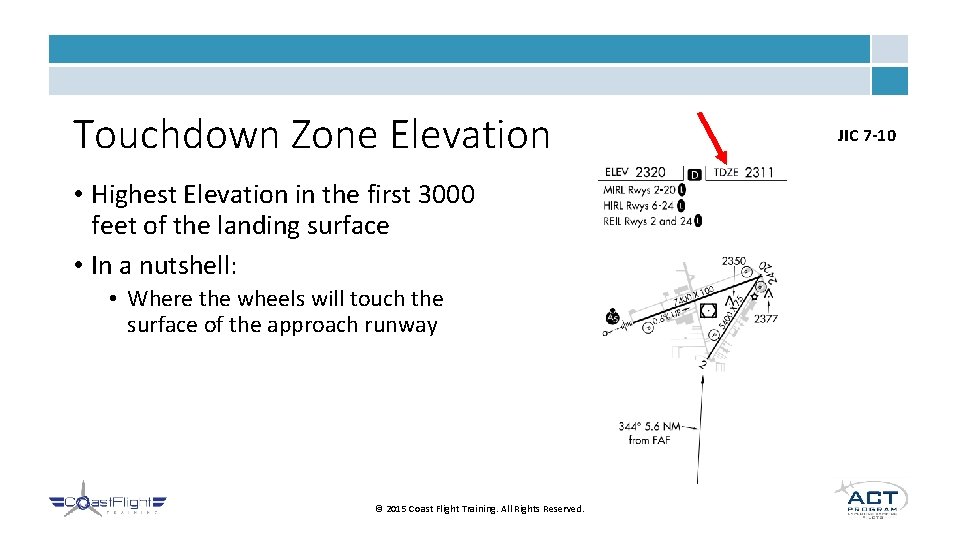
Touchdown Zone Elevation • Highest Elevation in the first 3000 feet of the landing surface • In a nutshell: • Where the wheels will touch the surface of the approach runway © 2015 Coast Flight Training. All Rights Reserved. JIC 7 -10
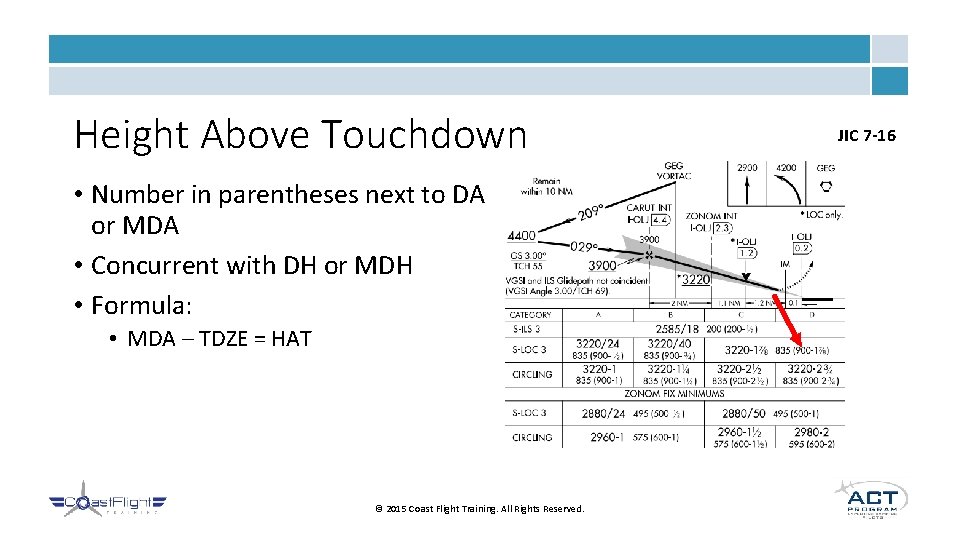
Height Above Touchdown • Number in parentheses next to DA or MDA • Concurrent with DH or MDH • Formula: • MDA – TDZE = HAT © 2015 Coast Flight Training. All Rights Reserved. JIC 7 -16
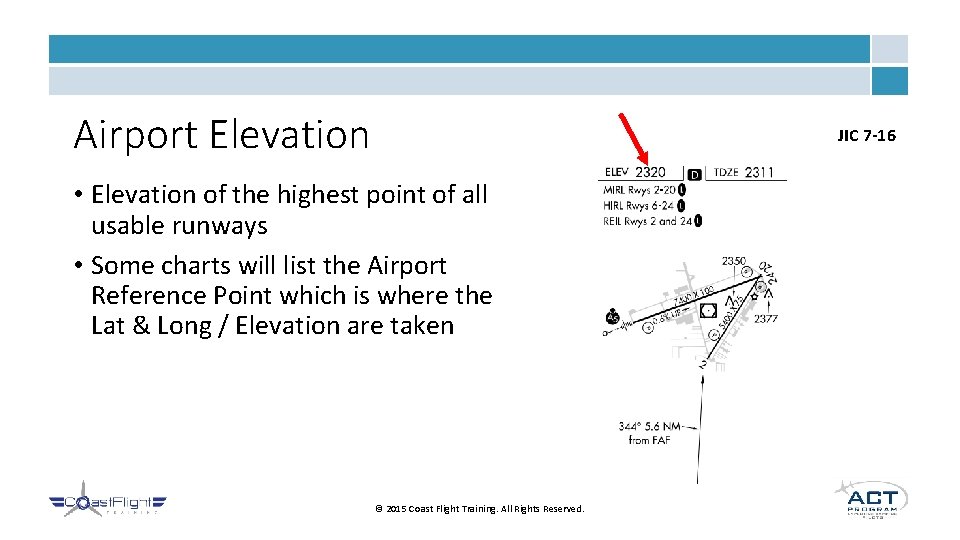
Airport Elevation JIC 7 -16 • Elevation of the highest point of all usable runways • Some charts will list the Airport Reference Point which is where the Lat & Long / Elevation are taken © 2015 Coast Flight Training. All Rights Reserved.
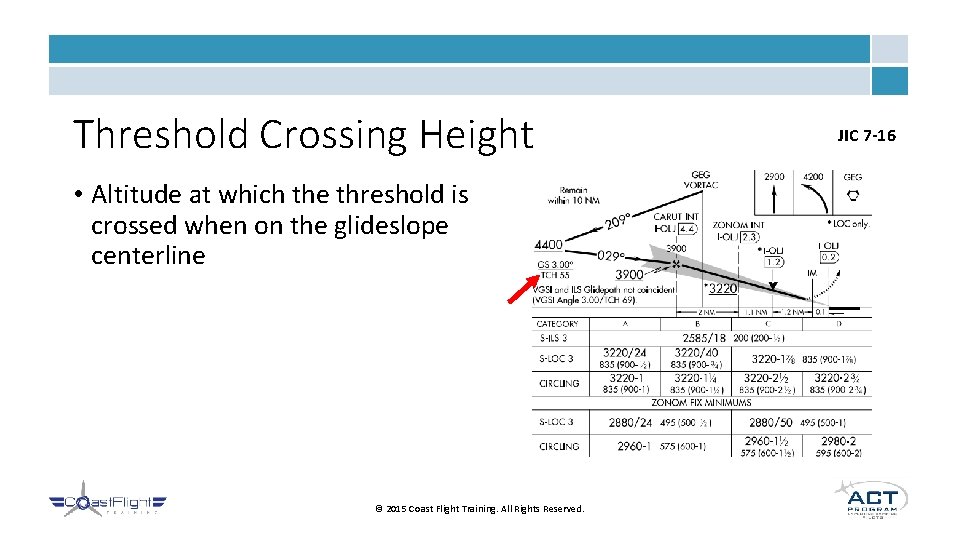
Threshold Crossing Height • Altitude at which the threshold is crossed when on the glideslope centerline © 2015 Coast Flight Training. All Rights Reserved. JIC 7 -16
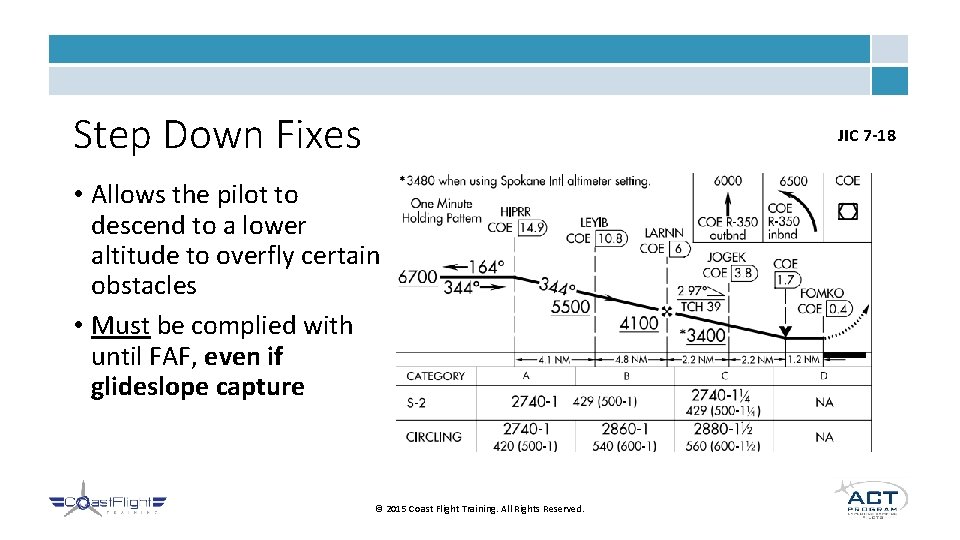
Step Down Fixes JIC 7 -18 • Allows the pilot to descend to a lower altitude to overfly certain obstacles • Must be complied with until FAF, even if glideslope capture © 2015 Coast Flight Training. All Rights Reserved.
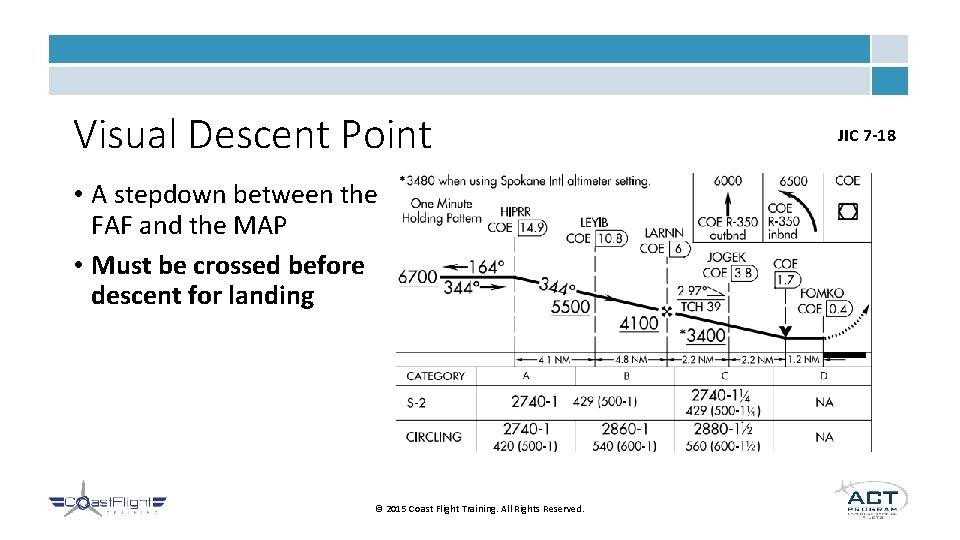
Visual Descent Point • A stepdown between the FAF and the MAP • Must be crossed before descent for landing © 2015 Coast Flight Training. All Rights Reserved. JIC 7 -18
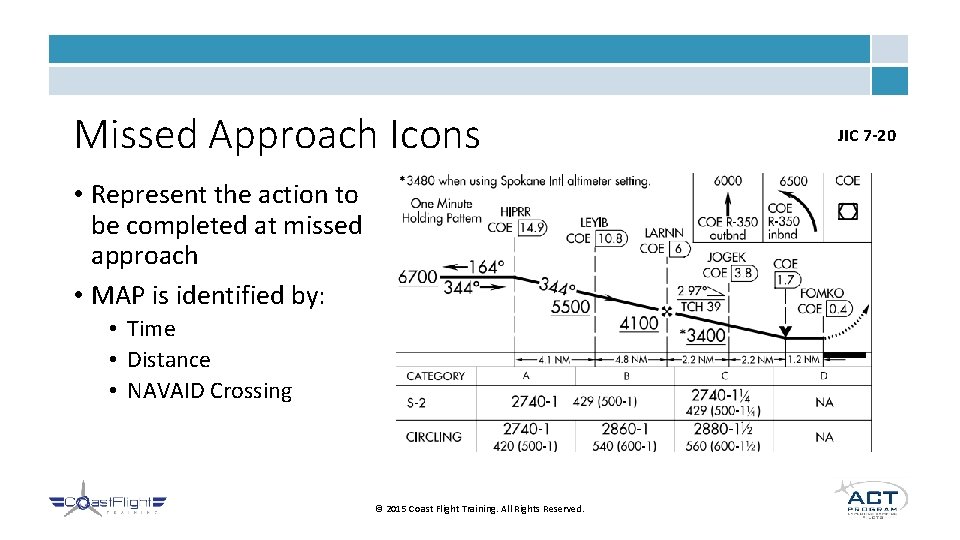
Missed Approach Icons • Represent the action to be completed at missed approach • MAP is identified by: • Time • Distance • NAVAID Crossing © 2015 Coast Flight Training. All Rights Reserved. JIC 7 -20
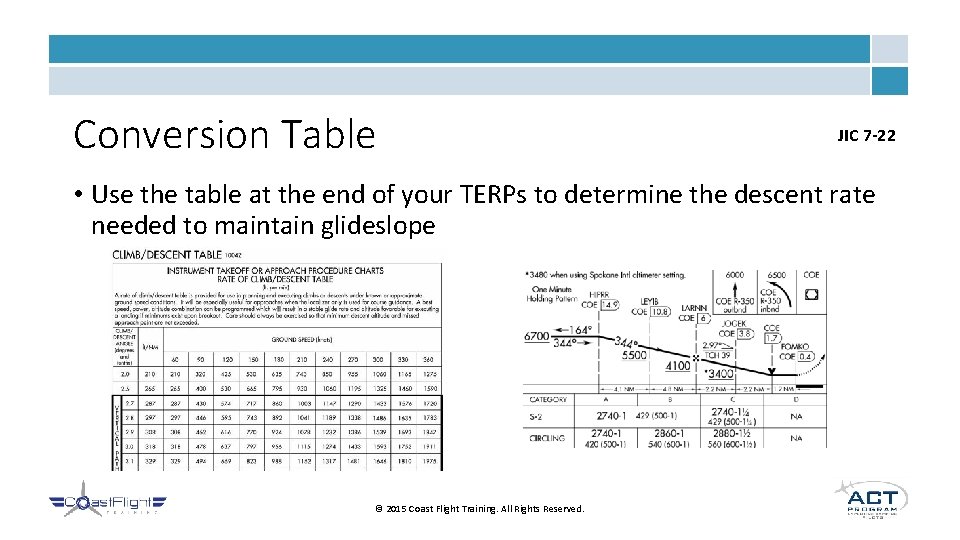
Conversion Table JIC 7 -22 • Use the table at the end of your TERPs to determine the descent rate needed to maintain glideslope © 2015 Coast Flight Training. All Rights Reserved.
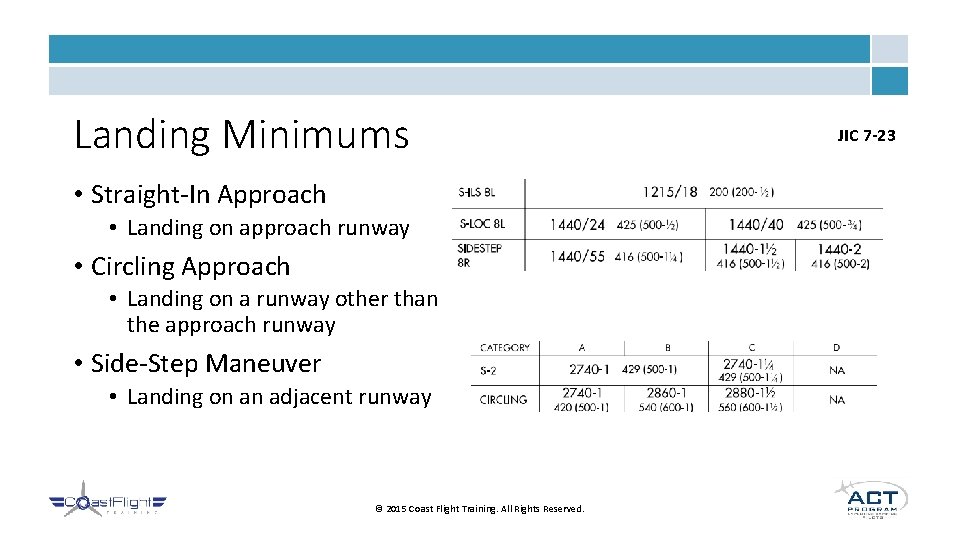
Landing Minimums • Straight-In Approach • Landing on approach runway • Circling Approach • Landing on a runway other than the approach runway • Side-Step Maneuver • Landing on an adjacent runway © 2015 Coast Flight Training. All Rights Reserved. JIC 7 -23
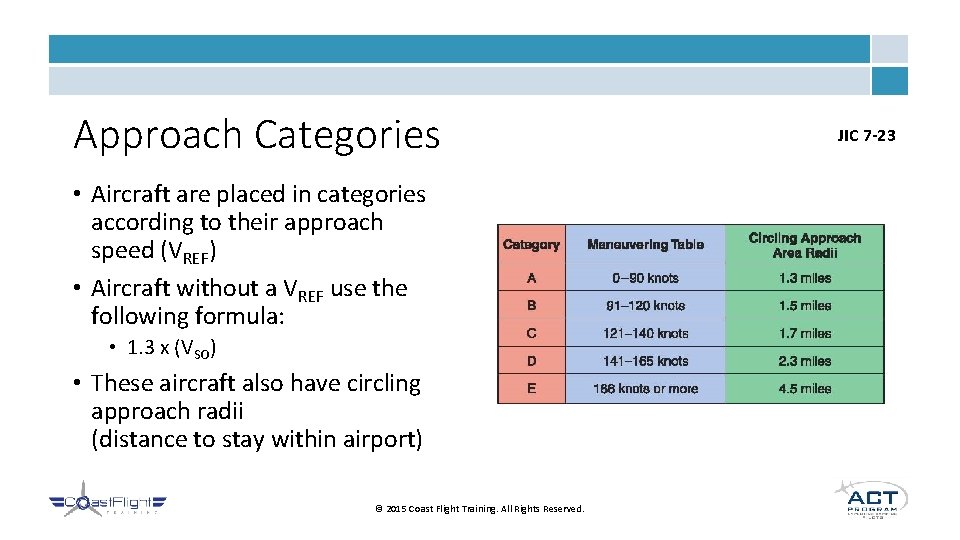
Approach Categories • Aircraft are placed in categories according to their approach speed (VREF) • Aircraft without a VREF use the following formula: • 1. 3 x (VSO) • These aircraft also have circling approach radii (distance to stay within airport) © 2015 Coast Flight Training. All Rights Reserved. JIC 7 -23
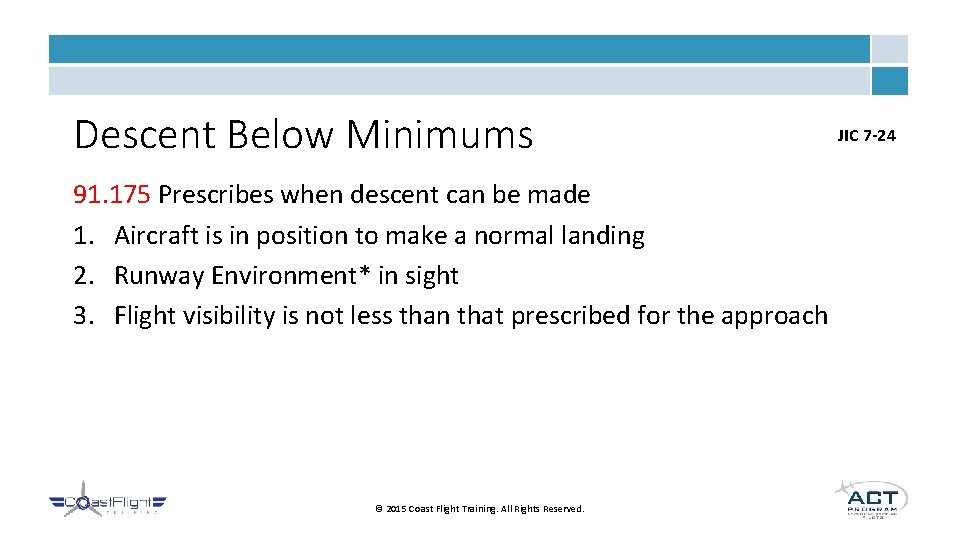
Descent Below Minimums 91. 175 Prescribes when descent can be made 1. Aircraft is in position to make a normal landing 2. Runway Environment* in sight 3. Flight visibility is not less than that prescribed for the approach © 2015 Coast Flight Training. All Rights Reserved. JIC 7 -24
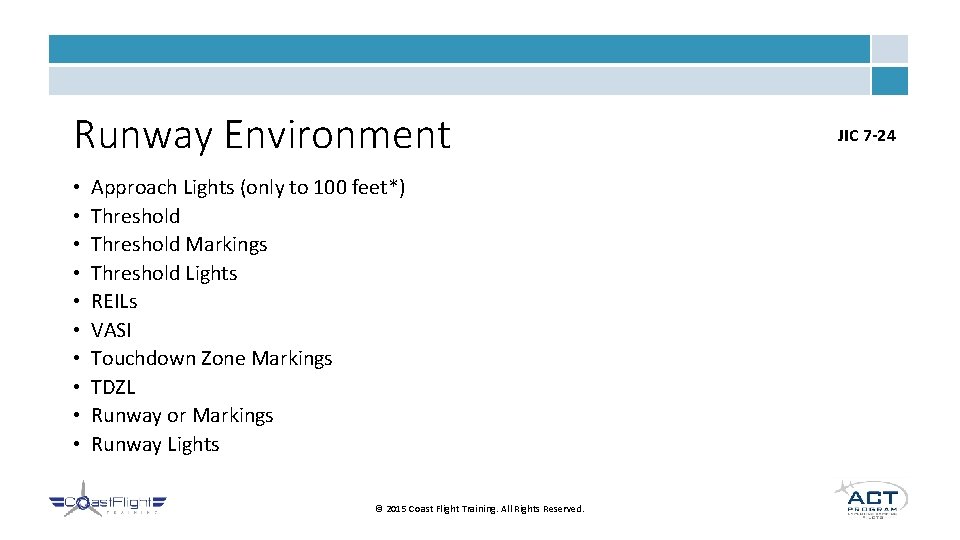
Runway Environment • • • Approach Lights (only to 100 feet*) Threshold Markings Threshold Lights REILs VASI Touchdown Zone Markings TDZL Runway or Markings Runway Lights © 2015 Coast Flight Training. All Rights Reserved. JIC 7 -24
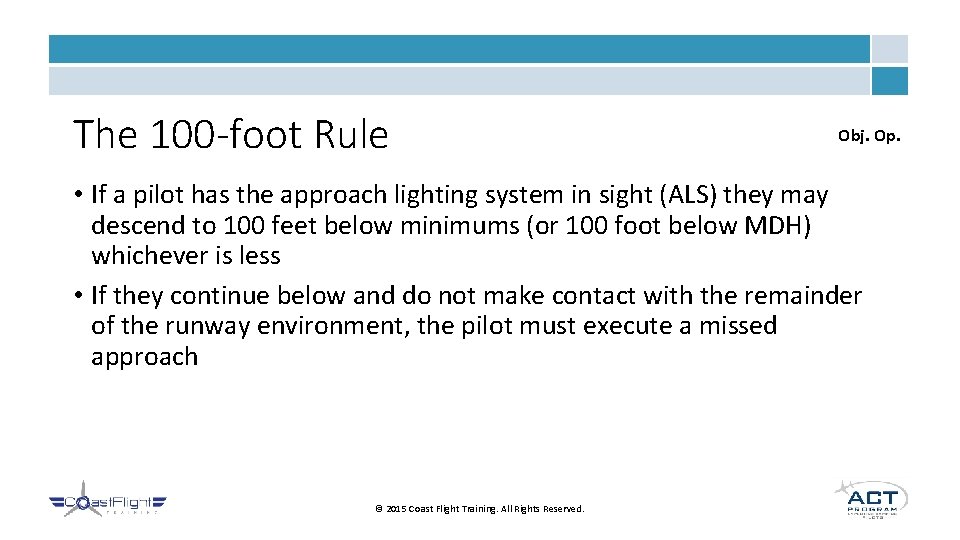
The 100 -foot Rule Obj. Op. • If a pilot has the approach lighting system in sight (ALS) they may descend to 100 feet below minimums (or 100 foot below MDH) whichever is less • If they continue below and do not make contact with the remainder of the runway environment, the pilot must execute a missed approach © 2015 Coast Flight Training. All Rights Reserved.
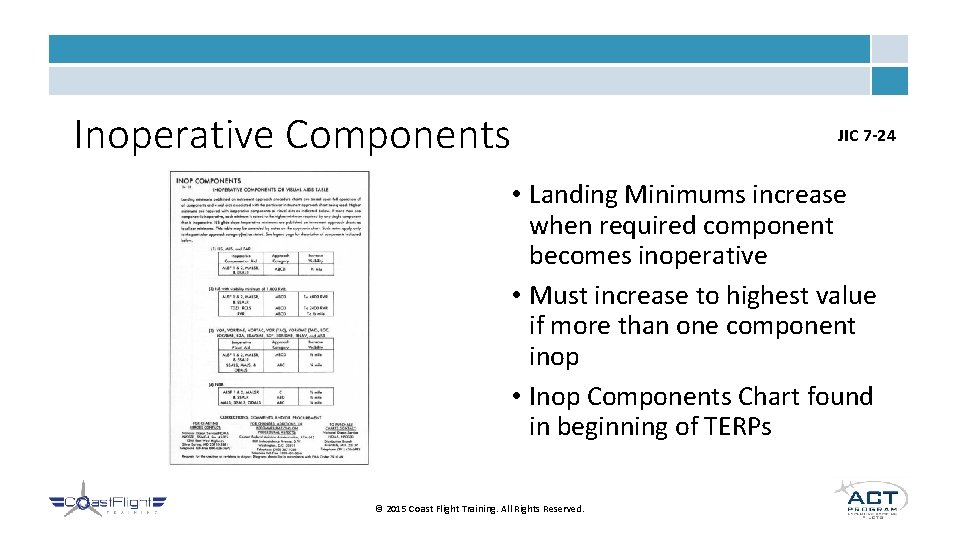
Inoperative Components JIC 7 -24 • Landing Minimums increase when required component becomes inoperative • Must increase to highest value if more than one component inop • Inop Components Chart found in beginning of TERPs © 2015 Coast Flight Training. All Rights Reserved.
References • JIC Jeppesen Instrument/Commercial: Guided Flight Discovery • Obj. Op. Objective Opinion • 14 CFR Federal Aviation Regulations © 2015 Coast Flight Training. All Rights Reserved.