
Approach 4 The Cognitive Approach 4 1 ASSUMPTIONS

- Slides: 20
Approach 4: The Cognitive Approach 4. 1 ASSUMPTIONS
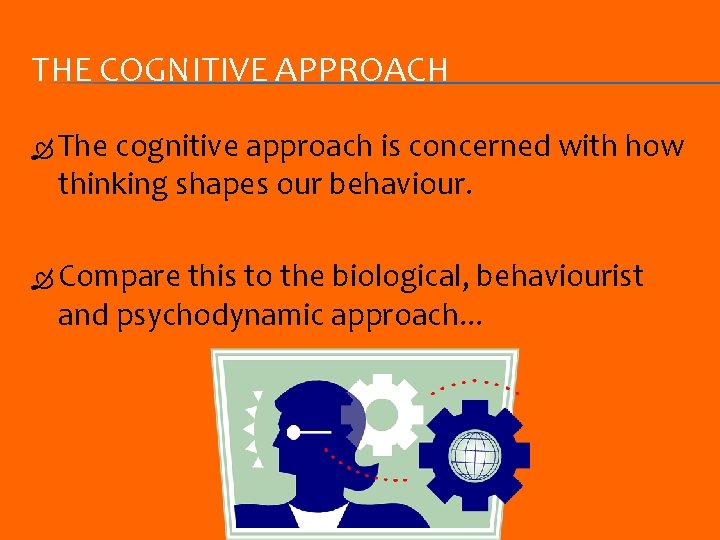
THE COGNITIVE APPROACH The cognitive approach is concerned with how thinking shapes our behaviour. Compare this to the biological, behaviourist and psychodynamic approach. . .
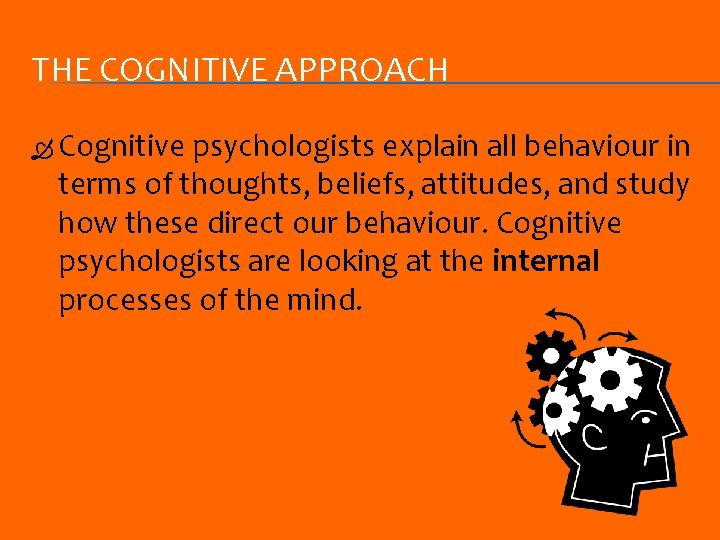
THE COGNITIVE APPROACH Cognitive psychologists explain all behaviour in terms of thoughts, beliefs, attitudes, and study how these direct our behaviour. Cognitive psychologists are looking at the internal processes of the mind.
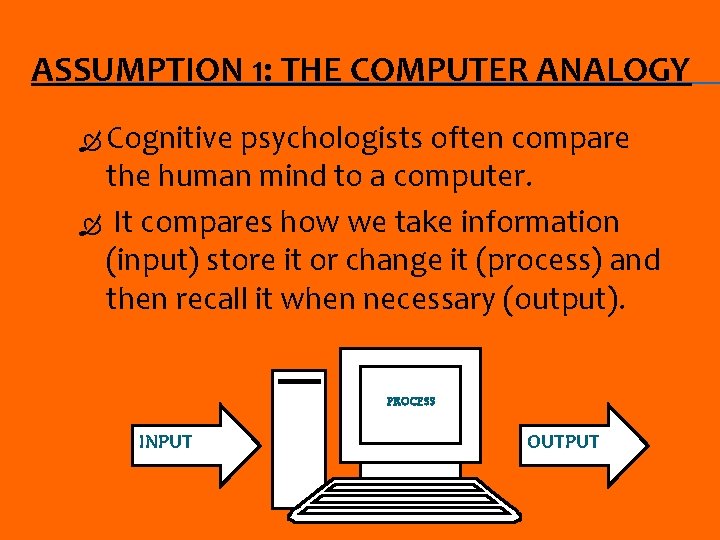
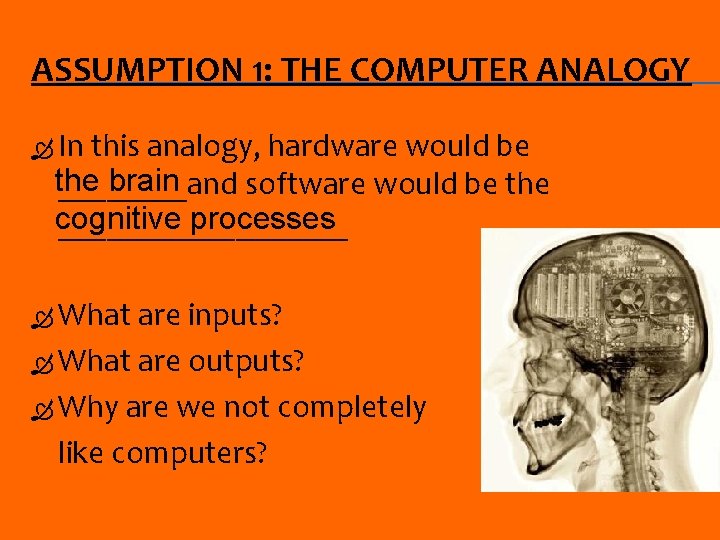
ASSUMPTION 1: THE COMPUTER ANALOGY Cognitive psychologists often compare the human mind to a computer. It compares how we take information (input) store it or change it (process) and then recall it when necessary (output). PROCESS INPUT OUTPUT
ASSUMPTION 1: THE COMPUTER ANALOGY In this analogy, hardware would be the brain ____and software would be the cognitive processes _________ What are inputs? What are outputs? Why are we not completely like computers?
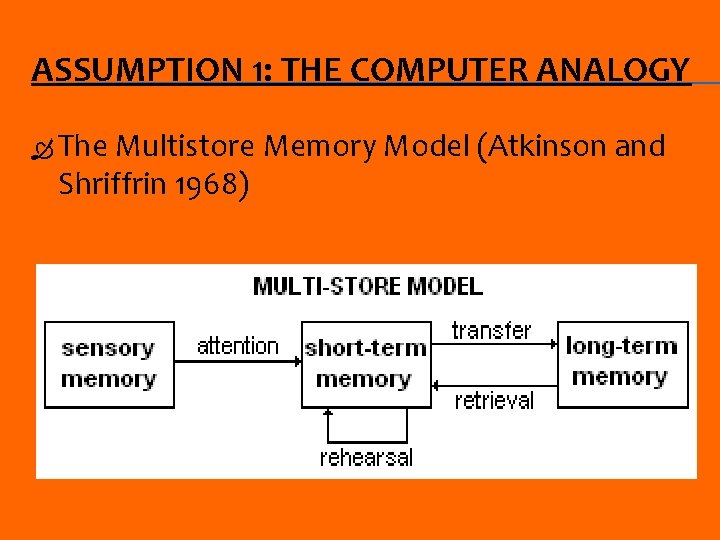
ASSUMPTION 1: THE COMPUTER ANALOGY The Multistore Memory Model (Atkinson and Shriffrin 1968)
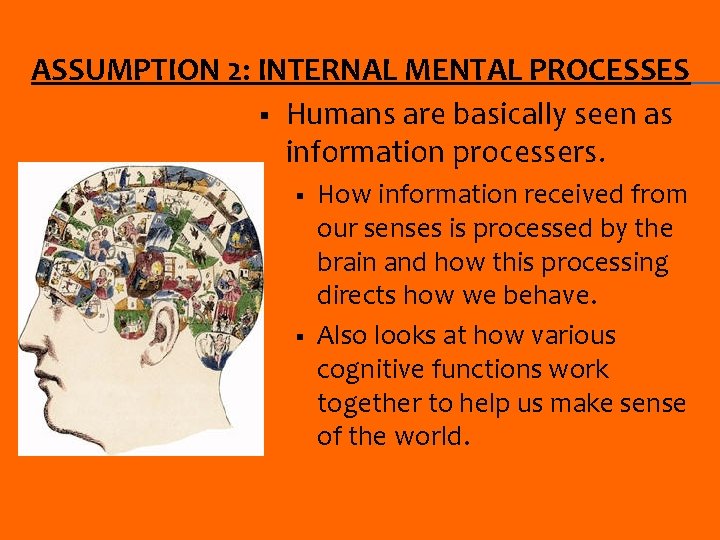
ASSUMPTION 2: INTERNAL MENTAL PROCESSES Humans are basically seen as information processers. How information received from our senses is processed by the brain and how this processing directs how we behave. Also looks at how various cognitive functions work together to help us make sense of the world.
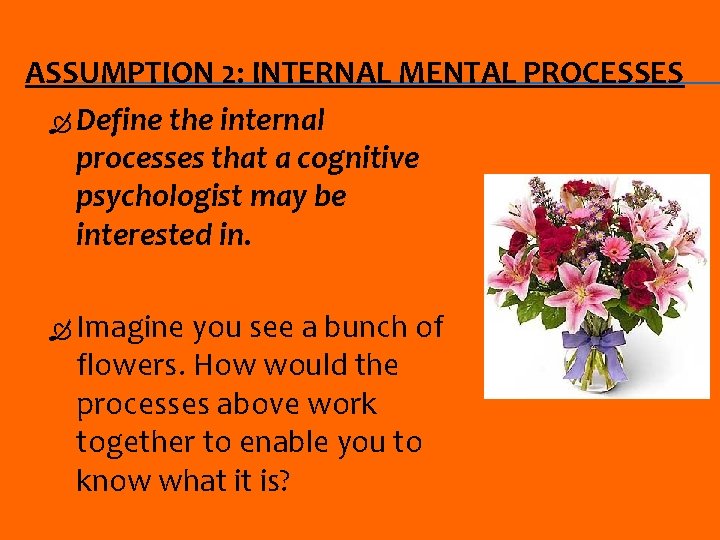
ASSUMPTION 2: INTERNAL MENTAL PROCESSES Define the internal processes that a cognitive psychologist may be interested in. Imagine you see a bunch of flowers. How would the processes above work together to enable you to know what it is?
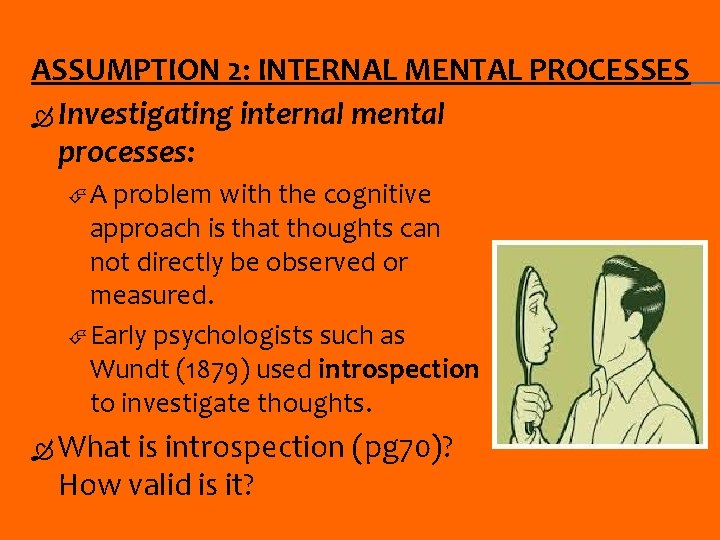
ASSUMPTION 2: INTERNAL MENTAL PROCESSES Investigating internal mental processes: A problem with the cognitive approach is that thoughts can not directly be observed or measured. Early psychologists such as Wundt (1879) used introspection to investigate thoughts. What is introspection (pg 70)? How valid is it?
ASSUMPTION 2: INTERNAL MENTAL PROCESSES Modern cognitive psychology takes a scientific approach towards studying behaviour. We can not directly observe the inner workings of the mind. However, scientific and controlled experiments allow psychologists to infer what is happening. Laboratory studies
ASSUMPTION 3: SCHEMATA Part of the mental processes identified by the cognitive approach are schemata (singular: schema). Mental structures that represent an aspect of the world, such as an object or event. Help us to make sense of the world, providing short cuts to identifying things that we come across.
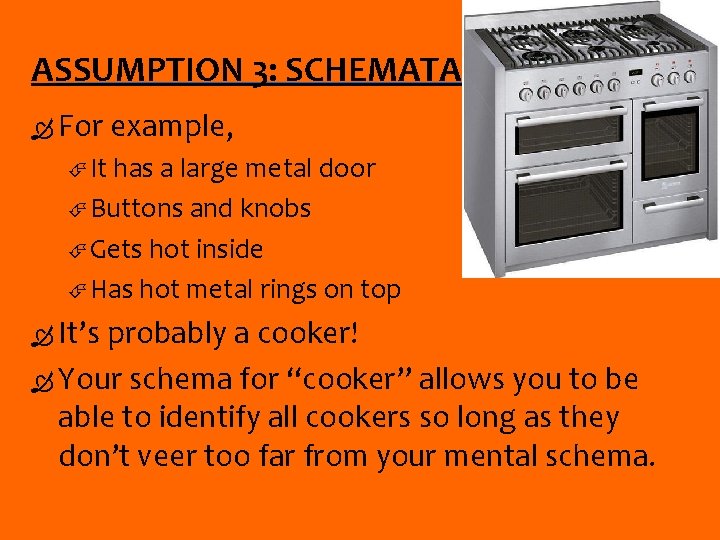
ASSUMPTION 3: SCHEMATA For example, It has a large metal door Buttons and knobs Gets hot inside Has hot metal rings on top It’s probably a cooker! Your schema for “cooker” allows you to be able to identify all cookers so long as they don’t veer too far from your mental schema.
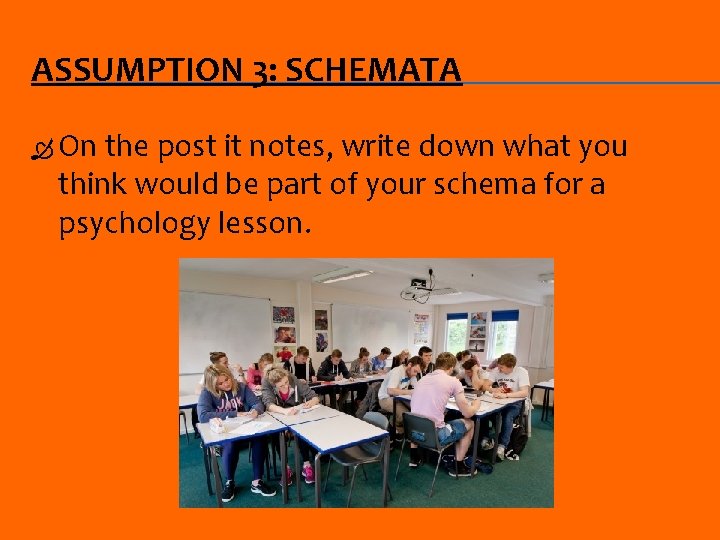
ASSUMPTION 3: SCHEMATA On the post it notes, write down what you think would be part of your schema for a psychology lesson.
ASSUMPTION 3: SCHEMATA The text on the sheet is a good example to demonstrate how a schema can have an effect on our recall. You will all be asked to read and recall the text. Half of you however will be given the title of the text, half will not. Who will remember the most?
ASSUMPTION 3: SCHEMATA Half of the class, close your eyes now! The title of the text is “How to do Laundry” Open your eyes! Read recall the text, and then see how much you can
ASSUMPTION 3: SCHEMATA Which group was able to recall more details? What was the title of the text? How would this affect recall?
ASSUMPTION 3: SCHEMATA Schemata are generated through experience and interactions with others. However they are not always correct Can be the basis for stereotypes, causing racism, sexism etc. Can cause us to misremember events that do not fit our schema
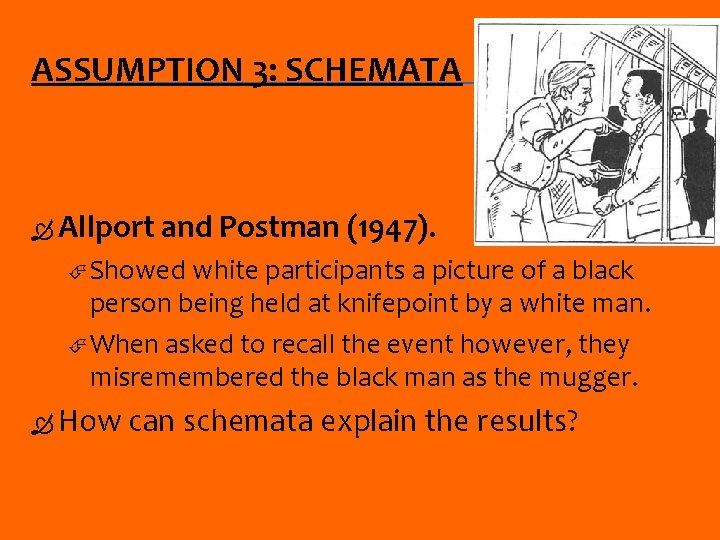
ASSUMPTION 3: SCHEMATA Allport and Postman (1947). Showed white participants a picture of a black person being held at knifepoint by a white man. When asked to recall the event however, they misremembered the black man as the mugger. How can schemata explain the results?
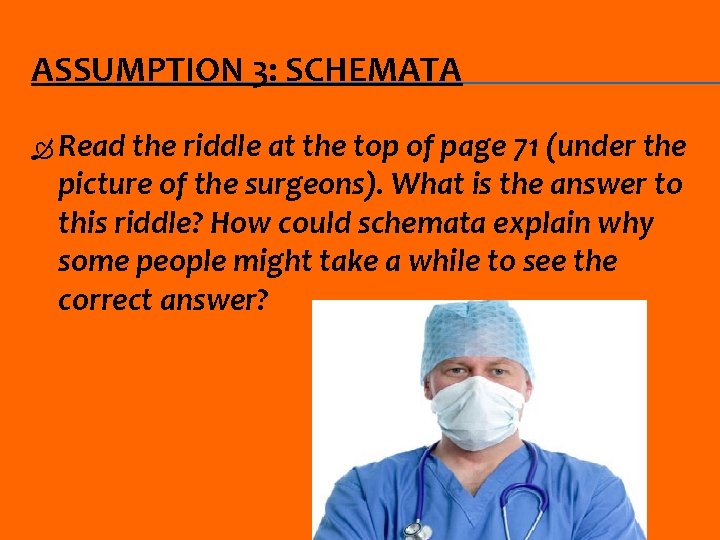
ASSUMPTION 3: SCHEMATA Read the riddle at the top of page 71 (under the picture of the surgeons). What is the answer to this riddle? How could schemata explain why some people might take a while to see the correct answer?
EXAM PRACTICE Exam corner on pg 71 Assumptions activities on pg 84