
appreciate appraise apply Part 4 Brenda Boucher PT
ü appreciate ü appraise ü apply Part 4 Brenda Boucher PT, Ph. D, CHT, OCS, FAAOMPT
Positive & Negative Predictive Values “In the sample population tested, what is the probability of a positive or negative test result in giving me the correct answer? ”
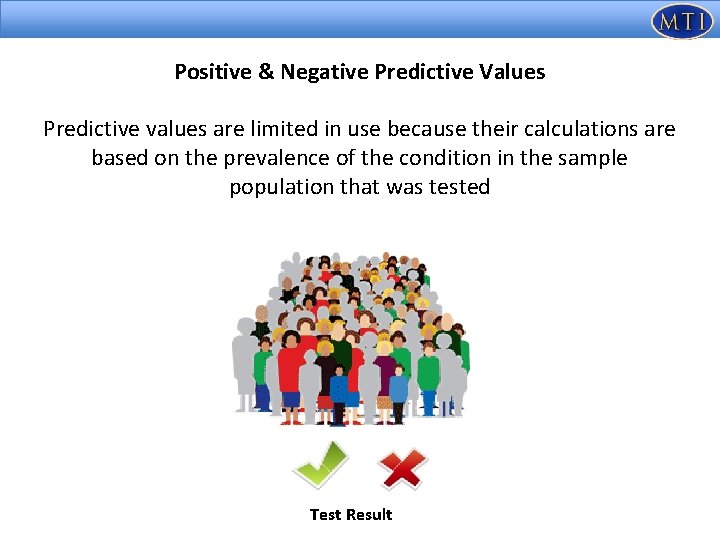
Positive & Negative Predictive Values Predictive values are limited in use because their calculations are based on the prevalence of the condition in the sample population that was tested Test Result
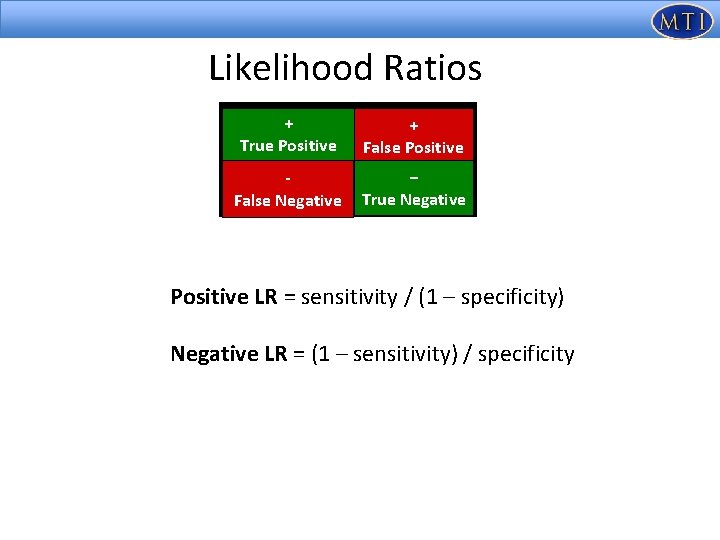
Likelihood Ratios + True Positive + False Positive False Negative − True Negative Positive LR = sensitivity / (1 – specificity) Negative LR = (1 – sensitivity) / specificity
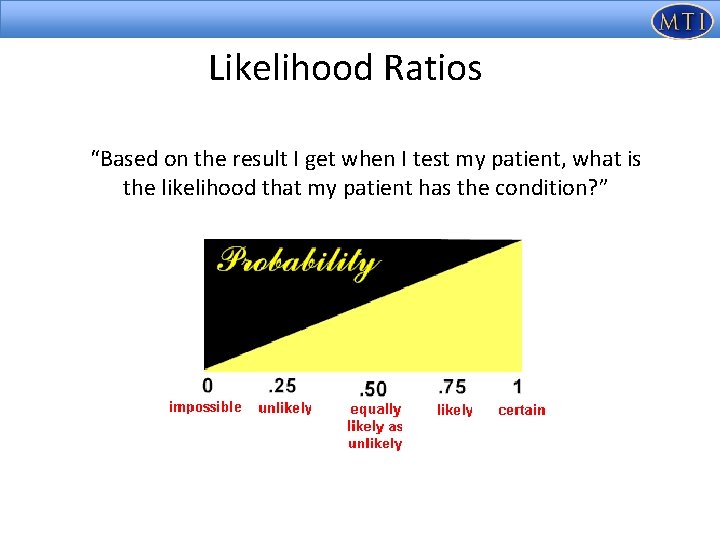
Likelihood Ratios “Based on the result I get when I test my patient, what is the likelihood that my patient has the condition? ”
Likelihood Ratios Likelihood ratios are calculated using combined information contained in sensitivity and specificity values into a ratio used to quantify shifts in probability once the test results are known
Positive & Negative Likelihood Ratios Positive Likelihood Ratio: indicates the increase In odds favoring the condition given a positive Ljjljl test result. Negative Likelihood Ratio: indicates the change In odds favoring the condition given a negative test result.
Positive & Negative Likelihood Ratios Ljjljl Positive likelihood ratios have values of 1 or greater: the higher the value, the greater the certainty that a positive test result indicates the presence of the condition. Negative likelihood ratios have values between 1 and 0: the lower the value, the greater the certainty that a negative test result indicates the absence of the condition.
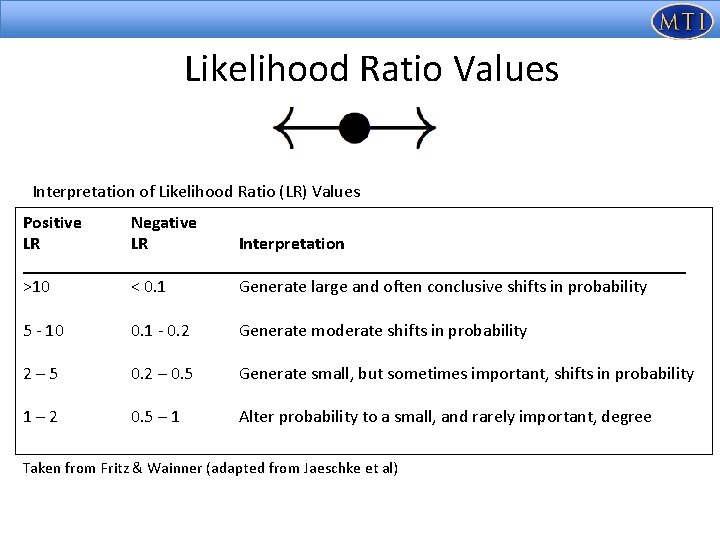
Likelihood Ratio Values Interpretation of Likelihood Ratio (LR) Values Positive Negative LR LR Interpretation _____________________________________ >10 < 0. 1 Generate large and often conclusive shifts in probability 5 - 10 0. 1 - 0. 2 Generate moderate shifts in probability 2– 5 0. 2 – 0. 5 Generate small, but sometimes important, shifts in probability 1– 2 0. 5 – 1 Alter probability to a small, and rarely important, degree Taken from Fritz & Wainner (adapted from Jaeschke et al)
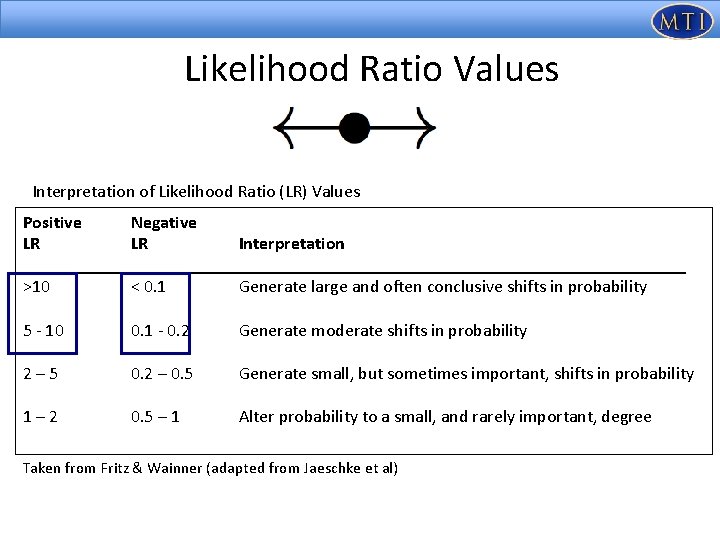
Likelihood Ratio Values Interpretation of Likelihood Ratio (LR) Values Positive Negative LR LR Interpretation _____________________________________ >10 < 0. 1 Generate large and often conclusive shifts in probability 5 - 10 0. 1 - 0. 2 Generate moderate shifts in probability 2– 5 0. 2 – 0. 5 Generate small, but sometimes important, shifts in probability 1– 2 0. 5 – 1 Alter probability to a small, and rarely important, degree Taken from Fritz & Wainner (adapted from Jaeschke et al)
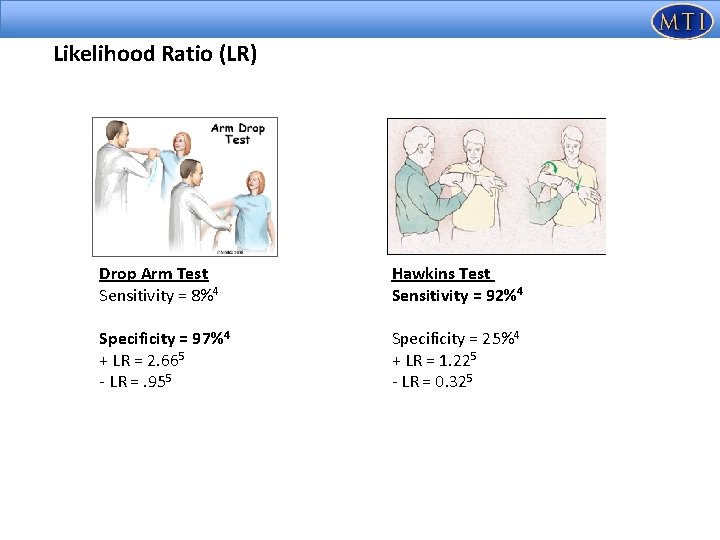
Likelihood Ratio (LR) Drop Arm Test Sensitivity = 8%4 Hawkins Test Sensitivity = 92%4 Specificity = 97%4 + LR = 2. 665 - LR =. 955 Specificity = 25%4 + LR = 1. 225 - LR = 0. 325
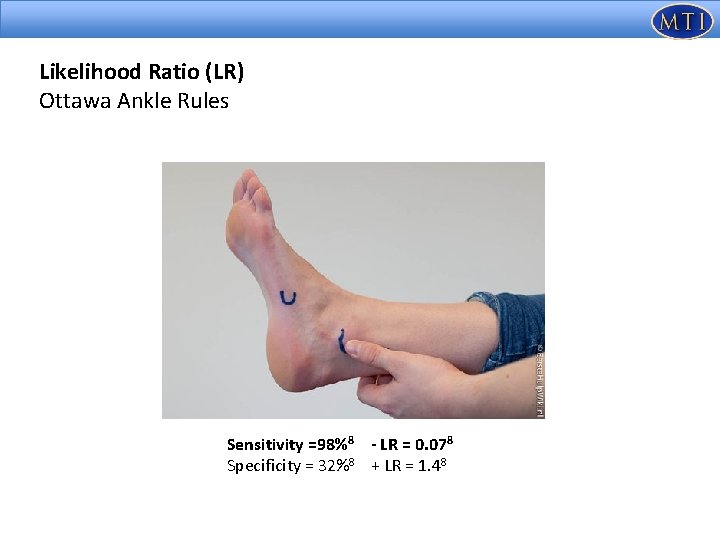
Likelihood Ratio (LR) Ottawa Ankle Rules Sensitivity =98%8 - LR = 0. 078 Specificity = 32%8 + LR = 1. 48
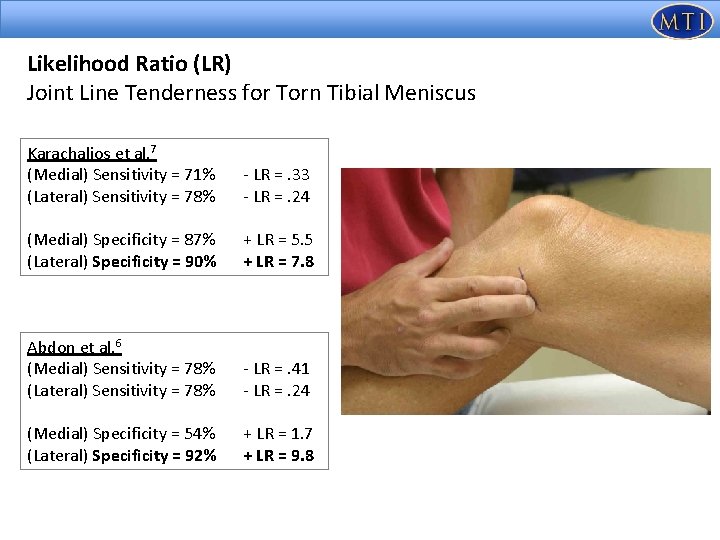
Likelihood Ratio (LR) Joint Line Tenderness for Torn Tibial Meniscus Karachalios et al. 7 (Medial) Sensitivity = 71% (Lateral) Sensitivity = 78% - LR =. 33 - LR =. 24 (Medial) Specificity = 87% (Lateral) Specificity = 90% + LR = 5. 5 + LR = 7. 8 Abdon et al. 6 (Medial) Sensitivity = 78% (Lateral) Sensitivity = 78% - LR =. 41 - LR =. 24 (Medial) Specificity = 54% (Lateral) Specificity = 92% + LR = 1. 7 + LR = 9. 8
Confidence Interval
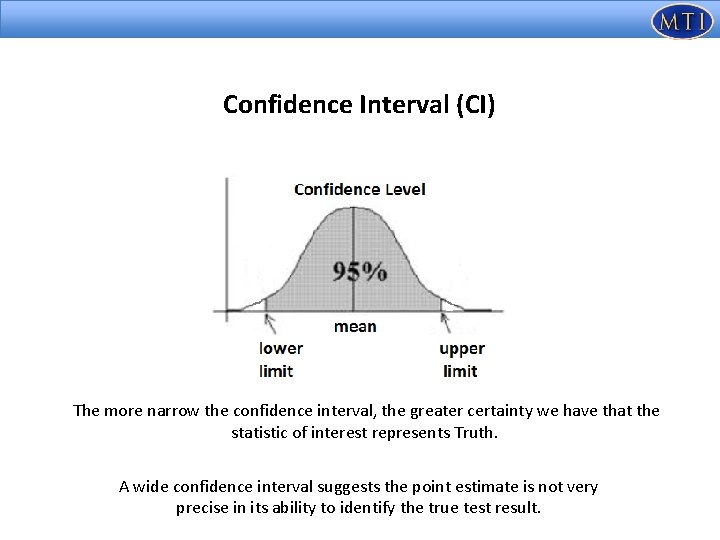
Confidence Interval (CI) The more narrow the confidence interval, the greater certainty we have that the statistic of interest represents Truth. A wide confidence interval suggests the point estimate is not very precise in its ability to identify the true test result.
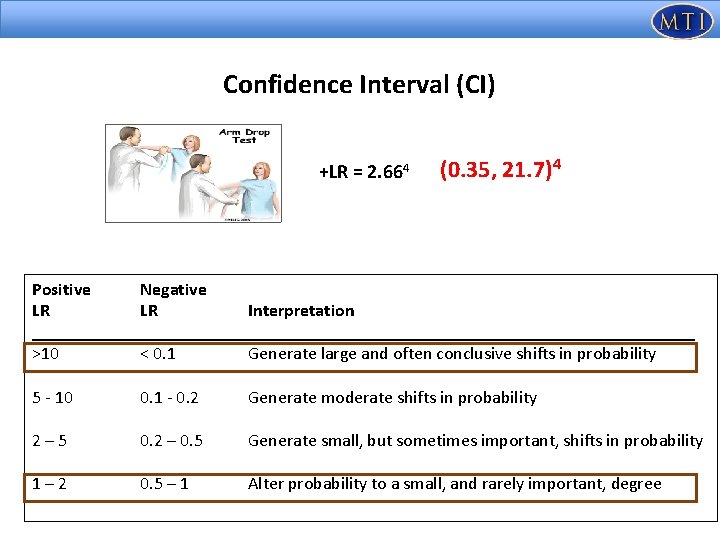
Confidence Interval (CI) +LR = 2. 664 4 4 (0. 35, 21. 7) Positive Negative LR LR Interpretation _____________________________________ >10 < 0. 1 Generate large and often conclusive shifts in probability 5 - 10 0. 1 - 0. 2 Generate moderate shifts in probability 2– 5 0. 2 – 0. 5 Generate small, but sometimes important, shifts in probability 1– 2 0. 5 – 1 Alter probability to a small, and rarely important, degree
Applying the Evidence sis: a o n g a i d np i e s i c r n exe ro sion i v e r y t babili
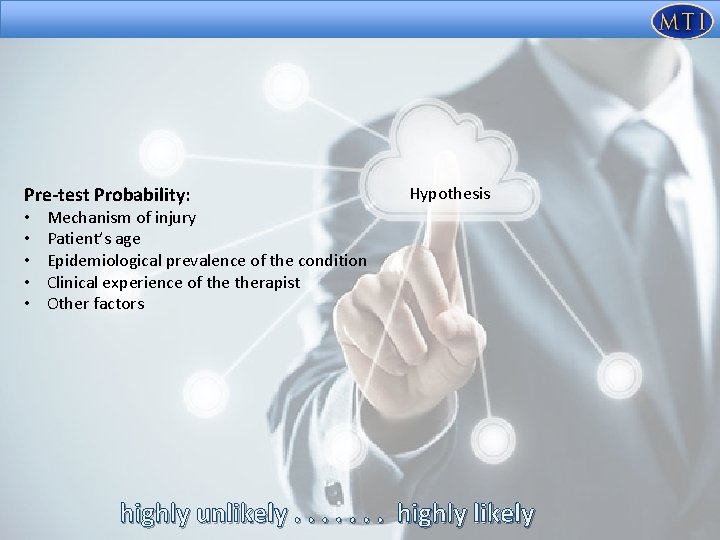
Pre-test Probability: • • • Hypothesis Mechanism of injury Patient’s age Epidemiological prevalence of the condition Clinical experience of therapist Other factors highly unlikely. . . . highly likely
Clinical Reasoning Sensitivity Specificity Likelihood Ratios
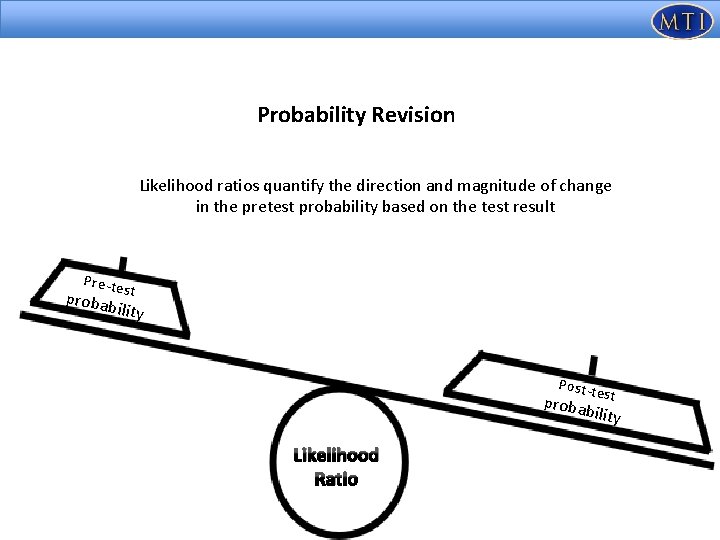
Probability Revision Likelihood ratios quantify the direction and magnitude of change in the pretest probability based on the test result Pre-te st proba bility Post-t proba est bility Likelihood Ratio
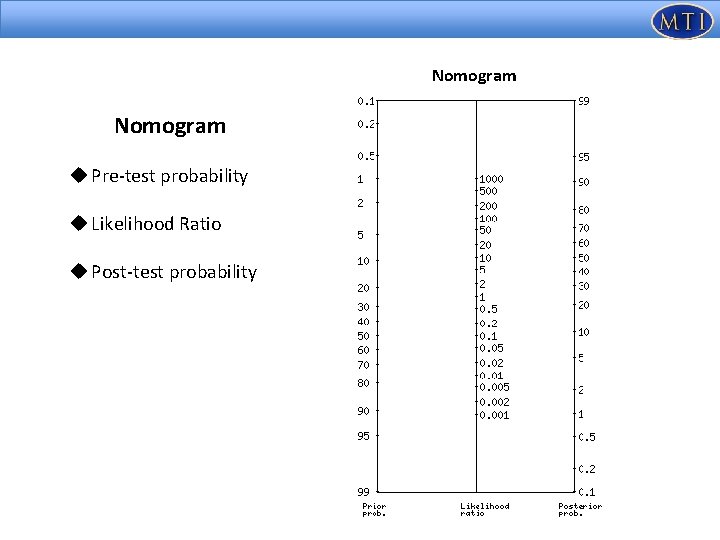
Nomogram u Pre-test probability u Likelihood Ratio u Post-test probability
Pretest -> Posttest Probability “What tests should be performed to rule-in or rule-out these conditions? ”
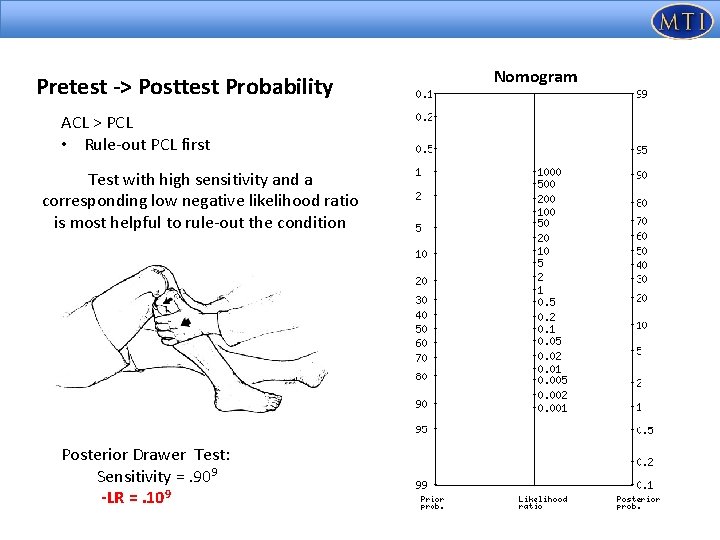
Pretest -> Posttest Probability ACL > PCL • Rule-out PCL first Test with high sensitivity and a corresponding low negative likelihood ratio is most helpful to rule-out the condition Posterior Drawer Test: Sensitivity =. 909 -LR =. 109 Nomogram
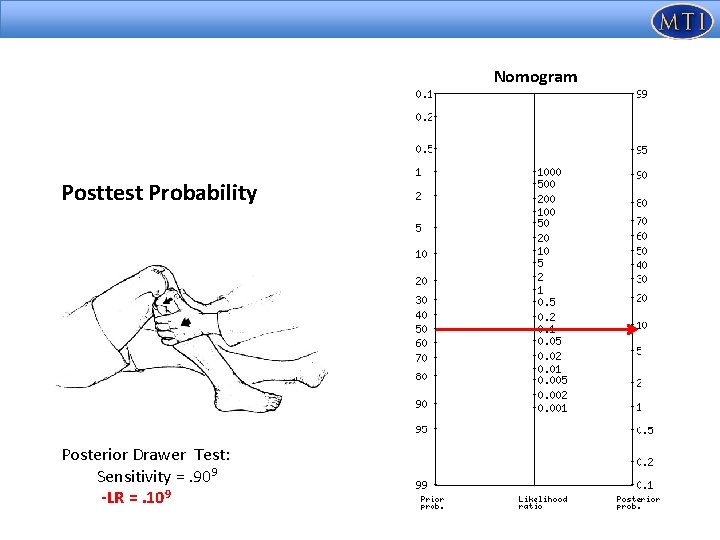
Nomogram Posttest Probability Posterior Drawer Test: Sensitivity =. 909 -LR =. 109
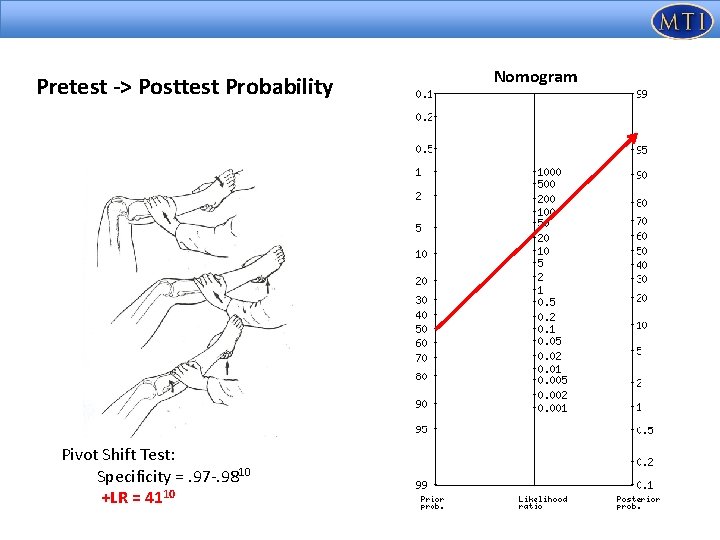
Pretest -> Posttest Probability Pivot Shift Test: Specificity =. 97 -. 9810 +LR = 4110 Nomogram

References 1. 2. 3. 4. 5. 6. 7. • 9. 10. Haynes RB, Sackett RB, Gray JMA, Cook DC, Guyatt GH. Transferring evidence from research into practice, 1: the role of clinical care research evidence in clinical decisions. ACP Journal Club. Nov-Dec 1996; 125: A-14 -15. Guyatt GH, Rennie D. User’s Guide to the Medical Literature. AMA press. 2002, Chicago, IL Simoneau, GG, Allison SC. Physical therapists as evidence-based diagnosticians. JOSPT. 2010; 40(10): 603 -605 Calis M, Akgun K, Birtane M, et al. Diagnostic values of clinical diagnostic tests in subacromial impingement syndrome. Ann Rheum Dis. 2000; 59: 44 -47. Fritz JM, Wainner RW. Examining diagnostic tests: an evidence-based perspective. Physical Therapy. 2001; 81(9): 1546 -1564. Abdon P, Lindstrand A, Thorngren KG. Statistical evaluation of the diagnostic criteria for meniscal tears. Int Orthop. 1990; 14: 341 -345. Karachalios T, Hantes M, Zibis AH, Zachos V, Karantanas AH, Malizos KN. Diagnositc accuracy of a new clinical test for early detection of meniscal tears. J Bone Joint Surg Am. 2005; 87: 955 -962. Bachmann LM, Kolb E, Koller MT, Steurer J, ter Riet G. Accuracy of Ottawa ankle rules to exclude fractures of the ankle and mid-foot: systematic review. BMJ. 2003; 326(7386): 417 Rubinstein RA, Jr. , Shelbourne KD, Mc. Carroll JR, et al. The accuracy of the clinical examination in the setting of posterior cruciate ligament injuries. Am J Sports Med 1994; 22(4): 550 -557. Katz J, Fingeroth R. The diagnostic accuracy of ruptures of the anterior cruciate ligament comparing the Lachman test, the anterior drawer sign, and the pivot shift test in acute and chronic knee injuries. Am J Sports Med 1986; 14: 88 -91.
- Slides: 27