
Appraisal of Personality Chapter 10 Personality Assessment Personality
- Slides: 25
Appraisal of Personality Chapter 10
Personality Assessment Personality What is it? How can it best be measured? Personality assessment can: Help identify client problems Help select interventions Assist in treatment decisions Assist in structuring counseling relationship
Personality Assessment Informal personality assessments: Observation Interviewing Formal personality assessments: Structured personality instruments Projective techniques
Informal Assessment Techniques Observation: Most commonly used method of informal assessment Counselor subjectivity Selective recall Selective interpretation Pre-existing assumptions Reliability & unsystematic error Validity – representativeness & generalizability
Informal Assessment Techniques Interviewing: Diagnostic vs. descriptive Consider quality of questions Reliability & validity concerns
Structured Personality Inventories Methods of constructing personality inventories: Content-related procedure Personality theory Empirical criterion keying Factor analysis Instruments most often used by counselors: Minnesota Multiphasic Personality Inventory 2 (MMPI-2) NEO Personality. Inventory-3 (NEO-PI-3) Myers-Briggs Type Indicator® (MBTI)
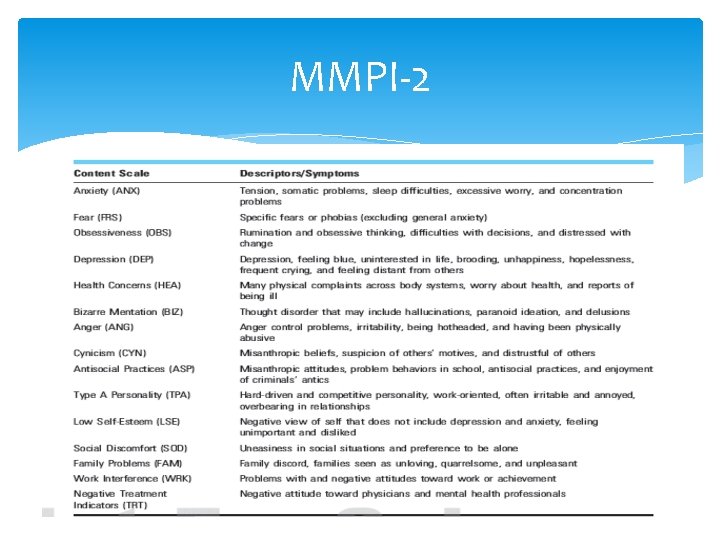
MMPI-2 Criterion-keyed instrument, used to diagnose emotional disorders Norming group of 2, 600 selected to match 1980 census data, debate exists about racial bias 567 items “true, ” “false, ” or “cannot say” Contains validity scales, 3 types of clinical scales: Basic, Content, and Special scales
MMPI-2 Validity scales: Cannot Say (? ) True Response Inconsistency (TRIN) Variable Response Inconsistency (VRIN) Infrequency (F) - also Infrequency Back [F(B)] and Psychopathology Infrequency [F(p)] Symptom Validity (FBS) Lie (L) Correction (K) Superlative Self-Presentation (S)
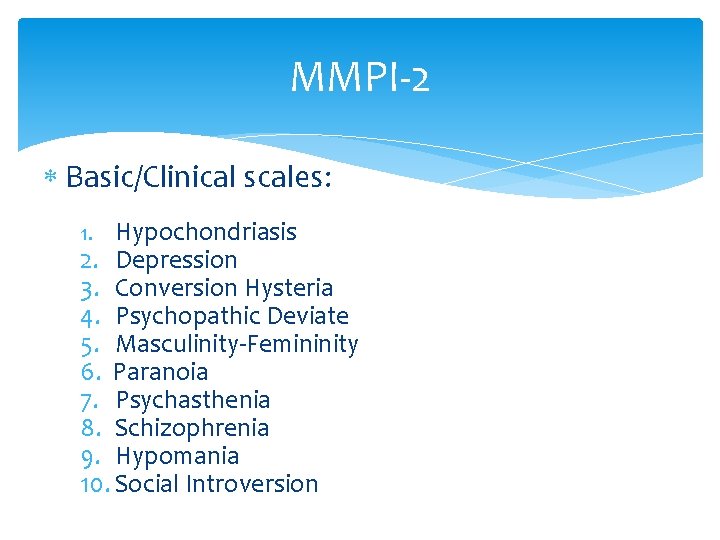
MMPI-2 Basic/Clinical scales: 1. Hypochondriasis 2. Depression 3. Conversion Hysteria 4. Psychopathic Deviate 5. Masculinity-Femininity 6. Paranoia 7. Psychasthenia 8. Schizophrenia 9. Hypomania 10. Social Introversion
MMPI-2
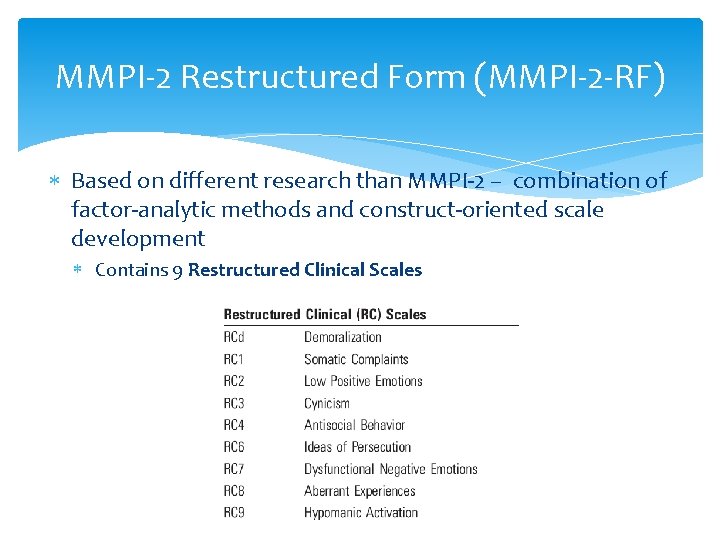
MMPI-2 Restructured Form (MMPI-2 -RF) Based on different research than MMPI-2 – combination of factor-analytic methods and construct-oriented scale development Contains 9 Restructured Clinical Scales
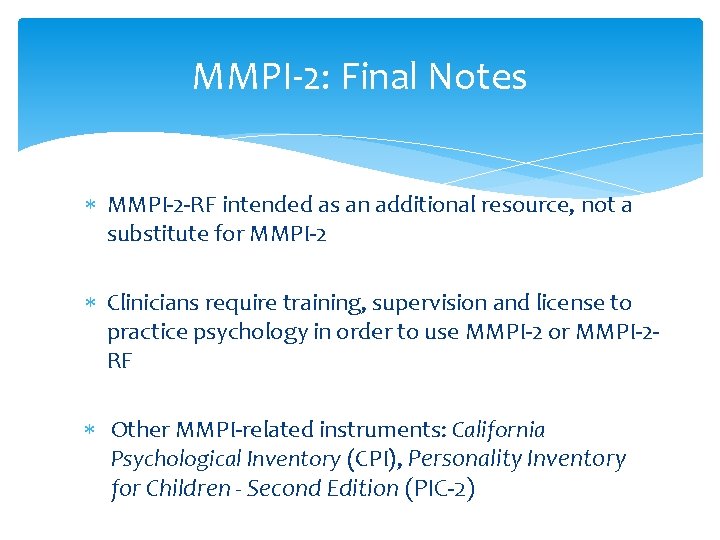
MMPI-2: Final Notes MMPI-2 -RF intended as an additional resource, not a substitute for MMPI-2 Clinicians require training, supervision and license to practice psychology in order to use MMPI-2 or MMPI-2 RF Other MMPI-related instruments: California Psychological Inventory (CPI), Personality Inventory for Children - Second Edition (PIC-2)
NEO-PI-3 Research suggests indentified 5 major factors of personality: I – Surgency (or Extroversion) II – Agreeableness III – Conscientiousness IV – Emotional Stability or (Neuroticism) V – Intellect (or Openness to Experience) Factors appear to apply across diverse cultures Abridged form: NEO Five Factor Inventory (NEO-FFI-3)
NEO-PI-3 Some debate over appropriate names for the 5 factors Counselors should be aware of research on stability of personality across the lifespan NEO-PI-3 useful for understanding clients, assisting in empathy and rapport building, providing feedback and insight, and selecting appropriate treatment Not designed for assessing psychopathology
MBTI ® Widely-used Based on Jungian theory For individuals 14 years and older Typology instrument providing scores on 4 dichotomies, resulting in individuals being categorized into one of 16 psychological types Murphy-Meisgeir Type Indicator for Children (ages 7 -12)
MBTI ® Dichotomies: Extroversion – Introversion Sensing – Intuition Thinking – Feeling Judging – Perceiving Preferences on the 4 continuums result in a 4 -letter code, producing a personality type Most recent version: Form Q/Step II each dichotomy further divided into five facets Counselors need to be familiar with reliability and validity evidence for this instrument
Other Standardized Personality Instruments Sixteen Personality Factor Questionnaire (16 PF) Includes measures of 16 factors and 5 global factors Version also exists for adolescents Jackson Personality Inventory – Revised (JPI-R) 15 subscales organized into 5 higher-order clusters Psychometrically-sound and well-researched
Limitations of Standardized Personality Instruments Majority are self-report instruments Clients are able to distort results (“fake” good or bad) Risk of response sets To increase validity of profiles: Inform client of purpose of inventory and how results will be used Instruct client to answer each question honestly Ask him/her to focus on each of the questions
Projective Techniques Provide client with relatively unstructured stimulus – examiner records and interprets responses Based on psychoanalytic concept of projection – individuals’ tendency to project their drives, defenses, desires, and conflicts onto external situations/stimuli Thought to uncover more of client’s unconscious and, thus, provide an indication of covert or latent traits More difficult to “fake” responses
Projective Techniques Includes significant subjectivity in interpretation Extensive training needed to use them appropriately Categories: Associations Construction Completions Arrangement/selection Expression
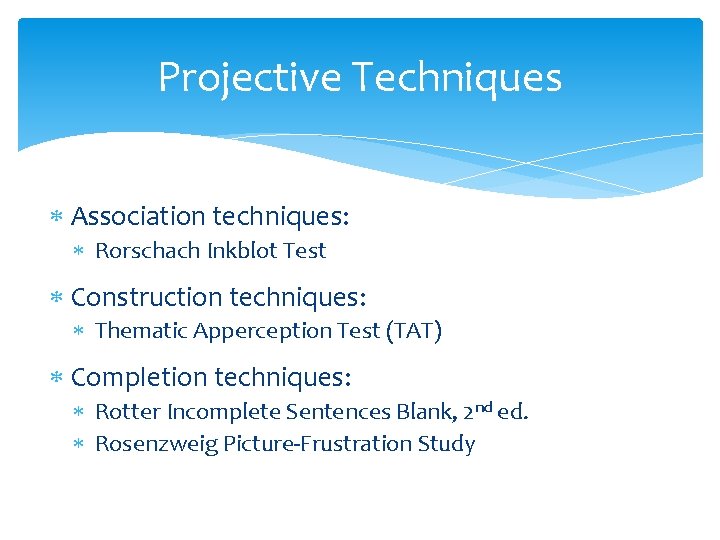
Projective Techniques Association techniques: Rorschach Inkblot Test Construction techniques: Thematic Apperception Test (TAT) Completion techniques: Rotter Incomplete Sentences Blank, 2 nd ed. Rosenzweig Picture-Frustration Study
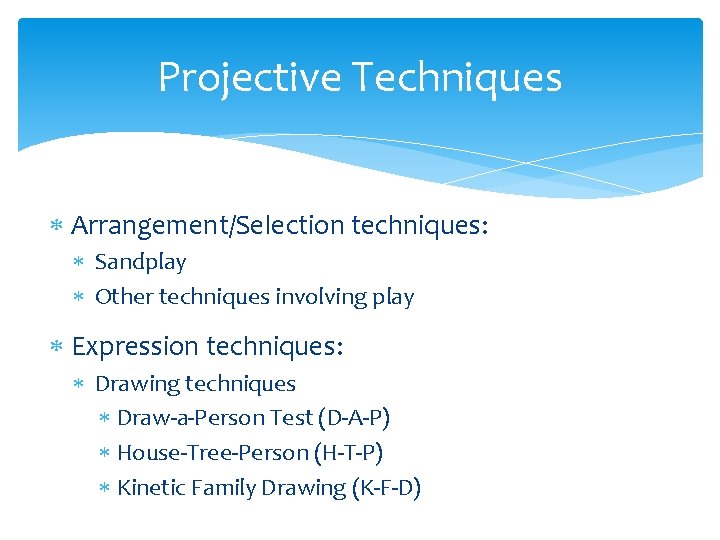
Projective Techniques Arrangement/Selection techniques: Sandplay Other techniques involving play Expression techniques: Drawing techniques Draw-a-Person Test (D-A-P) House-Tree-Person (H-T-P) Kinetic Family Drawing (K-F-D)
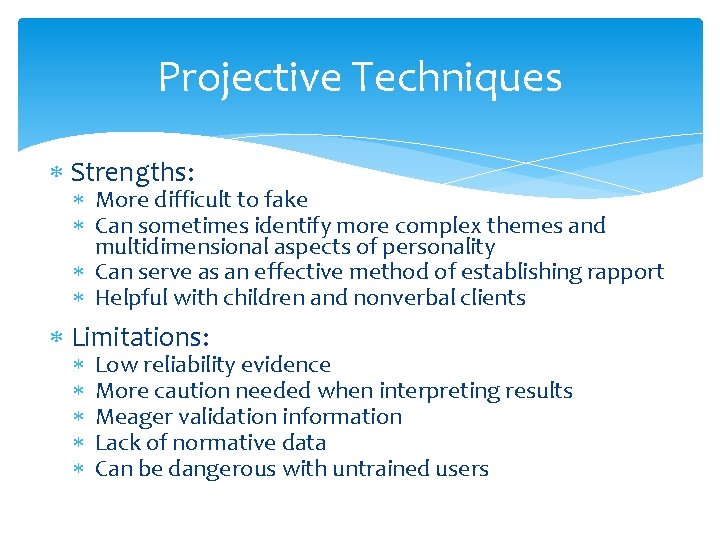
Projective Techniques Strengths: More difficult to fake Can sometimes identify more complex themes and multidimensional aspects of personality Can serve as an effective method of establishing rapport Helpful with children and nonverbal clients Limitations: Low reliability evidence More caution needed when interpreting results Meager validation information Lack of normative data Can be dangerous with untrained users
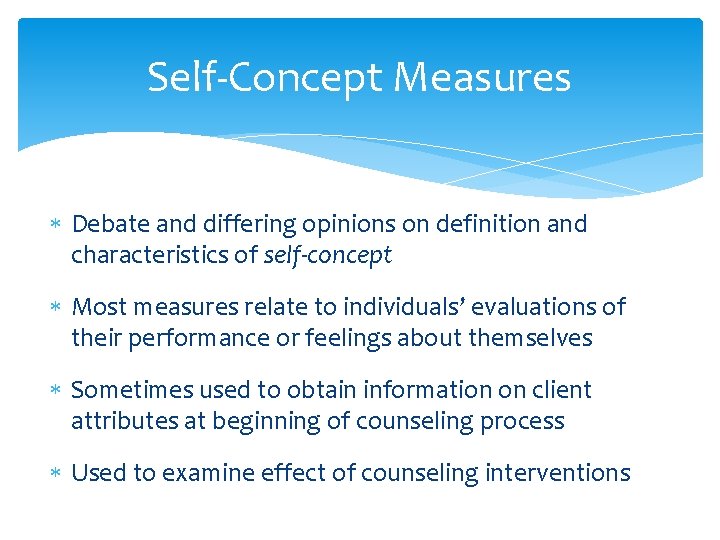
Self-Concept Measures Debate and differing opinions on definition and characteristics of self-concept Most measures relate to individuals’ evaluations of their performance or feelings about themselves Sometimes used to obtain information on client attributes at beginning of counseling process Used to examine effect of counseling interventions
Self-Concept Measures Examples: Piers-Harris Children Self-Concept Scale, Second Edition Tennessee Self-Concept Scale – Second Edition (TSCS-2)