
Applying to the UKRI Future Leaders Fellowship scheme

- Slides: 21
Applying to the UKRI Future Leaders Fellowship scheme
Agenda ▶ Introduction ▶ Making an application ▶ Practical exercise on communicating your research ▶ Panel Session
UKRI Future Leader Fellows ▶ Flagship UKRI investment, launched April 2018 alongside the creation of UKRI ▶ £ 900 m to support circa 550 early career researchers through 6 funding calls with two per annum for three years – – ▶ Up to 7 years of funding (4+3 model) Up to @£ 1. 2 m for first 4 years 3 competitions closed, next closing date 8 th October outline proposal, 7 th November full proposal. Rounds 5 and 6: May 2020 and October 2020 Aims to develop the next generation of innovation and research leaders from the UK and across the world
Purpose ▶ ▶ ▶ To support early career researchers and innovators with outstanding potential across the whole of UKRI remit No steers or ring fencing of funds for particular areas To facilitate and encourage – – – – interdisciplinary research international mobility cross-sector working part-time and flexible working research and innovation with and in businesses enhanced host support for ECRs diversity
UKRI and the changing environment ▶ Autumn 2017 Government announced a £ 7 billion increase in investment in R&D with the ambition to increase the proportion of GDP spent on R&D to 2. 4% by 2027 ▶ UK Research and Innovation was established in April 2018 and brought together 7 research councils, Innovate UK and Research England ▶ Creation of UKRI Cross Cutting Funds - clear shift to funding large collaborative, challenge orientated research which reaches across traditional disciplinary and professional boundaries and are often international in scope
UKRI Funding: The F factor Fund Budget Funding from…to Industrial Strategy Challenge Fund Talent Fund Strength in Places Fund Global Challenges Research Fund Newton Fund for International Development Strategic Priorities Fund £ 1. 7 billion 2017/18 - 21/22 £ 1. 3 billion £ 116 million £ 1. 5 billion 2017/18 - 23/24 2018/19 - 20/21 2016/17 - 19/20 £ 735 million £ 110 million 2014/15 - 20/21 2018/19 - 20/21 £ 560 million 2018/19 - 20/21 https: //esrc. ukri. org/research/future-of-social-science-insightsopportunities-and-expectations/
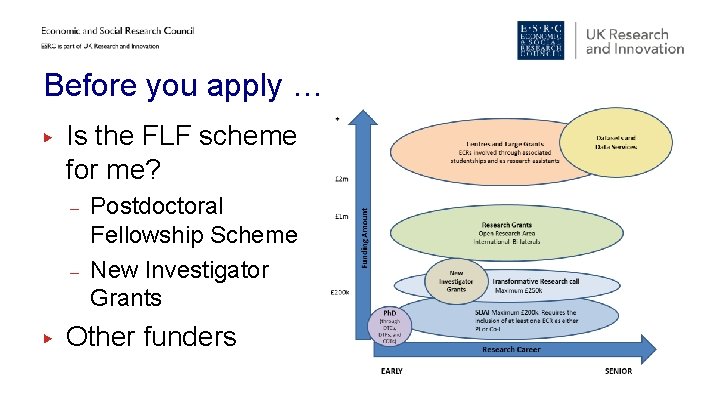
Before you apply … ▶ Is the FLF scheme for me? – – ▶ Postdoctoral Fellowship Scheme New Investigator Grants Other funders
ESRC Postdoctoral fellowships ▶ Funding for around 90 fellowships is available through our national network of Doctoral Training Partnerships (DTPs) and Centres for Doctoral Training (CDTs) ▶ Open to applicants who have completed their Ph. D at a research organisation that is part of a DTP or CDT and are within 12 months of passing their viva voce ▶ Aim to provide the opportunity to consolidate their Ph. D through developing publications, their networks, and their research and professional skills. New research is limited to a maximum of 25% ▶ Up to 12 months, full time. 18 months in exceptional circumstances
ESRC New investigator grants ▶ Aimed at supporting those looking to make the transition to an independent researcher through managing their first major research project and team ▶ Proposals must be for between £ 100, 000 and £ 300, 000 and for up to 5 years ▶ Open to high-quality candidates from anywhere in the world who have a maximum of four years’ postdoctoral experience (or equivalent professional experience) but time bound criteria will be removed in next few months ▶ Must not be current or former principal investigator on a UKRI grant
UKRI Future Leaders Fellowships: Reflections from Round 1 & 2 ▶ Success rates – – – ▶ Round 1: 11% - 369 applications, 42 awards offered could have offered up to 50 Round 2: 19% - 401 applications, 78 awards offered, could have offered up to 100 awards Aiming for 100 per round (or higher) top quality awards in the future Quality/excellence is vital but must be evident across all of the assessment criteria Applications that don’t address all aspects will not be competitive – – Research & Innovation Excellence; Applicant & their Development; Impact & Strategic Relevance; Research and Innovation Environment & Costs.
Reflections from Round 1& 2 ▶ Applicants need to be clearer on why they will gain from a long-term, flexible, fellowship as opposed to other mechanisms. For example: – – ▶ Why could the programme of work not be supported via standard grants? How will the fellowship enable applicants to achieve a demonstrable step change in their career trajectory? This is a scheme for Early Career Researchers, not established academics – Where applicants have previously received funding at this stage need to – be clear why further investment is good value Having a New Investigator award doesn’t bar you from applying – what would this fellowship enable you to do that you couldn’t with the NI
Reflections from Round 1&2 ▶ ▶ ▶ Strong applicants consider leadership and career development not only for themselves, but also for the staff they plan to employ on the award Host commitment is crucial – The proposed support should not just be generic but must demonstrate that they have considered the specific development needs of the applicant Candidates need to be able to articulate their research and the intended impact of such an award on their career to an interview panel from range of different backgrounds
Preparing an application ▶ Consider how to demonstrate the following: – – – Why you should be considered an early career researcher? Why is this fellowship the most appropriate funding for you and your programme of research? What would be the demonstrable impact of you having an FLF award? Why me? Why now? What is the evidence to support your potential to be a future leader? Leadership and development skills for you and any staff Addressing the assessment criteria
Writing a good application ▶ ▶ ▶ Allow yourself time Study your funding source Read the guidance documents Discuss your proposal Justify your costings
Writing a good application – content and presentation ▶ The proposal is the means by which you will be trying to convince the Panel that your proposal is worth funding so think carefully about what information you are going to give and how it is presented. ▶ Make sure you think your proposed plan of activities through and cover all stages of the research lifecycle from planning and research design to knowledge exchange and impact realisation activities. Ensure you clearly articulate your plans for your own development and that of the staff employed on the grant https: //esrc. ukri. org/funding/guidance-for-applicants/how-to-write-a-goodresearch-grant-proposal/ ▶
The assessment process ▶ Peer review – – – ▶ Proposals will usually have 3 usable reviews Speak to your nominated reviewers before submitting your application Be constructive when responding to your reviewer comments Panel stages – – – Short-listing and interview panels Moderating Panels Peer reviewers provide the expert view, panels have broader representation
Communicating your research
Practical exercise – your research ▶ You have 5 minutes to think about how to explain your research to someone with no knowledge of the area: – – – ▶ What you’re planning to do How you’re planning to do it What will be the impact of this research In pairs, take it in turns to give your elevator pitch and get feedback from your partner
Practical exercise – why you ▶ You have 5 minutes to think about: – – – ▶ Why is the right scheme for you at this time? How will you, and anyone employed on this award, benefit from this investment? If you were successful, where would you see yourself by the time the funding comes to an end? In pairs, take it in turns to make your case and get feedback from your partner
Panel session
Reflections from earlier rounds ▶ The panel will share their reflections of the scheme – – – Professor Gordon Harold, University of Sussex and Chair of an FLF Assessment Panel Dr Sarah Lewthwaite, UKRI Future Leader Fellow, University of Southampton Sam Lambshead, Research Development Associate, University of Bristol