
Applying to the NSF Graduate Research Fellowship Program
- Slides: 18
Applying to the NSF Graduate Research Fellowship Program (Fall 2018)
Before we begin, a crash course on writing: 1. Dump the relevant content of your brain onto the page. 2. Rewrite for organization and clarity. 3. Get feedback from your peers and anyone else willing to read your work. 4. Repeat steps 2 & 3 as many times as you can before your deadline.
Strategies for the “brain dump” • Brainstorm for all the major elements that might possibly belong on the page. • Break the major elements into their component parts to fill in details. • As you fill in details, more sections will likely occur to you. • Put words on the page – do not edit at this stage.
Rewriting for organization • Most writing begins with a brief overview, but this should be written last. Assemble your content first. • Consider your readers’ perspective and present material in an order that will make sense. • Experiment with moving sections around. Ask yourself whether this new order works better or worse, and why.
Rewriting for clarity • Make your writing as simple as possible, but no simpler. • Impress with your ideas, not with your vocabulary. • Yes, you can use the jargon and terminology of your field, but don’t expect this to take the place of clear, accessible explanations. • Read your work out loud. What feels awkward or forced? Do you find yourself wanting to change words as they come out of your mouth? • Put the work aside, and explain what you’re writing about to your friend/roommate/mother/etc.
Overview of your GRFP Application • Answer all the questions required by the Fast. Lane Application Module • Start this early. There’s a lot of information to assemble. • https: //www. fastlane. nsf. gov/grfp/Login. do • Complete two essays: • Personal, Relevant Background and Future Goals Statement • (Often referred to as simply the “Personal Statement”) • Maximum length: 3 pages, using required formatting instructions • Graduate Research Plan Statement • Maximum length: 2 pages, using required formatting instructions • Provide names/email addresses for three letters of recommendation.
Key Information: Program Solicitation • All the requirements are listed on the NSF Graduate Research Fellowship page at https: //www. nsfgrfp. org/ • Look under “Program solicitation” for all the details about applying. • Make sure you’re eligible. • Check the deadline for your field. • Computer and Information Science and Engineering: October 23, 2018 • Line up peers to edit your application – offer your own help in return. • Give yourself time for multiple revisions. • Current rule: Graduate students may only apply once. (You can withdraw your application no later than November 15)
Key qualifications: Publications/Posters • You don’t have to be a first author, but having your name on a published paper provides proof of your research experience. • Also mention any posters you’ve presented and where.
Applying in your first year: • Your application will be compared to other first year applicants, not to the entire application pool. • So if you have research experience and/or a publication history, you may have an advantage over many other first year students. • Receiving a fellowship your first year makes you a very attractive prospect for research projects, because a potential PI won’t have to worry about funding you.
Applying in your second year: • Will give you a GPA from graduate-level coursework. • Particularly important if you’ve switched school systems (international schools, for instance). • You’ll have time to build research experience. • You’ll have time to publish or present research at conferences.
Who reads these applications? • Reviewers should be experts in your field or a related field. • If your work is interdisciplinary, your work will be reviewed by a best match. • But first, your application will likely be examined by intermediaries to determine whether it meets basic requirements and which reviewer it should be sent to. • So your research subject needs to make enough sense to a non-expert that they can pass it along to a reviewer with relevant experience.
Personal Statement – a practical excercise • Get out a piece of paper. • Write a paragraph from your “Personal, Relevant Background and Future Goals Statement. ” • Please outline your educational and professional development plans and career goals. How do you envision graduate school preparing you for a career that allows you to contribute to expanding scientific understanding as well as broadly benefit society? Page limit - 3 pages • Describe your personal, educational and/or professional experiences that motivate your decision to pursue advanced study in science, technology, engineering or mathematics (STEM). Include specific examples of any research and/or professional activities in which you have participated. Present a concise description of the activities, highlight the results and discuss how these activities have prepared you to seek a graduate degree. Specify your role in the activity including the extent to which you worked independently and/or as part of a team. Describe the contributions of your activity to advancing knowledge in STEM fields as well as the potential for broader societal impacts. • Alternately: type this paragraph on a laptop • Would you like feedback here and now? • Email it to gmoulds@ucsc. edu
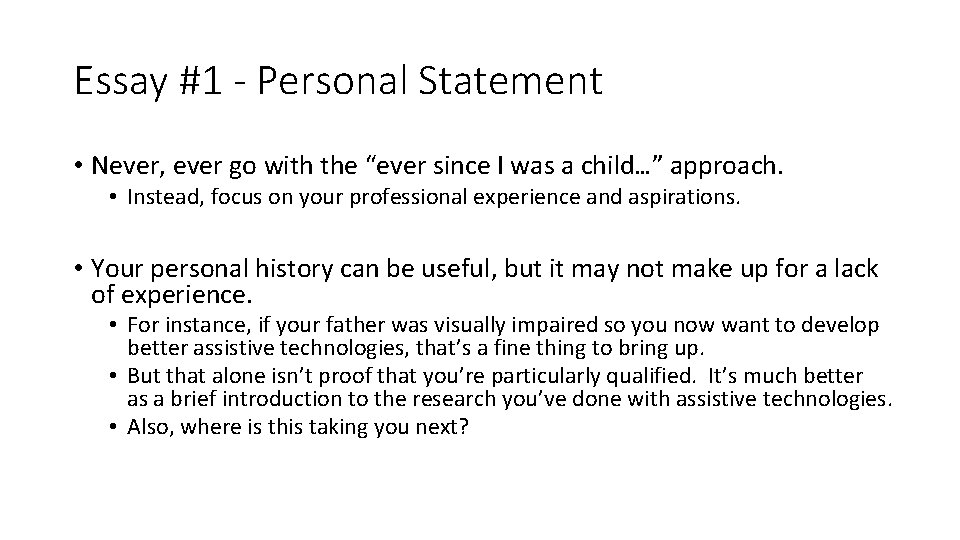
Essay #1 - Personal Statement • Never, ever go with the “ever since I was a child…” approach. • Instead, focus on your professional experience and aspirations. • Your personal history can be useful, but it may not make up for a lack of experience. • For instance, if your father was visually impaired so you now want to develop better assistive technologies, that’s a fine thing to bring up. • But that alone isn’t proof that you’re particularly qualified. It’s much better as a brief introduction to the research you’ve done with assistive technologies. • Also, where is this taking you next?
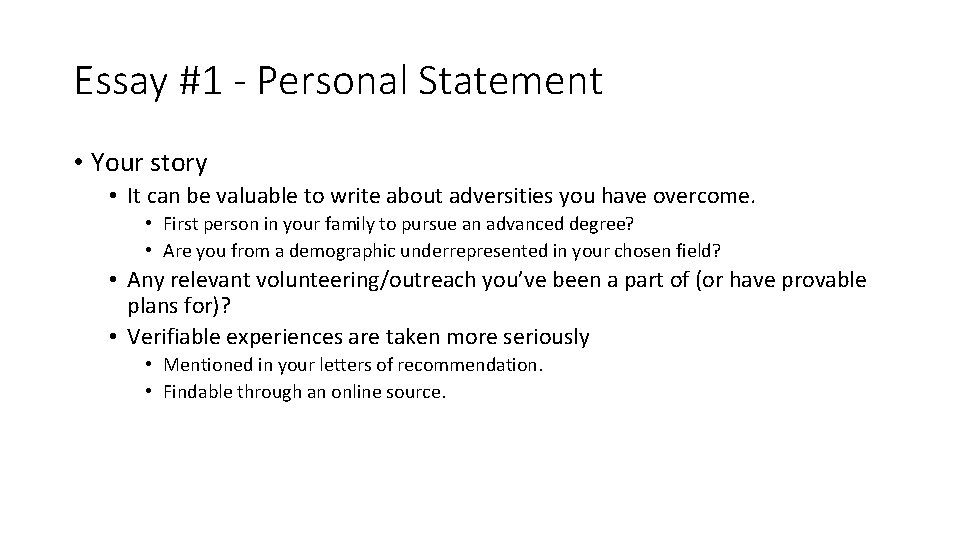
Essay #1 - Personal Statement • Your story • It can be valuable to write about adversities you have overcome. • First person in your family to pursue an advanced degree? • Are you from a demographic underrepresented in your chosen field? • Any relevant volunteering/outreach you’ve been a part of (or have provable plans for)? • Verifiable experiences are taken more seriously • Mentioned in your letters of recommendation. • Findable through an online source.
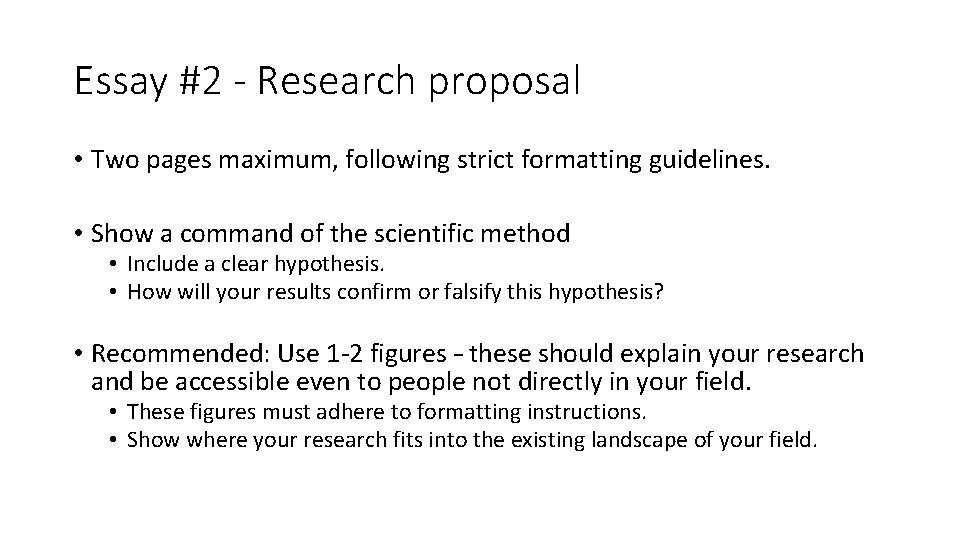
Essay #2 - Research proposal • Two pages maximum, following strict formatting guidelines. • Show a command of the scientific method • Include a clear hypothesis. • How will your results confirm or falsify this hypothesis? • Recommended: Use 1 -2 figures – these should explain your research and be accessible even to people not directly in your field. • These figures must adhere to formatting instructions. • Show where your research fits into the existing landscape of your field.
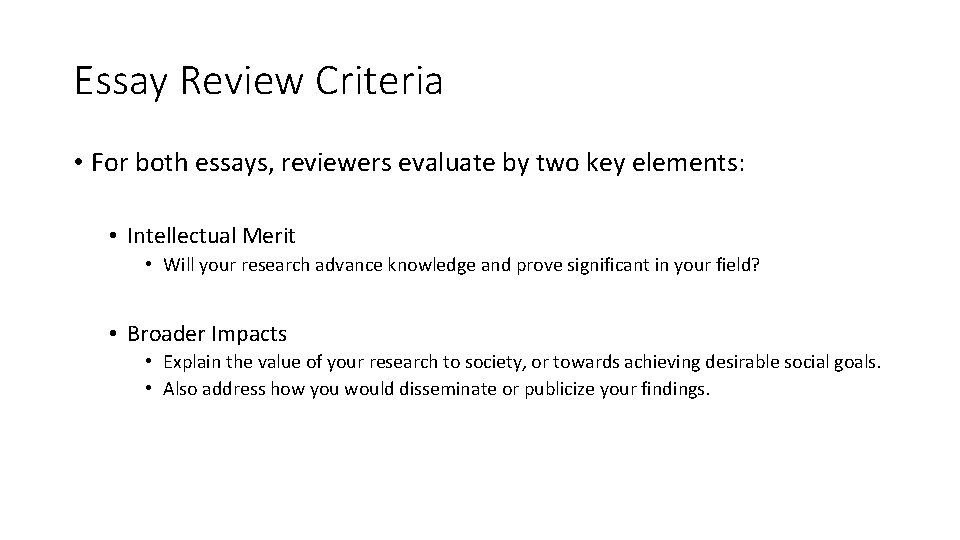
Essay Review Criteria • For both essays, reviewers evaluate by two key elements: • Intellectual Merit • Will your research advance knowledge and prove significant in your field? • Broader Impacts • Explain the value of your research to society, or towards achieving desirable social goals. • Also address how you would disseminate or publicize your findings.
Letters of Recommendation • Ask well in advance. • Also, follow up frequently, as some people put off writing letters and there’s no room for error if they miss the deadline. • This year’s letter deadline is November 2, 2018, by 5 pm EST. • Find three people who will be able to write about you in detail. • • Faculty Employers No family members allowed (not just a bad idea, but forbidden) Ideally, choose diverse recommenders (different fields, different sides of your work) • Give recommenders a copy of your personal statement. • This will help remind them of your accomplishments, and sometimes guide the content of their letters.
Useful resources: • NSF’s Frequently Asked Questions for GRFP Applicants • https: //www. nsf. gov/pubs/2017/nsf 17123. jsp • All About the NSF GRFP • Practical information about the process, and writing advice for essays: • https: //caffeinatedconfidence. com/2017/09/01/all-about-the-nsf-grfp/ • You. Tube Video: NSF GRFP tips from a reviewer and PI • https: //youtu. be/20 k. RV 8_mf. HU