
Applying the Technological Innovation Systems framework to the

- Slides: 20
Applying the Technological Innovation Systems framework to the analysis of the Small Wind Turbine Innovation System in Kenya Faith H. Wandera Globelics Conference Ghana 24 -26 th October 2018
Presentation outline • Introduction • Boundary of the Technological Innovation System for small wind turbines • Justification for small wind turbines • Research questions, literature review, methodology and actors • Analyzing the functioning of the TIS • Key policy issues & theoretical implications • Conclusions & future prospects for SWT in Kenya
Introduction • Kenya faces key energy challenges (energy access, climate change, energy security) • Renewable energy resources are abundant (hydro, geothermal, solar and wind and biomass) • Wind energy potential for SWT for electricity generation remains relatively unexploited but mainly large SWT for electricity generation are in place • The knowledge gap: limited knowledge of the nature, characteristics and functioning of SWT in Kenya • An evidence base is required in support of decentralised generation of electricity through SWT. The TIS approach was used to provide such an evidence base • Variables: Technology diffusion; Interactive learning; & firm capabilities
Boundaries of the Technological Innovation System for Small wind turbines • Systems < 100 k. W for electricity generation for lighting, phone charging, grinding, communication systems, and battery charging etc. in individual households institutions, and small businesses • Individual systems, isolated, with or without provision for connection to the grid & serving communities who lack electricity access because of geographical location or economic and feasibility reasons • Geographical boundary is national but there are interactions with international markets because most products are imported • A technological boundary whose functioning is impacted upon by other TISs such as Large scale wind & solar PV • Study focused on business firms but takes into account interactions with other actors in the TIS (Government, Learning institutions, R&D agencies, International SWT Companies, etc. )
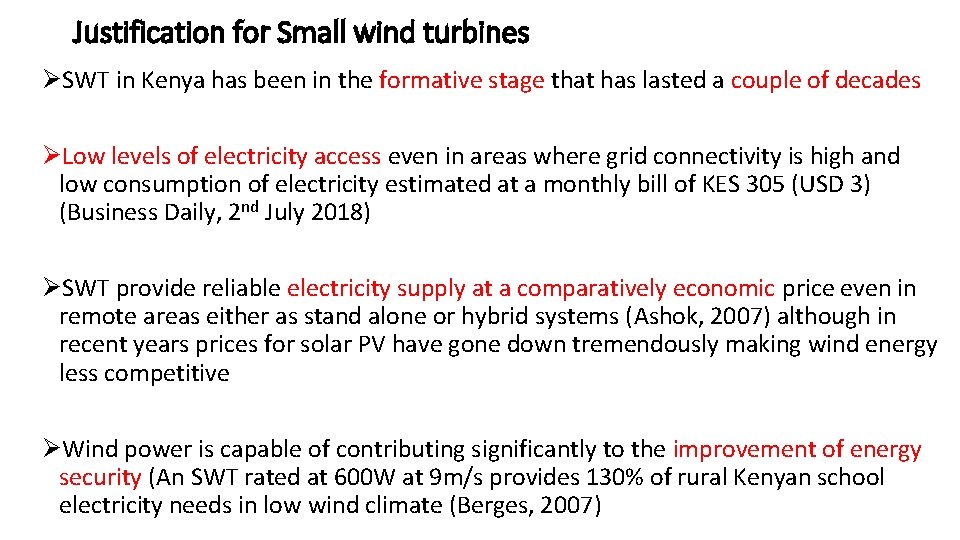
Justification for Small wind turbines ØSWT in Kenya has been in the formative stage that has lasted a couple of decades ØLow levels of electricity access even in areas where grid connectivity is high and low consumption of electricity estimated at a monthly bill of KES 305 (USD 3) (Business Daily, 2 nd July 2018) ØSWT provide reliable electricity supply at a comparatively economic price even in remote areas either as stand alone or hybrid systems (Ashok, 2007) although in recent years prices for solar PV have gone down tremendously making wind energy less competitive ØWind power is capable of contributing significantly to the improvement of energy security (An SWT rated at 600 W at 9 m/s provides 130% of rural Kenyan school electricity needs in low wind climate (Berges, 2007)
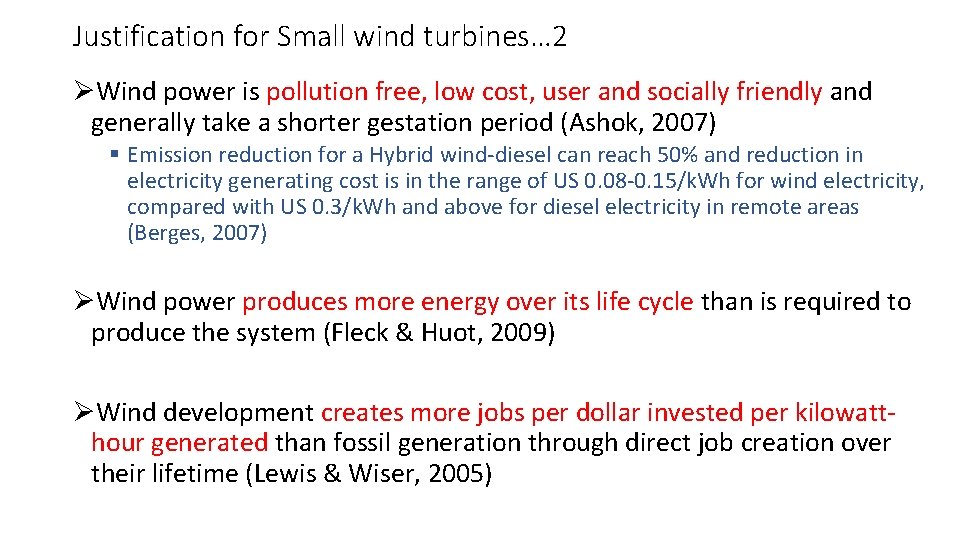
Justification for Small wind turbines… 2 ØWind power is pollution free, low cost, user and socially friendly and generally take a shorter gestation period (Ashok, 2007) § Emission reduction for a Hybrid wind-diesel can reach 50% and reduction in electricity generating cost is in the range of US 0. 08 -0. 15/k. Wh for wind electricity, compared with US 0. 3/k. Wh and above for diesel electricity in remote areas (Berges, 2007) ØWind power produces more energy over its life cycle than is required to produce the system (Fleck & Huot, 2009) ØWind development creates more jobs per dollar invested per kilowatthour generated than fossil generation through direct job creation over their lifetime (Lewis & Wiser, 2005)
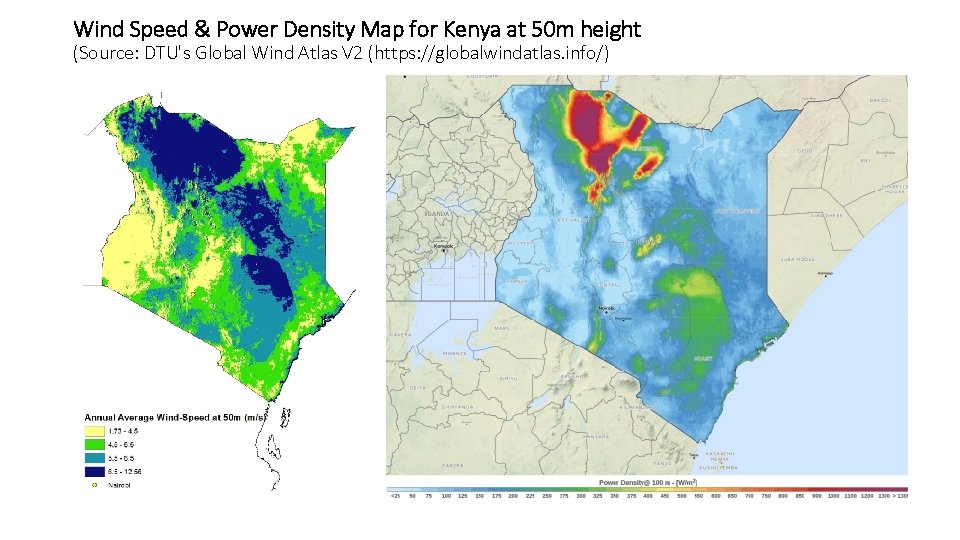
Wind Speed & Power Density Map for Kenya at 50 m height (Source: DTU's Global Wind Atlas V 2 (https: //globalwindatlas. info/)
Research Questions 1. Does a technological innovation system for diffusing SWT exist in Kenya? 2. If it does, what are the main inducing and blocking mechanisms? 3. How, well does the SWT TIS function in Kenya? 4. What does the future for SWT in Kenya look like?
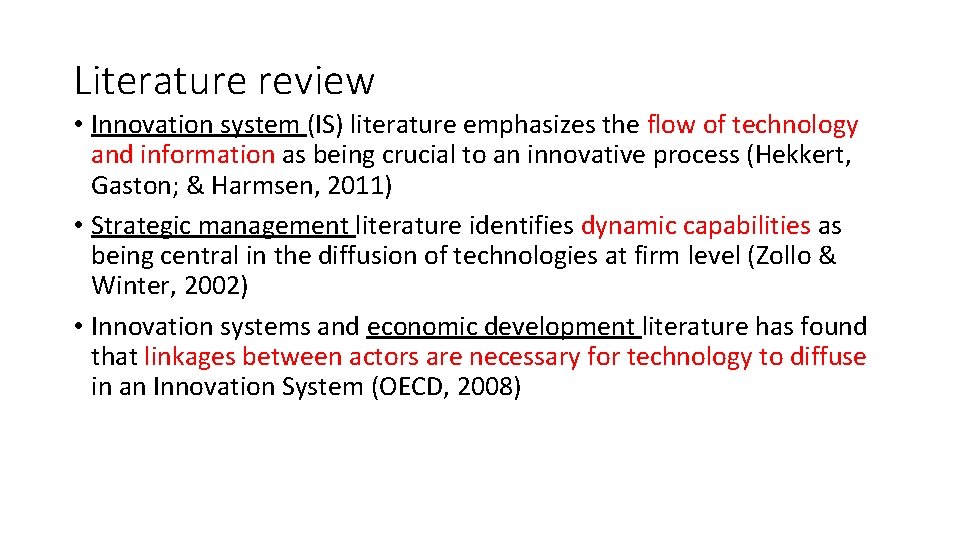
Literature review • Innovation system (IS) literature emphasizes the flow of technology and information as being crucial to an innovative process (Hekkert, Gaston; & Harmsen, 2011) • Strategic management literature identifies dynamic capabilities as being central in the diffusion of technologies at firm level (Zollo & Winter, 2002) • Innovation systems and economic development literature has found that linkages between actors are necessary for technology to diffuse in an Innovation System (OECD, 2008)
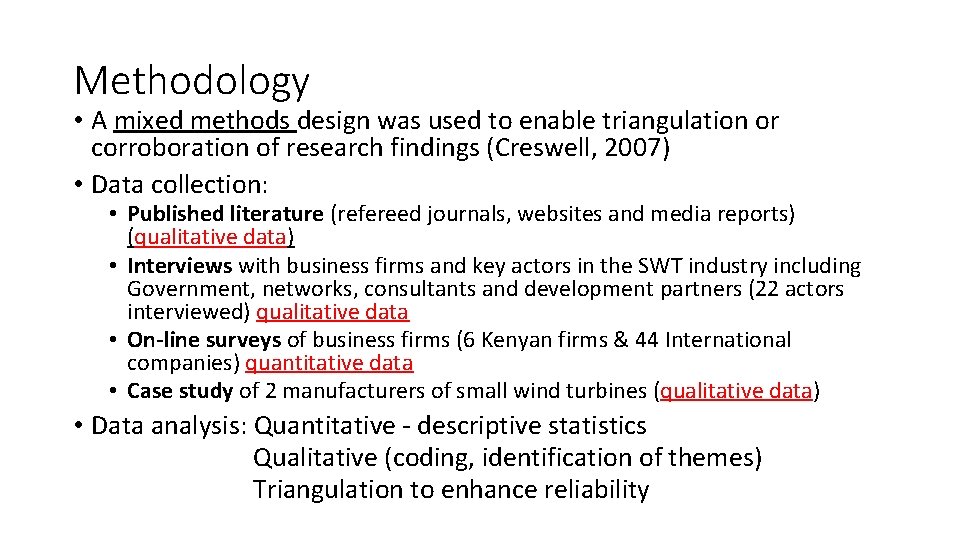
Methodology • A mixed methods design was used to enable triangulation or corroboration of research findings (Creswell, 2007) • Data collection: • Published literature (refereed journals, websites and media reports) (qualitative data) • Interviews with business firms and key actors in the SWT industry including Government, networks, consultants and development partners (22 actors interviewed) qualitative data • On-line surveys of business firms (6 Kenyan firms & 44 International companies) quantitative data • Case study of 2 manufacturers of small wind turbines (qualitative data) • Data analysis: Quantitative - descriptive statistics Qualitative (coding, identification of themes) Triangulation to enhance reliability
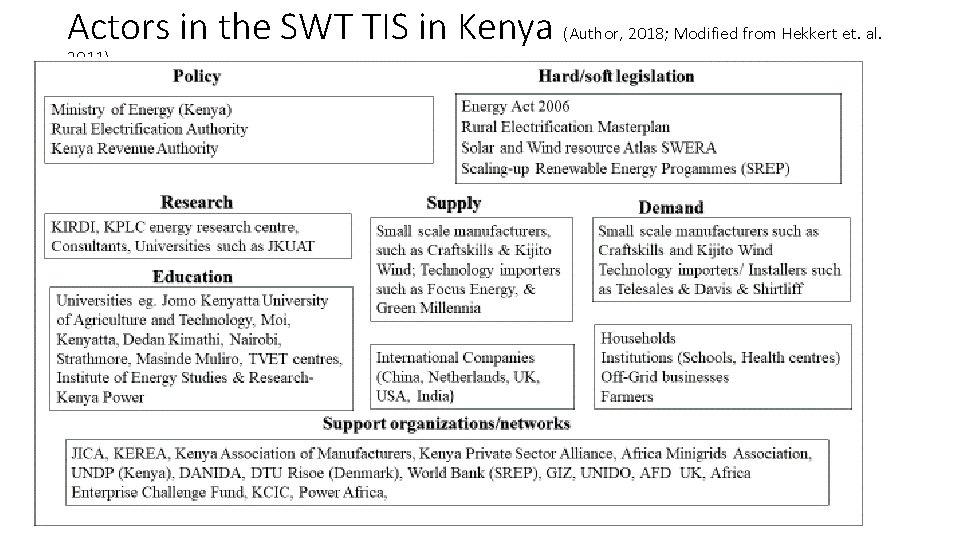
Actors in the SWT TIS in Kenya (Author, 2018; Modified from Hekkert et. al. 2011)
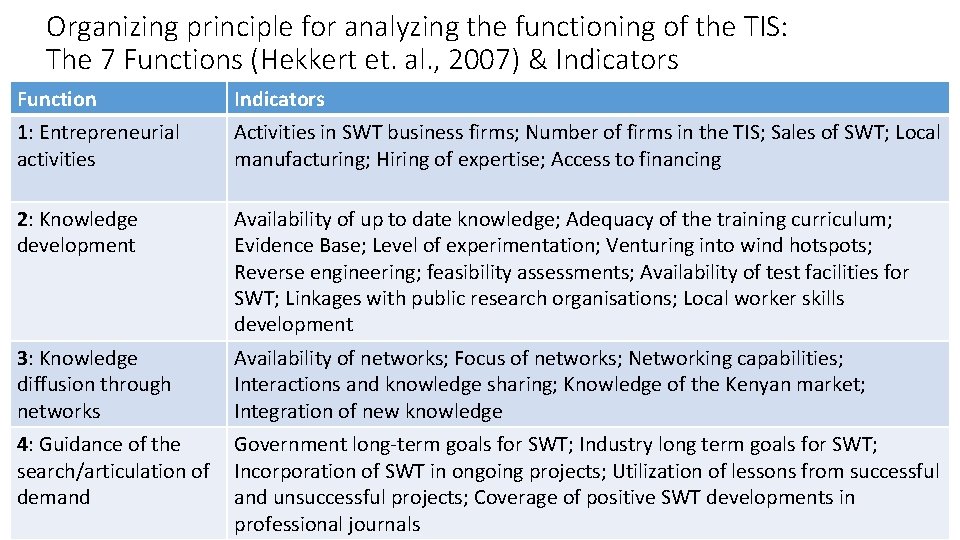
Organizing principle for analyzing the functioning of the TIS: The 7 Functions (Hekkert et. al. , 2007) & Indicators Function Indicators 1: Entrepreneurial activities Activities in SWT business firms; Number of firms in the TIS; Sales of SWT; Local manufacturing; Hiring of expertise; Access to financing 2: Knowledge development Availability of up to date knowledge; Adequacy of the training curriculum; Evidence Base; Level of experimentation; Venturing into wind hotspots; Reverse engineering; feasibility assessments; Availability of test facilities for SWT; Linkages with public research organisations; Local worker skills development 3: Knowledge diffusion through networks Availability of networks; Focus of networks; Networking capabilities; Interactions and knowledge sharing; Knowledge of the Kenyan market; Integration of new knowledge 4: Guidance of the search/articulation of demand Government long-term goals for SWT; Industry long term goals for SWT; Incorporation of SWT in ongoing projects; Utilization of lessons from successful and unsuccessful projects; Coverage of positive SWT developments in professional journals
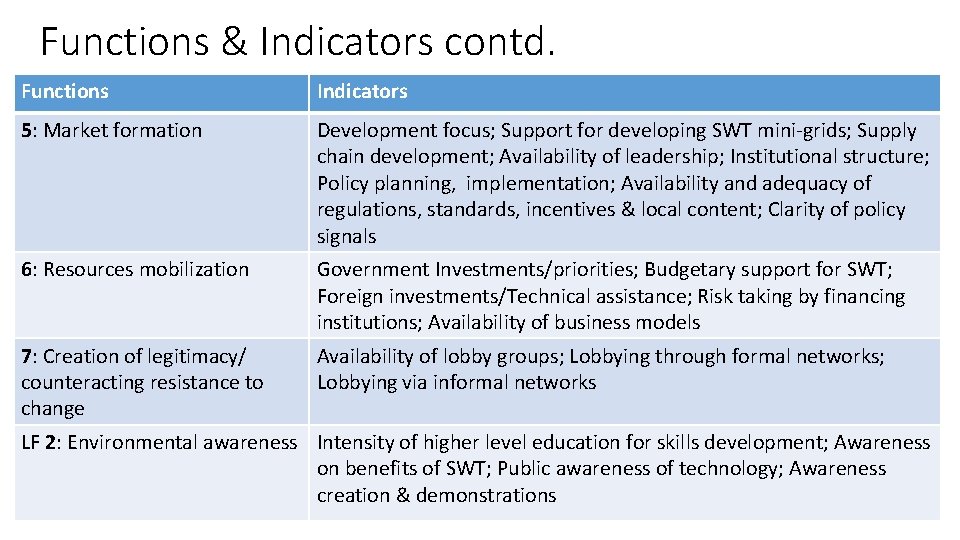
Functions & Indicators contd. Functions Indicators 5: Market formation Development focus; Support for developing SWT mini-grids; Supply chain development; Availability of leadership; Institutional structure; Policy planning, implementation; Availability and adequacy of regulations, standards, incentives & local content; Clarity of policy signals 6: Resources mobilization Government Investments/priorities; Budgetary support for SWT; Foreign investments/Technical assistance; Risk taking by financing institutions; Availability of business models 7: Creation of legitimacy/ counteracting resistance to change Availability of lobby groups; Lobbying through formal networks; Lobbying via informal networks LF 2: Environmental awareness Intensity of higher level education for skills development; Awareness on benefits of SWT; Public awareness of technology; Awareness creation & demonstrations
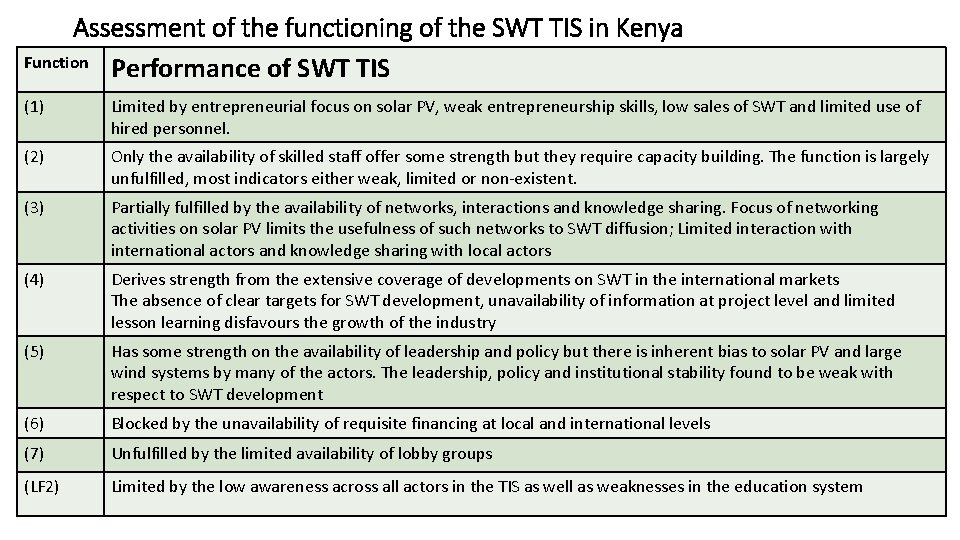
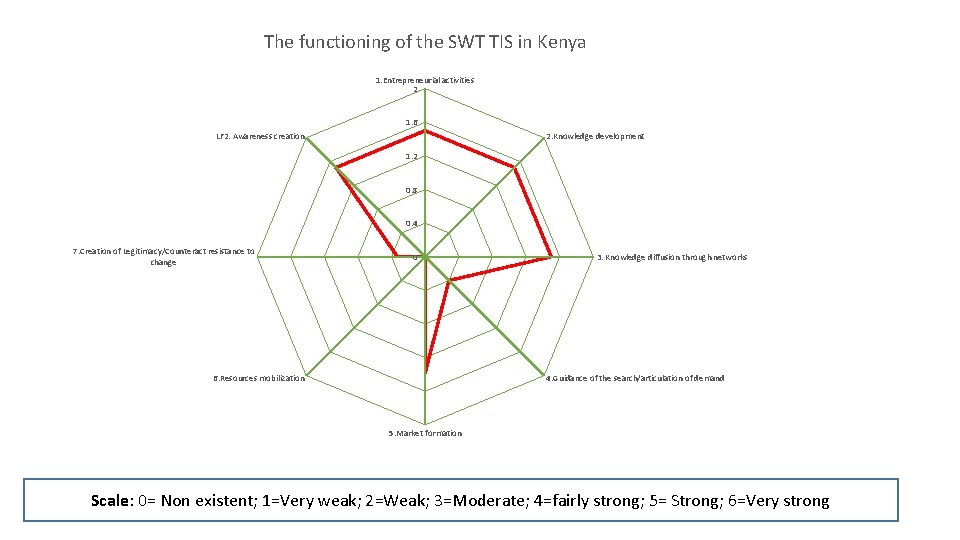
Assessment of the functioning of the SWT TIS in Kenya Function Performance of SWT TIS (1) Limited by entrepreneurial focus on solar PV, weak entrepreneurship skills, low sales of SWT and limited use of hired personnel. (2) Only the availability of skilled staff offer some strength but they require capacity building. The function is largely unfulfilled, most indicators either weak, limited or non-existent. (3) Partially fulfilled by the availability of networks, interactions and knowledge sharing. Focus of networking activities on solar PV limits the usefulness of such networks to SWT diffusion; Limited interaction with international actors and knowledge sharing with local actors (4) Derives strength from the extensive coverage of developments on SWT in the international markets The absence of clear targets for SWT development, unavailability of information at project level and limited lesson learning disfavours the growth of the industry (5) Has some strength on the availability of leadership and policy but there is inherent bias to solar PV and large wind systems by many of the actors. The leadership, policy and institutional stability found to be weak with respect to SWT development (6) Blocked by the unavailability of requisite financing at local and international levels (7) Unfulfilled by the limited availability of lobby groups (LF 2) Limited by the low awareness across all actors in the TIS as well as weaknesses in the education system
The functioning of the SWT TIS in Kenya 1. Entrepreneurial activities 2 1. 6 LF 2. Awareness creation 2. Knowledge development 1. 2 0. 8 0. 4 7. Creation of Legitimacy/Counteract resistance to change 0 6. Resources mobilization 3. Knowledge diffusion through networks 4. Guidance of the search/articulation of demand 5. Market formation Scale: 0= Non existent; 1=Very weak; 2=Weak; 3=Moderate; 4=fairly strong; 5= Strong; 6=Very strong
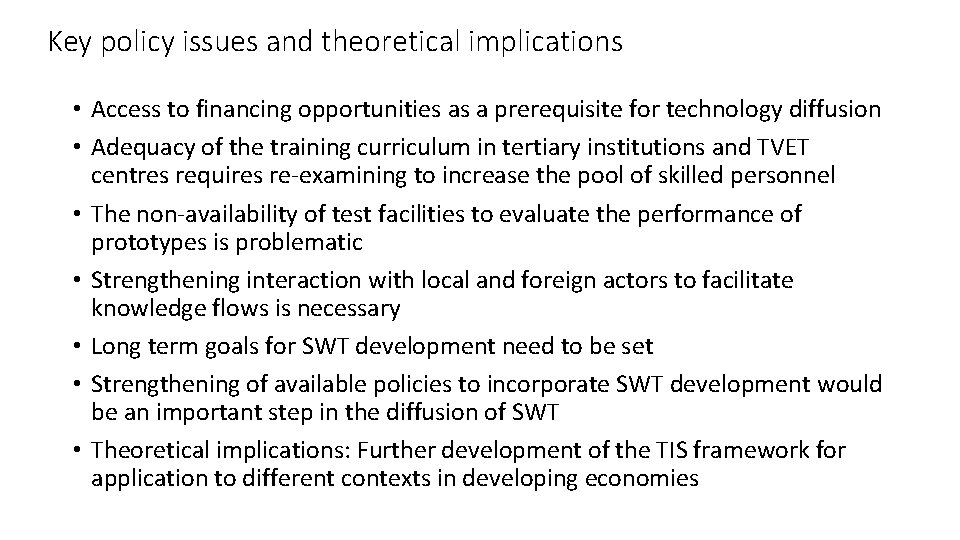
Key policy issues and theoretical implications • Access to financing opportunities as a prerequisite for technology diffusion • Adequacy of the training curriculum in tertiary institutions and TVET centres requires re-examining to increase the pool of skilled personnel • The non-availability of test facilities to evaluate the performance of prototypes is problematic • Strengthening interaction with local and foreign actors to facilitate knowledge flows is necessary • Long term goals for SWT development need to be set • Strengthening of available policies to incorporate SWT development would be an important step in the diffusion of SWT • Theoretical implications: Further development of the TIS framework for application to different contexts in developing economies
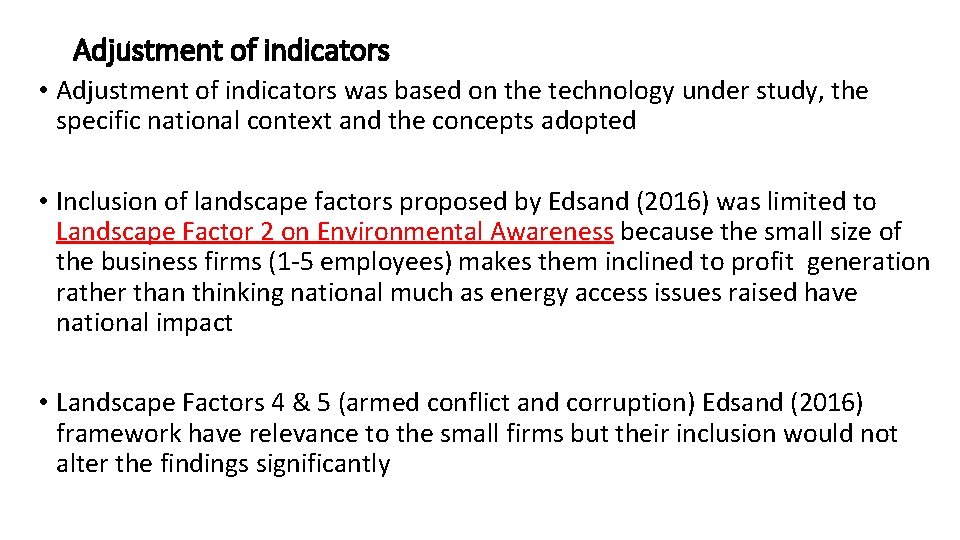
Adjustment of indicators • Adjustment of indicators was based on the technology under study, the specific national context and the concepts adopted • Inclusion of landscape factors proposed by Edsand (2016) was limited to Landscape Factor 2 on Environmental Awareness because the small size of the business firms (1 -5 employees) makes them inclined to profit generation rather than thinking national much as energy access issues raised have national impact • Landscape Factors 4 & 5 (armed conflict and corruption) Edsand (2016) framework have relevance to the small firms but their inclusion would not alter the findings significantly
Conclusion • The TIS framework provided useful means of analysis for the SWT TIS in Kenya under circumstances where no guidelines exist for assessing TIS in Africa (Tigabu, 2017) • An SWT TIS exists albeit in abstract form and it is just emerging • There are few inducing and many blocking mechanisms that affect the smooth functioning of the TIS. Addressing all the blocking and inducing mechanisms cannot be done in a single feat, but the policy recommendations made provide a useful starting point • Concerted action by all actors in the TIS is necessary • More empirical studies that apply different concepts, methodologies and sets of indicators could be useful in improving the functioning of the SWT TIS in Kenya • Application of TIS was inspired by Alphen et. al. , (2008), Perrot (2012); Kebede and Mitsufuji (2016); Tigabu (2017)
Future prospects for SWT in Kenya • Low prices of solar PV may mean SWT is not feasible except in combination with solar PV (Hybrids) but there is indication of SWT prices also declining • There may be a niche for SWT in combination with solar PV as complementary sources or as stand alone systems for electricity provision at night in households and institutions, small businesses, battery charging, and mobile phone charging
Comments; Questions & suggestions for improvement