
Applying the ARCS Model of Motivational Design in
- Slides: 13
Applying the ARCS Model of Motivational Design in Distance Learning John M. Keller, Florida State University
Topics Issues in Distance Learning l Characteristics of the ARCS Model l Empirical Studies of the ARCS Model l Motivation & Distance Learning l Summary l John M. Keller, Florida State University
Issues l l l l Drop out Non-completion Boredom Lack of support Need for support Scarcity of empirical studies Criticality of motivation John M. Keller, Florida State University
ARCS: Characteristics Four categories l Grounded in the literature l Provides basis for design l Integrated with learning & performance l John M. Keller, Florida State University
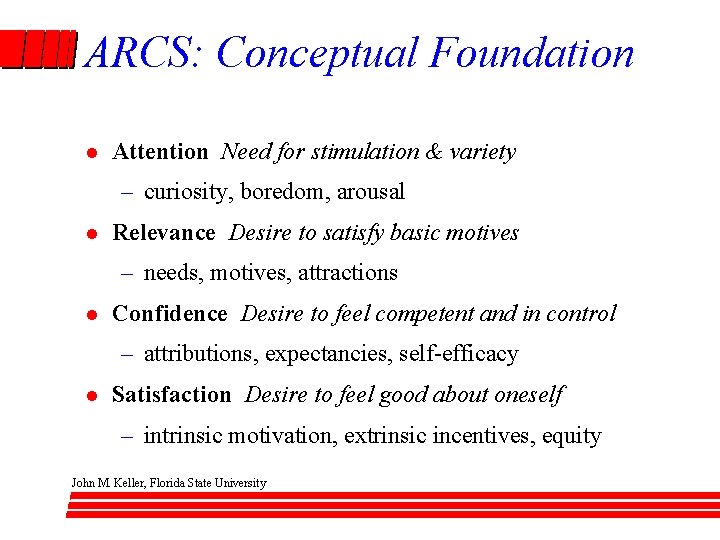
ARCS: Conceptual Foundation l Attention Need for stimulation & variety – curiosity, boredom, arousal l Relevance Desire to satisfy basic motives – needs, motives, attractions l Confidence Desire to feel competent and in control – attributions, expectancies, self-efficacy l Satisfaction Desire to feel good about oneself – intrinsic motivation, extrinsic incentives, equity John M. Keller, Florida State University
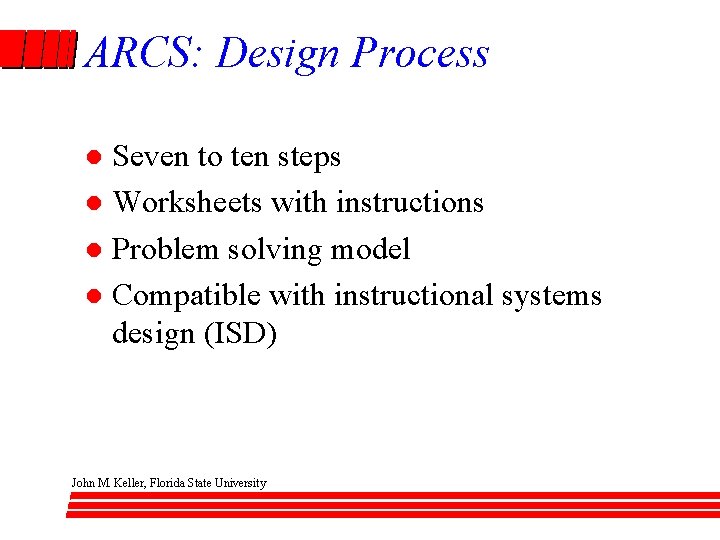
ARCS: Design Process Seven to ten steps l Worksheets with instructions l Problem solving model l Compatible with instructional systems design (ISD) l John M. Keller, Florida State University
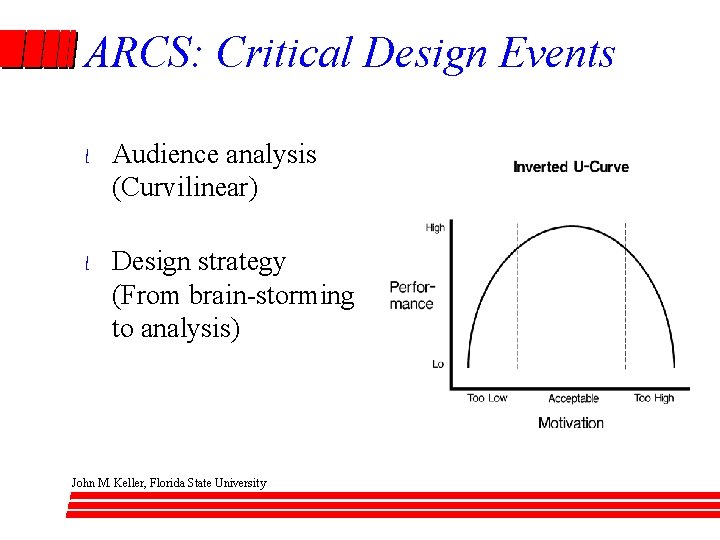
ARCS: Critical Design Events l Audience analysis (Curvilinear) l Design strategy (From brain-storming to analysis) John M. Keller, Florida State University
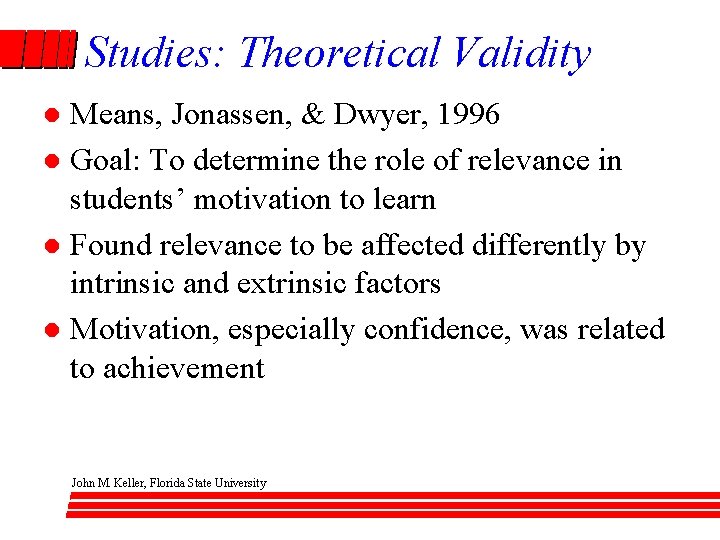
Studies: Theoretical Validity Means, Jonassen, & Dwyer, 1996 l Goal: To determine the role of relevance in students’ motivation to learn l Found relevance to be affected differently by intrinsic and extrinsic factors l Motivation, especially confidence, was related to achievement l John M. Keller, Florida State University
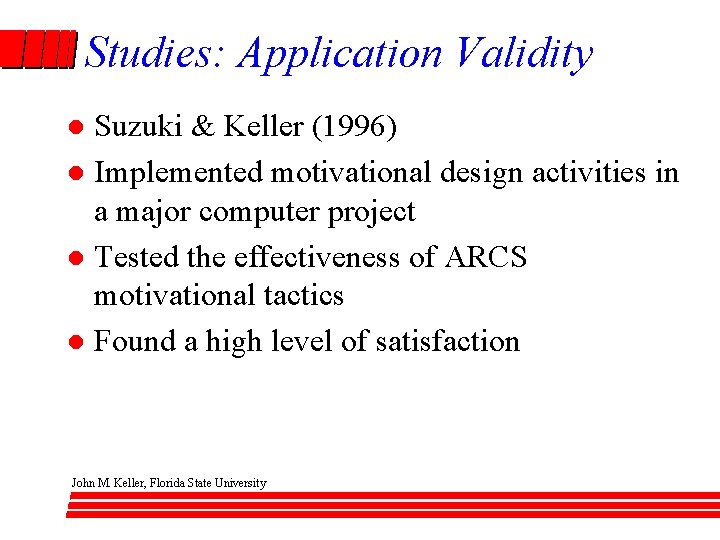
Studies: Application Validity Suzuki & Keller (1996) l Implemented motivational design activities in a major computer project l Tested the effectiveness of ARCS motivational tactics l Found a high level of satisfaction l John M. Keller, Florida State University
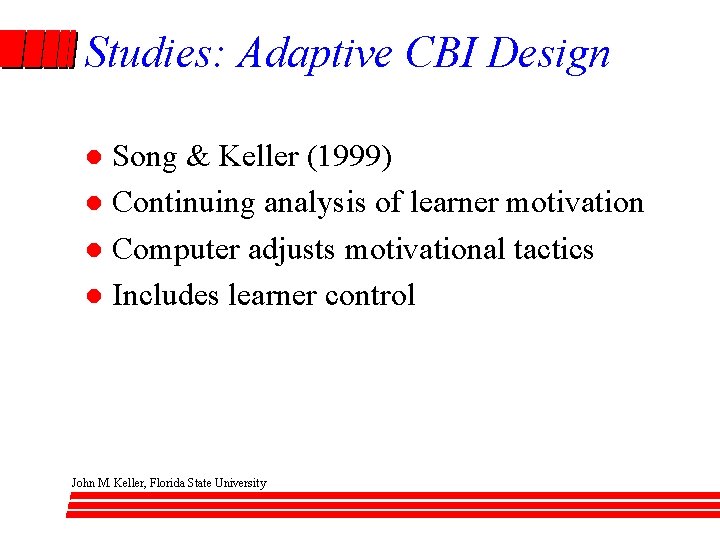
Studies: Adaptive CBI Design Song & Keller (1999) l Continuing analysis of learner motivation l Computer adjusts motivational tactics l Includes learner control l John M. Keller, Florida State University
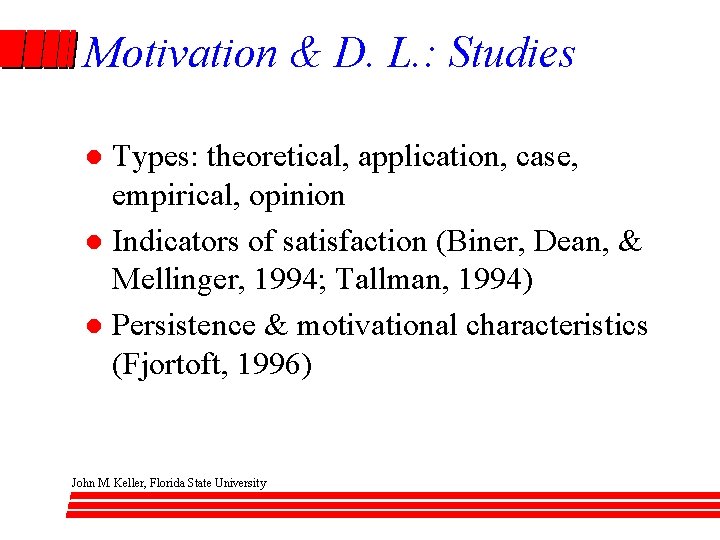
Motivation & D. L. : Studies Types: theoretical, application, case, empirical, opinion l Indicators of satisfaction (Biner, Dean, & Mellinger, 1994; Tallman, 1994) l Persistence & motivational characteristics (Fjortoft, 1996) l John M. Keller, Florida State University
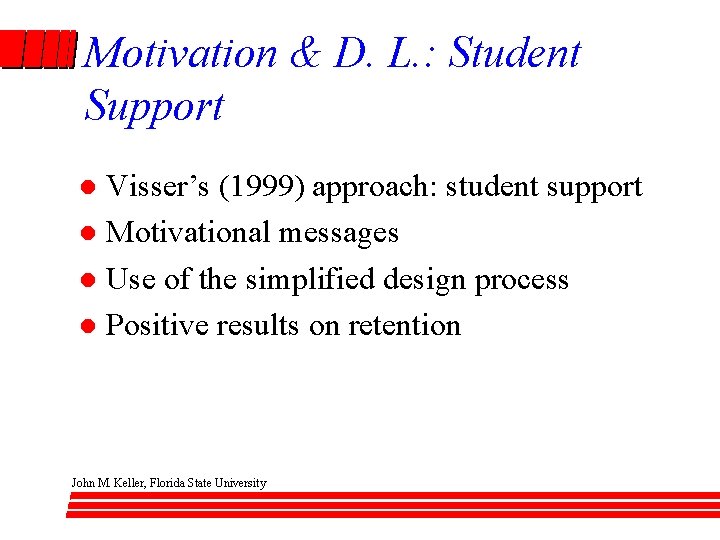
Motivation & D. L. : Student Support Visser’s (1999) approach: student support l Motivational messages l Use of the simplified design process l Positive results on retention l John M. Keller, Florida State University
Summary l Problem Solving Approach l Wide Range of Application l Still Evolving John M. Keller, Florida State University