
Applying Starch Grain Residue Analysis to Reconstruct Past

- Slides: 22
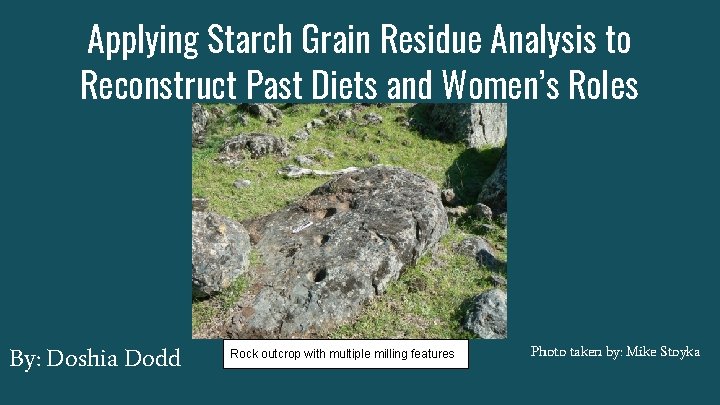
Applying Starch Grain Residue Analysis to Reconstruct Past Diets and Women’s Roles By: Doshia Dodd Rock outcrop with multiple milling features Photo taken by: Mike Stoyka
Goals of This Research ● Figure out what plant-based material was processed in bedrock milling features at Saddleback Ranch in Yuba County, CA ● Create a starch grain comparative collection ○ To Identify starch grain residue ● Reconstruct past diet ● Get a better understand prehistoric gender roles ● Make recommendations to an existing interpretive plan https: //www. teacherspayteachers. com/Product/Prehistoric-Food-CLIPART-Set-Four-Gatherer-Grains
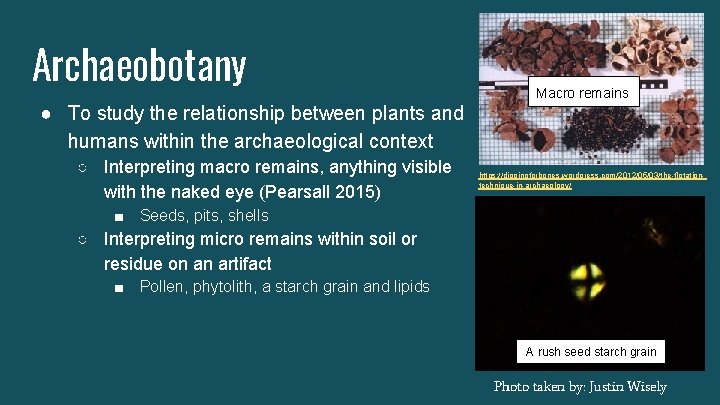
Archaeobotany Macro remains ● To study the relationship between plants and humans within the archaeological context ○ Interpreting macro remains, anything visible with the naked eye (Pearsall 2015) ■ https: //diggingforbones. wordpress. com/2012/05/03/the-flotationtechnique-in-archaeology/ Seeds, pits, shells ○ Interpreting micro remains within soil or residue on an artifact ■ Pollen, phytolith, a starch grain and lipids A rush seed starch grain Photo taken by: Justin Wisely
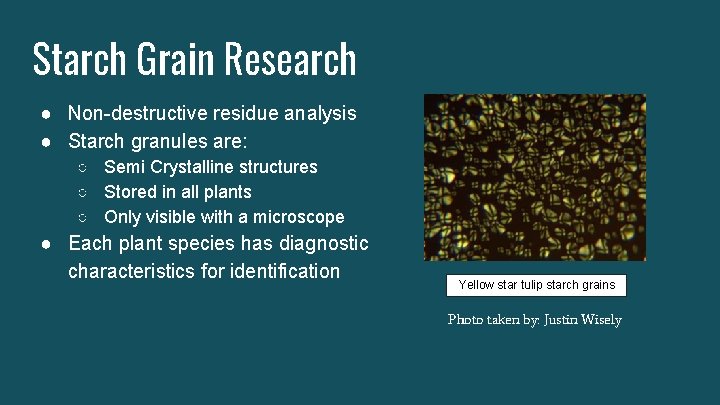
Starch Grain Research ● Non-destructive residue analysis ● Starch granules are: ○ Semi Crystalline structures ○ Stored in all plants ○ Only visible with a microscope ● Each plant species has diagnostic characteristics for identification Yellow star tulip starch grains Photo taken by: Justin Wisely
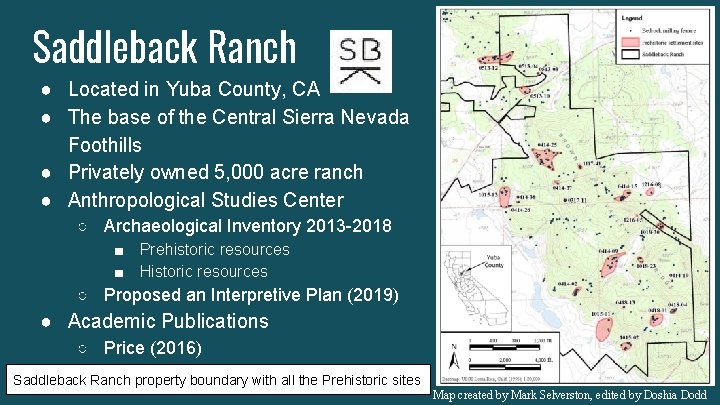
Saddleback Ranch ● Located in Yuba County, CA ● The base of the Central Sierra Nevada Foothills ● Privately owned 5, 000 acre ranch ● Anthropological Studies Center ○ Archaeological Inventory 2013 -2018 ■ ■ Prehistoric resources Historic resources ○ Proposed an Interpretive Plan (2019) ● Academic Publications ○ Price (2016) Saddleback Ranch property boundary with all the Prehistoric sites Map created by Mark Selverston, edited by Doshia Dodd
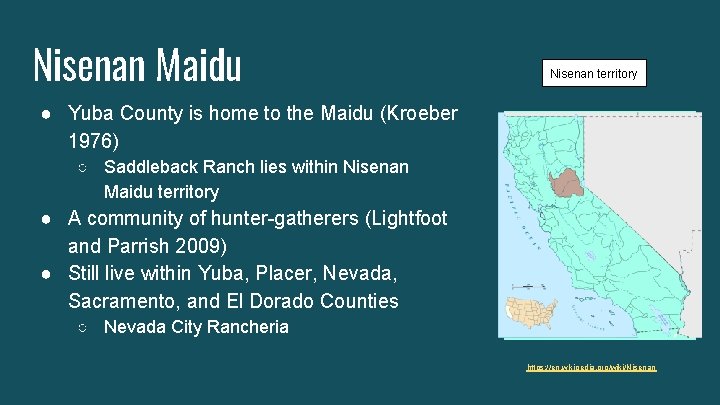
Nisenan Maidu Nisenan territory ● Yuba County is home to the Maidu (Kroeber 1976) ○ Saddleback Ranch lies within Nisenan Maidu territory ● A community of hunter-gatherers (Lightfoot and Parrish 2009) ● Still live within Yuba, Placer, Nevada, Sacramento, and El Dorado Counties ○ Nevada City Rancheria https: //en. wikipedia. org/wiki/Nisenan
Thesis Statement ● Assess what plant-based food and material the Nisenan women processed across their landscape by using starch grain residue analysis on bedrock milling features ● This data can provide direct insight into the Nisenan’s: https: //www. thoughtco. com/thesis-composition 1692546 ○ ○ Plant-based diet Past lifeways Assist in making inferences about gender roles Used to make recommendations for an existing interpretive plan
Literature Review ● Archaeologists and archaeobotanists have implemented starch grain residue analysis within four prevailing themes: ○ ○ New methodologies and ways to improve starch grain identification Reconstruction of past plant food diet Interpretation of past human behavior Gender roles and prehistoric milling tools
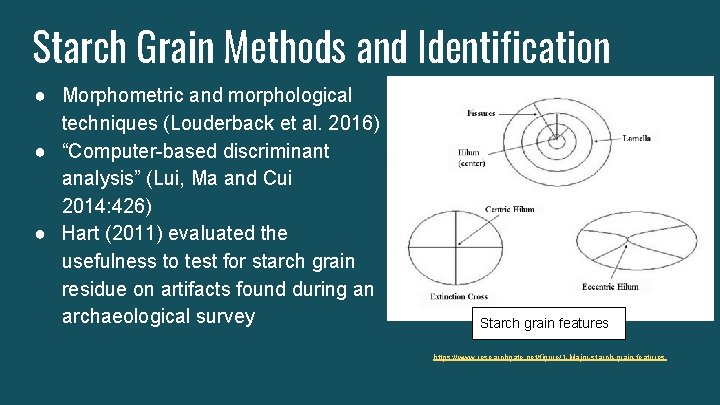
Starch Grain Methods and Identification ● Morphometric and morphological techniques (Louderback et al. 2016) ● “Computer-based discriminant analysis” (Lui, Ma and Cui 2014: 426) ● Hart (2011) evaluated the usefulness to test for starch grain residue on artifacts found during an archaeological survey Starch grain features https: //www. researchgate. net/figure/1 -Major-starch-grain-features
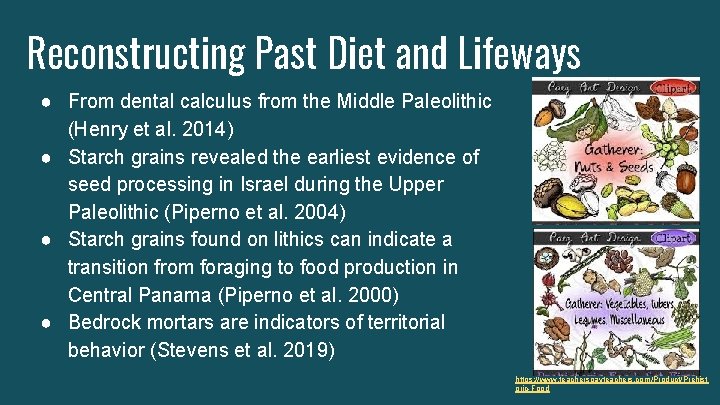
Reconstructing Past Diet and Lifeways ● From dental calculus from the Middle Paleolithic (Henry et al. 2014) ● Starch grains revealed the earliest evidence of seed processing in Israel during the Upper Paleolithic (Piperno et al. 2004) ● Starch grains found on lithics can indicate a transition from foraging to food production in Central Panama (Piperno et al. 2000) ● Bedrock mortars are indicators of territorial behavior (Stevens et al. 2019) https: //www. teacherspayteachers. com/Product/Prehist oric-Food
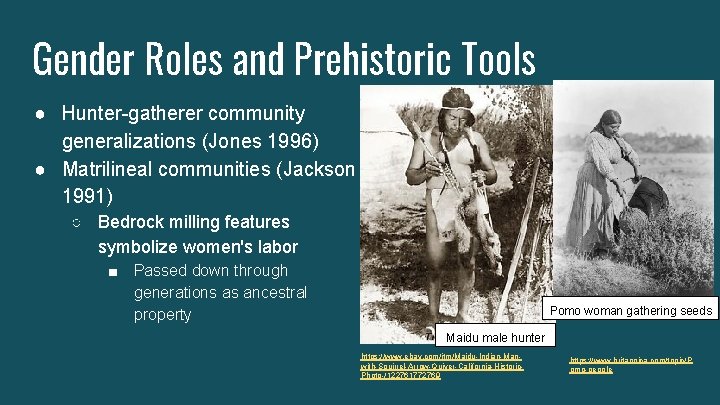
Gender Roles and Prehistoric Tools ● Hunter-gatherer community generalizations (Jones 1996) ● Matrilineal communities (Jackson 1991) ○ Bedrock milling features symbolize women's labor ■ Passed down through generations as ancestral property Pomo woman gathering seeds Maidu male hunter https: //www. ebay. com/itm/Maidu-Indian-Manwith-Squirrel-Arrow-Quiver-California-Historic. Photo-/122761772769 https: //www. britannica. com/topic/P omo-people
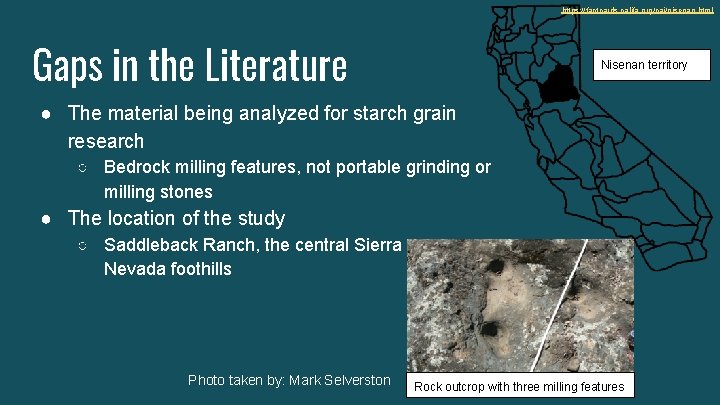
https: //factcards. califa. org/cai/nisenan. html Gaps in the Literature Nisenan territory ● The material being analyzed for starch grain research ○ Bedrock milling features, not portable grinding or milling stones ● The location of the study ○ Saddleback Ranch, the central Sierra Nevada foothills Photo taken by: Mark Selverston Rock outcrop with three milling features
Research Questions ● How can I identify a starch grain? ● What plant-based material did the Nisenan process across their landscape? ● Will a solo bedrock milling feature on an outcrop result in different starch than an outcrop with multiple milling features? ● What is the social significance behind milling? ● What kinds of additions can my research make to an existing interpretive plan? https: //www. skipprichard. com/ask-questions-toimprove-your-leadership/
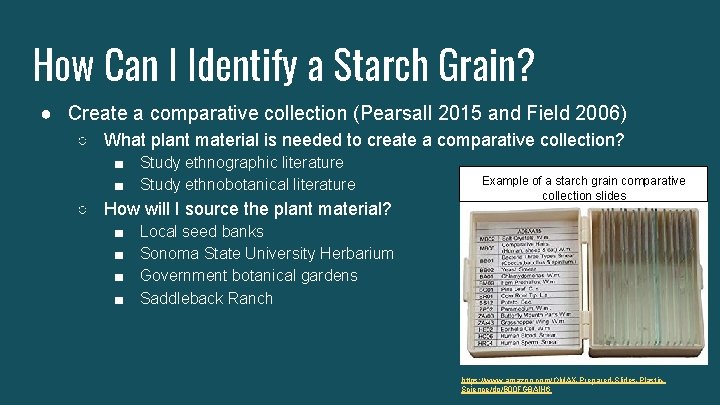
How Can I Identify a Starch Grain? ● Create a comparative collection (Pearsall 2015 and Field 2006) ○ What plant material is needed to create a comparative collection? ■ ■ Study ethnographic literature Study ethnobotanical literature ○ How will I source the plant material? ■ ■ Example of a starch grain comparative collection slides Local seed banks Sonoma State University Herbarium Government botanical gardens Saddleback Ranch https: //www. amazon. com/OMAX-Prepared-Slides-Plastic. Science/dp/B 00 FG 8 AIH 6
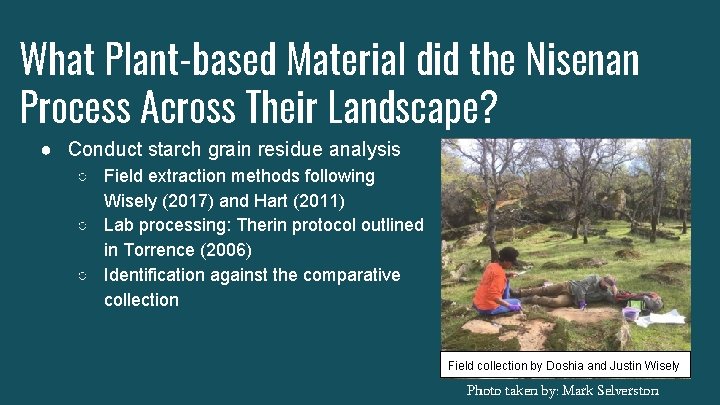
What Plant-based Material did the Nisenan Process Across Their Landscape? ● Conduct starch grain residue analysis ○ Field extraction methods following Wisely (2017) and Hart (2011) ○ Lab processing: Therin protocol outlined in Torrence (2006) ○ Identification against the comparative collection Field collection by Doshia and Justin Wisely Photo taken by: Mark Selverston
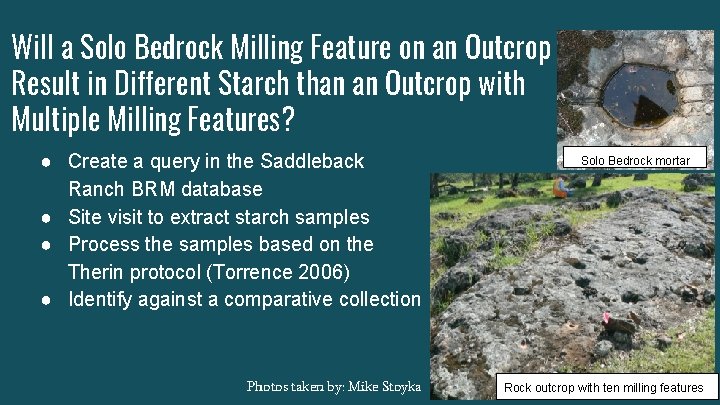
Will a Solo Bedrock Milling Feature on an Outcrop Result in Different Starch than an Outcrop with Multiple Milling Features? ● Create a query in the Saddleback Ranch BRM database ● Site visit to extract starch samples ● Process the samples based on the Therin protocol (Torrence 2006) ● Identify against a comparative collection Photos taken by: Mike Stoyka Solo Bedrock mortar Rock outcrop with ten milling features
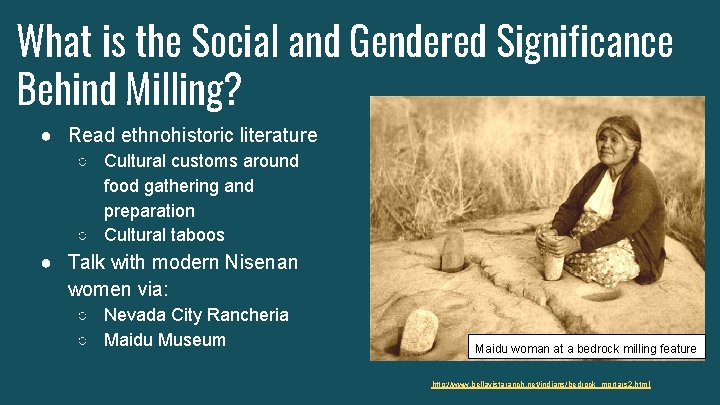
What is the Social and Gendered Significance Behind Milling? ● Read ethnohistoric literature ○ Cultural customs around food gathering and preparation ○ Cultural taboos ● Talk with modern Nisenan women via: ○ Nevada City Rancheria ○ Maidu Museum Maidu woman at a bedrock milling feature http: //www. bellavistaranch. net/indians/bedrock_mortars 2. html
What Kinds of Additions can my Research Make to an Existing Interpretive Plan? ● Read through the existing interpretive plan ○ Look for gaps ● Consult with modern Nisenan women ○ Nevada City Rancheria ○ Maidu Museum ■ Formulate additional interview questions
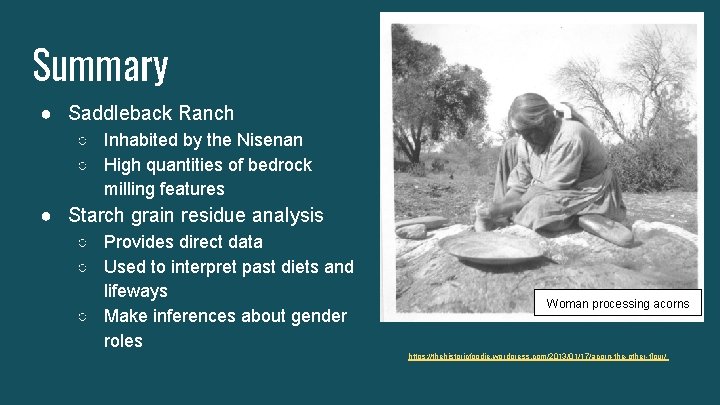
Summary ● Saddleback Ranch ○ Inhabited by the Nisenan ○ High quantities of bedrock milling features ● Starch grain residue analysis ○ Provides direct data ○ Used to interpret past diets and lifeways ○ Make inferences about gender roles Woman processing acorns https: //thehistoricfoodie. wordpress. com/2013/01/17/acorn-the-other-flour/
Significance ● Bring starch grain research to Saddleback Ranch ○ Questions posed by Price (2016) ● Identification of plant material is beneficial to: ○ California archaeologists ○ Archaeobotanists ○ Modern Maidu peoples ○ People interested in prehistoric foodways ● This data can be added to an existing interpretive plan ● It is important to understand women's roles in prehistory
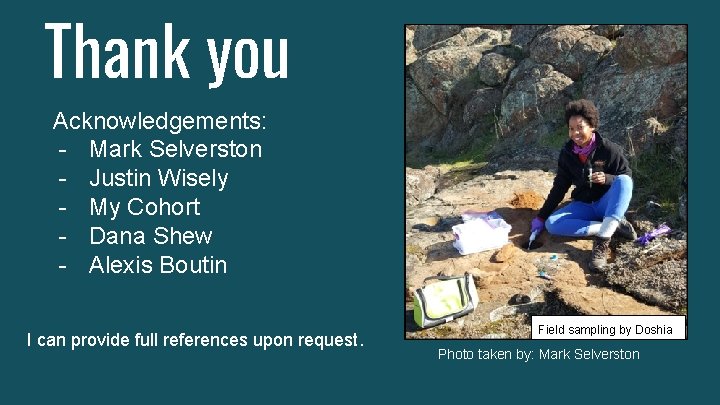
Thank you Acknowledgements: - Mark Selverston - Justin Wisely - My Cohort - Dana Shew - Alexis Boutin I can provide full references upon request. Field sampling by Doshia Photo taken by: Mark Selverston
References Cited Field, Judith 2006 Reference Collections. In Ancient Starch Research, edited by Robin Torrence and Huw Barton, pp. 95 -115. Left Coast Press Inc. , Walnut Creek, California. Hart, Thomas C. 2011 Evaluating the Usefulness of Phytoliths and Starch Grains Found on Survey Artifacts. Journal of Archaeological Science 38: 3244 -3253. Henry, Amanda G. , Alison S. Brooks, and Dolores Piperno 2014 Plant Food and the Dietary Ecology of Neanderthals and Early Modern Humans. Journal of Human Evolution 69: 44 -54. Jackson, Thomas L. 1991 Pounding Acorn: Women’s Production as Social and Economic Focus. In Engendering Archaeology Women and Prehistory, edited by Joan M. Gero and Margaret W. Conkey, pp. 301 -325. Basil Blackwell Inc. , Cambridge Massachusetts. Jones, Terry L. 1996 Mortars, Pestles, and the Division of Labor in Prehistoric California: A View From Big Sur. American Antiquity 61(2) 243 -264. Kroeber, A. L. 1976 Handbook of the Indians of California. Dove Publications Inc. , New York. Lightfoot, Kent G, and Otis Parrish 2009 California Indians and their Environment: an Introduction. University of California Press, Berkeley and Los Angeles, CA. Liu, Li, Sai Ma, and Jianxin Cui 2014 Identifying of Starch Granules Using a Two-Step Identification Method. Journal of Archaeological Science 52: 421 -427. Louderback, Lisbeth A. , Nicole M. Herzog, and Bruce M. Pavik 2016 A New Approach for Identifying Starch Granules of Wild Food Plants From Arid Western North America. Starch/ Stärke 68: 1 -7. Pearsall, Deborah M. 2015 Paleoethnobotany: A Handbook of Procedures. Academic Press, San Diego, California. Piperno, Dolores R. , Anthony J. Ranere, Irene Holst, and Patricia Hansell 2000 Starch Grains Reveal Early Root Crop Horticulture in the Panamanian Tropical Forest. Nature 407: 894 - 897. Price, David 2016 Niches in Bedrock: Towards Integrating Bedrock Mortars into a Niche Construction Framework. Master’s thesis, Department of Anthropology, Sonoma State University, Rohnert Park, California. Stevens, Nathan E. , Adrian R. Whitaker, and Jeffrey S. Rosenthal 2019 Bedrock Mortars as Indicators of Territorial Behavior in the Sierra Nevada. Quaternary International 518: 57 -68. Torrence, Robin 2006 Starch in Sediment. In Ancient Starch Research, edited by Robin Torrence and Huw Barton, pp. 145 -177. Left Coast Press Inc. , Walnut Creek, California. Wisely, Justin 2017 Starch Grain Analysis of Bedrock Milling Features: In Honor of Helen Mc. Carthy. Proceedings of the Society of California Archaeologist 31: 104 -113.