
Applying Social Constructivism in Education Through Social Media


- Slides: 36
Applying Social Constructivism in Education Through Social Media - “Friending Vygotsky: A Social Constructivist Pedagogy of Knowledge Building Through Classroom Social Media Use” - Kalen M. A. Churcher, Edward Downs and Doug Tewksbury Presentation by Brianna Chen
Vygotsky - Social Constructivism
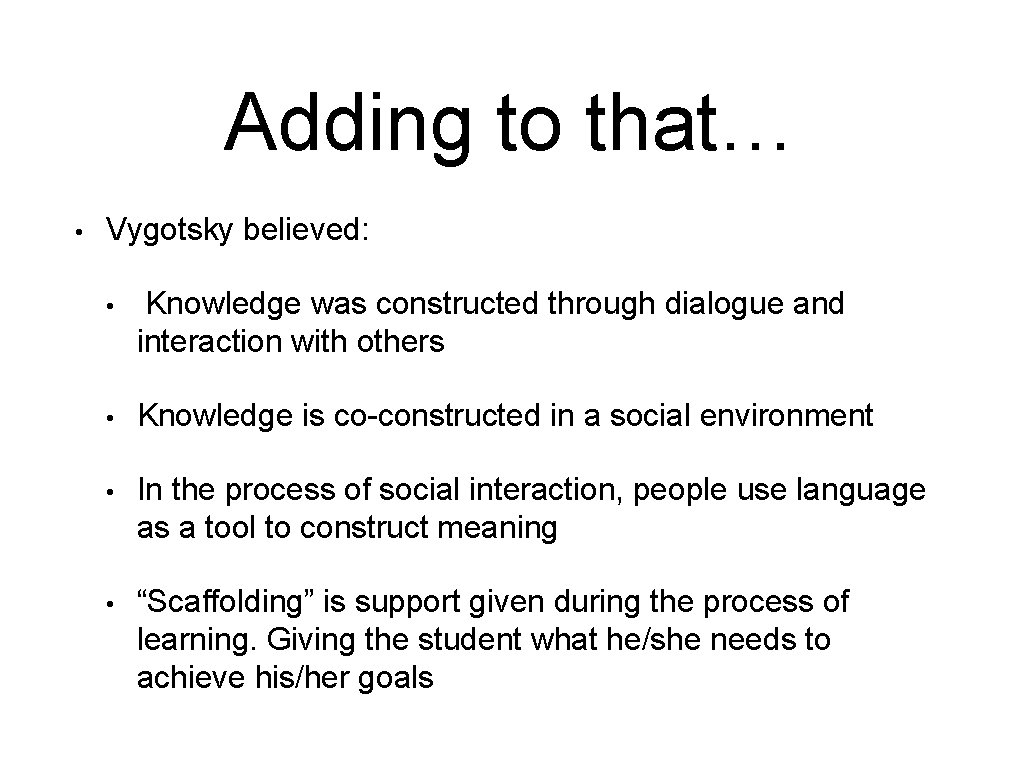
Adding to that… • Vygotsky believed: • Knowledge was constructed through dialogue and interaction with others • Knowledge is co-constructed in a social environment • In the process of social interaction, people use language as a tool to construct meaning • “Scaffolding” is support given during the process of learning. Giving the student what he/she needs to achieve his/her goals
“The role of the instructor is not solely to disseminate information, but rather to moderate the trajectory of user-generated content and community knowledge-sharing” –Wenger, E. , White, N. , and Smith, J. (2009) Digital Habitats: Stewarding Technology for Communities. CP Square Press
Why Social Media? • Social Media can: “facilitate collaboration, interaction and exchange of user-generated content” • Cost-effective • Popular • Integrated into society • No extra hardware needed other than computers • Popular sites: Facebook, Twitter, You. Tube, Four. Square etc. have variety of content and millions of subscribers
Pew Research Center Study 2010 • 93% of United States Teens (ages 12 - 17) and young adults (18 -29) are online • 73% of those online teens have used Social Networking Sites (SNS). (Figure has been climbing steadily since 2006) • 72% of the young adults have use SNS
Are there any other benefits/negatives that you can think of to using social media in the classroom?
To Incorporate Social Media: • A mediator must be present (Teacher) • Directions must be straightforward • Overall objectives clear • A underlying purpose towards improving education everpresent
Case Studies • Case Study #1 - Facebook as a Collaborative, Student-driven Platform • Case Study #2 - Wiki-based Collaborative Knowledge Building
Case Study #1 Facebook as a facilitator to online discourse
Case Study # 1 • Freshman-Level Communication Studies Course: Media Literacy • 36 Students - numerous majors at varying levels • Students learn to critically analyze media and deconstruct media messages • Students typically interested in material but become disengaged when discussions become paused to explain major-specific material or kept at an elementary level • Time constraints only permit a small percentage of students to contribute to course discussions
Case Study # 1 - Terms • Professor created a Facebook(FB) page. In addition to regular class activities and homework, students were required to: • Respond to specific questions via FB that were posed during the class period • Engage in virtual discussions • Periodically post examples that best represented key topics and terms
Case Study #1 - Goals • G 1. Increased Participation among students • G 2. Ownership in not only course content, but also course design and structure • G 3. A shared learning experience where students were encouraged to learn from one another and about one another, the latter serving to increase the diversity of viewpoints • * These goals were not shared with students
Facebook • 500 million active users • Approximately half logging in daily • Professor chose this outlet under the assumption most if not all would be familiar with the platform and able to navigate with ease • All students had active Facebook accounts prior to entering the classroom
Student’s Reactions • Crossing social/educational boundaries? • How will this help my education? • Professor responded by allowing students to create the rules applicable to their work on the Facebook page while he/she acted as the facilitator
“While abbreviations, emoticons, etc. are OK to use on the Facebook page, they are NOT OK to use in class assignments, papers and exams. In anything other than Facebook, I (the professor) expect good grammar, spelling, word use and punctuation”
Survey Results • 30 out of 36 students completed a survey after the semester was over • 14 believed that had learned more from the class because of the participation on FB. 10 were unsure. • 27 believed they learned more about other’s opinions. 3 of those did not believe that knowledge increased because of FB. • 14 believed they participated more in the class overall. 11 unsure. 5 felt they did not.
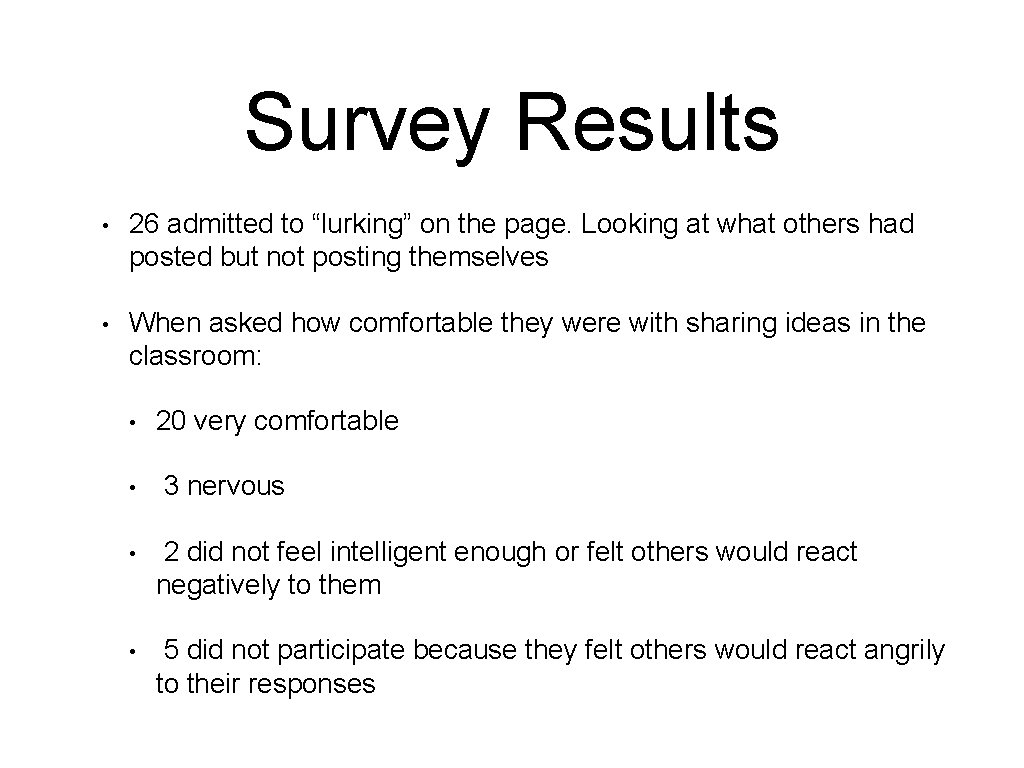
Survey Results • 26 admitted to “lurking” on the page. Looking at what others had posted but not posting themselves • When asked how comfortable they were with sharing ideas in the classroom: • • 20 very comfortable 3 nervous • 2 did not feel intelligent enough or felt others would react negatively to them • 5 did not participate because they felt others would react angrily to their responses
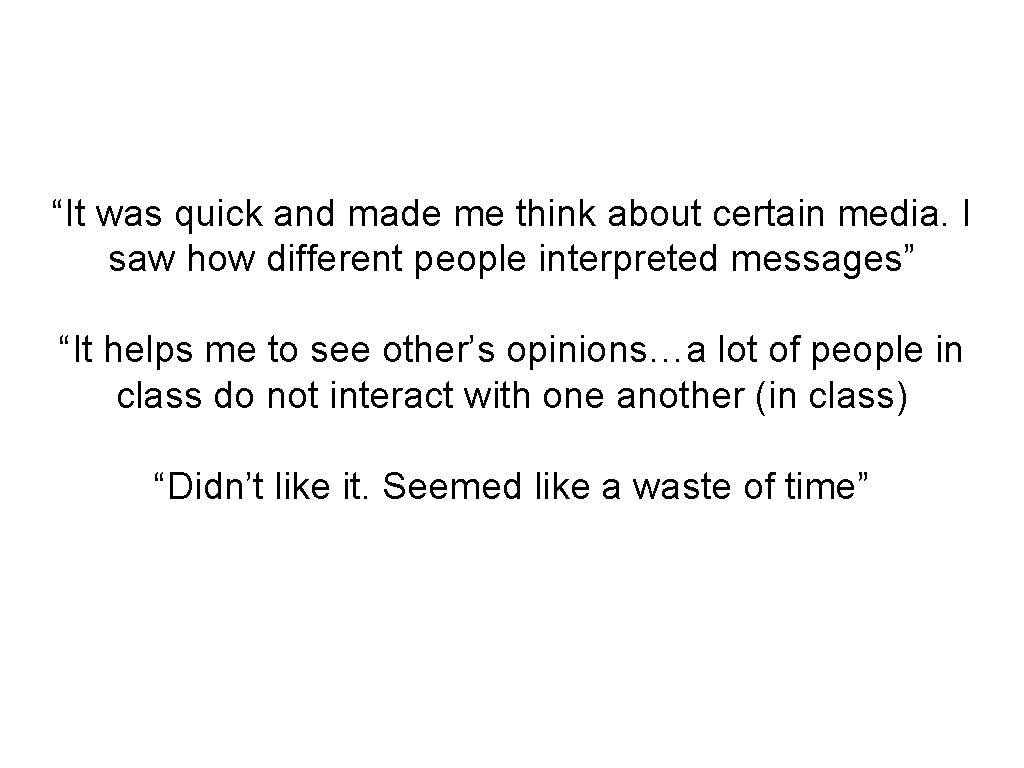
“It was quick and made me think about certain media. I saw how different people interpreted messages” “It helps me to see other’s opinions…a lot of people in class do not interact with one another (in class) “Didn’t like it. Seemed like a waste of time”
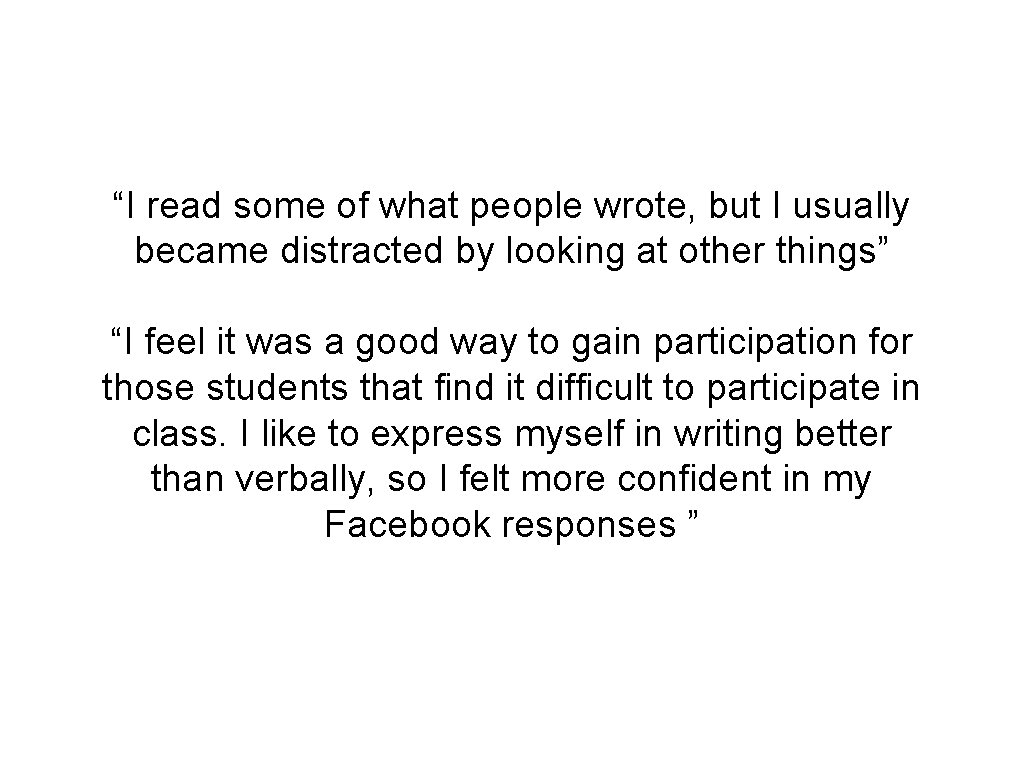
“I read some of what people wrote, but I usually became distracted by looking at other things” “I feel it was a good way to gain participation for those students that find it difficult to participate in class. I like to express myself in writing better than verbally, so I felt more confident in my Facebook responses ”
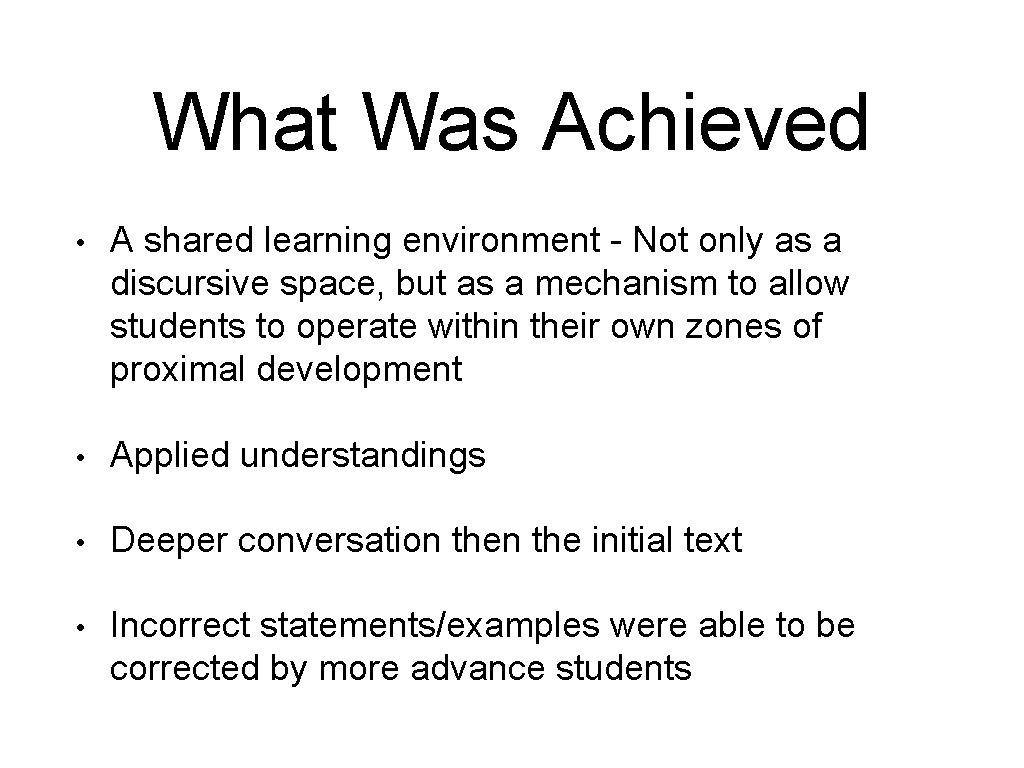
What Was Achieved • A shared learning environment - Not only as a discursive space, but as a mechanism to allow students to operate within their own zones of proximal development • Applied understandings • Deeper conversation the initial text • Incorrect statements/examples were able to be corrected by more advance students
Would you feel comfortable using a Facebook page as a participation requirement to your course?
Case Study #2 Wiki-based Collaborative Knowledge Building
Case Study #2 • Course: Communicating for Social Justice. • Required Introductory course for Communication majors at a small, liberal arts school • Mostly first and second year students • Evaluative Strategies: synchronous and asynchronous testing, writing activities, journaling, etc.
Case Study #2 • Wiki - a simplified, web-based architecture that creates a networked discursive community • Students controlled the information posted on the site, with an open-format of management guideline set forth by the instructor
Case Study #2 • A variety of applications and course direction can be derived by a Wiki-based platform • Professor experimented with many types of applications • This case study focuses on the application of usergenerated content to the creation of course exams
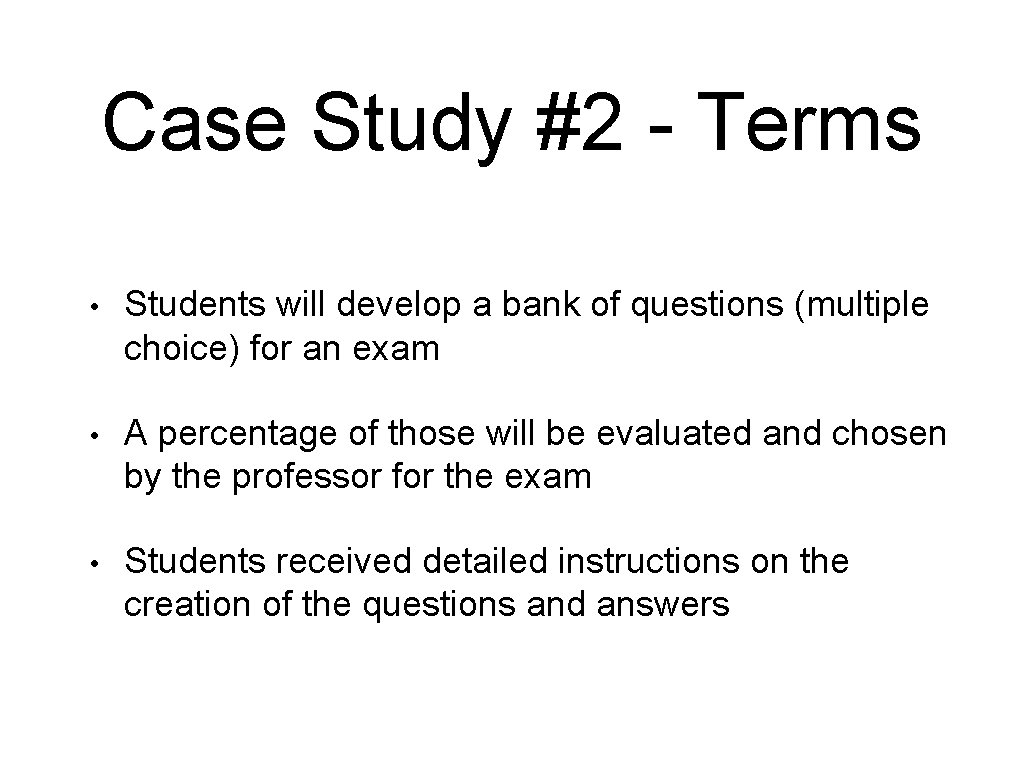
Case Study #2 - Terms • Students will develop a bank of questions (multiple choice) for an exam • A percentage of those will be evaluated and chosen by the professor for the exam • Students received detailed instructions on the creation of the questions and answers
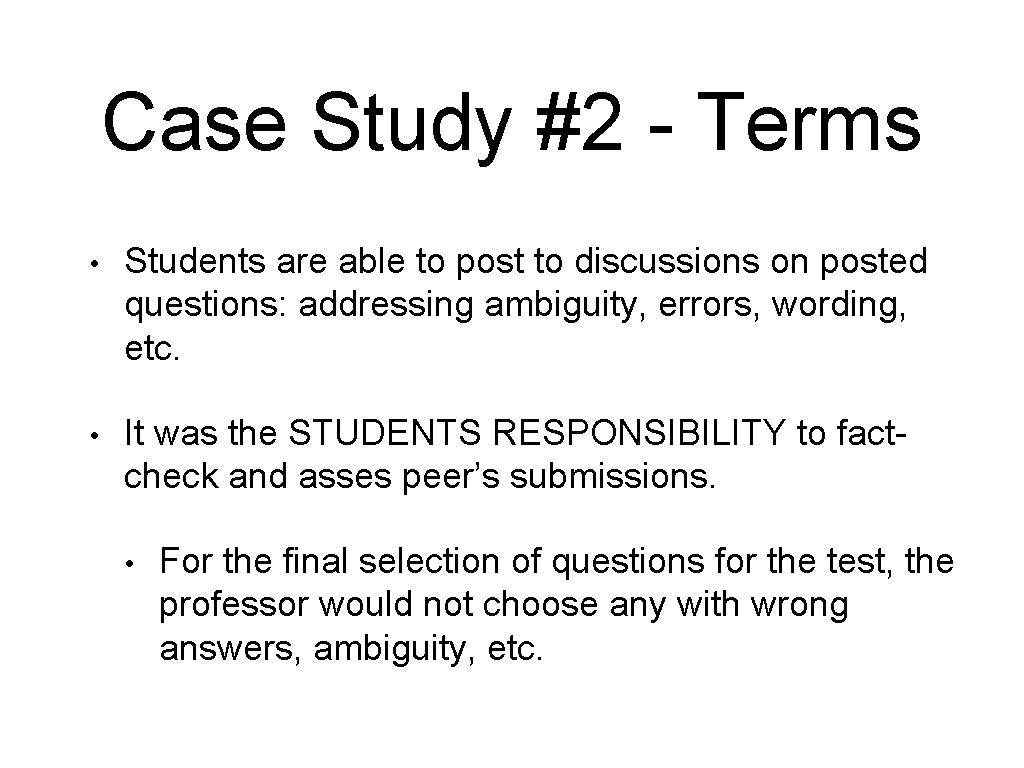
Case Study #2 - Terms • Students are able to post to discussions on posted questions: addressing ambiguity, errors, wording, etc. • It was the STUDENTS RESPONSIBILITY to factcheck and asses peer’s submissions. • For the final selection of questions for the test, the professor would not choose any with wrong answers, ambiguity, etc.
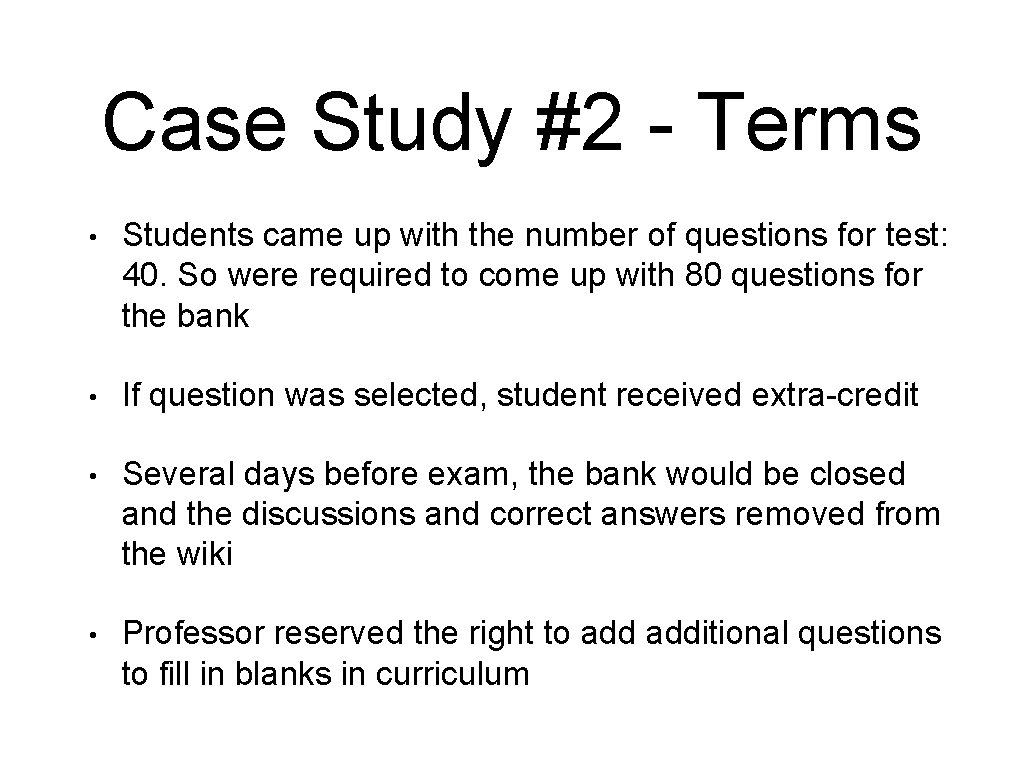
Case Study #2 - Terms • Students came up with the number of questions for test: 40. So were required to come up with 80 questions for the bank • If question was selected, student received extra-credit • Several days before exam, the bank would be closed and the discussions and correct answers removed from the wiki • Professor reserved the right to additional questions to fill in blanks in curriculum
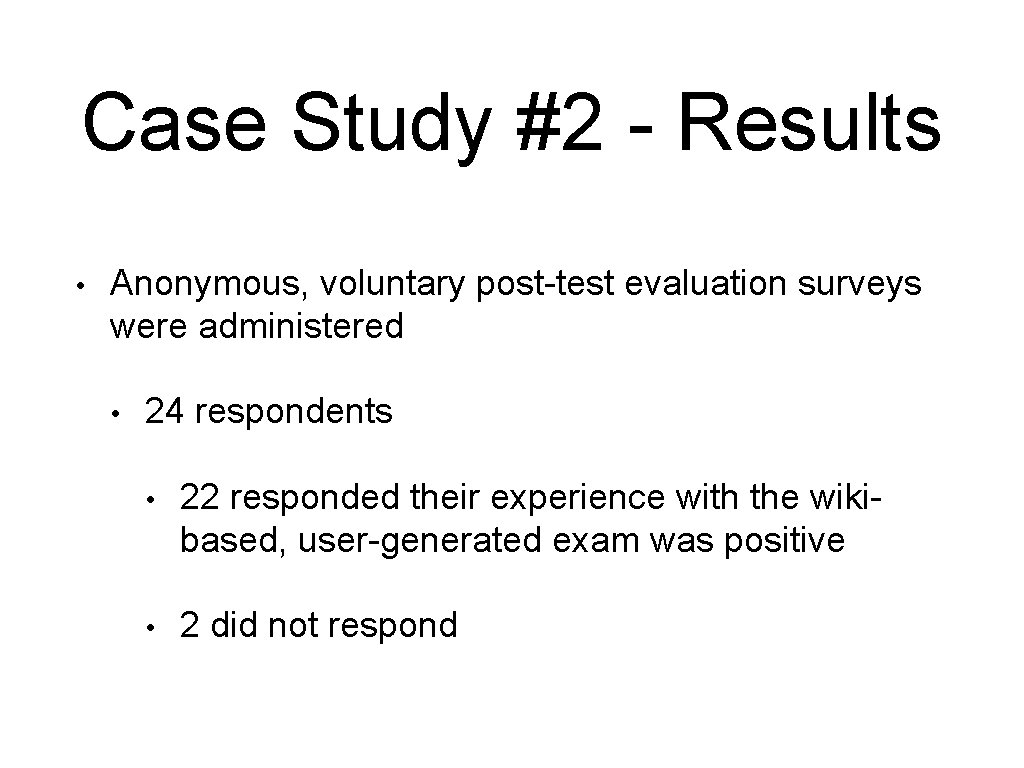
Case Study #2 - Results • Anonymous, voluntary post-test evaluation surveys were administered • 24 respondents • 22 responded their experience with the wikibased, user-generated exam was positive • 2 did not respond
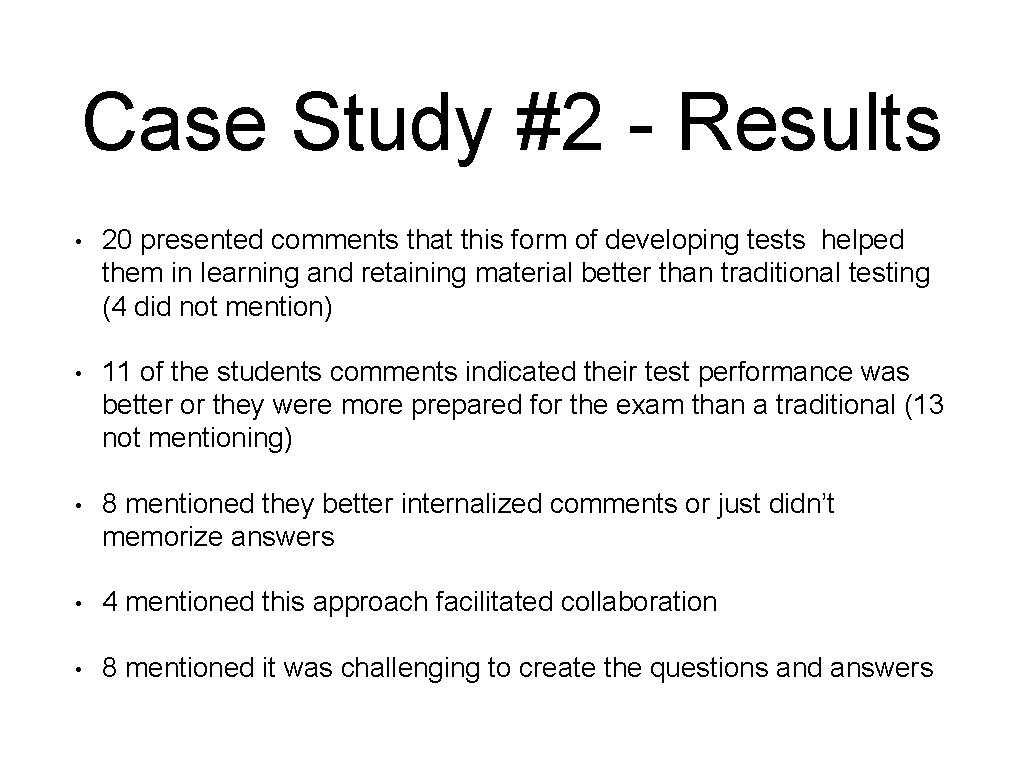
Case Study #2 - Results • 20 presented comments that this form of developing tests helped them in learning and retaining material better than traditional testing (4 did not mention) • 11 of the students comments indicated their test performance was better or they were more prepared for the exam than a traditional (13 not mentioning) • 8 mentioned they better internalized comments or just didn’t memorize answers • 4 mentioned this approach facilitated collaboration • 8 mentioned it was challenging to create the questions and answers
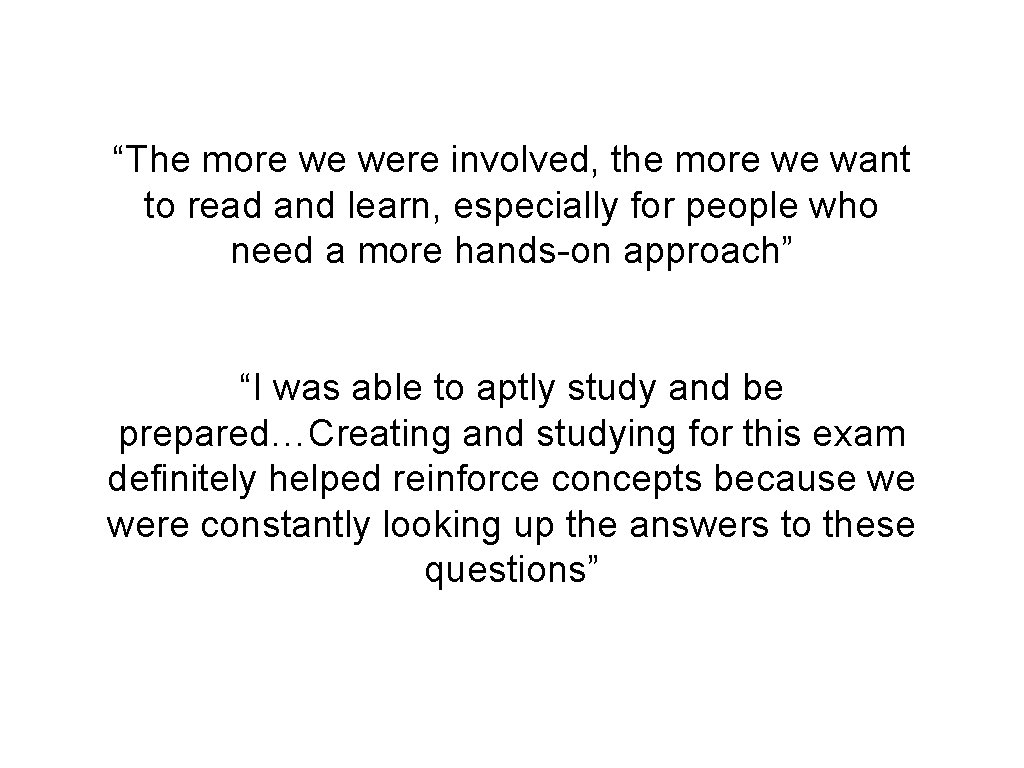
“The more we were involved, the more we want to read and learn, especially for people who need a more hands-on approach” “I was able to aptly study and be prepared…Creating and studying for this exam definitely helped reinforce concepts because we were constantly looking up the answers to these questions”
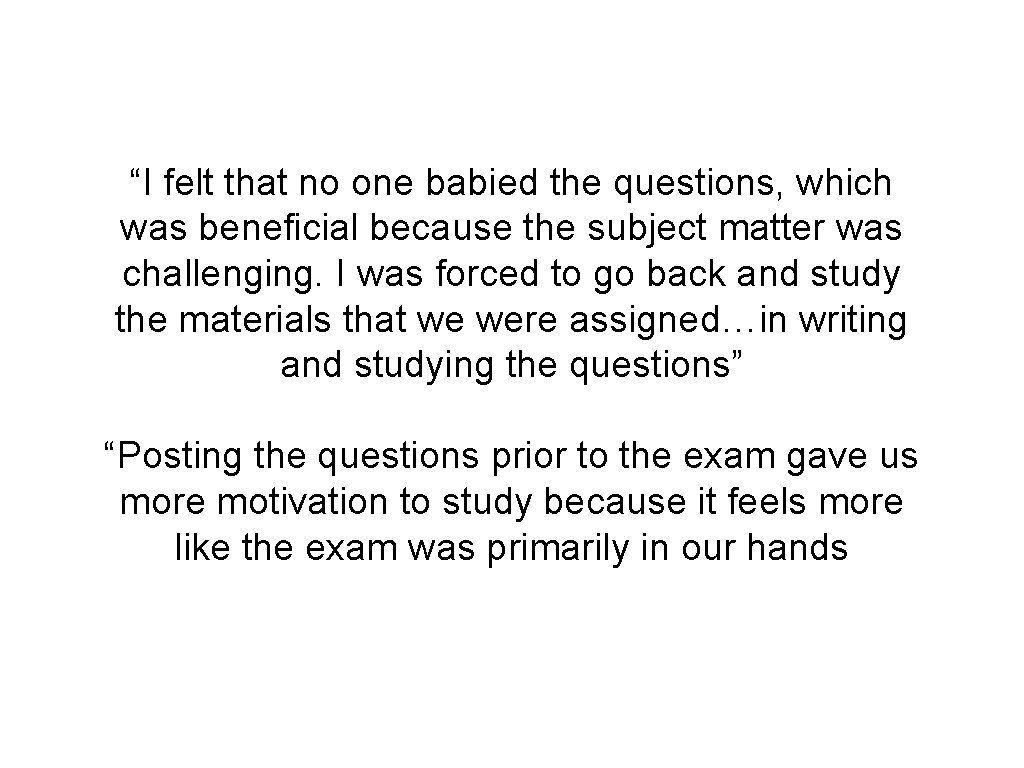
“I felt that no one babied the questions, which was beneficial because the subject matter was challenging. I was forced to go back and study the materials that we were assigned…in writing and studying the questions” “Posting the questions prior to the exam gave us more motivation to study because it feels more like the exam was primarily in our hands
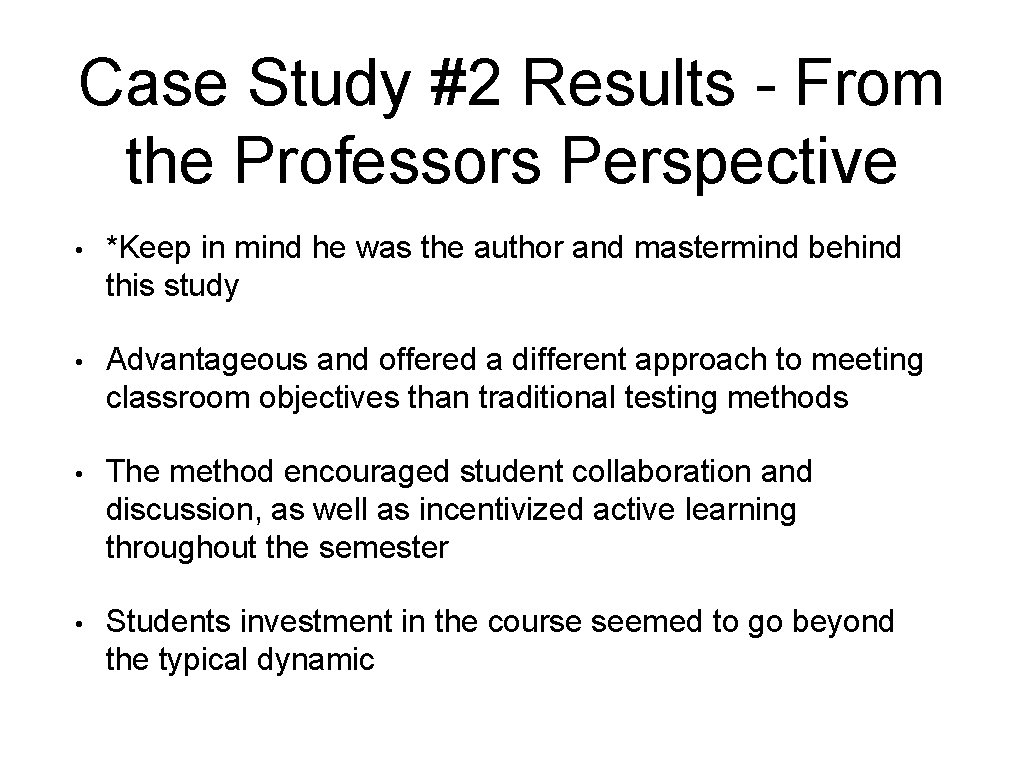
Case Study #2 Results - From the Professors Perspective • *Keep in mind he was the author and mastermind behind this study • Advantageous and offered a different approach to meeting classroom objectives than traditional testing methods • The method encouraged student collaboration and discussion, as well as incentivized active learning throughout the semester • Students investment in the course seemed to go beyond the typical dynamic
Keep in mind… • An instructor must be specific on the requirements of the SNS portion of the class: IE specific assignments, a written rubric etc. • A social networking component of the class must be a known platform to all students, or taught • Providing acceptable and non-acceptable examples of class discussions/behaviors on these sites would be useful • Should not be the only basis for a grade/learning environment in the classroom
Discussion • As a student, would you be nervous about how your discussion on a Facebook page would be evaluated? • As a teacher, are you comfortable reaching out to students on SNS, such as Facebook? • Other questions or thoughts?