
Applying Reduction Techniques to Software Functional Requirement Specifications

- Slides: 24
Applying Reduction Techniques to Software Functional Requirement Specifications (Use Case Maps Slicing) Jameleddine Hassine Rachida Dssouli Juergen Rilling Concordia University, Montreal, Canada Fourth SDL And MSC Workshop
Outline n Part I: Traditional Program Slicing ¨ ¨ n Part II: Use Case Maps ¨ ¨ n Introduction Program Slicing Example Generalized Slicing What is Use Case Maps Design Pyramid UCM Definition Example Part III: UCM Slicing Approach ¨ ¨ ¨ Need for Requirement Slicing Criteria UCM Slicing Limitations Conclusion & Future work 03 December 2020 2
Part I Traditional Program Slicing
Introduction n n Originally Introduced by Weiser in 1984 Program Reduction Technique (Simplification Technique) Studied primarily in the context of conventional programming languages (C, ADA, . . etc. ) Application of program slicing: ¨ Debugging ¨ Differencing ¨ Program Testing ¨ Program Maintenance (Comprehension, Analysis, …etc. ) ¨ Reverse Engineering ¨ Formal Verification 03 December 2020 4
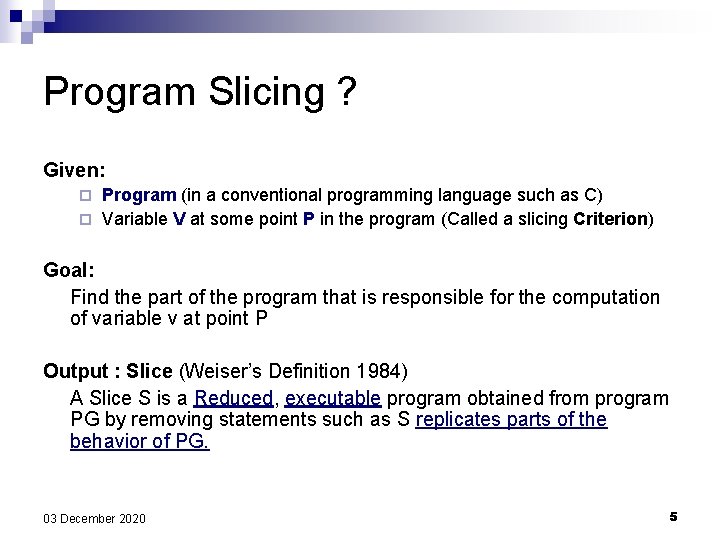
Program Slicing ? Given: Program (in a conventional programming language such as C) ¨ Variable V at some point P in the program (Called a slicing Criterion) ¨ Goal: Find the part of the program that is responsible for the computation of variable v at point P Output : Slice (Weiser’s Definition 1984) A Slice S is a Reduced, executable program obtained from program PG by removing statements such as S replicates parts of the behavior of PG. 03 December 2020 5
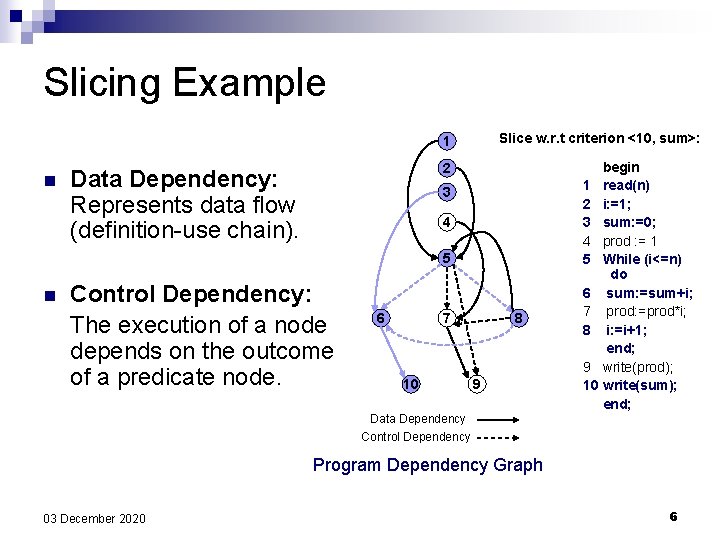
Slicing Example Slice w. r. t criterion <10, sum>: 1 n 2 Data Dependency: Represents data flow (definition-use chain). 3 4 5 n Control Dependency: The execution of a node depends on the outcome of a predicate node. 6 7 10 8 9 begin 1 read(n) 2 i: =1; 3 sum: =0; 4 prod : = 1 5 While (i<=n) do 6 sum: =sum+i; 7 prod: =prod*i; 8 i: =i+1; end; 9 write(prod); 10 write(sum); end; Data Dependency Control Dependency Program Dependency Graph 03 December 2020 6
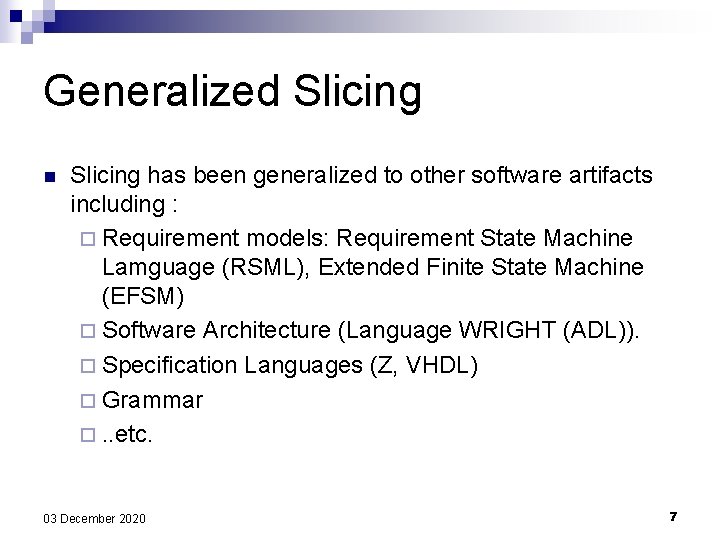
Generalized Slicing n Slicing has been generalized to other software artifacts including : ¨ Requirement models: Requirement State Machine Lamguage (RSML), Extended Finite State Machine (EFSM) ¨ Software Architecture (Language WRIGHT (ADL)). ¨ Specification Languages (Z, VHDL) ¨ Grammar ¨. . etc. 03 December 2020 7
Part II Use Case Maps
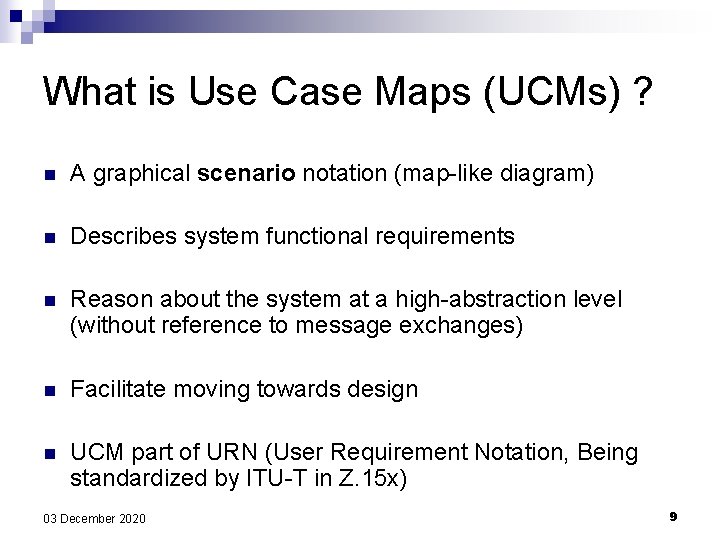
What is Use Case Maps (UCMs) ? n A graphical scenario notation (map-like diagram) n Describes system functional requirements n Reason about the system at a high-abstraction level (without reference to message exchanges) n Facilitate moving towards design n UCM part of URN (User Requirement Notation, Being standardized by ITU-T in Z. 15 x) 03 December 2020 9
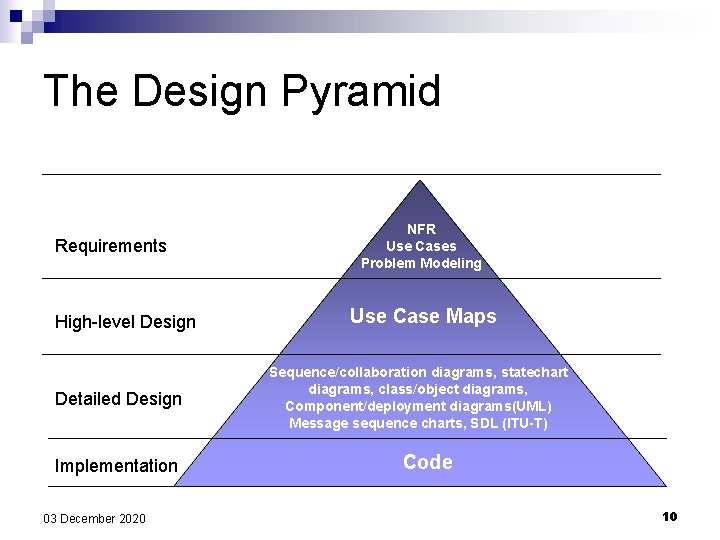
The Design Pyramid Requirements High-level Design Detailed Design Implementation 03 December 2020 NFR Use Cases Problem Modeling Use Case Maps Sequence/collaboration diagrams, statechart diagrams, class/object diagrams, Component/deployment diagrams(UML) Message sequence charts, SDL (ITU-T) Code 10
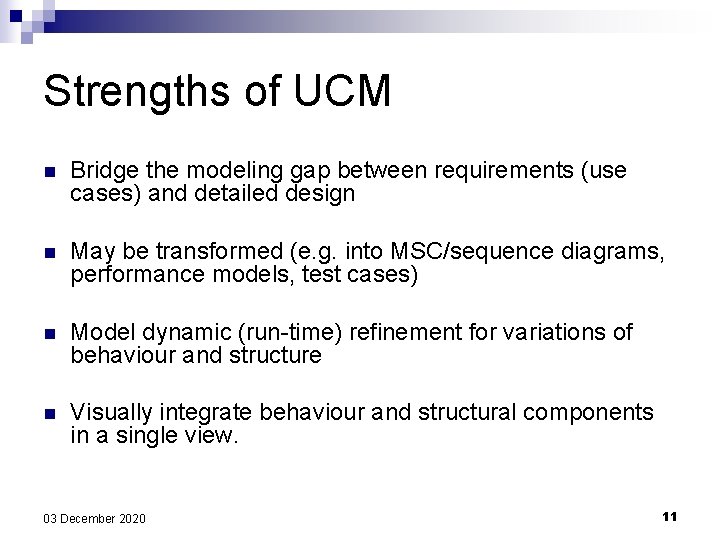
Strengths of UCM n Bridge the modeling gap between requirements (use cases) and detailed design n May be transformed (e. g. into MSC/sequence diagrams, performance models, test cases) n Model dynamic (run-time) refinement for variations of behaviour and structure n Visually integrate behaviour and structural components in a single view. 03 December 2020 11
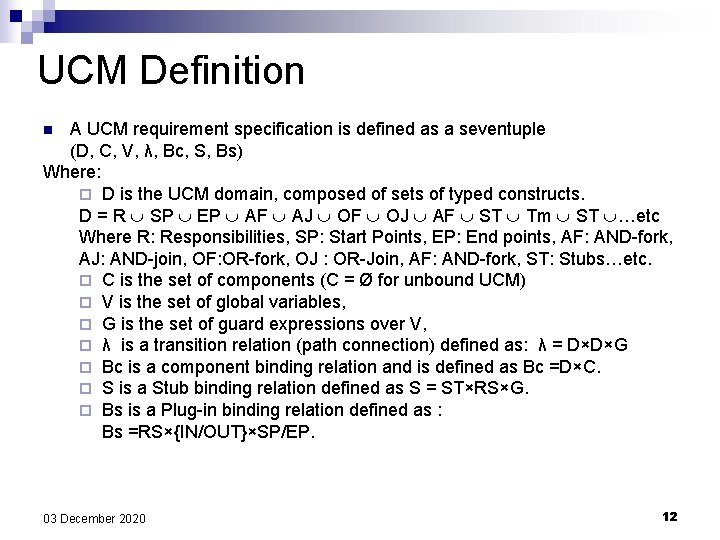
UCM Definition A UCM requirement specification is defined as a seventuple (D, C, V, λ, Bc, S, Bs) Where: ¨ D is the UCM domain, composed of sets of typed constructs. D = R SP EP AF AJ OF OJ AF ST Tm ST …etc Where R: Responsibilities, SP: Start Points, EP: End points, AF: AND-fork, AJ: AND-join, OF: OR-fork, OJ : OR-Join, AF: AND-fork, ST: Stubs…etc. ¨ C is the set of components (C = Ø for unbound UCM) ¨ V is the set of global variables, ¨ G is the set of guard expressions over V, ¨ λ is a transition relation (path connection) defined as: λ = D×D×G ¨ Bc is a component binding relation and is defined as Bc =D×C. ¨ S is a Stub binding relation defined as S = ST×RS×G. ¨ Bs is a Plug-in binding relation defined as : Bs =RS×{IN/OUT}×SP/EP. n 03 December 2020 12
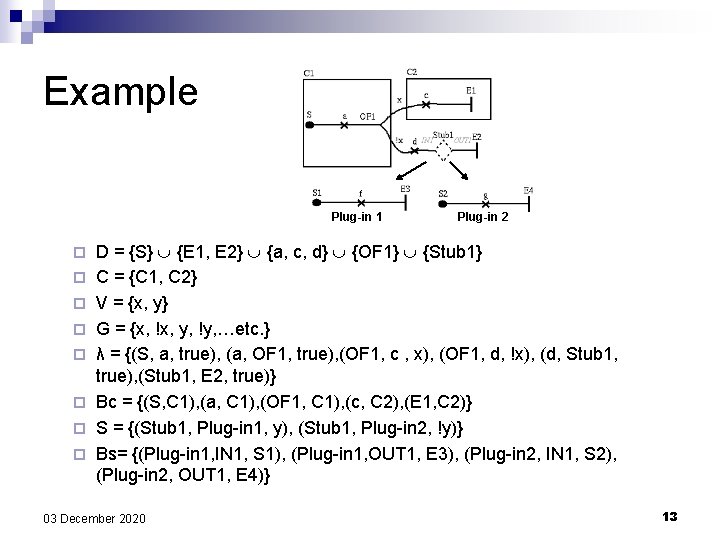
Example Plug-in 1 ¨ ¨ ¨ ¨ Plug-in 2 D = {S} {E 1, E 2} {a, c, d} {OF 1} {Stub 1} C = {C 1, C 2} V = {x, y} G = {x, !x, y, !y, …etc. } λ = {(S, a, true), (a, OF 1, true), (OF 1, c , x), (OF 1, d, !x), (d, Stub 1, true), (Stub 1, E 2, true)} Bc = {(S, C 1), (a, C 1), (OF 1, C 1), (c, C 2), (E 1, C 2)} S = {(Stub 1, Plug-in 1, y), (Stub 1, Plug-in 2, !y)} Bs= {(Plug-in 1, IN 1, S 1), (Plug-in 1, OUT 1, E 3), (Plug-in 2, IN 1, S 2), (Plug-in 2, OUT 1, E 4)} 03 December 2020 13
Part II UCM Slicing Approach
Need For Requirement Specification Slicing n Requirement Modeling and analysis represent a critical phase of complex system development n Requirements are evolving Complex and error-prone n Extract only just enough information to perform the task at hand (focus on some parts and ignore others) n Come up with Techniques and Tools to support requirement: ¨ Analysis ¨ Comprehension ¨ Testing ¨ Maintenance 03 December 2020 15
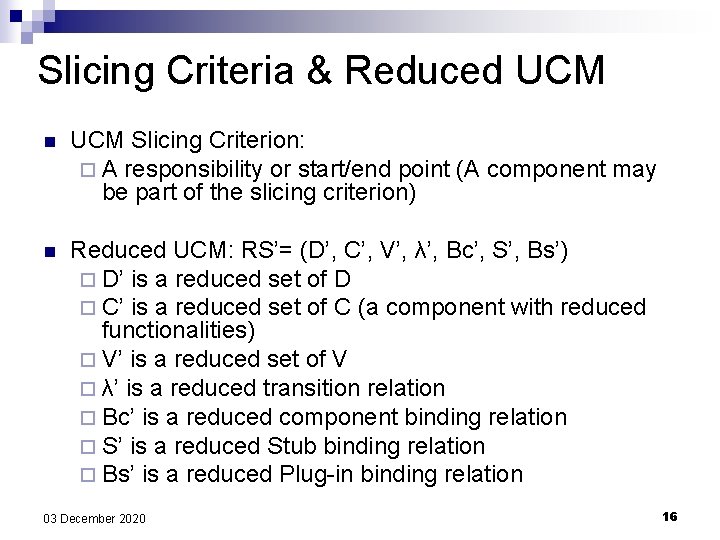
Slicing Criteria & Reduced UCM n UCM Slicing Criterion: ¨ A responsibility or start/end point (A component may be part of the slicing criterion) n Reduced UCM: RS’= (D’, C’, V’, λ’, Bc’, S’, Bs’) ¨ D’ is a reduced set of D ¨ C’ is a reduced set of C (a component with reduced functionalities) ¨ V’ is a reduced set of V ¨ λ’ is a reduced transition relation ¨ Bc’ is a reduced component binding relation ¨ S’ is a reduced Stub binding relation ¨ Bs’ is a reduced Plug-in binding relation 03 December 2020 16
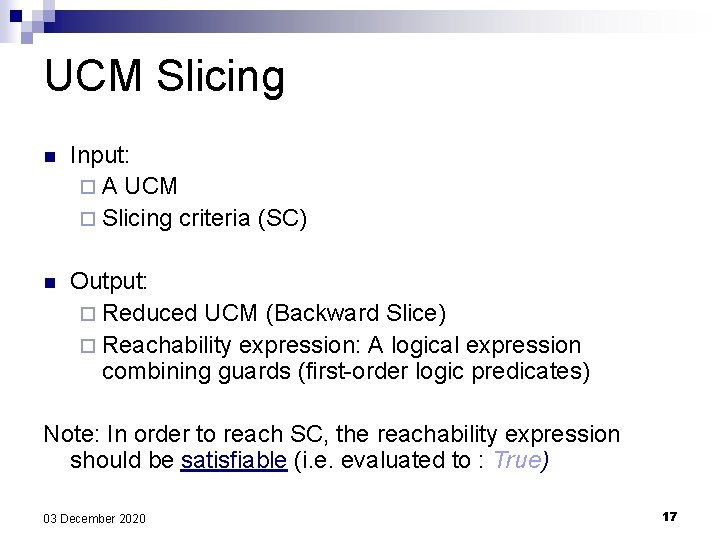
UCM Slicing n Input: ¨ A UCM ¨ Slicing criteria (SC) n Output: ¨ Reduced UCM (Backward Slice) ¨ Reachability expression: A logical expression combining guards (first-order logic predicates) Note: In order to reach SC, the reachability expression should be satisfiable (i. e. evaluated to : True) 03 December 2020 17
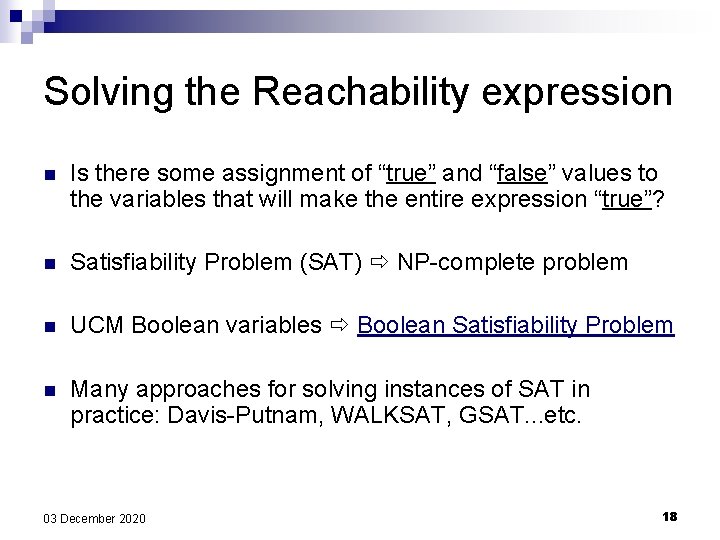
Solving the Reachability expression n Is there some assignment of “true” and “false” values to the variables that will make the entire expression “true”? n Satisfiability Problem (SAT) NP-complete problem n UCM Boolean variables Boolean Satisfiability Problem n Many approaches for solving instances of SAT in practice: Davis-Putnam, WALKSAT, GSAT. . . etc. 03 December 2020 18
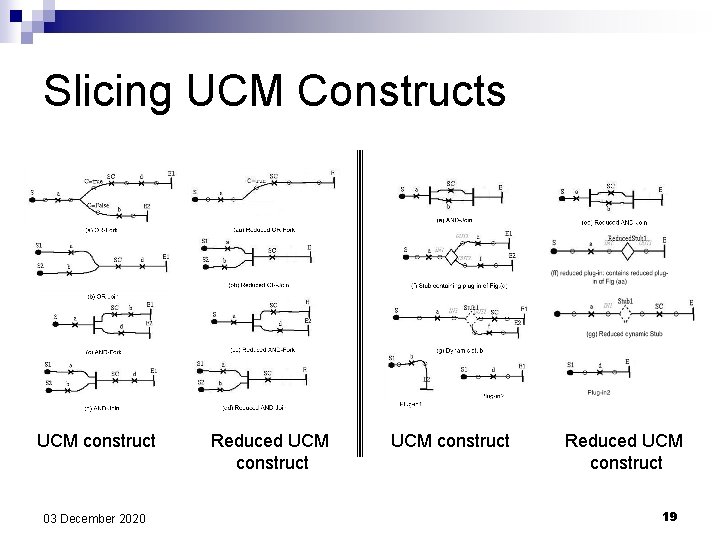
Slicing UCM Constructs UCM construct 03 December 2020 Reduced UCM construct 19
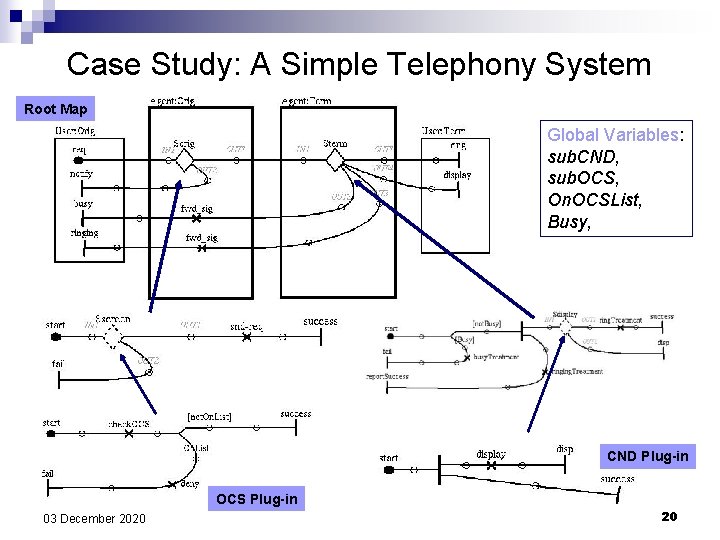
Case Study: A Simple Telephony System Root Map Global Variables: sub. CND, sub. OCS, On. OCSList, Busy, CND Plug-in OCS Plug-in 03 December 2020 20
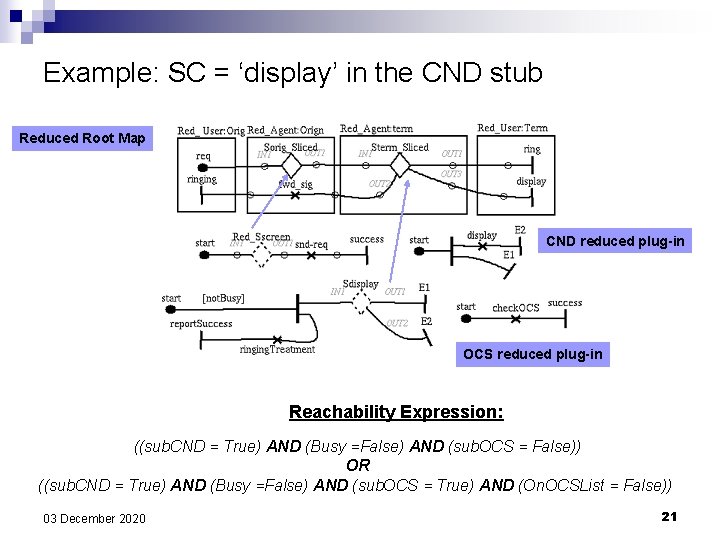
Example: SC = ‘display’ in the CND stub Reduced Root Map CND reduced plug-in OCS reduced plug-in Reachability Expression: ((sub. CND = True) AND (Busy =False) AND (sub. OCS = False)) OR ((sub. CND = True) AND (Busy =False) AND (sub. OCS = True) AND (On. OCSList = False)) 03 December 2020 21
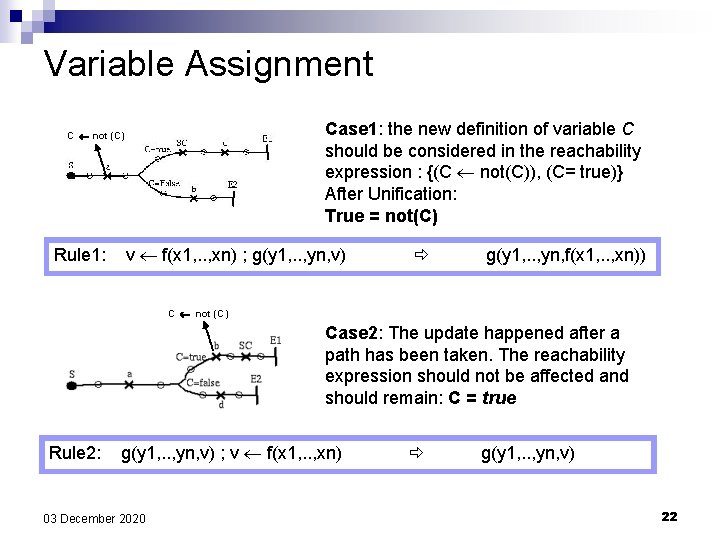
Variable Assignment Case 1: the new definition of variable C should be considered in the reachability expression : {(C not(C)), (C= true)} After Unification: True = not(C) C not (C) Rule 1: v f(x 1, . . , xn) ; g(y 1, . . , yn, v) g(y 1, . . , yn, f(x 1, . . , xn)) C not (C) Case 2: The update happened after a path has been taken. The reachability expression should not be affected and should remain: C = true Rule 2: g(y 1, . . , yn, v) ; v f(x 1, . . , xn) 03 December 2020 g(y 1, . . , yn, v) 22
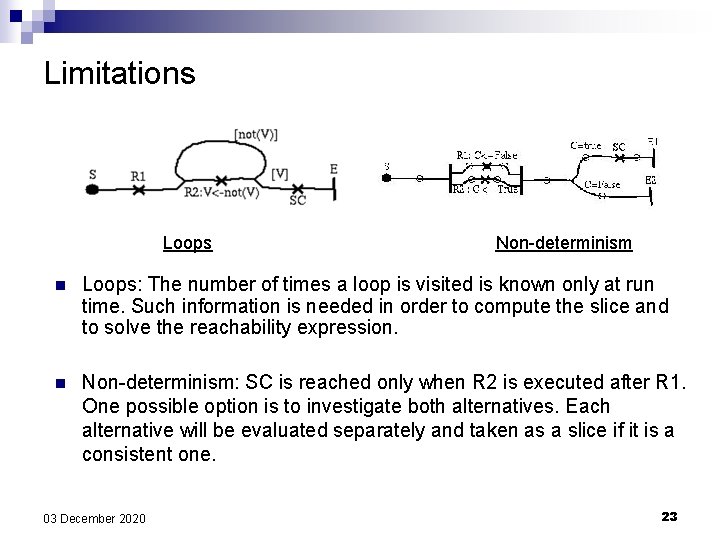
Limitations Loops Non-determinism n Loops: The number of times a loop is visited is known only at run time. Such information is needed in order to compute the slice and to solve the reachability expression. n Non-determinism: SC is reached only when R 2 is executed after R 1. One possible option is to investigate both alternatives. Each alternative will be evaluated separately and taken as a slice if it is a consistent one. 03 December 2020 23
Conclusion & Future work n Benefits Requirement understanding and analysis (Complexity reduction (search into a hierarchy of levels of abstraction (Stubs)), Feature extraction…etc. ) ¨ No state explosion, since UCM original semantics are preserved (Concurrency, non determinism) ¨ Testing (Regression testing, development testing) ¨ Maintenance (Corrective, perfective, Impact analysis…etc. ) ¨ n Future Work Derive test suites based on slicing (Selective testing, Regression testing) ¨ Dynamic Slicing (Reduces the size of a slice and simplifies the reachability expression) ¨ Impact Analysis (Combine backward and forward slicing) ¨ 03 December 2020 24