
Applying preservation metadata to repositories This section by
Applying preservation metadata to repositories This section by Steve Hitchcock Keep. It project Based on an earlier workshop presented for the Repositories Support Project (RSP), London, January 2008 For JISC Keep. It course on Digital Preservation Tools for Repository Managers Module 3, Primer on preservation workflow, formats and characterisation Westminster-Kingsway College, London, 2 March 2010
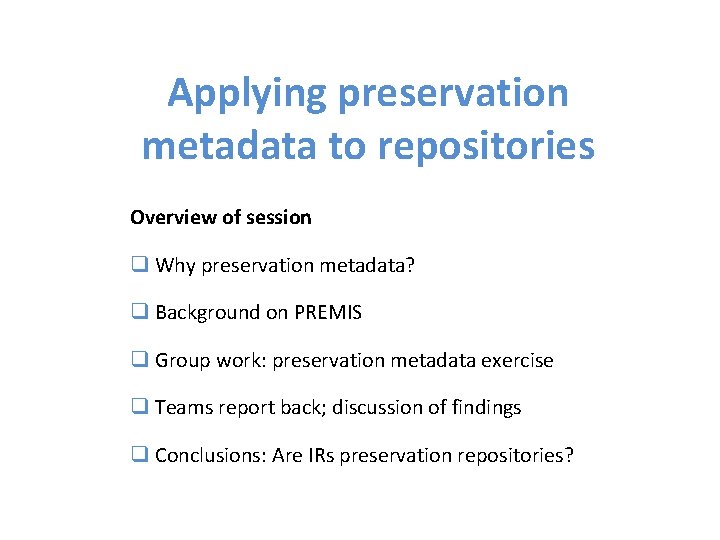
Applying preservation metadata to repositories Overview of session q Why preservation metadata? q Background on PREMIS q Group work: preservation metadata exercise q Teams report back; discussion of findings q Conclusions: Are IRs preservation repositories?
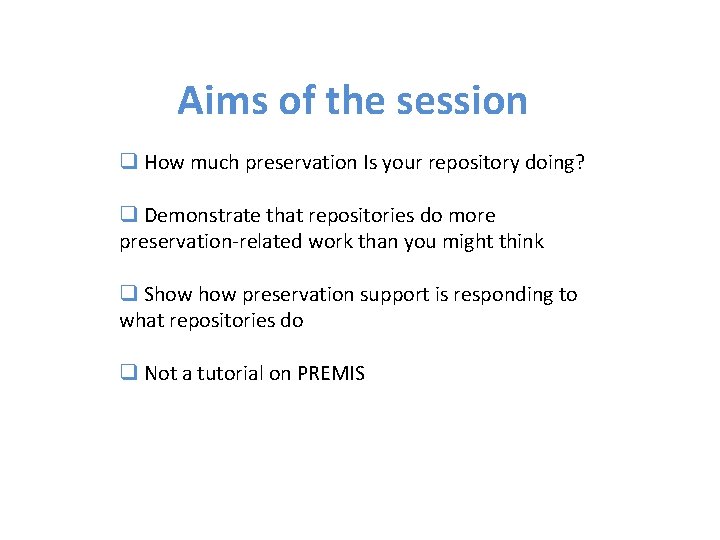
Aims of the session q How much preservation Is your repository doing? q Demonstrate that repositories do more preservation-related work than you might think q Show preservation support is responding to what repositories do q Not a tutorial on PREMIS

Preservation metadata Metadata designed for managing digital content over a long period of time is commonly referred to as preservation metadata, and typically informs, describes and records a range of activities concerned with preserving specific digital objects.
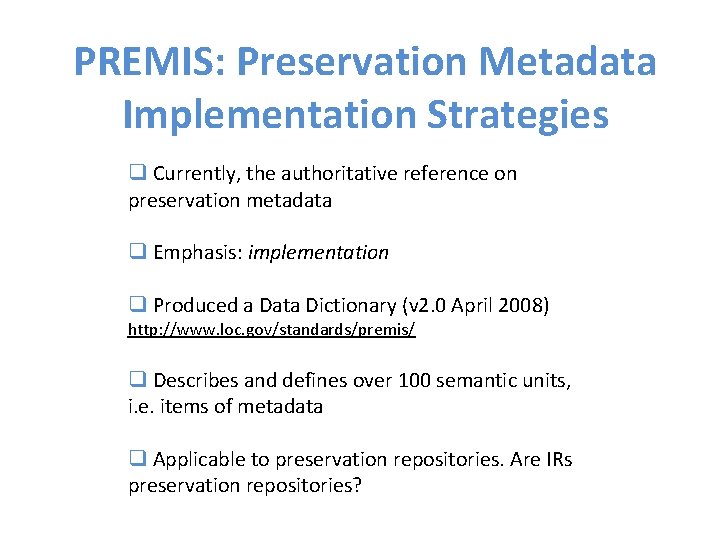
PREMIS: Preservation Metadata Implementation Strategies q Currently, the authoritative reference on preservation metadata q Emphasis: implementation q Produced a Data Dictionary (v 2. 0 April 2008) http: //www. loc. gov/standards/premis/ q Describes and defines over 100 semantic units, i. e. items of metadata q Applicable to preservation repositories. Are IRs preservation repositories?
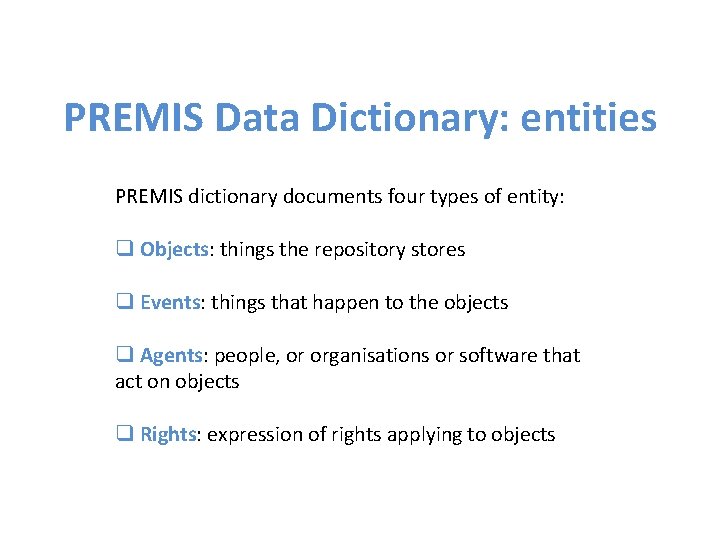
PREMIS Data Dictionary: entities PREMIS dictionary documents four types of entity: q Objects: things the repository stores q Events: things that happen to the objects q Agents: people, or organisations or software that act on objects q Rights: expression of rights applying to objects

PREMIS Data Dictionary: example entry This table taken from V 1. 0 (May 2005)
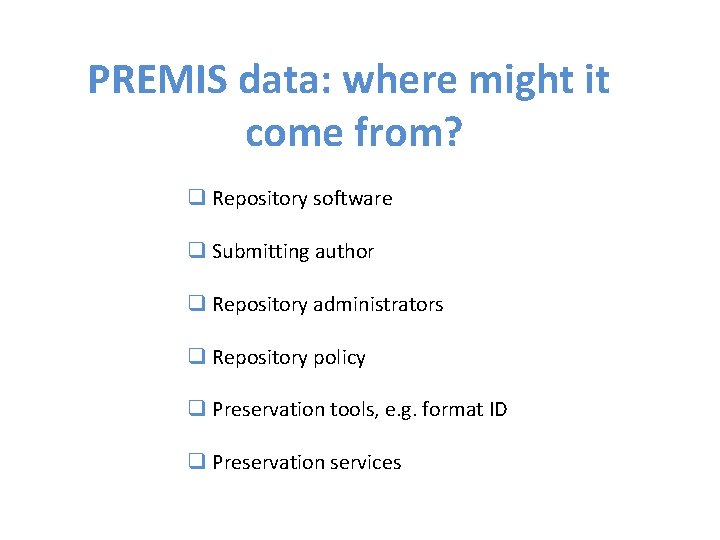
PREMIS data: where might it come from? q Repository software q Submitting author q Repository administrators q Repository policy q Preservation tools, e. g. format ID q Preservation services
Team task q You will be given a list of selected entries from the PREMIS Data Dictionary q The aim is to: q identify those entries that can serve your repositories, and q indicate where that information (metadata) is, or could be, generated Good luck with your team task!
Did we achieve the aims of the session? q This was not a test, not a survey, not a tutorial q It was about making preservation real for your repository q We often think of ‘preservation’ in an abstract sense, but repositories are already taking actions that affect preservation and contribute towards preservation results q You are probably doing more preservation than you think
Updating PREMIS It is likely that future revisions of PREMIS will accommodate the emerging Planets model of significant properties. Recording explicitly how a preservation action creates a new representation from an old one. This involves recording the relationship between: q the representations q the preservation action event q the agent used to perform the preservation action and details, such as q configuration parameters q significant characteristics which guided the choice of preservation action q measured differences between the source and the target (outcome information), etc.
- Slides: 11