
Applying New Technologies A Technical Communication Translation Case
- Slides: 26
Applying New Technologies: A Technical Communication & Translation Case Study in Multilateral International Collaboration Optimale — Rennes, France — 2013
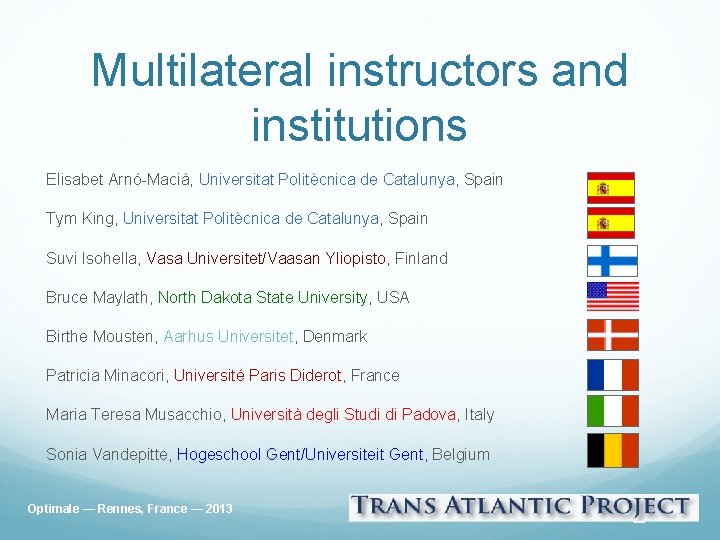
Multilateral instructors and institutions Elisabet Arnó-Macià, Universitat Politècnica de Catalunya, Spain Tym King, Universitat Politècnica de Catalunya, Spain Suvi Isohella, Vasa Universitet/Vaasan Yliopisto, Finland Bruce Maylath, North Dakota State University, USA Birthe Mousten, Aarhus Universitet, Denmark Patricia Minacori, Université Paris Diderot, France Maria Teresa Musacchio, Università degli Studi di Padova, Italy Sonia Vandepitte, Hogeschool Gent/Universiteit Gent, Belgium Optimale — Rennes, France — 2013
Multilateral instructors and institutions Elisabet Arnó-Macià, Universitat Politècnica de Catalunya, Spain Tym King, Universitat Politècnica de Catalunya, Spain Suvi Isohella, Vasa Universitet/Vaasan Yliopisto, Finland Bruce Maylath, North Dakota State University, USA Birthe Mousten, Aarhus Universitet, Denmark Patricia Minacori, Université Paris Diderot, France Maria Teresa Musacchio, Università degli Studi di Padova, Italy Sonia Vandepitte, Hogeschool Gent/Universiteit Gent, Belgium Optimale — Rennes, France — 2013
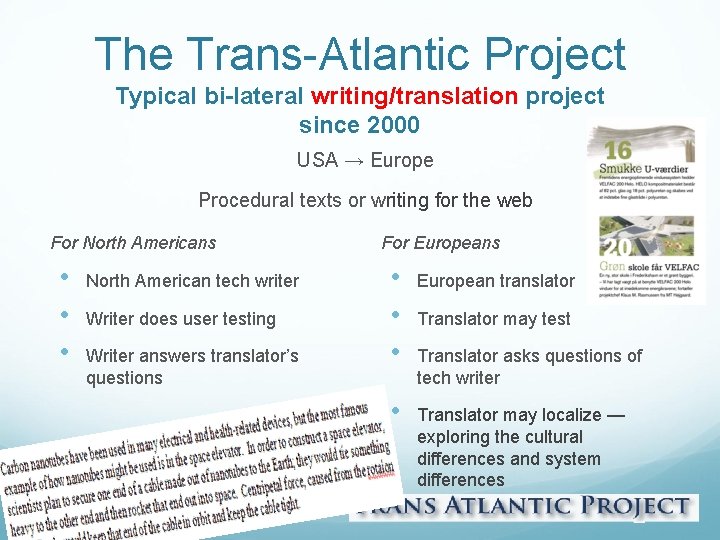
The Trans-Atlantic Project Typical bi-lateral writing/translation project since 2000 USA → Europe Procedural texts or writing for the web For North Americans • • • North American tech writer Writer does user testing Writer answers translator’s questions For Europeans • • Optimale — Rennes, France — 2013 European translator Translator may test Translator asks questions of tech writer Translator may localize — exploring the cultural differences and system differences
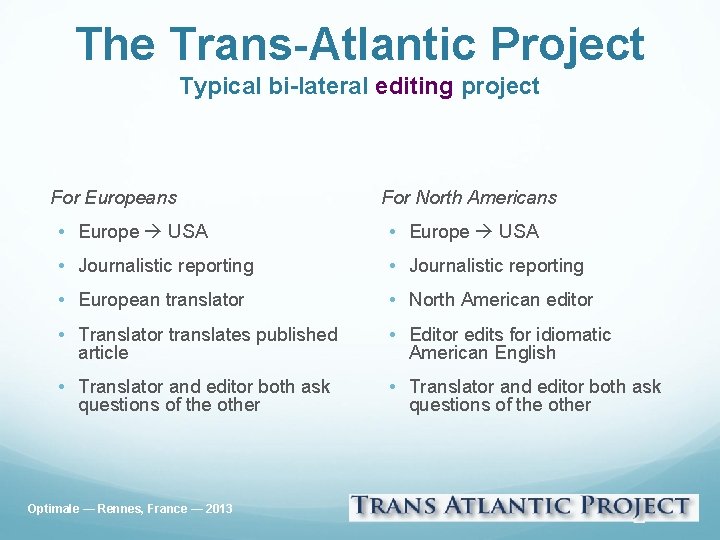
The Trans-Atlantic Project Typical bi-lateral editing project For Europeans For North Americans • Europe USA • Journalistic reporting • European translator • North American editor • Translator translates published article • Editor edits for idiomatic American English • Translator and editor both ask questions of the other Optimale — Rennes, France — 2013
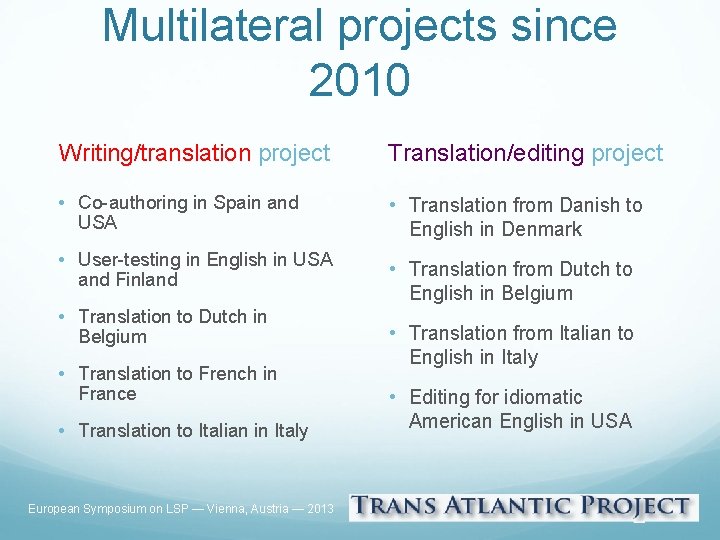
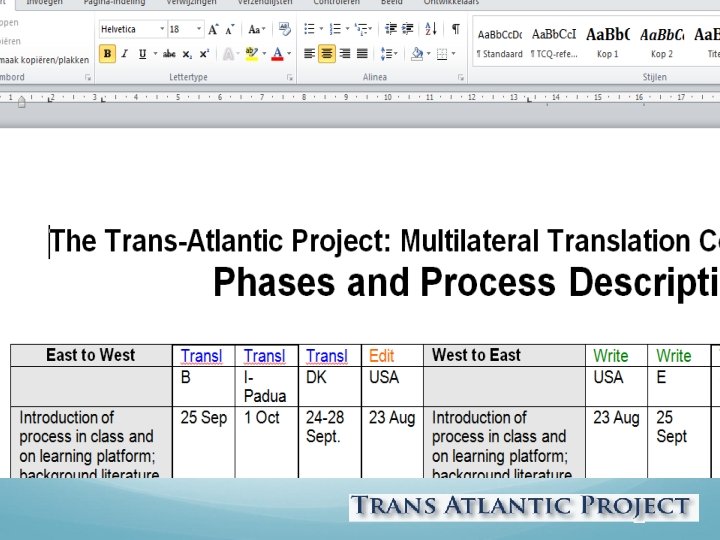
Multilateral projects since 2010 Writing/translation project Translation/editing project • Co-authoring in Spain and USA • Translation from Danish to English in Denmark • User-testing in English in USA and Finland • Translation from Dutch to English in Belgium • Translation to Dutch in Belgium • Translation to French in France • Translation to Italian in Italy European Symposium on LSP — Vienna, Austria — 2013 • Translation from Italian to English in Italy • Editing for idiomatic American English in USA
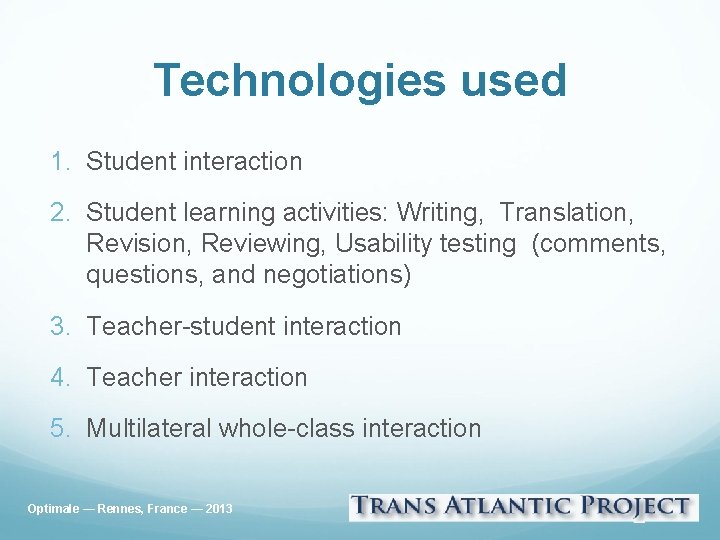
Technologies used 1. Student interaction 2. Student learning activities: Writing, Translation, Revision, Reviewing, Usability testing (comments, questions, and negotiations) 3. Teacher-student interaction 4. Teacher interaction 5. Multilateral whole-class interaction Optimale — Rennes, France — 2013
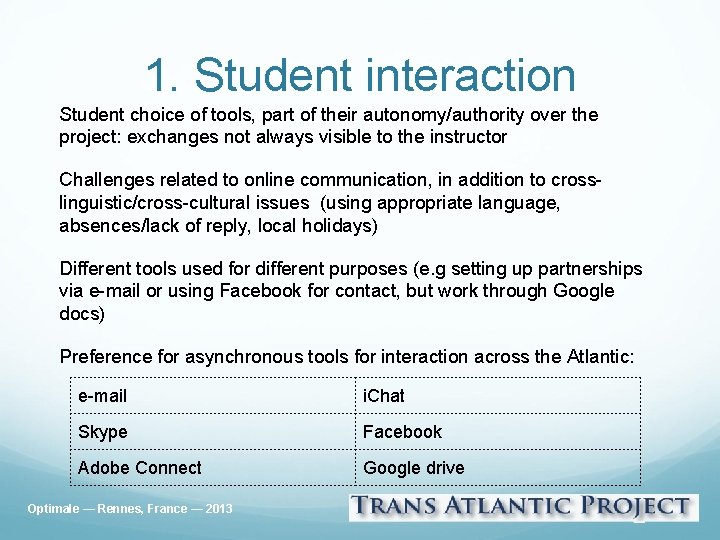
1. Student interaction Student choice of tools, part of their autonomy/authority over the project: exchanges not always visible to the instructor Challenges related to online communication, in addition to crosslinguistic/cross-cultural issues (using appropriate language, absences/lack of reply, local holidays) Different tools used for different purposes (e. g setting up partnerships via e-mail or using Facebook for contact, but work through Google docs) Preference for asynchronous tools for interaction across the Atlantic: e-mail i. Chat Skype Facebook Adobe Connect Google drive Optimale — Rennes, France — 2013
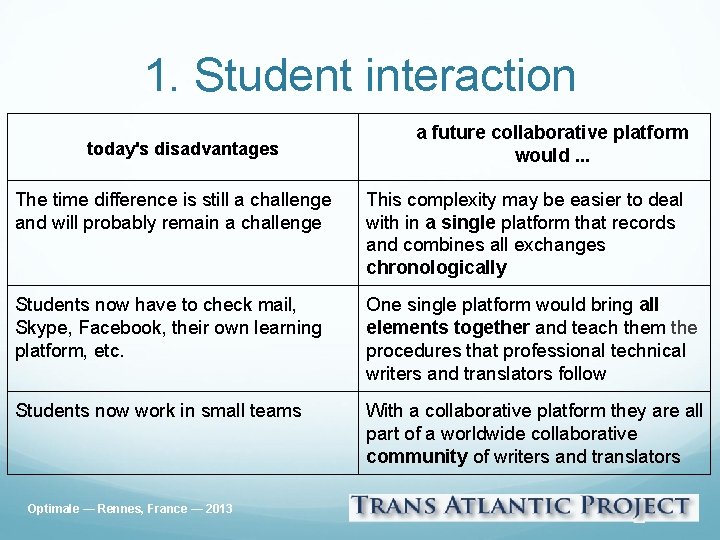
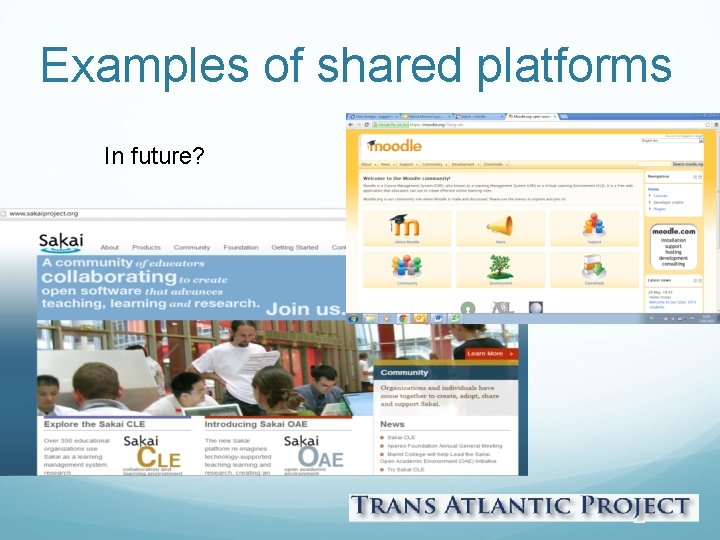
1. Student interaction today's disadvantages a future collaborative platform would. . . The time difference is still a challenge and will probably remain a challenge This complexity may be easier to deal with in a single platform that records and combines all exchanges chronologically Students now have to check mail, Skype, Facebook, their own learning platform, etc. One single platform would bring all elements together and teach them the procedures that professional technical writers and translators follow Students now work in small teams With a collaborative platform they are all part of a worldwide collaborative community of writers and translators Optimale — Rennes, France — 2013
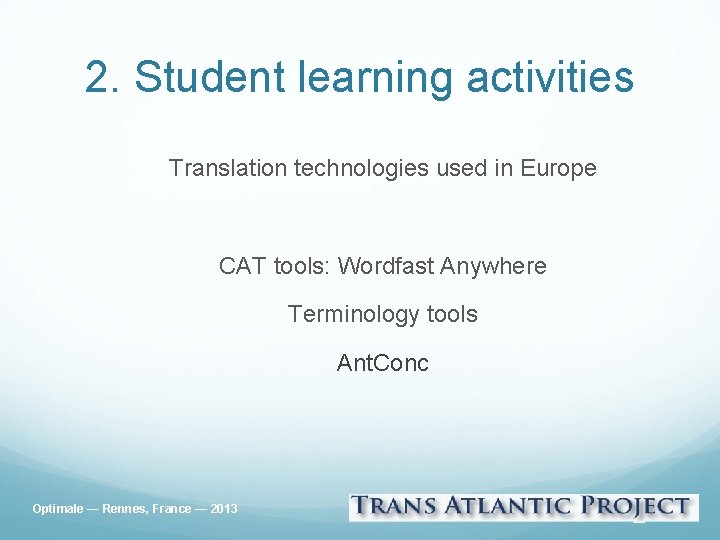
2. Student learning activities Translation technologies used in Europe CAT tools: Wordfast Anywhere Terminology tools Ant. Conc Optimale — Rennes, France — 2013
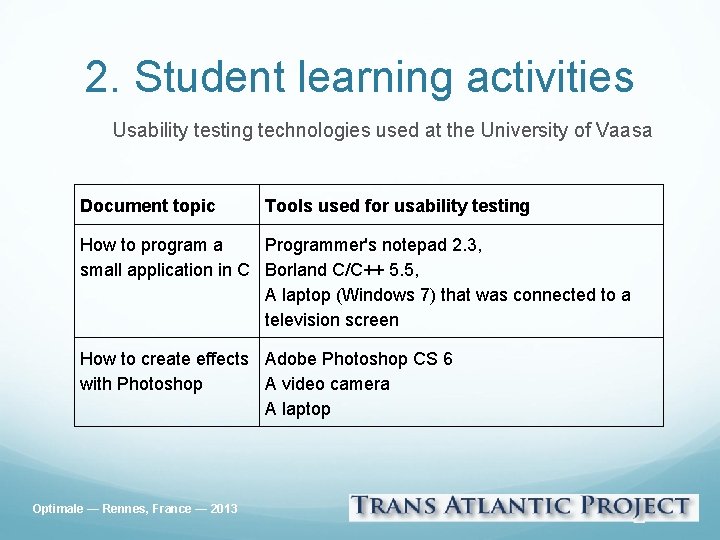
2. Student learning activities Usability testing technologies used at the University of Vaasa Document topic Tools used for usability testing How to program a Programmer's notepad 2. 3, small application in C Borland C/C++ 5. 5, A laptop (Windows 7) that was connected to a television screen How to create effects Adobe Photoshop CS 6 with Photoshop A video camera A laptop Optimale — Rennes, France — 2013
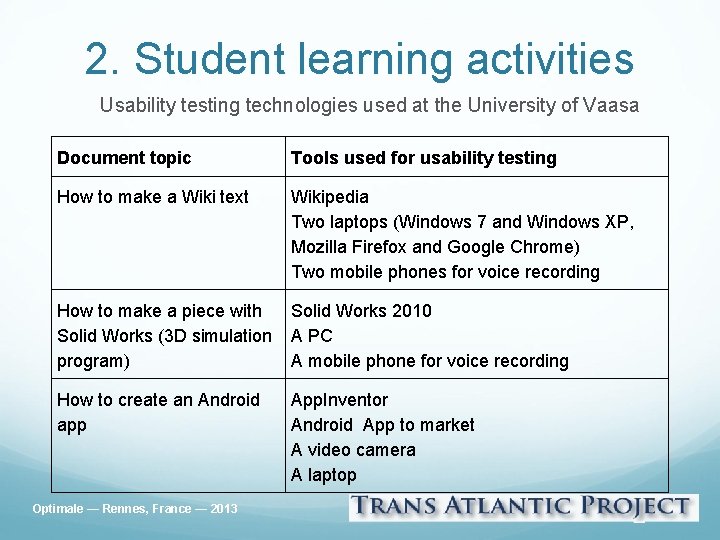
2. Student learning activities Usability testing technologies used at the University of Vaasa Document topic Tools used for usability testing How to make a Wiki text Wikipedia Two laptops (Windows 7 and Windows XP, Mozilla Firefox and Google Chrome) Two mobile phones for voice recording How to make a piece with Solid Works (3 D simulation program) Solid Works 2010 A PC A mobile phone for voice recording How to create an Android app App. Inventor Android App to market A video camera A laptop Optimale — Rennes, France — 2013
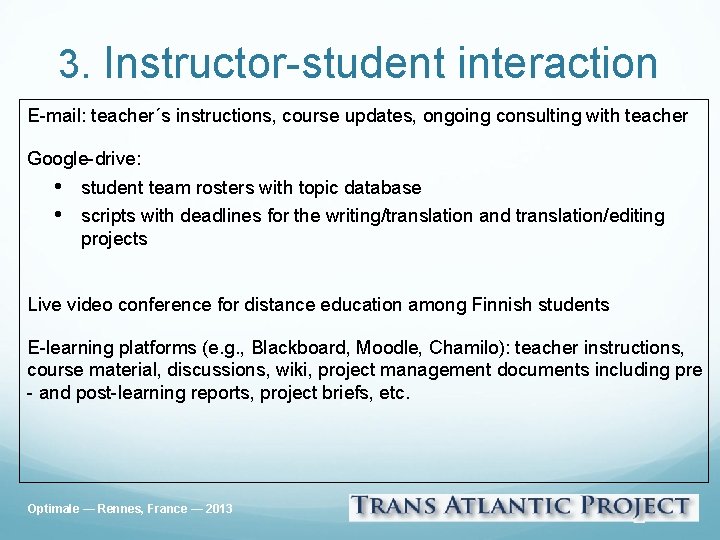
3. Instructor-student interaction E-mail: teacher´s instructions, course updates, ongoing consulting with teacher Google-drive: • • student team rosters with topic database scripts with deadlines for the writing/translation and translation/editing projects Live video conference for distance education among Finnish students E-learning platforms (e. g. , Blackboard, Moodle, Chamilo): teacher instructions, course material, discussions, wiki, project management documents including pre - and post-learning reports, project briefs, etc. Optimale — Rennes, France — 2013
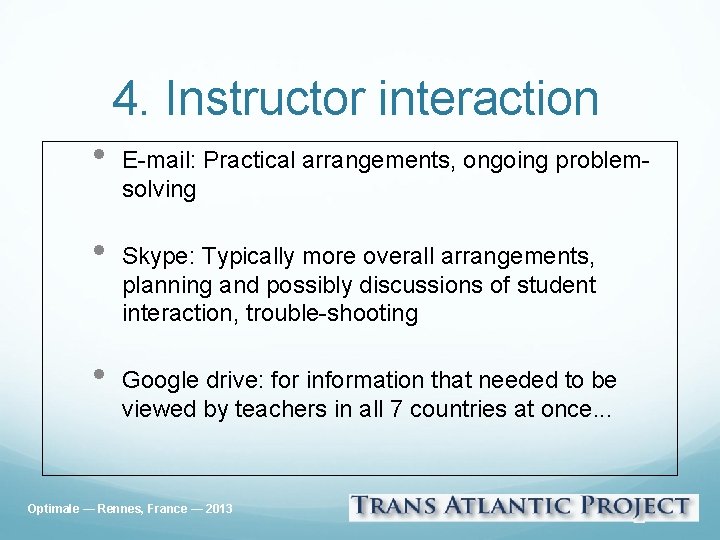
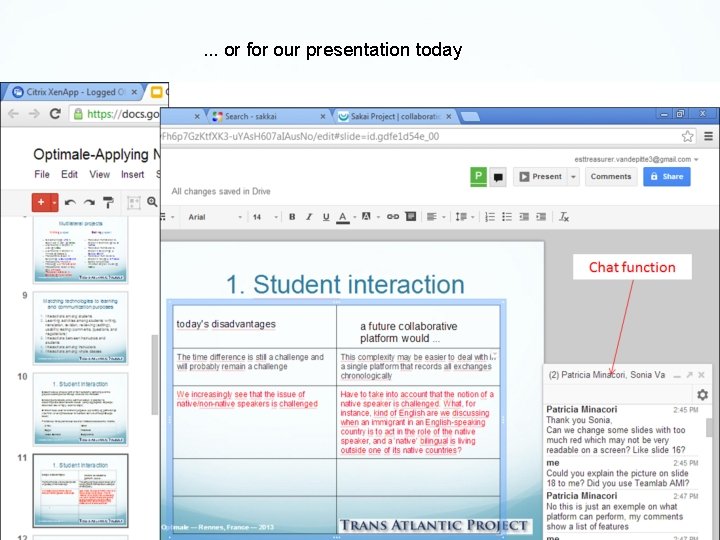
4. Instructor interaction • • • E-mail: Practical arrangements, ongoing problemsolving Skype: Typically more overall arrangements, planning and possibly discussions of student interaction, trouble-shooting Google drive: for information that needed to be viewed by teachers in all 7 countries at once. . . Optimale — Rennes, France — 2013
. . . or for our presentation today
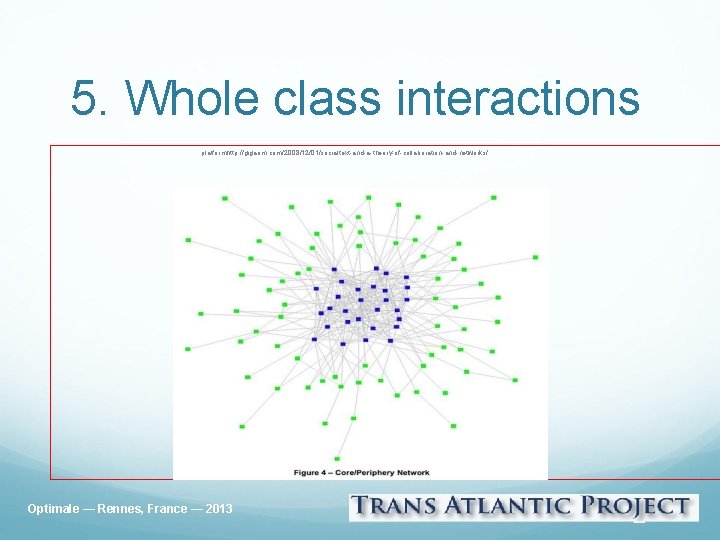
5. Whole class interactions platformhttp: //gigaom. com/2008/12/01/socialtext-and-a-theory-of-collaboration-and-networks/ Optimale — Rennes, France — 2013
5. Whole-class interactions • • Google-drive Live closed-circuit videoconferences Culmination of project Crossed 8 time zones Summarized main aspects of students' learning Permitted questions/answers and dialogue open to 100+ students and instructors at all participating institutions Optimale — Rennes, France — 2013
Conclusions • • • Our collaboration closely resembles the complexity of international documentation workplaces of language service providers The use of the various technologies proved to be a central element, both in the students’ activities and in the teachers’ guidance. The use of the various technologies also involved reflection and communication about the tools. Different communication tools are used for different communication purposes. We integrate experience of computer-mediated interaction into the face-to-face classroom. We use computer software and build specialized language corpora as a basis for later work, especially for independent translators Optimale — Rennes, France — 2013
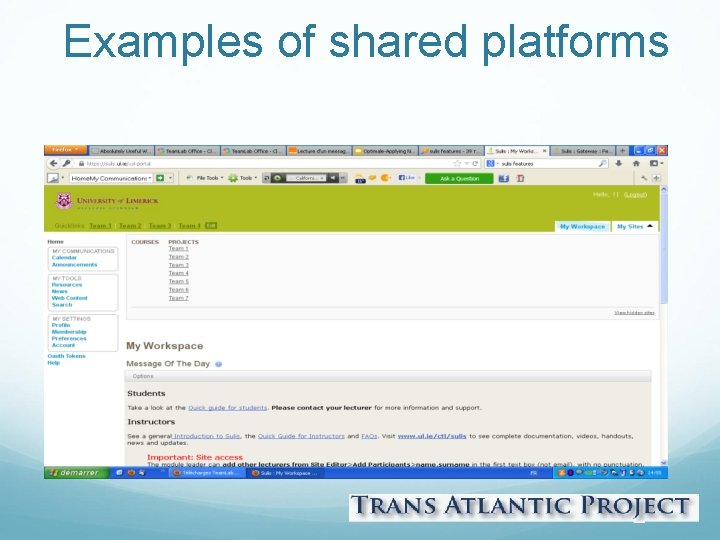
Examples of shared platforms
Examples of shared platforms In future?
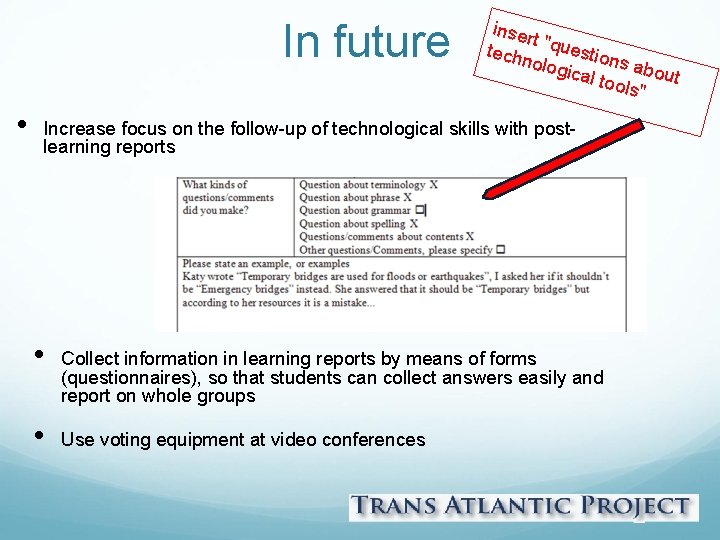
In future • inser t techn "question s ologi cal to about ols" Increase focus on the follow-up of technological skills with postlearning reports • • Collect information in learning reports by means of forms (questionnaires), so that students can collect answers easily and report on whole groups Use voting equipment at video conferences
References on our collaboration • Humbley, J. , Maylath, B. , Mousten, B. , Vandepitte, S. , & Veisblat, L. (2005). Learning localization through trans-Atlantic collaboration. In G. F. Hayhoe (Ed. ), Proceedings of the IEEE International Professional Communication Conference, 10 -13 July 2005, U of Limerick, Ireland (pp. 578 -595). New York: IEEE. • Jensen, B. , Mousten, B. and Laursen, A. L. (2012). Electronic Corpora as Translation Tools: A Solution in Practice. Communication and Language at Work—ICT Tools and Professional Language, Vol. 1. No. 1. , pp. 21 -33. • Maylath, B. , Vandepitte, S. , Minacori, P. , Isohella, S. , Mousten, B. , & Humbley, J. (2013). Managing complexity: A technical communication/translation case study in multilateral international collaboration. ” Technical Communication Quarterly, 22, 67 -84. • Maylath, B. , Vandepitte, S. , & B. Mousten. (2008). Growing grassroots partnerships: Trans- Atlantic collaboration between American instructors and students of technical writing and European instructors and students of translation. In D. Stärke-Meyerring & M. Wilson (Eds. ), Designing global learning environments: Visionary partnerships, policies, and pedagogies (pp. 52 -66). Rotterdam: Sense Publishers. • Mousten, B. , Maylath, B. , Vandepitte, S. , & Humbley, J. (2010). Learning localization through trans. Atlantic collaboration: Bridging the gap between professions. IEEE-Transactions on Professional Communication, 53, 401 -411. Optimale — Rennes, France — 2013
References on our collaboration • Mousten, B. , Vandepitte, S. , & Maylath, B. (2008). Intercultural collaboration in the trans. Atlantic project: Pedagogical theories and practices in teaching procedural instructions across cultural contexts. In D. Stärke-Meyerring & M. Wilson (Eds. ), Designing global learning environments: Visionary partnerships, policies, and pedagogies (pp. 129 -144). Rotterdam: Sense Publishers. • Mousten, B. , Humbley, J. , Maylath, B. , & Vandepitte, S. (2012). Communicating pragmatics about content and culture in virtually mediated educational environments. In S. Kelsey & K. St. Amant (Eds. ), Computer-mediated communication across cultures: International interactions in online environments. Hershey, PA: IGI Global. 312 -327. • Mousten, B. , Maylath, B. , Humbley, J. , Scarpa, F. , Livesey, M. , & Vandepitte, S. (2010). Pragmatic features in the language of cross-cultural virtual teams: A roundtable discussion of student-tostudent discourse in international collaborative project. In C. Heine & J. Engberg (Eds. ), Reconceptualizing LSP. Online proceedings of the XVII European Language for Specific Purposes Symposium 2009. Århus, Denmark. Retrieved from <http: //www. asb. dk/fileadmin/www. asb. dk/en/aboutasb/departments/departmentoflanguageandbusi nesscommunication/research/phdprogrammes/phdcourses/xviieuropeansymposiumonlsp/onlinepro ceedings/extendedcontributions/fileexplorer_fetchfile-aspx-file-16827. pdf>. Optimale — Rennes, France — 2013
Other references • Bowker, Lynne. 2002. Computer-Aided Translation Technology. A Practical Introduction. Ottawa: University of Ottawa Press. • Lesgold, Alan M. 2001. The nature and methods of learning by doing. American Psychologist, Vol 56(11), 964 -973. • Rodríguez-Inés, Patricia. 2010. Electronic corpora and other information and communication technology tools. The Interpreter and Translator Trainer, 4: 2, 251 -282. • Rodrigo, Elia Yuste (ed. ). 2008. Topics in language resources for translation and localisation. Amsterdam: J. Benjamins. • Valero Garcés, Carmen & de la Cruz Cabanillas, Isabel (eds. ). 2001. Traducción y Nuevas Tecnologías. Herramientas auxiliares del traductor. Encuentros en torno a la Traducción 4. Alcalá: Universidad de Alcalá.
Postscript In 2011, for the first time, two former students of the Trans-Atlantic Project—Steve Hammer from the USA and Maria Teresa Musacchio from Italy — led their own classes through the international collaboration. Optimale — Rennes, France — 2013