
Applying Monetary Fiscal Policy I Overview a Both
Applying Monetary & Fiscal Policy
I. Overview a. Both policies are used to stabilize the economy by: i. 1. Reducing a recession ii. 2. Controlling inflation. b. Tools that they use to stabilize: a. Fiscal Policy: 1. gov’t spending 2. taxation b. Monetary Policy: 1. open market operations (bonds) 2. the discount rate 3. reserve requirements c. Both policies have limitations: i. Policy lags: the time it takes to ID the problem and for policy actions to take effect ii. Political constraints: may limit the gov’t’s ability to do what is best for the Econ. iii. Timing: to be effective, gov’t actions must be timed well with the business cycle.
II. Expansionary Monetary & Fiscal Policy a. Situation: The economy is in a recession. b. Goal: to stimulate the economy by reducing unemployment and increasing investment. (Put $ into ppl’s hands) i. Fiscal: increasing gov’t spending or tax cuts ii. Monetary: you cash in your gov’t bonds or reduce the discount rate or the reserve requirement
c. Example: Unemployment rate is 9. 5% and CPI is 2%--the economy is in a recession and inflation is a minimal concern. d. How to fix it? i. Monetary: The Fed buys bonds (you cash them in) and lowers the discount rate to increase the money supply ii. Fiscal: Increased gov’t spending and have tax cuts to increase aggregate demand 1. Effect: Real GDP increases and prices rise. Unemployment falls. e. Conflict: fiscal is likely to raise the interest rates while monetary should decrease interest rates. The actual change in interest rates will depend on the relative strength of the two policies.
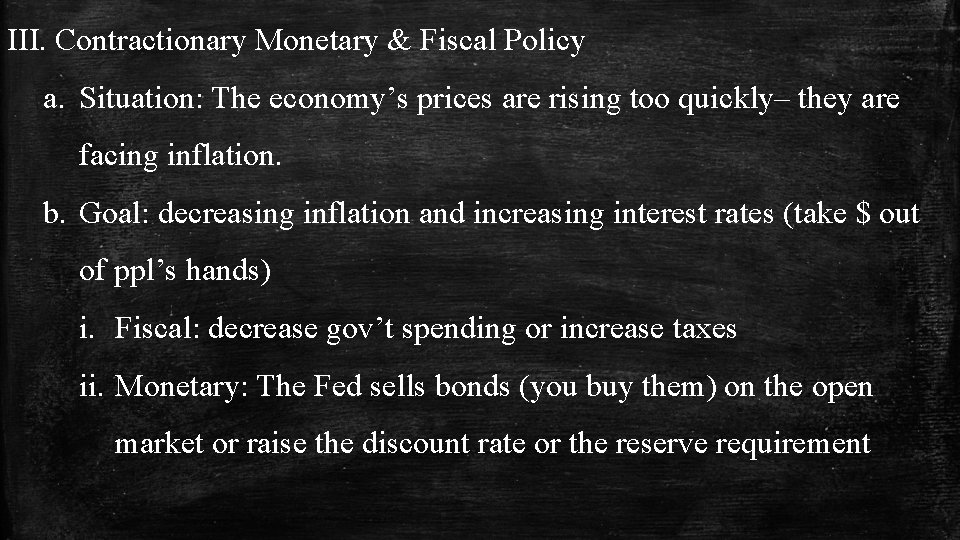
III. Contractionary Monetary & Fiscal Policy a. Situation: The economy’s prices are rising too quickly– they are facing inflation. b. Goal: decreasing inflation and increasing interest rates (take $ out of ppl’s hands) i. Fiscal: decrease gov’t spending or increase taxes ii. Monetary: The Fed sells bonds (you buy them) on the open market or raise the discount rate or the reserve requirement
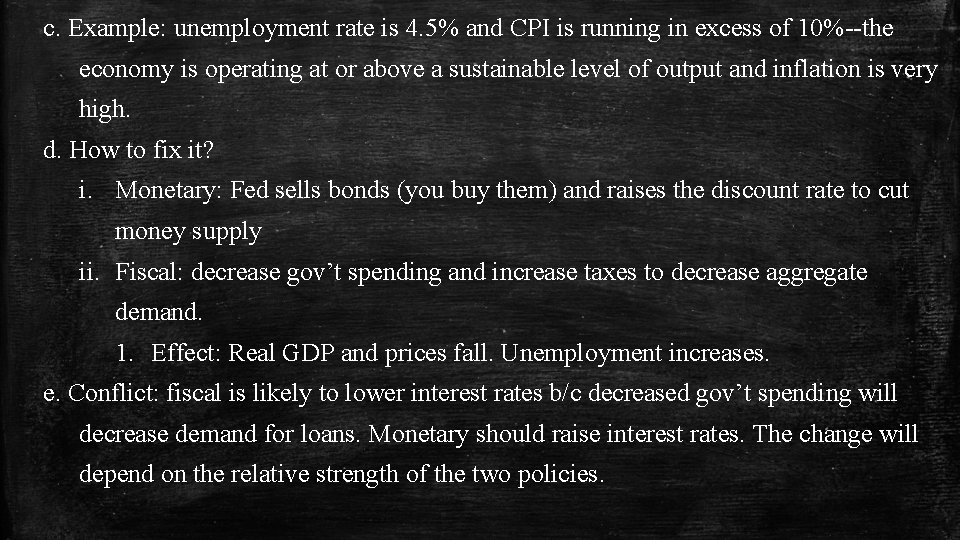
c. Example: unemployment rate is 4. 5% and CPI is running in excess of 10%--the economy is operating at or above a sustainable level of output and inflation is very high. d. How to fix it? i. Monetary: Fed sells bonds (you buy them) and raises the discount rate to cut money supply ii. Fiscal: decrease gov’t spending and increase taxes to decrease aggregate demand. 1. Effect: Real GDP and prices fall. Unemployment increases. e. Conflict: fiscal is likely to lower interest rates b/c decreased gov’t spending will decrease demand for loans. Monetary should raise interest rates. The change will depend on the relative strength of the two policies.
- Slides: 6